
逆周期调节政策

Search documents
前三季度人民币对美元中间价调升829个基点!专家:四季度走势以稳为主
Sou Hu Cai Jing· 2025-09-30 10:05
Core Viewpoint - The Chinese yuan has appreciated against the US dollar in the first three quarters of the year, influenced by a weakening dollar and internal economic improvements, while the yuan's appreciation is seen as moderate compared to the dollar's decline [1][2]. Group 1: Exchange Rate Trends - The central bank reported that the midpoint exchange rate for the yuan against the dollar is 7.1055, with the yuan appreciating by 829 basis points cumulatively in the first three quarters [1]. - The onshore yuan appreciated approximately 1700 basis points, or about 2.4%, while the offshore yuan appreciated around 2.8% [1]. - The dollar index fell by about 10% in the first three quarters, leading to a general appreciation of non-dollar currencies, including the yuan [1]. Group 2: Economic Analysis - The head of the State Administration of Foreign Exchange noted that the foreign exchange market has become more rational and stable during the 14th Five-Year Plan period, with the yuan's exchange rate showing two-way fluctuations and increased elasticity [2]. - The chief economist at China Bank Securities indicated that the yuan's performance against the dollar has improved this year, contrasting with the pressure experienced during Trump's first term [2]. - Factors influencing the yuan's depreciation are present but vary in their impact over time, suggesting a complex interplay of internal and external factors [2]. Group 3: Future Outlook - Analysts predict that the yuan will remain strong in the short term, with attention on the potential impact of US interest rate cuts on the dollar's performance [2]. - The yuan is expected to maintain a stable trajectory with limited risks of rapid appreciation or significant depreciation, supported by domestic policy measures and external economic conditions [2].
格林大华期货中国宏观经济三季报:8月经济数据有所回落,期待更多政策
Ge Lin Qi Huo· 2025-09-30 08:48
Report Industry Investment Rating No relevant content provided. Core Viewpoints - In the first eight months of 2025, China's economic performance was mixed, with some indicators falling short of market expectations. The economy needs continuous domestic demand to maintain rapid growth, and more counter - cyclical adjustment policies are expected in the fourth quarter [68]. Summary by Categories Investment - From January to August, national fixed - asset investment increased by 0.5% year - on - year, lower than the market expectation of 1.3% and the 1.6% growth in January - July. General infrastructure investment (including electricity) increased by 5.4%, narrow infrastructure investment (excluding electricity) increased by 2.0%, and manufacturing investment increased by 5.1%. Real estate development investment decreased by 12.9% [4]. Real Estate - From January to August, the sales area of new commercial housing decreased by 4.7% year - on - year, and the sales volume decreased by 7.3%. In August, the sales of new commercial housing accelerated their decline. In September, the year - on - year growth of commercial housing transactions in 30 large - and medium - sized cities was due to a low base last year, and the year - on - year growth rate in the fourth quarter will face challenges. In August, the prices of second - hand residential properties in first, second, and third - tier cities continued to decline [6][9][11]. Consumption - In August, the total retail sales of social consumer goods increased by 3.4% year - on - year, lower than the market expectation of 3.8%. From January to August, the total retail sales of social consumer goods increased by 4.6%. The growth rate of some categories related to the trade - in policy slowed down in August, while the growth of improved consumption accelerated. From January to August, service retail sales increased by 5.1% [13][15][18]. Industry - In August, the added value of industrial enterprises above designated size increased by 5.2% year - on - year, lower than the market expectation of 5.8%. The product sales rate of industrial enterprises above designated size was 96.6%, a year - on - year decrease of 0.1 percentage point. From January to August, the profits of industrial enterprises above designated size increased by 0.9% year - on - year, turning positive from a 1.7% decline in January - July [22][24][62]. Employment - In August, the national urban surveyed unemployment rate was 5.3%, up 0.1 percentage point from the previous month. The unemployment rate of 16 - 24 - year - old labor force (excluding students) in urban areas was 18.9%, higher than the same period last year [28][30]. Foreign Trade - In August, China's exports denominated in US dollars increased by 4.4% year - on - year, and imports increased by 1.3% year - on - year. Exports to ASEAN and the EU increased, while exports to the US decreased. Exports to regions other than the top five export destinations maintained high - speed growth [32][34][37]. Prices - In August, the CPI decreased by 0.4% year - on - year, mainly due to the high base of comparison in the same period last year and lower - than - seasonal food prices. The PPI decreased by 2.9% year - on - year, and the month - on - month decline ended [39][48]. Finance - In August, the social financing scale increased by 2.57 trillion yuan, less than the same period last year. The balance of M2 increased by 8.8% year - on - year, and the balance of M1 increased by 6% year - on - year. The stock of social financing scale increased by 8.8% year - on - year, and the balance of RMB loans increased by 6.8% year - on - year [52][56][59].
格林大华期货国债期货三季报:债市宽幅震荡
Ge Lin Qi Huo· 2025-09-30 08:25
Report Industry Investment Rating - Not provided in the document Core Viewpoints - In Q3, the prices of treasury bond futures contracts declined overall, and the yields of treasury bond cash bonds fluctuated upward. The yield curve showed a bearish steepening trend. The Chinese economy in August was generally below market expectations, and there is a significant downward pressure on the year - on - year economic growth rate in Q4 due to the high base of the previous year. The central bank may cut the reserve requirement ratio and interest rates in Q4, and it is advisable to consider a strategy of buying treasury bond futures at low prices and conducting band operations [8][10][78] Summary by Directory 1. Disk Review - **Treasury Bond Futures Active Contract Trends**: In July and August, the strong continuous rise of the A - share market pushed up the risk appetite in the capital market, causing the prices of treasury bond futures contracts to decline overall. In September, the medium - and short - term varieties of the main treasury bond futures contracts fluctuated widely, while the main contract of the ultra - long - term 30 - year treasury bond futures continued to decline significantly [8] - **Treasury Bond Cash Bond Yield Trends**: The yield of treasury bond cash bonds hit a low in early January, over - anticipating the whole - year interest rate cut. After the central bank tightened the money market liquidity in January, the yield of treasury bonds rose in Q1. It slightly declined in late March and then quickly dropped in early April due to the US tariff increase news. Since July, the continuous rise of the stock index has pushed up the overall yield of treasury bonds. In Q3, the yield of 10 - year treasury bonds fluctuated between 1.60% - 1.90% and ended at a relatively high level [10] - **Changes in the Treasury Bond Cash Bond Yield Curve**: Compared with June 30, the treasury bond cash bond yield curve on September 29 showed a bearish steepening trend, with the short - end rising less and the long - end rising more. The yields of 2 - year, 5 - year, 10 - year, and 30 - year treasury bonds increased by 15, 13, 24, and 38 basis points respectively [13] 2. Current Analysis - **Investment Data**: From January to August, the year - on - year growth rate of national fixed - asset investment was 0.5%, lower than the market expectation of 1.3%. The growth rates of various types of investment, such as infrastructure and manufacturing, all declined compared with the previous period, and real estate development investment continued to decline [18] - **Real Estate Market**: From January to August, the sales area and sales volume of new commercial housing decreased year - on - year, and the decline accelerated in August. The year - on - year growth of the average daily trading volume of commercial housing in 30 large - and medium - sized cities in September was due to the low base of the previous year, and the year - on - year data in Q4 will face challenges [20][23] - **Consumption Data**: In August, the year - on - year growth rate of the total retail sales of social consumer goods was 3.4%, lower than the market expectation of 3.8%. The growth rate of the national service production index was 5.6%, and the growth rate of the total retail sales of social consumer goods from January to August was 4.6%, with the growth rate dropping by 0.2 percentage points compared with January to July [25][27] - **Industrial Data**: In August, the year - on - year actual growth rate of the added value of large - scale industries was 5.2%, lower than the market expectation of 5.8%. The year - on - year growth rates of exports and imports in August were 4.4% and 1.3% respectively, with the trade surplus increasing [30][32] - **Employment Data**: In August, the national urban survey unemployment rate was 5.3%, up 0.1 percentage point from the previous month, and the unemployment rates of different groups showed different trends [35] - **Financial Data**: In August, the increase in the scale of social financing was 2.57 trillion yuan, and the increase in RMB loans was 5.9 trillion yuan. At the end of August, the year - on - year growth rates of M2 and M1 were 8.8% and 6% respectively [37][41] - **Price Data**: In August, CPI decreased by 0.4% year - on - year, and PPI decreased by 2.9% year - on - year. In September, the agricultural product wholesale price continued to rise, the South China Industrial Products Index fluctuated narrowly, and the RMB exchange rate against the US dollar fluctuated slightly [44][50][55] - **Overseas Data**: In September, the US treasury bond interest rate rebounded slightly after reaching a low point. The core CPI in the US in August increased by 3.1% year - on - year, and the unemployment rate was 4.3%. The market generally expects the Fed to cut interest rates twice in October and December [57][60][64] - **Other Data**: In Q3, the yield of AAA 1 - year inter - bank certificates of deposit increased slightly, the net financing of government bonds continued at a fast pace, and the term spreads of treasury bonds widened [65][68][72] 3. Strategy Recommendations - The Chinese economy in August was generally below market expectations. There is a significant downward pressure on the year - on - year economic growth rate in Q4 due to the high base of the previous year. The central bank may cut the reserve requirement ratio and interest rates in Q4. If the intensity of counter - cyclical policies in Q4 is weaker than market expectations, the yield of treasury bonds is likely to decline, and it is advisable to consider a strategy of buying treasury bond futures at low prices and conducting band operations [78]
格林大华期货研究院专题报告:9月制造业PMI略低于荣枯线,服务业PMI小幅扩张
Ge Lin Qi Huo· 2025-09-30 08:02
Group 1: Report Industry Investment Rating - No relevant content found Group 2: Core Viewpoints of the Report - In September, the manufacturing PMI was below the boom-bust line for the sixth consecutive month, showing production expansion and slightly weak demand. The service industry business activity index expanded moderately above the boom-bust line, but the new order index declined from the previous month. It is expected that counter-cyclical adjustment policies, including 50 billion yuan in new policy-based financial instruments, will be implemented in the fourth quarter [5][10]. Group 3: Summary by Related Catalogs Manufacturing Industry - **PMI**: In September, China's manufacturing PMI was 49.8%, below the boom-bust line for six consecutive months, up from 49.4% in the previous month. Large enterprises continued to expand in the prosperity range, medium-sized enterprises remained stable, and the decline of small enterprises narrowed [2][6]. - **Production Index**: The production index in September was 51.9%, up from 50.8% in the previous month, with accelerated production expansion for five consecutive months [2][6]. - **New Order Index**: The new order index in September was 49.7%, up from 49.5% in the previous month, indicating improved market demand, but still below the boom-bust line [2][6]. - **New Export and Import Order Indexes**: The new export order index in September was 47.8%, up from 47.2% in the previous month; the import index was 48.1%, up from 48.0% in the previous month. It is expected that China's exports will continue to grow rapidly in September [2][7]. - **Price Indexes**: The purchase price index of major raw materials and the ex-factory price index in September were 53.2% and 48.2% respectively. The former was in the expansion range for three consecutive months, while the latter declined from August. It is expected that the year-on-year decline of PPI in September will narrow to about 2.3% [3][7]. - **Inventory Indexes**: The raw material inventory index in September was 48.5%, up from 48.0% in the previous month; the finished product inventory index was 48.2%, up from 46.8% in the previous month. The rebound of the finished product inventory index was related to production expansion, and its sustainability depends on future new orders [4][8]. - **Employment and Expectation Indexes**: The employment index in September was 48.5%, up from 47.9% in the previous month, and the production and operation activity expectation index was 54.1%, up from 53.7% in the previous month, indicating a slight improvement in the employment situation and future expectations [9]. Non - Manufacturing Industry - **Overall Non - Manufacturing Business Activity Index**: In September, the non - manufacturing business activity index was 50.0%, down from 50.3% in the previous month [4][9]. - **Construction Industry**: The construction industry business activity index in September was 49.3%, up from 49.1% in the previous month, with a slight recovery but still weak. The new order index was 42.2%, up from 40.6% in the previous month; the employment index was 39.7%, down from 43.6% in the previous month; the business activity expectation index was 52.4%, up from 51.7% in the previous month. The real estate market was still at the bottom, and real estate development investment was expected to contract significantly in September, dragging down the construction industry [4][9]. - **Service Industry**: The service industry business activity index in September was 50.1%, down from 50.5% in the previous month. The new order index was 46.7%, down from 47.7% in the previous month; the employment index remained unchanged at 45.9%; the business activity expectation index was 56.3%, down from 57.0% in the previous month. Industries such as postal, telecommunications, and financial services were in a high - level prosperity range, while industries such as catering, real estate, and cultural and sports entertainment were below the critical point [4][10].
格林大华期货早盘提示:国债-20250930
Ge Lin Qi Huo· 2025-09-30 02:31
Report Summary 1. Report Industry Investment Rating - Not provided in the report 2. Core View of the Report - 8月中国经济整体表现低于市场预期,内需需持续发力以保持经济较快增长,部分逆周期调节政策或近期落地,临近假期国债期货短线或震荡,交易型投资建议波段操作 [2] 3. Summary by Relevant Catalogs 3.1 Market Review - 周一国债期货主力合约开盘全线小幅高开,多数早盘震荡走低、午后横向波动,30年期回调幅度大,截至收盘30年期国债期货主力合约TL2512下跌0.47%,10年期T2512下跌0.01%,5年期TF2512下跌0.04%,2年期TS2512下跌0.02% [1] 3.2 Important Information - 公开市场:周一央行开展2886亿元7天期逆回购操作,当日有2405亿元逆回购到期,实现净投放481亿元 [1] - 资金市场:周一银行间资金市场隔夜利率基本不变,DR001全天加权平均为1.31%,DR007全天加权平均为1.59% [1] - 现券市场:周一银行间国债现券收盘收益率多数上行,2年期到期收益率上行0.43个BP至1.51%,5年期上行1.62个BP至1.64%,10年期上行0.89个BP至1.89%,30年期上行2.40个BP至2.24% [1] - 中共中央政治局9月29日召开会议研究制定十五五规划重大问题,二十届四中全会将于10月20日至23日在北京召开 [1] - 9月29日国家发改委表示新型政策性金融工具规模5000亿元用于补充项目资本金,正抓紧投放资金,后续将督促开工建设形成实物工作量,还将持续发力实施宏观政策并加强经济监测 [1] 3.3 Market Logic - 8月中国经济低于预期,内需需发力,部分逆周期调节政策或落地,8月工业企业利润同比大幅增长有去年同期低基数原因,央行将保证流动性充裕,周一国债期货主力合约高开后受股指上涨制约回调,超长品种回调多 [2] 3.4 Trading Strategy - 交易型投资进行波段操作 [2]
低基数助力8月工业利润转正,债市仍偏震荡
Ge Lin Qi Huo· 2025-09-27 04:16
Report Summary 1. Report Industry Investment Rating No information provided in the content. 2. Core View of the Report - The bond market remains volatile, and treasury bond futures may fluctuate in the short - term. 8 - month industrial profit turned positive due to a low base, and some counter - cyclical adjustment policies may be implemented soon. The central bank will maintain ample liquidity, and positive interactions in Sino - US trade relations are beneficial for future trade talks [33]. 3. Summary by Relevant Content Treasury Bond Futures Market - This week, the main contracts of treasury bond futures showed a trend of bottoming out and rebounding. The 30 - year treasury bond fell 0.60%, the 10 - year bond fell 0.07%, the 5 - year bond fell 0.09%, and the 2 - year bond fell 0.02% [4]. - From September 19th to September 26th, the 2 - year and 30 - year treasury bond yields rose by 2 basis points, while the 5 - year and 10 - year yields remained flat [7]. - The logic of the treasury bond futures market is that the overall performance of the Chinese economy in August was lower than expected, and counter - cyclical adjustment policies may be introduced. The significant increase in industrial enterprise profits in August was due to the low base last year. The central bank will maintain liquidity, and Sino - US trade interactions are positive. The short - term trend of treasury bond futures is expected to be volatile, and the trading strategy is to conduct band operations [33][34]. Industrial Enterprise Data - From January to August, the profits of large - scale industrial enterprises increased by 0.9% year - on - year, reversing the downward trend since May. In August, industrial enterprise profits increased by 20.4% year - on - year, compared with a 1.5% decline in July. The increase in August was due to the low base in the same period last year [10]. - From January to August, the operating income of large - scale industrial enterprises was 89.62 trillion yuan, a year - on - year increase of 2.3%. The operating income in August increased by 1.9%, 1.0 percentage point faster than in July [10]. - From January to August, the operating income profit margin of large - scale industrial enterprises was 5.24%, a year - on - year decrease of 0.1 percentage point. Different industries had different profit margins, with the mining industry having a relatively high margin but a decline compared to the previous year [13]. - At the end of August, the asset - liability ratio of large - scale industrial enterprises was 58.0%, a year - on - year increase of 0.4 percentage points. The asset - liability ratio of large - scale manufacturing enterprises was 57.4%, a year - on - year increase of 0.3 percentage points [16]. - At the end of August, the average collection period of accounts receivable of large - scale manufacturing enterprises was 71.2 days, a year - on - year increase of 2.9 days, reaching a new high since 2015 [20]. - From January to August, the cumulative year - on - year growth rate of finished product inventory of large - scale industrial enterprises was 2.3%, showing a downward trend. Both China and the US have been destocking in recent months [23]. Real Estate Market - In the first quarter, the average daily trading area of commercial housing in 30 large - and medium - sized cities was 23.6 million square meters, a year - on - year increase of 2.5%. From April to August, there were year - on - year declines. From September 1st to 25th, the average daily trading area was 22 million square meters, a year - on - year increase of 12% due to the low base last year. The year - on - year data in the fourth quarter will face challenges [26]. Labor Market - In August, the unemployment rate of 16 - 24 - year - old labor force (excluding students) in urban areas was 18.9%, 0.1 percentage point higher than the same period last year. The unemployment rate of 25 - 29 - year - olds was 7.2%, 0.3 percentage point higher than the same period last year. The unemployment rate of 30 - 59 - year - olds was 3.9%, remaining stable compared with the previous month and the same period last year [29]. Capital Market - This week, the overnight funding rate declined. The weighted average of DR001 was 1.41%, compared with 1.46% last week. The average issuance rate of one - year AAA inter - bank certificates of deposit was 1.69%, compared with 1.68% last week. On September 25th, the central bank conducted a 600 - billion - yuan MLF operation, with a net investment of 300 billion yuan after deducting the 300 - billion - yuan maturity, marking the seventh consecutive month of increased roll - over [31].
LPR调整在即,央行重磅信号!
Sou Hu Cai Jing· 2025-09-20 03:33
Group 1 - The People's Bank of China (PBOC) will announce the new Loan Prime Rate (LPR) on September 22, with the current 1-year LPR at 3.0% and the 5-year LPR at 3.5%, unchanged for three months [1] - A press conference on the achievements of the financial sector during the 14th Five-Year Plan will be held on the same day, featuring key financial leaders [3] - The PBOC plans to issue 600 billion yuan of central bank bills with a 6-month maturity to enhance the RMB yield curve in Hong Kong [4] Group 2 - Following the Federal Reserve's recent rate cut, there is speculation that global central banks, including the PBOC, may follow suit, potentially leading to a second wave of market rally in A-shares [5] - The PBOC has adjusted its 14-day reverse repo operations to a fixed quantity and multi-price bidding, which is seen as a move to enhance liquidity management [6] - The PBOC's liquidity management tools are being optimized to ensure stability in the financial system, especially ahead of major holidays [6] Group 3 - The external environment, including the Fed's rate cut and trade policies, may exert downward pressure on the US dollar, providing upward momentum for the RMB [7] - The PBOC is expected to flexibly manage liquidity through various instruments to stabilize the economy and support the RMB exchange rate [7] - A report from Galaxy Securities indicates that the priority for monetary policy in the fourth quarter will focus on economic growth and employment, with potential interest rate cuts anticipated [8]

人民币对美元汇率逼近7.1关口 中间价连续两日调升
Sou Hu Cai Jing· 2025-09-17 02:50
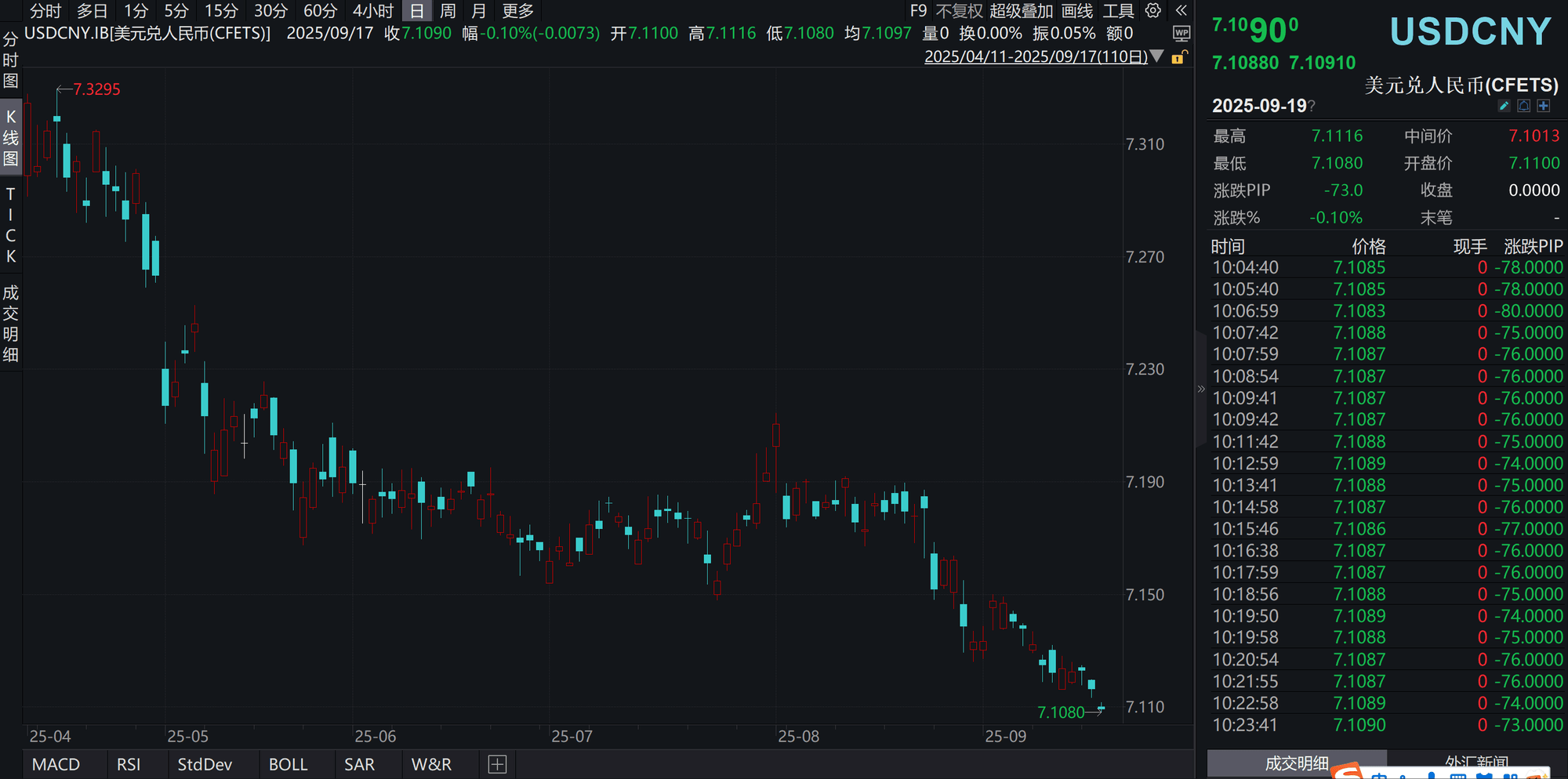
Core Viewpoint - The recent appreciation of the Renminbi (RMB) against the US dollar is influenced by expectations of potential interest rate cuts by the Federal Reserve and strong inflows of foreign capital into the domestic stock market [1][3]. Group 1: Exchange Rate Movements - In August, the onshore and offshore RMB appreciated by 0.83% and 1.21% against the US dollar, respectively [1]. - As of September 17, the onshore RMB reached a high of 7.1080 and the offshore RMB peaked at 7.1003 [1]. Group 2: Market Analysis - The anticipated Federal Reserve interest rate decision is contributing to a decline in the US dollar index, which is providing upward momentum for non-USD currencies, including the RMB [3]. - The strong performance of the domestic stock market is attracting foreign investment, increasing demand for currency exchange and improving market sentiment [3]. Group 3: Future Outlook - If the Federal Reserve resumes interest rate cuts and the impact of US government tariffs on the economy becomes more pronounced, the US dollar index may face further downward pressure, making it easier for non-USD currencies to appreciate [3]. - The domestic economic policies aimed at stabilizing economic performance will provide essential support for the RMB exchange rate, which is expected to maintain a stable trajectory with limited risk of rapid appreciation or depreciation [3].
宏观经济宏观月报:8月经济超预期回落,政策加码窗口打开-20250915
Guoxin Securities· 2025-09-15 08:26
Economic Performance - In August, the industrial added value above designated size grew by 5.2% year-on-year, a decline of 0.5 percentage points from July[1] - The total retail sales of consumer goods reached 39,668 billion yuan, with a year-on-year growth of 3.4%, down 0.3 percentage points from July[1] - From January to August, fixed asset investment (excluding rural households) totaled 326,111 billion yuan, with a year-on-year growth of 0.5%, down 1.1 percentage points from January to July[1] - The unemployment rate in urban areas rose to 5.3%, an increase of 0.1 percentage points from the previous month[1] GDP and Economic Drivers - The monthly GDP year-on-year growth rate for August is approximately 3.8%, a further decline of 0.5 percentage points from July, significantly below the annual growth target[2][3] - The construction sector contributed a drag of about 0.3 percentage points to GDP growth, while industrial and service sectors each contributed a drag of 0.1 percentage points[2][3] - The decline in economic growth is characterized by a simultaneous slowdown in consumption, investment, and exports, indicating a broad-based cooling of demand[3] Policy Outlook - The current economic situation presents a critical policy window, necessitating more aggressive macroeconomic responses to prevent further economic decline[4][15] - Key measures include accelerating the expenditure of accumulated fiscal deposits, increasing the issuance and utilization of local government special bonds, and enhancing support for infrastructure projects through policy financial tools[4][15] Risks and Challenges - The rising unemployment rate may suppress consumer income expectations and confidence, potentially undermining the effectiveness of consumption stimulus policies[3][15] - There is a risk of policy measures being ineffective if consumers choose to save rather than spend any subsidies received, leading to a "policy hollowing out" effect[3][15]
如何走出PPI负增长?
Sou Hu Cai Jing· 2025-09-05 15:20
Core Viewpoint - The article discusses the necessity of regulating industrial policies and controlling local governments' enthusiasm for industrial investment while emphasizing the need for further efforts to stimulate consumption [3][22]. Group 1: PPI Trends - Since October 2022, China's PPI has entered a continuous negative growth phase, experiencing 34 months of decline, which has pressured industrial profits and suppressed consumer spending [3][4]. - The current PPI negative growth is compared to a previous cycle from March 2012 to August 2016, which lasted 54 months, highlighting similarities in duration and abrupt declines [4][5]. - The current PPI decline is driven by two main factors: overcapacity in industries like photovoltaics and lithium batteries due to rapid demand growth, and significant adjustments in the real estate market since the second half of 2021 [5][6]. Group 2: Demand and Supply Dynamics - Both rounds of PPI decline are characterized by rapid capacity expansion exceeding demand growth, leading to oversupply, but the causes of demand insufficiency differ [6][11]. - The current round of PPI decline has seen a more significant impact from weak consumer demand, particularly in the context of the real estate market's deep adjustments, which have led to substantial wealth evaporation for residents [6][12]. Group 3: Industry Contributions to PPI Decline - The mining and upstream raw materials sectors contributed significantly to PPI declines in both periods, but their contribution decreased from 85.2% to 61.7% in the current cycle [11]. - The midstream manufacturing sector's contribution to PPI decline increased to 9.0% due to the overcapacity in the new energy sector, while the downstream manufacturing sector's contribution rose to 26.0%, particularly from essential consumer goods [11][12]. Group 4: Consumer Demand Analysis - The current cycle's core CPI has averaged around 0.3%, significantly lower than the previous cycle's average of 2.1%, indicating a substantial drop in consumer demand [13][14]. - Factors contributing to weak consumer demand include declining disposable income growth, increased savings tendencies, and unstable income expectations, leading to reduced consumption even with unchanged income levels [17][19]. Group 5: Policy Recommendations - To reverse the PPI negative growth, stronger counter-cyclical adjustment policies are needed, including lowering policy interest rates and expanding public investment [21][23]. - Enhancing consumer confidence through effective policies can lead to increased consumption, which is crucial for reversing the downward trend in downstream manufacturing prices and ultimately improving PPI [23][24].
