存款搬家

Search documents
8月金融数据解析:数据结构中的玄机
雪球· 2025-09-15 07:49
Core Viewpoint - The financial data for August indicates a weak demand for financing in the real economy, with signs of improvement in corporate long-term investments, while consumer confidence remains low, leading to a "deposit migration" phenomenon influenced by the performance of the capital market [12][13]. Group 1: Social Financing and Loan Data - The total social financing scale increased by 2.57 trillion yuan, slightly above market expectations, but decreased by 463 billion yuan year-on-year, marking the first decline in the year [3][5]. - New RMB loans amounted to 590 billion yuan, a year-on-year decrease of 310 billion yuan, remaining at a low level compared to previous years [3][5]. - Government bond net financing was 1.37 trillion yuan, becoming a drag on social financing for the first time in ten months due to a high base effect from last year [5][12]. Group 2: Credit Structure and Consumer Behavior - Resident loans increased by 30.3 billion yuan, a year-on-year decrease of 159.7 billion yuan, reflecting a cautious attitude towards debt amid an unstable job market [6][8]. - Consumer confidence index is low, and the employment outlook index has hit a new low since March 2020, limiting residents' willingness to leverage [6][8]. - The consumer loan interest subsidy policy started in September, and its effects are yet to be observed [8]. Group 3: Corporate Loan Trends - Non-financial corporate loans increased by 590 billion yuan, a year-on-year decrease of 250 billion yuan, with short-term loans showing a seasonal improvement for the first time in five years [8][12]. - The increase in short-term loans may be related to a recovery in production sentiment, while the decline in medium to long-term loan growth is slowing down [8][12]. Group 4: Monetary Supply and Deposit Trends - M2 grew by 8.8% year-on-year, remaining stable, while M1's growth rate increased by 0.4 percentage points to 6.0%, narrowing the gap between M2 and M1 to a 51-month low [11][12]. - In August, RMB deposits increased by 2.06 trillion yuan, a year-on-year decrease of 160 billion yuan, indicating a trend of "deposit migration" from residents to non-bank deposits [11][12]. Group 5: Future Outlook - The pace of government bond issuance will continue to impact social financing growth, with a projected decrease in net issuance in the fourth quarter compared to the previous year [12][13]. - The key factor for a rebound in private sector credit demand hinges on the stabilization of the real estate market and improvements in income expectations [13]. - The central bank's continued support and liquidity remain strong, suggesting that structural market trends may persist [13].


申万宏源证券:非银存款连创新高 “存款搬家”提速
Xin Hua Cai Jing· 2025-09-15 06:31
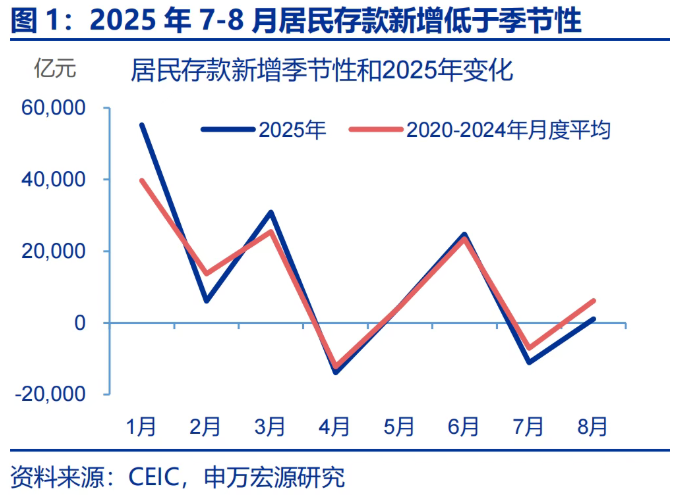
Core Insights - The central theme of the analysis is the notable shift in financial data released by the central bank, particularly highlighting the phenomenon of "deposit migration" as evidenced by a decline in resident deposits and an increase in non-bank deposits [1] Group 1: Financial Data Analysis - In August, resident deposits experienced a seasonal decline for two consecutive months, marking the first occurrence since 2025 [1] - Non-bank deposits saw an increase of 1.18 trillion, setting a new record for the same period since data collection began [1] - The relationship between resident and non-bank deposits has shown a "seesaw" effect, indicating a change in the asset structure of residents [1]

资本跨市场轮动如何影响债券市场流动性?
Southwest Securities· 2025-09-15 05:41
Report Industry Investment Rating No relevant content provided. Core Viewpoints - In the context of unchanged risk preferences, deposit "migration" follows a sequence from pure - bond wealth management products and money market funds to bond funds and equity funds. Pure - bond wealth management products are the main recipients of migrated deposits, followed by money market funds. Bond - type funds have a complex attractiveness structure, and equity funds are mostly outside the deposit migration path. As the equity market strengthens, the order of deposit outflow choices and the bank - to - bank liquidity structure change. The effectiveness of quantity - based indicators such as excess reserves decreases, while the risk of short - term shock to inter - bank liquidity increases, but the central bank's attitude towards liquidity is supportive [1][34][44]. Summary According to the Table of Contents 1 Capital Cross - market Rotation and Its Impact on Bond Market Liquidity 1.1 Cost - effectiveness as an Important Consideration for Deposit "Migration" - Due to the continuous decline in deposit interest rates, both household and corporate deposits are migrating. Households are affected by the decline in deposit interest rates, while enterprises are more affected by the ban on manual interest - supplement policies. Insurance products, pure - bond wealth management products, and bond funds have attracted migrated funds due to their yield advantages [12][15][16]. 1.2 Risk Preferences May Disturb the Direction of Deposit "Migration" - When risk preferences are stable, pure - bond wealth management products have the strongest ability to absorb migrated deposits, with a correlation coefficient of 0.87 between the spread of their yields over deposits and the difference between their scale growth rate and deposit growth rate. Money market funds rank second with a correlation of 0.64. Bond - type funds have a complex attractiveness, and equity funds are less involved in deposit migration. As the equity market strengthens, the order of deposit outflow changes, and the bank - to - bank liquidity structure becomes more complex [1][23][34]. 2 Important Matters - In August 2025, CPI was flat month - on - month and decreased by 0.4% year - on - year; PPI was flat month - on - month and decreased by 2.9% year - on - year. In August, M1 growth continued to pick up, and government bonds were the main support for social financing. The central bank will conduct a 6 - month 6000 - billion - yuan buy - out reverse repurchase operation on September 15, 2025 [55][56][59]. 3 Money Market 3.1 Open - market Operations and Fund Interest Rate Trends - From September 8 to 12, 2025, the central bank net - injected 1961 billion yuan through 7 - day reverse repurchase operations. It is expected that 13845 billion yuan of base money will be withdrawn from September 15 to 19. Bank - to - bank liquidity tightened marginally last week, and DR001 first rose and then fell [61][67]. 3.2 Certificate of Deposit Interest Rate Trends and Repurchase Transaction Volume - In the primary market, commercial banks' inter - bank certificates of deposit had a net financing scale of - 4680.1 billion yuan last week. The issuance scale of joint - stock banks was the largest, but they also had a net financing deficit. The issuance interest rate of certificates of deposit increased compared with the previous week. In the secondary market, the yields of certificates of deposit at all tenors increased due to the marginal tightening of the money market [70][74][79]. 4 Bond Market - In the primary market, the main supply of interest - rate bonds last week was still treasury bonds, with a total issuance scale of 5663.7 billion yuan and a net financing scale of 4155.9 billion yuan. The net financing rhythm of local government bonds from January to August was faster than that of treasury bonds. As of September 12, the cumulative net financing scale of special refinancing bonds in 2025 was 1.97 trillion yuan. In the secondary market, the bond market was in a weak mood last week, with the curve becoming steeper. The daily average turnover rate of active bonds increased, and the liquidity premium of 10 - year treasury bonds widened [83][90][95]. 5 Institutional Behavior Tracking - Last week, the 20 - day moving average of the daily trading volume of inter - bank pledged repurchase was 7.31 trillion yuan, and the average leverage trading scale was about 7.49 trillion yuan. In the cash bond market, state - owned banks increased their purchases of treasury bonds with a maturity of less than 5 years, rural commercial banks turned from selling to buying, insurance companies bought long - term treasury bonds and local bonds, while securities firms and funds sold bonds. In July 2025, the leverage ratio of all institutions in the inter - bank market decreased seasonally [111][119][122].
8月金融数据点评:实体经济融资需求有所恢复
Bank of China Securities· 2025-09-15 03:00
Group 1: Financial Data Overview - In August, new social financing (社融) reached 2.57 trillion yuan, a decrease of 463 billion yuan compared to the same month last year, but an increase of 1.44 trillion yuan from July, slightly above consensus expectations[2] - The year-on-year growth rate of social financing stock in August was 8.8%, down 0.17 percentage points from July, and slightly below the expected 8.85%[2] - New RMB loans in August amounted to 623.3 billion yuan, a decrease of 417.8 billion yuan compared to the same month last year, but an increase of 1.05 trillion yuan from July[2] Group 2: Financing Structure and Trends - The significant growth in August was seen in bill financing, indicating a recovery in short-term financing demand in the real economy[2] - Government bonds accounted for the largest share of new financing in August, with 1.37 trillion yuan, while direct financing through corporate bonds and stock financing remained relatively high[2] - The proportion of government bonds in the financing structure increased by 0.20 percentage points from July, while RMB loans, corporate bonds, and entrusted loans saw notable declines[2] Group 3: Deposit and Loan Trends - The trend of "deposit migration" continued, with new resident deposits of 110 billion yuan and new corporate deposits of 299.7 billion yuan, while non-bank deposits increased significantly by 1.18 trillion yuan compared to last year[2] - New loans from financial institutions in August totaled 590 billion yuan, a decrease of 310 billion yuan year-on-year, with corporate loans down by 250 billion yuan[2] - The increase in short-term loans and interbank loans was the only area showing growth compared to the same month last year, highlighting a shift in corporate financing behavior[2] Group 4: Economic Outlook and Risks - The marginal improvement in corporate financing demand is attributed to ongoing US-China tariff negotiations and domestic macro policies aimed at stabilizing employment and market expectations[2] - Attention is needed on the decline in long-term loans to residents compared to last year, indicating potential challenges in consumer financing[2] - Risks include a potential second wave of global inflation, rapid economic downturns in Europe and the US, and increasing complexity in international relations[2]
“存款搬家”提速,300亿顶流券商ETF(512000)单周再揽近17亿元
Xin Lang Ji Jin· 2025-09-15 02:49
Group 1 - The brokerage sector experienced a low opening but rallied, with Guosheng Financial leading gains at 4% and Dongfang Caifu rising over 1% [1] - The 300 billion yuan top-tier brokerage ETF (512000) saw a slight increase of 0.33%, with a trading volume exceeding 400 million yuan within half a day, indicating active trading [1] - Financial data for August revealed a year-on-year decrease of 600 billion yuan in household deposits, while non-bank deposits increased by 550 billion yuan, suggesting a shift towards the stock market [3] Group 2 - The number of new A-share accounts opened in August reached 2.65 million, a 35% increase from July, with average daily trading volume hitting 2.25 trillion yuan, surpassing levels seen in September 2024 and June 2015 [3] - The brokerage sector is expected to benefit from the active market environment, with continuous inflows into the brokerage ETF totaling 1.698 billion yuan over the last five trading days and over 7.6 billion yuan in the past 20 days [3] - Open-source Securities noted that the brokerage sector's valuation remains low, with institutional holdings being relatively low, highlighting the potential for growth driven by trading volume and policy factors [5] Group 3 - Dongwu Securities emphasized that the average valuation of the non-bank financial sector is still low, providing a safety margin, and the transformation of the brokerage industry is likely to create new growth points [5] - The brokerage ETF (512000) has surpassed 33 billion yuan in size, setting a new historical high, with an average daily trading volume of 957 million yuan, making it one of the leading ETFs in A-shares in terms of scale and liquidity [5] - The brokerage ETF passively tracks the CSI All Share Securities Company Index, encompassing 49 listed brokerage stocks, with nearly 60% of its holdings concentrated in the top ten leading brokerages [6]






存款搬家了吗?
Hu Xiu· 2025-09-15 02:26
Core Viewpoint - The phenomenon of "deposit migration" refers to individuals transferring their savings into financial investments, such as stock investments or asset management products, leading to a shift from traditional bank deposits to non-bank financial deposits [1] Group 1: Deposit Migration Dynamics - The most direct manifestation of deposit migration is the conversion of personal retail deposits into non-bank financial deposits, which can be observed through changes in the structure of total deposits in the country [1] - It is suggested to focus on absolute growth amounts rather than growth rates to better reflect current changes, as growth rates can be influenced by base effects [2] - The structure of M2, a measure of money supply, is analyzed to understand the internal changes related to deposit migration [3][6] Group 2: M2 Structure Analysis - As of July 2025, the total M2 scale in China is 330 trillion yuan, with specific structural components needing to be examined to understand the migration issue [4] - Since 2018, there has been a notable decline in the proportion of corporate demand deposits, while personal deposits have increased, indicating a shift in individual saving behavior [8] - The increase in personal time deposits and other deposits suggests a trend towards "personalization of deposits" and "time depositization" among individuals [10] Group 3: Investment Behavior and Market Trends - The significant increase in personal time deposits in 2023, reaching a record increment of 16 trillion yuan, indicates a temporary shift in investment behavior, with a subsequent decline in growth in 2024 and 2025 [14] - The increment of non-bank financial deposits also rose from 2.29 trillion yuan in 2023 to 5.16 trillion yuan in the first seven months of 2025, suggesting a gradual shift towards financial investments [14] - The current investment behavior reflects a recovery in public confidence, although it has not yet translated into increased consumption or real investment in the economy [15]
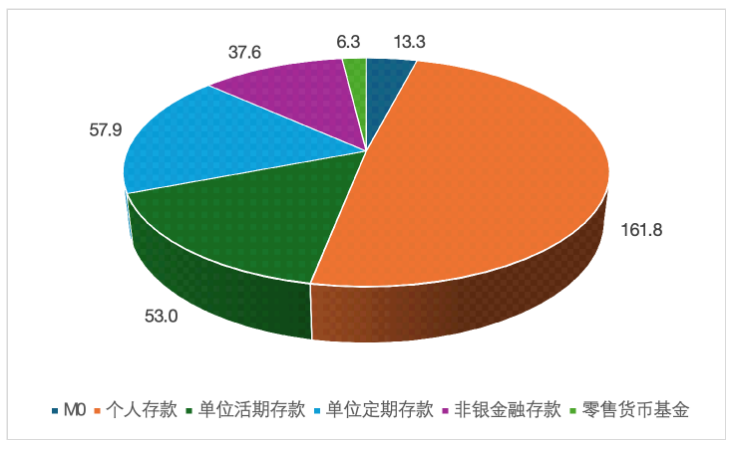
8月金融数据及公募降费解读
2025-09-15 01:49
Summary of Conference Call Notes Industry Overview - The conference call discusses the financial market in August, highlighting the performance of social financing (社融) and the impact of new regulations on public funds and investment strategies in the asset management industry. Key Points Social Financing and Economic Recovery - In August, the growth rate of social financing decreased to 8.8%, marking the first month-on-month decline of the year, primarily due to a reduction in government bonds by 250 billion yuan [3] - The total amount of government bonds issued was 1.4 trillion yuan, but the year-on-year increase was lower due to a high base last year [3] - Credit performance was weak, with a year-on-year decrease of 310 billion yuan, leading to a credit balance growth rate of 6.8% [3][6] - Both household and corporate loans showed weakness, indicating poor economic recovery [6][7] Deposit Trends - M1 growth rate rose to 6%, indicating a trend of "deposit migration" where funds are moving into non-bank deposits [4][10] - Non-financial institution deposits increased by 16%, higher than the previous month, suggesting a trend of funds entering the market [10][11] - Households accumulated approximately 5 trillion yuan in excess savings, driven by fluctuations in the bond market and declining bank interest rates [12] Fund Fee Reduction Policy - The third phase of the fund fee reduction policy aims to benefit investors by 30 billion yuan, primarily affecting sales service fees and subscription fees [13][15] - New regulations standardize redemption fees and holding periods, with a redemption fee of 1.5% for holdings under 7 days, impacting the short-term pure bond fund sector significantly [14][18] - The policy is expected to alter the competitive landscape of the asset management industry, potentially weakening the retail competitiveness of public funds [2][17] Impact on Short-term and Bond Funds - The extension of the holding period to 6 months will significantly impact short-term pure bond funds, which total approximately 1.1 trillion yuan [18][19] - Institutional investors, particularly wealth management subsidiaries, may withdraw from these funds due to liquidity management needs [19] - The new regulations may also affect the operational strategies of insurance funds that rely on these products for short-term gains [21] Market Reactions and Future Expectations - The market is expected to see an increase in M1 data to around 6.5% to 7% in September, indicating a potential influx of funds into the stock market [12] - The overall financial market performance is improving, with significant increases in trading volumes and account openings [10] Challenges for Asset Management Firms - The new regulations may force public fund institutions to adjust their product offerings, potentially leading to a shift towards other financial products [25] - Smaller institutions may face survival challenges due to reduced sales fees, making it difficult to incentivize distribution channels [25] Conclusion - The financial landscape is undergoing significant changes due to regulatory adjustments and economic conditions, with implications for various stakeholders in the asset management and banking sectors. The focus will be on adapting to these changes while seeking new investment opportunities and managing risks effectively.
【机构策略】本轮行情驱动力主要来自相对理性的资金
Zheng Quan Shi Bao Wang· 2025-09-15 01:23
Group 1 - The driving force behind the current market trend is the participation of rational funds, high-net-worth individuals, and corporate clients, leading to a significant institutional characteristic of incremental capital [1] - The current funding structure indicates that the market will primarily focus on high-prosperity industry trends or assets with sustainable cash returns, particularly in resources, new productive forces (AI, innovative drugs), and overseas expansion [1] - If the consensus on the nature of the market (structural bull) is established, funds seeking yield elasticity are likely to either maintain stable positions or engage in high-low trading within prosperous sectors, rather than blindly expanding into other sectors [1] Group 2 - The A-share index is currently in a consolidation phase, with the potential for directional selection depending on recent domestic and international events [2] - The attractiveness of current A-share valuations and the impact of "anti-involution" policies and demand-side policies will be crucial for the market's future performance [2] - As the National Day holiday approaches, a decrease in trading willingness is expected, potentially prolonging the market's consolidation phase [2]

非银存款连续两月大幅多增 居民“存款搬家”趋势强化
Sou Hu Cai Jing· 2025-09-14 17:29
Core Insights - The M1-M2 spread has narrowed, indicating increased liquidity and a trend of "deposit migration" as residents shift funds from bank deposits to non-bank financial institutions [1][2][3] - August financial data shows a significant increase in non-bank deposits, suggesting a potential shift of funds towards equity markets [2][6] Monetary Supply and Deposit Trends - As of the end of August, M2 stood at 331.98 trillion yuan, growing 8.8% year-on-year, while M1 reached 111.23 trillion yuan, up 6% year-on-year [2][3] - The M1-M2 spread narrowed to -2.8%, the lowest since June 2021, reflecting a trend of more funds being converted into demand deposits, which can stimulate consumption and investment [2][3] - Non-bank deposits increased by 1.18 trillion yuan in August, contrasting with a decline in household deposits, indicating a shift towards investment in capital markets [3][4] Economic Implications - Analysts suggest that the narrowing M1-M2 spread reflects enhanced liquidity as households and businesses convert time deposits into demand deposits for consumption or investment [3][4] - The trend of "deposit migration" is expected to continue, with non-bank deposits serving as a key indicator of capital market inflows [5][7] Consumer Behavior and Loan Trends - Despite the increase in non-bank deposits, households exhibit a cautious approach towards future economic conditions, maintaining a "more saving, less borrowing" attitude [8][9] - The total increase in household loans was only 711 billion yuan in the first eight months, significantly lower than previous years, indicating a trend of deleveraging among consumers [8][9] Policy Responses - The government has implemented various measures to stimulate consumer spending, including issuing consumption vouchers and providing interest subsidies for personal loans [10] - The effectiveness of these policies in boosting retail loan growth will depend on improvements in employment and income levels [10]
数据点评 | “存款搬家”提速(申万宏观·赵伟团队)
赵伟宏观探索· 2025-09-14 16:05
Core Viewpoint - The most significant change in the August financial data is the acceleration of "deposit migration," with household deposits declining for two consecutive months beyond seasonal trends, while non-bank deposits have seen a substantial increase [2][8][53]. Group 1: Deposit Trends - In August, household deposits decreased by 6000 million year-on-year, with a net increase of only 1100 million, marking two consecutive months of negative growth compared to seasonal averages, a first for 2025 [2][5][8]. - Non-bank deposits reached a record high for the same period, with an increase of 11800 million, indicating a shift in asset structure among residents [2][5][8]. - The relationship between household and non-bank deposits reflects a "seesaw" effect closely tied to capital market performance, suggesting early signs of changes in residents' asset allocation [2][8][53]. Group 2: Loan Trends - Household loans remain weak, with a year-on-year decrease of 1597 million, consistent with low consumer confidence levels [2][14][53]. - The consumer loan interest subsidy policy only started in September, meaning August data does not reflect its impact [2][14][53]. - The employment outlook is uncertain, as indicated by the Business Confidence Index (BCI) for hiring expectations, which fell to 44.07 in August, the lowest since March 2020 [2][14][53]. Group 3: Corporate Loan Dynamics - In August, the growth rate of medium and long-term corporate loans showed signs of stabilization, while short-term loans and bill financing decreased by 0.4 percentage points to 9.7% [3][20][54]. - The Producer Price Index (PPI) rebounded to -2.9% year-on-year, and the Purchasing Managers' Index (PMI) for business expectations rose from 52.6 to 53.7, indicating a potential shift in corporate investment attitudes from cautious to watchful [3][20][54]. Group 4: Social Financing and Policy Outlook - The growth rate of social financing stock declined by 0.2 percentage points to 8.8%, primarily due to the end of front-loaded fiscal financing [3][26][54]. - From January to July 2025, social financing stock growth accelerated from 8.0% to 9.0%, largely driven by front-loaded government bond financing, which totaled an additional 4.8 trillion [3][26][54]. - Future fiscal and monetary policy coordination may provide marginal support for the stability of social financing, with new subsidy policies and innovative financial tools expected to enhance credit and social capital mobilization [3][29][54]. Group 5: Overall Financial Data - In August, new credit totaled 5900 million, a year-on-year decrease of 3100 million, primarily from the corporate sector [4][36][56]. - The total social financing in August was 25700 million, down 4623 million year-on-year, mainly due to government bonds [4][36][56]. - M2 growth remained steady at 8.8%, while the new M1 increased by 0.4 percentage points to 6% [5][43][57].