
通胀预期

Search documents
贵金属早报-20251023
Da Yue Qi Huo· 2025-10-23 02:07
Report Summary 1. Report Industry Investment Rating No relevant information provided. 2. Core Viewpoints - Gold: Trump's cancellation of the meeting with Putin may lead to an escalation of Russian energy sanctions, causing the gold price to continue falling. The premium of Shanghai gold has converged to -2 yuan/gram, and domestic sentiment has significantly cooled. Despite short - term capital pressure making the gold price weak, the long - term upward trend remains unchanged due to trade concerns, government shutdowns, and interest - rate cut expectations [4]. - Silver: Trump's cancellation of the meeting with Putin may lead to an escalation of Russian energy sanctions, causing the silver price to continue falling. The premium of Shanghai silver has rapidly and significantly expanded to 300 yuan/gram, and domestic sentiment remains strong. With cooling trade concerns, the silver price, which follows the gold price, still has support but faces short - term correction pressure [5]. 3. Summary by Directory 3.1. Previous Day's Review - Gold: COMEX gold futures rose 0.18% to $4116.60 per ounce. The 10 - year US Treasury yield fell 2.49 basis points to 3.953%. The US dollar index fell 0.06% to 98.91, and the offshore RMB against the US dollar appreciated slightly to 7.1257. The basis of gold was - 2.31, with the spot at a discount to the futures. Gold futures warehouse receipts increased by 450 kilograms to 87015 kilograms [4]. - Silver: COMEX silver futures rose 1.00% to $48.18 per ounce. The basis of silver was - 13, with the spot at a discount to the futures. Shanghai silver futures warehouse receipts decreased by 57674 kilograms to 691688 kilograms [5]. 3.2. Daily Tips - Gold: The long - term upward trend of the gold price remains unchanged, but it is weak in the short term due to capital pressure. Today, pay attention to the closing of the Fourth Plenary Session of the 20th Central Committee of the Communist Party of China, as well as speeches by members of the Federal Reserve and the European Central Bank [4]. - Silver: The silver price, which follows the gold price, still has support but faces short - term correction pressure [5]. 3.3. Today's Focus - Time TBD: Closing of the Fourth Plenary Session of the 20th Central Committee of the Communist Party of China, Photovoltaic Industry High - Quality Development and Technology Standards Forum; South Korea's central bank to announce interest - rate decision. - 15:30: Swiss National Bank to release the meeting minutes of the September interest - rate decision. - 17:15: Deputy Governor of the Bank of England, Woods, to speak on economic growth in northern England. - 19:00: Central Bank of Ukraine to announce interest - rate decision. - 20:00: Chief Economist of the European Central Bank, Philip Lane, to speak. - 21:00: Member of the Bank of England's Monetary Policy Committee, Dhingra, to speak. - 22:00: Fed Governor and Vice - Chair for Supervision, Bowman, to testify on the supervision of financial regulatory agencies at a hearing of the US Senate Banking Committee, and possibly release the annualized total number of existing home sales in the US in September. - 22:25: Fed Governor Barr to speak on "community investment" at a tax conference [14]. 3.4. Fundamental Data - Gold: The 20 - day moving average is upward, and the K - line is above the 20 - day moving average. The main net position is long, but the long positions of the main players are decreasing [4]. - Silver: The 20 - day moving average is upward, and the K - line is above the 20 - day moving average. The main net position is long, and the long positions of the main players are increasing [5]. 3.5. Position Data - Gold: As of October 22, 2025, the long positions of the top 20 in Shanghai gold decreased by 6.81% to 175,296, the short positions decreased by 8.20% to 68,493, and the net position decreased by 5.90% to 106,803 [28]. - Silver: As of October 22, 2025, the long positions of the top 20 in Shanghai silver decreased by 3.56% to 362,840, the short positions decreased by 9.41% to 270,707, and the net position increased by 18.99% to 92,133 [31].
推动金价上涨的根本动力是什么?
Sou Hu Cai Jing· 2025-10-22 09:03
Core Viewpoint - The significant rise in gold prices, from over $1,500 per ounce in 2020 to over $4,200 currently, is primarily driven by excessive money supply, leading to currency devaluation and increased demand for gold as a hedge against inflation [1][3][4]. Group 1: Money Supply and Gold Prices - "Excessive money supply" refers to central banks printing large amounts of money, exemplified by the Federal Reserve increasing its balance sheet from $4.2 trillion to $8.96 trillion post-2020, effectively printing money equivalent to decades of previous issuance [1][4]. - The relationship between money supply and gold prices is illustrated by historical data, such as during the 2008 financial crisis when the Fed's quantitative easing led to a tripling of gold prices from $700 to $1,920 per ounce [4]. - A 1% increase in the U.S. M2 money supply correlates with an average monthly increase of 0.0113% in London gold prices, indicating that 78% of gold price fluctuations are related to excessive money supply [4]. Group 2: Inflation and Gold Demand - Increased money supply typically results in inflation, which has been observed with rising prices for essential goods like food and fuel [3]. - Anticipation of inflation drives investors to buy gold as a protective measure, with gold prices rising by 28% in 2023 due to inflation expectations even before the Federal Reserve cut interest rates [3][4]. - Lower interest rates, resulting from increased money supply, reduce the opportunity cost of holding gold, making it a more attractive investment [3]. Group 3: Economic Conditions and Gold Investment - Economic conditions influence gold prices; during strong economic periods, such as in 2017, gold prices rose only 13% as investors favored stocks and real estate [6]. - Conversely, in weaker economic conditions, such as projected low global growth in 2025, gold prices can surge significantly as investors seek safety [6]. - The depreciation of the U.S. dollar due to excessive printing makes gold cheaper for foreign buyers, further increasing demand [6]. Group 4: Investment Strategy for Gold - Investors are advised to monitor the Federal Reserve's actions, particularly interest rate changes, as these can significantly impact gold prices [8]. - A recommended allocation of 10%-15% of an investment portfolio to gold is suggested for hedging against currency devaluation, balancing the need for protection without overly compromising potential returns [8]. - Investors should be cautious of the volatility in gold prices, as they can decline during periods of interest rate hikes, emphasizing the importance of strategic buying during market corrections [9].

炸锅!美经济学家摊牌:2028年前30年房贷利率锁死6%-6.5%,想买房的人要熬到何时?
Sou Hu Cai Jing· 2025-10-22 03:23
Core Viewpoint - The chief economist of the Mortgage Bankers Association predicts that the 30-year fixed mortgage rates will stabilize between 6% and 6.5% by the end of 2028, primarily due to increasing government deficits and economic pressures [1][3]. Group 1: Mortgage Rates and Predictions - The average mortgage rate has remained above 6% for the past three years, currently at 6.27% [4]. - The MBA's economic research team forecasts that mortgage rates will stay above 6% until 2028, despite potential short-term rate cuts by the Federal Reserve [8]. - Some institutions are slightly more optimistic, predicting rates may dip below 6% by the end of 2026, but experts remain skeptical [5]. Group 2: Housing Market Dynamics - Despite high interest rates, the volume of home sales is expected to slightly increase, with an estimated 5 million homes sold next year, up from 4.8 million this year, due to increased housing supply [10]. - National home prices are predicted to decline for several quarters before gradually recovering by the end of 2027 [12]. - Regional disparities in housing prices are significant, with states like Florida and Colorado experiencing price drops due to increased supply, while states like New York and Illinois see faster price increases due to limited supply [13]. Group 3: Financial Burdens on Homebuyers - The current median monthly mortgage payment is approximately $2,067, which, while slightly lower than peak levels, remains significantly higher than five years ago [14]. - Many buyers are shifting to adjustable-rate mortgages (ARMs) or FHA loans to reduce monthly payments [15]. - Rising property taxes and homeowners' insurance add to the financial strain on both prospective and current homeowners [16][17].

贵金属早报-20251022
Da Yue Qi Huo· 2025-10-22 02:39
Report Overview - This is a precious metals morning report released on October 22, 2025, by Dayue Futures' Investment Consulting Department, focusing on gold and silver [1]. 1. Report Industry Investment Rating - Not provided in the report. 2. Core Views - **Gold**: Due to profit - taking by funds and a stronger US dollar, gold prices dropped significantly, with an intraday decline of over 5.7%, the largest single - day decline since 2013. However, long - term upward trends remain due to trade concerns, government shutdowns, and interest - rate cut expectations. In the short term, prices are likely to be volatile under capital pressure [4]. - **Silver**: Silver prices also tumbled, with an intraday decline of nearly 8%. It still has support as it follows gold prices, but there is short - term callback pressure [5]. 3. Summary by Directory 3.1. Previous Day's Review - **Gold**: COMEX gold futures closed down 5.07% at $4138.5 per ounce. The 10 - year US Treasury yield fell 2.49 basis points to 3.953%, and the US dollar index rose 0.35% to 98.97 [4]. - **Silver**: COMEX silver futures closed down 6.27% at $48.16 per ounce. The 10 - year US Treasury yield and the US dollar index had the same changes as gold [5]. 3.2. Daily Tips - **Gold**: Today, pay attention to the UK's September CPI and the speech of the ECB President. The long - term upward trend of gold prices remains unchanged, but it is volatile in the short term [4]. - **Silver**: Although silver prices are supported by following gold, there is short - term callback pressure [5]. 3.3. Today's Focus - 07:50 Japan's September imports, exports, and trade balance; Time TBD China's Solid - State Battery Conference; 10:00 Thailand's central bank's October monetary policy meeting minutes and policy forum analyst meeting; 14:00 UK's September CPI; 19:00 ECB Deputy President de Guindos' speech; 20:25 ECB President Lagarde's speech; Next day 05:00 Bank of England Deputy Governor Woods' speech [14]. 3.4. Fundamental Data - **Gold**: The basis is - 3.03, with the spot at a discount to the futures; gold futures warehouse receipts are 86,565 kg, a daily decrease of 1,959 kg [4]. - **Silver**: The basis is - 15, with the spot at a discount to the futures; Shanghai silver futures warehouse receipts are 749,362 kg, a daily decrease of 106,488 kg [5]. 3.5. Position Data - **Gold**: The main net position is long, but the long positions of the main players are decreasing [4]. - **Silver**: The main net position is long, and the long positions of the main players are increasing [5].
贵金属周报:美国信贷危机缓解和政府关门结束预期或使贵金属价格承压-20251021
Hong Yuan Qi Huo· 2025-10-21 08:24
1. Report Industry Investment Rating - Not provided in the given content 2. Core Viewpoints of the Report - The relief of the US credit crisis and the expectation of the end of the government shutdown may put pressure on precious metal prices. However, factors such as the weakening employment performance in the US leading to an increased expectation of the Fed's interest rate cuts, tight inter - bank liquidity potentially causing the Fed to end balance - sheet reduction by the end of 2025, the proactive fiscal expansion expectations of many global countries, continuous gold purchases by central banks of many countries, and intractable geopolitical risks provide long - term support for precious metal prices [3]. - It is expected that precious metal prices may be adjusted. Investors are advised to wait for price pull - backs before establishing long positions. Specific support and resistance levels are provided for London gold, Shanghai gold, London silver, and Shanghai silver [3]. 3. Summary According to Relevant Catalogs First Part: US Fiscal and Monetary Policy - The US outstanding public debt scale reached $3.80 trillion, an increase of $102.7 billion from the previous week. The net issuance of US federal government treasury bonds in Q3 2025 was $964.5 billion, and the net issuance in Q4 may decline quarter - on - quarter. The CBO's 2025 forecast shows that making the expanded additional tax credits permanent may increase the fiscal deficit by $23.4 - $43.9 billion from 2026 - 2035, and repealing health insurance - related provisions may increase the fiscal deficit by $1.4 - $37.5 billion from 2026 - 2035 [10]. - The Fed's daily overnight reverse repurchase scale was $4.1 billion. The Fed's bank reserve balance decreased from the previous week to $2.99 trillion, the overnight reverse repurchase agreement scale decreased to $347.9 billion, and the US Treasury cash account increased to $852 billion. The US Congress has not passed a new temporary appropriation bill, and the federal government shutdown has entered the fourth week, with 4,108 federal employees laid off [11][13]. - The Fed's rediscount loan to commercial banks decreased to $6.018 billion from the previous week, the seasonal loan increased to $0.49 billion, and the Bank Term Funding Program (BTFP) expired on March 11 and dropped to $0 [14]. - Due to the relief of the US credit crisis, the Fed's Standing Repurchase Facility (SRF) suspended operations on October 17, after having a scale of $15.1 billion on October 15 and 16 [15]. - The medium - and long - term inflation expectations implied by US Treasury bonds decreased, but the one - year and five - year inflation expectations of consumers in September were 4.8% and 3.9% respectively, remaining flat or higher than the previous values. The US Bureau of Labor Statistics will release the September consumer - end inflation CPI data on October 24 [16][17]. - Concerns about the weakening of the US employment market and the Fed's expected interest rate cuts and end of balance - sheet reduction led to a decline in the yields of short -, medium -, and long - term US Treasury bonds [19]. - The difference between long - and medium - term US Treasury bond yields was positive, but the difference between long - and short - to medium - term Treasury bond yields narrowed due to expectations of Fed interest rate cuts [22][23]. - The US Office of Financial Research (OFR) Financial Stress Index increased from the previous week to - 1.8610, mainly due to the Fed's continuous balance - sheet reduction and the US Treasury's reconstruction of the cash account, which tightened inter - bank market liquidity [24]. Second Part: US Economic and Employment Performance - The weekly rate of loans and leases of US commercial banks decreased quarter - on - quarter. The weekly rate of all commercial bank loans and leases was 0.01%, with different changes in various types of loans such as business and industrial loans, residential real estate loans, etc. [29][31]. - The weekly annual rate of US Redbook commercial retail sales increased to 5.9% from the previous week, indicating stable consumer spending [34]. - The US MBA Mortgage Application Activity Index decreased to 317.2 from the previous week. The 15 - year and 30 - year fixed mortgage rates decreased to 5.52% and 6.27% respectively. The total sales volume of new and existing homes in August increased to 4.8 million units [37]. - As of September 25, the number of initial jobless claims in the US was 218,000, lower than expected and the previous value, while the number of continued jobless claims was 1.926 million, lower than expected but higher than the previous value. The ADP non - farm private employment in September was - 32,000, lower than expected and the previous value, indicating concerns about the weakening of the US employment market [40]. - The differences in medium - and long - term Treasury bond yields between the US and Germany and Japan decreased due to factors such as the weakening of the US employment market and different monetary policy expectations of central banks in different countries [41][43]. - The euro - to - dollar exchange rate began to rise, and the dollar - to - RMB exchange rate began to weaken due to factors such as the weakening of the US employment market and different economic and political situations in different countries [44]. - The volatility of the US S&P 500 index decreased, while the volatility of the gold ETF increased [46]. Third Part: Gold - Silver Spread and Inventory Situation - As of September 23, the ratio of non - commercial long - to - short positions in COMEX gold futures decreased quarter - on - quarter, and the SPDR Gold ETF holdings increased from the previous week [55]. - The total inventory of gold in COMEX and the Shanghai Futures Exchange decreased from the previous week, with the COMEX gold futures inventory decreasing and the Shanghai Futures Exchange gold futures inventory increasing [59][60]. - The differences between domestic and foreign gold futures and spot prices were at relatively low levels. Investors are advised to pay attention to short - term, light - position, and low - entry arbitrage opportunities for the differences between domestic and foreign gold futures or spot prices [64]. - The London - COMEX gold basis was negative and at a relatively low level, while the basis between the Shanghai Gold Exchange and the Shanghai Futures Exchange was positive and at a relatively high level. Investors are advised to pay attention to short - term, light - position, and high - exit arbitrage opportunities for the Shanghai gold basis [66]. - The differences between near - and far - month contracts of COMEX and Shanghai gold futures were negative and basically within a reasonable range. Investors are advised to take profit on last week's long positions in the Shanghai gold monthly spread at high prices [69]. - The 1 - month London silver lease rate began to decline, and the supply shortage in the London silver market may be alleviated [71][73]. - As of September 23, the ratio of non - commercial long - to - short positions in COMEX silver futures increased quarter - on - quarter, and the iShare Silver ETF holdings increased from the previous week [75]. - The total inventory of silver in COMEX, the Shanghai Futures Exchange, and the Shanghai Gold Exchange decreased from the previous week [77][79]. - The differences between domestic and foreign silver futures and spot prices were at relatively low levels. Investors are advised to pay attention to short - term, light - position, and low - entry arbitrage opportunities for the differences between domestic and foreign silver futures or spot prices [82]. - The overseas and Shanghai silver bases were positive and at relatively high levels. Investors are advised to pay attention to short - term, light - position, and high - exit arbitrage opportunities for the Shanghai silver basis [83]. - The differences between near - and far - month contracts of COMEX and Shanghai silver futures were negative and basically within a reasonable range. Investors are advised to temporarily wait and see for arbitrage opportunities in the Shanghai silver near - and far - month contract spread [85]. - The "gold - silver ratio" in London, the US, and Shanghai was higher than the 25% and 50% quantiles of the past five years respectively. Investors are advised to hold last week's long positions in the "gold - silver ratio" cautiously [87]. - The "gold - oil ratio" in London, the US, and Shanghai was much higher than the 90% quantile of the past five years. Due to the expected increase in oil production by OPEC +, investors are advised to hold last week's long positions in the "gold - oil ratio" cautiously. The "gold - copper ratio" in London, the US, and Shanghai was also much higher than the 90% quantile of the past five years. Due to the uncertainty of Sino - US tariffs, investors are advised to hold last week's long positions in the "gold - copper ratio" cautiously [89].
波黑央行调查显示2025年预期通胀率微升至3.5%
Shang Wu Bu Wang Zhan· 2025-10-21 05:44
波黑《萨拉热窝时报》10月19日报道。根据波黑央行于2025年9月进行的最新通胀预期调查结果, 通胀预期呈现小幅波动至3.5%,较6月的调查上升0.1个百分点。与此同时,2026年的通胀预期则从6月 的3.2%降至3.1%。央行报告强调,通胀预期下降并不意味着商品与服务价格下跌,而是反映了预期通 胀压力的增速放缓。这一趋势增强了经济政策的可预测性,有助于促进供需匹配、提升政策制定效率, 并进一步强化了对可支配收入增长的信心。对整体经济而言,稳定的通胀预期意味着企业经营、投资决 策与战略规划具备更强可预见性。在此环境下,宏观经济气候将更有利于实现可持续的增长与发展。 (驻波黑使馆经商处) (原标题:波黑央行调查显示2025年预期通胀率微升至3.5%) ...
国际金价大涨近4%、逼近4400美元关口,已有分析师看高至4500美元
Huan Qiu Wang· 2025-10-21 00:58
Group 1 - International precious metal futures saw a general increase, with COMEX gold futures rising by 3.82% to $4,374.30 per ounce and COMEX silver futures increasing by 2.59% to $51.40 per ounce [1] - Analysts attribute the rise in gold's appeal to the U.S. government shutdown and heightened expectations for interest rate cuts by the Federal Reserve, alongside a shift in EU energy policy that exacerbates inflation expectations [1] - Central banks around the world continue to increase their gold reserves, further supporting the demand for gold [1] Group 2 - Chow Tai Fook is set to adjust its "fixed price" gold products for the second time this year at the end of October, with most products expected to see price increases of 12% to 18% [2] - Last week, the traditional handcrafted gold brand Lao Pu Gold announced a price adjustment for its products, effective October 26 [2]

影响金价涨跌的十个因素
Sou Hu Cai Jing· 2025-10-20 11:52
Core Viewpoint - The recent surge in gold prices has caught many investors off guard, with significant gains for those who purchased gold at lower prices [1] Factors Influencing Gold Prices - **Dollar Strength**: The relationship between gold and the US dollar is inversely correlated; a weaker dollar typically leads to higher gold prices, while a stronger dollar results in lower prices [3] - **Federal Reserve's Interest Rate Policy**: Lower interest rates from the Federal Reserve make gold more attractive as a non-yielding asset, leading to price increases, whereas higher rates tend to decrease gold's appeal [4] - **Geopolitical Tensions**: Events such as wars or financial crises increase demand for gold as a safe-haven asset, driving prices up during times of uncertainty [5] - **Economic Conditions**: Economic downturns or uncertainty lead to increased gold purchases as a stable investment, while strong economic performance tends to decrease demand for gold [6] - **Inflation Expectations**: Rising expectations of inflation boost gold's appeal as a hedge, resulting in price increases, while declining inflation expectations can lead to price drops [7] - **Safe-Haven Demand**: Events like pandemics or disasters heighten risk aversion, increasing gold prices, while a return to normalcy can reduce demand [9] - **Global Monetary Policy**: Coordinated global monetary easing, such as interest rate cuts or quantitative easing, tends to increase gold prices, while tightening policies can lead to price declines [10] - **Financial Crises**: During financial crises, gold is viewed as a safe haven, with prices rising in response to increased demand; as crises abate, prices typically fall [11] - **Market Demand**: The overall demand for gold, including purchases by central banks and for jewelry, affects prices; higher demand with limited supply leads to price increases [12] - **US Economic Indicators**: Poor performance in key US economic indicators can drive investors towards gold, resulting in price increases, while strong indicators may lead to price declines [13]

债市 中长期布局正当时
Qi Huo Ri Bao· 2025-10-17 22:11
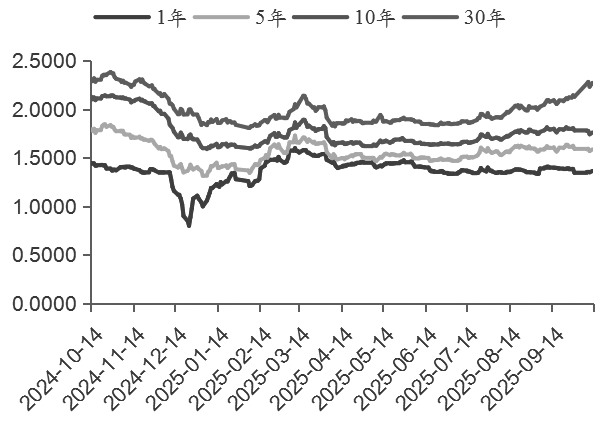
Group 1 - The bond market has experienced multiple shifts in logic this year, with tightening liquidity in Q1 leading to adjustments in short-term bonds, followed by pressure release in long-term bonds as liquidity turned loose in Q2 [1] - The 10-year government bond yield has risen to around 1.75%, with support expected near 1.8% after a 10 basis point rate cut this year [1] - The upward movement in bond yields since Q3 has been primarily driven by non-fundamental factors, indicating significant pressure on the bond market despite the central bank's efforts to maintain liquidity [2] Group 2 - The macroeconomic narrative has improved, but the bond market is still facing substantial pressure, with a bear-steep yield curve indicating stability in short-term bonds while long-term bonds have seen larger adjustments [2] - Recent inflation data shows a narrowing decline in PPI to 2.3% year-on-year, while core CPI has increased by 1%, suggesting a potential bottoming out of inflation, although demand remains a critical factor for further increases [4] - The bond market's attractiveness has diminished this year, leading to a higher likelihood of new funds entering the stock market rather than the bond market, resulting in reduced incremental funds and declining stock scale [4] Group 3 - The central bank's potential reinitiation of government bond trading is anticipated, especially if the bond market enters an overshoot state, with expectations for such actions remaining high for the year [5][6] - The central bank's objectives for restarting bond trading include liquidity management, influencing interest rates, and supporting government bond issuance [6] - Observations from September indicate a reversal in the decline of household deposits, suggesting a shift in market dynamics that could impact M1 growth, which needs further monitoring [7]
黄金市值破30万亿美元大关,费率成本最低的黄金ETF华夏飙涨3%,净值创历史新高
Ge Long Hui· 2025-10-17 06:19
Core Insights - Gold prices have reached a new high of $4,380.79, marking a continuous increase for five days and making gold the first global asset to surpass a total market value of $30 trillion [1] - The rise in gold prices is attributed to geopolitical tensions, expectations of interest rate cuts by the Federal Reserve, central bank purchases, de-dollarization trends, and strong buying in gold ETFs [1][3] - Major financial institutions have raised their gold price forecasts, with Goldman Sachs projecting a price of $4,900 per ounce by December 2026, and Bank of America and Societe Generale predicting prices could reach $5,000 next year [3] Market Dynamics - The recent surge in gold prices is influenced by several factors, including the U.S. government shutdown, trade tensions between the U.S. and China, and negative news from U.S. banks [1][2] - The ongoing uncertainty in the market is exacerbated by the U.S. Senate's repeated failure to pass a temporary funding bill, delaying economic data releases [1] - Concerns over bad loans in the banking sector due to fraud allegations have raised investor apprehensions about the banking industry's stability [2] Investment Opportunities - Notable investment vehicles include the low-cost gold and silver-related ETF, which has seen a net inflow of 1.661 billion yuan over the past 20 trading days [4] - The 华夏 Gold ETF has increased by 3.47%, with a total net inflow of 1.484 billion yuan in the last 20 trading days [4]