
去美元化

Search documents
中间价创新低,该持汇过节吗
Hua Er Jie Jian Wen· 2026-02-10 02:51
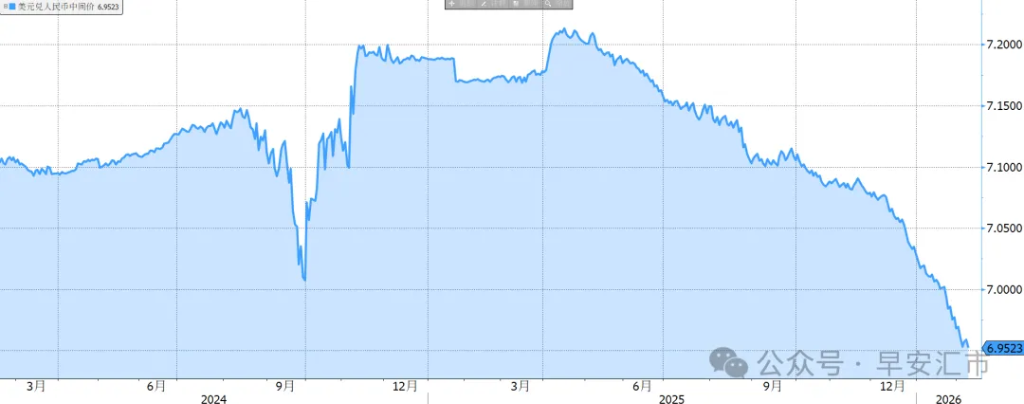
Group 1 - The core viewpoint of the article is that the Chinese yuan has returned to an appreciation trend, with the USD/CNY midpoint reaching a new low since May 2023 at 6.9523, approaching the critical level of 6.95 [1][10]. - The appreciation of the yuan began to accelerate in December last year, with a monthly increase of approximately 900 pips, followed by an additional 500 pips in January [2]. - The yuan's appreciation characteristics can be summarized as "self-driven," where the yuan gains momentum when the US dollar index declines, and experiences limited adjustments when the index rises [4][6]. Group 2 - The USD/CNY midpoint has been on a downward trend for eight consecutive months since the peak of the trade war in April last year, returning to a trajectory that aligns with market appreciation rates [5]. - There is a consensus among enterprises to adjust their currency exchange strategies flexibly, moving away from fixed points to follow market trends [7]. - Potential risks before and after the Spring Festival include supply-demand imbalances due to pre-holiday settlement pressures, with the possibility of the USD/CNY rate dropping to the 6.9 level [8]. Group 3 - Key data releases, including January's non-farm payrolls and CPI, could catalyze market movements, especially with the upcoming long Spring Festival holiday, which may increase volatility [8]. - The article notes that the longest Spring Festival holiday in history, lasting nine days, could yield a carry return of 50 pips, leading to speculative trading that may amplify market fluctuations [8][10]. - The article concludes that the appreciation of the yuan may not be over before the Spring Festival, and that adjusting exchange rates at higher levels is a reasonable strategy [10].

西南期货早间评论-20260210
Xi Nan Qi Huo· 2026-02-10 02:37
Report Industry Investment Rating No relevant information provided. Core Viewpoints - The macro - economic recovery momentum needs strengthening, and the monetary policy is expected to remain loose. Treasury bond futures are expected to face some pressure, and caution is advised [6][7]. - The domestic economy is stable, but the recovery momentum is weak. The valuation of domestic assets is low, and the market sentiment has warmed up. The volatility center of stock index futures is expected to gradually move up, and previous long positions can be held [9][10]. - The global trade - financial environment is complex. Gold is favored for its allocation and hedging value, but the recent sharp rise has led to high speculative sentiment. The market volatility of precious metals is expected to increase significantly, and long positions should be liquidated for observation [11][12]. - The supply - demand pattern of steel products is weak. The prices of rebar and hot - rolled coils may continue to oscillate weakly. Investors can look for opportunities to go long on pullbacks and manage positions carefully [13]. - The supply - demand pattern of iron ore is weak, and the futures may continue to oscillate in the short term. Investors can look for opportunities to go long on pullbacks and manage positions carefully [15]. - The coke and coking coal futures may continue to oscillate in the medium term. Investors can look for low - level buying opportunities and manage positions carefully [17]. - The ferro - alloy market has an overall surplus, but the cost has a certain bottom - support. After a decline, investors can consider long positions in the low - level range [19]. - The negotiation between the US and Iran is complex, and geopolitical risks remain. The capital is still bullish on crude oil, and the rebound of crude oil is expected to continue. Investors can focus on long - position opportunities in the main crude oil contract [20][21][22]. - The supply of fuel oil in Singapore is tightening, and the cost - end crude oil is rebounding, so the fuel oil price has room to rise. Investors can focus on long - position opportunities in the main fuel oil contract [23][24]. - As the Spring Festival approaches, the demand for polyolefins will shrink significantly, and pre - festival cautious operation is recommended [25][26]. - The synthetic rubber market may oscillate strongly. Attention should be paid to the resumption progress of logistics and infrastructure after the Lantern Festival and the inventory reduction rate of tire enterprises [27][28][29]. - The natural rubber market is in an oscillating trend. Due to the approaching Spring Festival, positions should be controlled [30][31]. - The PVC market may oscillate strongly. The key to price trends and inventory reduction lies in the post - Spring Festival demand recovery [32][33][34]. - The urea market may oscillate strongly, and attention should be paid to Indian tenders, domestic policies, and post - festival demand recovery [35]. - The PX market may oscillate and adjust in the short term. Cautious participation is recommended, and attention should be paid to macro - policies and fundamentals [36][37]. - The PTA market may oscillate in the short term. It is expected to accumulate a small amount of inventory in January and February. Cautious operation is recommended, and attention should be paid to oil price changes [38]. - The ethylene glycol market may maintain an oscillating bottom - building pattern in the short term. Cautious operation is recommended, and attention should be paid to port inventory and supply changes [39][40]. - The short - fiber market mainly trades based on the cost - end logic before the Spring Festival. Cautious observation is recommended, and attention should be paid to cost changes and downstream pre - festival stocking [41]. - The bottle - chip market is expected to follow the cost - end trend. Cautious participation is recommended before the Spring Festival, and attention should be paid to the implementation of maintenance devices [42][43]. - The soda ash market is in a slack season, and cautious treatment is still required [44]. - The glass market is expected to oscillate before the Spring Festival. Attention should be paid to the risk of returning to the fundamentals [45][46][47]. - The caustic soda market has significant seasonal characteristics. Although the cost is expected to rise, the fundamentals of the middle and lower reaches have not improved significantly, so cautious treatment is required [49][50]. - The pulp market is expected to have limited fluctuations before the Spring Festival due to weak support [51]. - The lithium carbonate market has strong support at the bottom, but short - term fluctuations may increase, and risk control should be noted [52][53]. - The copper price may be weakly adjusted before the Spring Festival due to weakening market sentiment and fundamentals [54][55]. - The aluminum price may be under pressure as speculative funds leave the market [56][57][58]. - The zinc price will enter an adjustment period as market sentiment cools and zinc ingot inventory accumulates [59][60]. - The lead market is in a situation of weak supply and demand, and the price may oscillate weakly [61][62]. - The tin price has support at the bottom, but short - term fluctuations may intensify due to the uncertainty of US policies, and risk control should be noted [63][64]. - The nickel market is in an oversupply pattern, and attention should be paid to relevant Indonesian policies [65]. - For soybean meal, long - position opportunities in the low - cost support range can be considered; for soybean oil, observation is advisable after the price leaves the low - cost range [66][67]. - For palm oil, long - position opportunities after pullbacks can be considered [68][69]. - For rapeseed meal and rapeseed oil, temporary observation is recommended [70][71][72]. - The cotton price is expected to be strong in the medium and long term, but there is pressure on the domestic market in the short term. Pre - festival observation is recommended [73][74][75]. - The sugar market is expected to be weak in the medium term [76][77][78]. - The apple price is expected to be strong in the medium and long term. Pre - festival observation is recommended, and long - position operations can be considered in batches after pullbacks [79][80]. - For live pigs, pre - festival observation is recommended due to the large supply pressure after the Spring Festival [80][81]. - For eggs, pre - festival temporary observation is recommended due to the high supply and the end of pre - festival stocking [82][83]. - The corn and corn starch market: Corn is expected to face supply pressure after the Spring Festival, and corn starch may follow the corn market. Cautious observation is recommended [84][85][86]. - The log market has weak future demand expectations, and attention should be paid to foreign quotes, holiday progress, and shipping dynamics [87][88][89]. Summary by Directory Pulp - The previous trading day, the main 2605 contract closed at 5,200 yuan/ton, down 0.99%. The port inventory continued to accumulate, the terminal demand stagnated, and the market lacked trading basis. The price is expected to have limited fluctuations before the Spring Festival [51]. Carbonate Lithium - The previous trading day, the main carbonate lithium contract rose 3.55% to 137,000 yuan/ton. The supply is in a tight balance, the consumption end is improving, and the social inventory is gradually decreasing. The price has strong support at the bottom, but short - term fluctuations may increase [52][53]. Copper - The previous trading day, the Shanghai copper main contract closed at 102,450 yuan/ton, up 0.93%. Due to weakening market sentiment and fundamentals, the copper price may be weakly adjusted before the Spring Festival [54][55]. Aluminum - The previous trading day, the Shanghai aluminum main contract closed at 23,625 yuan/ton, up 0.17%; the alumina main contract closed at 2,862 yuan/ton, down 0.46%. The alumina is bearish, and the aluminum price may be under pressure as speculative funds leave the market [56][57][58]. Zinc - The previous trading day, the Shanghai zinc main contract closed at 24,490 yuan/ton, down 0.39%. The zinc market has a pattern of weak supply and demand, and the price will enter an adjustment period [59][60]. Lead - The previous trading day, the Shanghai lead main contract closed at 16,665 yuan/ton, up 0.6%. The lead market is in a situation of weak supply and demand, and the price may oscillate weakly [61][62]. Tin - The previous trading day, the Shanghai tin main contract rose 4.18% to 385,140 yuan/ton. The supply - demand is tight, the price has support at the bottom, but short - term fluctuations may intensify due to the uncertainty of US policies [63][64]. Nickel - The previous trading day, the Shanghai nickel main contract rose 0.91% to 134,820 yuan/ton. The nickel market is in an oversupply pattern, and attention should be paid to relevant Indonesian policies [65]. Soybean Oil and Soybean Meal - The previous trading day, the soybean meal main contract fell 0.33% to 2,729 yuan/ton, and the soybean oil main contract rose 0.07% to 8,114 yuan/ton. For soybean meal, long - position opportunities in the low - cost support range can be considered; for soybean oil, observation is advisable after the price leaves the low - cost range [66][67]. Palm Oil - The Malaysian palm oil rose. The market expects the inventory to decline in January. For palm oil, long - position opportunities after pullbacks can be considered [68][69]. Rapeseed Meal and Rapeseed Oil - The Canadian rapeseed rose. For rapeseed meal and rapeseed oil, temporary observation is recommended [70][71][72]. Cotton - The previous trading day, the domestic Zhengzhou cotton oscillated. The cotton price is expected to be strong in the medium and long term, but there is pressure on the domestic market in the short term. Pre - festival observation is recommended [73][74][75]. Sugar - The previous trading day, the Zhengzhou sugar rebounded slightly. The sugar market is expected to be weak in the medium term [76][77][78]. Apple - The previous trading day, the domestic apple futures oscillated. The apple price is expected to be strong in the medium and long term. Pre - festival observation is recommended, and long - position operations can be considered in batches after pullbacks [79][80]. Live Pigs - The previous trading day, the main live - pig contract fell 0.69% to 11,565 yuan/ton. Pre - festival observation is recommended due to the large supply pressure after the Spring Festival [80][81]. Eggs - The previous trading day, the main egg contract rose 0.03% to 2,909 yuan/500 kg. Pre - festival temporary observation is recommended due to the high supply and the end of pre - festival stocking [82][83]. Corn and Starch - The previous trading day, the corn main contract fell 0.18% to 2,265 yuan/ton; the corn starch main contract rose 0.28% to 2,538 yuan/ton. Corn is expected to face supply pressure after the Spring Festival, and corn starch may follow the corn market. Cautious observation is recommended [84][85][86]. Logs - The previous trading day, the main 2603 contract closed at 775.0 yuan/ton, down 1.90%. The log market has weak future demand expectations, and attention should be paid to foreign quotes, holiday progress, and shipping dynamics [87][88][89].
2026年02月10日:期货市场交易指引-20260210
Chang Jiang Qi Huo· 2026-02-10 01:44
1. Report Industry Investment Ratings - **Macro - finance**: Bullish on stock indices in the medium - to - long - term with a strategy of buying on dips; expect government bonds to move in a range [1][6] - **Black building materials**: Short - term trading for coking coal, range trading for rebar, buying on dips for glass [1][6] - **Non - ferrous metals**: General traders are advised to reduce trading positions before the holiday, while hedgers are recommended to increase hedging coverage for copper; strengthen observation for aluminum; wait - and - see for nickel; range trading for tin, gold, and silver; expect lithium carbonate to move in a range [1][10] - **Energy and chemicals**: Range trading for PVC, styrene, rubber, urea, and methanol; temporary wait - and - see for caustic soda and soda ash; expect polyolefins to be weakly volatile [1][20] - **Cotton textile industry chain**: Expect cotton and cotton yarn to adjust in a range, apples and jujubes to move in a range [1][29] - **Agriculture and animal husbandry**: Short - term supply - demand game for hogs, with a strategy of selling on rallies for off - season contracts; sell on rallies for hedging post - festival contracts of eggs; short - term cautious about chasing high prices for corn, and grain holders can wait for rallies to sell for hedging; expect soybean meal to be mainly volatile in the short term, with the M2603 contract paying attention to the performance at the 3030 level; expect oils and fats to be volatile at high levels in the short term, and recommend buying on pullbacks [1][31] 2. Core Views of the Report - The report provides trading suggestions for various futures products based on their fundamentals, market sentiment, and macro - economic factors. It takes into account factors such as supply and demand, cost, inventory, and policy to analyze the price trends of different commodities and gives corresponding investment strategies [1][6] 3. Summary by Relevant Catalogs Macro - finance - **Stock indices**: Bullish in the medium - to - long - term, expected to be volatile and stronger. Overseas rebounds and reduced liquidity shock disturbances may drive stock indices to move in this way. It is recommended to buy on dips [1][6] - **Government bonds**: Expected to move in a range. Although institutions may have a demand to hold bonds during the holiday, the rebound of the TL2603 contract was blocked, and there are uncertainties after the holiday [6] Black building materials - **Double - coking coal**: Expected to move in a range, with short - term trading recommended. The coal market has short - term fluctuations, but the price increase is not sustainable due to weak demand and other factors [7][8] - **Rebar**: Expected to move in a range. The price is currently at a low static valuation, and the recent weakness is due to weakened cost support. It is recommended to trade with a light position before the holiday [8] - **Glass**: Expected to move in a range with a bullish bias. There are industry rumors, and although there is pressure above, the price is at a relatively low level again. It is recommended to buy on dips [9][10] Non - ferrous metals - **Copper**: Expected to be volatile at a high level. The recent sharp decline is due to macro - level panic. Although there are uncertainties, it may stabilize in a range after risk release. Traders are advised to reduce positions, and hedgers to increase coverage [11][12] - **Aluminum**: Expected to be volatile at a high level. Supply is increasing, while demand is weakening. It is recommended to strengthen observation and reduce positions before the holiday [13] - **Nickel**: Expected to move in a range. Although there is positive news, the fundamentals are weak. It is recommended to wait and see [15] - **Tin**: Expected to move in a range. Supply is tight, and consumption is in a recovery stage. It is recommended to conduct range trading [16][17] - **Silver and gold**: Expected to move in a range. Affected by factors such as the nomination of the Fed chairman and economic data, the medium - term price center is rising. It is recommended to conduct range trading and pay attention to relevant economic data [17][18] - **Lithium carbonate**: Expected to move in a range. Supply and demand are both changing, and it is necessary to pay attention to the impact of mine - end disturbances [19] Energy and chemicals - **PVC**: Expected to be volatile at a low level in a wide range. The current supply - demand situation is weak, but there are opportunities for industrial upgrading in the long - term. It is recommended to be cautious about chasing high prices [21] - **Caustic soda**: Expected to be volatile at a low level. Demand is weak, and supply is under pressure. It is recommended to wait and see [22] - **Styrene**: Expected to move in a range. There is support for inventory reduction, but the valuation is high. It is recommended to be cautious about chasing high prices and pay attention to cost and supply - demand changes [23] - **Rubber**: Expected to move in a range. Supply is tightening, and demand is under pressure. It is recommended to conduct range trading [23] - **Urea**: Expected to move in a range. Supply is increasing, and demand is stable. It is recommended to pay attention to factors such as compound fertilizer production and export policies [24][25] - **Methanol**: Expected to move in a range. Supply is decreasing, and demand is weak. It is affected by geopolitical and port factors [25] - **Polyolefins**: Expected to be weakly volatile. Supply is high, and demand is weakening. It is recommended to sell on rallies and pay attention to downstream demand and inventory [26][28] - **Soda ash**: It is recommended to wait and see. Supply is expected to shrink, and there is cost support. The price may have limited downward space [28] Cotton textile industry chain - **Cotton and cotton yarn**: Expected to adjust in a range. Although there is short - term pressure, the long - term outlook is optimistic [29] - **Apples and jujubes**: Expected to move in a range. The market for apples in production areas is stable, and the price of jujubes is determined by quality [29][31] Agriculture and animal husbandry - **Hogs**: Expected to build a bottom in a range. In the short - term, there is a supply - demand game, and it is recommended to sell on rallies for off - season contracts. In the long - term, pay attention to capacity reduction [31] - **Eggs**: Expected to rebound from a low level. The supply is sufficient in the short - term, and the market will experience a grinding process in the long - term. It is recommended to be cautious about short - selling and consider hedging on rallies [33] - **Corn**: The price increase is limited. In the short - term, it is recommended to be cautious about chasing high prices, and grain holders can sell on rallies for hedging. In the long - term, the supply - demand pattern is relatively loose [34][35] - **Soybean meal**: Expected to be volatile at a low level. Pay attention to the support at 2700 yuan/ton for the M2605 contract, and it is recommended to short on rallies [35] - **Oils and fats**: Expected to be volatile at high levels. It is recommended to buy on pullbacks and pay attention to position risks before the holiday. Different oils have different performance characteristics [36][41]
宝城期货贵金属有色早报(2026年2月10日)-20260210
Bao Cheng Qi Huo· 2026-02-10 01:41
投资咨询业务资格:证监许可【2011】1778 号 宝城期货贵金属有色早报(2026 年 2 月 10 日) ◼ 品种观点参考 时间周期说明:短期为一周以内、中期为两周至一月 | 品种 | | 短期 | 中期 | 日内 | 观点参考 | 核心逻辑概要 | | --- | --- | --- | --- | --- | --- | --- | | 黄金 | 2604 | 震荡 | 震荡 | 震荡 偏弱 | 观望 | 短期恐慌抛售暂缓,去美元化长 期趋势不变 | | 铜 | 2603 | 强势 | 震荡 | 震荡 偏强 | 长线看强 | 国内供应收缩给予铜价支撑 | 说明: 1.有夜盘的品种以夜盘收盘价为起始价格,无夜盘的品种以昨日收盘价为起始价格,当日日盘收盘价为终点价格, 计算涨跌幅度。 2.跌幅大于 1%为弱势,跌幅 0~1%为震荡偏弱,涨幅 0~1%为震荡偏强,涨幅大于 1%为强势。 3.震荡偏强/偏弱只针对日内观点,短期和中期不做区分。 主要品种价格行情驱动逻辑—商品期货 品种:黄金(AU) 日内观点:震荡偏弱 中期观点:震荡 期货研究报告 品种:铜(CU) 参考观点:观望 核心逻辑:上周黄金市场经历剧 ...
2026年2月10日申万期货品种策略日报-黄金白银-20260210
Shen Yin Wan Guo Qi Huo· 2026-02-10 01:41
2026 年 2 月 10 日申万期货品种策略日报-黄金白银 4.美国白宫国家经济委员会主任哈塞特在接受 CNBC 采访时就劳动力市场表示,应预期就业数据会 走低,但这不应引发恐慌。哈塞特认为,鉴于人口增长缓慢但生产率增长"飙升",较低的就业数 据仍将与高 GDP 增长保持一致。哈塞特补充称,所谓的均衡就业增长率(即每月为保持失业率稳定 所需的就业增长幅度)"远低于"前总统乔·拜登执政时期的水平。哈塞特关于劳动力数据的评论 推动美国国债价格上扬。哈塞特还表示,GDP 增长"非常强劲",预计到年底增长率将达到 4.0%, 全年整体增长率为 3.0%,并将去年第一季度的负增长归咎于拜登政府。 评 论 及 策 略 贵金属延续反弹。此前贵金属巨震,主要受美联储主席提名和资金踩踏两方面因素影响:1 月 30 日 特朗普宣布提名凯文·沃什为下一任联储主席,沃什的传统鹰派立场以及缩表主张,导致降息预期 降温,同时市场对美联储独立性担忧缓解,带动美元指数明显回升。1 月以来贵金属快速上涨,波 动率已处于高位,沃什获提名成为触发因素,引发大量资金获利了结。从长期角度来看,去美元化、 地缘风险、央行购金等支撑因素并未发生逆转,我 ...
申万期货品种策略日报-铂、钯-20260210
Shen Yin Wan Guo Qi Huo· 2026-02-10 01:39
1. Report Industry Investment Rating - The report maintains a bullish outlook on platinum and palladium [4]. 2. Core Viewpoints of the Report - The long - term core logic for platinum and palladium remains unchanged, but short - term fluctuations are intensified due to technical corrections and Fed personnel changes. The nomination of Kevin Warsh as the next Fed Chair by Trump has led to a short - term strengthening of the US dollar, dragging down platinum and palladium prices. However, the long - term bullish logic is not affected by short - term disturbances [4]. - Macroscopically, the judicial investigation of Powell shakes the US dollar's credit, the global central bank gold - buying spree continues, and the reserve value of platinum and palladium is prominent under de - dollarization. The geopolitical risks in Greenland provide a phased bottom for prices, and the expectation of a Fed rate cut in June remains unchanged, providing long - term support [4]. - At the industrial level, there is a clear supply - demand gap for platinum, with surging hydrogen energy demand and South African production capacity constraints providing strong support. Palladium has a rigid supply, and hybrid demand and strict emission policies support demand, resulting in a tight balance in the spot market [4]. 3. Summary According to the Table of Contents Futures Market of Platinum and Palladium - **Prices and Changes**: For platinum futures (pt2606, pt2608, pt2610), the current prices are 545.05, 539.90, and 535.15 respectively, with price increases of 52.15, 56.85, and 57.45 and increases of 10.58%, 11.77%, and 12.03% respectively. For palladium futures (pd2606, pd2608, pd2610), the current prices are 438.15, 433.00, and 436.10 respectively, with price increases of 30.90, 28.75, and 38.35 and increases of 7.59%, 7.11%, and 9.64% respectively [1]. - **Trading Volume and Open Interest**: The open interest for platinum and palladium futures is 12078 and 4142 respectively. The trading volumes of pt2606, pt2608, pt2610 are 13074, 229, 143 respectively, and the trading volumes of pd2606, pd2608, pd2610 are 6013, 59, 49 respectively [1]. - **Spot Premium and Discount**: The spot premiums and discounts for platinum futures are - 1.06, 4.09, 8.84 respectively, and for palladium futures are - 18.15, - 13, - 16.1 respectively [1]. Spot Market - **Platinum Spot**: The previous closing prices of Shanghai platinum, London platinum, Chow Tai Fook platinum, and Lao Fengxiang platinum are 543.99 yuan/gram, 2054.00 US dollars/ounce, 836.00 yuan/gram, and 960.00 yuan/gram respectively. The price changes are - 2.48, 30.00, - 58.00, 0.00 respectively, and the price change rates are - 0.005%, 0.015%, - 0.072%, 0.000% respectively [1]. - **Palladium Spot**: The previous closing prices of Chinese palladium and Russian palladium are 420.00 yuan/gram and 4226.59 rubles/gram respectively. The price changes are 2.00 and 64.66 respectively, and the price change rates are 0.005% and 0.016% respectively [1]. - **Price Ratios**: The current values of platinum/palladium, Shanghai platinum/London platinum, pt2608 - pt2606, pt2610 - pt2606, Chinese palladium/Russian palladium, pd2608 - pd2606 are 1.30, 1.14, - 5.15, - 9.90, 1.08, - 5.15 respectively, and the previous values are - 1.24, - 0.36, - 7.45, - 14.40, 0.34, - 2.05 respectively [1]. Inventory - **Platinum Inventory**: The current NYMEX platinum inventory is 646,440.78 ounces, a decrease of 16178.0 ounces compared to the previous value. The NYMEX registered platinum warehouse receipts remain unchanged at 326,637.95 ounces. The turnover of platinum on the gold exchange is 5,189.29 million yuan, a decrease of 446.1 million yuan compared to the previous value, and the trading volume is 96.00 kilograms, a decrease of 12.0 kilograms compared to the previous value [1]. - **Palladium Inventory**: The NYMEX palladium inventory and registered warehouse receipts remain unchanged at 190,873.50 ounces and 148,317.64 ounces respectively [1]. Related Derivatives and Market Indicators - **Market Indicators**: The current values of the US dollar index, S&P index, US Treasury yield, Nasdaq index, Dow Jones index, and US dollar to RMB exchange rate are 96.85, 6,964.82, 4.22, 23,238.67, 50,135.87, 6.95 respectively. The previous values are 97.61, 6,932.30, 4.22, 23,031.21, 50,115.67, 6.96 respectively. The changes are - 0.76, 32.52, 0.00, 207.46, 20.20, - 0.01 respectively [1]. - **Related Derivatives**: The current values of Shanghai gold futures (2604, 2606, 2608) are 1125.94, 1128.78, 1131.24 respectively, with increases of 35.82, 36.06, 35.42 respectively. The current values of Shanghai silver futures (2604, 2606, 2608) are 20873.00, 20175.00, 19846.00 respectively, with increases of 2074, 2231, 2236 respectively [1]. Macroeconomic News - **Fed Policy**: The Fed maintains the benchmark interest rate at 3.50% - 3.75%, pausing after three consecutive 25 - basis - point rate cuts, which is in line with market expectations. Fed Chair candidate Waller supports a 25 - basis - point rate cut, consistent with Trump's "designated" director Milan [2]. - **Fed Chair Nomination**: Trump nominates former Fed governor Kevin Warsh as the next Fed Chair, but the nomination needs Senate approval. Some senators oppose the nomination [2]. - **China's Economic Data**: In January 2026, China's manufacturing market demand tightened, but production expanded, and the industrial structure continued to optimize. The manufacturing PMI was 49.3%, a 0.8 - percentage - point decrease from the previous month. The PMIs of the equipment manufacturing and high - tech manufacturing industries were 50.1% and 52% respectively, showing stable and positive development [2]. - **PBOC Meeting**: The People's Bank of China requires promoting the high - quality development of the modern payment system in 2026, including accelerating the construction of the RMB cross - border payment system, strengthening regulatory measures, and improving payment services [3].
环球富盛:给予中国宏桥“买入”评级 企业利润扩大明显 目标价45.58港元
Zhi Tong Cai Jing· 2026-02-10 01:09
Group 1 - The core viewpoint of the report is that China Hongqiao (01378) is expected to achieve net profits attributable to shareholders of 186.75 billion, 252.99 billion, and 271.76 billion yuan for the years 2025-2027, respectively, with a target price of 45.58 HKD based on a 16x PE for 2026 [1] - The estimated net profit for 2025 is projected to be between 170.0 billion and 200.0 billion yuan, with adjustments made to the 2024 net profit figure to 172.28 billion yuan due to a significant asset restructuring involving the acquisition of Shandong Hongtuo Industrial Co., Ltd. [2] - The production cost of electrolytic aluminum has decreased, leading to a significant expansion in enterprise profits, with the average production cost at 15,747.31 yuan/ton, a month-on-month decrease of 149.18 yuan/ton, and an industry average profit of 8,295.19 yuan/ton, reflecting a month-on-month increase of 2,266.98 yuan/ton [3] Group 2 - The electrolytic aluminum market is entering a new cycle, with historical price highs driven by a weakening dollar and geopolitical factors, leading to fluctuations in aluminum prices [4] - The overall electrolytic aluminum production capacity in China is expected to grow from 43.76 million tons to 45.15 million tons from 2021 to 2025, with a tightening of new capacity control due to the 45 million ton capacity "ceiling" and "dual carbon" goals [5]
环球富盛:给予中国宏桥(01378)“买入”评级 企业利润扩大明显 目标价45.58港元
智通财经网· 2026-02-10 01:04
Group 1 - The core viewpoint of the report by Global Fortune predicts China Hongqiao's net profit attributable to shareholders for 2025-2027 to be 186.75, 252.99, and 271.76 billion yuan respectively, with a target price of 45.58 HKD based on a 16x PE for 2026 [1] - The expected net profit for 2025 is projected to be between 170.0 and 200.0 billion yuan, with a significant asset restructuring involving the acquisition of Shandong Hongtuo Industrial Co., Ltd. expected to be completed by December 31, 2025 [1] Group 2 - In January 2026, the average production cost of electrolytic aluminum in China decreased to approximately 15,747.31 yuan/ton, a month-on-month decrease of 149.18 yuan/ton, with an industry average profit of 8,295.19 yuan/ton, reflecting a month-on-month increase of 2,266.98 yuan/ton [2] - The weighted average production cost was 14,804.09 yuan/ton, down 177.55 yuan/ton from the previous month, with 81.21% of production capacity below 16,000 yuan/ton [2] Group 3 - The electrolytic aluminum market experienced a historic surge in early January 2026, driven by a significant depreciation of the US dollar, with expectations of continued volatility in aluminum prices [3] - The forecast for February indicates a potential trading range for aluminum prices between 23,000 and 24,500 yuan/ton, influenced by market sentiment and fundamental pressures [3] Group 4 - China's electrolytic aluminum production capacity is constrained by a "ceiling" of 45 million tons and carbon neutrality goals, with a projected growth rate of only 0.44% for new capacity by 2025 [4] - Future capacity changes in the electrolytic aluminum industry are expected to focus on capacity replacement and regional transfer due to strict controls on new capacity [4]
地缘与政策角力,油价走势偏强:申万期货早间评论-20260210
申银万国期货研究· 2026-02-10 00:53
Group 1 - Iran's Foreign Minister, Zarif, announced that negotiations with the U.S. in Muscat focused on nuclear issues, with both sides agreeing to continue discussions, pending leadership decisions on the next meeting's timing and location [1] - The Federal Reserve's Vice Chairman, Jefferson, stated that the current interest rate stance is "fully appropriate" for a stable economy, indicating no immediate urgency to resume interest rate cuts [1] - The FAO reported that global grain consumption is expected to increase by 61.8 million tons or 2.2% in the 2025/26 season, reaching 2.938 billion tons, primarily driven by a 3.0% rise in corn consumption [1] Group 2 - Precious metals continued to rebound, influenced by the nomination of Kevin Warsh as the next Fed Chair, which cooled rate cut expectations and led to a significant recovery in the dollar index [2][17] - The oil market saw a 1.97% increase in night trading, with ongoing indirect negotiations between Iran and the U.S. in Muscat, where both parties agreed to continue discussions without threats or pressure [3][12] - Copper prices rose by 0.6% in night trading, amid tight supply of concentrates and fluctuating smelting profits, with short-term adjustments expected due to stable electricity investment and mixed performance in downstream demand [18] Group 3 - The domestic futures market showed a mixed performance, with most major contracts declining, while caustic soda and synthetic rubber saw increases of over 2% and 1% respectively [1] - The market is currently cautious regarding various commodities, with a focus on potential adjustments in supply and demand dynamics, particularly in metals and energy sectors [5][10]

再失97关口!美元滑向四年低位 机构重申金价6000美元目标
Di Yi Cai Jing· 2026-02-09 23:29
另一影响因素是媒体援引匿名知情人士的报道称,美国国债可能面临新一轮抛售,这意味着市场或出现 更大规模、更持续减持美元等美国资产的趋势。 外汇风险管理咨询公司 Klarity FX 董事阿马尔吉特·萨霍塔表示:"当前流传的一个重要趋势 ——即'抛 售美国资产'的市场心态,这一情绪仍是今年困扰交易员的主要市场趋势之一"。 本周首个交易日,市场对美元前景的担忧再度浮现。受日本议会选举结果及美债资产减持报道的双重影 响,美元指数承压走低。随着失守97关口,指数回落至2022年2月以来的低位区间。与此同时,贵金属 市场迎来强劲反弹,国际金价日内大涨超2%,重回5000美元关口。 美元低迷 导致美元走弱的因素之一是上周末日本议会选举结果 ——日本首相高市早苗领导的执政党赢得超多数 席位,消除了市场此前面临的一项不确定性。 机构XS高级市场分析师拉妮娅·古勒称,金价重新回升至5000美元这一关键水平上方,"不只是一次异常 的价格波动,更是全球货币体系结构、货币与资产信心格局发生更深层次转变的直接体现"。 德意志银行贵金属分析师薛家康(Michael Hsueh)在报告中重申,维持对金价长期触及6000美元/盎司 的预测。他 ...