
流动性

Search documents
当前流动性的几点关注
Tianfeng Securities· 2025-08-15 01:19
Report Industry Investment Rating No information provided in the content. Core Viewpoints - In August, liquidity has become a key factor in the bond market. The linkage between risky assets and the bond market has continued for some time, and in the medium - to long - term, the bond market is still priced based on fundamentals. Risky assets' strength is a short - term disturbance. If liquidity is stable, changes in funds flowing to risky assets are not the key to the bond market. An abundant liquidity environment is more likely to lead to a "double - bull" market for stocks and bonds. Attention should be paid to the central bank's operations, large banks' net lending levels, and the liability - side stability of bond funds and other broad - based funds [1][2]. - Although there are disturbances such as government bond supply, certificate of deposit (CD) maturities, and tax payments in August, there are also clear supporting factors. It is expected that the central bank will use various tools to maintain the stability of the money market, and the central level of money market rates will remain in a low - level volatile pattern, but special - time fluctuations need attention [4]. Summary by Directory 1. August: Liquidity Becomes a Key Factor in the Bond Market - Since July, the linkage between stocks, commodities, and bonds has attracted market attention. Liquidity plays a dual role in the stock - bond market linkage. Abundant liquidity benefits both markets, while changes in risk appetite and equity returns drive asset reallocation, causing some bond market funds to flow into stocks and commodities [1][8]. - In late July, high inter - bank liquidity demand and the rise of stocks and commodities suppressed the bond market. At the beginning of August, loose liquidity led to a "double - bull" market for stocks and bonds. From August 11 - 13, the relationship between stocks and bonds changed from a "seesaw" to a "double - bull" situation. On August 11, the central bank's large - scale net withdrawal in the open market and the strength of risky assets dragged down bond market sentiment. On August 13, the bond market showed resilience [1][8][9]. - In the second half of August, the bond market lacks a new narrative. Liquidity will continue to be crucial. The sustainability of risky assets' performance remains to be seen. If liquidity is stable, it won't be the key to the bond market. An abundant liquidity environment is more likely to lead to a "double - bull" market. Attention should be paid to the central bank's operations, large banks' net lending levels, and the liability - side stability of bond funds [2][14]. 2. July: Turbulence in the Money Market - In July, the money market had a "roller - coaster" ride, with funds loosening at the beginning, tightening in the middle, and then fluctuating again in the late stage. The central bank's operations were more targeted, with more precise and flexible liquidity injections [15]. - In terms of money prices, overnight money rates often ran below the policy rate but rose during tax payments and at the end of the month. The 7 - day money rate's central level declined, and the 7 - day money rate's stratification phenomenon was more prominent, while the overnight money rate's stratification was similar to the previous month [17]. - In terms of money quantity, the net lending of large state - owned banks decreased, while the lending of money market funds and wealth management products increased. The microstructure of money lending changed, increasing the volatility of overnight money rates [30]. - Factors affecting money supply and demand in July included precise and targeted open - market operations, government bond issuance (which decreased month - on - month but remained high year - on - year), high CD maturities with stable issuance prices, and a structural differentiation in credit in July after an unexpected increase in June [35][40][46]. 3. Current Concerns about the Money Market - Historically, August has a relatively low central level of money market rates in the second half of the year. In 2022 and 2023, there were large fluctuations at the end of August due to external policy variables [53]. - Currently, there are several concerns: high CD maturities above 3 trillion yuan in August, but banks' liability - side pressure is neutral, and the demand for price - increasing issuance is limited; continued government bond supply pressure, with the central bank likely to use various tools to maintain money market stability; and over 1.2 trillion yuan of medium - to long - term liquidity maturing in August, but a 70 - billion - yuan 3 - month buy - out reverse repurchase was carried out on August 8 [61][62][64]. - Although there are disturbances in August, there are also supporting factors such as seasonal factors and the central bank's support. It is expected that the central level of money market rates will remain low - level volatile, but attention should be paid to fluctuations at special times [66].
高瑞东:低增的信贷和脆弱的债市
Sou Hu Cai Jing· 2025-08-14 14:18
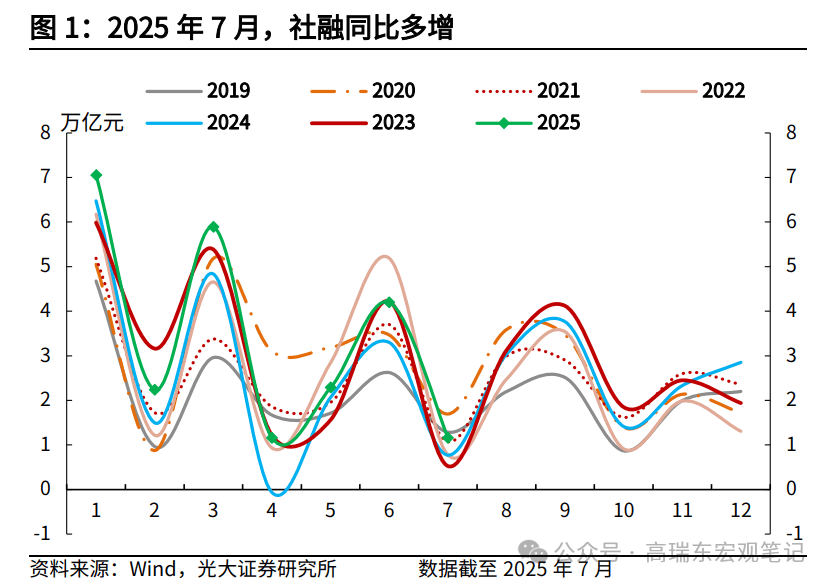
Core Insights - The financial data for July 2025 indicates a stable social financing (社融) environment but weak credit performance, suggesting a potential recovery in credit demand due to upcoming policy effects such as long-term special government bonds and consumer loan interest subsidies [2][10] Group 1: Social Financing and Credit Performance - In July, new social financing amounted to 1.16 trillion yuan, which is 389.3 billion yuan more than the same month last year, but below market expectations. The social financing stock's year-on-year growth rate was 9.0%, up 0.1 percentage points from the previous month [3][9] - The structure of social financing showed a decrease in RMB loans by 4.263 billion yuan, with foreign currency loans also declining by 8.6 billion yuan. Non-standard financing decreased by 166.7 billion yuan [3][4] - Direct financing saw significant contributions, with net financing from government bonds at 1.24 trillion yuan, an increase of 555.9 billion yuan year-on-year, and corporate bonds net financing at 279.1 billion yuan, reflecting a positive trend [3][9] Group 2: Loan Structure and Trends - RMB loans from financial institutions decreased by 500 billion yuan, with long-term loans to households down by 120 billion yuan and corporate long-term loans down by 390 billion yuan [4][10] - The short-term financing for enterprises remained stable, with a year-on-year increase in corporate bill financing by 312.5 billion yuan [4][10] Group 3: Monetary Indicators - The M1 money supply growth rate was 5.6%, up 1.0 percentage points from the previous month, while M2 growth improved to 8.8%, an increase of 0.5 percentage points [7][10] - In July, RMB deposits increased by 500 billion yuan, with a notable decrease in household deposits by 1.11 trillion yuan [7][10] Group 4: Future Outlook - The upcoming policies, including the issuance of long-term special government bonds and consumer loan interest subsidies, are expected to stimulate credit demand [10][13] - The bond market is sensitive to liquidity changes due to low bond yields, and the central bank is likely to maintain liquidity support, which could positively influence the bond market's performance [2][10][13]

5000亿!央行再次释放一个信号
凤凰网财经· 2025-08-14 14:14
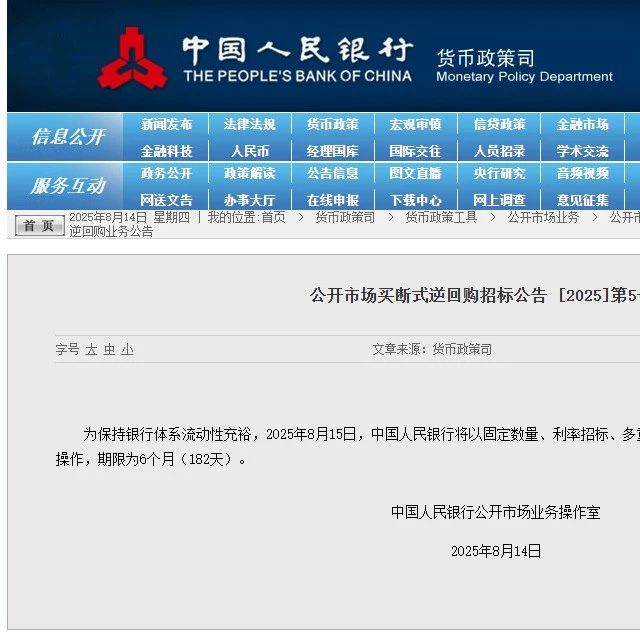
Core Viewpoint - The central bank is committed to maintaining a loose monetary policy to support market operations amid an incomplete economic recovery, as evidenced by recent liquidity injections through reverse repos [2][3]. Group 1: Central Bank Operations - On August 15, the People's Bank of China (PBOC) will conduct a 500 billion yuan reverse repo operation with a six-month term to ensure ample liquidity in the banking system [1]. - This operation follows a previous 700 billion yuan reverse repo on August 8, indicating a consistent approach to liquidity management [1][2]. Group 2: Market Impact - The 500 billion yuan injection aims to alleviate the funding pressure in the interbank market, especially as significant amounts of funds are maturing [3]. - The central bank's actions are expected to enhance market risk appetite, particularly as the A-share market reaches historical highs, signaling a commitment to stabilize growth and the market [3]. Group 3: Monetary Policy Context - The central bank's liquidity measures are aligned with the government's directive to accelerate bond issuance and maintain a stable monetary environment, which is crucial for economic recovery [5]. - Current monetary policy is focused on promoting reasonable price recovery and stabilizing growth, with an "appropriate loosening" stance sending positive signals to the market [4].
5000亿!央行再次释放一个信号
Wind万得· 2025-08-14 09:38
Group 1 - The central bank has implemented a buyout reverse repurchase operation of 500 billion yuan to maintain liquidity in the banking system, indicating a preference for a loose monetary policy amid an incomplete economic recovery [3] - The operation aims to alleviate the funding pressure in the interbank market, providing a net injection of 500 billion yuan, which is expected to support market liquidity [3] - The central bank's actions are aligned with the recent political bureau meeting's directive to accelerate government bond issuance, suggesting a continued peak in bond issuance in August [4] Group 2 - The July financial data showed weak overall performance, with private sector financing demand insufficient, particularly in new loans, indicating a need for enhanced real economy demand [5] - The central bank's monetary policy is shifting towards promoting reasonable price recovery and stable growth, signaling a proactive approach to maintain liquidity and support economic stability [4][5] - The emphasis on maintaining ample liquidity and lowering financing costs is expected to benefit both the stock and bond markets, with a focus on supporting technology innovation and small enterprises [5]

国债期货日报:风险偏好抬升,国债期货全线收涨-20250814
Hua Tai Qi Huo· 2025-08-14 07:11
Report Industry Investment Rating No relevant content provided. Core Viewpoints - Affected by the strong stock market, the recovery of risk appetite suppresses the bond market. Meanwhile, the probability of the Fed cutting interest rates in September exceeds 95%, and the increasing global trade uncertainty adds to the uncertainty of foreign capital inflows. Overall, the bond market fluctuates between the expectations of stable growth and monetary easing. Short - term attention should be paid to policy signals at the end of the month [3]. - The price of Treasury bond futures fluctuates. It is recommended to short the 2509 contract on rallies. For arbitrage, pay attention to the decline of the basis of TF2509. For hedging, as there is medium - term adjustment pressure, short - side investors can use far - month contracts for moderate hedging [4][5]. Summary by Directory 1. Interest Rate Pricing Tracking Indicators - Price indicators: China's monthly CPI has a 0.40% month - on - month increase and 0.00% year - on - year change; monthly PPI has a - 0.20% month - on - month and - 3.60% year - on - year change [9]. - Monthly economic indicators: Social financing scale is 431.26 trillion yuan, with a 1.04 - trillion - yuan month - on - month increase and 0.24% growth rate; M2 year - on - year is 8.80%, up 0.50% from the previous period with a 6.02% growth rate; manufacturing PMI is 49.30%, down 0.40% from the previous period with a - 0.80% growth rate [9]. - Daily economic indicators: The US dollar index is 97.78, down 0.28 with a - 0.29% change; the offshore US dollar - to - RMB exchange rate is 7.1817, down 0.009 with a - 0.13% change; SHIBOR 7 - day is 1.43, up 0.00 with a 0.07% change; DR007 is 1.45, up 0.01 with a 0.54% change; R007 is 1.56, down 0.12 with a - 7.38% change; the 3 - month inter - bank certificate of deposit (AAA) is 1.53, down 0.01 with a - 0.65% change; the AA - AAA credit spread (1Y) is 0.08, down 0.01 with a - 0.65% change [10]. 2. Overview of Treasury Bonds and Treasury Bond Futures Market - Multiple charts are provided to show the closing price trend, price change rate, precipitation of funds, position ratio, net position ratio (top 20), long - short position ratio (top 20), spread between government - issued bonds and Treasury bonds, and Treasury bond issuance of Treasury bond futures main contracts [13][16][18]. 3. Overview of the Money Market Funding Situation - Multiple charts are provided to show the Shibor interest rate trend, the maturity yield trend of inter - bank certificates of deposit (AAA), the trading statistics of inter - bank pledged repurchase, and the local government bond issuance [32][28]. 4. Spread Overview - Multiple charts are provided to show the inter - term spread trend of Treasury bond futures, the term spread of spot bonds and the cross - variety spread of futures [31][38]. 5. Two - Year Treasury Bond Futures - Multiple charts are provided to show the implied interest rate and Treasury bond yield of the TS main contract, the IRR and funding rate of the TS main contract, and the basis and net basis trends of the TS main contract in the past three years [41][43][52]. 6. Five - Year Treasury Bond Futures - Multiple charts are provided to show the implied interest rate and Treasury bond yield of the TF main contract, the IRR and funding rate of the TF main contract, and the basis and net basis trends of the TF main contract in the past three years [50][54][51]. 7. Ten - Year Treasury Bond Futures - Multiple charts are provided to show the implied interest rate and Treasury bond yield of the T main contract, the IRR and funding rate of the T main contract, and the basis and net basis trends of the T main contract in the past three years [58][60][61]. 8. Thirty - Year Treasury Bond Futures - Multiple charts are provided to show the implied interest rate and Treasury bond yield of the TL main contract, the IRR and funding rate of the TL main contract, and the basis and net basis trends of the TL main contract in the past three years [66][69][72].
光大期货金融期货日报-20250813
Guang Da Qi Huo· 2025-08-13 06:26
Report Industry Investment Rating No relevant information provided. Core Viewpoints of the Report - The stock market has been rising recently due to three logics: long - term, the market anticipates more fiscal policies to promote consumption and an increase in domestic inflation after the easing of Sino - US relations, with foreign capital flowing in and usually buying large - cap growth stocks; medium - term, the anti - involution trend is strong, and infrastructure investment on the demand side benefits upstream cyclical sectors; short - term, capital inflows due to RMB appreciation under a weak US dollar and improved corporate deposit and loan data lead to more entity liquidity flowing into the stock market. For stock index futures, a strategy of selling put options can be considered [1]. - For treasury bond futures, the bond market is under pressure due to the strong stock market this week. In the short term, the bond market is lack of directional drive and will mainly fluctuate, although the expected weak credit data in July may provide some support [2]. Summary by Relevant Catalogs Research Views Stock Index Futures - Yesterday, the A - share market continued to rise with increased trading volume. The Wind All - A index rose 0.34% with a trading volume of 1.91 trillion yuan. The CSI 1000, CSI 500, SSE 50, and SSE 300 indices also had varying degrees of increase. The implementation of the parenting subsidy system is expected to be an important path to stabilize and increase inflation. The long - term, medium - term, and short - term logics for the recent stock market rise are analyzed, and a selling put options strategy is recommended [1]. Treasury Bond Futures - The 30 - year, 10 - year, 2 - year, and 5 - year treasury bond futures contracts showed different trends. The central bank conducted 1146 billion yuan of 7 - day reverse repurchase operations, with a net withdrawal of 461 billion yuan. The bond market is under pressure from the strong stock market and will mainly fluctuate in the short term [2]. Daily Price Changes - For stock index futures, IH, IF, IC, and IM all rose, with increases of 0.72%, 0.64%, 0.70%, and 0.47% respectively. For stock indices, the SSE 50, SSE 300, CSI 500, and CSI 1000 also increased. For treasury bond futures, TS, TF, T, and TL had different degrees of decline [3]. Market News - On August 11, local time, US President Trump signed an executive order to extend the tariff suspension measures on China for another 90 days [4]. Chart Analysis Stock Index Futures - Charts show the trends of IH, IF, IM, IC main contracts, and the basis trends of various stock indices [6][7][9][10][11]. Treasury Bond Futures - Charts present the trends of treasury bond futures main contracts, treasury bond spot yields, basis, inter - period spreads, cross - variety spreads, and capital interest rates [13][16][17][18]. Exchange Rates - Charts display the trends of the US dollar to RMB central parity rate, euro to RMB central parity rate, forward US dollar to RMB, forward euro to RMB, US dollar index, euro to US dollar, British pound to US dollar, and US dollar to Japanese yen [21][22][23][25][26].
中国机构配置手册(2025版)之流动性与货币政策篇
2025-08-12 15:05
Summary of Key Points from the Conference Call Industry Overview - The conference call discusses the liquidity and monetary policy framework in China, focusing on the broad money supply (M2) and its implications for the banking sector and the economy as a whole [1][2][3]. Core Insights and Arguments - As of April 2025, China's broad money supply (M2) reached 325 trillion yuan, which includes M1, time deposits, and personal deposits, reflecting the purchasing power of society [1][4]. - The legal reserve requirement ratio (RRR) determines the amount of reserves that commercial banks must freeze, impacting their excess reserves and liquidity management [6][14]. - The People's Bank of China (PBOC) is shifting its monetary policy focus from the quantity of money supply to interest rates, with ongoing reforms to the Loan Prime Rate (LPR) [2][23]. - The relationship between M2 and the macroeconomy has weakened due to an increase in time and personal deposits, leading to a decrease in the velocity of money and reduced consumer and investment behavior [19]. - The PBOC has restarted government bond trading operations to manage liquidity more effectively, especially as the room for further RRR cuts is limited [18]. Important but Overlooked Content - The liquidity analysis of broad money considers various channels, including loan-derived deposits and the phenomenon of deposit outflows when residents purchase stocks or bonds, which do not count towards M2 [13]. - The phenomenon of "deposit disintermediation" is becoming more pronounced, with residents increasingly investing in low-risk financial products, which poses challenges for liquidity management in banks and the central bank [20][21]. - The behavior of bond fund managers can significantly impact market liquidity due to their similar investment strategies and regulatory requirements, leading to synchronized actions that affect the overall financial system [22]. - The current LPR reform is still evolving and aims to enhance the loan pricing mechanism, increasing transparency and market responsiveness [26]. This summary encapsulates the key points discussed in the conference call, providing insights into the current state of China's monetary policy and its implications for the banking sector and the broader economy.
流动性跟踪与地方债策略专题:地方债隐含增值税率怎么看及后续投资策略
Minsheng Securities· 2025-08-12 04:13
流动性跟踪与地方债策略专题 地方债隐含增值税率怎么看及后续投资策略 2025 年 08 月 12 日 ➢ 货币政策与流动性观点 政治局会议在货币政策表述上删除了"适时降准降息"有关内容,与当前经济状 态并不急需货币政策刺激有关,预计后续降息会更为克制,不过年内降准依然可 期。8 月 14 日"取消对债券回购的质押券进行冻结"的征求意见稿到期,预计 央行会出台正式稿件,这个规定的调整有利于疏通央行国债买卖的机制,为后续 重启国债买卖奠定基础,因为当前央行把国债买卖定性为流动性工具而非价格工 具,质押券解冻后可流动的国债规模会明显加大,能够降低央行国债买卖对国债 价格的影响。 8 月买断式到期 9000 亿元(4000 亿元 3M+5000 亿元 6M),8 日央行已经操 作了 7000 亿元 3M 买断式,预计月内还有一次 6M 的买断式操作,本月同业存 单到期规模超过 3 万亿元,买断式能够稳定中期流动性预期。本周资金面的扰动 因素有:①7DOMO 到期规模 11267 亿元,依然大幅高于季节性,②同业存单 到期规模大幅上升至 9065 亿元,有一定续发压力,③8 月 15 日为纳税申报截 止日。总体而言,资 ...
大摩闭门会-牛市亦真亦幻-纪要
2025-08-11 14:06
Summary of Key Points from Conference Call Industry or Company Involved - The discussion primarily revolves around the **Chinese economy**, **automobile industry**, and **equity markets** in China, particularly focusing on the implications of the **anti-involution policy** and its effects on various sectors. Core Points and Arguments 1. **Economic Growth Forecast**: The Chinese economy is expected to slow down to a growth rate of **4.5%** in the second half of the year, with deflationary pressures likely to persist into the first half of next year, and the GDP deflator projected at around **-0.9%** [2][6][29]. 2. **Anti-Involution Policy**: This policy aims to improve corporate return on equity (ROE) by addressing overcapacity and price pressures, although its short-term effects are limited. The long-term outlook is more positive as it encourages investment in core technological innovations [2][3][7][23][24]. 3. **Foreign Investment Trends**: There is a continued inflow of foreign capital into the Chinese market, although actively managed public funds are still experiencing net outflows. The interest in Chinese equities is expected to rise as the U.S. enters a rate-cutting cycle and the dollar weakens [2][19]. 4. **Stock Market Dynamics**: The disparity in performance between Hong Kong and A-shares is notable, with Hong Kong benefiting from high-quality sectors and active IPO markets. A-shares are recommended for increased allocation due to their attractive valuations and responsiveness to policy changes [2][14][16][15]. 5. **Automobile Industry Challenges**: The anti-involution policy is expected to suppress price-cutting strategies among car manufacturers, leading to a focus on supply chain optimization and core technology investment. However, short-term profitability may be limited [3][24][25]. 6. **Supply-Side Reforms**: The automobile sector is undergoing supply-side reforms aimed at eliminating inefficient capacity and optimizing production configurations, with a focus on electric and smart vehicles [25][26]. 7. **Consumer Behavior and Financial Assets**: There is a significant shift in household financial asset allocation towards equities, driven by low interest rates and a strong stock market performance, which supports a bullish market sentiment [6][42]. 8. **Inflation and Deflation Concerns**: The current economic narrative indicates a need to address structural issues causing deflation, with a focus on market-oriented reforms to optimize resource allocation and improve consumer demand [34][35]. 9. **Impact of New Social Security Regulations**: The new social security regulations, effective September 1, will impose significant financial burdens on small businesses and individual entrepreneurs, potentially affecting employment and the business environment in the short term [36]. 10. **Export Outlook**: China's export growth is expected to decline sharply, with projections of around **0%** growth in the second half of the year, influenced by U.S. tariff policies and global trade dynamics [37][38]. Other Important but Possibly Overlooked Content 1. **Long-Term Market Sentiment**: Despite short-term challenges, there is a growing recognition of the resilience and innovative capabilities of Chinese enterprises among international investors [10][11][12]. 2. **Regulatory Environment**: The regulatory landscape is evolving to address issues of fair competition and prevent excessive price wars, particularly in the e-commerce and delivery sectors [43][44][46]. 3. **Consumer and Employment Effects**: The competitive landscape, while leading to internal market pressures, has also stimulated consumer demand and increased employment opportunities in the service sector, particularly for gig workers [46]. 4. **Future Economic Risks**: Key risks include the effectiveness of the anti-involution policy, the impact of new social security regulations, and uncertainties in U.S.-China trade relations, which could affect overall economic stability [29][38][39].