量化宽松

Search documents
量化专题报告:美联储流动性的量价解构与资产配置应用
GOLDEN SUN SECURITIES· 2025-05-20 23:30
Quantitative Models and Construction Methods Model Name: Net Liquidity - **Construction Idea**: Net liquidity is derived from the Federal Reserve's balance sheet, focusing on the core components of cash in circulation and bank reserves[2] - **Construction Process**: - Calculate net liquidity as total assets minus Treasury General Account (TGA) and reverse repos - Formula: $ \text{Net Liquidity} = \text{Total Assets} - \text{TGA} - \text{Reverse Repos} $ - This represents the base money supply under the money multiplier effect, directly determining the amount of money available for transactions and credit activities in the market[2][21] - **Evaluation**: Net liquidity effectively reflects the real available funds in the market, providing a clearer signal than total assets[31] Model Name: Federal Reserve Credit Support - **Construction Idea**: Federal Reserve credit support is based on the quality of collateral purchased by the Fed, aiming to enhance credit by buying lower-grade collateral[2] - **Construction Process**: - Construct the credit support indicator as the ratio of long-term government bonds, federal agency bonds, and mortgage-backed securities (MBS) to cash in circulation, reserves, and reverse repos - Formula: $ \text{Credit Support} = \frac{\text{Long-term Government Bonds} + \text{Federal Agency Bonds} + \text{MBS}}{\text{Cash in Circulation} + \text{Reserves} + \text{Reverse Repos}} $ - This indicator is smoothed and compared year-over-year to identify the direction of credit support changes[2][42] - **Evaluation**: The credit support indicator is significantly negatively correlated with credit spreads, indicating its effectiveness in reducing default risk in the economy[42] Model Name: Fed Sentiment Index - **Construction Idea**: The Fed Sentiment Index captures the sentiment of Federal Reserve officials' public statements to predict policy tendencies[3] - **Construction Process**: - Use Natural Language Processing (NLP) to analyze the sentiment of Fed officials' speeches, interviews, tweets, etc. - Assign scores ranging from extremely dovish to extremely hawkish - Calculate the total sentiment score daily to provide timely and comprehensive interpretations of Fed communication[57][59] - **Evaluation**: The Fed Sentiment Index improves the accuracy of predicting federal funds rates and bond yields, offering better differentiation for the S&P 500 compared to low-frequency document signals[59] Model Name: Market Implied Rate - **Construction Idea**: The market implied rate tracks the market's expectations of future interest rate changes based on federal funds rate futures contracts[3] - **Construction Process**: - Calculate the implied rate as $ 100 - \text{futures price} $ - Focus on the price difference between futures contracts maturing in the next month and those maturing in the month of the upcoming FOMC meeting - Smooth the quarterly differences to identify marginal changes in market expectations[68][72] - **Evaluation**: The market implied rate indicator leads actual policy rate adjustments, providing early signals of policy shifts[72] Model Name: Announcement Surprise - **Construction Idea**: Announcement surprise captures the unexpected impact of FOMC meeting decisions on market expectations[3] - **Construction Process**: - Use the price changes of federal funds rate futures contracts maturing three months after the meeting to calculate the difference between actual and implied rate changes - Sample high-frequency data 10 minutes before and 20 minutes after the meeting to precisely capture the policy expectation gap[74][75] - **Evaluation**: Announcement surprise effectively identifies the unexpected tightening or easing of Fed policies, with significant impacts on bond yields[74] Model Backtest Results Net Liquidity - **Annualized Excess Return**: 5.1% relative to S&P 500 equal-weight benchmark[92] - **Annualized Excess Return**: 7.2% relative to Nasdaq 100 equal-weight benchmark[92] - **Maximum Drawdown Reduction**: 15% for S&P 500, 31% for Nasdaq 100[92] Federal Reserve Credit Support - **Annualized Sharpe Ratio**: Enhanced for most assets during periods of increased credit support[48] Fed Sentiment Index - **Annualized Excess Return**: Significant differentiation for S&P 500 returns in hawkish vs. dovish sentiment periods[61] Market Implied Rate - **Annualized Excess Return**: Effective in predicting policy shifts, leading actual rate adjustments[72] Announcement Surprise - **Bond Yield Impact**: Higher future bond yields in unexpected easing scenarios compared to unexpected tightening scenarios[76] Quantitative Factors and Construction Methods Factor Name: Net Liquidity - **Construction Idea**: Derived from the Federal Reserve's balance sheet, focusing on cash in circulation and bank reserves[2] - **Construction Process**: - Calculate net liquidity as total assets minus TGA and reverse repos - Formula: $ \text{Net Liquidity} = \text{Total Assets} - \text{TGA} - \text{Reverse Repos} $ - This represents the base money supply under the money multiplier effect, directly determining the amount of money available for transactions and credit activities in the market[2][21] - **Evaluation**: Net liquidity effectively reflects the real available funds in the market, providing a clearer signal than total assets[31] Factor Name: Federal Reserve Credit Support - **Construction Idea**: Based on the quality of collateral purchased by the Fed, aiming to enhance credit by buying lower-grade collateral[2] - **Construction Process**: - Construct the credit support indicator as the ratio of long-term government bonds, federal agency bonds, and MBS to cash in circulation, reserves, and reverse repos - Formula: $ \text{Credit Support} = \frac{\text{Long-term Government Bonds} + \text{Federal Agency Bonds} + \text{MBS}}{\text{Cash in Circulation} + \text{Reserves} + \text{Reverse Repos}} $ - This indicator is smoothed and compared year-over-year to identify the direction of credit support changes[2][42] - **Evaluation**: The credit support indicator is significantly negatively correlated with credit spreads, indicating its effectiveness in reducing default risk in the economy[42] Factor Name: Fed Sentiment Index - **Construction Idea**: Captures the sentiment of Federal Reserve officials' public statements to predict policy tendencies[3] - **Construction Process**: - Use NLP to analyze the sentiment of Fed officials' speeches, interviews, tweets, etc. - Assign scores ranging from extremely dovish to extremely hawkish - Calculate the total sentiment score daily to provide timely and comprehensive interpretations of Fed communication[57][59] - **Evaluation**: Improves the accuracy of predicting federal funds rates and bond yields, offering better differentiation for the S&P 500 compared to low-frequency document signals[59] Factor Name: Market Implied Rate - **Construction Idea**: Tracks the market's expectations of future interest rate changes based on federal funds rate futures contracts[3] - **Construction Process**: - Calculate the implied rate as $ 100 - \text{futures price} $ - Focus on the price difference between futures contracts maturing in the next month and those maturing in the month of the upcoming FOMC meeting - Smooth the quarterly differences to identify marginal changes in market expectations[68][72] - **Evaluation**: Leads actual policy rate adjustments, providing early signals of policy shifts[72] Factor Name: Announcement Surprise - **Construction Idea**: Captures the unexpected impact of FOMC meeting decisions on market expectations[3] - **Construction Process**: - Use the price changes of federal funds rate futures contracts maturing three months after the meeting to calculate the difference between actual and implied rate changes - Sample high-frequency data 10 minutes before and 20 minutes after the meeting to precisely capture the policy expectation gap[74][75] - **Evaluation**: Effectively identifies the unexpected tightening or easing of Fed policies, with significant impacts on bond yields[74] Factor Backtest Results Net Liquidity - **Annualized Excess Return**: 5.1% relative to S&P 500 equal-weight benchmark[92] - **Annualized Excess Return**: 7.2% relative to Nasdaq 100 equal-weight benchmark[92] - **Maximum Drawdown Reduction**: 15% for S&P 500, 31% for Nasdaq 100[92] Federal Reserve Credit Support - **Annualized Sharpe Ratio**: Enhanced for most assets during periods of increased credit support[48] Fed Sentiment Index - **Annualized Excess Return**: Significant differentiation for S&P 500 returns in hawkish vs. dovish sentiment periods[61] Market Implied Rate - **Annualized Excess Return**: Effective in predicting policy shifts, leading actual rate adjustments[72] Announcement Surprise - **Bond Yield Impact**: Higher future bond yields in unexpected easing scenarios compared to unexpected tightening scenarios[76]
【财经分析】日本国债拍卖“崩了” 投资者需警惕“连锁反应”
Xin Hua Cai Jing· 2025-05-20 11:31
当全球金融市场的焦点集中在美债走势之时,日本超长期国债的结构性风险正悄然的攀升,"供需错 位"导致日本债券拍卖遇冷,超长期日债收益率跳涨或导致全球金融市场震动,而作为日本国债最大的 买家,日本央行的量化紧缩能否持续推进再次出现了较大的不确定性。 截至5月20日发稿,日本20年期国债收益率跃升至2.555%,为2000年10月以来的最高水平;日本30年期 国债收益率上涨13个基点至纪录高点3.10%;40年期国债收益率则跃升10个基点至3.591%的历史最高 点。日本基准10年期国债收益率一度升至1.525%,为3月底以来高位。 日本债券市场的供需失衡也令日本央行陷入两难局面,一方面若日本央行持续推进量化紧缩(QT), 可能导致长端债券收益率继续上行,引发债市剧烈波动,使持债机构面临巨大账面损失,最终甚至可能 迫使央行重启收益率曲线控制(YCC)或重新实施负利率。 另一方面,如果日本央行选择提前放弃紧缩政策,重新启动量化宽松(QE),虽然有助于缓解市场波 动,但可能加剧通胀压力,导致日元大幅贬值、资本外流。 日债收益率上升的"连锁反应" 日本央行的量化紧缩能否持续? 当地时间5月20日,日本财务省进行的1万亿日 ...
【UNFX课堂】外汇交易货币利率和量化宽松的机制
Sou Hu Cai Jing· 2025-05-20 10:07
Group 1: Monetary Policy Overview - Monetary policy is a core macroeconomic tool that directly affects market liquidity, credit costs, and economic structure [1] - Interest rates and quantitative easing (QE) are the two key methods used by central banks to adjust the economy [1] Group 2: Interest Rate Tools - Interest rate tools influence economic behavior by adjusting funding costs, primarily including benchmark interest rates, reserve requirements, and discount rates [11] - The mechanism involves a transmission path where a decrease in benchmark interest rates leads to lower bank loan rates, reduced corporate financing costs, and increased investment and consumption [1][11] - In 2024, the Federal Reserve raised interest rates to 5.5% to combat high inflation by increasing borrowing costs to suppress demand [3] - In 2025, the People's Bank of China lowered interest rates by 0.6 percentage points to support financing for the real economy [4] - Advantages of interest rate tools include direct transmission and quick effects, while limitations include the zero lower bound (ZLB) constraint, which cannot address deep deflation [5] Group 3: Unconventional Liquidity Injection - When interest rates approach zero, central banks inject liquidity into the market by purchasing long-term bonds and other assets, with tools including asset purchase programs and credit facilities [6] - The mechanism involves expanding the central bank's balance sheet, increasing base money, enhancing banking system liquidity, and promoting credit expansion [8] - Advantages include breaking the zero interest rate constraint and directly increasing liquidity, while risks may include potential asset bubbles and uncontrolled inflation [12] Group 4: Coordination of Interest Rates and QE - In normal times, interest rate tools are primarily used for precise adjustments, while in crisis periods, QE and interest rate tools work together as a "dual easing" combination [13][14] - Interest rate tools typically show faster transmission effects (1-3 months) compared to QE (6-12 months) [15] - Interest rate tools cover the entire market, while QE focuses on specific sectors, with potential side effects including exchange rate volatility and increased wealth inequality [15][16] Group 5: Future Trends and Challenges - Innovations in interest rate tools include negative interest rate policies attempted in the Eurozone and Japan, though their effectiveness remains uncertain [18] - The challenge of exiting QE is highlighted by the Federal Reserve's 2017 balance sheet reduction, which led to rising U.S. Treasury yields and increased market volatility [20] - The integration of digital currencies may enhance the direct impact of interest rate policies and allow for more precise liquidity control through blockchain technology [22][23] Group 6: Summary of Policy Roles - Interest rates serve as the "steering wheel" determining the direction of funding costs, suitable for regular adjustments [24] - QE acts as the "accelerator/brake," modulating economic momentum through liquidity scale adjustments in extreme situations [25] - The principle of coordination suggests prioritizing interest rates while using QE as a safety net, with a gradual exit strategy to avoid market turmoil [26]
日债拍卖史诗级崩溃,日本正在暴雷?
华尔街见闻· 2025-05-20 07:06
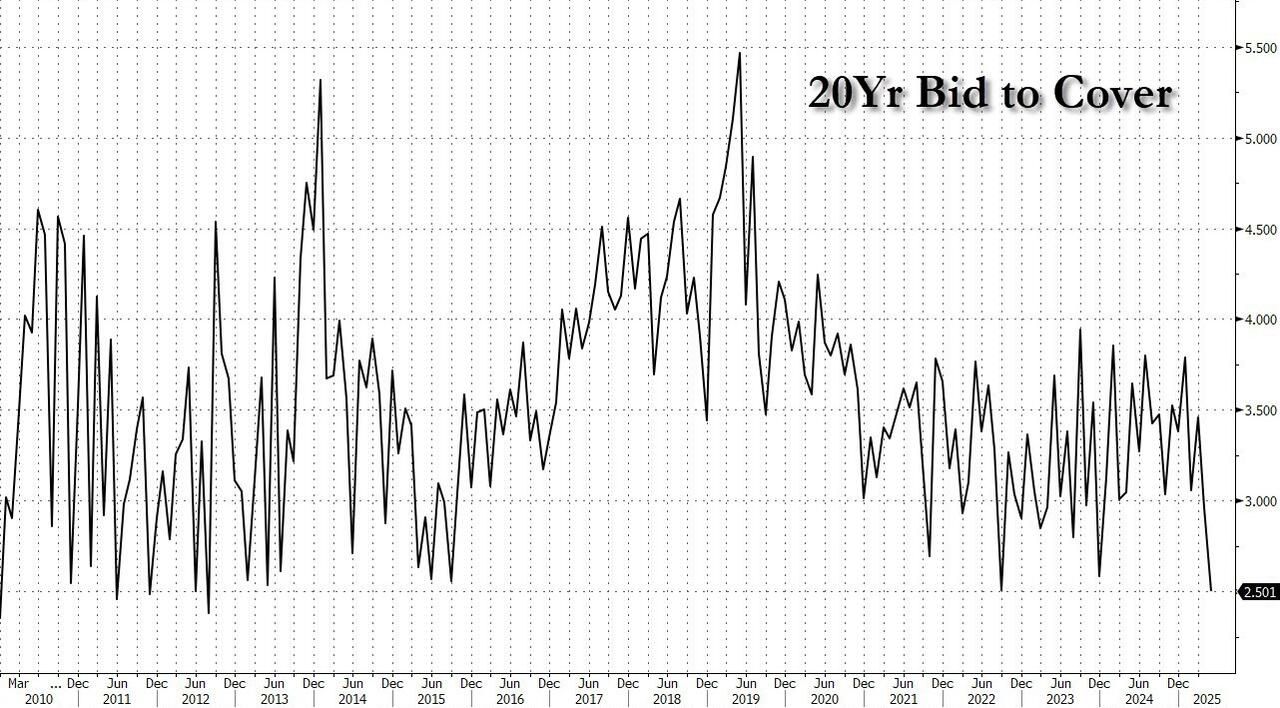
就在全世界都在密切关注美国国债是否会因穆迪下调评级暴跌时,真正的债券市场崩溃发生在地球另一边的日本。 日本20年期国债迎来自2012年以来最差拍卖,投标倍数跌至2.5倍,尾差飙升至1987年以来最高水平,这场债券灾难已经引发日本40年期国债收益率突破历史 高点,达3.59%。 随着日本央行量化紧缩(QT)计划受到质疑,投资者需警惕全球债券市场动荡可能引发的连锁反应,尤其是对持有日债、美债的机构投资者而言。 史诗级崩溃:日本债券拍卖惨败 日本财务省周二进行的1万亿日元(约69亿美元)20年期国债拍卖录得灾难性结果。投标倍数仅为2.5倍,远低于上月的2.96倍,创下自2012年以来的最低水 平。 更为震撼的是,尾差(Auction Tail,即平均价格与最低接受价格之间的差距)飙升至1.14,为1987年以来最高水平。 作为 债券拍卖的"温度计" ,尾差越大,意味着 市场需求极为低迷,买家基本不愿意接盘长期国债 。投资者对当前价格不买账,风险变高。 据媒体报道,日本央行本周将与市场参与者进行磋商,以评估其量化紧缩计划的进度。 国内政治因素也使日本央行关于量化紧缩政策的决定变得复杂。日本议员正在讨论是否需要减税或增 ...


美联储“隐秘”购债引关注,全球货币格局或生变
Huan Qiu Wang· 2025-05-20 06:26
美联储此举对部分新兴市场资产或构成利好,尤其是拉美等资源丰富、藏有实物资产的经济体。今年以来,iShares MSCI巴西ETF(EWZ)和 iShares拉美40 ETF(ILF)分别上涨约24%,凸显出从美元走软与商品价格上涨中受益的战略性配置。 分析认为,美联储的"静悄悄动作"或预示市场将有大动作。尽管QE通常提振美股,但在美元信任度下降、地缘政治紧张加剧背景下,黄金、比特 币和拉美市场或更具避险价值与盈利潜力,有望成为真正的"风暴避难所"。(陈十一) 【环球网财经综合报道】美联储近日悄然展开"隐秘操作",买入436亿美元美国国债,其中5月8日单日购入88亿美元30年长期美债,其余348亿美 元于上周早些时候完成。分析师认为,美联储虽称只是将到期债券本金再投资以避免资产负债表迅速缩小,未正式称其为量化宽松(QE),但实 质上买债行为难掩"隐形宽松"本质,如此操作并非其常规之举,买入规模亦不容小觑。 一些交易员已察觉此动态,精明投资者亦应予以关注,商品交易员对这类货币"障眼法"尤为敏感。 全球央行购金热潮持续。高盛数据显示,今年3月全球央行购金需求强劲,购入64吨黄金,中国为最大可识别买家,当月购入30吨 ...

全世界都盯着美债的时候,日本正在暴雷?
Hua Er Jie Jian Wen· 2025-05-20 06:14
就在全世界都在密切关注美国国债是否会因穆迪下调评级暴跌时,真正的债券市场崩溃发生在地球另一边的日本。 日本20年期国债迎来自2012年以来最差拍卖,投标倍数跌至2.5倍,尾差飙升至1987年以来最高水平。这场债券灾难已经引发日本40年期国债收益率突破历 史高点,达3.59%。随着日本央行量化紧缩(QT)计划受到质疑,投资者需警惕全球债券市场动荡可能引发的连锁反应,尤其是对持有日债、美债的机构投资 者而言。 史诗级崩溃:日本债券拍卖惨败 日本财务省周二进行的1万亿日元(约69亿美元)20年期国债拍卖录得灾难性结果。投标倍数仅为2.5倍,远低于上月的2.96倍,创下自2012年以来的最低水 平。 更为震撼的是,尾差(Auction Tail,即平均价格与最低接受价格之间的差距)飙升至1.14,为1987年以来最高水平。 "结果比我预期的还要糟糕。30年和40年期债券因财政扩张风险和流动性下降而遭到抛售,但市场条件恶化现已蔓延至此前相对稳定的20年期债 券。" 作为债券拍卖的"温度计",尾差越大,意味着市场需求极为低迷,买家基本不愿意接盘长期国债。投资者对当前价格不买账,风险变高。 这场债市惨败立即引发日本国债期货 ...
三十年“激进主义”或将终结 美联储或将迎来时代转折
智通财经网· 2025-05-15 22:25
Core Viewpoint - The recent Hoover Institution conference at Stanford University highlighted the challenges facing the Federal Reserve in achieving its inflation target of 2% while gradually lowering interest rates, suggesting that this "mission" may never be fully accomplished and indicating a potential redefinition of the Fed's role in the future [1][2]. Group 1: Federal Reserve's Evolving Role - The Federal Reserve has transitioned from a mere monetary policy maker to a "super central bank" that actively intervenes in crises, a role it has played for the past 30 years [1]. - There is a growing consensus that the era of aggressive Fed intervention is nearing its end, with future policies expected to be more restrained and limited [1][3]. - Criticism has emerged regarding the Fed's current policy tools and theoretical frameworks, with calls for a focus on ensuring monetary predictability to support economic contracts rather than solely controlling inflation [1][2]. Group 2: Critiques and Recommendations - Harvard professor Jason Furman criticized the Fed for its "confused framework" and urged for clearer, more predictable rules instead of reactive measures [2]. - Cleveland Fed's new president, Loretta Mester, suggested a reevaluation of the Fed's balance sheet and the long-term impacts of quantitative easing and tightening policies [2]. - Concerns were raised about the brevity of current policy decision memos, which may lead to market instability due to excessive speculation on Fed Chair Jerome Powell's statements [2]. Group 3: Future Leadership and Policy Directions - Powell's term is set to end in May next year, with speculation that his successor may be Kevin Walsh, who advocates for a less interventionist Fed focused solely on inflation control [3]. - Another potential successor, Michelle Bowman, also leans towards a more lenient regulatory stance, indicating a shift within the Fed [3]. - The Fed is expected to release a new policy framework review this summer, but skepticism exists regarding its effectiveness before leadership changes occur [3]. Group 4: Economic Outlook - Under Walsh's potential leadership, the Fed may adopt a more restrained approach, which could leave it "under-armed" in the event of a future financial crisis [4]. - Furman noted that the economy is entering a new phase, raising doubts about whether inflation can decrease further even without new tariffs from Trump [4].
关税大降,又到AII IN美股了?
美股研究社· 2025-05-15 11:02
以下文章来源于海豚投研 ,作者海豚君 海豚投研 . 有灵魂的思考、有态度的研究。 来源 | 海豚投研 从4月2日的对等关税解放日到5月12日,经过一个多月的中美关税互相拉扯,5月12日,中美终于 给出了一个令人松口气的谈判结果——美国对中国征收30%的关税,另外24%暂缓90天执行;中 国对美国征收10%的关税,另外24%暂缓90天执行。 这个结果,无论是对中美双方如何,对于资本市场是一个显著的利好,但现在的问题是,是不是 说美股风险就可以消除了,美股能够继续疫情大放水后的辉煌时代,人们又可以ALL IN 美股了 吗? 这 下 , 所 有 人 都 赢 麻 了 ? 按照中美最新贸易谈判公告,等于一通互撕之后,双方都回到了4月2日,也就是解放日当天的关 税上,而2号之后互扔刀子的税率——50%、41%全都取消了。 围绕4月2日美国一键拉出的对华34%的对等关税,10%保留,剩下24%暂缓90天执行;中国也是 同样:保留10%的对美关税,其余24%暂缓90天执行。 4月2日之前,重新上任的特朗普,还以美国以芬太尼为由,对中国所有商品2、3月份连续两次加 征关税,每次加征10%,两次累计20%。 美 国 关 税 到 ...

格局已定?美元走向长期贬值!
Hua Er Jie Jian Wen· 2025-05-15 03:45
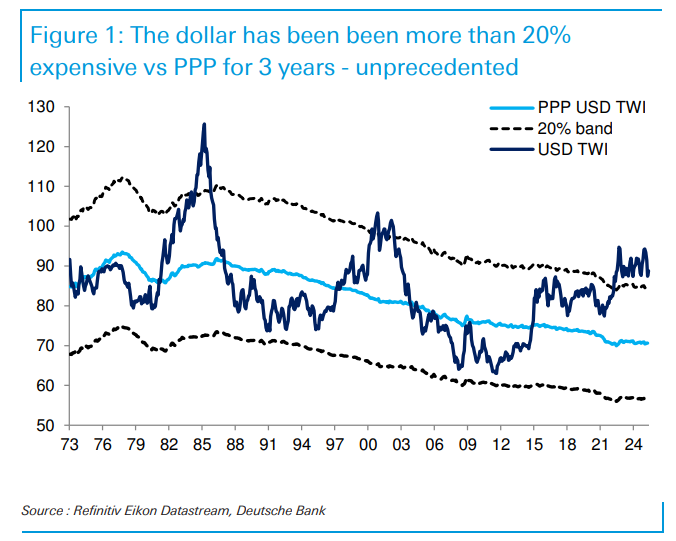
多重极端因素累加,美元势将走向长期贬值! 据追风交易台消息,德意志银行在最新研报中称,在市场经历了为期六周的动荡期后,尽管关税前景趋于温和,但对美元前景的看法仍保持长期看跌立 场。 报告指出,最近的政策和市场波动可能已经足够令人担忧,促使投资者重新考虑在美国的投资。这本身对美元来说并不是一个大问题,但当前的极端估值 和仓位使美元特别容易受到冲击。 此外,德意志银行还指出,财政政策变化可能导致德国发债规模扩大,改变美债在全球安全资产中的主导地位。这也不利于美元的走势。 极端估值、仓位、财政政策变化=美元长期贬值 报告指出,美元估值已处于历史极端水平。数据显示,美元已连续三年相对购买力平价(PPP)高估超过20%,这在历史上前所未有。 与此同时,美国经常账户赤字正在扩大,进一步加剧了对美元高估的担忧。 报告还强调,美国股票估值相比全球其他市场也达到了历史高点,几个月前的市盈率溢价高达60%。 数据还显示,外国投资者对美股的持仓已经超过历史平均水平。 最后,德意志银行的研究显示,由于美国发债规模大且量化宽松(QE)力度小于欧洲央行,美国提供了远超欧元区的安全政府债券供应量,实际上是欧元区 的三倍以上。 这为全球投资 ...

1971年戴维营的隐秘豪赌:一场颠覆你钱包的54年金融暗战
Sou Hu Cai Jing· 2025-05-08 08:58
Core Viewpoint - The article discusses the significant financial transformation initiated by President Nixon's decision to decouple the US dollar from gold in 1971, marking a pivotal moment in monetary history that has led to long-term economic consequences. Group 1: Historical Context - The seeds of this monetary revolution were sown as early as 1933 when President Roosevelt confiscated gold from the public, leading to a public outcry and the declaration of the "death of the free dollar" [3] - The critical turning point occurred in 1971 during the Cold War when the US gold reserves were rapidly depleting, prompting Nixon to announce the permanent decoupling of the dollar from gold [3] Group 2: Immediate Consequences - Following the decoupling, the price of gold surged past $40 within 72 hours, and the Federal Reserve's gold reserves were significantly compromised, with a 2012 audit revealing that 60% of the gold in Fort Knox was actually tungsten [3][4] - The US government began an aggressive money printing strategy, leading to a dramatic increase in national debt from $398 billion in 1971 to $36 trillion, resulting in each newborn in the US being burdened with $220,000 in debt [4] Group 3: Socioeconomic Impact - The financial policies post-decoupling have exacerbated wealth inequality, with the top 1% of Americans now holding more wealth than the entire middle class [6] - The 2008 financial crisis highlighted the disparity, as the legal fees for bankruptcy cases soared while blue-collar workers faced severe economic hardships [6] Group 4: Technological and Cultural Shifts - The emergence of Bitcoin in the aftermath of the 2008 crisis serves as a critique of the failed monetary system established in 1971, with its characteristics of being decentralized and immutable standing in stark contrast to the Federal Reserve's practices [6] - The decision by El Salvador to adopt Bitcoin as legal tender reflects a historical irony, as it ties back to Nixon's announcement of the dollar's detachment from gold [6]