
产能过剩

Search documents
行业产能过剩 万凯新材主动调减PET生产计划
Zheng Quan Shi Bao Wang· 2025-07-03 12:48
Group 1 - Wan Kai New Materials plans to orderly reduce PET production and conduct equipment maintenance, affecting 600,000 tons of PET capacity, which accounts for 20% of the company's total capacity [1] - The reduction is a response to industry overcapacity and losses, with peers also deciding to limit production to reduce inventory [1][4] - The company reported a loss last year due to intensified competition and a more than 30% decline in average processing fees, despite stable sales volume [1] Group 2 - In May, China Resources Materials indicated that PET capacity is expected to remain in phase overcapacity until 2025, focusing on cost reduction and quality improvement [2] - The polyester bottle chip capacity is projected to increase from 16.61 million tons at the end of 2023 to 20.43 million tons, a nearly 23% year-on-year increase [3] - Wan Kai New Materials is expanding its overseas capacity with a 300,000-ton production base in Nigeria and plans for a 750,000-ton base in Indonesia [3] Group 3 - In 2024, the company's overseas business revenue reached 6.239 billion yuan, a year-on-year increase of 11.61%, accounting for 36.21% of total revenue [4] - Major companies, including Hainan Yisheng and China Resources Materials, have announced production halts to address domestic overcapacity and optimize resource allocation [4]
中国焚烧厂,高价抢垃圾
Hu Xiu· 2025-07-02 07:21
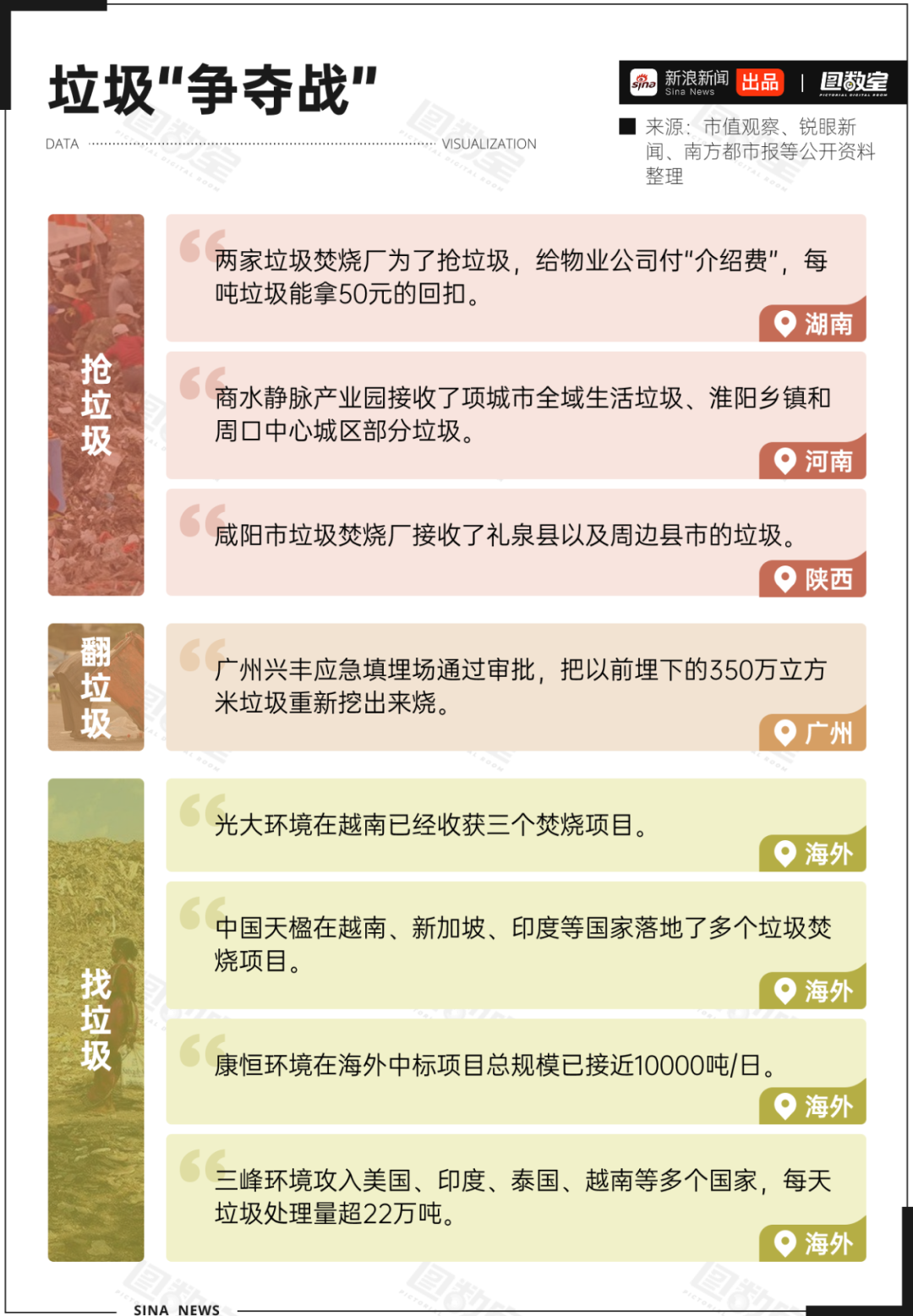
Core Insights - The Chinese waste incineration industry is facing a "garbage shortage," with many facilities forced to excavate old landfills or purchase waste at high prices to maintain operations [1][6][11] - Despite having the highest waste incineration capacity globally, with a daily capacity of 1.11 million tons, the industry is experiencing significant underutilization, with an average load rate of only 60% and 40% of capacity idle [2][5][20] - The rapid expansion of incineration capacity has led to a disconnect between capacity and actual waste processing, resulting in over 83,467 days of planned shutdowns in 2023 [5][12][20] Industry Overview - China's waste incineration capacity has increased dramatically, with the number of incineration plants growing nearly ninefold and processing capacity increasing 16 times over the past 13 years [20][18] - The shift from "garbage encirclement" to "garbage shortage" reflects a significant change in the waste management landscape, with incineration becoming the dominant method of waste disposal, rising from 32.51% in 2014 to 82.49% in 2023 [15][3] - The industry is characterized by a concentration of facilities in eastern regions, leading to imbalances in waste availability and further exacerbating the "garbage shortage" [21][23] Competitive Dynamics - A "garbage competition" has emerged among incineration plants, with some facilities offering incentives to waste management companies to secure waste [6][7] - Companies are also looking overseas for waste, with several firms establishing incineration projects in countries like Vietnam, Singapore, and India [7][6] - The practice of "co-firing" involves mixing other combustible waste with municipal solid waste to optimize incineration capacity and reduce disposal costs [8] Economic Factors - The waste incineration industry is highly profitable, with revenue streams from waste disposal fees, electricity sales, and government subsidies [27][30] - The average gross profit margin for established companies can range from 30% to 50%, supported by a stable operational cost structure and long-term contracts [31][30] - Despite the apparent profitability, the industry faces challenges in addressing overcapacity without resorting to artificially increasing waste generation [34][11]

甲醇聚烯烃早报-20250702
Yong An Qi Huo· 2025-07-02 01:35
甲醇聚烯烃早报 研究中心能化团队 2025/07/02 甲 醇 日期 动力煤期 货 江苏现货 华南现货 鲁南折盘 面 西南折盘面 河北折盘 面 西北折盘 面 CFR中国 CFR东南 亚 进口利润 主力基差 盘面MTO 利润 2025/06/2 5 801 2640 2518 2480 2600 2470 2590 285 346 155 250 -1189 2025/06/2 6 801 2760 2505 2480 2600 2460 2580 286 347 258 340 -1243 2025/06/2 7 801 2820 2505 2460 2600 2460 2580 282 350 267 400 -1176 2025/06/3 0 801 2785 2485 2430 2600 2445 2543 280 350 220 350 -1173 2025/07/0 1 801 2520 2480 2430 2550 2445 2543 280 350 220 90 -1208 日度变化 0 -265 -5 0 -50 0 0 0 0 0 -260 -35 塑 料 日期 东北亚乙 烯 华北LL 华东 ...
市场主流观点汇总-20250701
Guo Tou Qi Huo· 2025-07-01 11:41
Report Summary 1. Report Industry Investment Rating No information provided regarding the report industry investment rating. 2. Core View of the Report The report aims to objectively reflect the research views of futures companies and securities companies on various commodity varieties, track hot - spot varieties, analyze market investment sentiment, and summarize investment driving logics. It is based on the publicly - released research reports of institutions in the current week, and the closing price data is from last Friday, with the weekly change calculated as the change in the closing price from the previous Friday [2]. 3. Summary by Relevant Catalogs 3.1行情数据 - **Commodities**: From June 23 to June 27, 2025, commodities such as coke, copper, and iron ore had price increases, with coke rising 2.67%, copper rising 2.47%, and iron ore rising 1.92%. Commodities like corn, gold, and palm oil had price decreases, with corn falling 1.04%, gold falling 1.56%, and palm oil falling 1.87%. Crude oil had a significant drop of 12.02% [3]. - **A - shares**: During the same period, the CSI 500 rose 3.98%, the SSE 50 rose 1.27%, and the CSI 300 rose 1.95% [3]. - **Overseas Stocks**: The Nikkei 225 rose 4.55%, the Nasdaq Index rose 4.25%, and the S&P 500 rose 3.44% [3]. - **Bonds**: The 5 - year Chinese Treasury bond rose 0.64%, the 10 - year Chinese Treasury bond rose 0.30%, and the 2 - year Chinese Treasury bond rose 0.19% [3]. - **Foreign Exchange**: The euro - US dollar exchange rate rose 1.69%, the US dollar index fell 1.52%, and the US dollar central parity rate fell 0.09% [3]. 3.2大宗商品观点汇总 3.2.1宏观金融板块 - **Stock Index Futures**: Among 8 institutions' views, 2 were bullish, 1 was bearish, and 5 were for a sideways market. Bullish factors included rising Fed rate - cut expectations, a low risk - premium rate of the CSI 300, increased issuance of equity - oriented public funds, and sufficient bottom - supporting funds. Bearish factors included short - term difficulty in improving corporate fundamentals, the central bank's change in monetary policy stance, and over - heated market sentiment [4]. - **Treasury Bond Futures**: Among 7 institutions' views, 3 were bullish, 1 was bearish, and 3 were for a sideways market. Bullish factors included net liquidity injection by the central bank, weak credit and inflation data, and strong demand for bond allocation. Bearish factors included the central bank's change in monetary policy stance, the stock - bond seesaw effect, and rising long - term interest rates [4]. 3.2.2能源板块 - **Crude Oil**: Among 9 institutions' views, 3 were bullish, 2 were bearish, and 4 were for a sideways market. Bullish factors included falling US and Cushing crude oil inventories, reduced Russian exports, and geopolitical tensions. Bearish factors included the decline in geopolitical premiums, expected OPEC production increases, and weak terminal demand [5]. - **Eggs**: Among 8 institutions' views, 2 were bullish, 2 were bearish, and 4 were for a sideways market. Bullish factors included postponed peak - season stocking, approaching stocking season, potential egg - price increases, and reduced supply due to heat. Bearish factors included limited decline in laying - hen inventory, high chick - replenishment volume, high new - production capacity, and postponed downstream stocking [5]. 3.2.3有色板块 - **Copper**: Among 7 institutions' views, 5 were bullish, 0 were bearish, and 2 were for a sideways market. Bullish factors included rising Fed rate - cut expectations, improved risk appetite, and falling global visible inventories. Bearish factors included the substitution effect of recycled copper, weakening downstream procurement, and weakening terminal demand [6]. - **Methanol**: Among 7 institutions' views, 0 were bullish, 1 was bearish, and 6 were for a sideways market. Bullish factors included limited port - available goods, expected low port inventories, and increased downstream demand. Bearish factors included expected increases in Iranian imports, port inventory accumulation, potential MTO device maintenance, and a loosening supply - demand pattern [6]. 3.2.4贵金属 - **Gold**: Among 7 institutions' views, 4 were bullish, 1 was bearish, and 2 were for a sideways market. Bullish factors included rising Fed rate - cut expectations, a downward trend in real interest rates, and the strengthening of gold's safe - haven property. Bearish factors included reduced safe - haven demand, capital flowing to risky assets, and technical - level sell - offs [7]. 3.2.5黑色板块 - **Iron Ore**: Among 8 institutions' views, 2 were bullish, 2 were bearish, and 4 were for a sideways market. Bullish factors included increased molten - iron production, expected decline in overseas shipments, and improved macro sentiment. Bearish factors included rising port inventories, increased global shipments, weakening demand for five major steel products, and narrowing basis [7].
期货收评:集运午后急速拉升 一度涨超8%!黑色建材集体走低
news flash· 2025-07-01 07:03
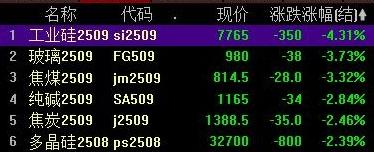
Group 1: Market Performance - The black building materials sector collectively declined, with glass and焦煤 falling over 3% [1][6] - Industrial silicon and polysilicon also saw significant drops, with industrial silicon down over 4% [1][8] - The European shipping main contract surged over 8%, breaking through 1900 points, indicating a recovery in shipping rates [3][5] Group 2: Supply and Demand Dynamics - The SCFI-Europe index rose significantly, reflecting a recovery in market shipping rates, with a 9.6% increase to 2123.24 points [5] - Supply and demand fundamentals are impacting the market, with expectations of a decline in cargo volume in Q3 after a summer inventory build-up [5][7] - The end of supply disruptions in焦煤 is expected to lead to further price declines, as steel demand weakens during the off-season [6][7] Group 3: Industrial Silicon Insights - Industrial silicon prices have seen a significant drop, with a current price of 7790 yuan/ton, and a recent decline of over 4% [8][9] - Production of industrial silicon is expected to increase in July, particularly in regions like Sichuan and Yunnan, but uncertainty remains regarding overall production levels [8][9] - Analysts suggest that the current price levels are close to historical lows, but the core issue remains overcapacity in the market [9]
汽车行业破解“内卷”要找准方向
Zhong Guo Chan Ye Jing Ji Xin Xi Wang· 2025-06-30 22:25
Core Viewpoint - The domestic automotive industry is experiencing an intensified "price war" that has lasted over two years, with significant price reductions leading to widespread industry repercussions [1][2]. Group 1: Price War Dynamics - In May, several leading companies initiated limited-time promotions, with some models seeing price cuts exceeding 50,000 yuan, prompting many manufacturers to follow suit [1]. - Over 60 models had price reductions in the first four months of the year, with the number exceeding 100 in May alone [1]. - The China Association of Automobile Manufacturers and other industry organizations have called for an end to disorderly price competition, urging companies to adhere to market rules and engage in rational competition [1]. Group 2: Impact on Profitability - The automotive industry is facing a "vicious cycle" where increased sales do not translate into higher profits, with profit margins dropping from 5.7% in 2022 to 4.1% by April 2023, and further declining to below 4% in May [2]. - This decline in profitability contrasts sharply with the previous years when profit margins were around 7% [2]. - Many manufacturers are experiencing sustained pressure on profitability, with some dealers caught in a "volume increase but profit decrease" scenario [2]. Group 3: Market Conditions and Challenges - The automotive market in China has transitioned from a phase of rapid growth to one of saturation, leading to intensified competition among a large number of manufacturers [3]. - The forecast for 2024 indicates a sales volume of 31.436 million units, representing a 4.5% year-on-year growth, which is below the average growth rate of 6% over the past decade [3]. - The industry is characterized by low market concentration and an excess of operational entities, which hampers innovation and leads to a lack of competitive differentiation [3]. Group 4: Solutions and Recommendations - To address the "involution" in the industry, companies must focus on reducing excess capacity and enhancing innovation capabilities [4]. - Automotive firms are encouraged to invest more in technology research and development to create high-value innovative products and pursue differentiation strategies [4]. - Government agencies should strengthen price regulation, standardize pricing behaviors, and implement policies that promote innovation and guide companies towards healthy competition and industry restructuring [4].
能化延续偏弱对待
Tian Fu Qi Huo· 2025-06-30 14:14
Group 1: Report Industry Investment Rating - The report suggests a generally bearish outlook for the energy and chemical sector, indicating a weak stance towards the industry [1] Group 2: Core Viewpoints of the Report - The energy and chemical sector should be treated with a weak outlook Overall, most products in the sector are recommended to hold short - positions based on fundamental and technical analyses [1][3] Group 3: Summary by Variety Crude Oil - Logic: After the end of the Israel - Iran conflict, geopolitical premiums were quickly squeezed out. Fundamentally, it is strong in the short - term due to low inventory but has a strong expectation of medium - term oversupply under the OPEC+ production increase cycle [2] - Technical Analysis: Daily - level medium - term oscillation, hourly - level short - term decline. Today, it oscillated with reduced positions, and the short - cycle center of gravity slowly moved down. The short - term resistance level is temporarily seen at 512. The strategy is to hold short positions on the hourly cycle [4] Styrene (EB) - Logic: Styrene production remains at a high level, demand is weak in the off - season, inventory is neutral, and there is an expectation of a significant increase in production capacity with new plant launches in the medium term [7] - Technical Analysis: Hourly - level short - term decline. Today, it oscillated intraday without changing the downward path. After a large gap reversal, the short - term resistance is not standard, and temporarily focus on 7340. The strategy is to hold short positions on the hourly cycle [7] Rubber - Logic: In May, Thailand's exports of mixed rubber increased by 144% year - on - year, and China's rubber imports also increased significantly. Coupled with the sharp drop in the price of rubber latex in the Thai production area, the expectation of increased supply is gradually being realized. The tire industry is in an overall oversupply situation, and the inventory of semi - steel tires has reached a historical high. The downstream demand expectation remains pessimistic [9] - Technical Analysis: Daily - level medium - term decline, hourly - level decline. Today, it tested the resistance and then declined with reduced positions, still on a downward path. The strategy is to hold short positions on the hourly cycle, with a stop - loss reference at 14100 [9] Synthetic Rubber (BR) - Logic: The fundamentals of synthetic rubber are extremely weak. In addition to the weak demand expectation in the tire sector, there will be a large amount of production capacity put into operation for raw material butadiene plants this year. Currently, the operating rates of butadiene and cis - polybutadiene rubber have reached historical highs, and there is a logic of cost collapse in the later stage [12] - Technical Analysis: Daily - level medium - term decline, hourly - level short - term decline. Today, it rose and then fell, oscillating intraday without changing the downward path. The short - term resistance level is temporarily focused on 11670. The strategy is to hold short positions on the hourly cycle [12] PX - Logic: Profit has been repaired, some PX plants have resumed production, and the operating rate has increased. The polyester demand is weak, but the short - term fundamentals are not weak due to ongoing destocking [14] - Technical Analysis: Hourly - level short - term decline. Today, it rose and then fell, remaining in a downward structure after failing to break through the resistance. The short - term resistance is temporarily focused on 6870. The strategy is to hold short positions on the hourly cycle [14] PTA - Logic: There is an expectation of reduced production in the polyester industry in July, but the PTA operating rate has declined due to tight PX inventory. There are not many short - term fundamental contradictions [18] - Technical Analysis: Hourly - level short - term decline. Today, it rose and then fell, remaining in a downward structure after failing to break through the resistance. The short - term resistance is temporarily focused on 4840. The strategy is to hold short positions on the hourly cycle [18] PP - Logic: The number of maintenance plants has increased, and the PP operating rate has declined. However, the newly added production capacity has gradually increased recently, so the supply expectation is not weak. Demand is still weak in the off - season, and the short - term fundamentals are bearish [20] - Technical Analysis: Hourly - level short - term decline. Today, it declined with reduced positions, continuing the weak trend. The short - term resistance is temporarily focused on 7290. The strategy is to hold short positions on the hourly cycle [20] Methanol - Logic: The domestic weekly methanol operating rate is 78.1%, reaching a new high in the past five years, and the supply remains high. With the end of the Israel - Iran conflict, the previously shut - down plants in Iran will quickly resume production, and the import expectation is still strong. Supply is high, demand is weak in the off - season, and the fundamentals are bearish [22] - Technical Analysis: Daily - level medium - term decline. Today, it declined with reduced positions without changing the downward path. The short - term resistance is temporarily focused on 2510. The strategy is to hold short positions on the hourly cycle [22] PVC - Logic: The supply - side operating rate is at a historical median, and the supply is the same as the same period last year. The downstream terminal demand is still weak, and the operating rate remains at the lowest level in the same period. The fundamentals are bearish [25] - Technical Analysis: Daily - level medium - term decline, hourly - level short - term decline. Today, it tested the resistance and then rose and fell. There is an opportunity to enter a short position on the hourly cycle, with a stop - loss reference at 4955 [25] Ethylene Glycol (EG) - Logic: The maintenance plants on the supply side will gradually resume production, and the polyester operating rate on the demand side has declined. The short - term fundamentals have weakened [28] - Technical Analysis: Daily - level medium - term decline, hourly - level short - term decline. Today, it oscillated intraday, and the short - term resistance is 4345. The strategy is to hold short positions on the hourly cycle [28] Plastic - Logic: There is pressure from large - scale plant launches in the medium term, and the expectation of increased supply is large. The medium - term view is bearish [30] - Technical Analysis: Daily - level medium - term decline, hourly - level decline. Today, it oscillated intraday, and the resistance is temporarily focused on 7450. The strategy is to hold short positions on the hourly cycle [30]
激荡三十年,锂电老牌霸主欣旺达何以持续穿越产业周期|深度
24潮· 2025-06-29 22:23
Core Viewpoint - The article highlights the significant evolution of the lithium battery industry over the past 30 years, emphasizing the stability and growth of the company XINWANDA (300207.SZ) amidst industry challenges and cycles [1][2]. Company Overview - XINWANDA has shown remarkable resilience, with revenue growth from 489 million yuan in 2008 to 56.02 billion yuan in 2024, marking a 113.56-fold increase over 17 years [2]. - The company has never reported a loss in 17 years and has maintained positive net profit growth for nearly 12 years [2]. - In Q1 2024, XINWANDA achieved record revenue and profit, with a gross margin reaching the highest point in nearly 13 years [2]. Business Development - Founded by Wang Mingwang and his cousin Wang Wei, XINWANDA initially focused on OEM and ODM models before entering the supply chains of major companies like Philips and Apple [8][10]. - The company has successfully transitioned from consumer electronics batteries to power and energy storage batteries, establishing a dual-wing development strategy [8][18]. Market Position - XINWANDA is the global leader in consumer batteries, holding a 30% market share in mobile phone batteries, and is positioned as the second-largest player in the mobile battery market after ATL [15][18]. - The company has made significant strides in the power battery sector, with revenue from electric vehicle batteries rising from 2.93 billion yuan in 2021 to 15.14 billion yuan in 2024, accounting for 27.02% of total revenue [23]. Financial Performance - In Q1 2024, the power business generated 3.3 billion yuan in revenue, with a year-on-year growth of 20% [26]. - The company’s energy storage business contributed 1.889 billion yuan in revenue in 2024, reflecting a 70.19% increase [29]. Global Expansion - XINWANDA has established a strong international presence, with overseas revenue accounting for approximately 42.58% of total revenue from 2008 to 2024, and consistently exceeding 20 billion yuan since 2022 [40][39]. - The company is expanding its production capabilities in Vietnam, Hungary, Morocco, and Thailand to enhance its global footprint [43][44]. Challenges and Strategic Adjustments - The company faces challenges due to over-reliance on consumer batteries and intense competition in the power battery market, leading to a decline in gross margins [48]. - XINWANDA has initiated a split IPO plan for its power battery platform to address funding pressures, with significant investments planned for future growth [49][50].


嘉元科技: 广东嘉元科技股份有限公司2025年主体信用评级报告
Zheng Quan Zhi Xing· 2025-06-27 16:31
Core Viewpoint - Guangdong Jiayuan Technology Co., Ltd. is a leading enterprise in the electrolytic copper foil industry, with significant scale advantages and stable customer relationships, but faces challenges due to industry overcapacity and fluctuating profitability [2][3][4]. Advantages - Jiayuan Technology is a top-tier player in the electrolytic copper foil industry, with production capacity exceeding 110,000 tons per year by the end of 2024, and production and sales have been growing, reaching 67,000 tons and 67,700 tons respectively in 2024 [2]. - The company maintains high R&D investment, with a focus on ultra-thin electrolytic copper foil products, achieving mass production of 5μm and 4.5μm products, and mastering the core technology for 3.5μm products [2]. - Jiayuan has established stable long-term relationships with key customers, with sales to major clients accounting for over 65% of total sales from 2022 to 2024 [2]. - The company has a robust capital structure and smooth financing channels, with a debt-to-asset ratio of 45.98% and a total debt capitalization ratio of 40.45% by the end of 2024 [2]. Concerns - The company's profitability has been unstable, with significant losses in 2024 due to declining processing fees for electrolytic copper foil; however, it turned a profit in Q1 2025, albeit at a low level [2][3]. - The electrolytic copper foil industry is experiencing overall overcapacity and intense competition, leading to a decline in processing fees and profitability across the sector [3]. - Jiayuan's diversification efforts into copper wire sales, photovoltaic energy storage, and new materials are still under observation, with only the copper wire business achieving a certain scale by the end of 2024 [3]. - The company's information disclosure and regulatory compliance have room for improvement, as it has faced multiple regulatory measures in recent years [3]. Industry Comparison - Compared to peer companies, Jiayuan Technology has higher product sales and revenue scale, but all companies in the comparison group reported losses in 2024; Jiayuan's debt ratios are lower, indicating stronger short-term solvency [4][6]. - In 2024, Jiayuan's copper foil production and sales reached 67,000 tons and 67,700 tons, ranking second among comparable companies [4]. - The company has a high customer concentration, with over 80% of sales coming from its top five customers in 2024, significantly higher than its peers [4][6]. Business Status - Jiayuan Technology is a significant player in the electrolytic copper foil industry, with a focus on R&D, manufacturing, and sales of various copper foil products, primarily lithium battery copper foil [14]. - The company has seen a recovery in the electrolytic copper foil market in Q1 2025, achieving a revenue of 1.981 billion yuan, a year-on-year increase of 113% [14][16]. - Jiayuan's copper foil products are primarily used in lithium-ion batteries, with over 90% of its copper foil business revenue coming from lithium battery copper foil from 2022 to 2024 [13][14]. Production Capacity - By the end of 2024, Jiayuan's total copper foil production capacity reached over 110,000 tons, with plans to expand to over 200,000 tons by 2029 [19][20]. - The company has multiple production bases across the country, with a significant portion of sales concentrated in East, South, and Southwest China, accounting for over 90% of copper foil sales in 2024 [18][19]. Customer Base - Jiayuan's largest customer is Ningde Times, accounting for over 60% of its copper foil sales, with total sales to this customer reaching 4.292 billion yuan in 2024 [21].

甲醇聚烯烃早报-20250627
Yong An Qi Huo· 2025-06-27 02:26
甲醇聚烯烃早报 研究中心能化团队 2025/06/27 甲 醇 日期 动力煤期 货 江苏现货 华南现货 鲁南折盘 面 西南折盘面 河北折盘 面 西北折盘 面 CFR中国 CFR东南 亚 进口利润 主力基差 盘面MTO 利润 2025/06/2 0 801 2750 2665 2525 2700 2480 2600 296 346 195 210 -1445 2025/06/2 3 801 2735 2643 2543 2700 2480 2633 295 346 171 210 -1350 2025/06/2 4 801 2635 2510 2510 2600 2480 2615 285 346 160 240 -1163 2025/06/2 5 801 2640 2518 2480 2600 2470 2590 285 346 160 250 -1189 2025/06/2 6 801 2640 2518 2480 2600 2460 2580 285 346 160 340 -1243 日度变化 0 0 0 0 0 -10 -10 0 0 0 90 -54 观点 高进口开始兑现,累库开始发生,盘面低估值, ...