均衡配置

Search documents
中信期货晨报:国内商品期货多数下跌,农副产品跌幅居前-20251105
Zhong Xin Qi Huo· 2025-11-05 05:18
1. Report Industry Investment Rating No information provided in the given content. 2. Core Viewpoints of the Report - Overseas macro: The Fed cut interest rates by 25 basis points to 3.75%–4.00% in October and will end balance - sheet reduction in December, transitioning the liquidity environment from contraction to stability [6]. - Domestic macro: Domestic policy support has been strengthened, and economic resilience has been maintained. The manufacturing industry slowed down in October, but the construction and service industries continued to expand. Investment repair accelerated, and the economy continued to stabilize [6]. - Asset views: With policy announcements, risk appetite has improved, and a balanced allocation strategy is maintained. Liquidity improvement and eased Sino - US economic and trade relations will benefit equity assets, especially in technology, independent manufacturing, and innovation. However, short - term policy benefits have been fully priced, and the stock index may fluctuate. In the medium term, the equity market has upward momentum. A "balanced allocation, structural offensive" strategy is recommended [6]. 3. Summary by Related Catalogs 3.1 Macro Highlights - Overseas: The Fed's actions in October aimed at risk management, balancing growth and liquidity stability [6]. - Domestic: Policy orientation emphasized economic construction. Although the manufacturing PMI declined in October, the economy showed resilience with investment repair [6]. - Assets: A balanced allocation strategy is suggested. Non - ferrous metals, black commodities, bonds, and precious metals have different performance characteristics and investment opportunities [6]. 3.2 Viewpoint Highlights 3.2.1 Financial Sector - Stock index futures: Catalyzed by technology events, the growth style is active, and it is expected to rise with fluctuations [7]. - Stock index options: Market turnover has slightly declined, and it is expected to move sideways [7]. - Treasury bond futures: The bond market remains weak, and it is expected to move sideways [7]. 3.2.2 Precious Metals - Gold and silver: Due to geopolitical and economic - trade easing, precious metals are in a phased adjustment, and are expected to move sideways [7]. 3.2.3 Shipping - Container shipping to Europe: The peak season has passed, and there is no upward driving force. It is expected to move sideways [7]. 3.2.4 Black Building Materials - Steel products: With limited fundamental support, the price is under pressure. It is expected to move sideways [7]. - Iron ore: Port inventory is accumulating rapidly, and it is expected to move sideways [7]. - Coke: Cost support is strengthening, and a third price increase may be implemented. It is expected to move sideways [7]. - Coking coal: Supply is tight, and the spot price is rising. It is expected to move sideways [7]. 3.2.5 Non - ferrous Metals and New Materials - Copper: Due to renewed trade frictions, the copper price has declined in the short term. It is expected to move sideways [7]. - Aluminum: Inventory has decreased, and the aluminum price is expected to rise with fluctuations [7]. 3.2.6 Energy and Chemicals - Crude oil: Supply pressure persists, and it is expected to move sideways [9]. - LPG: Supply is excessive, and it is expected to move sideways [9]. - Asphalt: With the decline of crude oil and rebar prices, it is expected to decline with fluctuations [9]. - Ethylene glycol: Supply surplus expectations suppress the price, and it is expected to decline with fluctuations [9]. 3.2.7 Agriculture - Oils and fats: After rising and then falling, it is expected to decline with fluctuations [9]. - Protein meal: The crushing profit is being repaired, and it is expected to move sideways [9].
今日晨报 | 政策靴子落地,维持均衡配置
Sou Hu Cai Jing· 2025-11-03 01:01
Group 1 - The Federal Reserve has cautiously lowered interest rates by 25 basis points to a range of 3.75%–4.00% and announced the end of balance sheet reduction starting in December, indicating a transition from a tightening to a stable liquidity environment [1] - Domestic policies are strengthening to support the economy, with the Fourth Plenary Session and the "14th Five-Year Plan" emphasizing "technological self-reliance, reducing involution, and expanding domestic demand," while maintaining a focus on economic construction [1] - The October PMI dropped to 49.0%, indicating a short-term slowdown in manufacturing, but construction and services sectors continue to expand, supported by the accelerated implementation of policy financial tools and special bonds [1] Group 2 - Market sentiment is improving due to the Federal Reserve's rate cut and end of balance sheet reduction, along with positive outcomes from the US-China summit and the release of specific content from the Fourth Plenary Session and the "14th Five-Year Plan" [2] - The marginal improvement in liquidity and the easing of US-China trade relations are expected to benefit domestic and foreign equity assets, particularly in technology, self-manufacturing, and innovation sectors [2] - A balanced allocation strategy is recommended, with non-ferrous metals expected to perform well due to the technology cycle and trade recovery, while black commodities may see a phase of rebound supported by policy expectations and valuation recovery [2]
沪指时隔十年再上4000点 投资者当下要注意什么?
天天基金网· 2025-10-28 09:42
Core Viewpoint - The Shanghai Composite Index has broken the 4000-point mark for the first time in ten years, indicating strong market confidence in China's economic future and capital market reforms, and suggesting the potential for a new bull market [5]. Market Performance - On October 28, the Shanghai Composite Index reached a new high, with a year-to-date increase of 19% [5]. - Historically, the index has only surpassed 4000 points during the bull markets of 2007 and 2015, marking significant milestones in those periods [5]. Expert Insights - Economist Song Qinghui emphasized the milestone significance of the index crossing 4000 points, reflecting market confidence and the potential for attracting more long-term capital, including foreign investment and pension funds [5]. - He also noted that while there may be short-term technical fluctuations following this breakthrough, the long-term outlook will depend on the ability of the "hard technology" sector to generate sustained profit growth [5]. Investment Strategies - Investors are advised to adopt a phased buying strategy to avoid chasing highs, especially in the context of potential market volatility following the index's new high [6]. - A balanced asset allocation strategy is recommended, utilizing a "core-satellite" approach to stabilize the investment base while capturing structural opportunities [7]. - It is suggested to set profit-taking targets without exiting the market entirely, allowing for dynamic adjustments to positions based on valuation levels and market conditions [7].


“娃哈哈”品牌重磅回归!食品饮料ETF天弘(159736)连续7日“吸金”,消费布局正当时?
Sou Hu Cai Jing· 2025-10-24 05:45
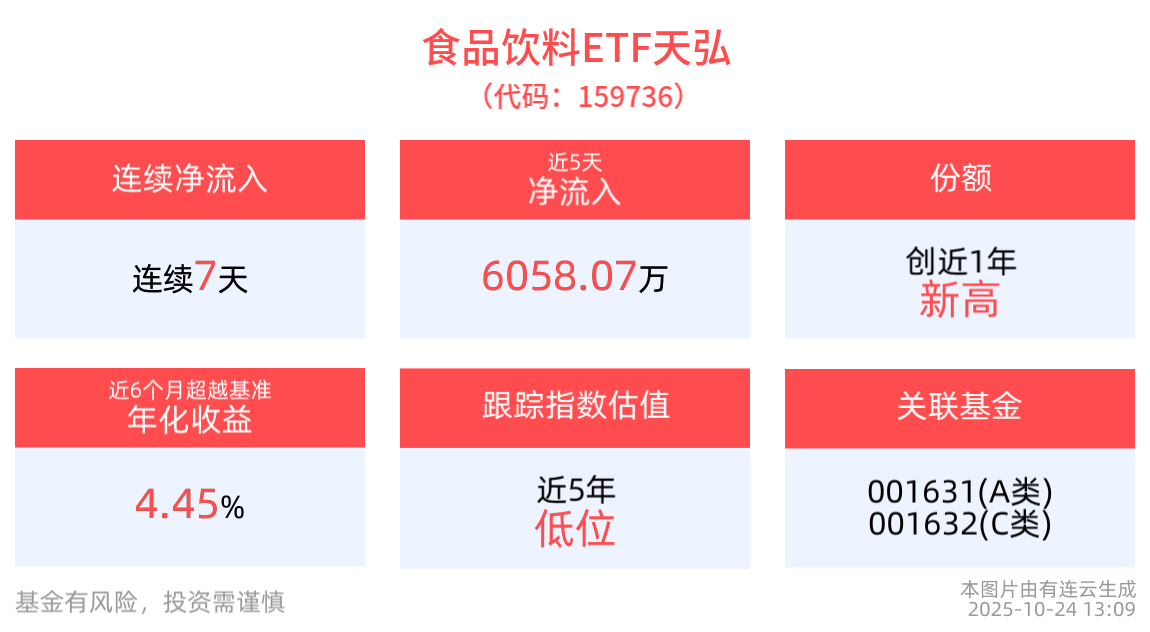
Core Viewpoint - The Tianhong Food and Beverage ETF (159736) is experiencing a rebound with significant net inflows, indicating strong investor interest in the food and beverage sector, particularly amidst recent market fluctuations [3][4]. Fund Performance - As of October 24, 2025, the Tianhong Food and Beverage ETF (159736) has seen a trading volume of 21.35 million yuan, with a net subscription of 18 million shares [3]. - The fund has reached a total share count of 7.804 billion, marking a one-year high as of October 23, 2025 [4]. - Over the past week, the fund has recorded continuous net inflows, with a peak single-day inflow of 21.634 million yuan, totaling 76.619 million yuan in net inflows [4]. Market Trends - The Tianhong Food and Beverage ETF (159736) tracks a diverse index covering essential sectors such as alcohol, beverages, and food, which enhances its resilience against single-industry volatility, making it suitable for long-term investment in consumer upgrades [5]. - The Central Securities A500 ETF (159360) has also shown positive performance, with a 1.05% increase and a trading volume of 37.40 million yuan as of October 24, 2025 [4]. Industry Insights - Recent reports indicate a significant shift in the beverage market, with the reactivation of the "Wahaha" brand by Zong Fuli, reversing a previous decision to introduce a new brand [5]. - The Fourth Plenary Session of the 20th Central Committee emphasized the importance of boosting consumption and effective investment, aiming to strengthen the domestic market and enhance economic resilience [6]. Analyst Opinions - CITIC Securities has noted that the autumn sugar and wine fair met expectations, with the industry actively engaging consumers and expanding market demand. They predict that the industry fundamentals may bottom out in the third quarter of 2025, with the second half of the year showing potential recovery trends [7].
沪指尾盘发力极限翻红,煤炭、能源金属板块表现活跃,机构维持均衡配置观点| 华宝3A日报(2025.10.23)
Xin Lang Ji Jin· 2025-10-23 09:21
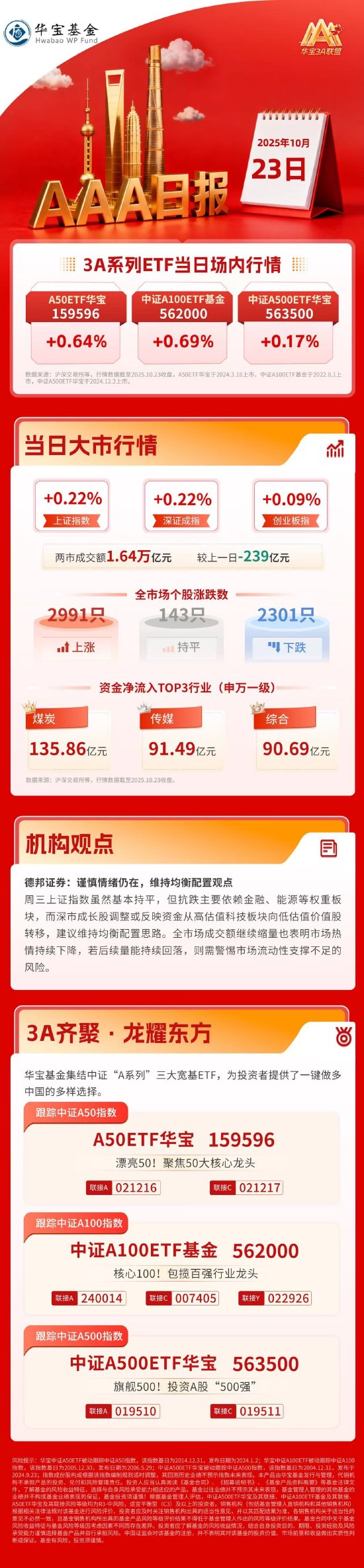
Group 1 - The market showed a slight increase with the Shanghai Composite Index remaining stable, primarily supported by financial and energy sectors, while growth stocks in the Shenzhen market adjusted, indicating a shift of funds from high-valuation tech stocks to undervalued value stocks [2] - The total trading volume in the market decreased to 1.64 trillion yuan, down by 239 billion yuan from the previous day, reflecting a continued decline in market enthusiasm [2] - The three major broad-based ETFs from Huabao Fund provide investors with diverse options to invest in China's market, tracking the CSI A50, CSI A100, and CSI A500 indices [2] Group 2 - The A50 ETF Huabao was launched on March 18, 2024, the China A100 ETF Fund on August 1, 2022, and the CSI A500 ETF Huabao on December 2, 2024 [1] - The market saw a net inflow of funds into specific sectors, indicating potential investment opportunities in those areas [1]
均衡配置穿越周期波动 多只绩优基金连续8年战胜指数
Zheng Quan Shi Bao· 2025-10-22 17:25
Core Insights - The A-share market has been steadily rising since October, driven by liquidity and policy, but the volatility has increased, making it crucial for investors to identify opportunities between offense and defense [1] - Utilizing balanced-style public funds for allocation is considered an effective method for participating in equity investments [1] Fund Performance - Only four actively managed equity funds have outperformed the CSI Taibao Active Balanced Equity Fund Index for eight consecutive years from early 2018 to September 30 this year, with GF Multi-Factor being one of them, achieving a net value growth rate of 393.05% and an annualized return of 22.84% [1][2] - GF Multi-Factor is managed by Yang Dong and Tang Xiaobin, who combine top-down allocation with bottom-up stock selection [2] Investment Strategy - The investment style of GF Multi-Factor is balanced, with long-term allocations across three types of industries: undervalued stable growth sectors like non-bank financials and banks, growth sectors such as electronics, computers, and pharmaceuticals, and cyclical sectors like chemicals and real estate [2] - The top ten holdings of GF Multi-Factor have historically accounted for less than 55% of the fund's net value, indicating a focus on diversification [3] Market Adaptability - The diversified allocation strategy helps the fund keep pace with market changes and increases the probability of investment success, providing a sustainable profit space [3] - GF Multi-Factor's long-term stable performance and clear investment logic offer a quality allocation choice for investors, serving as a practical example for achieving long-term success in a frequently changing market [3]
短期内均衡配置思路或仍将占优, 同类规模最大的自由现金流ETF(159201)布局价值凸显
Mei Ri Jing Ji Xin Wen· 2025-10-22 02:39
Core Viewpoint - The stock market experienced a decline on October 22, with the Shanghai Composite Index down by 0.52%, the Shenzhen Component Index down by 0.7%, and the ChiNext Index down by 0.73%. However, the National Index of Free Cash Flow showed a slight increase of approximately 0.2% [1]. Group 1: Market Performance - The three major stock indices opened lower, with specific declines noted for each index [1]. - The National Index of Free Cash Flow is undergoing fluctuations but has shown a slight upward trend [1]. Group 2: Fund Inflows - The largest free cash flow ETF (159201) has seen a continuous net inflow of funds over the past six days, totaling 209 million yuan, indicating significant capital attraction [1]. Group 3: Future Market Outlook - According to Hu Long Securities, after the short-term disturbances are digested, the market is expected to stabilize due to positive policy factors and continued moderate monetary easing by the central bank, alongside resilient external demand and gradual recovery in domestic demand [1]. - De Bond Securities suggests that with the peak of third-quarter earnings disclosures approaching, a balanced allocation strategy may remain favorable in the short term [1]. Group 4: ETF Characteristics - The free cash flow ETF (159201) and its linked funds (A: 023917; C: 023918) closely track the National Index of Free Cash Flow, selecting stocks with positive and high free cash flow after liquidity, industry, and ROE stability screening [1]. - The ETF is characterized by high quality and strong risk resistance, making it suitable for core portfolio allocation and long-term investment needs [1]. - The fund management fee is set at an annual rate of 0.15%, and the custody fee at 0.05%, both of which are the lowest in the market, maximizing benefits for investors [1].
小微盘股开始活跃!市场风格要切换?
Mei Ri Jing Ji Xin Wen· 2025-10-21 08:50
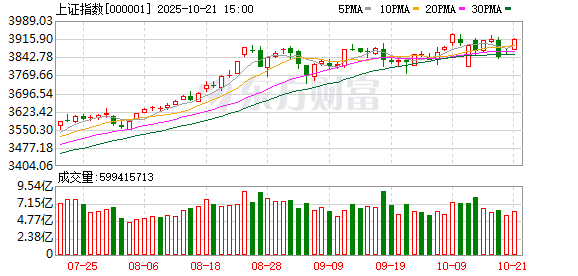
Market Performance - The A-share market saw a collective rise in the three major indices, with the Shanghai Composite Index recovering the 3900-point mark, closing up 1.36% [2] - The total trading volume in the Shanghai and Shenzhen markets approached 1.9 trillion yuan, an increase of over 100 billion yuan compared to the previous day [3] - Over 4600 stocks rose throughout the day, with nearly 100 stocks hitting the daily limit [3] Sector Performance - The mining, engineering machinery, electronic components, shipbuilding, real estate development, consumer electronics, non-metallic materials, and trade sectors led the gains, while coal, gas, and precious metals sectors declined [3] - The technology narrative remains a consistent theme in the current market rally, influenced by Apple's stock performance and the strong sales of the iPhone 17 series, which saw a 14% increase in sales compared to the iPhone 16 during the same period [5] Stock Highlights - Stocks related to the consumer electronics supply chain surged, with companies like Fuliwang rising over 12% and Luxshare Precision hitting the daily limit [5] - In the computing and liquid cooling sectors, stocks such as Yuanjie Technology and Zhongfu Circuit saw significant gains, with Yuanjie hitting a 20% limit up [5] Market Trends - The performance of large-cap stocks, as indicated by the Shanghai 50 and CSI 300 indices, rose by 1.09% and 1.53% respectively, while small-cap stocks, represented by the CSI 1000 and CSI 2000 indices, increased by 1.45% and 1.93% [8] - Tianfeng Securities noted that historically, small-cap stocks tend to outperform in the fourth quarter, suggesting a potential shift in market style towards a more balanced phase [10] Broker Performance - The recent focus on the reform of state-owned assets in Hubei province led to significant gains for local brokerage firms, with Tianfeng Securities rising by 5.70% and Changjiang Securities by 2.67% [11] - Guojin Securities highlighted the high probability of continued strong performance in the brokerage sector, with current valuations being attractive [12]
下周开盘前的几条建议
表舅是养基大户· 2025-10-12 13:28
Core Viewpoint - The article discusses the recent market volatility triggered by social media comments from a prominent figure, leading to significant declines in various asset classes, particularly cryptocurrencies, which saw nearly $20 billion in liquidations within 24 hours and over 1.6 million accounts affected [1]. Market Volatility - Market fluctuations are considered reasonable and almost inevitable, especially in a market lacking a robust short-selling mechanism, which can exacerbate volatility beyond typical levels [3]. - Historical data indicates that October is the month with the highest volatility in the U.S. stock market over the past 80 years [4]. Recent Market Performance - The article compares the recent market downturn to previous trade tensions, highlighting that the Nasdaq index fell by over 3.5%, marking its largest single-day drop since April [8]. - The performance of various indices during the recent trade tensions is detailed, showing significant declines across multiple asset classes, including a 44.76% drop in the three-times leveraged ETF for China [7]. Investment Strategies - Two main strategies are suggested for navigating short-term volatility: 1. **For Existing Capital**: Emphasizes the importance of preemptive measures rather than reactive ones, advocating for balanced asset allocation to reduce volatility and maintain positions during market fluctuations [17][18]. 2. **For New Capital**: Recommends preparing to invest incrementally as indices decline, specifically suggesting a 10% drop as a benchmark for adding positions [20]. Fund Management Insights - The article advises against focusing solely on high-performing, single-style funds and instead suggests selecting funds with a strong margin of safety, highlighting a specific fund manager known for a balanced investment approach [21][24]. Market Valuation Context - The article provides a comparative analysis of market valuations before and after significant market events, noting a 31.74% increase in margin financing over the past six months, which may influence market stability [30][31]. - It emphasizes the importance of understanding the underlying value of stocks, which is determined by earnings and valuations, rather than solely relying on market interventions [28].

程强:走势分化,均衡配置
Sou Hu Cai Jing· 2025-10-11 03:41
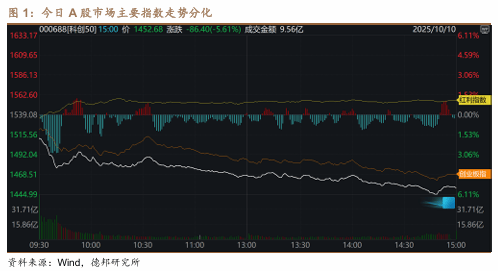
Market Overview - The A-share market, government bond futures, and commodity markets experienced widespread adjustments on October 10, 2025 [1] Market Analysis Stock Market - The stock market showed significant adjustment, with major indices declining; the Shanghai Composite Index fell by 0.94% to 3897.03 points, losing the 3900-point threshold; the Sci-Tech 50 index dropped by 5.61%, and the ChiNext index fell by 4.55% [2] - Defensive sectors outperformed, with the Dividend Index rising by 1.14% and the Micro Index increasing by 0.62% [2] - The market's style exhibited a shift from growth to defensive, with a trading volume of 2.53 trillion, slightly down from 2.67 trillion the previous day [3] - The adjustment may be attributed to increased uncertainty from external factors, including recent announcements from the Ministry of Commerce and Customs regarding export controls on superhard materials, rare earths, and lithium batteries, raising concerns about trade friction [2][3] - The Bank of England's warning about overvaluation in AI-related tech companies may have also contributed to negative sentiment in the tech sector [2] Bond Market - The bond market saw adjustments, with the 30-year bond futures (TL2512) down by 0.49%, and the 10-year (T2512), 5-year (TF2512), and 2-year (TS2512) bonds down by 0.06%, 0.09%, and 0.05% respectively [5] - The funding environment remained stable, with the central bank conducting a 409 billion yuan 7-day reverse repurchase operation, offsetting 600 billion yuan in maturing funds, resulting in a net withdrawal of 191 billion yuan [5] - The market is expected to continue a trend of oscillating recovery, with a focus on liquidity easing and policy expectations [6] Commodity Market - The commodity futures market showed a "more declines than gains" pattern, with non-ferrous metals experiencing a pullback after initial gains; notable increases included rebar (3.01%), red dates (2.29%), and coke (1.86%) [7] - The price of live pigs continued to decline, dropping by 3.21%, attributed to a sharp drop in consumer demand post-holiday and high inventory levels in the egg market [8] - The recent ceasefire agreement in Gaza may have reduced the safe-haven demand for gold, contributing to a price drop, although long-term trends may still support precious metals due to ongoing Fed rate cuts [7] Trading Hotspots Recent Popular Products - Key products include AI, nuclear fusion, domestic semiconductor replacements, and robotics, driven by factors such as central bank policies, capital expenditures from tech giants, and industry advancements [11] - The focus for future developments includes monitoring the Fed's rate decisions, geopolitical risks, and domestic technological progress [11] Core Thoughts Summary - The market has shifted from a tech-led rally to a more balanced allocation strategy, with both tech and dividend sectors showing potential [12] - The bond market is expected to see slight recovery, with long-term bonds presenting attractive value [12] - In commodities, precious metals and non-ferrous metals are anticipated to benefit from global liquidity, while industrial products may experience volatility due to policy changes [12]