
季节性因素

Search documents
欧线基础知识及行情分析
Zhe Shang Guo Ji Jin Rong Kong Gu· 2025-07-04 05:55
Report Industry Investment Rating No information provided on the report's industry investment rating. Core Viewpoints of the Report - The supply - demand pattern in 2025 remains in an oversupply situation. The container shipping volume growth rate in 2025 is expected to be 2.6%, lower than the shipping growth rate of 5.3% [4]. - The impact of the rush - shipping in the US line on the European line is limited. Currently, the transfer of US line capacity is not obvious, and subsequent capacity adjustments need to be monitored [5]. - The 06 and 08 contracts are traditional peak - season contracts for the European line, and the shipping companies have strong bargaining power and price - holding ability. The 10 - month contract faces uncertainties after the 90 - day buffer period, and it is a traditional off - season [6]. - In 2025, the freight rate of the European line is expected to show a downward trend, and this supply - demand imbalance may continue until 2026. Short - term freight rate fluctuations are affected by tariff policies and geopolitical disturbances in the Middle East [49]. Summary According to the Directory 1. Shipping Basics - **Shipping Market Introduction**: The shipping market is the cornerstone of global trade, accounting for over 90% of international cargo transportation. It can be divided into three main segments. In 2024, the global container trade volume reached 210 million TEU, accounting for 15.1% of the total global maritime trade volume. The container shipping volume of the Asia - Europe route accounts for 10.7% of the total container shipping volume [13][14]. - **Introduction to European Line Shipping Indexes**: The main China - Europe freight rate indexes include SCFI, SCFIS, CCFI, and the Baltic Freight Index (China - Europe). SCFI has a leading effect on SCFIS by about 2 weeks. CCFI changes more slowly than immediate freight rate indexes during rapid price increases or decreases [19][25]. - **Introduction to the Container Shipping Index (European Line) Futures**: It was listed on the Shanghai International Energy Exchange in August 2023, with the underlying index being the Shanghai Export Container Settlement Freight Rate Index (European Route). The trading unit is 50 yuan/point, and the contract delivery months are even - numbered months of the year [26]. 2. Analysis Logic - **Seasonality**: Usually, 7 - 8 months are the Christmas stocking period, and 12 - 1 months are the pre - Chinese New Year rush - shipping period, which are peak seasons. 3 - 4 months and around October are off - seasons. However, during the pandemic and the Red Sea crisis, there were anti - seasonal price increases [28][29]. - **Shipping Costs**: Taking a 20,000 - TEU container ship as an example, the main costs include depreciation, loan costs, fuel costs, and port fees. Focusing on variable costs, in an efficient operation scenario, the cost per standard container can be compressed to the range of $545 - 579, corresponding to an index below 800 points. Currently, the European line index is still well above this level [32][36]. - **Capacity Supply**: Container ship construction is mainly undertaken by China, Japan, and South Korea. In 2025, the global delivery volume is expected to be 232 ships/1.89 million TEU. The overall global capacity will be in an oversupply situation, and it is expected to ease after 2026 [37]. - **Geopolitics**: Since the Red Sea situation deteriorated, about 90% of ships on the Asia - Europe route have chosen to bypass the Cape of Good Hope, which increases the shipping cycle and costs and provides some price support for the European line [42]. - **European Economy and Tariff Impact on Demand**: The demand for the European line is mainly affected by the European economy. Economic indicators such as the consumer confidence index, PMI, and GDP can affect the freight volume and shipping company costs on the European line [46]. 3. Market Analysis - **Shipping Situation Before Tariff Negotiations**: After the US imposed reciprocal tariffs on April 2, China's exports to the US declined significantly. Shipping companies transferred some US line capacity to the European line, causing the shipping price to fall by over 40% in April [50]. - **Shipping Situation After Tariff Negotiations**: After the Sino - US Geneva Economic and Trade Talks Joint Statement took effect on May 12, the shipping capacity in June decreased slightly compared to the beginning of May. The main shipping companies on the European line significantly increased their quotes for late June, and the settlement price in June is expected to be between 1900 - 2000 points [54]. - **Impact of the Iran - Israel Conflict on Prices**: On June 13, the European line price rose due to the Iran - Israel conflict. The conflict led to a more than 10% increase in crude oil prices, which is expected to drive up the total cost of the European line by 4%. The continuous conflict may support the European line price in the long - term, but the sustainability of the price increase is questionable [55]. 4. Operation Suggestions - The 06 contract has entered the delivery month, and the final delivery price is expected to be around 1900 - 1950 points. The 7 - month market may see an increase in both supply and demand. The 8 - month contract has room for shipping companies to hold up prices. The 10 - month contract may be the lowest price of the year [57]. - It is recommended to short - allocate the 10 - month off - season contract on rallies. If the price difference between the 10 and 12 contracts further narrows, an arbitrage strategy can be implemented [57].
五矿期货能源化工日报-20250625
Wu Kuang Qi Huo· 2025-06-25 01:49
1. Report Industry Investment Rating No relevant content provided. 2. Report's Core View - Current geopolitical risks have gradually been released, and oil prices have deviated significantly from macro and fundamental guidance. Oil prices have reached a reasonable range, and short positions can still be held, but it is not advisable to chase short positions [2]. - For methanol, after the geopolitical situation cools down and crude oil prices drop sharply, the market will gradually return to its own supply - demand fundamentals. The overall contradiction is limited, and it is recommended to wait and see [4]. - For urea, the geopolitical sentiment has cooled down, and the overall supply - demand is still relatively loose. There is no unilateral trend in the short term, and it is recommended to wait and see [6]. - For rubber, it is not pessimistic about rubber prices in the medium term. It is recommended to adopt a neutral approach, short - term operations, and pay attention to the band operation opportunities of going long on RU2601 and shorting on RU2509 [11]. - For PVC, under the expectation of strong supply and weak demand, the main logic of the market is inventory reduction and weakening, and it is expected to continue to fluctuate downward [13]. - For PX, after the end of the maintenance season, the load remains high. In the third quarter, it is expected to continue to reduce inventory. After the geopolitical situation eases, pay attention to the opportunity of going long on dips following crude oil [21]. - For PTA, the end of the supply - side maintenance season slows down inventory reduction, and the demand side is under pressure. After the geopolitical situation eases, pay attention to the opportunity of going long on dips following PX [22]. - For ethylene glycol, the inventory reduction of ports is expected to slow down. The valuation is relatively high year - on - year, and the fundamentals are weak. Pay attention to the opportunity of short - side allocation, but beware of the risk of ethane imports [23]. 3. Summary by Relevant Catalogs Crude Oil - **Market Quotes**: WTI main crude oil futures fell $2.22, a decline of 3.30%, to $65.01; Brent main crude oil futures fell $2.83, a decline of 4.01%, to $67.82; INE main crude oil futures fell 53.70 yuan, a decline of 9.35%, to 520.9 yuan [1]. - **Data**: At Fujeirah Port, gasoline inventory decreased by 0.18 million barrels to 8.06 million barrels, a month - on - month decrease of 2.23%; diesel inventory increased by 0.75 million barrels to 2.17 million barrels, a month - on - month increase of 52.97%; fuel oil inventory decreased by 0.16 million barrels to 9.41 million barrels, a month - on - month decrease of 1.69%; total refined oil inventory increased by 0.41 million barrels to 19.64 million barrels, a month - on - month increase of 2.11% [1]. Methanol - **Market Quotes**: On June 24, the 09 contract of methanol fell 125 yuan/ton to 2379 yuan/ton, and the spot price fell 100 yuan/ton, with a basis of +261 [4]. - **Analysis**: After the geopolitical situation cools down and crude oil prices drop, the market will return to supply - demand fundamentals. The domestic supply remains high, and the demand may weaken in the future. It is recommended to wait and see [4]. Urea - **Market Quotes**: On June 24, the 09 contract of urea fell 13 yuan/ton to 1698 yuan/ton, and the spot price fell 10 yuan/ton, with a basis of +42 [6]. - **Analysis**: The geopolitical sentiment has cooled down, and the overall supply - demand is relatively loose. There is no unilateral trend in the short term, and it is recommended to wait and see [6]. Rubber - **Market Quotes**: NR and RU fluctuated weakly. As of June 19, 2025, the operating load of all - steel tires of Shandong tire enterprises was 65.46%, 4.24 percentage points higher than last week and 7.31 percentage points higher than the same period last year; the operating load of semi - steel tires of domestic tire enterprises was 77.92%, 0.31 percentage points higher than last week and 0.81 percentage points lower than the same period last year [9][10]. - **Data**: As of June 15, 2025, China's natural rubber social inventory was 127.8 tons, a month - on - month increase of 0.3 tons, an increase of 0.26%. As of June 22, 2025, the inventory of natural rubber in Qingdao was 49.47 (+0.99) tons [10]. - **Analysis**: It is not pessimistic about rubber prices in the medium term. It is recommended to adopt a neutral approach, short - term operations, and pay attention to the band operation opportunities of going long on RU2601 and shorting on RU2509 [11]. PVC - **Market Quotes**: The PVC09 contract fell 52 yuan to 4844 yuan, the spot price of Changzhou SG - 5 was 4740 (-70) yuan/ton, the basis was - 104 (-18) yuan/ton, and the 9 - 1 spread was - 73 (0) yuan/ton [13]. - **Data**: The overall operating rate of PVC this week was 78.6%, a month - on - month decrease of 0.6%. The factory inventory was 40.2 tons (+0.5), and the social inventory was 56.9 tons (-0.4) [13]. - **Analysis**: Under the expectation of strong supply and weak demand, the main logic of the market is inventory reduction and weakening, and it is expected to continue to fluctuate downward [13]. Benzene Ethylene - **Market Quotes**: The spot price and futures price of benzene ethylene both fell, and the basis strengthened. The cost of pure benzene decreased, and the supply was relatively abundant. The supply - side profit of ethylbenzene dehydrogenation was repaired, and the operating rate continued to rise [15]. - **Data**: The inventory of benzene ethylene ports increased. The overall operating rate of the demand - side three S was weak, but the operating rate of PS rebounded [15]. - **Analysis**: After the end of the Middle East conflict, it is expected that the price of benzene ethylene will maintain a volatile trend [15]. Polyolefin Polyethylene - **Market Quotes**: The futures price of polyethylene fell. The end of the Iran - Israel conflict led to a significant decline in crude oil prices, affecting the import volume of polyethylene from Iran to China [17]. - **Data**: In June, the new production capacity on the supply side was small, and the pressure on the supply side would be relieved. The inventory of traders decreased marginally. The demand - side agricultural film orders decreased marginally, and the overall operating rate fluctuated downward [17]. - **Analysis**: The price of polyethylene is expected to maintain a volatile trend [17]. Polypropylene - **Market Quotes**: The futures price of polypropylene fell. The profit of Shandong refineries declined, and the operating rate continued to decline, resulting in a blocked return of propylene supply [18]. - **Data**: In June, there was a planned production capacity of 2.2 million tons on the supply side, and the inventory of upstream production enterprises increased significantly. The demand - side operating rate is expected to decline seasonally [18]. - **Analysis**: It is expected that the price of polypropylene will be bearish in June [18]. PX, PTA, and Ethylene Glycol PX - **Market Quotes**: The PX09 contract fell 366 yuan to 6760 yuan, and the PX CFR fell 40 dollars to 859 dollars [20]. - **Data**: The Chinese load of PX was 85.6%, a month - on - month decrease of 0.2%; the Asian load was 74.3%, a month - on - month decrease of 1.3%. The inventory at the end of April was 4.51 million tons, a month - on - month decrease of 170,000 tons [20][21]. - **Analysis**: After the end of the maintenance season, the load remains high. In the third quarter, it is expected to continue to reduce inventory. After the geopolitical situation eases, pay attention to the opportunity of going long on dips following crude oil [21]. PTA - **Market Quotes**: The PTA09 contract fell 236 yuan/ton to 4776 yuan, and the spot price in East China fell 160 yuan to 5100 yuan [22]. - **Data**: The operating rate of PTA was 79.1%, a month - on - month decrease of 3.9%. The social inventory on June 13 was 2.198 million tons, a month - on - month increase of 32,000 tons [22]. - **Analysis**: The end of the supply - side maintenance season slows down inventory reduction, and the demand side is under pressure. After the geopolitical situation eases, pay attention to the opportunity of going long on dips following PX [22]. Ethylene Glycol - **Market Quotes**: The EG09 contract fell 169 yuan/ton to 4332 yuan, and the spot price in East China fell 117 yuan to 4480 yuan [23]. - **Data**: The supply - side operating rate increased. The import arrival forecast was 62,000 tons, and the port inventory was 622,000 tons, an increase of 6,000 tons [23]. - **Analysis**: The inventory reduction of ports is expected to slow down. The valuation is relatively high year - on - year, and the fundamentals are weak. Pay attention to the opportunity of short - side allocation, but beware of the risk of ethane imports [23].
饲料养殖产业日报-20250611
Chang Jiang Qi Huo· 2025-06-11 01:22
Report Industry Investment Rating No relevant content provided. Core Viewpoints - The overall supply-demand pattern in the feed and aquaculture industry is complex, with different products facing various short - term, medium - term, and long - term supply and demand situations, resulting in different price trends and investment strategies [1][2][4][8][9]. Summary by Product 1. Pig - **Price Situation**: On June 11, the spot prices in Liaoning, Henan, Sichuan, and Guangdong were 13.9 - 14.2 yuan/kg, 13.8 - 14.4 yuan/kg, 13.8 - 14 yuan/kg, and 15 - 15.4 yuan/kg respectively, with prices in Liaoning rising and those in other regions remaining stable [1]. - **Supply - Demand Analysis**: In the short term, the supply - demand pattern of strong supply and weak demand remains unchanged. There is still significant pressure on pig slaughter in June, and the seasonal demand off - season is emerging. In the long term, the supply from June to September is expected to increase, and the supply pressure in the fourth quarter is still high [1]. - **Strategy**: The futures market is in a state of discount. In the short term, it will fluctuate at a low level. It is advisable to short at the resistance level after a rebound [1]. 2. Egg - **Price Situation**: On June 11, the prices in Shandong Dezhou and Beijing were 2.5 yuan/jin and 2.78 yuan/jin respectively, both showing a decline [2]. - **Supply - Demand Analysis**: In the short term, the demand is seasonally weakening, and the supply is still relatively sufficient. In the medium term, the supply is expected to increase in the future. In the long term, the supply pressure may ease in the fourth quarter [2]. - **Strategy**: Temporarily observe the 07 contract. For the 08 and 09 contracts, take a bearish view and short at high levels after a rebound. Look for long opportunities for the 10 contract at low levels [2]. 3. Oil - **Price Situation**: On June 10, the US soybean oil main contract rose, the Malaysian palm oil main contract fell, and domestic palm oil and soybean oil prices mostly declined while rapeseed oil prices rose [4]. - **Supply - Demand Analysis**: The fundamentals of palm oil, soybean oil, and rapeseed oil are all mixed. Palm oil has limited upside potential due to seasonal production increases. Soybean oil is under supply pressure but has some support. Rapeseed oil has short - term supply pressure but may see inventory reduction in the long term [5][6][7]. - **Strategy**: The 09 contracts of soybean, palm, and rapeseed oil will fluctuate in the short term. Consider the oil - meal ratio shrinking strategy [8]. 4. Soybean Meal - **Price Situation**: On June 10, the US soybean 07 contract rose, and the domestic soybean meal futures price also increased [8]. - **Supply - Demand Analysis**: In the short term, the US soybean price is strong due to weather factors, while the domestic supply is increasing. In the long term, the cost increase and weather factors will drive the price to rise steadily [8]. - **Strategy**: Go long on the M2509 contract at low levels and hold existing long positions [8]. 5. Corn - **Price Situation**: On June 10, the new corn purchase price in Jinzhou Port rose, and the price in Shandong Weifang remained stable [9]. - **Supply - Demand Analysis**: In the short term, the supply - demand game intensifies, and the price has support. In the long term, the supply - demand situation tightens, but the price increase is limited by substitutes [9]. - **Strategy**: Take a bullish view overall. For the 07 contract, go long at the lower end of the range. Consider the 7 - 9 positive spread arbitrage [9]. 6. Today's Futures Market Overview - The table shows the price changes of various futures and spot products such as CBOT soybeans, soybean meal, CBOT corn, etc. from the previous trading day [10].
饲料养殖产业日报-20250529
Chang Jiang Qi Huo· 2025-05-29 01:48
Report Industry Investment Rating No relevant content provided. Core Viewpoints - The overall short - term trend of the feed and breeding industry is complex, with different products showing different trends. The long - term trend is also affected by various factors such as supply and demand, policies, and weather [1][2][4] - For different products, there are corresponding trading strategies based on their market conditions Summary by Product 1. Pig - **Short - term**: On May 29, pig prices in various regions were stable. The supply pressure was released in mid - to - late May, and there may be reluctance to sell at the end of the month. The demand increased due to the approaching Dragon Boat Festival, but the increase was limited. The short - term pig price has support at the low level and the volatility intensifies [1] - **Long - term**: From May to September 2024, the supply increased. From November 2024 to February 2025, the number of piglets increased year - on - year, and the supply pressure in the second quarter of 2025 was still large. The pig price still has a risk of decline under the pattern of strong supply and weak demand. The supply pressure in the fourth quarter is still large, and the forward price is under pressure [1] - **Strategy**: The futures price has support at the bottom, but is under pressure above. The 07 contract has a pressure level of 13700 - 13800 and a support level of 13000 - 13100; the 09 contract has a pressure level of 14000 - 14200 and a support level of 13300 - 13400. Wait for the price to rebound to the pressure level and then go short [1] 2. Egg - **Short - term**: On May 29, egg prices in some regions were stable. With the approaching Dragon Boat Festival, the terminal consumption is expected to increase, and the supply pressure is relieved to some extent. However, the supply pressure is still large, and the egg price is under pressure [2] - **Medium - term**: The high number of chicks replenished from February to April 2025 corresponds to a large number of newly - laid hens from June to August 2025, and the long - term supply increase trend is difficult to reverse [2] - **Long - term**: The enthusiasm for chick replenishment has declined, and the number of newly - laid hens in the fourth quarter may decrease month - on - month [2] - **Strategy**: Be cautious about shorting the 07 contract after June. The 08 and 09 contracts should be shorted on rebounds. The 10 contract can be considered for long positions at low prices [2] 3. Oil - **Palm oil**: On May 28, the Malaysian palm oil futures rose. From May 1 - 25, the export data improved, and the production increase slowed down. The inventory accumulation in May may be lower than expected, but the long - term trend is still inventory accumulation. The short - term is expected to fluctuate in the range of 3800 - 4000 for the 08 contract. In China, the inventory recovery is expected to continue [4][5] - **Soybean oil**: On May 28, the US soybean oil futures fell. The macro - risk has weakened, but the uncertainty of US biodiesel policy still exists. The US soybean is expected to fluctuate in the range of 1050 - 1080 for the 07 contract. In China, the soybean arrival volume is large from May to July, and the soybean oil inventory is expected to increase [4][6] - **Rapeseed oil**: The old - crop inventory in Canada continues to decline, and the new - crop sowing is normal. The ICE rapeseed is expected to fluctuate in the short term. In China, the rapeseed oil inventory is at a high level, but if the supply tightens, the inventory is expected to decrease. Pay attention to the result of the anti - dumping investigation on Canadian rapeseed [7] - **Overall strategy**: The 09 contracts of soybean, palm, and rapeseed oil are expected to fluctuate in the short term. Pay attention to the operating ranges of 7500 - 8000, 7800 - 8200, and 9200 - 9500 respectively. The spread expansion strategy of the 09 contracts of soybean - palm, rapeseed - palm, and rapeseed - soybean can be concerned in the long term [8] 4. Soybean Meal - **Short - term**: On May 28, the US soybean futures fell. The US soybean is expected to fluctuate in the short term. In China, the soybean arrival volume increases, and the soybean meal price is expected to be weak. The 09 contract is expected to gradually return to its fundamental value and be strong [8] - **Long - term**: The import cost of US soybeans increases, and the supply is expected to be tight. The domestic soybean meal price is expected to be strong [8] - **Strategy**: The 09 contract should be operated in the range of [2860, 3000] in the short term, and go long on pullbacks after mid - to - early June [8] 5. Corn - **Short - term**: On May 28, the corn price in some regions was stable or slightly decreased. The supply increased, and the upward trend slowed down, but the price has support due to the reduction of grass - roots grain sources [9] - **Long - term**: The supply and demand are tightening marginally, but the price increase space is limited due to the supplement of substitutes [9] - **Strategy**: The 07 contract is expected to fluctuate at a high level (2300 - 2360), and go long at the lower edge of the range. Pay attention to the 7 - 9 positive spread [9] 6. Today's Futures Market Overview - The prices of various futures and spot products showed different changes on May 28 and May 29, including increases, decreases, and stability [10]
综合晨报-20250528
Guo Tou Qi Huo· 2025-05-28 02:29
Group 1: Energy - International oil prices closed slightly lower overnight, with the Brent 07 contract down 0.8%. The market driver may shift to the medium - term logic. After the US - Iran nuclear talks on Friday, the focus may return to supply - demand. With inventory accumulation and OPEC+ production increase, oil prices may fluctuate weakly around the May 31 OPEC+ meeting [2] - Precious metals fell overnight. Gold is still bullish in the long - term, but currently in a volatile adjustment. Maintain the idea of buying on dips [3] - High - sulfur fuel oil's FU cracking spread is expected to oscillate at a high level. Low - sulfur fuel oil's unilateral trend follows crude oil, with weak supply - demand guidance [21] - In June, domestic asphalt refineries plan to produce 231 million tons, a 14.4% year - on - year increase. Demand shows seasonal improvement but is still lower year - on - year. The BU cracking spread is under pressure [22] - Overseas LPG supply is abundant and weakening. Domestic terminals have high inventory, and the short - term fundamentals have limited improvement power. The market runs weakly [23] Group 2: Metals - Overnight, Lun copper oscillated slightly. LME inventory continued to decline. Hold short positions in the second - half - year contracts [4] - Overnight, Shanghai aluminum rose slightly. The market is in a strong - reality situation. Test the resistance at 20300 yuan. Consider selling on rallies if it breaks through [5] - Guinea's alumina mine production impact expansion is unlikely. Spot is tight in the short - term, but the long - term is pessimistic. Don't chase short positions [6] - SMM 0 zinc is at 22,730 yuan/ton. With the end of the peak season, zinc is mainly for short - allocation [7] - Shanghai lead is running weakly. Keep an eye on consumption performance in the future [8] - Nickel and stainless steel markets are weak. Nickel iron inventory increased by 900 tons, and pure nickel inventory decreased by 2,000 tons. Consider short - entry [9] - Tin prices oscillated lower. Continue the short - allocation idea [10] - Lithium carbonate prices rebounded. The market is waiting for supply - demand improvement. Short - sellers should take profit opportunistically [11] - Industrial silicon futures prices continued to decline. Supply pressure accumulates, and demand is weak. Silicon prices are expected to decline [12] - Polysilicon prices rebounded to above the cost line. In June, supply is expected to increase, and prices may run weakly [13] - Steel prices continued to decline overnight. In the off - season, demand is weak, and supply pressure is high. The market is bearish [14] - Iron ore prices oscillated weakly. Supply is in a seasonally strong stage, and demand is in the off - season. Prices may oscillate weakly [15] - Coke prices rebounded slightly after hitting the bottom. Carbon supply is abundant, and pay attention to the negative feedback [16] - Coking coal prices rebounded slightly after hitting the bottom. Supply is abundant, and don't be overly bearish [17] - Manganese silicon prices continued to decline. The fundamentals have slightly improved. Pay attention to the impact of tariffs [18] - Ferrosilicon prices oscillated narrowly. Demand is okay, and prices are still weak due to the black market [19] Group 3: Chemicals - Styrene supply increases, and inventory may rise slightly. Downstream demand is weak [26] - Polypropylene and polyethylene markets are weak. Supply and demand support is limited [27] - PVC prices continue to weaken. Supply is high, and demand is weak. Caustic soda is under pressure at high levels [28] - PX supply increases, and demand is expected to be low. PTA is in de - stocking. There is pressure on supply increase and demand weakening in the long - term [29] - Ethylene glycol's near - term supply - demand is good, but there will be pressure after June [30] - Short - fiber prices follow raw materials and oscillate weakly. Bottle - chip production is increasing, and consider short - term processing margin repair [31] - Glass prices are weak. Inventory pressure is high, and supply is volatile. Be cautious [32] - Natural rubber supply is increasing, and demand is slightly decreasing. Synthetic rubber supply is decreasing, and inventory is increasing [33] - Urea futures lack upward momentum. The market oscillates weakly in the short - term [24] - Methanol supply is expected to increase significantly. The market runs weakly, and pay attention to the macro impact [25] Group 4: Agricultural Products - Domestic soybean meal prices are generally falling. Supply is loose, and there is no continuous upward driver [34] - Domestic soybean oil and palm oil prices oscillate. Supply is increasing, and they follow US soybean prices [35] - Rapeseed meal and oil are recommended to be long - biased. Rapeseed meal may be stronger [36] - Domestic soybeans oscillate. Import supply is abundant from May to July, and weather affects prices [37] - Corn prices may oscillate weakly. Supply is increasing, and pay attention to inventory changes [38] - Live pig futures oscillate weakly. Supply is expected to increase in the medium - long term [39] - Egg futures fall sharply, and spot prices rebound. Egg prices may decline after the Dragon Boat Festival [40] - Cotton prices are affected by US - China relations. Inventory is decreasing, and consider option strategies [41] - Sugar prices are expected to oscillate. Brazilian production is the focus, and domestic supply and demand are stable [42] - Apple prices are weak. Market focuses on new - season production estimates [43] - Wood prices are weak. Supply has some positive factors, but demand is in the off - season [44] - Pulp prices fall. Inventory is still high, and demand is weak. Consider buying on dips [45] Group 5: Others - The CCFI (European Line) may be at the end of the decline. The spot price is close to the central level. Pay attention to the peak - season price increase [20] - A - shares oscillated lower. With overseas risk preference rising, A - shares may oscillate more evenly in the short - term [46] - Treasury bond futures oscillate weakly. Directional strategies may not break through, and curve steepening needs data support [47]
4月PMI数据点评:季节性因素叠加外部环境变化,制造业PMI降至收缩区间
Tai Ping Yang Zheng Quan· 2025-04-30 12:42
Group 1: Manufacturing PMI Insights - China's April manufacturing PMI dropped to 49.0%, down 1.5 percentage points from the previous month, indicating a return to contraction territory[4] - The production index fell to 49.8%, a decrease of 2.8 percentage points, while the new orders index declined to 49.2%, down 2.6 percentage points[10] - New export orders plummeted to 44.7%, a significant drop of 4.3 percentage points, reflecting weakened external demand[10] Group 2: Economic Factors and Trends - Seasonal factors and external environment changes contributed to the decline in manufacturing PMI, with April historically showing negative month-on-month growth since 2016[6] - Price indices for major raw materials and factory output remained below the critical level, with the former at 47.0% and the latter at 44.8%, indicating ongoing supply-demand imbalances[15] - High-tech manufacturing PMI stood at 51.5%, showing resilience compared to other sectors, which experienced declines[17] Group 3: Non-Manufacturing Sector Performance - The non-manufacturing PMI for April was 50.4%, down 0.4 percentage points but still indicating expansion[18] - The service sector's business activity index was 50.1%, supported by increased consumer spending during the Qingming Festival[22] - The construction sector's business activity index remained robust at 51.9%, driven by infrastructure projects and government initiatives[26]
美股震荡之际,“五月清仓”古谚叩响投资警钟
智通财经网· 2025-04-30 11:18
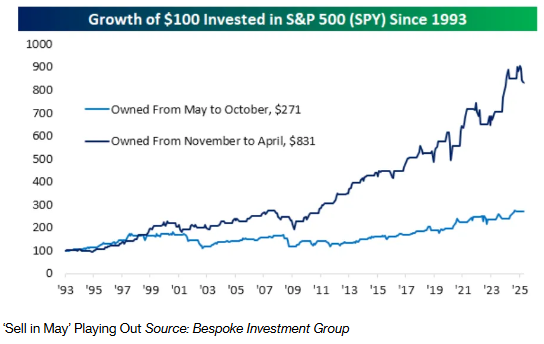
Group 1 - The old market adage "Sell in May and go away" is influencing the current rebound in the US stock market, with historical data supporting this trend [1] - A fund tracking the S&P 500 index since 1993 shows a cumulative return of 171% from May to October, compared to 731% from November to April, indicating a significant seasonal performance difference [1][2] - The S&P 500 index has rebounded 12% from its low this month but is still down 5.5% year-to-date, suggesting caution in chasing gains [1] Group 2 - Over the past 74 years, the S&P 500 index has only achieved a cumulative return of 35% from May to October, while the return from November to April has been as high as 11,657% [2] - The upcoming US non-farm payroll report is expected to be a key focus for the market, as it may influence investor sentiment and market direction [2] - Some indicators have signaled a buying opportunity, including a drop in investor confidence and the S&P 500 index recovering above 5,500 points, indicating a potential shift towards buying on dips [2] Group 3 - Historical data suggests that in years where the stock market has a poor start, the S&P 500 index tends to perform worse from May to October, with an average decline of 0.4% in such years [3] - The SPDR S&P 500 ETF has seen a year-to-date decline of 5.4%, reflecting the cautious market sentiment [3] - The Chicago Board Options Exchange Volatility Index (VIX) remains elevated around 25, above the long-term average of approximately 20, indicating ongoing market volatility [3] Group 4 - The potential expiration of tariff suspensions by Trump in July could serve as a source of volatility, reinforcing the "Sell in May" trend and highlighting the impact of global trade dynamics on market movements [5] - Market analysts suggest that long-term holding strategies may be wiser for ordinary investors compared to attempting to time the market, with a buy-and-hold strategy since 1993 yielding a return of 2,100% for the SPDR S&P 500 ETF [5]

美股动荡之际,“五月卖出”魔咒会否依然奏效?
Hua Er Jie Jian Wen· 2025-04-30 10:51
Group 1 - The article discusses the historical phenomenon of "Sell in May and Go Away," highlighting that the cumulative returns of the S&P 500 from May to October are significantly lower than from November to April [1][2] - Bespoke Investment Group's analysis shows that an investment in a fund tracking the S&P 500 since 1993 would yield a cumulative return of 171% from May to October, compared to 731% from November to April [1] - Over the past 74 years, the cumulative return for the S&P 500 from May to October has been only 35%, while the return for the other half of the year has reached 11,657% [1] Group 2 - Seasonal data is particularly important this year, with indications that the balance has shifted towards a potential decline in the S&P 500 in May [2] - If the S&P 500 shows negative growth from January to April, the SPDR S&P 500 ETF Trust (SPY) has historically averaged a decline of 0.4% from May to October [2] - The volatility index (VIX) remains elevated around 25, which is significantly above the long-term average of approximately 20, indicating increased market volatility as May approaches [2] Group 3 - Tariff discussions and uncertainties are highlighted as key variables affecting market conditions, overshadowing seasonal trends [2]