
消费需求

Search documents
能源价格拖累,5月份CPI环比下降0.2%
Di Yi Cai Jing· 2025-06-09 03:11
Core CPI and Economic Policy - The core CPI shows a steady upward trend, reflecting the effectiveness of macroeconomic policies and the increasing impact of domestic demand on prices [1][5] - In May, the core CPI excluding food and energy prices rose by 0.6% year-on-year, an increase of 0.1 percentage points from the previous month [2][4] CPI and PPI Trends - In May, the CPI decreased by 0.2% month-on-month and 0.1% year-on-year, while the PPI fell by 0.4% month-on-month and 3.3% year-on-year, with the year-on-year decline widening by 0.6 percentage points [2][7] - Energy prices dropped by 6.1% year-on-year, contributing approximately 0.47 percentage points to the CPI decline [4] Food Prices and Consumer Demand - Food prices decreased by 0.4% year-on-year, with pork prices rising by 3.1% but showing a decline in growth rate compared to the previous month [4] - The analysis indicates that consumer demand is in a critical recovery phase, with expectations of gradual improvement in consumption as counter-cyclical policies take effect [4][5] Sector-Specific Price Movements - Certain sectors are experiencing marginal price improvements, with some consumer goods seeing price stabilization or increases [8] - High-tech product demand is expanding, leading to price increases in sectors such as integrated circuits and aircraft manufacturing [8] Future Price Outlook - Short-term inflation may face dual pressures, with expectations of continued negative growth in CPI and PPI in the second and third quarters [9] - Recent financial policies may signal the start of a new round of incremental policies aimed at stabilizing employment, businesses, and market expectations [9]

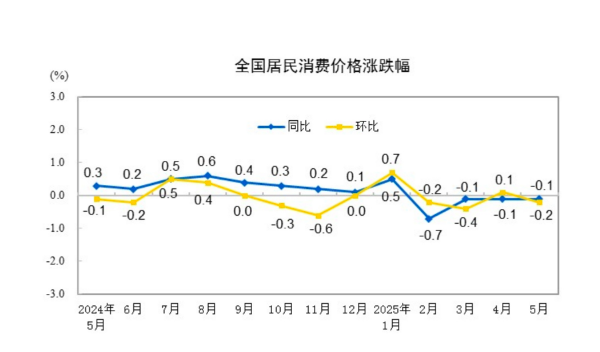
受能源价格影响,5月全国CPI同比下降0.1%
Bei Jing Shang Bao· 2025-06-09 02:58
Group 1 - The core viewpoint of the articles indicates that the Consumer Price Index (CPI) in May showed a month-on-month decrease of 0.2% and a year-on-year decrease of 0.1%, primarily driven by falling energy prices [1][2] - Energy prices decreased by 1.7% month-on-month, contributing approximately 0.13 percentage points to the CPI decline, accounting for nearly 70% of the total decrease [1] - The price of gasoline fell by 3.8%, with the decline expanding by 1.8 percentage points compared to the previous month [1] Group 2 - Food prices decreased by 0.2% month-on-month, which is less than the seasonal decline of 1.1%, contributing about 0.04 percentage points to the CPI decline [1] - Seasonal vegetables saw an increase in supply, leading to a 5.9% drop in fresh vegetable prices, while prices for eggs, pork, and poultry slightly decreased by 0.3% to 1.0% [1] - Prices for fresh fruits, freshwater fish, and seawater fish increased by 3.3%, 3.1%, and 1.5% respectively, due to supply constraints from adverse weather and fishing moratoriums [1] Group 3 - Consumer demand is showing signs of recovery, with hotel accommodation and tourism prices rising by 4.6% and 0.8% month-on-month, both exceeding seasonal levels [1] - The price increase for hotel accommodation is noted to be the highest for the same period in nearly a decade [1] - Clothing prices increased by 0.6% due to the seasonal change in summer apparel [1] Group 4 - Year-on-year, the CPI showed a slight decline, with energy prices down by 6.1%, which is a 1.3 percentage point increase in the rate of decline compared to the previous month [2] - The core CPI increased by 0.6% year-on-year, with the industrial consumer goods price excluding energy also rising by 0.6%, marking a 0.2 percentage point increase in the growth rate [2] - Prices for gold jewelry, household textiles, and durable consumer goods rose by 40.1%, 1.9%, and 1.8% respectively, with all showing an increase in growth rates [2]
能源价格拖累5月CPI同比下降0.1%,但核心CPI涨幅略有扩大
Sou Hu Cai Jing· 2025-06-09 02:15
Group 1: Consumer Price Index (CPI) Analysis - In May, China's Consumer Price Index (CPI) decreased by 0.1% year-on-year, with the decline remaining consistent compared to April [1] - The main factor contributing to the CPI decline was a 6.1% year-on-year drop in energy prices, which impacted the CPI by approximately 0.47 percentage points [1] - Food prices fell by 0.4% year-on-year, with significant declines in fresh vegetable prices (down 8.3%) and a smaller increase in pork prices (up 3.1%) [1] Group 2: Core CPI and Future Outlook - The core CPI increased by 0.6% year-on-year in May, reflecting a slight improvement compared to the previous month [3] - Future price trends may be supported by consumption-boosting policies, although potential negative impacts from the US-China tariff situation and "export to domestic" pressures should be monitored [3] - There is a possibility that the CPI may remain in negative territory in June, with macroeconomic policies aimed at stabilizing price levels in the second half of the year [3] Group 3: Producer Price Index (PPI) Insights - The Producer Price Index (PPI) saw a year-on-year decline of 3.3%, with the drop widening by 0.6 percentage points compared to April [1] - Some industries are experiencing improved supply-demand relationships, leading to price recoveries in certain sectors, particularly in consumer goods [4] - The future trajectory of industrial prices will largely depend on the effectiveness of counter-cyclical policies, especially those supporting the real estate sector [4]
食品饮料周报(25年第20周):白酒淡季特征明显,啤酒、饮料步入旺季-20250519
Guoxin Securities· 2025-05-19 08:40
Investment Rating - The report maintains an "Outperform the Market" rating for the food and beverage sector [1][4][72]. Core Views - The food and beverage sector has shown a slight increase of 0.53% in the week from May 12 to May 16, 2025, but underperformed the Shanghai Composite Index by 0.23 percentage points [1][20]. - The report highlights three investment themes: 1) Leading companies with proven risk resilience such as Kweichow Moutai, Shanxi Fenjiu, and Wuliangye; 2) Companies like Luzhou Laojiao that are showing positive feedback from digital initiatives and are undervalued; 3) Brands like Jinsiyuan and Yingjia Gongjiu that have potential for market share growth [1][12][13]. Summary by Sections 1. Weekly Insights - The report notes that the white liquor market is currently in a low demand season, while beer and beverage sectors are entering a peak season [1][10]. - White liquor prices have shown a year-on-year decrease of 2% and a month-on-month stability, indicating ongoing pressure on consumption demand [1][10]. - The first quarter of 2025 saw a 7.22% year-on-year decline in white liquor production, with sales revenue of 196.3 billion yuan, down 0.38% year-on-year [1][10]. 2. Key Data Tracking - The food and beverage sector's performance in the week of May 12-16, 2025, was characterized by a 0.53% increase, which lagged behind the Shanghai Composite Index [20]. - The report provides insights into the performance of various segments, including a 3.7% year-on-year revenue growth in the beer sector for Q1 2025, driven by stable dining demand and inventory replenishment [13][14]. 3. Company Earnings Forecasts and Investment Ratings - Kweichow Moutai is rated "Outperform the Market" with an expected EPS of 68.64 yuan for 2025 and a PE ratio of 23.5 [3]. - Luzhou Laojiao is also rated "Outperform the Market" with an expected EPS of 9.02 yuan for 2025 and a PE ratio of 14.0 [3]. - The report emphasizes the importance of focusing on leading companies with strong market positions and growth potential in the food and beverage sector [1][12].





食品饮料周报(25 年第 20 周):白酒淡季特征明显,啤酒、饮料步入旺季
Guoxin Securities· 2025-05-19 07:20
Investment Rating - The report maintains an "Outperform the Market" rating for the food and beverage sector [1][4][3]. Core Views - The report highlights the distinct off-season characteristics of the liquor market, while beer and beverages are entering their peak season [1][10]. - The liquor market is experiencing continued pressure on consumption demand, with a notable decline in production and sales figures for the first quarter of 2025 [1][10]. - The beer industry is showing signs of recovery, with a focus on inventory replenishment and stable demand, particularly in the 8-10 yuan price range [2][13][14]. - The snack food sector is experiencing mixed performance, with some companies showing significant revenue growth despite overall challenges [2][15]. - The report suggests a structural configuration opportunity in the beverage sector, with expectations of continued growth in demand for products like no-sugar tea and energy drinks [2][19]. Summary by Sections Liquor Market - The liquor market is under pressure, with April prices showing a year-on-year decline of 2% and a production drop of 7.22% in Q1 2025 [1][10]. - Key companies like Kweichow Moutai are expanding their consumer reach through new policies and channel strategies, with online sales showing over 30% growth [1][10]. - Investment recommendations focus on resilient leaders such as Kweichow Moutai, Shanxi Fenjiu, and Wuliangye, as well as companies like Luzhou Laojiao that are showing signs of recovery [1][12]. Beer Market - The beer sector is entering a phase of inventory replenishment and demand stabilization, with Q1 2025 showing a revenue increase of 3.7% year-on-year [2][13]. - Leading brands like Yanjing and Zhujiang are experiencing significant growth due to effective cost management and product strategy adjustments [2][14]. - The report anticipates a favorable outlook for the beer sector in Q2 2025, recommending continued investment in quality beer leaders [2][14]. Snack Food Sector - The snack food sector's revenue growth in Q1 2025 was impacted by the timing of the Spring Festival, with a year-on-year increase of 31% [2][15]. - Companies like Wanchen Group and Youyou Food are leading in revenue growth, driven by channel expansion and product innovation [2][15]. - The report suggests focusing on companies with competitive advantages and those that are likely to benefit from new product categories [2][15]. Other Food and Beverage Segments - The condiment sector is performing steadily, with a focus on inventory replenishment and strong cash flow among leading companies [2][16]. - The frozen food market is facing challenges due to weak restaurant demand, with Q1 2025 revenue showing a slight decline [2][17]. - The dairy sector is expected to see improvements in supply and demand dynamics, with potential policy catalysts supporting growth [2][19]. - The beverage sector is entering a peak consumption period, with leading companies increasing their market presence through strategic investments [2][19].
铜市|关税互减超预期,现货紧张支撑铜价偏强震荡
Sou Hu Cai Jing· 2025-05-19 07:11
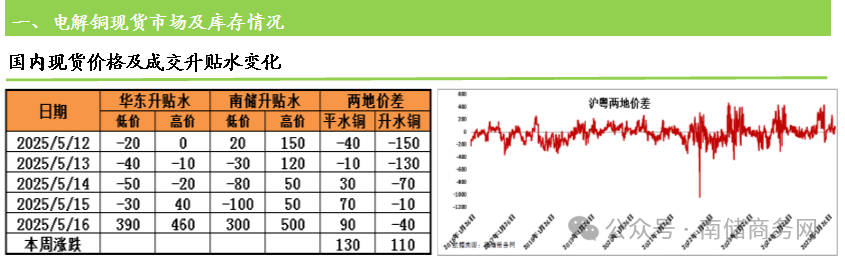
Group 1: Market Overview - Domestic spot prices and transaction spreads have shown fluctuations, with significant changes in the market sentiment due to easing U.S. inflation and favorable tariff policies [1][2] - The overall market sentiment has improved, supported by a series of stimulus policies in China, including interest rate cuts and capital market reforms, leading to a marginal macroeconomic improvement [1] - Social inventory continues to decline, although the pace of inventory reduction has slowed down, indicating resilience in the market despite high copper prices [1] Group 2: Supply and Demand Dynamics - The demand side is facing challenges as rising copper prices have suppressed downstream orders, with customers primarily focused on inventory digestion, leading to a noticeable decline in new orders [1][2] - The current market is characterized by a tight supply situation, but the demand release has not been significant, resulting in a cautious purchasing stance from downstream buyers [2] - The expectation for next week’s price spread is between a premium of 200 to 300 yuan/ton, reflecting ongoing concerns about demand weakness [1][2] Group 3: Inventory Changes - As of May 16, the total national electrolytic copper social inventory is 128,000 tons, showing an increase of 10,100 tons from the previous week [3][5] - In Guangdong, the electrolytic copper social inventory decreased by 800 tons to 13,600 tons, while in Shanghai, it increased by 6,700 tons to 98,200 tons [3][5] - Global inventory, including the Shanghai bonded zone, stands at 527,000 tons, which is an increase of 8,200 tons compared to the previous week [5]
港股,又又又涨了
3 6 Ke· 2025-05-12 10:46
Group 1 - The Hong Kong stock market has seen significant gains, with the Hang Seng Index rebounding nearly 20% from its low, surpassing 23,000 points [1][2] - Positive developments in trade negotiations have contributed to the bullish sentiment in the market, with expectations of further inflows into Chinese assets [2][4] - Major Chinese tech companies like Alibaba and Tencent are expected to report optimistic earnings, particularly regarding their AI strategies, which could further boost market confidence [2][4] Group 2 - The Hong Kong market is experiencing a confluence of favorable factors, including policy support, capital inflows, and strong earnings growth, particularly in the tech sector [4] - The Central Bank's monetary easing measures, including liquidity injections, are expected to drive growth in both domestic consumption and technology sectors [4] - The upcoming IPO of CATL (Contemporary Amperex Technology Co., Limited) is anticipated to attract significant investor interest, with plans to issue approximately 118 million shares [4][5] Group 3 - CATL reported a projected revenue of 362.01 billion yuan for 2024, with a year-on-year increase in lithium-ion battery sales of 21.79% [5][6] - The company's gross profit is expected to rise to 88.49 billion yuan in 2024, reflecting strong growth in both power and energy storage battery segments [6] Group 4 - Market strategies suggested by analysts indicate a potential shift in investment focus, with recommendations to "buy the expectation, sell the fact" following trade agreement announcements [7] - The overall global debt has reached a record high of 324 trillion dollars, which poses risks for the market if long-term interest rates rise uncontrollably [7]
一季度山东CPI同比下降0.2%,呈现低位运行态势
Zhong Guo Fa Zhan Wang· 2025-04-24 08:11
Group 1 - The core viewpoint is that Shandong Province has maintained stable market prices and sufficient supply of essential goods in 2023, with a slight decrease in the Consumer Price Index (CPI) [1][2] - In the first quarter, the CPI in Shandong decreased by 0.2% year-on-year, indicating a low-level operation trend [1] - Food prices primarily decreased, with an overall decline of 2.2% year-on-year, influenced by seasonal demand fluctuations post-Spring Festival [1] Group 2 - The prices of industrial consumer goods saw a slight increase of 0.1% year-on-year, driven by rising international precious metal prices [1] - Service prices experienced a modest increase of 0.5% year-on-year, with notable rises in household services and entertainment [2] - The economic environment in Shandong is expected to support stable price levels, with upcoming holidays likely to boost demand for goods and services [2]