
红利风格

Search documents
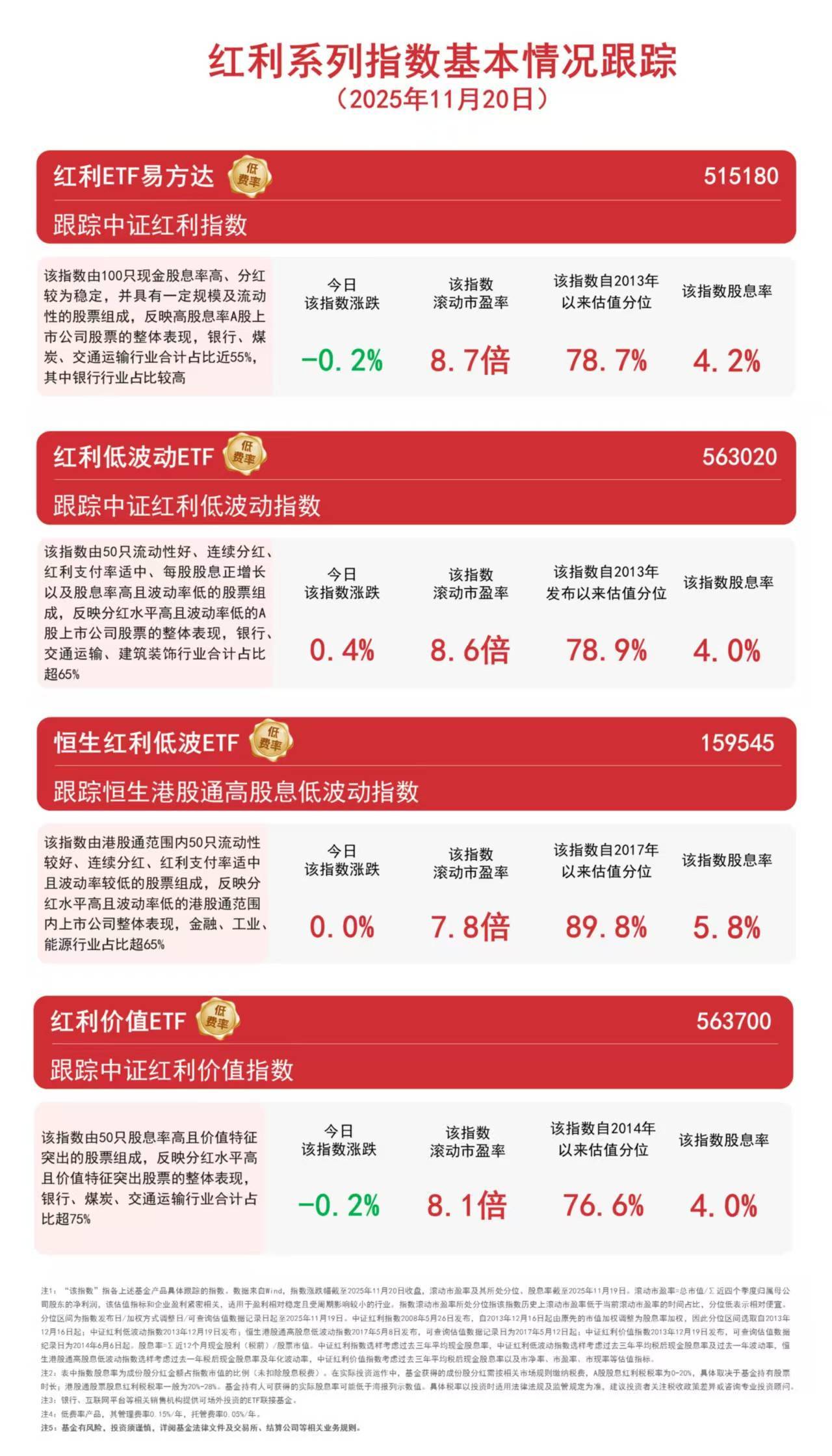
红利板块震荡分化,恒生红利低波ETF(159545)全天获1500万份净申购
Sou Hu Cai Jing· 2025-11-20 10:42
Group 1 - The core viewpoint indicates that the market is currently in a bull market consolidation phase, characterized by high capital flow into low volatility stocks and a horizontal index movement with reduced trading volume [1] - The China Securities Index shows that the CSI Dividend Low Volatility Index increased by 0.4%, while the CSI Dividend Index and CSI Dividend Value Index both decreased by 0.2% [1] - The market is supported by structural prosperity and ample liquidity, suggesting limited downside potential [1] Group 2 - The banking, coal, and transportation sectors collectively account for nearly 55% of the high dividend yield A-share market, with the banking sector having a significant weight [3] - The rolling price-to-earnings ratio for the CSI Dividend Index is reported at 8.7 times, with a valuation percentile of 78.7% since its inception [3] - The market is advised to focus on dividend styles towards the end of the year, with a shift in investment style already underway [1]

近十年数据复盘!年末A股风格切换,谁在领跑?
天天基金网· 2025-11-20 08:38
Core Viewpoint - The article analyzes the performance of the A-share market in the last two months of each year over the past decade, highlighting that large-cap value and dividend styles tend to outperform, while small-cap and growth styles lag behind. Consumer and cyclical sectors show relatively better performance [1][7]. Market Performance Summary - In the last two months of each year, large-cap value and dividend styles have consistently outperformed small-cap and growth styles, indicating a trend in investor preference [7]. - The historical performance of major indices from 2015 to 2024 shows fluctuations, with significant gains in 2015 (e.g., Shanghai Composite Index up 4.6%) and notable declines in 2023 (e.g., Shanghai Composite Index down 1.5%) [2]. Leading Industries Summary - Over the past decade, the leading industries in the last two months have included: - 2015: Comprehensive, Social Services, Real Estate, Electronics, Beauty Care [4] - 2016: Oil & Petrochemicals, Construction Decoration, Steel, Retail, Building Materials [4] - 2017: Food & Beverage, Oil & Petrochemicals, Home Appliances, Steel, Coal [4] - 2018: Electronics, Comprehensive, Food & Beverage, Agriculture, Beauty Care [4] - 2019: Building Materials, Non-ferrous Metals, Electronics, Media, Automotive [4] - 2020: Non-ferrous Metals, Social Services, Power Equipment, Food & Beverage, Defense [4] - 2021: Media, Light Industry Manufacturing, Communication, Environmental Protection, Building Materials [4] - 2022: Food & Beverage, Social Services, Beauty Care, Retail, Media [4] - 2023: Coal, Machinery, Media, Communication, Comprehensive [4] - 2024: Retail, Banking, Comprehensive, Textile & Apparel, Oil & Petrochemicals [4] Investment Strategy Insights - Various institutions suggest strategies for the year-end market, emphasizing the importance of focusing on low-value sectors and potential rebounds in banking and non-bank financials. They recommend monitoring sectors like battery, photovoltaic equipment, energy metals, and chemical products for investment opportunities [8][9]. - The article suggests a balanced investment approach, combining dividend and technology strategies to optimize asset allocation while avoiding frequent trading to minimize costs and risks [9].

中金:日历效应视角下 年末或可关注质量风格的配置机会
智通财经网· 2025-11-19 00:23
Group 1 - The report from CICC highlights the existence of calendar effects in the market, influenced by the rhythm of earnings disclosures, dividend events, and seasonal changes in institutional investors' risk preferences [1][3] - Small-cap style shows significant volatility in the first half of the year, with overall improvement in the second half; the small-cap style underperformed in April, with the CSI 2000 index excess returns of -2.3% and -2.2% [1][2] - Growth style exhibits a "high first, low last" characteristic, with significant excess returns in January and June-July, achieving a win rate of 90.9% [1][2] Group 2 - Quality style demonstrates a "strong at both ends" pattern, with January (excess return of 1.4%, win rate of 81.8%) and December (excess return of 0.5%, win rate of 80%) being the strongest months for quality style [2] - Dividend style performs well in April and August, with win rates of 83.3%, while June and October show significantly lower excess win rates [2][3] - The internal mechanisms of calendar effects are linked to the timing of earnings disclosures and dividend announcements, which influence investor focus and fund flows towards stocks with better fundamentals [3]
W131市场观察:大小盘交易活跃度趋势分化
Changjiang Securities· 2025-11-17 23:30
Market Overview - The Shanghai Composite Index closed at 3990.49, experiencing fluctuations throughout the week[1] - The average daily trading volume remained stable above 20 trillion CNY[1] Sector Performance - The consumer sector, particularly social services, agricultural products, and commercial trade, showed significant recovery in trading activity[1] - The healthcare and consumer staples sectors led the weekly gains, with excess returns of 3.78% and 3.38% respectively[26] Investment Style Trends - Small-cap stocks demonstrated sustained activity, while growth stocks generally experienced declines[5] - Institutional heavyweights across various indices saw weekly adjustments, with the fund overlap index down by 1.76%[20] Market Sentiment - The micro-cap stock index's trading heat continued to recover, indicating improved market sentiment[5] - The overall risk appetite in the market remains balanced and defensive, reflecting cautious investor behavior[1] Risk Considerations - The report emphasizes that historical data does not guarantee future performance, highlighting the potential for market volatility due to macroeconomic changes[34]
ETF基金周报:港股高股息类ETF基金获资金青睐-20251117
Dongguan Securities· 2025-11-17 10:14
Group 1 - The report highlights that after the longest government shutdown in U.S. history lasting 43 days, market liquidity has improved, leading to a rebound in equity markets, with MSCI Emerging Markets up 0.29% and MSCI Developed Markets up 0.43% [10][11] - Commodity ETFs performed exceptionally well, with an average weekly increase of 2.95%, reflecting strong price movements in precious metals and oil [10][11] - The report notes a net inflow of 29.597 billion yuan into ETFs this week, with all types of ETFs experiencing varying degrees of inflow except for bond ETFs, which saw a slight outflow [11][12] Group 2 - The report indicates that the stock ETF indices with the highest returns are primarily in the pharmaceutical, consumer, and chemical sectors, while the technology growth sector has shown caution due to concerns over AI bubble narratives [16][18] - The report mentions that the bond ETF market is seeing a preference for interest rate bonds over credit bonds, with convertible bond ETFs showing an average weekly increase of 0.44% [20][21] - The report emphasizes that the high dividend yield of 5.5% for Hong Kong stocks, compared to a 3.69 percentage point spread over the 10-year government bond yield, makes them attractive to investors seeking stable returns in a low-interest environment [23]
港股收评:三大指数齐跌,恒科指跌0.96%,军工股上涨
Ge Long Hui· 2025-11-17 09:05
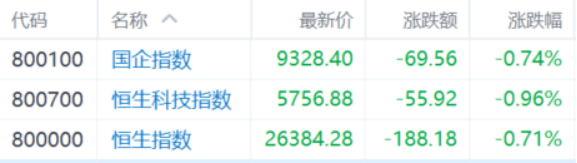
港股三大指数全天表现弱势,恒生指数跌0.71%报26384点,国企指数跌0.74%报9328点,恒生科技指数 跌0.96%报5756点,市场情绪继续疲软,三者均录得2连跌行情。 | 最新价 涨跌额 涨跌幅 | 代码 | | --- | --- | | 800100 国企指数 | 9328.40 -69.56 -0.74% | | 800700 恒生科技指数 5756.88 -55.92 -0.96% | | | 800000 | | 盘面上,大型科技股表现低迷拖累大市下行,其中,上周五大跌超7%的百度再度下跌近3%,铝、铜、 黄金等有色金属板块齐跌。另一方面,电池股逆势领涨,军工股拉升明显,中船防务盘中一度涨至 9%,服装股板块下跌。 | | | | | 汽车 | 地产发展商 -0.25% | 生物技术 -2.04% | | 图层 -1.32% | | --- | --- | --- | --- | --- | --- | --- | --- | --- | | 銀行 | -0.76% | 线上零售商 -0.20% | 电讯服务 -0.63% | -0.54% | 黄金及贵 | 互动媒体及 | 煤炭 | 家庭 ...
煤炭、石油、机械轮番上攻!标普红利ETF(562060)逆市走强,资金狂涌超1亿元
Xin Lang Ji Jin· 2025-11-17 03:44
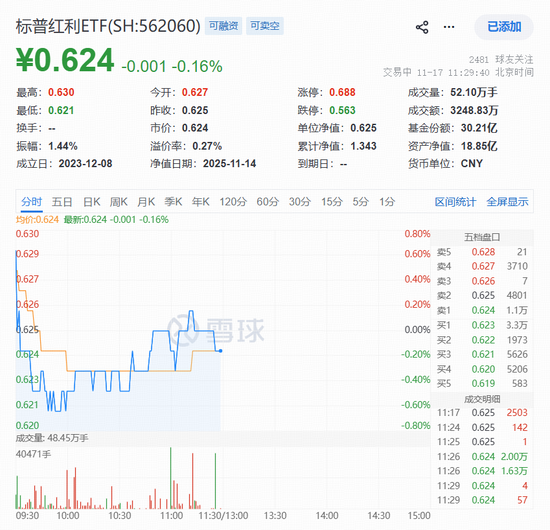
11月17日早盘,三大指数承压,煤炭、石油化工、机械等传统高股息红利板块再度走强。孚日股份涨 停,潍柴动力、中国石油、川恒股份等高股息、低估值热门股轮番上攻,"能追牛、能扛熊"的红利热门 标的——标普红利ETF(562060)开盘下挫后随即上行,韧性十足,截至午盘微跌0.16%收盘且持续溢 价,实时成交额突破3000万元。 数据来源:沪深交易所,截至2025.11.17午盘收盘 长江证券分析称,根据综合观察,成长风格在前三季度的收益弹性相对较高,但第四季度的波动性有所 加大。红利风格在全年各阶段的表现稳定性相对突出,尤其在第四季度的整体回撤控制方面展现出一定 韧性。随着政策端不断引导"长期投资"、"耐心资本",红利股相对优势愈发明显。 值得注意的是,上证指数突破4000点后市场重回震荡,红利资产重获资金青睐。上交所数据显示,标普 红利ETF(562060)连续5日获资金净流入7369万元;时间进一步拉长至近10日,标普红利ETF (562060)连续吸金合计超1亿元。 数据来源:沪深交易所等,截至2025.11.14 公开资料显示,标普红利ETF(562060)及其联接基金(A类501029、C类005125 ...
高股息“港港好”?连续9日吸金,港股通红利ETF(159220)11月12日场内大涨1.91%,又双叒叕创收盘价新高!
Xin Lang Ji Jin· 2025-11-13 01:39
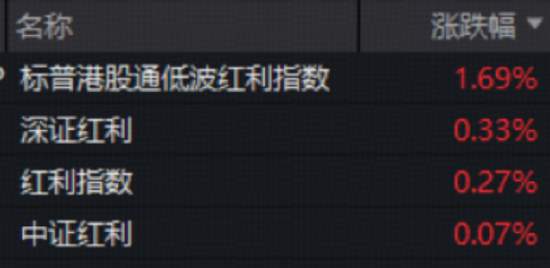
Market Overview - On November 12, A-shares experienced fluctuations, with the Shanghai Composite Index hovering around the 4000-point mark, while Hong Kong stocks strengthened, with the Hang Seng Index rising by 0.85% [1] - The Hong Kong Dividend ETF (159220), which passively tracks the S&P Hong Kong Low Volatility Dividend Index, surged by 1.91%, outperforming mainstream dividend indices in A-shares [1] Performance Metrics - The S&P Hong Kong Low Volatility Dividend Index increased by 1.69%, while other indices such as the Shenzhen Dividend Index and the CSI Dividend Index saw smaller gains of 0.33% and 0.07%, respectively [2] - The Hong Kong Dividend ETF has achieved a new closing price high for six consecutive trading days since November 5, indicating strong momentum in dividend assets [2] Fund Inflows and Investor Behavior - The Hong Kong Dividend ETF has seen a net inflow of funds for nine consecutive days, driven by significant buying from southbound funds, which recorded a net inflow of HKD 66.53 billion on November 10, with total net inflows exceeding HKD 1.3 trillion for the year [3][4] - The ETF's transparency, low fees, and trading convenience have made it increasingly popular among investors [3] Index Composition and Dividend Potential - The S&P Hong Kong Low Volatility Dividend Index includes a mix of large-cap and mid-cap stocks, with over half of its constituents being state-owned enterprises, which are expected to benefit from favorable policies related to state-owned enterprise market value management [4] - In the first half of 2025, 713 Hong Kong companies announced dividends totaling HKD 812.7 billion, a year-on-year increase of 31.35%, indicating a strong dividend-paying trend in the market [4] Dividend Yield Comparison - As of the end of October 2025, the Hong Kong Dividend ETF's underlying index had a dividend yield of 5.54%, significantly higher than the yields of the CSI Dividend Index (4.80%), CSI Low Volatility Dividend Index (4.74%), and Shanghai Dividend Index (5.31%) [6]
股市缩量震荡,债市情绪偏多
Zhong Xin Qi Huo· 2025-11-13 01:38
1. Report Industry Investment Ratings - No specific industry investment ratings are provided in the report. 2. Core Views - The stock market shows a shrinking volume and narrow - range oscillation, with the dividend style being prominent. It is recommended to transfer technology funds to the price - rising chain and continue the dumbbell configuration [1][6]. - The bond market sentiment is bullish. Although there is still short - term support, the downward space for yields may be limited, and the bond market is expected to oscillate strongly [2][7]. - For stock index options, it is advisable to continue holding covered positions for defense as the market style rotates and no capital main line has been formed yet [1][6]. 3. Summary by Relevant Catalogs 3.1 Market Views 3.1.1 Stock Index Futures - **View**: Shrinking volume and narrow - range oscillation, with the dividend style being prominent. The basis, spread, and position of IF, IH, IC, and IM have changed to varying degrees [6]. - **Logic**: The Shanghai Composite Index oscillated narrowly around 4,000 points on Wednesday, with a trading volume of 2 trillion yuan. The style structure was further adjusted, and the sustainability of hotspots was limited. After the release of the 25Q3 monetary policy report, long - term bond prices opened higher and rose, the bank sector soared in the morning, and the dividend index was strong. High - risk - appetite sectors retreated, and the external market's drag on the domestic market weakened [6]. - **Operation Suggestion**: Dividend ETF + IM long positions [6]. 3.1.2 Stock Index Options - **View**: Focus on covered defense [6]. - **Logic**: The equity market oscillated weakly yesterday, and the turnover of each option variety oscillated and recovered but remained at a relatively low level of liquidity since October. The option sentiment index showed a weak trend, especially for the CSI 1000 index options and technology - sector option varieties. Option trading sentiment changed with the style switch, and option volatility strengthened [6]. - **Operation Suggestion**: Covered positions [6]. 3.1.3 Bond Index Futures - **View**: Bond market sentiment is bullish. The trading volume, position, spread, and basis of T, TF, TS, and TL have changed to varying degrees. The central bank conducted 195.5 billion yuan of 7 - day reverse repurchases, with 92.8 billion yuan of reverse repurchases maturing on the same day [7]. - **Logic**: Bond index futures prices rose across the board yesterday. The domestic bond market was generally bullish, interest - rate bond yields mostly declined, and the inter - bank market liquidity improved. The central bank's third - quarter monetary policy report in 2025 continued the keynote of a "moderately loose monetary policy" [2][7]. - **Operation Suggestion**: Trend strategy: oscillate strongly. Hedging strategy: pay attention to long - position substitution at high basis levels. Basis strategy: pay attention to the positive spread strategy and basis widening. Curve strategy: appropriately pay attention to curve steepening [8]. 3.2 Economic Calendar - The report lists the economic indicators to be released in China from November 13 to 14, 2025, including new RMB loans, social financing scale, M2 money supply annual rate, total retail sales of consumer goods annual rate, and added value of industrial enterprises above designated size annual rate [9]. 3.3 Important Information and News Tracking - **Sino - US Relations**: Chinese Vice - Premier He Lifeng met with representatives of the National Committee on United States - China Relations, emphasizing the broad cooperation space in the economic and trade fields between the two countries and the need to implement the consensus of the two heads of state [10]. - **New Energy**: The National Energy Administration issued a guiding opinion on promoting the integrated and coordinated development of new energy, including optimizing the power structure and energy - storage configuration ratio of "desert, Gobi, and wasteland" new - energy bases and exploring the construction of new water - wind - solar integrated bases [10]. - **Automobile**: The Ministry of Public Security completed the solicitation draft of the national standard "Technical Conditions for Motor Vehicle Operation Safety", which includes speed - limit requirements and safety requirements for new - energy vehicles [11]. - **Power Battery**: The 2025 World Power Battery Conference held a signing ceremony in Yibin, Sichuan, with 180 projects signed, totaling 86.13 billion yuan. After full operation, the expected annual output value will exceed 90 billion yuan, and over 50 leading enterprises will settle in Yibin [11]. 3.4 Derivatives Market Monitoring - The report includes sub - sections on stock index futures data, stock index options data, and bond index futures data, but no specific data content is provided in the given text [12][16][28].
指数冲击“八连阳”,恒生红利低波ETF(159545)持续获资金布局
Mei Ri Jing Ji Xin Wen· 2025-11-12 07:17
Group 1 - The Hong Kong dividend sector continues to rise, with the Hang Seng High Dividend Low Volatility Index up 0.6%, potentially achieving an "eight consecutive days" increase [1] - The Hang Seng Dividend Low Volatility ETF (159545) has seen a net subscription of nearly 150 million units during the day, with a total net inflow of approximately 750 million yuan over the past nine trading days [1] - Analysts suggest that the dividend style may continue to outperform as the market shifts from extreme growth trading to a mean reversion in growth value returns, benefiting dividend styles [1] Group 2 - Institutional investors are likely to shift their holdings towards dividend and stable styles due to the demand for steady returns at year-end [1] - Insurance funds are facing a transition to new accounting standards, which may drive a demand for lower volatility assets, further pushing funds towards dividend styles [1] - According to Guotai Junan Securities, dividend assets are expected to outperform relative returns amid significant market volatility due to multiple uncertainties [1] Group 3 - The valuation of Hong Kong dividend assets offers a higher dividend yield advantage compared to A-shares [1] - There is an anticipated increase in demand for dividend asset allocation from insurance funds in the fourth quarter, supported by a backdrop of easing overseas liquidity [1] Group 4 - E Fund is currently the only fund company that implements low fee rates for all dividend ETFs, with management fees for various products set at 0.15% per year [2] - This low-cost structure aids investors in efficiently allocating to high dividend assets [2]