
美元走强

Search documents
黄金温和反弹遇阻,保持区间震荡运行
Sou Hu Cai Jing· 2025-11-21 03:16
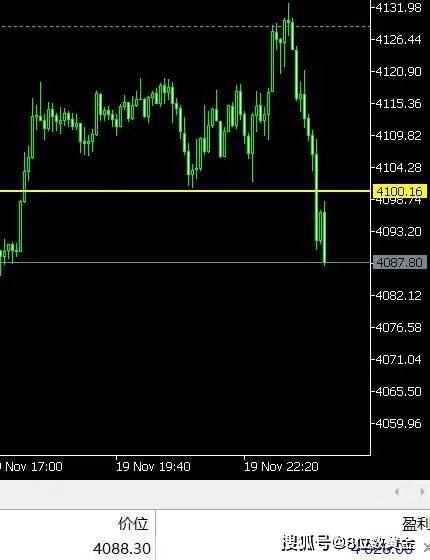
Core Viewpoint - Despite the high valuation pressure on US tech stocks leading to market sell-offs, which has spread to Asian and European markets, gold has seen a mild rebound. However, the Federal Reserve's hawkish stance on interest rate cuts has limited the upside for gold prices [1][3]. Group 1: Market Dynamics - The recent sell-off in US tech stocks has influenced global markets, pushing gold prices to experience a mild rebound [1]. - The Federal Reserve's signals against rate cuts have led to a reduction in market bets for a December rate cut, which has put pressure on gold prices [1][3]. Group 2: Gold Price Movements - Gold prices faced resistance at $4,110, retreated to $4,042, and then fluctuated around $4,085 before stabilizing [3]. - The price of gold fluctuated within a range, with a low of $4,038 and a closing price around $4,087, indicating a range-bound trading pattern [3]. Group 3: Economic Indicators - The release of the US non-farm payroll data for September showed mixed results, with an increase in job numbers but a rise in the unemployment rate and a slowdown in wage growth [3]. - Following the data release, market expectations for a Federal Reserve rate cut slightly increased to 35%, while the probability of maintaining the current rate approached 65% [3].


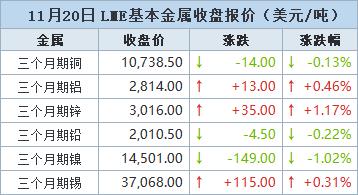
金属涨跌互现 期铜下跌,受累于需求担忧和美元强劲 【11月20日LME收盘】
Wen Hua Cai Jing· 2025-11-21 00:39
Core Viewpoint - LME copper prices have declined due to a strong dollar and concerns over weak demand, despite a year-to-date increase of approximately 22% [1][4]. Group 1: Market Performance - On November 20, LME three-month copper fell by $14, or 0.13%, closing at $10,738.50 per ton [1][2]. - Other base metals showed mixed performance, with three-month aluminum up by $13 (0.46%) and three-month zinc up by $35 (1.17%), while three-month lead fell by $4.50 (0.22%) [2]. Group 2: Demand and Supply Dynamics - Concerns over weak demand persist, highlighted by a 13.62% month-on-month and 16.32% year-on-year decline in China's refined copper imports for October 2025 [5]. - Cochilco has raised its copper price forecasts for 2025 and 2026 to historical highs due to weak production, now expecting an average price of $4.45 per pound for 2025 and $4.55 per pound for 2026 [5].
11.20黄金连跳大跌90美金 继续争夺4100
Sou Hu Cai Jing· 2025-11-20 07:19
Core Viewpoint - Gold prices experienced significant volatility, with sharp declines following a period of high trading, indicating ongoing market adjustments and uncertainty in the economic landscape [1][12]. Market Performance - Gold saw a dramatic drop after reaching around 4129, falling below the 4100 mark, and subsequently rebounding to 4040 before facing further declines [5][7][12]. - The market is currently in a phase of rapid fluctuations, characterized by quick rises and falls, with adjustments being the primary focus [8]. Technical Analysis - The key resistance level is identified at 4100, with potential upward movement towards 4142 if broken [9]. - Conversely, if the price fails to maintain above 4100, further downward pressure is expected, with support levels at 4040 and 4000 [10][12]. Influencing Factors - Recent U.S. unemployment claims data showed significant revisions, indicating rising layoffs and increasing uncertainty, which has positively impacted gold prices [13]. - The narrowing trade deficit in the U.S. exceeded expectations, while the absence of key economic data for October has left the market in suspense regarding future Federal Reserve actions [13]. - Geopolitical factors, including easing tensions between the U.S. and Russia, have also contributed to the recent volatility in gold prices [13]. Upcoming Events - The upcoming non-farm payroll report is anticipated to provide critical insights into the labor market, which could further influence market dynamics and financial stability [14].
华安期货:11月20日黄金白银高位盘整
Sou Hu Cai Jing· 2025-11-20 03:40
Core Viewpoint - Precious metals are currently under pressure due to a stronger dollar and changing expectations regarding Federal Reserve policies, but long-term trends such as global central bank gold purchases and potential impacts of U.S. debt issues on dollar credibility continue to support precious metals [1][3]. Group 1: Market Performance - COMEX gold futures rose by 0.29% to $4,078.30 per ounce, while COMEX silver futures increased by 1.08% to $51.07 per ounce [1]. - The platinum market is expected to experience a significant shortage for the third consecutive year, with a projected shortfall of 22 tons, revised down by 5 tons from previous estimates [1]. Group 2: Federal Reserve Insights - The minutes from the Federal Reserve's October policy meeting revealed significant divisions among officials regarding interest rate decisions, with some suggesting that maintaining rates through 2025 may be appropriate, while others indicated that another rate cut in December could be likely if economic performance aligns with expectations [1]. Group 3: Employment Data - The U.S. Bureau of Labor Statistics announced that it will not release the October employment report, indicating that the non-farm employment data will be included in the November report instead [1].
KVB外汇:美联储鹰派言论与美元走强拖累金价
Sou Hu Cai Jing· 2025-11-17 10:01
Group 1 - Gold (XAU/USD) shows initial signs of strength but quickly loses momentum as market sentiment shifts, influenced by hawkish signals from Federal Reserve officials [1][2] - The expectation for immediate interest rate cuts has diminished, with the probability of a December rate cut falling below 50%, putting pressure on gold prices [2][3] - The strengthening of the US dollar, driven by adjustments in interest rate expectations, increases the purchasing cost of gold for international buyers, adding further pressure on gold prices [2][3] Group 2 - Key support level around $4000 has become crucial, coinciding with the lower boundary of an expanding wedge pattern, indicating technical buying interest remains [6] - If the wedge pattern holds, gold may consolidate in this area before attempting another upward move, with mid-term resistance at approximately $4150 [6] - The interplay of macroeconomic uncertainty and technical pressures keeps gold in a state of volatility, with future movements dependent on upcoming data and policy signals [6]
今日黄金多少钱一克?11月13日黄金价格又跌价
Sou Hu Cai Jing· 2025-11-15 14:17
Core Insights - On November 13, 2025, global financial markets focused on precious metals, with international spot gold prices experiencing notable fluctuations, reaching $4,129.2 per ounce [1] - The domestic gold market also showed complex dynamics, with real-time prices providing investors with immediate market references [2] Domestic Precious Metals Market - The domestic gold price was reported at 946.3 RMB per gram, while silver, platinum, and palladium prices were 11.6 RMB, 365.7 RMB, and 332.6 RMB per gram respectively [2] - Various jewelry brands offered different retail prices for gold, with notable examples including Chow Tai Fook at 1,313 RMB per gram for gold jewelry and 642 RMB for platinum [5] Gold Price Trends - The Shanghai Gold Exchange reported a gold price of 942.19 RMB per gram, down 4.31 RMB from the previous trading day, reflecting a decline of 0.455% [6] - The price fluctuated during the day, reaching a high of 949.22 RMB and a low of 938.16 RMB [6] Financial Institutions' Gold Bar Pricing - Different financial institutions offered varying prices for their gold bars, with prices ranging from 936.1 RMB to 976 RMB per gram [7] - For instance, the Agricultural Bank's gold bar was priced at 945.2 RMB per gram, while the higher-priced option from Qianjiaxin was 1,072 RMB per gram [7] Investment Logic Behind Gold Price Movements - Recent adjustments in international gold prices followed a significant prior increase, with London spot gold prices dipping below $4,000 per ounce [8] - Factors influencing this trend included a strengthening dollar, high interest rates, and a shift in global investor risk appetite [8][9] Dollar and Interest Rate Impact - A strong dollar typically pressures gold prices, while a weak dollar supports them; recent Federal Reserve actions have contributed to a stronger dollar [9] - High yields on 10-year U.S. Treasury bonds, currently above 4.1%, have led investors to reassess the opportunity cost of holding gold [9] Evolving Investor Sentiment - The allure of gold as a safe-haven asset has diminished as geopolitical and financial risks have eased, prompting a shift of funds towards equities, bonds, and cryptocurrencies [10] - The adjustment in gold prices reflects a rebalancing of market investment logic rather than panic selling or a decline in gold's intrinsic value [10]
燃料油:弱势运行
Bao Cheng Qi Huo· 2025-11-14 05:26
Report Industry Investment Rating - Not provided in the report Core Viewpoints - Since late October, affected by supply - side disturbances and seasonal weakness in demand, the domestic high - sulfur fuel oil futures 2601 contract has fluctuated widely in the range of 2600 - 2850 yuan/ton. After being dragged down by the sharp decline in domestic and international crude oil futures prices, it fell 4% and dropped below the 2600 yuan/ton line. In a bearish atmosphere, it is expected that fuel oil will maintain a weak and volatile trend in the future [2]. - In the context of increasing macro - risks, the fuel oil futures market is under short - term pressure, and its subsequent trend depends more on the structural changes on the supply side rather than the strong recovery of demand [3]. - Although the short - term macro - outlook is weak and the strengthening of the US dollar may suppress the fuel oil futures price, the restricted supply pattern of Russian fuel oil is difficult to reverse in the short term, and geopolitical risk premiums will still exist. Affected by the recent sharp decline in domestic and international crude oil futures prices, it is expected that fuel oil futures may maintain a weak and volatile trend [4]. Summary by Related Catalogs Market Performance - Since late October, the domestic high - sulfur fuel oil futures 2601 contract has fluctuated widely in the range of 2600 - 2850 yuan/ton. After being dragged down by the sharp decline in domestic and international crude oil futures prices, it fell 4% and dropped below the 2600 yuan/ton line [2]. Macro - factors - Recent "hawkish" signals from Fed officials mean that the US will maintain a high - interest - rate environment for a longer time, which boosts the US dollar index. The government "shutdown" has dragged down the economy, and the weakening macro - expectations will have multiple impacts on the fuel oil futures market [2]. - High - interest - rate environment suppresses global economic growth expectations and the demand for dollar - denominated commodities, increasing the volatility and risk of trading and indirectly suppressing the consumption demand for marine fuel oil [2]. Supply - side Factors - Since August 2025, Russian energy facilities have been frequently attacked, and its refining capacity has declined by about 20% as of the end of October. In November, the US and the EU further tightened sanctions on Russian oil companies, reducing its export capacity [3]. - In the Middle East, some Saudi refineries are in the maintenance cycle, and some Kuwaiti refineries have shut down part of their production capacity due to device fires. In Latin America, the export volume of high - sulfur fuel oil in countries such as Mexico shows a seasonal decline, and new secondary processing devices in some refineries will also restrict supply growth [3]. Demand - side Factors - As the crude oil quota of domestic refineries is running out in the fourth quarter, some refineries tend to purchase high - sulfur fuel oil as feedstock for delayed coking units, providing new demand support [4]. - The number of ships equipped with desulfurization towers globally has exceeded 4500 in 2025. Due to the economic advantages of using high - sulfur fuel oil after installation, the demand from this part of the fleet remains stable [4].
美元走强对港股意味着什么
2025-11-10 03:34
Summary of Conference Call Records Industry Overview - The discussion primarily revolves around the impact of a strong US dollar on the Hong Kong stock market (港股) and the broader implications for foreign investment and local liquidity [1][4]. Key Points and Arguments 1. **Reasons for Recent Dollar Strength**: - The US government shutdown has led to liquidity tightening, with the Treasury's account balance rising significantly, pulling approximately $700 billion in liquidity since June [2]. - The Federal Reserve's hawkish stance has cooled expectations for interest rate cuts, with the probability of a December rate cut dropping from nearly 100% to around 60% [2]. - The weakness of non-US currencies, particularly the Japanese yen, has also contributed to the strengthening of the dollar [2]. 2. **Impact on Hong Kong Stock Market**: - The Hong Kong stock market is heavily influenced by foreign capital, with foreign investment accounting for about 60% of the market [1][4]. - Historical data shows a strong correlation between foreign capital flows and the US dollar index, with significant outflows occurring during periods of rapid dollar appreciation [4]. - Since the end of September, flexible foreign capital has net exited the Hong Kong stock market by approximately HKD 75 billion [1][4]. 3. **Local Currency and Liquidity Dynamics**: - Hong Kong operates under a linked exchange rate system, where the Monetary Authority must withdraw liquidity when the HKD approaches the weak side of the peg at 7.85 [1][4]. - Despite the dollar's strength, the HKD has remained close to the strong side of the peg due to inflows from mainland China and reduced expectations for US rate cuts, meaning there is currently no need for liquidity withdrawal [1][4]. 4. **Market Outlook**: - Recent factors such as stabilizing US-China trade negotiations and potential resolution of the US government shutdown may alleviate pressure on the Hong Kong market [5]. - The current valuation of the Hong Kong stock market is considered reasonable, with potential for a bull market if suppressive factors are lifted and quality assets accumulate in sectors like internet, innovative pharmaceuticals, and new consumption [5][6]. - The technology sector, particularly AI leaders, innovative pharmaceuticals, and brokerage firms, are expected to lead market growth in the future [3][5][6]. Other Important Insights - The strong dollar has a direct impact on liquidity in the Hong Kong market, affecting both foreign and local investors [1][4]. - The potential for a bull market hinges on the resolution of current economic pressures and the influx of new capital into high-quality sectors [5][6].
国泰海通 · 晨报1110|宏观、海外策略、交运、机械
国泰海通证券研究· 2025-11-09 14:48
Group 1: Inflation Trends - The core inflation continues to rise steadily, with October CPI increasing by 0.2% year-on-year and 0.2% month-on-month, while PPI shows a year-on-year decline of 2.1% but a month-on-month recovery to 0.1% [3][5] - The main drivers for the recent rise in core CPI include anti-involution governance, fiscal stimulus, and rising gold prices, while long-term recovery relies on improving consumer capacity and high-quality consumption scenarios [3][5] - Food price drag has lessened, with core service prices rising seasonally, reaching the highest level since March 2024 [3][5] Group 2: Market Dynamics - The strong dollar has led to outflows of foreign capital from Hong Kong stocks, with a net outflow of 791.8 million HKD since the end of September [9][10] - The dollar's strength is attributed to U.S. government shutdowns, hawkish Fed statements, and weakness in non-dollar currencies, impacting liquidity in Hong Kong [8][9] - Despite short-term pressures, the Hong Kong market is expected to reach new highs in the medium term, driven by inflows of incremental capital and high-quality assets [10] Group 3: Aviation Sector Outlook - The Chinese aviation sector is entering a "super cycle," with a significant rise in profitability expected as supply and demand recover, leading to higher ticket prices [14][15] - The supply side is constrained by airspace bottlenecks, while demand is supported by a growing aviation population and recovery in customer structure [14] - The long-term logic of the aviation sector suggests a strategic increase in positions, particularly in high-quality networks, as demand continues to strengthen [15] Group 4: Machinery Industry Performance - The machinery industry is projected to see overall improvement by 2025, with significant revenue growth and profit increases reported in the first three quarters of 2025 [17] - Key growth areas include humanoid robots and engineering machinery, driven by advancements in AI manufacturing and increased orders from overseas markets [18] - The energy equipment sector is also recovering, with a focus on rational competition and price recovery in the photovoltaic equipment market [18]

国泰海通证券:美元走强对港股意味着什么
Zhi Tong Cai Jing· 2025-11-09 07:32
Core Viewpoint - The recent strengthening of the US dollar is primarily driven by the US government shutdown, hawkish statements from the Federal Reserve, and weakness in non-US currencies, which may lead to capital outflows from Hong Kong stocks and impact local liquidity under the currency peg system [1][2]. Impact of Strong US Dollar on Hong Kong Stocks - The US dollar index has strengthened since the end of September, surpassing the 100 mark on November 4, reaching its highest level since July [1]. - The strong dollar has historically correlated with capital outflows from Hong Kong stocks, as foreign capital remains sensitive to dollar movements [3]. - Recent data shows a net outflow of HKD 791.8 billion from foreign capital in Hong Kong stocks since the end of September, with flexible foreign capital being more sensitive to dollar strength [3]. Factors Contributing to Dollar Strength - The US government shutdown has led to a liquidity crunch, with the Treasury's total account balance rising to USD 1 trillion, effectively removing about USD 700 billion from the market [1]. - The Federal Reserve's hawkish stance has cooled expectations for interest rate cuts, with the probability of a December rate cut dropping from over 90% to 61.5% [2]. - Weakness in non-US currencies, particularly the Japanese yen and British pound, has further supported the dollar's strength [2]. Local Liquidity and Market Impact - The Hong Kong Monetary Authority's currency peg system may lead to short-term impacts on local liquidity and sectors sensitive to interest rates, such as consumption and real estate [4][5]. - Historical patterns indicate that a strong dollar often coincides with rising dollar interest rates, which can tighten local liquidity if the Hong Kong dollar depreciates significantly [5]. Market Outlook - Short-term focus should be on the potential reopening of the US government and upcoming economic data, which could influence market liquidity [6]. - Mid-term prospects for Hong Kong stocks appear positive, with low valuations and potential inflows of capital, particularly in the technology sector driven by AI [6][7]. - The Hong Kong stock market is expected to benefit from a combination of increased foreign and domestic capital inflows, alongside the scarcity of quality assets [7][8].
