AI基础设施建设

Search documents
铜价上涨趋势能否延续
Zheng Quan Ri Bao· 2025-12-04 16:15
Core Insights - Recent strong surge in copper prices has drawn market attention, with Shanghai copper futures reaching a historic high of 90,000 yuan/ton on December 3 [1] - The tight supply situation in the copper market is reflected in the premium of LME spot copper over three-month futures, which reached $86 per ton, the highest since mid-October [1] Group 1: Factors Driving Copper Demand - The comprehensive economic transformation is driving a steady increase in copper demand, particularly in the electric vehicle and photovoltaic sectors [2] - The demand for copper in the new energy sector is becoming increasingly significant, with electric vehicles consuming 2 to 3 times more copper than traditional cars [2] - The construction of new power grids is further increasing the demand for copper, with significant differences in copper usage between traditional and new energy power generation [2] Group 2: Supply Constraints - The supply side is facing increasing constraints, with major copper-producing countries experiencing notable declines in output, such as a 26% drop in production at Peru's Antamina mine [3] - LME copper inventories have fallen to relatively low levels, indicating a supply shortage [3] Group 3: Price Outlook and Market Strategies - Despite some institutions warning of potential short-term corrections, most remain bullish on copper prices, with forecasts suggesting prices could exceed $12,000/ton [4] - The average grade of global copper mines is declining, and low capital expenditures are expected to limit supply, while demand from the new energy sector continues to grow [4] - Companies are advised to develop reasonable procurement strategies and utilize financial tools to hedge against price fluctuations [6]
存储市场“雪上加霜”?美光将退出“消费级存储业务”,聚焦AI存储芯片34/64
美股IPO· 2025-12-04 03:32
Core Viewpoint - Micron Technology announced the complete shutdown of its Crucial brand business, which has been operational for nearly 30 years, while continuing to ship products through consumer channels until February 2026. This exit will create a significant gap in the consumer storage market, especially as analysts warn of potential memory shortages lasting for several years [1][4]. Group 1: Strategic Shift - Micron is shifting its focus from consumer storage to advanced storage chip production for AI data centers, particularly High Bandwidth Memory (HBM), amid a global supply crunch for storage chips [3][5]. - The decision to exit the consumer market is driven by the surge in demand for storage due to AI-driven data center growth, as stated by Micron's Chief Business Officer [3][5]. Group 2: Market Impact - Micron's exit will leave a substantial void in the consumer storage market, where it holds a 13% market share in NAND flash memory for SSDs. This move raises concerns about whether other companies can fill this gap [4][9]. - The withdrawal of Micron from the consumer market is expected to exacerbate supply shortages, particularly as major companies are investing billions in building large data centers, further increasing demand for storage [7][10]. Group 3: Financial Performance - Micron's HBM revenue reached nearly $2 billion in the latest quarter, indicating a strong pivot towards more profitable segments compared to its consumer business, which has not been a significant driver of revenue [5][6]. - The cloud storage segment of Micron reported a 213% year-over-year growth, reflecting robust demand from AI data centers [6]. Group 4: Competitive Landscape - Micron is the third-largest DRAM supplier globally, following Samsung and SK Hynix, which together hold 92% of the DRAM market share. The competitive landscape is intensifying as companies prioritize profitability over risky capacity expansions [4][10]. - The demand for advanced storage chips is driven by AI chip manufacturers like NVIDIA and AMD, which require significantly more memory compared to traditional consumer devices [8].



迈威尔科技(MRVL.US)2026财年Q3业绩会:定制ASIC业务下一财年预计增长约20%
Zhi Tong Cai Jing· 2025-12-04 03:17
Core Viewpoint - Marvell Technology (MRVL.US) anticipates revenue of approximately $10 billion for the next fiscal year, supported by an organic growth plan, with expectations for sequential growth each quarter and stronger growth in the second half of the year [1][2] Revenue Projections - The custom ASIC business is expected to grow by about 20% in the next fiscal year, with projections to double by fiscal year 2028 compared to fiscal year 2027 [1][2] - The interconnect business is projected to continue growing at a rate that exceeds capital expenditures [1][2] - Other segments of the data center business, including storage and switching, are expected to grow by 10% in fiscal year 2028, leading to an overall data center business growth rate of nearly 40% in that year [1][2] - The compound annual growth rate (CAGR) for the data center business since 2023 is approximately 50% [1][2] Long-term Growth Drivers - Assuming communication and other businesses grow at GDP rates, Marvell's total revenue growth rate for fiscal year 2028 is estimated to be around 30% [1][2] - Growth drivers such as Celestial AI are expected to start contributing from fiscal year 2028 and further accelerate in fiscal year 2029 and beyond [1][2] AI and Product Development - Marvell has secured orders for next-generation 3nm and 2nm XPU products, with a strong product pipeline and visibility [3] - Revenue targets for Celestial AI, including $500 million and $1 billion, are based on the overall business, with initial revenue expected from PF small chips [3][4] - The collaboration with a leading customer is crucial for driving initial growth, with significant interest in the photonics transition within data centers [4] Custom Business Insights - The custom business is projected to have a solid growth base of 20%, with strong order reserves and expected acceleration in the second half of the year [5] - Long-term guidance is provided due to the multi-year cycle of AI infrastructure development, enhancing confidence in achieving future revenue targets [5] Strategic Partnerships - The extension of a warrant agreement with Amazon for 1 million shares related to photonic architecture indicates a strong partnership, with significant potential for collaboration [6] - The optical business is driven by AI and AI accelerators, with growth expected to exceed capital expenditures [6] System-Level Solutions - Marvell aims to provide comprehensive rack-level solutions, integrating various optical interconnect technologies, while maintaining a vision for system-level capabilities [7] - Current forecasts do not include system-level revenue, but the strategy emphasizes a holistic approach rather than isolated solutions [7]

集邦:五大NAND原厂Q3营收环比增长16.5%,铠侠大涨33.1%
Sou Hu Cai Jing· 2025-12-03 10:05
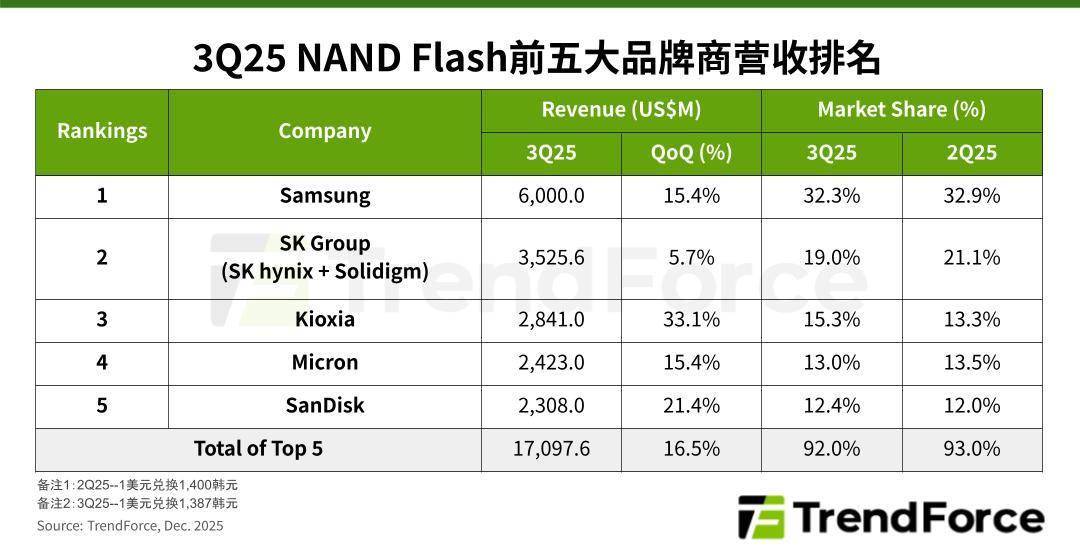
IT之家 12 月 3 日消息,研调机构 TrendForce 集邦咨询今日表示,五大 NAND 原厂今年三季度相关业务营收实现 16.5% 环比增长,总额接近 171 亿美元 (IT之家注:现汇率约合 1210.36 亿元人民币),其中 KIOXIA 铠侠营收相较二季度大幅扩张 33.1%。 | Rankings | Company | Revenue (US$M) | | | Market Share (%) | | --- | --- | --- | --- | --- | --- | | | | 3Q25 | QoQ (%) | 3Q25 | 2Q25 | | 1 | Samsung | 6,000.0 | 15.4% | 32.3% | 32.9% | | 2 | SK Group (SK hynix + Solidigm) | 3,525.6 | 5.7% | 19.0% | 21.1% | | 3 | Kioxia | 2,841.0 | 33.1% | 15.3% | 13.3% | | 4 | Micron | 2,423.0 | 15.4% | 13.0% | 13.5% | | 5 | ...
英伟达CFO:5000亿美元芯片预订不含OpenAI合作,千亿美元协议仍未敲定
美股IPO· 2025-12-03 00:57
Core Viewpoint - Nvidia's CFO Colette Kress indicated that the projected $500 billion in orders for Blackwell and Rubin AI chips by 2026 does not include any ongoing work related to the next phase of collaboration with OpenAI, and the previously announced $100 billion investment agreement with OpenAI has not yet been finalized [1][3][4] Group 1: Nvidia and OpenAI Collaboration - Nvidia's investment agreement with OpenAI, which was announced in September, involves deploying at least 10 gigawatts of Nvidia systems, sufficient to power over 8 million American households, with a commitment to invest up to $100 billion as systems come online [3][4] - Kress stated that the $500 billion demand for Blackwell and Rubin systems does not account for any work being done for the next phase of the OpenAI agreement [4] - OpenAI is currently procuring mainly through cloud partners like Microsoft and Oracle rather than the direct purchasing path outlined in the September letter of intent [5][6] Group 2: Market Demand and Financial Implications - Nvidia has previously disclosed sales and market demand for Blackwell and Rubin but did not clarify the relationship between the $500 billion order figure and the OpenAI collaboration [8] - Kress reiterated that the $500 billion figure could increase, and new partnerships announced during the reporting period have not been fully accounted for [8] - The latest 10-Q filing from Nvidia suggests that the investment arrangements may not be completed as expected, indicating potential risks associated with the OpenAI agreement and other investments [9] Group 3: Challenges and Competition - Nvidia acknowledged that the pace of technological updates complicates planning, as the company has shifted to annual releases of new architectures while supporting previous generations [10] - Concerns have been raised about the potential for market volatility related to AI workloads, similar to past cycles seen in cryptocurrency mining [11] - Despite the uncertainty surrounding the OpenAI agreement, Kress emphasized that Nvidia's relationship with OpenAI remains strong, and the company's sales outlook does not rely on this pending collaboration [12]


中金 • 全球研究 | 解码再工业化系列(三):美国制造业回流趋势篇——关注三条投资主线
中金点睛· 2025-11-26 23:34
Core Viewpoint - The article emphasizes the ongoing trend of re-industrialization in the U.S., focusing on three main investment themes for 2026: robust public infrastructure projects, a rebound in industrial equipment investment after a three-year downturn, and the growth of the data center industry driven by AI infrastructure [2][3]. Investment Themes - **Theme 1: Public Infrastructure Projects** The article predicts a strong recovery in non-residential construction investments, particularly in sectors like manufacturing and soft infrastructure, driven by large public projects [2][3][9]. - **Theme 2: Industrial Equipment Investment Rebound** Following a three-year decline, the industrial equipment investment indicators are expected to recover, reflecting renewed production activities in the manufacturing sector [3][30]. - **Theme 3: Data Center Industry Growth** The demand for AI infrastructure is anticipated to significantly boost the data center industry, with projected investments of approximately $100-110 billion in 2026, despite a decrease in growth rate from previous years [3][46][49]. Manufacturing Sector Dynamics - The article highlights that the re-shoring of manufacturing is positively impacting construction investments, particularly in sectors like semiconductors, batteries, and pharmaceuticals, with a projected annual investment increase exceeding $300 billion under optimistic scenarios [7][30]. - From 2021 to 2024, the U.S. manufacturing sector is expected to see a substantial increase in construction investments, with a projected growth of 184% from $816 billion in 2021 to $2.321 trillion in 2024 [31]. Infrastructure Investment Trends - The Infrastructure Investment and Jobs Act (IIJA) is driving a significant increase in public infrastructure spending, with $1.2 trillion authorized for infrastructure projects, of which $550 billion is allocated for new investments [14][15]. - As of the end of 2024, 21% of the planned projects under the IIJA have been funded, indicating a strong pipeline for future infrastructure investments [15]. Employment and Labor Market Insights - The article notes that employment in the non-residential construction sector has accelerated due to infrastructure spending, although growth rates are expected to decline post-2024 [18][21]. - The labor market in the construction sector is expected to remain robust, with a shift towards specialized contractors as the focus moves from large public projects to ongoing maintenance and upgrades [18][21]. Sector-Specific Insights - The article identifies that the commercial construction sector is experiencing a structural divide, with data center projects leading the way, while traditional commercial investments are lagging [23][25]. - The residential construction sector is projected to recover in 2026 after a period of decline, with new housing starts expected to stabilize [25][30]. Conclusion - Overall, the article presents a comprehensive analysis of the U.S. re-industrialization trend, highlighting significant investment opportunities across various sectors, particularly in infrastructure, manufacturing, and data centers, driven by government policies and technological advancements [2][3][30].

阿里结束多元化:财报背后的组织变化
3 6 Ke· 2025-11-26 11:23
Core Viewpoint - The article discusses Alibaba's organizational transformation from a decentralized "federal" structure to a more centralized model, emphasizing the need for unified infrastructure to compete effectively in the market. This shift is evidenced by significant changes in financial performance and strategic focus, particularly in the realm of instant retail and AI infrastructure. Group 1: Organizational Structure and Strategy - The nature of an organization's structure directly influences its product system, with a decentralized structure leading to modular and incompatible products [1] - Alibaba's "1+6+N" organizational reform aimed to create a federal system, but this approach has effectively ended, leading to a return to a centralized model [1][2] - The shift to a centralized structure is seen as necessary for addressing the challenges of building integrated physical and digital infrastructures [1][4] Group 2: Financial Performance - Taotian Group's adjusted EBITA dropped from 44.3 billion to 10.5 billion yuan, a decline of 76% year-over-year [2] - The significant profit drop is interpreted as a strategic decision to reallocate resources rather than a mere consequence of increased competition [3][4] - The centralized decision-making process allows for the redistribution of profits from profitable units to support critical areas like instant retail [4][7] Group 3: Instant Retail and AI Infrastructure - Instant retail is framed as a foundational infrastructure rather than just a business, focusing on long-term strategic investments rather than immediate profitability [6][8] - The integration of various business units is crucial for operational efficiency, enabling seamless collaboration across logistics, supply chain, and sales [8] - Alibaba's cloud intelligence group reported a 34% revenue growth, with AI-related products experiencing triple-digit growth for five consecutive quarters [8][9] Group 4: Capital Expenditure and Strategic Focus - High capital expenditure (CapEx) of 31.4 billion yuan indicates a strategic commitment to AI infrastructure, which is seen as a long-term investment [9][10] - The centralized approach to AI infrastructure is necessary to avoid data fragmentation and inefficiencies across different business units [10][11] - The transition from an "application factory" to a "smart power plant" reflects a strategic pivot towards building a unified AI capability [12] Group 5: Implications of Centralization - The centralization process results in the marginalization of non-core businesses, with a 25% revenue decline in "other" business segments [13][14] - The focus on core areas like e-commerce and cloud services signals a shift away from diversified operations towards a more streamlined infrastructure model [14][16] - The article highlights the challenges of executing this transformation, including potential internal confusion and inefficiencies during the transition [16][17]

英伟达:三季度业绩稳健,四季度指引有望缓解市场对AI泡沫的担忧
Zhao Yin Guo Ji· 2025-11-21 05:08
2025 年 11 月 21 日 招银国际环球市场 | 睿智投资 | 行业研究 英伟达(NVDA US,未评级)再次交出了超预期的季度业绩。公司三季度收入大 幅增长至 570 亿美元,同比增长 62%,环比增长 22%,超出彭博一致预期/公司 指引 3%/6%。公司本季度收入环比增加 100 亿美元,显著超出 40-50 亿美元的历 史正常水平。Non-GAAP 毛利率为 73.6%,略低于彭博预期但小幅超出公司指 引。毛利率环比提升 1.0 个百分点,主要得益于数据中心产品组合升级、交货周 期缩短以及成本结构优化。管理层给出了强劲的四季度指引:预计收入将达到 650 亿美元,同比增长 65%,环比增长 14%,高于彭博预期的 620 亿美元。这意 味着公司下季度将实现 80 亿美元的大幅环比增长。四季度 non-GAAP 毛利率指 引为 75.0%,符合公司此前预计毛利率将在年底达到 75%左右的目标。对于 2027 财年,管理层预计毛利率将持续维持在 75%。 值得注意的是,英伟达在多重挑战下仍交出了出色的业绩,例如:1)受出口管 制,中国市场的收入贡献几乎忽略不计;2)市场对 AI 行业是否存在泡沫产生 ...
工业富联(601138):看好AI服务器业务量利齐升
HTSC· 2025-11-14 03:56
Investment Rating - The report maintains a "Buy" rating for the company with a target price of 100.0 RMB [6][5]. Core Insights - The company is poised to capitalize on the strong demand for AI infrastructure, achieving a balance between volume and profitability. The revenue from GPU AI servers is expected to continue its rapid growth, with Q3 revenue increasing over five times year-on-year and a strong outlook for Q4 [1][2]. - The company anticipates improvements in gross margin due to the ramp-up of new products, enhanced yield rates, and increased self-supply value of components. The outlook for Q4 remains optimistic, with expectations of significant revenue growth [1][3]. - The AI server and 800G switch businesses are experiencing exponential growth, with CSP AI server revenue expected to increase over four times year-on-year in Q4, and the 800G switch revenue projected to grow over 4.5 times [2][4]. Summary by Sections Revenue Growth - The company reported a year-on-year revenue increase of over three times for CSP AI servers and over five times for GPU AI servers in Q3. For Q4, CSP AI server revenue is expected to grow over four times year-on-year, while GPU AI server revenue may also exceed five times growth [2][4]. - The overall cloud computing business, including AI servers, is projected to grow by 83.6%, 103.3%, and 24.5% in 2025, 2026, and 2027 respectively, with its contribution to total revenue increasing significantly [2][15]. Profitability and Margin - The gross margin for the first three quarters of 2025 was 6.8%, consistent with the previous year. The company expects this margin to improve in Q4 due to successful product launches and cost efficiencies [3][5]. - Factors supporting margin improvement include successful mass production of new products, increased self-supply value of key components, and strong customer partnerships that enhance profitability [3][4]. Market Outlook - The report highlights a robust investment outlook for AI infrastructure, with North America's top five CSPs expected to invest over 390 billion USD in data centers by 2025. Global AI infrastructure capital expenditure is projected to exceed 1 trillion USD by 2030 [4][5]. - The company anticipates that the demand for 800G switches will continue to grow, with expectations of doubling shipment volumes annually, indicating a strong market for AI cluster construction [4][5]. Financial Projections - The company forecasts net profits of 353.2 billion RMB, 550.1 billion RMB, and 627.8 billion RMB for 2025, 2026, and 2027 respectively, with corresponding EPS of 1.78, 2.77, and 3.16 RMB [5][10]. - The projected revenue for 2025 is 892.2 billion RMB, with a year-on-year growth rate of 46.5% [10][15].

突发,黑天鹅!4.7万亿巨头,直线下挫
Xin Lang Cai Jing· 2025-11-12 15:56
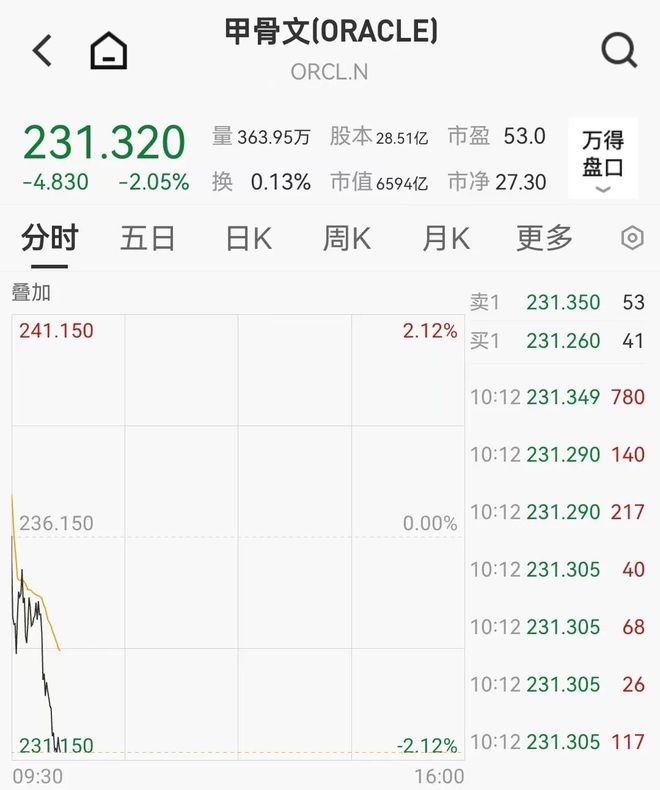
Core Viewpoint - Barclays Bank has downgraded Oracle's debt rating to "underweight," warning that its credit rating could potentially fall to BBB-, which is close to junk bond territory [2][4]. Financial Performance - Oracle's total interest-bearing debt has doubled over the past decade to $111.6 billion, with a debt-to-equity ratio of 500%, significantly higher than Amazon's 50% and Microsoft's 30% [4]. - The company has over $100 billion in unrecognized lease commitments off its balance sheet, raising concerns about its leverage levels [4]. - Oracle's cash reserves, currently around $11 billion, may be exhausted by November 2026, leading to refinancing needs [3][4]. Market Reaction - Following the downgrade, Oracle's stock opened down over 2%, reflecting immediate market concerns [1][2]. - The anxiety surrounding AI investments has also affected other tech giants like Google and Meta, which saw their stock prices decline sharply [6][9]. Industry Context - The bond spreads for hyperscale cloud service providers, including Oracle, Google, and Meta, have widened to 78 basis points, the highest level since market turmoil in April [9]. - Investors are increasingly worried about the rising leverage levels and potential overcapacity in the AI infrastructure market, despite these companies having substantial cash reserves [9].