自主可控

Search documents
机构科技仓位突破40%!震荡要来了?——道达投资手记
Sou Hu Cai Jing· 2025-10-30 13:01
Core Viewpoint - The recent US-China economic and trade discussions in Kuala Lumpur have provided a buffer period that is beneficial for exports, contributing to a rebound in Hong Kong stocks after the A-share market closed [3] Market Overview - The A-share market experienced a collective pullback, with the Shanghai Composite Index falling below the 4000-point mark, closing down 0.73%. The Shenzhen Component and ChiNext Index dropped 1.16% and 1.84%, respectively. The total trading volume in the Shanghai and Shenzhen markets reached 24.217 billion yuan, an increase of 1.656 billion yuan from the previous day [5] - The market saw 1242 stocks rise and 4100 stocks fall, with a median decline of 1.25% in stock prices. The Shanghai Composite Index has shown two consecutive gaps since last Friday, indicating potential for a market correction to fill the gap from Monday [5][6] Technical Analysis - The Shanghai Composite Index has broken through the resistance zone of 4000-4184 points, suggesting that even with market corrections, there is a lower limit for the index, with expectations to fill the gap at 3950 points [5][6] - A range-bound expectation of 3950-4100 points is established based on current market conditions [6] Sector Performance - The technology sector, particularly AI hardware stocks, has shown signs of adjustment, with core stocks experiencing high volatility. Traditional sectors like nuclear construction and aluminum have shown stronger performance, indicating a rotation of funds [8][10] - Institutional investors' holdings in the technology sector have surpassed 40%, a level not seen since the peak of the new energy wave from 2020-2022, suggesting a high concentration of investment in this area [9] - The steel sector index rose by 1.32%, marking it as the top-performing sector, which historically signals the nearing end of a market phase [11] Investment Strategy - Given the current market conditions, it is advised to avoid blindly chasing high-performing AI hardware stocks. Instead, investors should look for opportunities to enter during significant price declines, adopting a short-term perspective [10][11]

中航重机:三季度业绩短期承压 航空装备列装提速长期潜力可期
Zheng Quan Shi Bao Wang· 2025-10-30 12:22
Core Insights - 中航重机 reported a revenue of 7.776 billion yuan and a net profit of 616 million yuan for the first three quarters of 2025, with R&D investment reaching 458 million yuan, a year-on-year increase of 9.43%, laying a solid foundation for future development [1] - The company inaugurated the "Advanced Aviation Forging and Casting Technology Innovation Center," aiming to support high-quality development in the modern aviation industry and advance research in cutting-edge aviation technology [1] Group 1 - 中航重机 signed a cooperation memorandum with Jintian Technology to deepen their collaboration, which has lasted for 12 years, starting from the aviation titanium material supply business [2] - The partnership will expand to cover material R&D, industry chain integration, and capital cooperation, effectively reducing production costs and enhancing overall competitiveness [2] - Despite short-term fluctuations in operational data, the company is expected to benefit from the accelerated deployment of aviation equipment and potential reforms in the aviation supply chain, which may enhance market share [2] Group 2 - 中航重机 is actively advancing the layout and mass production of large and medium-sized high-value-added forgings, which are expected to gradually improve overall profitability [3] - The company has gained supplier qualification from 46 clients, including major players like COMAC and Safran, and aims to further expand its market presence in aviation forgings and gas turbine markets [3] - The expected production capacity for the C919 aircraft has been raised to 75 units per year, reflecting a positive long-term trend in the global civil aviation market [3]

光大证券:美联储降息周期开启 港股未来或继续震荡上行
智通财经网· 2025-10-30 08:16
Core Viewpoint - The A-share and Hong Kong stock markets experienced fluctuations in October, with Hong Kong showing strong overall profitability and low valuations despite recent gains [1][2][4]. A-share Market Summary - The A-share market showed mixed performance in October, with the Shanghai Composite Index rising by 2.7% while the Sci-Tech Innovation 50 Index fell by 1.6% [2]. - Various sectors exhibited significant performance divergence, with coal, telecommunications, and banking sectors performing well due to market sentiment and profit-taking [2][3]. - Positive factors such as the approval of the 15th Five-Year Plan and ongoing US-China trade negotiations are expected to bolster market confidence [3]. Hong Kong Market Summary - The Hong Kong stock market faced a pullback in October due to increased overseas uncertainties and a decline in domestic risk appetite, with major indices showing mixed results [2]. - Despite recent increases, the overall valuation of the Hong Kong market remains low, indicating a favorable long-term investment opportunity [1][4]. - The market is expected to continue a volatile upward trend, supported by the ongoing development of the AI industry and the commencement of the Federal Reserve's interest rate cuts [4]. Industry Configuration - Mid-term focus should be on the TMT (Technology, Media, Telecommunications) and advanced manufacturing sectors, with a shift to high-dividend and consumer sectors during market fluctuations [3][4]. - A "barbell" strategy is recommended, emphasizing both technology growth and high-dividend stocks, particularly in sectors like telecommunications, utilities, and banking [4].

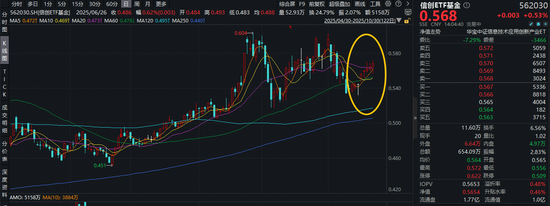
新修《网络安全法》新增AI安全!信创ETF基金(562030)逆市上探1.2%,冲击8连阳!
Xin Lang Ji Jin· 2025-10-30 06:16
Group 1 - The focus is on the performance of the Xinchuang ETF fund (562030), which saw a peak intraday increase of 1.24% and is currently up 0.53%, marking an eight-day consecutive rise [1] - Key constituent stocks include Geer Software hitting the daily limit, Foxit Software rising over 16%, and other significant gains from companies like Xinan Century, Zhiyuan Huilian, and others [1] Group 2 - An important meeting on October 28 approved amendments to the Cybersecurity Law, which will take effect on January 1, 2026, emphasizing enhanced legal responsibilities and penalties for violations, as well as new provisions for AI security and development [3] - The development of the Xinchuang industry is seen as crucial for national security, driven by multiple factors including policy support, ongoing external disturbances, and frequent security incidents [3] - The Xinchuang industry is transitioning from policy-driven to a dual-driven approach of policy and market, with significant growth expected in market size, projected to reach over 2.6 trillion yuan by 2026 [3] Group 3 - The Xinchuang ETF fund tracks the CSI Xinchuang Index, which covers core segments of the Xinchuang industry, including hardware, software, and information security, characterized by high growth and elasticity [5] - Four key investment rationales for the Xinchuang industry include: 1. International dynamics necessitating self-sufficiency due to geopolitical tensions [6] 2. Increased local government debt efforts leading to a potential recovery in government procurement for Xinchuang [6] 3. Technological advancements by domestic manufacturers like Huawei, indicating a rise in market share for domestic software and hardware [6] 4. The timing of Xinchuang initiatives reaching critical milestones with further refinement of procurement standards [6]
筑牢数字政务根基:多领域政务应用适配鸿蒙,引领行业数字化转型
Cai Fu Zai Xian· 2025-10-30 05:06
Core Insights - The HarmonyOS ecosystem is expanding in the government sector, with various applications adapted for internal management and professional services, indicating its capability to support critical industries and complex scenarios [1][5]. Group 1: Government Applications - The "Blue Letter" platform provides secure collaboration tools for large organizations, becoming a digital foundation for numerous government and enterprise organizations [3]. - The "Geological Cloud" platform supports data sharing for various geological services, enhancing safety in field operations through the "Geological Safety" application [3][4]. - The "Fire Fusion Communication" system integrates multiple communication methods for emergency response, while the "Mobile Emergency" platform improves efficiency in emergency management [3]. Group 2: Environmental and Sports Management Services - The "China Environment" app offers a digital platform for environmental professionals and the public, providing services such as environmental assessments and community support [4]. - The "China Sports Lottery Management Version" app ensures compliance and efficiency in lottery operations by providing data management and risk event oversight [4]. Group 3: Technological Breakthroughs - The adaptation of HarmonyOS in government applications signifies a major technological advancement, establishing a reliable foundation for government and enterprise trust [5]. - The successful implementation of government applications serves as a benchmark for digital transformation across other industries, promoting the acceleration of HarmonyOS adoption [5]. Group 4: Future Outlook - The continued penetration of HarmonyOS in government applications is expected to create a safer, more efficient, and smarter digital governance framework, contributing to the establishment of a self-controlled digital infrastructure in China [6].

恒生科技指数转跌,机构称短期以科技资产为主,赔率性价比更高的恒生科技为港股首推
Mei Ri Jing Ji Xin Wen· 2025-10-30 02:05
Group 1 - The Hong Kong stock market opened higher on October 30, with the Hang Seng Index rising by 0.76% to 26,545.92 points, and the Hang Seng Tech Index increasing by 0.53% [1] - The technology sector showed mixed performance, with major stocks like Tencent, Horizon Robotics, Midea Group, and Alibaba leading gains, while Tencent Music, Trip.com, Sunny Optical Technology, and Xiaomi faced declines [1] - Guotai Junan Futures highlighted that "technology" is the main investment theme during the 14th Five-Year Plan period, suggesting a focus on technology assets such as the AI industry chain and innovative pharmaceuticals for better risk-reward ratios in Hong Kong stocks [1] Group 2 - The medium-term strategy for Chinese stocks involves a "barbell strategy," with A-shares focusing on offensive sectors like technology (AI industry chain and innovative pharmaceuticals) and emerging industries such as new energy and aerospace, while Hong Kong stocks are positioned defensively [2] - The "barbell strategy" includes cross-border selections, emphasizing A-share self-innovation technology themes and industry leaders in the "anti-involution" sector for offensive strategies, alongside value technology and dividends in Hong Kong stocks for defensive positioning [2] Group 3 - Relevant ETFs include the Hang Seng Tech Index ETF (513180) for Hong Kong technology direction, supporting T+0 trading, and the Cloud Computing 50 ETF (516630) for A-share technology direction, covering popular computing concepts [3]
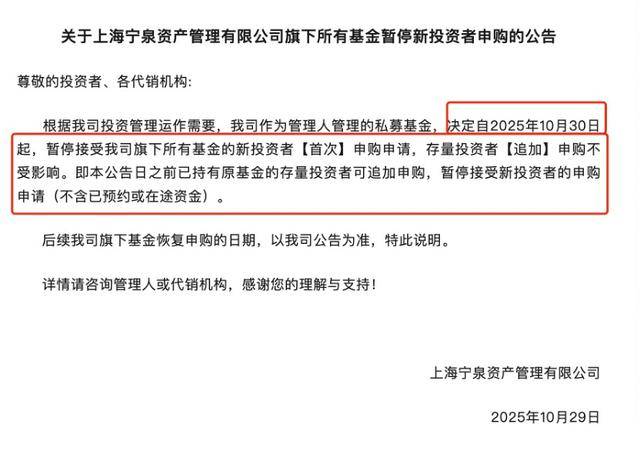
百亿私募宁泉宣布封盘,大佬杨东这次是何考虑?今年来主动封盘并非个案
Sou Hu Cai Jing· 2025-10-30 01:23
Core Viewpoint - Ningquan Asset, a private equity firm, announced a suspension of new investor subscriptions for all its funds starting October 30, 2023, amidst a strong market rally where the Shanghai Composite Index stabilized above 4000 points [1][2]. Group 1: Company Actions - The suspension applies to all products and new investors, with existing investors allowed to make additional subscriptions [2]. - The firm has not provided a timeline for when subscriptions will reopen, indicating that future announcements will dictate the resumption [2]. Group 2: Market Context - Ningquan Asset's decision to suspend new investments is interpreted as a response to its large asset management scale, which reportedly exceeded 400 billion yuan as of the first quarter of this year [4][5]. - The firm’s founder, Yang Dong, is recognized for his cautious market predictions, having previously warned investors at critical market peaks [7]. Group 3: Industry Trends - The trend of private equity firms suspending new subscriptions is not uncommon this year, with several firms, including Ruijun Asset and Yanfeng Investment, also announcing similar actions to prioritize performance and manage growth [8]. - The broader market context shows that the A-share market is experiencing a potential slow bull run, supported by economic recovery and policy measures [10][11].
金信基金:站稳4000点再出发
Zhong Guo Jing Ji Wang· 2025-10-30 00:48
Group 1 - The Shanghai Composite Index has risen 0.70% and surpassed the 4000-point mark, indicating a recovery in investor confidence regarding the macroeconomic environment [2][3] - The surge in the new energy sector, particularly in photovoltaic and energy storage stocks, is attributed to signs of a bottoming cycle in the industry, with both supply-side and demand-side factors contributing to this growth [1][2] - The third-quarter performance of leading companies in the new energy sector exceeded expectations, triggering an overall rebound in the sector [1][2] Group 2 - The economic recovery is supported by significant growth in industrial output and GDP, with industrial value-added increasing by 6.5% year-on-year in September, and GDP growing by 5.2% in the first three quarters [2][3] - The "14th Five-Year Plan" emphasizes technological self-reliance and advanced manufacturing, positioning these areas as key drivers for economic growth over the next five years [2][3] - The capital market is expected to benefit from the listing and financing of quality technology companies, as well as increased investments from institutional funds [2][3] Group 3 - The A-share market's upward trend is supported by economic recovery, policy enhancements, and improved US-China relations, with the technology sector acting as a core driver for market growth [3] - Investors are encouraged to focus on long-term trends in sectors such as semiconductor equipment, AI computing, high-end manufacturing, and new energy, which align with national strategies and exhibit performance elasticity [3]
电子行业周报:电子上游“通胀”起,AI拉动下存储“周期与成长共振”-20251029
Guoxin Securities· 2025-10-29 14:45
Investment Rating - The report maintains an "Outperform" rating for the electronic industry, indicating expected performance above the market index by more than 10% [10]. Core Views - The electronic upstream inflation is rising, driven by AI demand, leading to a resonance of storage cycles and growth. The Shanghai Composite Index rose by 2.88%, while the electronic sector increased by 8.49% in the past week, with components up by 12.84% and optical electronics up by 4.04% [1]. - The storage prices have been continuously increasing, with a clear upward trend in the storage cycle. The price of 512Gb/1Tb Flash Wafer has risen over 25% since September, and the price of 1TB PCIe 4.0 SSD has increased by over 20% during the same period [2]. - The demand for AI continues to drive high growth in the industry, with significant capital expenditures expected from major cloud service providers, projected to exceed $420 billion in 2025, and potentially reaching $520 billion in 2026 [5]. Summary by Sections Market Performance - The electronic industry overall rose by 8.49% in the past week, with significant gains in sub-sectors such as components and optical electronics [11]. Company Performance - TI's revenue for Q3 2025 was $4.742 billion, a year-on-year increase of 14.2%, and is expected to be between $4.22 billion and $4.58 billion for Q4 2025 [3]. - Several PCB manufacturers reported strong performance, with Dingtai Gaoke's revenue for Q3 2025 reaching 553 million yuan, a year-on-year increase of 33% [4]. Investment Recommendations - The report suggests focusing on domestic storage manufacturers such as Jiangbolong, Demingli, and Zhaoyi Innovation, which are expected to benefit from rising prices and demand [2]. - It also recommends companies with high-end capacity and advantageous customer structures, including Huidian Co., Shengyi Technology, and Pengding Holdings [4].
ETF日报:A股今天站稳4000点关口,市场情绪在短期内显得比较积极
Xin Lang Ji Jin· 2025-10-29 12:42
Core Viewpoint - The A-share market is showing a steady upward trend, with the Shanghai Composite Index rising by 0.70% to 4016.33 points, and the Shenzhen Component Index increasing by 1.95% [1] Market Performance - The trading volume in the Shanghai and Shenzhen markets reached approximately 22560.3 billion yuan, an increase of about 1081.7 billion yuan compared to the previous trading day [1] - The market sentiment appears relatively positive in the short term, with 2672 stocks rising and 2621 stocks falling, indicating a balanced performance [1] Sector Analysis - Strong performance is noted in sectors related to anti-involution, such as photovoltaic, carbon neutrality, and new energy vehicles, while traditional sectors like consumer goods are underperforming [1][2] - The TMT sector is shifting focus from light modules and PCBs to domestic computing and consumer electronics, indicating a rotation of funds within sectors [2] Economic Outlook - The macroeconomic environment is characterized by pressure on total demand, with weak consumption and investment, and a decline in government spending expected in the fourth quarter [2][12] - Financial data shows that social financing is primarily supported by government bonds, while internal credit growth remains weak, indicating a potential "double weakness" in government and market credit [2][12] Investment Strategy - The current investment strategy suggests focusing on sectors with high growth potential, such as photovoltaic and new energy vehicles, while being cautious about traditional consumer sectors that are not showing signs of recovery [2][8] - Institutional investors are increasingly favoring technology and growth sectors, with a notable shift away from traditional consumer sectors like food and beverage [8][9] Policy Implications - The "14th Five-Year Plan" emphasizes expanding domestic demand and enhancing profits in mature industries, which aligns with the current market focus on technology and growth sectors [8] - The People's Bank of China has resumed government bond trading, which may signal a more accommodative monetary policy moving forward [12]