
通胀预期

Search documents
日本央行年内或按兵不动 受政治与关税不确定性制约
Jin Tou Wang· 2025-09-24 03:58
周三(9月24日)亚盘早盘,美元兑日元上涨,目前交投于147附近,截止北京时间11:43分,美元兑日 元报价147.84,上涨0.15%,上一交易日美元兑日元收盘为147.62。澳新银行研究部高级国际经济学家 TomKenny在报告中表示,日本央行今年剩余时间可能维持政策利率不变。 他指出,美国关税对日本经济影响的不确定性加剧,加之日本国内政治局势不明朗,这些因素可能使日 本央行在明年之前保持按兵不动。日本央行上一次加息是在2025年初。Kenny称,央行暂停加息的一个 主要原因是其下调了2026财年的通胀预期,目前该预期已低于2%的物价稳定目标。这表明央行政策委 员会成员对实现物价稳定使命的信心有所下降,他补充道。澳新银行已将日本央行25个基点的加息预期 从2025年10月推迟至2026年1月。 美元兑日元支撑位是147.00关口,若跌破该点位,现货价格可能会加速下跌至146.20的水平支撑位。下 跌趋势可能会进一步延伸至145.50-145.45区域,这是上周三触及的7月7日以来的最低水平。 ...
发达经济体超长债利率大幅波动
工银亚洲· 2025-09-23 05:28
Report Summary 1. Report Industry Investment Rating No industry investment rating is provided in the report. 2. Core Views - In the short - term, the ultra - long - term US bond yields may decline from their highs, while those of the UK, France, Japan, and Germany are expected to have potential for phased spikes, but the room for continuous and significant upward movement is limited. In the medium - to - long - term, the term premium may remain high, and there is a risk of a central increase in long - term yields [2][23]. - The foundation for the upward trend of Chinese asset prices is solid, and they are expected to further attract diversified capital allocation [31]. 3. Summary by Relevant Catalogs 3.1 Recent Market Review of Sharp Fluctuations in Ultra - long - term Bond Yields of Developed Economies - On September 2, 2025, the ultra - long - term bond yields of major developed economies rose rapidly. The 30 - year UK government bond yield reached 5.752%, the highest since 1998; Germany and France's 30 - year government bond yields reached 3.443% and 4.523% respectively, the highest since 2011 and 2009; the 30 - year Japanese government bond yield reached 3.302%, a record high; the 30 - year US government bond yield approached 5%. Market concerns spread to the European foreign exchange and stock markets. As of September 12, except for the impact of the resignation of Ishiba Shigeru on Japanese bond yields, the ultra - long - term bond yields of the UK, France, and Germany declined slightly [4]. - Since the end of the interest - rate hike cycle in the second half of 2023, the short - term government bond yields of major European and American economies have declined from their highs and accelerated their decline after the start of the interest - rate cut cycle in the second half of 2024. In contrast, the ultra - long - term government bond yields have shown a fluctuating upward trend. As of September 12, 2025, the average 2 - year government bond yields of G7 countries (except Japan) decreased by more than 31BP, while the 30 - year government bond yields increased by an average of 42BP [5]. 3.2 Reasons for Sharp Fluctuations in Ultra - long - term Bond Yields of Developed Economies - **Economic Aspect**: Loose fiscal policies, high leverage, and continuous fermentation of concerns about debt sustainability, combined with political instability and rising risk - aversion sentiment. For example, in the UK, fiscal difficulties have continuously disturbed the market; in France, it is difficult to promote fiscal discipline rectification, and the government changes frequently; in Germany, although the market responds positively to fiscal expansion, the "debt brake" increases concerns; in Japan, the resignation of the prime minister and concerns about fiscal easing have increased; in the US, the pressure of fiscal interest payments has increased, and the independence of the Federal Reserve is facing challenges [6][10]. - **Policy Aspect**: Affected by tariff frictions, inflation expectations have risen, restricting the prospects of interest - rate cuts and worsening the fiscal burden, forming a negative cycle. Since April 2025, the inflation levels of major economies have marginally rebounded, and central bank monetary policy decisions are facing dilemmas [15]. - **Funding Aspect**: The wave of corporate bond issuance and the reconstruction of the TGA account have led to a phased increase in bond supply, but the demand for long - term capital allocation is weak. In September, the bond issuance volume in Europe reached a record high, and the US Treasury plans to increase the TGA account balance. At the same time, the sharp rise and large fluctuations in ultra - long - term bond yields have reduced the enthusiasm of long - term funds such as insurance for allocation [20]. 3.3 Outlook for the Future Trends of Ultra - long - term Bond Yields of Developed Economies and Their Possible Impact on Chinese Asset Prices - **Outlook for the Future Trends of Ultra - long - term Bond Yields of Developed Economies** - **Short - term**: The ultra - long - term US bond yields may decline from their highs. The short - term supply pressure of US bonds is generally controllable, and the market expects the Fed to restart interest - rate cuts in September. In Europe and Japan, concerns about fiscal sustainability are still fermenting, and political adjustments increase the risk of rising ultra - long - term bond yields. However, the term spreads of some economies' government bonds are at relatively high historical levels, and policy intervention may limit the continuous and significant upward momentum [23][27]. - **Medium - to - long - term**: The term premium may remain high, and there is a risk of a central increase in long - term yields. Global economic growth momentum is under pressure, and countries' fiscal expansion efforts are increasing, so the term spreads are expected to remain high [30]. - **Possible Impact on Chinese Asset Prices**: The Chinese equity market has been warming up since September 2024, with significant increases in major indices. In the bond market, the increases in 10Y and 30Y government bond yields are relatively small compared to developed economies. The RMB exchange rate has been rising steadily. The cultivation of new productive forces, the release of endogenous consumption growth momentum, a stable interest - rate and exchange - rate environment, and relatively low capital market valuations are expected to attract continuous inflows of diversified capital [31].
公众通胀预期创五年新高 英国央行压力骤增
Jin Tou Wang· 2025-09-23 05:00
Core Viewpoint - The British public's inflation expectations for the next five years have risen to 3.8%, the highest since May 2019, which may cause concern among some Bank of England policymakers ahead of next week's interest rate decision [1] Group 1: Inflation Expectations - The rise in public inflation expectations could become a risk factor for future inflation, increasing the likelihood of demands for higher wages and acceptance of higher prices [1] - Public satisfaction with the Bank of England's methods for controlling inflation has decreased from +6 in May to +2 in August, although it remains higher than most of the past three years [1] Group 2: Economic Indicators - The UK's Consumer Price Index (CPI) reached an 18-month high of 3.8% in July, the highest level among the G7 countries, with the Bank of England expecting inflation to reach 4% in September and return to target levels by Q2 2027 [1] Group 3: Currency Analysis - The GBP/USD exchange rate is currently at 1.3508, with a slight decline of 0.03% from the previous close of 1.3512 [1] - Technical indicators show that the MACD value for GBP/USD is negative and close to zero, indicating slight bearish strength, while the RSI is hovering around 50, suggesting a balanced market without clear overbought or oversold conditions [1]
黄金存量平衡下的风险与避险
2025-09-23 02:34
Summary of Key Points from Conference Call Industry Overview - The conference call discusses the gold market and its dynamics, particularly in relation to macroeconomic factors and central bank behaviors. The focus is on how these elements influence gold prices and investment strategies. Core Insights and Arguments 1. **Commodity Market Dynamics**: Agricultural and pig prices have declined due to oversupply, reflecting fundamental signals in the global commodity market, aligning with liquidity expectation trading judgments [1] 2. **Gold Price Sensitivity**: Gold prices are influenced by supply, inventory, consumption, and investment demand. A 25 basis point interest rate change can affect gold prices by approximately $40 to $50 per ounce [4][1] 3. **Investment Demand**: Investment demand is a crucial factor in determining the central price of gold, with private sector investments through ETFs significantly influenced by risk appetite. As of the end of 2024, the European and American markets accounted for over 90% of global ETF holdings, while China's share was 4% [6][7] 4. **Central Bank Purchases**: Central bank gold purchases have a significant impact on gold prices, with historical data showing a shift from net selling to net buying leading to high premiums. Major contributors to this trend include China, Russia, and India [11][10] 5. **ETF Role in Gold Market**: ETFs serve as a critical tool for reflecting risk-hedging behavior, with significant fluctuations in holdings during major uncertainty events. However, ETF funds typically do not remain in the market long-term, often exiting after the peak of uncertainty [9][8] 6. **Risk Hedging Function**: Gold is primarily viewed as a risk-hedging tool within asset allocation strategies, akin to insurance, protecting other assets from unexpected risk events [13][15] 7. **Economic Cycle Impact**: Future economic cycles will significantly influence gold prices. Continued Fed rate cuts amid recession risks may drive more investors toward gold, while an overheating economy could weaken this trend [14][20] 8. **Market Environment**: The current market is characterized as both promising and risky for gold, benefiting from factors like de-globalization, trade conflicts, inflation expectations, and potential stagflation risks [17][18] 9. **Oil Prices and Inflation**: Oil prices are currently low but could rise due to geopolitical risks, impacting inflation expectations and interest rate trading [19][20] Other Important Insights - **Weak Correlation with Other Assets**: The weak correlation of gold with other risk assets enhances its value in multi-asset portfolios, particularly in low-probability scenarios [15] - **Future Price Volatility**: The gold market is expected to experience volatility rather than consistent upward trends, influenced by macroeconomic indicators and policy changes [20] - **Long-term Investment Considerations**: Investors should focus on macro events and geopolitical risks rather than short-term price movements when considering gold investments [16]
资金跟踪系列之十二:北上活跃度回升,整体继续净卖出
SINOLINK SECURITIES· 2025-09-22 12:55
Macro Liquidity - The US dollar index has rebounded, and the degree of the China-US interest rate "inversion" has deepened, with inflation expectations also rising [1][14] - Offshore US dollar liquidity has generally loosened, while the domestic interbank funding situation remains balanced [1][19] Market Trading Activity - Overall market trading activity has increased, with most industry trading activities remaining above the 80th percentile [2][25] - Major indices' volatility has also risen, with the communication sector's volatility exceeding the 80th historical percentile [2][31] - Market liquidity indicators have declined, with all sectors' liquidity indicators below the 40th historical percentile [2][36] Institutional Research - The electronic, pharmaceutical, communication, non-ferrous metals, and automotive sectors have seen high research activity, while sectors like steel, electricity, utilities, machinery, light industry, building materials, and real estate have shown a rising trend in research activity [3][43] Analyst Forecasts - Analysts have continued to lower the net profit forecasts for the entire A-share market for 2025/2026, with the proportion of stocks with upward revisions increasing [4][50] - The net profit forecasts for sectors such as non-bank financials, chemicals, coal, and retail have been raised for 2025/2026 [4][21] - The net profit forecast for the Shanghai Stock Exchange 50 index for 2025/2026 has been adjusted upward [4][23] Northbound Trading Activity - Northbound trading activity has increased, but there continues to be a net sell-off overall [5][31] - Based on the top 10 active stocks, the buy-sell ratio in sectors like electronics, electric new energy, and communication has risen, while it has decreased in non-bank financials, pharmaceuticals, and non-ferrous metals [5][32] Margin Financing Activity - Margin financing has reached a high point not seen since September 2024, with a net purchase of 466.70 billion yuan last week [6][35] - The main net purchases in margin financing were in the electronic, non-bank financial, and machinery sectors, while net sales were seen in military, non-ferrous metals, and coal sectors [6][39] Active Equity Funds and ETFs - Active equity funds have increased their positions, particularly in coal, communication, and home appliance sectors, while reducing positions in computers, non-bank financials, and electronics [7][45] - ETFs have continued to see net subscriptions, primarily in personal ETFs, with significant net purchases in non-bank financials, non-ferrous metals, and machinery sectors [7][52]
市场焦点转向通胀数据 纸白银多头态势强劲
Jin Tou Wang· 2025-09-22 07:23
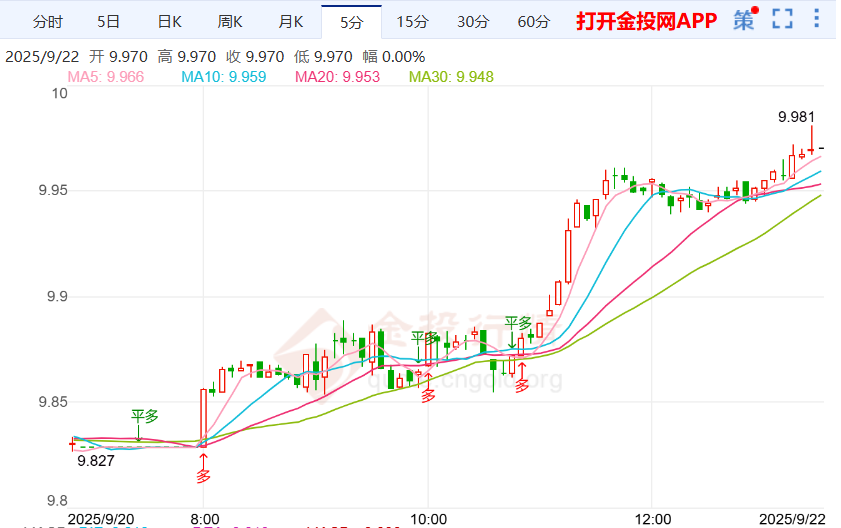
Group 1 - The core viewpoint indicates that silver prices are currently experiencing a bullish trend, with paper silver trading around 9.971 CNY per gram, up 1.44% from the opening price of 9.829 CNY per gram [1] - The Federal Reserve's decision on interest rates has been influenced by inflation uncertainties, with the core personal consumption expenditures index rising to 2.9% year-on-year, the highest since February [3] - Industrial demand for silver remains stable, driven by applications in solar panels, electronics, and semiconductors, which continues to support physical silver demand as investors seek attractive entry points [3] Group 2 - The resistance level for paper silver is identified in the range of 9.981 to 10.000 CNY per gram, while the support level is noted between 9.700 and 9.829 CNY per gram [4]

英银利率不变支撑英镑 但降息预期仍存
Jin Tou Wang· 2025-09-22 02:52
Group 1 - The Bank of England has decided to maintain the current interest rate level, reflecting its policy dilemma between a weak labor market and persistent inflation pressures [1] - Early initiation of a rate-cutting cycle could further elevate inflation expectations, while maintaining high rates for an extended period may suppress consumption and investment, increasing economic downturn risks [1] - For ordinary investors, this policy stance suggests that interest rates on savings products may remain stable in the short term, but mortgage rates will stay high, making repayment pressures difficult to alleviate [1] Group 2 - The GBP/USD exchange rate shifted from an upward trend to a downward trend, with the "Evening Star" pattern prompting a drop below 1.3500, increasing the likelihood of testing the convergence of the 100-day and 50-day moving averages around 1.3477/63 [2] - A daily closing price below this convergence would clear the path for testing the low of 1.3332 from September 3, while a closing price above 1.3600 could reinforce the rationale for challenging the annual peak of 1.3788 [2]
南华外汇(美元兑人民币)周报:买预期,卖事实-20250921
Nan Hua Qi Huo· 2025-09-21 12:15
1. Report Industry Investment Rating No relevant content provided. 2. Core Views of the Report - The Fed's next - stage core challenge is to balance the demands of different stakeholders and formulate monetary policies that align with economic fundamentals and market expectations while maintaining central bank independence. Over - betting on loose policies currently may pose potential risks. The market may continue to focus on interest - rate cut trading for the US dollar index, but the room for further development is limited, and it may shift from trading on strong expectations to trading on reality. The rebound space of the US dollar index may be limited without a significant improvement in the US labor market. The USD/CNY spot exchange rate has formed a "three - price unity" pattern around 7.10, and it may fluctuate around this level in the short term. There is no clear sign of a trend appreciation of the RMB for now [1]. 3. Summary by Related Catalogs 3.1 One - Week Market Review and Outlook 3.1.1 Foreign Exchange Market Review - Last week, the overall trend of the international foreign exchange market was mainly affected by the monetary policy adjustment directions of major global central banks. The key logic was centered on the expected differences in monetary policies and the repricing of interest - rate paths. By September 19th, 16:30, the US dollar index slightly appreciated compared to the previous Friday. The on - shore RMB, offshore RMB, Japanese yen, and euro all appreciated against the US dollar, while the British pound depreciated against the US dollar [3]. - The Fed cut the benchmark interest rate by 25 basis points in September, with the rate range dropping to 4.75% - 5.00%. Fed Chairman Powell defined this as a "risk - management interest - rate cut" to prevent deterioration in the employment market. The dot - plot indicated two more rate cuts were likely this year [3]. - The Bank of Japan maintained its policy rate but had internal differences, with two of nine members advocating for a rate hike. It also announced an ETF reduction plan, signaling a move towards policy normalization [3]. - The Bank of Canada cut the benchmark interest rate by 25 basis points to 2.5% for the first time since March due to slow economic growth and reduced inflation risks, without providing clear forward - looking guidance [3]. - The Bank of England kept the benchmark interest rate at 4% and adjusted its quantitative tightening plan, reducing the scale from £100 billion to £70 billion in the next 12 months and cutting long - term bond sales to minimize the impact on the bond market [3]. 3.1.2 Weekly Review of USD/CNY Spot Exchange Rate - **Market Trading Logic** - **US dollar index trading logic**: At the beginning of the week, the market's high - consensus expectation of a Fed rate cut in September drove the US dollar index into a downward channel. After the official rate cut, Powell's "cautiously dovish" statement and the decline in US initial jobless claims led to a V - shaped rebound of the US dollar index [11]. - **USD/CNY spot exchange rate trading logic**: It moved in tandem with the US dollar index. It adjusted moderately when the US dollar index declined and strengthened when it rebounded. The "three - price unity" expectation also influenced market sentiment, with no one - sided speculation [11]. - **Weekly Market Review** - **Before the FOMC meeting**: The market's strong expectation of a Fed rate cut led to a downward movement of the US dollar index and a moderate adjustment of the USD/CNY spot exchange rate. The exchange rate converged towards the "three - price unity" target, and there was no obvious one - sided speculation [12]. - **After the FOMC meeting**: Powell's statement and the decline in initial jobless claims led to a rebound of the US dollar index. The USD/CNY spot exchange rate achieved "three - price unity" and entered an upward channel [12]. 3.1.3 Market Outlook - The Fed cut the federal funds rate target range by 25 basis points to 4.00% - 4.25% on September 18th. The core issues for the market now are the Fed's future interest - rate cut rhythm and amplitude, which depend on the actual severity of the weakening US labor market, the speed of interest - rate adjustment to the neutral level, and the reasonable anchoring of the "neutral interest rate" [17][19]. - It is expected that the conditions for the Fed to implement large - scale consecutive interest - rate cuts this year are not yet mature. Such a policy is more likely to be implemented in 2026, which may face challenges. Economic factors such as the slowdown (but not a stall) in the US employment market and inflation pressure, as well as the cooling real - estate market, limit the scope for large - scale easing. Politically, although there is uncertainty, the "gradual adjustment" policy line is difficult to change in the short term [19]. 3.1.4 Strategy Recommendations - For enterprises with import and foreign - exchange purchase needs, it is advisable to use forward contracts to lock in exchange - rate costs. Export - oriented enterprises can conduct spot foreign - exchange settlement at the upper end of the exchange - rate range and carry out hedging operations for forward foreign - exchange settlement. Currently, the spread between spot and forward exchange rates is narrowing, reducing the profit - making space. Cross - market volatility arbitrage and short - straddle option combinations have better risk - return characteristics. For low - risk - preference participants, iron - condor option combinations or covered - call strategies can be preferred [27]. 3.1.5 Weekly Risk Warnings and Key Events - China will hold a press conference on the "14th Five - Year Plan" achievements in the financial industry, with PBOC Governor Pan Gongsheng attending. The US will release the September Markit manufacturing PMI preliminary value, August PCE data. Attention should also be paid to the speeches of overseas central - bank officials [28]. 3.2 RMB Market Observation 3.2.1 Policy Tool Tracking - Counter - Cyclical Factor - As of last Friday, the central parity rate of the USD/CNY was 7.1128, up 109 basis points from the previous Friday. The current trend of the counter - cyclical factor indicates that the central bank's attitude towards the exchange rate is generally neutral [30]. 3.2.2 Investor Expectations and Sentiment Tracking - **Enterprise Sector Expectations**: In August, China's foreign - exchange market was stable, with active trading and a general balance between supply and demand. The cross - border receipts and payments of non - bank sectors increased by 8% year - on - year, and the cross - border capital inflow was $3.2 billion, with a bank settlement - sale surplus of $14.6 billion [35]. - **Overseas Investor Expectations**: As of last Friday, the narrowing spread between offshore and on - shore RMB indicated a slight decline in overseas investors' appreciation sentiment towards the RMB [40]. - **Professional Investor Expectations**: As of last Friday, the one - year NDF closing price of USD/CNH slightly decreased. The USDCNY risk - reversal option indicators (25Delta) showed little change in market sentiment [43]. 3.2.3 Derivatives Market Tracking - **Hong Kong RMB Futures Market**: Relevant charts show the price trends and basis differences of the HKEX USDCNH futures contracts [46][48]. - **Singapore RMB Futures Market**: Charts present the price trends and basis differences of the SGX USDCNH futures contracts, as well as the basis comparison between SGX and HKEX contracts [50][52]. 3.3 Key Data and Events to Watch 3.3.1 One - Week Global Key Events Review - **China**: High - level Sino - US economic and trade talks were held in Madrid. China's economic data in August showed growth in industrial added value, service production, and consumer spending. Policy measures were introduced to expand service consumption, and relevant economic data and policy statements were released [57]. - **US**: The September New York Fed manufacturing index dropped sharply. The Fed cut interest rates as expected, and the new - home construction and initial jobless claims data were released [59]. - **UK**: The UK CPI remained high in August. The Bank of England kept the interest rate unchanged and adjusted the quantitative tightening plan. The UK budget deficit reached a five - year high [61]. - **Eurozone**: The EU proposed a new round of sanctions against Russia [62]. - **Japan**: Japan's exports and imports declined in August. The Bank of Japan maintained the benchmark interest rate and announced an ETF and REIT reduction plan [63]. 3.3.2 One - Week Global Central - Bank Key Speeches - Speeches from central - bank officials in various countries covered topics such as the TikTok issue, Sino - US relations, and exchange - rate policies [63][65]. 3.3.3 This Week's Key Financial and Economic Data and Events - Key data to be released this week include China's central - bank loan prime rate, US economic data such as GDP deflator, PCE price index, and initial jobless claims, as well as speeches by central - bank officials from different countries [68][69]. 3.4 International Market Conditions 3.4.1 Major Countries' Exchange - Rate Quotes - Charts show the exchange - rate trends of the US dollar against major currencies such as the euro, yen, pound, and others [71][73]. 3.4.2 Correlation of Major Asset Classes - Charts display the trends of major assets including London gold, VIX, crude oil prices, stock - market indices such as S&P 500 and CSI 300, and the price differences of gold [93][100]. 3.4.3 Capital Flows - Charts present the central - bank's open - market operations, Shibor quotes, and SOFR quotes [105][107]. 3.4.4 Sino - US Interest - Rate Spread - Charts show the trends of the Sino - US interest - rate spread, 10 - year US Treasury yields, and 10 - year Chinese Treasury yields [109][110]. 3.4.5 RMB Exchange - Rate Index - The chart shows the trends of three major RMB exchange - rate indices [112]. 3.4.6 Global Economic and Trade Friction Tracking - In June 2025, the global economic and trade friction index was at a medium - high level but showed a significant easing trend. The US's tariff policies and trade - negotiation progress will mainly determine future developments. The index is high for countries like India, the US, and Brazil, and in industries such as electronics. The 19 - country (region) index for China - related economic and trade frictions is also high, but the amount involved has decreased [113][115].
美联储降息“靴子落地” 货币政策预期博弈游戏刚刚开始?
Qi Huo Ri Bao· 2025-09-20 01:18
Group 1 - The Federal Reserve has restarted interest rate cuts, lowering the federal funds rate target range by 25 basis points to 4.00%-4.25%, marking the first rate cut of the year [1] - The decision to cut rates is based on weak economic data, easing inflation pressures, and a weakening labor market, which reinforced market expectations for a rate cut [1][4] - Financial markets exhibited a "buy the rumor, sell the news" phenomenon, with major U.S. stock indices initially rising but then retreating after the announcement, indicating a typical "buy the fact" reaction [1] Group 2 - The Fed's future rate cut pace will depend on three interconnected issues: the severity of the labor market's downturn, the speed at which policymakers adjust rates to neutral levels, and how to anchor the "neutral rate" in the current economic environment [1] - The Fed has expressed increased concern over "downside risks" in the labor market, adjusting its previous assessment of a "strong labor market" to a view of "slowing job growth and rising unemployment" [4] - Despite the Fed's rate cut, it is acting more slowly than the European Central Bank, and inflation remains a core constraint on further rate cuts, alongside risks in the housing market [4][5] Group 3 - The Fed views stabilizing long-term inflation expectations as a core monetary policy goal, with internal structural pressures on inflation still present despite manageable overall inflation [5] - The housing market shows signs of cooling, with weak demand and low existing home sales, which directly impacts monetary policy decisions [5] - Political uncertainties may influence the pace of rate cuts, but the Fed's independence is expected to maintain a gradual adjustment policy [7][8]
欧洲央行按兵不动释放积极信号
Jing Ji Ri Bao· 2025-09-19 22:15
Core Viewpoint - The European Central Bank (ECB) has not provided explicit guidance on future interest rate cuts but has released positive signals regarding economic fundamentals, inflation expectations, and financial markets, indirectly raising expectations that the "rate-cutting cycle is nearing its end" [1][4] Economic Activity Outlook - In September, the ECB noted continued growth in manufacturing and services, emphasizing that previous rate cuts and government fiscal policies have created positive momentum for the economy [2] - The ECB believes that rate cuts will further stimulate consumption and investment, with government spending on infrastructure and defense expected to support investment in the Eurozone [2] External Economic Environment - The ECB has shifted its stance on external risks, indicating that while trade tensions and a strong euro may suppress growth in the short term, these negative impacts are expected to dissipate by 2026 [2][3] - The recent trade agreement between the US and EU is anticipated to reduce uncertainty, leading the ECB to view the risks to Eurozone economic growth as more balanced [2] Inflation Outlook - ECB President Lagarde stated that the factors driving inflation are dissipating, leading to a more stable inflation outlook, with current inflation around 2%, close to the medium-term target [3][4] - The ECB's latest forecasts indicate an upward revision for 2025 and 2026 inflation rates, with projections of 2.1% for 2025 and 1.7% for 2026, while the 2027 forecast was slightly lowered to 1.9% [3] Monetary Policy Stance - The ECB maintains that despite inflation being below target, there is no need to alter monetary policy due to "minor deviations" [4] - The ECB has signaled a commitment to maintaining current interest rates and will continue to adopt a "data-dependent, meeting-by-meeting" approach to determine appropriate monetary policy [4] Market Stability - The ECB has reassured markets regarding the stability of the Eurozone sovereign bond market, indicating that it has the necessary tools to address risks if market conditions deteriorate [4][5] - Despite a reduction in the likelihood of rate cuts, some institutions still believe that the ECB may adopt a more dovish stance if certain factors arise [4][6] Risks and Considerations - Potential risks include financial market volatility and unexpected changes in external monetary policies, particularly if the Federal Reserve adopts a more aggressive rate-cutting stance [5][6] - The ECB is currently more optimistic about external conditions and internal momentum, which supports its decision to maintain the current monetary policy stance [5][6]