
降息

Search documents
美联储理事称货币政策仍偏紧,具备降息空间
Sou Hu Cai Jing· 2025-12-17 14:31
沃勒称,降息并不存在迫切性,美联储可以"稳步地"将政策利率逐步向中性水平靠拢,以应对通胀放缓 但经济仍具韧性的局面。 来源:央视新闻客户端 总台记者当地时间12月17日获悉,美联储理事克里斯托弗·沃勒表示,美国货币政策目前仍处于限制性 区间,美联储在未来具备进一步降息的空间。 ...

美联储理事称货币政策仍偏紧 具备降息空间
Sou Hu Cai Jing· 2025-12-17 14:20
沃勒称,降息并不存在迫切性,美联储可以"稳步地"将政策利率逐步向中性水平靠拢,以应对通胀放缓 但经济仍具韧性的局面。(央视记者 曹健) 总台记者当地时间12月17日获悉,美联储理事克里斯托弗·沃勒表示,美国货币政策目前仍处于限制性 区间,美联储在未来具备进一步降息的空间。 ...
美股前瞻 | 交易员押注周四CPI“无关紧要”,美股波动预期骤降 特朗普将周三面试美联储理事沃勒
智通财经网· 2025-12-17 14:19
Market Movements - US stock index futures are all up, with Dow futures rising by 0.23%, S&P 500 futures up by 0.34%, and Nasdaq futures increasing by 0.44% [1] - European indices show mixed results, with Germany's DAX down by 0.01%, UK's FTSE 100 up by 1.63%, France's CAC40 down by 0.15%, and the Euro Stoxx 50 up by 0.12% [1] Oil Prices - WTI crude oil has increased by 1.74%, reaching $56.09 per barrel, while Brent crude oil is up by 1.63%, priced at $59.88 per barrel [2] Market News - President Trump is expected to interview Federal Reserve Governor Christopher Waller for the position of Fed Chair, with the process moving quickly [3] - Traders are showing less concern regarding the upcoming CPI report, with expectations of only a 0.7% volatility in the S&P 500 index, significantly lower than the 1% average volatility seen in previous months [3] Oil Market Dynamics - Oil prices have rebounded from four-year lows due to geopolitical tensions in Venezuela, with the country’s oil production recovering but still below historical levels [4] - Goldman Sachs indicates that the Federal Reserve may be more inclined to cut rates next year, influenced by labor market data [4] AI Financing Insights - Concerns regarding AI financing are deemed exaggerated, with Goldman Sachs estimating that $700 billion to $1 trillion will be needed for future expenditures, primarily funded by operational cash flow [5] - Amazon is reportedly in talks to invest $10 billion in OpenAI, which could enhance its competitive position against Nvidia in the AI chip market [5] Corporate Developments - Warner Bros. plans to reject a hostile takeover bid from Paramount due to concerns over financing arrangements [6][7] - Nvidia is collaborating with SK Hynix to develop AI solid-state drives, aiming for production by 2027, with performance improvements expected to be significant [7] - Waymo, a subsidiary of Alphabet, is seeking to raise over $15 billion at a valuation nearing $100 billion [8] - GlaxoSmithKline has received FDA approval for a new asthma drug, which could become a significant product with a dosing frequency of only twice a year [9]
特朗普死磕降息,美联储主席悬念!两大凯文争霸,谁能坐上交椅?
Sou Hu Cai Jing· 2025-12-17 13:58
这篇国际评论,主要来分析美联储主席人选博弈,特朗普急推降息遇阻,候选人轮番登场,这权力拉锯战背后藏着不少门道。 最近美国金融圈最热闹的事,莫过于谁来接美联储主席鲍威尔的班。这事看着是人事变动,本质上就是一场围绕"降息"的权力博弈。特朗普急着让美联储放 水救经济,鲍威尔却按兵不动,拉锯战让下一任主席人选成了全球关注的焦点。 特朗普的"降息执念"与鲍威尔的"独立坚守" 要理解这场主席悬案,我们必须从特朗普总统对降息近乎偏执的渴望说起。过去一年里,特朗普对现任美联储主席鲍威尔的"炮火"从未停歇。 从公开批评鲍威尔的货币政策过于紧缩,到质疑美联储内部的运作效率,甚至一度扬言要直接将其解职。这种高压态势,充分展现了特朗普希望通过低利率 刺激经济增长的急切心情。 然而,美联储作为独立的中央银行,其主席的任命和罢免并非总统一人说了算。根据美国法律,美联储主席的任期受法律保护,除非有"法定事由",否则总 统无权随意解雇。鲍威尔本人也展现了强大的独立性,明确表示不会因外界压力而辞职。 这使得特朗普虽然满腹牢骚,却也只能等待鲍威尔明年任期届满,才能通过重新提名来改变美联储的领导层。这总统与央行行长之间的"猫鼠游戏",也正是 本次 ...

摩根大通「逃离」美联储 3500 亿美元猛攻美债
Jin Shi Shu Ju· 2025-12-17 13:41
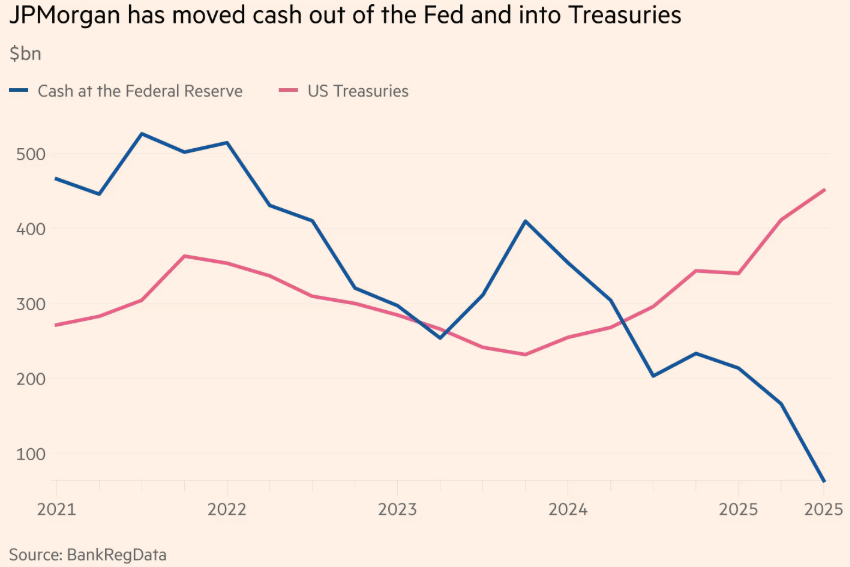
Core Insights - JPMorgan Chase has withdrawn nearly $350 billion from its Federal Reserve account since the beginning of 2023, reallocating most of these funds into U.S. government bonds as a defensive strategy against potential profit erosion from interest rate cuts [1][5] - The bank's balance at the Federal Reserve has plummeted from $409 billion at the end of 2022 to just $63 billion by the third quarter of 2023, while its holdings of U.S. Treasury securities have surged from $231 billion to $450 billion [1][5] - This strategic shift reflects how the largest U.S. bank is preparing for the end of a period of easy profitability, where it previously earned returns on cash held at the Federal Reserve while paying low interest to most depositors [1] Group 1 - JPMorgan Chase is proactively moving funds from the Federal Reserve to U.S. Treasuries to lock in higher yields in anticipation of declining interest rates [5][9] - The bank's actions have been significant enough to offset the total changes in deposits at the Federal Reserve for over 4,000 other banks, which saw total deposits drop from $1.9 trillion to approximately $1.6 trillion since the end of 2023 [9] - The Federal Reserve's interest payments on reserves have surged, with projected payments reaching $186.5 billion in 2024, raising questions about the effectiveness of this policy [9][12] Group 2 - JPMorgan Chase has not disclosed the duration of its U.S. Treasury investments or the extent to which it uses interest rate swap contracts to manage risk [5] - The bank's stable deposit base allowed it to benefit from returns on cash held at the Federal Reserve during high interest periods, contrasting with competitors like U.S. Bank, which faced significant losses [5] - In 2024, JPMorgan Chase is expected to receive $15 billion in interest payments from the Federal Reserve, contributing to its total projected profit of $58.5 billion for the year [12]

2026年配置策略展望:中美宏观经济预期与资产配置策略
Guo Tai Jun An Qi Huo· 2025-12-17 13:03
Report Industry Investment Rating No relevant information provided. Core Viewpoints of the Report - In 2026, as the Fed cuts interest rates (market expects a cut to 3.0 - 3.25% by the end of 2026), commodities may bottom out and present allocation opportunities [1]. - The 10 - year Chinese Treasury bond interest rate is expected to oscillate in the range of 1.5 - 2.0%. Slow fiscal spending and inflation recovery will limit the downside space of Treasury bond futures [1]. - The Shanghai Composite Index will oscillate at a high level. It is recommended to be cautiously bullish, appropriately reduce positions, and pay attention to the Fed's subsequent interest - rate cut process and specific measures to expand terminal consumption in China [1]. Summary by Related Catalogs 2025 Review - In 2025, there was a divergence in Sino - US commodities, with US commodities being stronger and Chinese commodities being weaker. The overall view at the end of 2024 for 2025 was that Treasury bonds would oscillate, stock indices would be slightly bullish, and commodities would be bearish, which was generally correct, except that US commodities were stronger than expected [5]. - In the US, with the Fed's interest - rate cuts, Trump's policies of adding tariffs externally, cutting taxes internally, and restricting immigration, the US economy may face stagflation risks. In China, the real estate market still faced pressure in recovery, private fixed - asset investment decreased year - on - year, and demand was weak. Although a more proactive fiscal policy brought short - term impacts on the stock, bond, and commodity markets, commodities then trended towards reality [5]. - Overseas, on April 2, Trump issued a more - than - expected reciprocal tariff policy, causing commodity prices to plummet. Subsequently, commodity and energy prices continued to weaken. The Fed cut interest rates twice in September and October to address weak employment. The US economy showed stagflation characteristics [5]. - Domestically, after a rebound at the beginning of the year, commercial housing sales continued to weaken, and domestic demand remained weak. In October, China's PPI was - 2.1% and CPI was 0.2%, the first positive CPI growth in Q2 2025 but still at a low level. The prices of domestic - priced black commodities slightly rebounded due to anti - involution meetings and production - cut plans but weakened again as anti - involution expectations cooled. The 10 - year Treasury bond interest rate strengthened and oscillated at a high level [6]. 2026 Outlook US - The US economic growth is expected to slow down moderately, presenting a pattern of "slowing employment and consumption - high inflation and deficits". The high deficit rate of nearly 6% makes government debt unsustainable. The contradiction between high interest rates and fiscal deficit sustainability is becoming more prominent, posing potential risks to the US economy [8]. - It is estimated that the real GDP growth rate in the US will be about 1.8% in 2026, showing a moderately slowing trend. Consumption and import growth are expected to slow down as fiscal deficits decline; private - sector construction investment growth is expected to continue to slow down due to trade - friction uncertainties, the decline of investment tax credits, and doubts about the sustainability of AI capital expenditure; the consumption and inventory cycles face certain downward pressure [10]. - The labor market shows weak signals. In 2025, the number of new jobs in the US was consistently below 200,000, and the unemployment rate continued to rise. In September 2025, the number of new non - farm jobs was 119,000, and the unemployment rate was 4.4%. It is expected that the US will still face high unemployment in 2026, and solving labor - market weakness may be the primary goal of monetary and fiscal policies [12]. - The US CPI growth rate is expected to be in the range of 2.2 - 2.9% in 2026, maintaining a relatively high inflation level. Factors contributing to inflation resilience include high salaries and personal consumption expenditures, Trump's policies with inflation - promoting attributes, and the "dovish" stance of the new Fed chairman, which may push up inflation through interest - rate cut expectations [16]. - In 2026, the US will still be in an interest - rate cut cycle, but the path is not smooth. The market expects the federal funds rate to be reduced to the 3.0 - 3.25% range. If inflation does not decline as expected, it will make the interest - rate cut space volatile and increase market fluctuations [18]. - The sustainability of the US fiscal deficit is being tested. The US national debt exceeded 38 trillion US dollars in October 2025. The "Big and Beautiful Act" is expected to add about 3.4 trillion US dollars in fiscal deficits in the next decade, on top of the debt accumulated by the "Tax Cuts and Jobs Act". To reduce the fiscal deficit rate to 3%, a combination of reducing fiscal spending, increasing fiscal revenue, and cutting interest rates is required [19]. China - China's inflation data was weak in 2025. With the support of policies such as the 14th Five - Year Plan and anti - involution, inflation is expected to bottom out in 2026. In October 2025, China's PPI was - 2.1% year - on - year, and CPI was 0.2% year - on - year. After an increase in commercial housing sales within the year, it declined again, and the year - on - year increase in M1 was significant [24]. - In the short term, it is still difficult to see an obvious upward trend in inflation. The Fed's high - interest - rate policy in H1 2025 pressured China's exports; the decline in commercial housing prices led to continuous negative growth in new household credit and real - estate investment, and it is difficult to reverse the weakening trend of housing prices under the "housing is for living in, not for speculation" principle; there is over - capacity in some industries, and the aging population has depressed private - sector demand. The implementation of anti - involution policies and production cuts due to processing losses are expected to increase bottom - level fluctuations in commodities in 2026 [26]. - Monetary policy will maintain a supportive stance, with reserve - requirement ratio cuts and interest - rate cuts to ensure sufficient market liquidity, and new structural monetary policy tools to support the development of small and micro enterprises. The reasons for strengthening supportive monetary policy include high real interest rates due to slow inflation and the need to create a more liquid environment for economic development and local - government leverage management [27]. - To boost inflation and economic growth, China needs a combination of fiscal, stock - market, real - estate, and consumption - subsidy policies. In 2025, the central bank only adjusted the LPR once in May. The weakening real - estate market has weakened the wealth effect, consumer confidence, and domestic demand, and strengthened residents' savings motivation. In October 2025, China's household deposit balance exceeded 160 trillion yuan, almost double the level at the end of 2019 before the pandemic [28]. - The bull market in the Chinese stock market in 2025 led to a deposit - transfer effect, but it has not been transmitted to the consumption end. The number of new stock - market accounts increased with the rise of the CSI 300, but may decline in November and December. In 2025, new RMB loans were at a five - year low, while new government bonds increased, indicating an expansionary fiscal policy. The M1 - M2 gap narrowed significantly, but consumption data did not improve significantly. To transmit the deposit - transfer effect to consumption in 2026, the stock - market bull market needs to continue, and policies need to boost consumption [30]. 2026 Allocation Outlook - In the US, with a downward - shifting interest - rate center and high inflation, the US economic resilience is expected to decline, consumption and imports will fall, and employment may be poor. Expansionary fiscal policies may cause debt - sustainability issues. The yield of US Treasury bonds will oscillate at a high level between 3.5 - 4.5%, the US dollar will oscillate between 95 - 100 (±3), gold prices are high, and non - ferrous metals should be over - allocated. Attention should be paid to trading opportunities arising from the oscillation of US consumption and imports [33]. - In China, with a more proactive fiscal policy and a moderately loose monetary policy, inflation is expected to bottom out in 2026, and PPI will rise to - 0.5 - - 1%. There is room for interest - rate cuts in the monetary - policy end. With liquidity support, A - shares are expected to remain active in trading, and Treasury bond yields present allocation opportunities. The implementation of the 14th Five - Year Plan and anti - involution policies may support commodity prices at the bottom, and prices may bottom out in H2 2026 [33]. - In asset allocation, non - ferrous metals and Treasury bonds should be over - allocated, and equities should be neutrally allocated: - The yield of 10 - year US Treasury bonds will oscillate widely between 3.5% - 4.5% and is expected to decline [33]. - The US dollar is expected to oscillate between 95 - 100 (±3). Attention should be paid to improvements in the US fiscal and trade deficits, which will affect the Fed's interest - rate cuts and the US dollar's downward trend [34]. - Gold is expected to oscillate at a high level between 4400 - 4500. It is relatively expensive, and some non - ferrous rare - earth metals should be allocated. Global central - bank gold purchases and the Fed's interest - rate cut cycle will push up the gold - price center [34]. - The target of the CSI 300 is 4300 - 5200 points. Attention should be paid to the boost of policies in the 14th Five - Year Plan to the technology and energy sectors, and the continuation of the structural bull market in H2 2025. Also, pay attention to the re - balance between stocks and bonds [34]. - The yield of 10 - year Chinese Treasury bonds is expected to oscillate between 1.5 - 2.0%, and there will be good allocation opportunities when the interest rate rises to 2.0% [34]. - Commodities are expected to present bottom - level allocation opportunities in 2026. Attention should be paid to phased opportunities in H2 2026, such as crude oil, coking coal, live pigs, and some chemical products [34][35].
英镑应声下跌!英国11月CPI超预期回落,市场押注本周迎来年内第四次降息
Hua Er Jie Jian Wen· 2025-12-17 11:53
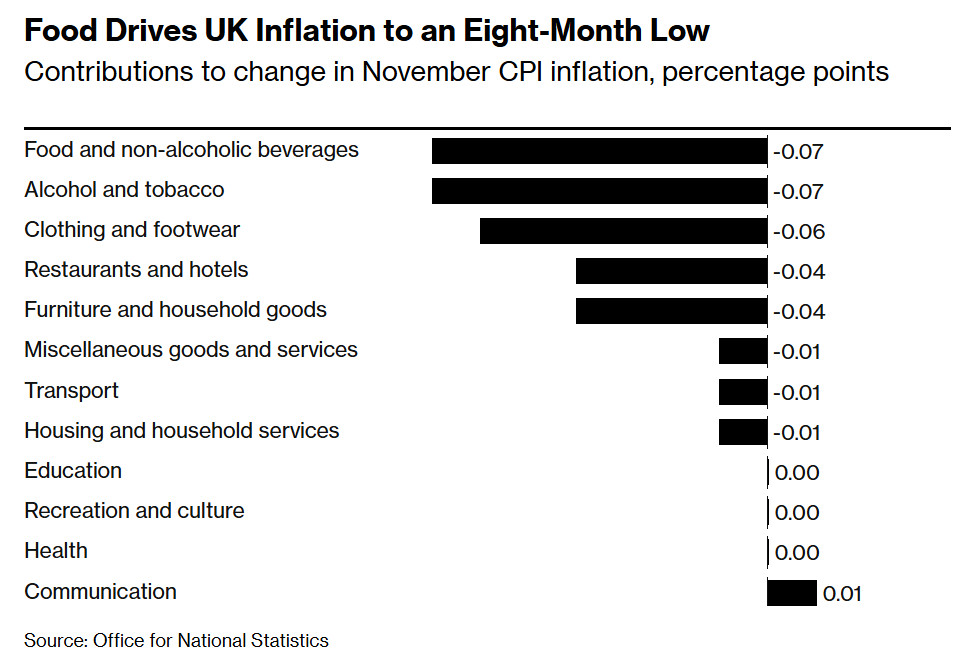
英国通胀降温速度快于预期,且从较低的峰值加速回落,这一显著迹象表明该国经济正在放缓,为英国央行在本周做出年内第四次降息的决定铺 平了道路。 英国国家统计局周三公布的数据显示,11月消费者价格指数(CPI)年率降至3.2%,不仅低于10月的3.6%,也低于经济学家所预期的3.5%。这是 自今年3月以来该数据的最低水平。受到通胀超预期回落的影响,英镑兑美元汇率在数据发布后小幅下跌0.69%,现报1.3327美元。 市场普遍认为,这份数据使得英国央行在本周四宣布降息几成定局。尽管央行上个月因价格压力持续而暂停了季度降息周期,但在当前劳动力市 场疲软和经济放缓的背景下,包括行长Andrew Bailey在内的决策者预计将采取行动。 经济学家指出,通胀消退的速度超出了所有人的预期。这不仅足以促使英国央行在圣诞节前为借款人送上降息的"礼物",也为明年初进一步放宽 货币政策打开了大门。 通胀全线回落 最新的通胀数据表明,英国物价压力的缓解速度快于英国央行决策者的预期。英国国家统计局首席经济学家Grant Fitzner指出,通常在每年这个时 候上涨的食品价格出现回落,是推动此次通胀下降的主要因素。此外,备受关注的服务业通胀 ...

刚刚,降息25个基点
中国基金报· 2025-12-17 10:12
Core Viewpoint - The Bank of Thailand has lowered its benchmark interest rate by 25 basis points to 1.25%, the lowest level since 2022, in an effort to support a fragile economy amid a strong baht and rising political uncertainty [4][9]. Economic Conditions - The Thai economy is facing significant challenges, including the impact of U.S. tariffs, severe flooding in the southern provinces, and fatal border conflicts with Cambodia [4]. - The central bank has revised its growth forecast for next year from 1.6% to 1.5% due to slowing consumption and exports [4][10]. Monetary Policy Decisions - The Monetary Policy Committee (MPC) unanimously voted to lower the overnight repurchase rate, marking the fifth rate cut in the past 14 months [4][9]. - The decision aims to create a more accommodative financial environment to support economic recovery and alleviate the debt burden on vulnerable groups [4][9]. Currency and Inflation - The Thai baht has appreciated over 8% this year, making it the second-best performing currency in Asia, which has negatively impacted exports and tourism [6][11]. - Consumer prices in Thailand have been in negative growth since April, primarily due to supply-side factors, with inflation struggling to stabilize within the central bank's target range of 1% to 3% [8][11]. Future Economic Projections - The MPC projects economic growth rates of 2.2%, 1.5%, and 2.3% for 2025, 2026, and 2027, respectively, with a noted slowdown in private consumption and exports due to external pressures [10]. - Overall inflation is expected to remain low, with forecasts of -0.1%, 0.3%, and 1.0% for the years 2025, 2026, and 2027, respectively, primarily influenced by declining global energy prices and limited demand-driven inflation [11]. Financial Stability and Credit Conditions - Despite multiple rate cuts, credit remains constrained, reflecting weak private spending and investment amid rising uncertainty [11][12]. - The central bank will continue to monitor credit growth closely and support targeted financial measures to assist vulnerable groups, particularly small and medium-sized enterprises (SMEs) facing liquidity pressures [11][12].

英国通胀超预期降温,降息“圣诞礼物”有望兑现!
Jin Shi Shu Ju· 2025-12-17 09:30
Core Points - The UK inflation rate has dropped to its lowest level in eight months, with the Consumer Price Index (CPI) rising only 3.2% year-on-year in November, down from 3.6% in October, primarily due to falling prices of cakes, biscuits, and breakfast cereals [1][4] - This unexpected decline in inflation has led traders to believe that a rate cut by the Bank of England is now almost certain, with the market fully pricing in two rate cuts by the end of April next year [4][6] Group 1 - The inflation rate of 3.2% is below economists' expectations of 3.5% and the Bank of England's forecast of 3.4%, resulting in a 0.7% drop in the GBP/USD exchange rate [4] - The Chief UK Economist at Capital Economics noted that the speed of inflation decline was faster than anticipated, suggesting that this would likely prompt the Bank of England to consider a rate cut [6] - The service sector prices increased by 4.4% year-on-year, slightly better than the Bank of England's current expectation of 4.5%, providing crucial data ahead of the Bank's decision [6] Group 2 - The UK economy contracted for the second consecutive month in October, influenced by market speculation ahead of the budget announcement, which aims to alleviate cost-of-living pressures [7] - The Bank of England's preliminary analysis indicates that government policies could reduce the inflation rate by up to 0.5 percentage points by next spring [8] - Producer input prices have continued to rise, with fuel and raw material costs increasing by 1.1% year-on-year, marking the fastest growth in over a year [8] Group 3 - The Chief Economist at RSM UK suggested that while December's inflation rate might see a slight uptick due to tobacco tax and potential food price rebounds, the significant drop in November's inflation opens the door for further rate cuts in early next year [9] - Analysts from Bloomberg indicated that the substantial slowdown in November's inflation sets the stage for a rate cut by the Bank of England in December, although they expect only one more cut next year due to lingering cost pressures [9]
邦达亚洲:美元指数持续下滑 黄金受益小幅收涨
Xin Lang Cai Jing· 2025-12-17 08:59
Group 1 - Federal Reserve Governor Milan reiterated that the Fed's policy stance imposes unnecessary restrictions on the economy, suggesting that the "underlying" inflation level is close to the Fed's target after excluding "phantom inflation" [1][6][7] - Milan emphasized that U.S. households' pain from recent inflation is reasonable, stating that while prices are at higher levels, they have stabilized, and monetary policy should reflect this reality [1][6] - He warned that maintaining unnecessary tight policies could lead to unemployment, asserting that underlying inflation is running below 2.3%, within the target range of 2% [1][6][7] Group 2 - S&P Global reported that U.S. business activity continued to expand in December, but the pace of expansion slowed to the lowest in six months, with a cost input measure reaching a three-year high [2][7] - The preliminary Markit PMI data for December showed a composite PMI of 53, below the expected 53.9 and previous 54.2, with manufacturing PMI at 51.8 and services PMI at 52.9, both lower than expectations [2][7] - Despite the slowdown, the survey data indicates a projected annualized GDP growth rate of about 2.5% for the fourth quarter, although growth has decelerated for two consecutive months [2][7]