
反内卷政策

Search documents
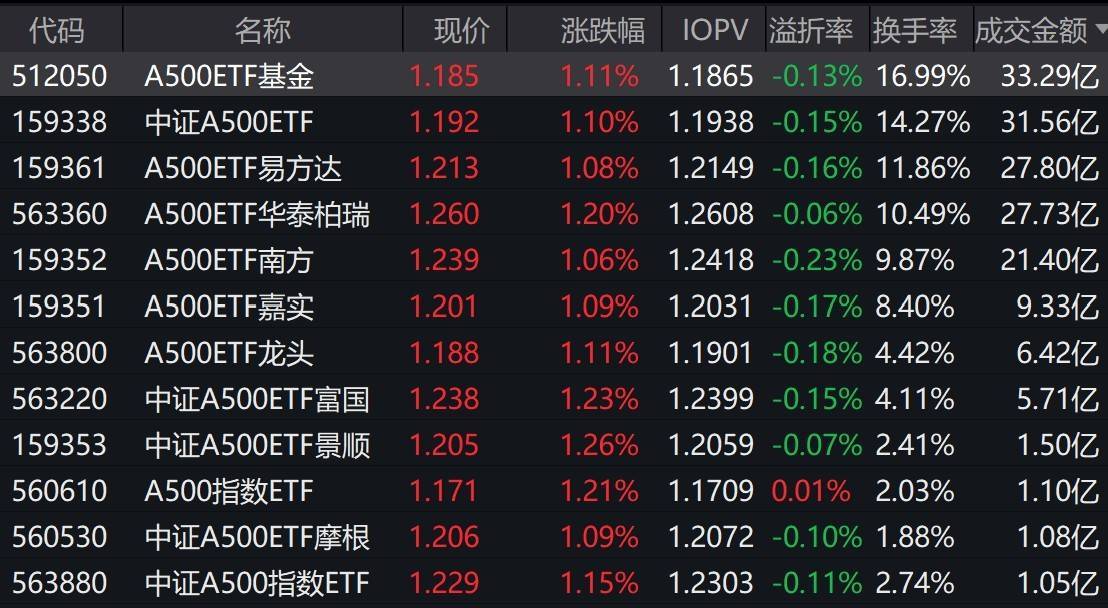
市场早盘震荡走强,中证A500指数上涨1.33%,2只中证A500相关ETF成交额超31亿元
Sou Hu Cai Jing· 2025-11-13 03:52
Market Overview - The market showed a strong upward trend in the early session, with the Shenzhen Component Index rising nearly 2% and the ChiNext Index increasing over 2% after a low opening. The CSI A500 Index saw a rise of 1.33% [1] Sector Performance - The lithium battery industry chain experienced a significant surge, while the Fujian sector continued to rise. Conversely, the banking sector showed weak performance [1] ETF Trading Activity - By the morning close, ETFs tracking the CSI A500 Index rose over 1%. Notably, 12 CSI A500-related ETFs had trading volumes exceeding 100 million yuan, with 2 surpassing 3.1 billion yuan. The A500 ETF Fund and the CSI A500 ETF had trading volumes of 3.329 billion yuan and 3.156 billion yuan, respectively [1][2] Market Outlook - According to brokerage firms, the foundation for the current slow bull market remains intact due to ongoing global technology investment enthusiasm, the continuous promotion of "anti-involution" policies, and increased household savings entering the market. There is potential for further strengthening of the A-share index in the future [1]

四川10月电力、热力生产和供应业价格环比下降
Si Chuan Ri Bao· 2025-11-13 02:51
Group 1: CPI Trends - In October, Sichuan's Consumer Price Index (CPI) decreased by 0.6% year-on-year, with a narrowing decline of 0.3 percentage points compared to the previous month, and a month-on-month increase of 0.4% [1][2] - The average CPI from January to October in Sichuan fell by 0.4% compared to the same period last year [1] Group 2: Price Movements - Fresh vegetable and fruit prices increased by 5.7% and 2.2% month-on-month in October, primarily due to seasonal factors and the demand surge during the National Day and Mid-Autumn Festival [2][3] - Pork prices continued to decline, with a month-on-month decrease of 1.9% and a year-on-year drop of 20.2%, attributed to sufficient market supply and the timing of seasonal consumption [3] - Egg prices also fell by 1.3% month-on-month due to temporary oversupply and post-holiday demand drop [4] Group 3: Core CPI Insights - The core CPI, which excludes volatile food and energy prices, rose by 0.9% year-on-year in October, marking a 0.3 percentage point increase from the previous month, the highest since February 2023 [4] - Service prices contributed to the core CPI increase, with notable rises in air ticket prices (10.8%), travel agency fees (7.3%), and accommodation costs (3.4%) [4] Group 4: PPI Trends - The Producer Price Index (PPI) in Sichuan fell by 2.5% year-on-year in October, with a month-on-month decrease of 0.3%, reflecting a shift from previous increases [7] - The automotive manufacturing sector saw a month-on-month price drop of 0.5%, while electricity and heat production prices decreased by 1.5% month-on-month [7] - Despite the overall decline, some industries, such as computer manufacturing and non-ferrous metal processing, showed signs of price recovery [7] Group 5: Future Outlook - For the fourth quarter, the PPI is expected to continue operating at low levels, but the rate of decline may narrow due to improved market demand and ongoing policy support [8] - The "anti-involution" policies are positively impacting certain industries, leading to a reduction in price declines in sectors like coal and metal processing [8]
华峰化学:目前己二酸行业整体盈利水平属于历史底部区域
Di Yi Cai Jing· 2025-11-13 02:44
Core Viewpoint - The adipic acid industry is currently experiencing low overall profitability, situated at a historical bottom, and is undergoing a phase of survival of the fittest with further concentration of production capacity [1] Industry Summary - The adipic acid industry is facing short-term pressures such as intensified competition, unmet demand expectations, and fluctuations in raw material prices [1] - However, the release of downstream demand, driven by economic recovery and "anti-involution" policies, is expected to significantly boost the consumption growth of adipic acid products [1]

大越期货玻璃早报-20251113
Da Yue Qi Huo· 2025-11-13 01:50
1. Report Industry Investment Rating - No investment rating information is provided in the report. 2. Core View of the Report - The glass market has a weak fundamental situation, with production profit repair being sluggish, supply at a historically low level for the same period, downstream deep - processing orders being generally weak and below the previous year's level, and real - estate terminal demand being weak with high inventory. The short - term expectation is for the glass market to operate in a weak and volatile manner [2]. 3. Summary by Relevant Catalogs 3.1 Glass Futures Market - The closing price of the main glass futures contract decreased from 1053 yuan/ton to 1049 yuan/ton, a decline of 0.38%. The spot price of Shahe Safety large - board glass remained unchanged at 1036 yuan/ton. The main basis increased from - 17 yuan/ton to - 13 yuan/ton, a change of - 23.53% [5]. 3.2 Glass Spot Market - The market price of 5mm white glass large - board in the spot benchmark area of Hebei Shahe was 1036 yuan/ton, remaining the same as the previous day [10]. 3.3 Fundamental Analysis - Cost Side - There is no specific content about the cost - side analysis other than the mention of glass production profit, but no detailed data is provided. 3.4 Fundamental Analysis - Supply - The number of operating national float glass production lines is 222, with an operating rate of 75.92%, and the daily melting volume is 15.91 tons, both at historically low levels for the same period. Influenced by policies such as "anti - involution" and environmental protection, there has been capacity clearance in the float glass industry, and production losses have occurred due to "coal - to - gas" conversion in the Shahe area and cold repairs in the industry [21][23]. 3.5 Fundamental Analysis - Demand - Real - estate terminal demand remains weak, and the number of orders from glass deep - processing enterprises is at a historical low for the same period. The capital collection situation in the deep - processing industry is not optimistic, and traders and processors are cautious, mainly focusing on consuming raw glass inventory [4]. 3.6 Fundamental Analysis - Inventory - The inventory of national float glass enterprises is 63.136 million weight boxes, a decrease of 4.03% from the previous week, and the inventory is above the five - year average [42]. 3.7 Fundamental Analysis - Supply - Demand Balance Sheet - The supply - demand balance sheet shows production, consumption, and other data from 2017 to 2024E. For example, in 2024E, the production is expected to be 55.1 million tons, the consumption is 53.1 million tons, and the production growth rate is 3.94%, while the consumption growth rate is - 1.15% [43]. 3.8 Factors Affecting the Market - **Positive Factors**: Under the influence of "anti - involution" and environmental protection policies, there has been capacity clearance in the float glass industry, and production losses have occurred due to "coal - to - gas" conversion in the Shahe area and cold repairs in the industry [3]. - **Negative Factors**: The main logic is that glass supply has stabilized and rebounded at a low level, the downstream's phased replenishment has ended, and the glass factory's inventory has increased. It is expected that the glass market will operate in a weak and volatile manner at a low level. The risk point is that the intensity of the "anti - involution" policy may exceed expectations [3].
机构:快递行业“反内卷”政策成效持续释放
Zheng Quan Shi Bao Wang· 2025-11-13 00:31
国家邮政局监测数据显示,10月21日至11月11日,全国邮政快递企业共揽收快递包裹139.38亿件,期间 日均揽收量达6.34亿件,是日常业务量的117.8%。旺季单日业务量峰值达7.77亿件,刷新单日业务量纪 录。 方正证券认为,"反内卷"涨价叠加旺季提价,快递单价趋势向好。前期行业监管自上而下坚决落实"反 内卷"政策,提价效果已在8—9月高频数据中如期兑现。10月全国各地再度推进新一轮底价提涨政策。 随着电商正式进入旺季,预计在"反内卷"政策背书+成本要素抬升等驱动下,行业或将继续迎来多轮提 价机会,四季度头部企业盈利改善幅度将更为显著。同时关注后续旺转淡窗口期的"反内卷"监管执行力 度、末端价格结构变化、政策端奖惩机制的持续性等。 银河证券认为,当前下沉电商等新业态成为快递行业主要驱动力,且呈现显著的轻小件化趋势。"反内 卷"政策成效持续释放,多地通过设定价格底线、配套罚款机制整治低价无序竞争,伴随行业格局进一 步优化和智能网联车辆科技赋能,头部快递企业发力打造差异化竞争优势,高质量发展将继续作为未来 发展方向。 ...
行业景气观察:10月PPI降幅持续收窄,新能源产业链价格普遍上涨
CMS· 2025-11-12 14:01
Core Insights - In October, the Consumer Price Index (CPI) turned positive year-on-year at 0.2%, while the Producer Price Index (PPI) saw a narrowing decline of 2.1%, indicating a recovery trend in prices driven by improved consumer demand and supply-side adjustments [12][23][24] - The "anti-involution" policy continues to promote supply clearance, leading to price improvements in key sectors such as coal, new energy, and automotive industries [20][23] Industry Overview Resource Sector - Prices for most metals and coal have increased, contributing to a positive outlook for the resource sector [1][20] - The PPI for coal mining and washing narrowed its decline to -15.6%, while the PPI for non-metallic mining improved to a growth of 2.1% [20][24] Information Technology - The Philadelphia Semiconductor Index remained stable, while the Taiwan Semiconductor Industry Index declined by 2.15%. The DXI Index increased by 36.37% [25][26] - The import and export values of integrated circuits showed a rolling year-on-year decline, indicating a mixed performance in the semiconductor sector [25][26] Midstream Manufacturing - The prices across the new energy supply chain have generally risen, with significant increases in the prices of lithium raw materials and electrolytic nickel [20][24] - The production and sales of automobiles showed a rolling year-on-year decline, while new energy vehicle production increased by 21.37% [20][24] Consumer Services - The prices of fresh vegetables and fruits improved, contributing positively to the CPI, while the prices of pork and liquor continued to exert downward pressure [14][15][23] - The tourism and medical service sectors saw price increases due to heightened consumer demand during the holiday season [15][23] Financial and Real Estate - The monetary market experienced a net withdrawal, with a decline in A-share turnover rates and daily transaction volumes [24] - The land transaction premium rates and the area of commodity housing transactions both decreased, indicating a cooling real estate market [24] Public Utilities - The ex-factory price of natural gas in China decreased, and the average daily power generation of key power plants showed a widening year-on-year decline [24][32]
每日核心期货品种分析-20251112
Guan Tong Qi Huo· 2025-11-12 11:51
1. Report Industry Investment Rating - No relevant content provided 2. Core Views of the Report - As of the close on November 12, domestic futures main contracts showed mixed performance. Some commodities like silver, tin, and crude oil rose, while container shipping, eggs, and jujubes declined. There were also fluctuations in stock index futures and treasury bond futures. The flow of funds into and out of different contracts varied [6][7]. - The prices of various commodities are influenced by multiple factors including supply - demand relationships, policy changes, and international trade situations. For example, copper prices are affected by supply uncertainties and weak downstream demand; lithium carbonate prices are supported by supply - demand tightness; and crude oil prices are affected by OPEC+ decisions and geopolitical issues [9][11][12] 3. Summary by Relevant Catalogs 3.1 Commodity Performance and Market Overview - As of November 12, domestic futures main contracts had mixed performance. Silver, tin, butadiene rubber, SC crude oil, rapeseed oil, low - sulfur fuel oil, and iron ore rose over 1%, while container shipping, eggs, and jujubes had significant drops. Stock index futures and treasury bond futures also had different trends. In terms of funds, some contracts had inflows while others had outflows [6][7] 3.2 Market Analysis of Specific Commodities 3.2.1 Copper - Supply: With long - term contract negotiations approaching, there is uncertainty in long - term contract prices and settlement methods. In November, 5 smelters are expected to conduct maintenance, affecting 4.80 million tons of production. The开工 rate of copper concentrate smelters decreased, while that of smelters using scrap copper or anode copper increased. Scrap copper supply is expected to increase [9] - Demand: The peak season was weaker than previous years, and downstream demand remained weak. Copper product开工 rates declined, and the inventory of the Shanghai Futures Exchange has been increasing [9] 3.2.2 Lithium Carbonate - Supply: In October, the amount of lithium carbonate exported from Chile to China decreased year - on - year, but domestic production continued to grow. The开工 rate increased [11] - Demand: Supported by the strong performance of energy - storage batteries, downstream procurement was smooth. The production of power, energy - storage, and consumer batteries increased, and new - energy vehicle sales also grew [11] 3.2.3 Crude Oil - Supply: OPEC+ decided to increase production in December but pause in the first quarter of next year. Saudi Aramco lowered prices for Asian markets. US crude production reached a new high, and overall oil inventories increased slightly [12] - Demand: The peak consumption season ended, and market concerns about demand increased due to factors like the decline in the US manufacturing index [12] - Geopolitical factors: US sanctions on Russian oil companies, the US - Venezuela military stand - off, and the attitude of Indian oil companies towards Russian oil all affect the market [12][14] 3.2.4 Asphalt - Supply: The开工 rate decreased slightly last week, and November's production is expected to decline. Some refineries plan to resume production [15] - Demand: Downstream开工 rates mostly increased, but were restricted by funds and weather. Northern projects are rushing to work, while southern demand is affected by rain [15] 3.2.5 PP - Supply: The开工 rate of PP enterprises increased, and new production capacity was put into operation. The proportion of standard - grade production increased [16][17] - Demand: The downstream开工 rate was at a low level in the same period. Orders had limited follow - up, and the market lacked large - scale purchases [17] 3.2.6 Plastic - Supply: The开工 rate increased, and new production capacity was put into operation or in trial operation [18] - Demand: The downstream开工 rate decreased. Although the agricultural film season was in progress, the peak season was not as expected, and downstream purchasing willingness was low [18] 3.2.7 PVC - Supply: The开工 rate increased and was at a relatively high level in the same period. New production capacity was put into operation, and some enterprises' maintenance was about to end [20] - Demand: The downstream开工 rate declined slightly. Exports are expected to weaken, and social inventory increased [20] 3.2.8 Coking Coal - Supply: Mongolian coal imports increased, but domestic production decreased. Policy - driven production cuts and environmental protection warnings made the supply in a tight - balance situation [21] - Demand: Steel mills'开工 and iron - water production decreased, and downstream demand was weak [22] 3.2.9 Urea - Supply: Factory复产 and new production increased the daily output, and high production is expected to continue this month [23] - Demand: Downstream high - price acceptance was average, but demand in the Northeast increased. The market was affected by export news, and inventory was decreasing [23]
10月通胀数据点评:通胀正在温和回升
Xiangcai Securities· 2025-11-12 09:17
Group 1: Inflation Data - In October, China's CPI increased by 0.2% year-on-year, up by 0.5 percentage points from the previous value[3] - The year-on-year growth rate of food items in CPI recorded a decline of -2.9%, narrowing the drop by 1.5 percentage points compared to the previous value[3] - The core CPI, excluding food and energy, showed a year-on-year growth of 1.2%, an increase of 0.2 percentage points from the previous value[3] Group 2: PPI Trends - The PPI decreased by -2.1% year-on-year in October, improving by 0.2 percentage points from the previous value, with a month-on-month increase of 0.1%[16] - From July to October, the PPI year-on-year declines were -3.6%, -2.9%, -2.3%, and -2.1%, indicating a trend of monthly recovery[4] - The overall industrial product PPI decreased by -2.7% from January to October[16] Group 3: Investment Recommendations - The rise in both CPI and the narrowing decline in PPI suggest a potential need for further stimulus policies to boost domestic demand and sustain inflation recovery[5] - The PPI is expected to continue to recover, supported by policies aimed at reducing internal competition and improving upstream prices[5] - Monitoring marginal changes in indicators such as food prices, oil prices, and coal prices is recommended[5] Group 4: Risks - Risks include potential underperformance in consumer recovery, unexpected economic recession, and unforeseen impacts from tariffs on related industries[20]
研报掘金丨中银证券:维持韵达股份“增持”评级,短期消费旺季或将驱动业务量增长
Ge Long Hui A P P· 2025-11-12 08:04
Core Viewpoint - Yunda Holdings reported a net profit attributable to shareholders of 730 million yuan for the first three quarters of 2025, a year-on-year decrease of 48.15%, indicating a phase of financial pressure [1] Industry Summary - The implementation of "anti-involution" policies is expected to promote rational pricing in the industry, coupled with demand catalyzed by the consumption peak season, which may lead to an increase in the average price per delivery [1] - Short-term growth in business volume is anticipated due to the consumption peak season, while long-term growth is supported by steady domestic economic growth and the expansion of consumption scenarios [1] - The accelerated construction of rural express delivery networks is expected to release demand for express services from both urban and rural areas, providing incremental space for the express delivery industry [1] Company Summary - The company is expected to enhance operational efficiency, alleviating cost pressures, as it continues to advance its "1+N+AI" multi-layered technology strategy, which empowers profitability and strengthens its competitive position in the industry [1] - Due to the pressure on delivery prices this year, the company has adjusted its previous profit forecasts but maintains an optimistic outlook for future operations under the "anti-involution" context, sustaining an "overweight" rating for the company [1]


《有色》日报-20251112
Guang Fa Qi Huo· 2025-11-12 06:36
1. Report Industry Investment Ratings No information about industry investment ratings is provided in the reports. 2. Core Views of the Reports Copper - The price of copper rebounded slightly yesterday. In the medium - long term, the supply - demand contradiction supports the upward shift of the bottom center of copper prices. The main contract is expected to trade between 85,500 - 87,500 yuan/ton, and future attention should be paid to demand - side marginal changes and overseas liquidity [1]. Zinc - The Shanghai zinc futures oscillated at a high level yesterday. The supply - side pressure may be limited in the future, and the demand side has no outstanding performance. The LME zinc has upward pressure, while the export of zinc ingots may boost domestic zinc prices. The main contract is expected to trade between 22,300 - 23,000 yuan/ton [3]. Industrial Silicon - The spot price of industrial silicon stabilized, while the futures price oscillated downward. In November, the market still faces inventory accumulation pressure, but it is less than that in October. The price is expected to oscillate at a low level, mainly in the range of 8,500 - 9,500 yuan/ton [4]. Polysilicon - The spot price of polysilicon stabilized, the component quotation increased, but the silicon wafer price dropped significantly, and the futures price oscillated downward. The market is expected to oscillate at a high level, and attention should be paid to the spot support strength, platform company establishment, production control, and demand - side order increase [5]. Tin - The supply of tin ore remains tight, and the demand shows no obvious improvement. The market sentiment has improved, and long positions should be held. If the supply in Myanmar recovers smoothly, the tin price may weaken; otherwise, it is expected to continue to run strongly [7]. Alumina - The alumina futures oscillated at a low level yesterday. The supply pressure is high, and the cost support is gradually shifting down. The price is expected to continue to oscillate weakly, with the main contract reference range of 2,750 - 2,900 yuan/ton [9]. Electrolytic Aluminum - The electrolytic aluminum futures continued to oscillate at a high level yesterday. The market shows a pattern of strong macro - drive and weak fundamental support. The price is expected to fluctuate between 21,000 - 21,800 yuan/ton, and attention should be paid to LME warehouse receipt flow, domestic inventory changes, and overseas macro - trends [9]. Nickel - The Shanghai nickel futures oscillated narrowly yesterday. The market is mixed with long and short factors. The price is expected to oscillate in a range, with the main contract reference range of 118,000 - 124,000 yuan/ton, and attention should be paid to macro - expectations and Indonesian industrial policies [10]. Stainless Steel - The stainless - steel futures continued to weaken yesterday. The policy and macro - drive are gradually weakening, and the fundamentals have not improved significantly. The price is expected to oscillate weakly in the short term, with the main contract reference range of 12,400 - 12,800 yuan/ton, and attention should be paid to macro - expectations and steel mill supply [12]. Lithium Carbonate - The lithium carbonate futures ran strongly yesterday. The short - term fundamentals provide support for the price, but the upward movement of the futures is mainly driven by funds. The futures may oscillate and adjust in the short term, and attention should be paid to the end - of - year resumption of large factories and downstream marginal changes [14]. Aluminum Alloy - The cast aluminum alloy market oscillated strongly yesterday. Supported by cost and with a tight supply - demand balance, the ADC12 price is expected to oscillate strongly, with the main contract reference range of 20,400 - 21,200 yuan/ton. Attention should be paid to scrap aluminum supply, downstream procurement, and inventory reduction [16]. 3. Summaries According to Relevant Catalogs Price and Basis - **Copper**: SMM 1 electrolytic copper price was 86,765 yuan/ton, up 0.27% from the previous day. The spot - futures basis and other price - related indicators showed different changes [1]. - **Zinc**: SMM 0 zinc ingot price was 22,660 yuan/ton, up 0.40% from the previous day. The import profit and loss, month - to - month spread, etc. also changed [3]. - **Industrial Silicon**: The price of East China oxygen - passing S15530 industrial silicon remained unchanged at 9,500 yuan/ton, and the basis increased by 52.38% [4]. - **Polysilicon**: The average price of N - type re - feeding material remained at 52,200 yuan/kg, and the main futures contract dropped 3.33% to 51,930 yuan/ton [5]. - **Tin**: SMM 1 tin price was 287,700 yuan/ton, up 0.66% from the previous day. The LME 0 - 3 premium increased by 11.10% [7]. - **Aluminum**: SMM A00 aluminum price was 21,620 yuan/ton, up 0.60% from the previous day. The import profit and loss and month - to - month spread changed accordingly [9]. - **Nickel**: SMM 1 electrolytic nickel price was 121,300 yuan/ton, up 0.08% from the previous day. The LME 0 - 3 decreased by 2.68% [10]. - **Stainless Steel**: The price of 304/2B (Wuxi Hongwang 2.0 coil) was 12,750 yuan/ton, down 0.39% from the previous day. The spot - futures spread increased by 24.66% [12]. - **Lithium Carbonate**: SMM battery - grade lithium carbonate average price was 82,300 yuan/ton, up 1.92% from the previous day. The basis decreased by 858.62% [14]. - **Aluminum Alloy**: SMM aluminum alloy ADC12 price was 21,500 yuan/ton, up 0.23% from the previous day. The month - to - month spread and other indicators changed [16]. Fundamental Data Production and Import/Export - **Copper**: In October, the electrolytic copper production was 109.16 million tons, a month - on - month decrease of 2.62%. In September, the import volume was 33.43 million tons, a month - on - month increase of 26.50% [1]. - **Zinc**: In October, the refined zinc production was 61.72 million tons, a month - on - month increase of 2.85%. In September, the import volume was 2.27 million tons, a month - on - month decrease of 11.61% [3]. - **Industrial Silicon**: In October, the national industrial silicon production was 45.22 million tons, a month - on - month increase of 7.46%. The export volume in October was 7.02 million tons, a month - on - month decrease of 8.36% [4]. - **Polysilicon**: In October, the polysilicon production was 13.40 million tons, a month - on - month increase of 3.08%. In September, the import volume was 0.13 million tons, a month - on - month increase of 28.46% [5]. - **Tin**: In September, the tin ore import was 8,714 tons, a month - on - month decrease of 15.13%. In October, the SMM refined tin production was 16,090 tons, a month - on - month increase of 53.09% [7]. - **Aluminum**: In October, the alumina production was 778.53 million tons, a month - on - month increase of 2.39%. The electrolytic aluminum production was 374.21 million tons, a month - on - month increase of 3.52% [9]. - **Nickel**: In October, the Chinese refined nickel production was 35,900 tons, a month - on - month increase of 0.84%. The import volume was 38,164 tons, a month - on - month increase of 124.36% [10]. - **Stainless Steel**: In October, the production of Chinese 300 - series stainless steel crude steel (43 manufacturers) was 182.17 million tons, a month - on - month increase of 0.38%. The import volume was 12.03 million tons, a month - on - month increase of 2.70% [12]. - **Lithium Carbonate**: In October, the lithium carbonate production was 92,260 tons, a month - on - month increase of 5.73%. The import volume in September was 19,597 tons, a month - on - month decrease of 10.30% [14]. - **Aluminum Alloy**: In October, the production of recycled aluminum alloy ingots was 64.50 million tons, a month - on - month decrease of 2.42%. The production of primary aluminum alloy ingots was 28.60 million tons, a month - on - month increase of 1.06% [16]. Operating Rates - **Copper**: The electrolytic copper rod operating rate was 61.97%, up 1.54 percentage points from the previous week [1]. - **Zinc**: The galvanizing operating rate was 55.13%, down 2.41 percentage points from the previous week [3]. - **Industrial Silicon**: The national operating rate was 68.12%, up 6.18 percentage points from the previous month [4]. - **Tin**: The SMM refined tin average operating rate in September was 43.60%, down 20.3 percentage points from the previous month [7]. - **Aluminum**: The aluminum profile operating rate was 52.60%, down 0.9 percentage points from the previous week [9]. - **Nickel**: There is no significant information about the operating rate in the nickel report. - **Stainless Steel**: There is no significant information about the operating rate in the stainless - steel report. - **Lithium Carbonate**: In October, the lithium carbonate operating rate was 56%, up 1.82 percentage points from the previous month [14]. - **Aluminum Alloy**: The recycled aluminum alloy operating rate was 55.84%, down 1.7 percentage points from the previous week [16]. Inventory - **Copper**: The domestic social inventory was 19.59 million tons, down 2.10% from the previous week; the SHFE inventory was 11.50 million tons, down 0.95% from the previous week [1]. - **Zinc**: The seven - region social inventory of Chinese zinc ingots was 15.96 million tons, down 1.30% from the previous week; the LME inventory remained unchanged at 3.5 million tons [3]. - **Industrial Silicon**: The Xinjiang inventory was 11.21 million tons, up 3.70% from the previous week; the social inventory was 55.20 million tons, down 1.08% from the previous week [4]. - **Polysilicon**: The polysilicon inventory was 25.90 million tons, down 0.77% from the previous week; the silicon wafer inventory was 17.52 million tons, down 7.45% from the previous week [5]. - **Tin**: The SHEF inventory was 5,992 tons, up 1.23% from the previous week; the social inventory was 7,033 tons, up 5.22% from the previous week [7]. - **Aluminum**: The social inventory of Chinese electrolytic aluminum remained unchanged at 62.70 million tons; the LME inventory was 54.5 million tons, down 0.37% from the previous day [9]. - **Nickel**: The SHFE inventory was 37,187 tons, up 1.19% from the previous week; the social inventory was 49,133 tons, up 2.14% from the previous week [10]. - **Stainless Steel**: The 300 - series social inventory (Wuxi + Foshan) was 48.89 million tons, down 0.65% from the previous week; the SHFE warehouse receipt was 7.17 million tons, down 0.41% from the previous day [12]. - **Lithium Carbonate**: In October, the total lithium carbonate inventory was 84,234 tons, down 10.90% from the previous month; the downstream inventory was 53,291 tons, down 13.50% from the previous month [14]. - **Aluminum Alloy**: The weekly social inventory of recycled aluminum alloy ingots was 5.58 million tons, up 1.82% from the previous week [16].