
人民币国际化

Search documents
中国又抛118亿美债,全球抢着卖,美元霸权真撑不住?
Sou Hu Cai Jing· 2025-12-22 16:37
美联储若被政治化,美元信用的一个重要支柱就会动摇,谁还敢无限制地以美元计价借贷并持有美国资产。 把三件事连在一起看,就不是三道孤立的新闻,而是一条链条,链条在受力,断裂的可能性在增加,这是全球金融再定价的开端。 美债曾是世界的避风港,但避风港也会漏水,赤字、债务和政治不确定性是漏水的裂缝,而市场在修补或者撤退。 去美元化是过程不是口号,国家层面的资产配置调整是实务,是在经济与政治双重维度下的必然选择。 那么,这些动作将带来什么后果?第一,美元融资成本将上升,美国财政的外部可持续性面临更大考验。 第二,全球资产再平衡,黄金、欧元、一篮子货币或替代资产的吸引力上升,资金流向会重构。 中国大幅减持美债,还是全球债市的一声惊雷?美国盟友疯狂出逃,特朗普更换美联储主席提议如同挑衅全球信任,这三件事到底在较劲什么,谁在收场。 中国的减持不是赌气而是策略,外储配置在调整与分散的逻辑下进行,中国自有盘算与风险管理的理由明显。 数据摆在那儿,持仓从高位向下,这是多年的慢动作,是在重塑外汇安全垫,而不是一夜之间的激进甩卖。 中国连续增持黄金,这一动作像给家里保险柜再上把锁,既反映国际金融预期,又是一种避险的信号,外行看起来像胆怯 ...


外媒:人民币融资掀国际热潮 市场需求成核心驱动
Xin Lang Cai Jing· 2025-12-22 13:12
Group 1 - The core viewpoint is that international investors are increasingly turning to RMB financing, driven by fundamental market demand for RMB assets, marking a significant step in the internationalization of the currency [1][4]. - The issuance of offshore RMB bonds has seen notable activity, with Kazakhstan's Development Bank issuing 2 billion RMB bonds in September, and Indonesia's government issuing 6 billion RMB bonds in October, indicating a growing trend in Central and Southeast Asia [4][5]. - The total issuance of offshore RMB bonds this year has reached approximately 870 billion RMB, surpassing the record total for 2024 and achieving growth for eight consecutive years [5]. Group 2 - The stability of the RMB compared to the more volatile USD and EUR enhances its attractiveness for financing, as noted by rating agencies [5]. - Experts predict that RMB yields will not experience significant fluctuations in the short to medium term, supported by the People's Bank of China's moderately accommodative policies [7]. - Recent measures announced by the People's Bank of China aim to optimize the "Bond Connect" southbound mechanism and support domestic investors in expanding offshore bond market investment channels, further promoting RMB internationalization [7].
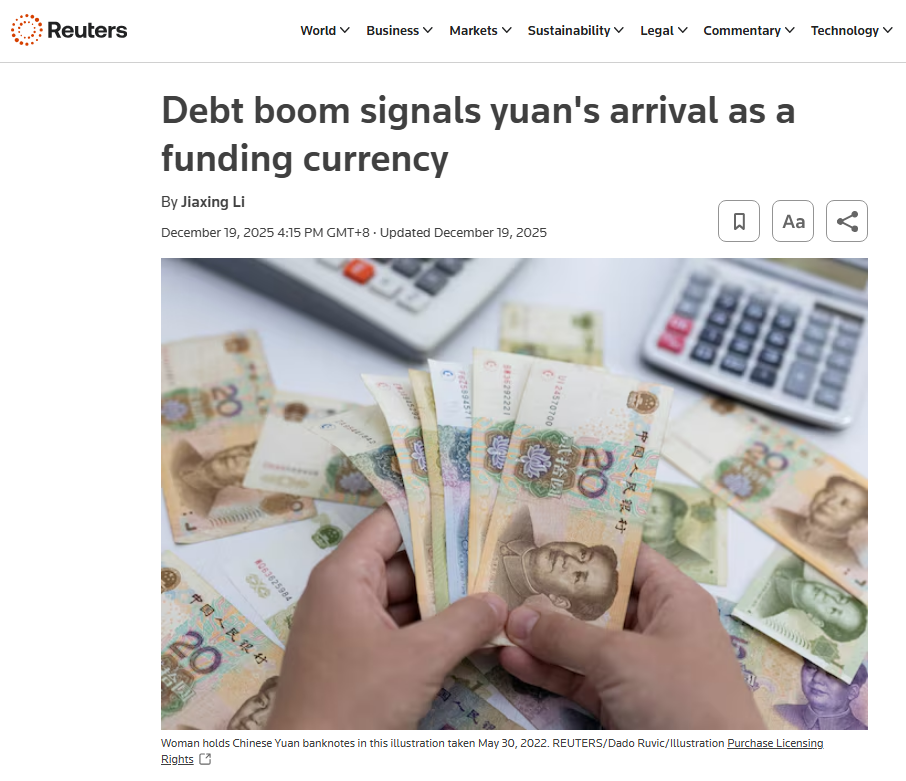
破7在即!人民币升值4%,中巴结算用人民币,去美元化要加速了?
Sou Hu Cai Jing· 2025-12-22 12:49
Core Viewpoint - The Chinese Yuan (CNY) is approaching the critical exchange rate of 7 against the US Dollar (USD), with current rates indicating a strong upward trend, making a breach of this level likely imminent [1][5]. Exchange Rate Trends - The Yuan has experienced significant fluctuations throughout the year, starting at 7.33 CNY per USD in early 2025, dropping to a low of 7.48 CNY due to trade tensions, and then rebounding to a current rate of approximately 7.03 CNY, representing an overall appreciation of about 4% since the beginning of the year [3][6]. - As of December 22, the Yuan continues to appreciate slowly, with the latest exchange rate at 0.1420, indicating a steady upward movement [5]. Factors Driving Appreciation - Three main factors are contributing to the Yuan's appreciation: 1. The US Federal Reserve's ongoing interest rate cuts, which have lowered borrowing costs and weakened the USD. The Fed has cut rates by a total of 75 basis points over the year, with expectations for further cuts in the near future [9][11]. 2. A year-end trend where companies are converting USD to CNY to avoid losses from currency depreciation, leading to increased demand for the Yuan [15][16]. 3. The need for a strong Yuan to support its internationalization, as many countries are moving away from reliance on the USD, making a stable and appreciating Yuan more attractive for trade settlements [18][20]. Market Sentiment - The market sentiment is increasingly bullish on the Yuan, with both onshore and offshore rates reaching 14-month highs, indicating strong expectations for further appreciation [5][6].

杨德龙:年底是布局2026年行情的时间窗口 | 立方大家谈
Sou Hu Cai Jing· 2025-12-22 12:39
杨德龙 | 立方大家谈专栏作者 2025年行情逐步接近尾声,整体来看,我国资本市场在2025年走出了一轮较为典型的慢牛、长牛走势, 主要指数一度突破4000点关口。然而,由于市场内部结构性分化较为明显,银行股与科技股表现相对突 出,集中配置上述方向的投资者获得了较好回报,而其他板块和部分投资者的获得感相对不足。这也导 致一个较为特殊的现象,即在指数已运行至4000点附近的背景下,仍有相当一部分市场参与者并不认为 这是一轮牛市。 进入年底阶段,部分资金选择兑现收益,市场出现一定幅度的调整。但从当前情况来看,这一调整已接 近尾声,部分着眼于2026年布局的资金开始逐步入场,市场整体呈现反复震荡、逐步企稳的特征。综合 判断,当前阶段正是为2026年行情、尤其是一季度春季行情进行布局的相对合适窗口。 展望2026年,宏观层面上,我国经济有望出现一定程度的复苏,稳增长相关政策预计将进一步加码。中 央经济工作会议对2026年的经济工作作出了明确部署,提出将采取更加积极有为的宏观政策以稳定经济 增速,并通过有效措施推动房地产市场止跌回稳。这有助于改善投资者预期,稳定消费增速。在提振内 需作为重要政策方向的背景下,通过内需修 ...
《报告》:中国离岸金融从“规模扩张”迈向“结构优化”
Zhong Guo Jing Ying Bao· 2025-12-22 11:41
Core Insights - The "China Offshore Financial Index Report (2024-2025)" indicates a slight increase of 0.31% in the offshore financial index for China, reaching 106.16 points, marking a new phase of stabilization and recovery after experiencing "double V-shaped" fluctuations [1] - The report highlights a significant structural transformation in China's offshore finance, characterized by a "four increases and one decrease" pattern, including a 3.04% growth in offshore bond issuance, a 1.28% rise in offshore trade settlement volume, and a 14% year-on-year increase in cross-border RMB transactions, surpassing 35 trillion yuan [1] - The comprehensive tax rate in free trade pilot zones has decreased to 8.63%, while the proportion of traditional offshore lending and deposit business is gradually shrinking, indicating a shift from extensive growth to qualitative development in offshore finance [1] Recommendations - The report suggests the need for continuous promotion of synergy between onshore and offshore markets, leveraging reform and innovation to address development challenges and enhance China's voice and influence in the international financial system [2]
海南封关,背后真相到底是啥?东北人赢麻了
Sou Hu Cai Jing· 2025-12-22 11:41
Core Viewpoint - The recent news about Hainan's customs closure indicates a strategic move by the government to create a "super Singapore," focusing on institutional innovation to enhance its global competitiveness in logistics, finance, and petrochemicals [4][7]. Group 1: Strategic Intent - The intention behind Hainan's customs closure is to establish a competitive environment similar to Singapore, which has become a global logistics and financial hub through innovative policies rather than natural resources [4]. - Hainan aims to attract high-end foreign investment and gain pricing power over global commodities by enhancing product value through institutional reforms [7]. Group 2: Policy Measures - A key policy is the "30% value-added tax exemption" for processed goods, encouraging foreign companies to set up manufacturing in Hainan to avoid tariffs [10]. - Hainan's corporate income tax is set at 15%, significantly lower than the mainland's 25%, making it an attractive destination for foreign businesses [10][11]. Group 3: Economic Transformation - Hainan is expected to evolve from a tourism-focused economy to a major processing trade hub, competing for global capital, technology, and talent [14]. - The region will likely become a logistics center for imports such as Australian beef and Chilean cherries, enhancing its role in global supply chains [14]. Group 4: Impact on Local Economy - The closure will lead to lower prices for imported goods, benefiting local consumers with access to global products at competitive rates [15]. - The demand for high-end services, particularly in healthcare and education, is anticipated to rise, mirroring trends seen in Singapore [15]. Group 5: Demographic Changes - Hainan's population is projected to grow from 10 million to 15 million, driven by an influx of talent and investment, altering the dynamics of real estate and local markets [16].

17年以来最低,为什么欠中国的钱变少了,美国反而更焦虑了?
Sou Hu Cai Jing· 2025-12-22 09:45
Core Viewpoint - The article highlights the significant reduction of U.S. Treasury holdings by China, which has dropped to its lowest level since 2008, indicating a strategic shift in China's financial management and a potential challenge to U.S. financial dominance [1][5][20]. Group 1: China's Reduction of U.S. Treasury Holdings - China's holdings of U.S. Treasuries decreased by $11.8 billion in October, falling to $688.7 billion, marking the first time in 17 years that it has dropped below the $700 billion threshold [1][3]. - Since reaching a peak of $1.08 trillion in November 2021, China has cumulatively reduced its U.S. Treasury holdings by $391.3 billion over four years, with only four months showing slight increases [3][5]. - The current holding of $688.7 billion represents a nearly 50% reduction from the peak of $1.3 trillion in 2013 [5][14]. Group 2: Comparison with Other Countries - In contrast to China's reduction, Japan increased its U.S. Treasury holdings by $10.7 billion to $1.2 trillion, while the UK raised its holdings by $13.2 billion to $877.9 billion [3][5]. - This divergence in U.S. Treasury holdings reflects a broader financial competition between China and the U.S., with implications for global financial stability [3][16]. Group 3: China's Strategic Approach - China's strategy of reducing U.S. Treasury holdings has been cautious and orderly, opting for a "hold to maturity" approach rather than aggressive selling, which helps avoid market volatility and potential losses [5][14]. - The reduction in U.S. Treasury holdings is part of a broader strategy to diversify foreign exchange reserves, with the proportion of U.S. Treasuries in China's reserves dropping to about 20%, down from nearly 80% in 2015 [12][14]. Group 4: Implications for the U.S. Economy - The U.S. federal debt is projected to exceed $36 trillion by the end of 2025, with daily interest accumulating at approximately $5.97 million, raising concerns about fiscal sustainability [7][16]. - The reduction in demand for U.S. Treasuries from China could lead to increased borrowing costs for the U.S., with 30-year Treasury yields surpassing 5%, the highest since 1981 [16][18]. - The potential for a loss of confidence in U.S. financial instruments is exacerbated by recent actions that have weaponized financial tools, leading to a global shift towards de-dollarization [10][12]. Group 5: Future Financial Landscape - The ongoing reduction of U.S. Treasury holdings by China signifies a transformative shift in the global financial landscape, moving towards a more diversified and multipolar financial system [20][22]. - The decline in the attractiveness of U.S. dollar assets is evident, as major credit rating agencies have downgraded the U.S. credit rating, reflecting growing concerns over fiscal discipline [18][20]. - The financial chessboard is being reshaped, with China reallocating its resources towards gold, rare earths, and the internationalization of the renminbi, challenging the traditional perception of U.S. Treasuries as "risk-free" [22].
中国减持美债再创新低,仅剩6887亿美元!美国还得硬撑多久?
Sou Hu Cai Jing· 2025-12-22 09:44
美国的国债,正在变成中国手中的一粒定时炸弹。谁都知道美债是全球金融市场的"压舱石",但如今, 中国已经不想再帮它压舱了。 根据2025年12月18日美国财政部发布的数据,中国10月再次减持美债118亿美元,总持有量降到6887亿 美元,创下2008年以来的最低点。这不是一次性"调仓",而是一种趋势,一场清算的开始。 这不是简单的投资组合调整,这是战略判断,是对世界格局冷静而清醒的回应。 中国为什么要减持美债?答案不能用一句"中国不看好美债"打发,这背后,其实是三重逻辑在交错推 进。 第一重是对美国经济基本盘的不信任。别被华尔街的光鲜业绩和AI泡沫骗了,底子到底硬不硬,中国 最清楚。美联储的加息游戏玩得再花,也掩盖不了他们经济正在失速的事实。真实的数据早就透露端 倪,只不过被政客包装成"繁荣"。 你就看"英伟达"这个例子,一个AI芯片公司,市值4—5万亿美元?放眼世界,有这样的定价逻辑吗?这 已经不是市场信仰了,而是金融畸胎。从黄仁勋本人开始疯狂减持变现,看得出他们都觉得价格虚高。 美国的数据已经不再值得信。从特朗普怒斥统计局"唱反调"直接炒掉负责人那一刻起,中国就该清醒 了。押宝美国财务状况稳定,风险已经埋下 ...
海南封关!这五件事将极大推动海南产业发展!
Sou Hu Cai Jing· 2025-12-22 09:44
Core Viewpoint - The official launch of the Hainan Free Trade Port marks a significant milestone in China's free trade zone development, with expectations for it to serve as a model for national trade integration by 2035 [1][3]. Group 1: Key Policies of Hainan Free Trade Port - The Hainan Free Trade Port will implement five basic policies: a corporate income tax rate of approximately 15%, a personal income tax rate of approximately 15%, zero tariffs, zero barriers to service trade, and tax exemption on repatriated overseas investment profits [3][4]. - These policies are expected to provide historical and long-term momentum for Hainan's economy and the construction of China's free trade ports [3]. Group 2: Strategic Directions for Hainan - Hainan aims to integrate domestic and international trade, ensuring that domestic and foreign trade operate under the same standards and regulations, thereby eliminating entry barriers [3]. - The development of service trade is emphasized as crucial for China's goal of becoming a global trade powerhouse, aligning with the Party's 20th National Congress report [3]. - Hainan is positioned to become a bridge and hub for economic exchanges between Southeast Asia and the mainland [3][4]. - The island is expected to build a system to facilitate the repatriation of renminbi held by countries along the "Belt and Road" initiative [4]. - Hainan will explore various methods to promote the internationalization of the renminbi, establishing itself as a key base and node for this initiative [4].
非金融机构绿色债券CGT贴标比例大幅提升|绿金周报
2 1 Shi Ji Jing Ji Bao Dao· 2025-12-22 09:14
Group 1: Green Bond Market Developments - The proportion of non-financial institutions actively seeking CGT-labeled green bonds has surged from approximately 10% to 92% as of November [2] - Future development paths for green bonds include expanding the scope of labeled objects, promoting orderly transitions to the CGT 2024 version, maintaining the "label incentive" property, enhancing information disclosure, and emphasizing cross-border applications [2] Group 2: RMB Internationalization and Climate Financing - The RMB bond market is emerging as a significant source of low-cost climate financing for developing countries amid shrinking traditional financing channels [3] - By the third quarter of 2025, offshore entities are projected to issue approximately 120 billion RMB in panda bonds and 667 billion RMB in dim sum bonds, indicating substantial growth [3] Group 3: Carbon Market Performance - The highest carbon price recorded last week was 62.98 RMB per ton, with a closing price increase of 7.53% compared to the previous week [4] - The total transaction volume of carbon emission allowances reached 9,728,818 tons, with a total transaction value of approximately 579.63 million RMB [5] Group 4: Financial Guidelines and Innovations - A financial operation manual for the transformation of steel and coking enterprises in Shanxi was released, providing practical guidance for financing and reducing information asymmetry [7] - The Hong Kong Quality Assurance Bureau released guidelines for climate-related financial disclosures, covering 77 industries and aiming to enhance companies' disclosure capabilities [8] - The first "transformation + biodiversity + circular" loan in China was issued, supporting an agricultural enterprise's smart and ecological transformation project [9]