
地缘政治风险

Search documents
金银价格创40年最大单日跌幅,发生了什么?贵金属牛市见顶了吗?
Sou Hu Cai Jing· 2026-01-31 02:57
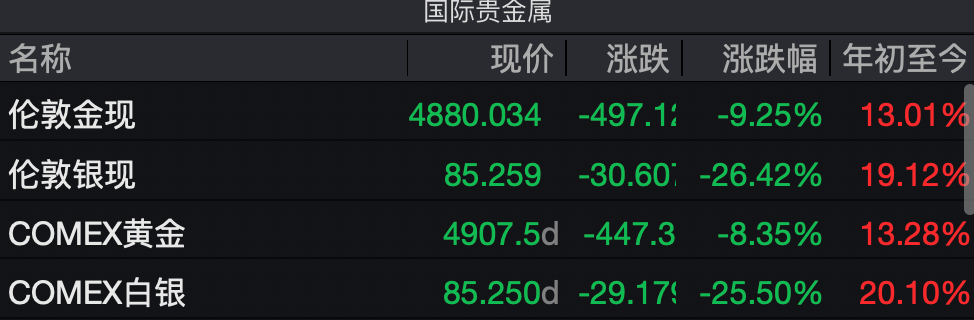
贵金属出现史诗级暴跌。 Wind数据显示,截至收盘,现货黄金下跌9.25%,报4880.034美元/盎司,盘中一度下跌12.92%,跌穿每盎司4700美元,最低触及4682美元/ 盎司。现货白银价格盘中更是一度暴跌35.89%,截至收盘跌26.42%,报85.259美元/盎司。 分析人士认为,沃什的提名之所以对黄金、白银"杀伤力"极强,并非因为市场突然相信美联储将转向激进加息,而是沃什被视为能"重新锚 定美联储公信力"的人选。 | 国际贵金属 | | | --- | --- | | 名称 | 现价 涨跌 涨跌幅 年初至今 | | 伦敦金现 | 4880.034 -497.11 -9.25% 13.01% | | 伦敦银现 | 85.259 -30.60 -26.42% 19.12% | | COMEX黄金 | 4907.5d -447.3 -8.35% 13.28% | | COMEX白银 | 85.250d -29.17! -25.50% 20.10% | 一路狂飙的黄金、白银价格为何急转直下?贵金属价格是牛市见顶,还是未完待续? 黄金、白银出现史诗级暴跌 自北京时间1月30日下午开始,黄金、白银价格便出现 ...

能源日报-20260130
Guo Tou Qi Huo· 2026-01-30 14:13
【燃料油&低硫燃料油】 目前伊朗局势持续升温,原油强势上行,带动燃料油和低硫燃料油同步上涨。其中高硫现货升贴水进一步走 扩,而地缘风险亦将持续为其价格提供韧性支撑。现货偏紧与预期走强形成共振,使高硫在油品系中表现突 出。低硫除受成本端带动外,寒潮推升天然气价格、柴油裂解走强也从纽分端传导支撑,共同推动其裂解价差 走强。中期来看,低硫供应主要取决于海外炼厂:科威特出口逐步增加,而尼日利亚丹格特炼厂RFCC装置回归 推迟,整体供应呈小幅增长趋势。综合来看,燃料油市场预计将跟随原油维持偏强震荡,高低硫基本面分化的 格局仍将延续。 【沥青】 原油领涨油品市场,沥青主力合约突破3400元/吨后继续上行。山东地区部分地炼停产,南方地区主力炼厂维持 间歇生产,供应压力有限。54家样本企业出货量环比增加15%,下游消费表现亦有改善。kpler数据显示1月以来 发船至中国的委油大幅减少,预计一季度后期炼厂面临替代原料成本提升等问题。据悉维多和托克等向国内炼 厂提供委油,贴水报价大幅提升。成本端多重提振下沥青表现偏强。 | 11/2 > 國技期货 | | 能源 日报 | | --- | --- | --- | | 操作评级 | ...
铜月报(2026 年1月)-20260130
Zhong Hang Qi Huo· 2026-01-30 12:58
Report Industry Investment Rating - Not provided in the content Core Viewpoints - In January 2026, copper prices showed significant volatility and a generally strong performance. The price increase was driven by multiple factors including macro - liquidity expectations, supply constraints at the mine end, and positive future demand prospects. The market has entered a stage dominated by strong expectations. However, the risk of overheating in the market is accumulating, and sharp fluctuations due to a rapid reversal of sentiment should be highly vigilant. It is recommended to take a bullish approach on dips [7][8]. Summary by Directory 1. Market Review - In January, copper prices were generally strong. At the beginning of the month, prices rose rapidly, reaching 105,320 yuan on January 6th, then entered a high - level consolidation phase. On January 23rd, the upward trend resumed, and on January 29th, the main contract of Shanghai copper (2603) once broke through the 110,000 yuan/ton mark [9][10]. 2. Macro - economic Analysis 2.1 United States - The US economic data is mixed. In December 2025, the seasonally - adjusted non - farm payrolls increased by 50,000, lower than the expected 60,000 and the previous value of 64,000. The unemployment rate in December was 4.4%, slightly lower than the market expectation of 4.5%. The third - quarter GDP in 2025 had an annualized quarter - on - quarter growth of 4.4%, higher than the initial value. The core PCE price index in November increased by 2.8% year - on - year and 0.2% month - on - month, both in line with expectations. The number of initial jobless claims last week was 200,000, lower than the expected 210,000 [13]. - The Federal Reserve kept the benchmark interest rate unchanged at 3.50% - 3.75%. After three consecutive 25 - basis - point interest rate cuts, it paused its actions, which was in line with market expectations. Fed Chair Powell's term ends on May 15th, and the new chair is expected to be either Reed or Walsh. It is anticipated that they will follow Trump's idea of significant monetary easing and continuous interest rate cuts, and another interest rate cut cycle may come in the second half of 2026, which may drive a new round of increases in non - ferrous metals [13]. - Since the New Year's Day, frequent geopolitical events led by the US, such as military actions against Venezuela, tense situation in Iran, and the Greenland issue, have reduced market risk appetite and exerted downward pressure on copper prices. These events have entered a more complex stage, and the future US national security strategy may lead to more geopolitical contradictions and risks [15][16]. 2.2 China - China's central bank maintained the one - year and five - year loan prime rates (LPR) at 3% and 3.5% respectively for eight consecutive months. In 2025, China's GDP increased by 5% year - on - year, reaching 140.19 trillion yuan. The central bank governor stated that in 2026, China would continue to implement a moderately loose monetary policy, with room for reserve requirement ratio cuts and interest rate cuts. The first batch of 936 billion yuan in ultra - long - term special treasury bonds has been issued to support equipment renewal projects, which are expected to drive total investment of over 4600 billion yuan [20]. 3. Fundamental Analysis 3.1 Supply - At the beginning of 2026, the global copper mine supply remained fragile. Labor disputes at the Mantoverde copper - gold mine in northern Chile have not been fully resolved, and Southern Copper has lowered its 2026 production target due to declining ore grades in Peruvian mines. In addition, the supply chain in some African regions has been affected by geopolitical situations, and the output of large mines such as Grasberg in Indonesia is still restricted by previous accidents. These factors have strengthened the market's long - term expectation of tight raw material supply [22]. - As of January 28th, the spot processing fee for copper concentrates was - 50.2 US dollars/ton, remaining in a deep negative range. The China Smelters Purchase Team (CSPT) has effectively abandoned the quarterly guidance price setting, reflecting the extreme shortage of copper concentrate supply. The extremely low processing fees are driving substantial adjustments in the industry, with major smelting enterprises' joint production cuts moving from proposals to implementation. The supply of scrap copper is also temporarily tight due to import policy and tax adjustments, which has further exacerbated the structural pressure on raw material sources at the smelting end [25]. 3.2 Inventory - Domestic copper inventories have been continuously increasing, and COMEX copper inventories have also been piling up. As of January 23rd, the copper inventory on the Shanghai Futures Exchange was 225,900 tons, with a cumulative increase of over 50% since the beginning of the year. As of January 28th, the COMEX copper inventory was 572,300 tons, still at a historical high. The domestic social inventory is at a high level, indicating that downstream acceptance of high copper prices is limited [28]. 3.3 Production - In December 2025, China's refined copper (electrolytic copper) production was 1.326 million tons, a year - on - year increase of 9.1%. The cumulative production from January to December was 14.72 million tons, a year - on - year increase of 10.4%. In January 2026, 5 smelters had maintenance plans, involving a rough - smelting capacity of 1.05 million tons, with an expected impact of about 19,000 tons. Only one of the two smelters originally planned to start production in January was able to do so on time, and the other was postponed to the end of March or early April [31]. 3.4 Import - In December 2025, China's scrap copper imports were 239,000 tons, a month - on - month increase of 14.81% and a year - on - year increase of 9.90%, reaching a new monthly high for the year. Asian countries remained the main suppliers, with Japan still at the top, Thailand's supply increasing month - on - month, and South Korea's supply decreasing significantly. Smelters have strengthened their procurement of scrap copper due to the tight supply of copper mines [34]. 3.5 Downstream Consumption - In December 2025, the production of domestic refined copper rods was 687,400 tons, a month - on - month decrease of 16.61%. The production capacity utilization rate was 51.10%, a month - on - month decrease of 12.22% and a year - on - year decrease of 15.06%. In January 2026, the production of refined copper rods was expected to be 755,900 tons, a month - on - month increase of 9.97%. The production capacity utilization rate was 53.97%, a month - on - month increase of 2.88% and a year - on - year increase of 5.46%. However, due to the extreme copper price movement in January, the overall increase in production was limited [39]. - In 2025, China's automobile production and sales both exceeded 34 million units, reaching a new historical high. New energy vehicle production and sales both exceeded 16 million units, accounting for over 50% of domestic new car sales. In December 2025, the newly - installed photovoltaic capacity decreased significantly, with a year - on - year decrease of 43.3% [46].

什么信号?标普新高之际,企业高管与大资金却悄然“离开牌桌”
Zhi Tong Cai Jing· 2026-01-30 12:29
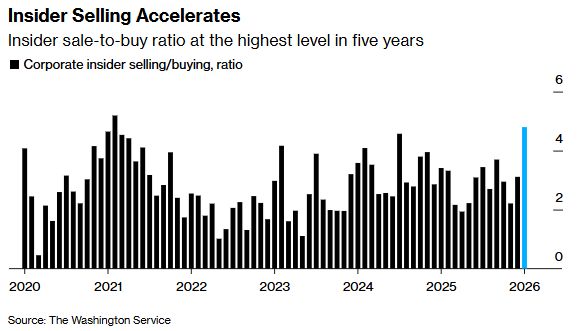
Group 1 - The core concern is the sustainability of the recent rally in the U.S. stock market, highlighted by a significant number of executives selling their company shares, with nearly 1,000 executives reducing their holdings compared to only 207 increasing them, resulting in the highest sell/buy ratio in five years [1] - The cautious stance of company management, alongside concerns over high valuations, increased AI spending, and geopolitical uncertainties, signals potential risks in the market [1] - Insider trading behavior is viewed as a strong predictor of future stock returns, indicating that executives are recognizing risks and taking profit opportunities [1] Group 2 - The recent market downturn, following a record high for the S&P 500, reflects underlying concerns, particularly regarding the value of substantial AI expenditures as indicated by Microsoft's earnings report [3] - Despite a resilient economic backdrop and strong earnings expectations, there are signs of weakening momentum, with only 77% of approximately 150 companies exceeding earnings expectations, marking one of the weakest performances in a year [3] - Ongoing geopolitical uncertainties and high market valuations after three years of double-digit gains contribute to increasing market pressures [3] Group 3 - Institutional investors are showing a cautious sentiment, with a rise in bearish and neutral views reaching a four-week high, indicating a shift in asset allocation from large growth and tech stocks to more cyclical sectors [5] - Hedge funds are adopting a defensive posture, with significant net selling in single-stock positions, marking the largest sell-off in four weeks [5]

铝月报(2026年1月)-20260130
Zhong Hang Qi Huo· 2026-01-30 12:17
铝月报(2026年1月) 范玲 期货从业资格号:F0272984 投资咨询资格号:Z0011970 中航期货 2026-1-30 目录 01 后市研判 02 行情回顾 02 行情回顾 03 宏观 面 04 基本 面 后市研判 PART 01 1月氧化铝、电解铝、铝合金期价走势分化 1月份氧化铝期货价格呈现探底回升走势;1月份电解铝、铝合金期货价格呈现走势偏强的格局。 宏观面:美国就业市场弱平衡,通胀表现温和,1月份美联储按兵不动,但货币政策宽松预期不改,地缘潜在风险升 级 全球铝溢价传导加剧;国内方面,央行行长表示灵活高效运用降准降息等多种货币政策工具,今年降准降息还有 一定的空间。 氧化铝:铝土矿价格继续下跌,氧化铝成本因此下降,随着几内亚雨季结束,进口矿价格仍存在下跌预期。氧化铝部 分炼厂出现减产,供应压力稍有缓解,提振期价上涨,不过,目前供应过剩格局未改,氧化铝难以摆脱弱势。 目前供应过剩格局未改,氧化铝难以摆脱弱势。 电解铝:供应端目前电解铝运行产能变化有限,后期有增产预期。进入季节性淡季后,需求表现趋弱,且春节临近、 铝价高企或抑制下游拿货积极性,下游企业的提前退市将接踵而来,不过,光伏抢出口带动需 ...
原油月报:地缘扰动推升油价,警惕地缘风险溢价回落-20260130
Zhong Hang Qi Huo· 2026-01-30 12:06
1. Industry Investment Rating - Not mentioned in the report 2. Core Viewpoints - Geopolitical risks are the core factors affecting the crude oil market. The escalation of US - Iran tensions may lead to supply disruptions and drive up oil prices. If the situation eases, the risk premium in oil prices may quickly disappear. The upside of oil prices may be limited if the situation does not further escalate, but short - term pulse - type price increases may occur due to unexpected events. It is recommended to track geopolitical developments [54] 3. Summary by Directory 3.1 Market Review - In January, the crude oil market was strong under geopolitical influence. At the beginning of the month, the US raid on Venezuela and the detention of President Maduro raised concerns about supply disruptions, supporting short - term price increases. Then, the US hinted at relaxing sanctions on Venezuela, causing a drop in oil prices. Subsequently, rising Middle - East geopolitical risks, such as Trump's military threat to Iran and the deployment of US warships, pushed up oil prices again [7] 3.2 Macroeconomic Analysis 3.2.1 Geopolitical Tensions - The US detained Venezuelan President Maduro and his wife. A large number of US military planes flew to Europe, and Iran strengthened its combat readiness. Trump is considering new major strikes against Iran. As the US completes military deployment in the Middle East, the risk of intensified geopolitical tensions is rising. The way of US military intervention will determine the impact on oil prices [10] - The US, Russia, and Ukraine held their first tripartite talks, but there were still significant differences on the issue of Ukrainian territory. The situation is expected to continue with a combination of fighting and negotiation, and the direct impact on oil prices is currently limited [11] 3.2.2 OPEC+ Production Policy - OPEC+ continued to suspend production increases in January and reaffirmed the plan to pause production increases in the first quarter. The total OPEC+ crude oil production in December decreased compared to November. The suspension of production increases and over - quota cuts support oil prices. Attention should be paid to the potential impact of rising oil prices and Middle - East tensions on OPEC+ production policies [14] 3.2.3 Federal Reserve Policy - The Federal Reserve paused interest rate cuts, but there were internal disagreements. The Fed upgraded its assessment of the US economy. Powell said that interest rate cuts depend on the labor market. Although the market has priced in the pause of rate cuts, expectations of future rate cuts may rise due to Trump's potential appointment of a new Fed chairman [17] 3.3 Supply - Demand Analysis 3.3.1 Supply - OPEC's crude oil production increased in December, but the growth rate slowed down. After the end of the first - quarter production - increase suspension, attention should be paid to changes in OPEC+ production policies [18] - US crude oil production decreased from the previous month as of January 23, and is expected to remain stable at a high level [21] - The number of US oil rigs decreased slightly, and it is expected to remain at a low level [24] 3.3.2 Demand - In December, the US manufacturing PMI decreased and was below the boom - bust line, which suppressed crude oil demand to some extent. The US refinery utilization rate decreased seasonally, but is expected to rise in the second quarter [26][31] - In December, China's manufacturing PMI increased and was above the boom - bust line. The production side was relatively stable, but the demand side was weak. The operating rates of Chinese refineries showed a differentiation trend, and overall domestic crude oil consumption is expected to slightly improve [39][43] 3.3.3 Inventory - The US EIA crude oil inventory faced the pressure of seasonal accumulation. The Cushing crude oil inventory decreased slightly, and the gasoline inventory reached an inflection point [48][52]
每日核心期货品种分析-20260130
Guan Tong Qi Huo· 2026-01-30 11:40
Industry Investment Rating - No information provided Core Viewpoints - As of the close on January 30, most domestic futures main contracts declined. Platinum and palladium dropped nearly 12%, lithium carbonate hit the daily limit down with a 10.99% decline, and tin futures fell over 8%. PVC rose over 3% and logs rose over 2%. In the bond market, the 2 - year Treasury futures (TS) main contract remained flat, the 5 - year (TF) rose 0.01%, the 10 - year (T) rose 0.06%, and the 30 - year (TL) fell 0.23%. In terms of funds, PVC2605, ten - year bond 2603, and pulp 2605 had capital inflows, while Shanghai gold 2604, Shanghai silver 2604, and CSI 2603 had capital outflows [4][5] Summary by Related Catalogs Futures Market Overview - As of the close on January 30, domestic futures main contracts mostly declined. Platinum, palladium, lithium carbonate, tin, silver, gold, and other metals fell, while PVC and logs rose. In the stock index futures, IF, IH, IC, and IM all declined, and in the bond futures, there were different trends. As of 15:20 on January 30, PVC2605, ten - year bond 2603, and pulp 2605 had capital inflows, while Shanghai gold 2604, Shanghai silver 2604, and CSI 2603 had capital outflows [4][5] Market Analysis Copper - Shanghai copper opened high but closed lower. Supply was affected by a strike at a Chilean copper mine, and the TC/RC fees were weak and trending down. SMM expected a 1.23% month - on - month decrease in domestic electrolytic copper production in January. Demand showed that copper apparent consumption increased in December 2025, but near the Spring Festival and with high copper prices, SMEs' procurement willingness was low. The real estate policy change was positive, and the possible change of the Fed chairman and dollar depreciation affected the market. After a previous rise, profit - taking led to a downward turn [7] Lithium Carbonate - Lithium carbonate opened low and hit the daily limit down. The average prices of battery - grade and industrial - grade lithium carbonate declined. Supply was affected by a planned restart of some production lines and the suspension of a lithium mine. The export tax - rebate policy for batteries was adjusted. Inventory was being depleted, and downstream production schedules in the first quarter were expected to be good. However, terminal new - energy vehicle sales declined in January, and after a meeting, the market was affected by negative news [9] Crude Oil - OPEC+ decided to maintain the production plan in February and March 2026. Due to winter storms, US crude oil inventories decreased more than expected, and production losses reached up to 2 million barrels per day. The IMF raised the global economic growth forecast, and cold weather increased diesel demand. However, the global crude oil floating storage was high, and the supply was still in surplus. Geopolitical risks in Iran continued to rise, and the situation in Kazakhstan's oil fields was improving. Crude oil prices were oscillating strongly [10][11] Asphalt - The asphalt开工率 decreased to 25.5% this week, and the February production was expected to decline. Downstream开工率 mostly fell, and the national shipments decreased. The refinery inventory rate remained at a low level. The supply of Venezuelan heavy crude to domestic refineries was restricted, but the possibility of domestic refineries obtaining it increased. In the short term, asphalt was expected to oscillate strongly, and the arbitrage suggestion was reverse arbitrage [12][13] PP - The PP downstream开工率 decreased to 52.08% this week. The enterprise开工率 fell to 78.5%, and the proportion of standard - grade drawing production increased. Petrochemical inventories were at a low level. With rising crude oil prices, PP was expected to oscillate strongly in the short term, but the improvement in the supply - demand pattern was limited, and the sustainability of the rebound was to be treated with caution. The L - PP spread was expected to decline [14] Plastic - The plastic开工率 rose to 90% on January 30. The PE downstream开工率 decreased to 37.76%, and orders and raw - material inventories in the agricultural film and packaging film sectors decreased. Petrochemical inventories were at a low level. With rising crude oil prices, plastic was expected to oscillate strongly in the short term, but the supply - demand improvement was limited, and the L - PP spread was expected to decline [15][16] PVC - The upstream calcium carbide price in the northwest was stable. The PVC开工率 increased slightly to 78.93%, and the downstream开工率 decreased slightly. PVC exports increased due to the cancellation of export tax - rebates, but the transaction resistance increased. Social inventories continued to rise, and the real estate market was still in adjustment. The PVC market was volatile, and caution was advised [17] Coking Coal - Coking coal opened and closed higher. As the Spring Festival approached, domestic mines started holidays, and the mine inventory started to accumulate. Downstream iron - water production decreased slightly, and the first round of coke price increase was implemented. The market sentiment was volatile, and the coking coal price was expected to oscillate strongly in the short term [19] Urea - Urea opened high and closed lower, falling over 1%. The spot price was stable due to good pre - sales. In February, there would be复产 of gas - head devices, and the daily output was close to 210,000 tons. Agricultural dealers' purchases increased, but downstream factory开工率 decreased. Inventory decreased slightly. In the short term, the urea futures market was expected to be resistant to decline and mainly trade in a high - level range [20]
原油日报:原油冲高回落-20260130
Guan Tong Qi Huo· 2026-01-30 11:20
Report Industry Investment Rating - Not provided Core View - Due to geopolitical situations and cold weather, crude oil prices are oscillating strongly. However, the market is still in a state of oversupply, and the EIA's latest January report has raised the expected surplus for 2026. Traders should be aware of significant price fluctuations and manage risks [1] Summary by Directory Market Analysis - On January 4, OPEC+ decided to maintain the production plan set in early November 2025, suspending production increases in February and March 2026. Despite the off - peak demand season, winter storms led to an unexpected decline in US crude oil inventories and a slight increase in refined oil inventories, resulting in an overall decrease in oil product inventories. US oil producers lost up to 2 million barrels per day, about 15% of the national production, last weekend due to the storms. The IMF raised the 2026 global economic growth forecast by 0.2 percentage points, and cold weather boosted diesel heating demand, alleviating demand concerns. Chevron is increasing the transportation of Venezuelan crude, which currently has little impact on global supply and demand. The US imposed new sanctions on Iran on the 23rd and has not ruled out military action. The Iranian military will conduct live - fire exercises in the Strait of Hormuz on February 1 - 2. The Tengiz oilfield in Kazakhstan will restart, but only half of its capacity will be restored by February 7 [1] Futures and Spot Market - Today, the main crude oil futures contract 2603 rose 0.81% to 470.8 yuan/ton, with a low of 465.8 yuan/ton and a high of 499.6 yuan/ton. The open interest decreased by 4265 to 44117 lots [2] Fundamental Tracking - The EIA monthly report raised the 2026 WTI crude oil price forecast by $0.79/barrel to $52.21/barrel, lowered the 2026 global oil demand forecast from 105.2 million barrels per day to 104.8 million barrels per day, and raised the 2026 global oil production forecast from 107.4 million barrels per day to 107.7 million barrels per day. The IEA raised the 2026 global oil demand growth rate by 70,000 barrels per day to 930,000 barrels per day and the 2026 global oil production growth rate by 100,000 barrels per day to 2.5 million barrels per day. On January 28, EIA data showed that US crude oil inventories for the week ending January 23 decreased by 2.295 million barrels, against an expected increase of 1.848 million barrels, and were 2.94% higher than the five - year average. Gasoline inventories increased by 223,000 barrels, against an expected increase of 1.009 million barrels; refined oil inventories increased by 329,000 barrels, against an expected decrease of 583,000 barrels; heating oil inventories increased by 26,000 barrels, against an expected increase of 279,000 barrels. Cushing crude oil inventories decreased by 278,000 barrels [3] Supply and Demand - OPEC's latest monthly report showed that its November 2025 crude oil production decreased by 21,000 barrels per day to 28.459 million barrels per day, and its December 2025 production increased by 105,000 barrels per day to 28.564 million barrels per day. US crude oil production for the week ending January 23 decreased by 36,000 barrels per day to 13.696 million barrels per day, near the historical high. The four - week average supply of US crude oil products increased to 20.271 million barrels per day, a 0.08% decrease from the same period last year, with the decline narrowing. Gasoline weekly production increased 11.78% to 8.757 million barrels per day, with a four - week average of 8.266 million barrels per day, a 0.39% decrease from the same period last year. Diesel weekly production increased 15.47% to 4.069 million barrels per day, with a four - week average of 3.721 million barrels per day, a 4.78% decrease from the same period last year. The increase in gasoline and diesel production led to a 2.49% increase in the single - week supply of US crude oil products [4]
美股上市公司高管密集离场 是落袋为安还是预见危机?
Ge Long Hui A P P· 2026-01-30 11:01
Core Insights - The article highlights a concerning trend among U.S. corporate executives, with nearly 1,000 out of approximately 6,000 publicly traded companies' executives selling shares, while only 207 increased their holdings, resulting in the highest sell-buy ratio in five years [1] Group 1: Executive Actions - Approximately 1,000 executives have sold shares, indicating a cautious stance amidst high valuations and geopolitical uncertainties [1] - Only 207 executives have increased their stock holdings, suggesting a lack of confidence in the sustainability of the current market rally [1] Group 2: Market Sentiment - The high sell-buy ratio among executives is seen as a strong signal for predicting future stock returns, raising concerns about the sustainability of the recent stock market surge [1] - Joe Gilbert from Integrity Asset Management notes that executives may be anticipating risks related to geopolitical issues and high stock valuations, leading them to capitalize on profits [1]
1月人民币对美元即期汇率升值近0.58%
Sou Hu Cai Jing· 2026-01-30 10:10
中间价方面,1月30日人民币对美元中间价报6.9678,较上一交易日调升93个基点。1月人民币对美元中 间价累计升值近0.87%。 兴业研究在研报中指出,2026年1月,地缘政治风险高发,美元指数先升后贬,纽约联储代表美国财政 部对美元兑日元进行rate check(汇率检查),日元带动非美货币反弹,特朗普"鼓励"弱美元加速美元下 行。人民币相对美元升值速率较去年12月放缓,非美货币相对人民币升值,有效汇率先升后贬。展望后 市,中间价熨平波动,人民币汇率继续温和升值。纽约联储主导的rate check已构筑日元多头氛围,压 制美元指数,需密切关注是否有日本单边和美日联合实质性干预措施。美元指数下行波段中,因弹性差 异,欧元等非美货币相对人民币升值。 1月人民币对美元中间价和即期汇率双双大涨。 1月最后一个交易日,人民币对美元即期汇率16时30分收于6.9486,较上一交易日下跌26个基点。整个1 月,人民币对美元即期汇率累计升值404个基点,升值幅度达到0.578%。 ...