新消费

Search documents
外资积极加仓,KWEB连续6周净流入!港股科技50ETF融资余额创新高
Xin Lang Cai Jing· 2025-09-23 04:15
Group 1 - Hong Kong stocks experienced a decline, with notable drops in companies such as NIO-SW (over 7%), Baidu Group (over 6%), and others like ZTE Corporation, JD Group-SW, and BYD Company (over 4%) [1] - The Hong Kong Technology 50 ETF (159750) fell by 2.17% with a trading volume of 116 million, while net inflow exceeded 50 million during the session, marking over 200 million in net inflows over the past seven trading days [1] - The Hong Kong Technology 50 ETF has been included in margin trading, with a net margin buy of 1.03 million in the previous trading day, and a monthly margin of 43.92 million, setting a new record since its listing [1] Group 2 - There is a notable trend of foreign capital returning, with the KraneShares CSI China Internet ETF (KWEB) seeing its sixth consecutive week of inflows, the longest streak since February [3] - According to EPFR data, foreign net inflows into offshore Chinese stocks reached 1.86 billion, the highest weekly figure since November of the previous year [3] Group 3 - CITIC Securities suggests that with the Federal Reserve's interest rate cuts, the Hong Kong-US interest rate differential has narrowed, reducing the likelihood of a weak-side guarantee, and liquidity tightness is easing [4] - Foreign capital is expected to continue flowing into the Hong Kong market and Chinese assets, with a focus on core growth sectors such as internet, innovative pharmaceuticals, new consumption, and technology [4] - The valuation of Hong Kong technology assets is considered attractive, significantly lower than that of major global technology indices like NASDAQ (43.41x) and ChiNext (43.65x) [4] Group 4 - Changjiang Securities is optimistic about three directions for Hong Kong stocks: AI technology and new consumption have significant growth potential, continued inflow of southbound funds is enhancing marginal pricing power, and the transmission from broad monetary policy to broad credit could support further market growth [6] - The Hong Kong Technology 50 ETF tracks the Hong Kong Technology Index and is the only index covering the "Top Ten Chinese Technology Stocks," outperforming the Hang Seng Technology Index [6]

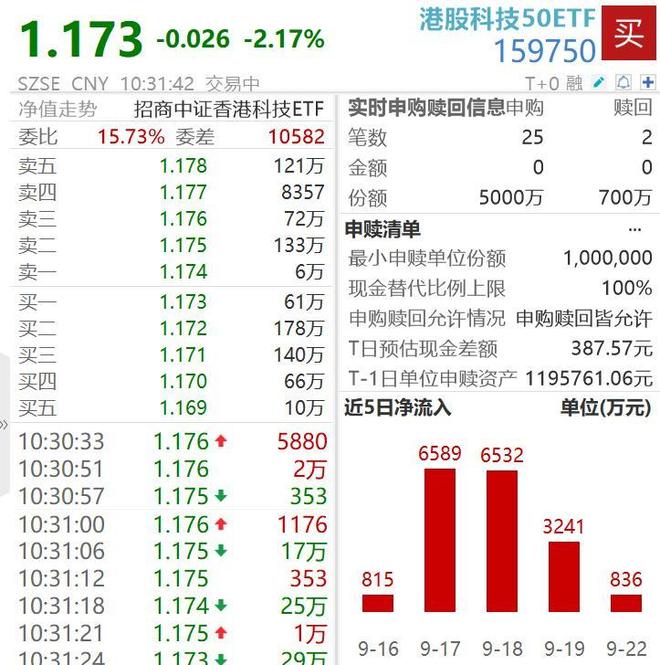
KWEB连续第六周资金流入!港股科技50ETF(159750)融资余额创上市新高,机构:内外资有望持续流入港股
2 1 Shi Ji Jing Ji Bao Dao· 2025-09-23 03:15
Market Performance - Hong Kong stocks experienced a decline, with notable drops in companies such as NIO-SW (over 7%), Baidu Group (over 6%), and others like ZTE Corporation, JD Group-SW, and BYD Company (over 4%) [1] - The Hong Kong Technology 50 ETF (159750) fell by 2.17%, with a trading volume exceeding 116 million yuan, while it saw a net subscription of 43 million shares during the session [1] - The ETF has recorded a continuous net inflow of over 200 million yuan in the past seven trading days [2] Foreign Investment Trends - There is a positive trend in foreign capital inflow, with a reported net inflow of 1.86 billion USD into Chinese stocks, marking the highest weekly inflow since November of the previous year [2] - The KraneShares CSI China Internet ETF (KWEB) has seen a continuous inflow for six weeks, totaling 599 million USD, although this is less than one-third of the inflows recorded in January and February [1][2] Valuation Insights - As of September 22, the valuation of the Hong Kong Technology Index stands at 24.56 times PE-TTM, which is significantly lower than the Nasdaq Index (43.41x) and the ChiNext Index (43.65x) [2] - The Hong Kong Technology Index has shown a cumulative increase of 131.68% since its base date, outperforming the Hang Seng Technology Index, which increased by 109.81% during the same period [3] Investment Outlook - Long-term prospects for AI technology and new consumption sectors are viewed positively, with expectations of driving market growth [3] - Continuous inflow of southbound funds is expected to enhance marginal pricing power in the Hong Kong market, particularly in the context of a low-interest-rate environment [3] - The transition from broad monetary policy to broad credit policy in China, along with potential further interest rate cuts in the U.S., may support the Hong Kong market's upward trajectory [3]
0922港股日评:港股蓄势,回调迎新机
Xin Lang Cai Jing· 2025-09-22 16:01
Market Overview - The Hang Seng Index declined by 0.76% to 26,344.14, while the Hang Seng Technology Index fell by 0.58% to 6,257.91, and the Hang Seng China Enterprises Index decreased by 1.07% to 9,370.73 [3] - In the A-share market, the Shanghai Composite Index rose by 0.22%, the CSI 300 increased by 0.46%, and the Wind All A Index gained 0.52%, while the Dividend Index fell by 0.84% [3] Sector Performance - Among the sectors in the Hong Kong Stock Connect, Electronics (+1.85%), Steel (+1.58%), and Non-ferrous Metals (+1.39%) led the gains, while Defense and Military (-2.59%), Comprehensive Finance (-2.44%), and Comprehensive (-2.39%) were the biggest losers [3] - Concept indices showed significant movements, with the Foxconn Index rising by 15.02%, the OLED Index increasing by 10.30%, and the Apple Index up by 6.57%. Conversely, the Port Transportation Index fell by 3.57%, the Charging Pile Index decreased by 3.34%, and the Fuel Cell Index dropped by 3.19% [3] Market Commentary - On September 22, 2025, the total trading volume in the Hong Kong market reached HKD 290.54 billion, with net inflows from southbound funds amounting to HKD 12.736 billion [4] - The decline in the Hong Kong stock indices is attributed to macroeconomic factors, particularly the Federal Reserve's decision to cut interest rates by 25 basis points, which was already anticipated by the market [4] - The sentiment in the automotive sector was negatively impacted by news of overseas shareholders reducing their stakes, while upcoming increases in port service fees for Chinese vessels entering U.S. ports are expected to suppress the performance of the transportation sector [4] Future Outlook - The Hong Kong market may reach new highs driven by three key factors: 1) AI technology and new consumption trends, which are expected to have significant growth potential [5] 2) Continued inflows of southbound funds, enhancing marginal pricing power [5] 3) The transmission of wide monetary policy to wide credit, alongside potential further interest rate cuts in the U.S. to improve global liquidity [5]
0922港股日评:港股蓄势,回调迎新机-20250922
Changjiang Securities· 2025-09-22 15:21
Group 1 - The core viewpoint of the report indicates that the Hong Kong stock market is experiencing a pullback, with the Hang Seng Index down by 0.76% to 26,344.14, and the Hang Seng Technology Index down by 0.58% to 6,257.91, primarily due to macroeconomic factors including the Federal Reserve's interest rate decision [5][8] - On September 22, 2025, the total trading volume in the Hong Kong stock market reached HKD 290.54 billion, with net inflows from southbound funds amounting to HKD 12.736 billion [8] - The report highlights that the recent interest rate cuts by the Federal Reserve and the Hong Kong Monetary Authority, which were already anticipated by the market, did not significantly boost market sentiment [8] Group 2 - In terms of sector performance, the report notes that the electronics sector led gains with an increase of 1.85%, while the defense and military industry saw a decline of 2.59% [5][8] - The report identifies that the automotive sector's sentiment has weakened due to news of overseas shareholder reductions, impacting overall market performance [8] - Future potential for the Hong Kong stock market to reach new highs is suggested in three areas: AI technology and new consumption, continued inflows from southbound funds, and improved global liquidity from potential further rate cuts by the U.S. [8]
【IPO前哨】7倍牛股冲刺A+H!若羽臣靠“悦己”产品翻身?
Sou Hu Cai Jing· 2025-09-22 13:15
Core Viewpoint - Ruoyuchen, a fast-moving consumer goods e-commerce company listed on the Shenzhen Stock Exchange, has rapidly gained popularity in the new consumption sector, with its stock price increasing over 700% in the past year, leading to a market capitalization of approximately 13.7 billion RMB [2][3]. Group 1: Company Overview - Founded in 2011, Ruoyuchen initially focused on e-commerce agency services, specializing in beauty, pet food, and health products, becoming one of China's leading e-commerce TP companies [3]. - In 2020, the company shifted its strategy to launch its own brand, Zhanjia, targeting the high-end home cleaning market, and subsequently introduced other brands focused on oral beauty and dietary supplements [3][4]. Group 2: Market Trends and Positioning - The new consumption trend emphasizes personalized experiences and value recognition, driving brands to shift from merely selling products to creating resonance with consumers [4]. - Ruoyuchen positions itself as a consumer-driven new brand company, aiming to create popular products across multiple categories, focusing on "self-care," "health," and "quality" [4]. Group 3: Financial Performance - The company's total revenue grew from 1.217 billion RMB in 2022 to 1.766 billion RMB in 2024, with a compound annual growth rate (CAGR) of 20.5%, while net profit surged from 33.79 million RMB to 106 million RMB, reflecting a CAGR of 76.8% [10]. - In the first half of 2025, Ruoyuchen achieved a revenue of 1.319 billion RMB, a year-on-year increase of 67.6%, with net profit rising by 85.6% [10]. - The revenue structure has shifted significantly, with the self-owned brand business becoming the largest revenue source in the first half of 2025, surpassing the e-commerce operation service, which has seen a decline [10][11]. Group 4: Product and Brand Strategy - The flagship product Zhanjia includes items like laundry detergent and car air fresheners, combining functionality with emotional appeal, emphasizing "self-care and lifestyle aesthetics" [6]. - Zhanjia has the highest growth rate among established brands in the home cleaning industry, with a growth rate of 72.6% from 2022 to 2024 [8]. Group 5: Challenges and Risks - Despite rapid growth, Ruoyuchen faces challenges, including high dependence on a few e-commerce platforms, with 61.4% of its self-owned brand sales coming from Douyin in the first half of 2025 [16]. - The company has seen a significant increase in sales and marketing expenses, which reached 5.99 billion RMB in the first half of 2025, accounting for 45.4% of total revenue, raising concerns about long-term sustainability [17]. - The second-largest shareholder has been reducing their stake, which may affect investor confidence amid the company's rapid growth [18].


逾70%仓位聚焦AI、数字货币与新消费,止于至善调整定位变身“全球价值投资践行者”
Jing Ji Guan Cha Bao· 2025-09-22 13:09
Core Viewpoint - The article highlights the increasing investment focus of private equity firms in Hong Kong's stock market, particularly in AI, digital currency, and new consumption sectors, with a significant portion of their portfolios allocated to these areas [1][2]. Group 1: Investment Strategy - The company has adjusted its positioning to become a "global value investment practitioner," planning to increase investments in global markets, especially in AI and digital currency sectors [1]. - Currently, over 70% of the company's portfolio is allocated to AI, digital currency, and new consumption sectors, with AI being identified as the largest investment opportunity encountered [1][2]. - The company is focusing on two specific segments within the AI sector: HBM investments and application AI companies, which are expected to have substantial growth potential due to increasing demand for bandwidth and efficiency improvements [2]. Group 2: Digital Currency Focus - The digital currency sector has become a new investment priority for the company, with a particular emphasis on DAT (Digital Asset Treasury) companies, which are seen as stable business models that can capitalize on the growth of digital currencies [3]. - As capital flows into the AI and digital currency sectors, valuations of many listed companies in these fields have surged, prompting the company to enhance its risk management capabilities to ensure dynamic portfolio balance [3]. Group 3: New Consumption Sector - The company is closely monitoring investment opportunities in the new consumption sector, particularly focusing on companies that can deliver sustained emotional value and high product value-to-price ratios to consumers [4]. - The investment strategy includes regular communication with investors to keep them informed about the latest investment trends and potential risks in the AI and digital currency sectors [4].
量化观市:警惕微盘股的短期回调信号
SINOLINK SECURITIES· 2025-09-22 12:37
Quantitative Models and Construction - **Model Name**: Macro Timing Strategy **Model Construction Idea**: The model evaluates macroeconomic growth and monetary liquidity signals to determine equity allocation levels[41][42] **Model Construction Process**: 1. The model assigns signal strengths to economic growth and monetary liquidity dimensions - Economic growth signal: 100% - Monetary liquidity signal: 50% 2. Equity allocation recommendation is derived based on these signals, with September's recommended equity position at 75% 3. Historical performance: From early 2025 to date, the strategy achieved a return of 11.75%, compared to Wind All A's return of 22.98%[41][42] **Model Evaluation**: The model provides a balanced view of macroeconomic and liquidity conditions, offering actionable insights for equity allocation[41][42] - **Model Name**: Rotation Model for Small-Cap Stocks **Model Construction Idea**: The model identifies style rotation opportunities between small-cap stocks and large-cap stocks (represented by the "茅指数")[19][20][22] **Model Construction Process**: 1. Relative net value comparison: Small-cap stocks/茅指数 relative net value is compared to its 243-day moving average - If above the moving average, small-cap stocks are preferred; otherwise, 茅指数 is recommended 2. 20-day closing price slope analysis: - Positive slope indicates preference for the respective index - Current slopes: Small-cap stocks (-0.08%) vs 茅指数 (0.24%) 3. Risk control indicators: - Volatility crowding degree (-35.58%) - 10-year government bond yield (-8.12%) - Both indicators are below risk thresholds (55% and 30%, respectively)[19][20][22] **Model Evaluation**: The model effectively captures style rotation signals and provides risk control measures for small-cap stock investments[19][20][22] --- Quantitative Factors and Construction - **Factor Name**: Stock Selection Factors **Factor Construction Idea**: Eight major stock selection factors are tracked across different stock pools (All A-shares, CSI 300, CSI 500, CSI 1000)[45][53][55] **Factor Construction Process**: 1. Factors include: - **Value**: Metrics like SP_TTM (past 12-month revenue/latest market value) - **Growth**: Metrics like OperatingIncome_SQ_Chg1Y (quarterly operating income YoY growth) - **Quality**: Metrics like ROE_FTTM (future 12-month expected net profit/shareholder equity average) - **Technical**: Metrics like Skewness_240D (240-day return skewness) - **Volatility**: Metrics like IV_CAPM (CAPM residual volatility)[53][55] 2. Weekly tracking of IC mean values and multi-long-short portfolio returns - Quality factors performed well last week, while others showed mixed results across stock pools[45][53][55] **Factor Evaluation**: Provides comprehensive insights into factor performance across different market segments, aiding in stock selection[45][53][55] - **Factor Name**: Convertible Bond Selection Factors **Factor Construction Idea**: Convertible bond factors are derived from the relationship between convertible bonds and their underlying stocks[50][53] **Factor Construction Process**: 1. Key factors include: - **Stock Consensus Expectation**: Predictive metrics for underlying stocks - **Stock Financial Quality**: Metrics like ROE_FTTM - **Convertible Bond Valuation**: Metrics like parity and bottom price premium rate[50][53] 2. Weekly tracking of IC mean values and multi-long-short portfolio returns - Positive IC mean values observed for stock consensus expectation, financial quality, stock value, and convertible bond valuation factors[50][53] **Factor Evaluation**: Offers robust predictive insights for convertible bond selection based on stock-related metrics[50][53] --- Backtesting Results Models - **Macro Timing Strategy**: - Return: 11.75% (2025 YTD) - Benchmark (Wind All A): 22.98%[41][42] - **Rotation Model for Small-Cap Stocks**: - Small-cap stocks/茅指数 relative net value: 1.88 (above 243-day moving average of 1.62) - 20-day closing price slopes: Small-cap stocks (-0.08%), 茅指数 (0.24%)[19][20][22] Factors - **Stock Selection Factors**: - IC mean values: Quality factors performed best last week[45][53][55] - **Convertible Bond Selection Factors**: - IC mean values: Positive for stock consensus expectation, financial quality, stock value, and convertible bond valuation factors[50][53]

港股2025H1业绩综述:盈利维持正增,新旧经济分化
Ping An Securities· 2025-09-22 11:16
Group 1: Overall Performance - The overall performance of Hong Kong stocks in H1 2025 shows positive profit growth, with leading companies showing a stronger willingness to expand production. The revenue growth rates for major indices are as follows: Hang Seng Index at 1.98%, Hang Seng Tech at 15.98%, and China Enterprises Index at 2.42%, all showing improvements compared to H2 2024 [6][10] - The return on equity (ROE) for the Hang Seng Index slightly decreased to 7.9%, while net profit margin and leverage levels increased, indicating overall stable operational efficiency [8][9] Group 2: Industry Comparison - The AI and innovative pharmaceuticals sectors continue to lead in high prosperity, while real estate and certain cyclical industries remain under pressure. The healthcare and technology sectors show strong profit growth, with healthcare at 51.7% and technology at 31.5% [12][14] - Non-essential consumption saw a decline in profit growth, primarily due to negative performance in the automotive sector, while essential consumption profits increased, particularly in non-alcoholic beverages, which grew by 75.4% [17][18] Group 3: Performance Outlook - Profitability in Hong Kong stocks is expected to rebound in H2 2025, with most industries likely to see marginal improvements. Bloomberg consensus forecasts indicate a recovery in profit growth for the Hang Seng Index and Hang Seng China Enterprises Index [3][12] - High-prosperity industries such as healthcare, technology, and new consumption are anticipated to continue delivering strong performance, supported by favorable domestic policies and increased foreign capital inflows [3][12]
对话|转转集团CEO黄炜谈关闭C2C业务: “做重”是为了建立信任机制,价格战从不是真正竞争
Sou Hu Cai Jing· 2025-09-22 10:21
Core Viewpoint - The company has decided to close its C2C "free market" due to a lack of trust and the inability to improve the user experience, shifting its focus to a C2B2C model that emphasizes service and trust in second-hand transactions [1][4][12] Group 1: Business Model Transition - The transition from a pure internet company to a new consumption company reflects a strategic shift to address user trust issues in second-hand transactions [3][12] - The C2B2C model integrates a service platform between buyers and sellers, aiming to reduce risks and enhance user confidence in transactions [5][10] Group 2: Trust and Standardization - Trust is identified as the core issue in second-hand trading, as each item is unique and comes from individual sellers, making standardization crucial for building sustainable trust [7][8] - The company is actively working to standardize non-standard products to facilitate trust between buyers and sellers [8][10] Group 3: Investment Focus - The company has invested heavily in quality inspection services and face-to-face transactions to address consumer trust concerns, leading to the establishment of a large team of quality inspectors [9][11] - Future investments will continue to align with consumer needs, focusing on solutions that enhance user experience rather than purely technological advancements [11] Group 4: Industry Reflection - The CEO reflects on the ongoing price wars in the e-commerce industry, questioning the long-term value of such competition and emphasizing the need for differentiation beyond price [13] - The company aims to create unique value in the supply side of the market, moving away from viewing users merely as traffic [13]

谢治宇最新发声:当前大类资产配置面临三大新挑战……
聪明投资者· 2025-09-22 08:50
Core Viewpoint - The current investment landscape is characterized by a new economic cycle, with significant shifts in macroeconomic analysis, particularly the need to focus on country-specific dynamics rather than solely on the US economy [2][25]. Group 1: Major Challenges in Asset Allocation - The first challenge is the misalignment of global economic cycles, where non-US developed countries' monetary policies diverge significantly from the US, influenced by de-globalization and supply chain restructuring [23][24]. - The second challenge is the decline in long-duration risk returns, driven by prolonged monetary easing in the US and increased demand for long-term bonds in China due to economic transformation and aging demographics [26][27]. - The third challenge is the simultaneous volatility of stocks and bonds in overseas markets, necessitating a greater allocation to counter-cyclical assets like gold for risk hedging [29]. Group 2: Insights on Major Asset Classes - For US dollar assets, there is potential for short-term rebounds due to economic soft landing expectations, but long-term attractiveness may diminish due to debt monetization and rising credit risks [30]. - Chinese yuan assets are expected to appreciate in the short term due to improved economic momentum and foreign capital inflows, with long-term growth potential linked to the rising importance of physical assets [30]. - The outlook for bonds remains uncertain, with US Treasury yields expected to steepen while the long-term trajectory for Chinese bonds is influenced by demographic pressures and economic structural changes [30]. Group 3: Investment Strategies and Trends - The investment strategy for cyclical stocks involves a speculative approach based on commodity price movements, which carries high risks due to the assumption of uniformity among companies within the sector [21]. - A more strategic approach involves selecting stocks with high price and income elasticity based on demand expansion trends, particularly in sectors like new energy and lightweight materials [21]. - Value-based strategies focus on identifying buying opportunities in cyclical stocks by analyzing asset elasticity, valuation levels, and demand signals [22]. Group 4: Performance of Managed Funds - The managed funds by the manager have shown significant performance, with the flagship fund achieving a return of 32.9% year-to-date and a cumulative return of 705.37% since inception [2][3]. - The investment philosophy emphasizes a balanced strategy, focusing on high-quality companies and growth stocks, with a high concentration in top holdings [4][6]. - Recent adjustments in the portfolio include increased allocations to semiconductor and biopharmaceutical sectors, reflecting a proactive approach to market trends [7][14].