
扩大内需

Search documents
坚持内需主导,建设强大国内市场——着力推进全年经济工作八大重点任务①
Ren Min Ri Bao· 2026-01-05 07:06
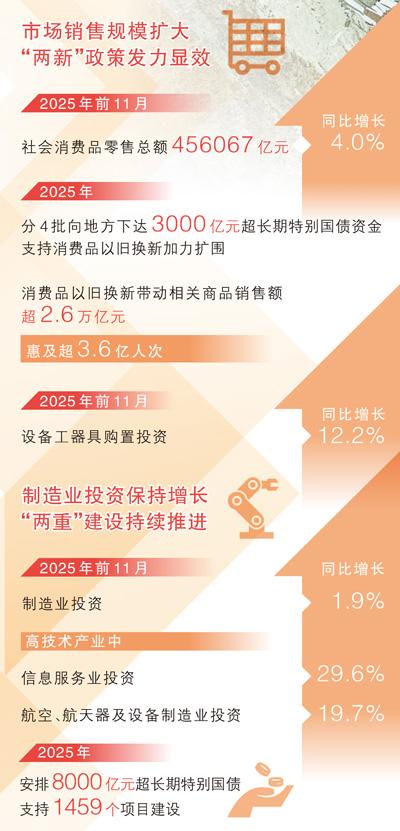
Group 1 - The core focus of the Central Economic Work Conference is to ensure a strong start for the "14th Five-Year Plan" by emphasizing the importance of domestic demand and building a robust domestic market [1] - In 2026, the government plans to implement eight key tasks, with the first being to maintain domestic demand as the main driver of economic growth [1] - The "Two New" policies and "Two Heavy" projects will be optimized for implementation, with an initial allocation of 62.5 billion yuan for consumer goods replacement programs [1] Group 2 - The ice and snow economy is becoming a significant driver of consumption and domestic demand, with outdoor skiing searches increasing over threefold since December 2025 [2] - The "old for new" policy has led to a 20% increase in Haier's appliance sales, with air conditioning units seeing over a 50% rise [2] - In 2025, the sales from the "old for new" policy exceeded 2.6 trillion yuan, benefiting over 360 million people and supporting continuous consumption growth [2] Group 3 - Investment in equipment and tools has seen a 12.2% year-on-year increase, contributing 1.8 percentage points to overall investment growth [3] - Key sectors such as electricity and internet services have experienced significant investment growth, with electricity investment up 12.5% and internet services up 20.7% [3] - The domestic demand scale is expanding, with its quality and international influence improving, making it a crucial driver of economic growth [3] Group 4 - There is still substantial potential and space for expanding domestic demand, despite facing some challenges [4] - Digital technologies and AI are fostering new business models and consumption scenarios, indicating a continuous release of consumer potential [6] Group 5 - Effective investment opportunities remain vast, with technology companies requiring significant investment for R&D and equipment upgrades [7] - Traditional industries are undergoing transformation, creating a strong demand for equipment renewal and technological upgrades [7] Group 6 - The strategy to expand domestic demand must prioritize boosting consumption, with a focus on enhancing the supply of quality goods and services [9] - The government is expected to maintain high levels of fixed asset investment, projected to exceed 3.6 trillion yuan in 2025 [10] - The government aims to stimulate private investment and create a stable and transparent environment for private enterprises to participate in major projects [10] Group 7 - The commitment to expanding domestic demand is essential for leveraging China's large market advantages into competitive strengths for national development [11]
七部门部署消费品以旧换新
Mei Ri Jing Ji Xin Wen· 2026-01-05 05:05
近日,商务部消费促进司负责人就《关于提质增效实施2026年消费品以旧换新政策的通知》(以下简称 《通知》)进行解读。 该负责人表示,2026年继续实施汽车、家电、手机等数码产品等传统领域补贴政策,在保持政策总体延 续稳定基础上,适当优化补贴品类和标准。同时,将补贴范围扩大至智能终端等新兴领域,培育壮大消 费新动能,带动新技术、新装备、新产业发展。 每经记者 张怀水 每经编辑 陈星 补贴标准为上述产品扣除各环节优惠后最终销售价格的15%,每人每类可补贴1件,其中,家电产品每 件补贴不超过1500元,数码和智能产品每件补贴不超过500元。 张建平向《每日经济新闻》记者表示,家电属于耐用品,在经过前几年以旧换新之后会有一定的使用周 期,所以产品类别也需要适时调整。"平板、智能手表、智能眼镜等产品都是当前消费热点,市场需求 大、消费动力强,将这些产品补充进来,能够更好地激发消费潜力。" 给予地方更多自主空间 《每日经济新闻》记者注意到,《通知》要求,给予地方更多自主空间。对地方安排的配套资金,若用 于支持全国统一的四个领域,补贴品类、补贴标准、组织实施方式等需按照全国统一要求执行。 《每日经济新闻》记者梳理发现,近期 ...
稳中求进、提质增效 实现“十五五”良好开局丨坚持内需主导,建设强大国内市场
Ren Min Ri Bao· 2026-01-05 03:39
Group 1 - The core focus of the Central Economic Work Conference is to ensure a strong start for the "14th Five-Year Plan" by prioritizing domestic demand and building a robust domestic market [3][15] - The implementation of policies to expand domestic demand has shown significant results, with a focus on optimizing the "two new" policies and "two heavy" projects for 2026 [3][4] - The ice and snow economy is highlighted as a strong driver for consumption and domestic demand, with outdoor skiing searches increasing over threefold since December 2025 [5][6] Group 2 - The "old for new" consumption policy has led to a stable market growth, with sales of related products exceeding 2.6 trillion yuan in 2025, benefiting over 360 million people [6][7] - Investment in equipment and tools has seen a rapid increase, with a 12.2% year-on-year growth in equipment purchases from January to November 2025, contributing to overall investment growth [7][11] - The digital economy and new consumption models are emerging, with significant potential for growth in online retail and immersive consumer experiences [9][10] Group 3 - There is a strong emphasis on the need to boost consumption as a key driver of economic growth, with strategies to enhance consumer purchasing power and improve social security systems [13][14] - Effective investment is crucial for economic stability, with projected fixed asset investments exceeding 3.6 trillion yuan in 2025, focusing on infrastructure and public welfare projects [14][15] - The government aims to maintain reasonable investment levels and stimulate private investment to create a stable and predictable environment for economic development [14][15]

中国经济进入内需攻坚之年
Jin Rong Shi Bao· 2026-01-05 03:32
Group 1 - In the first half of 2025, China's economy achieved a growth rate of 5.3% due to proactive fiscal measures, effective trade-in policies, and strong export resilience. However, growth momentum slowed in the second half of the year as the effects of stimulus policies diminished and high base effects emerged [1] - The 2026 economic work is under close scrutiny as it marks the beginning of the 14th Five-Year Plan, with a focus on maintaining economic growth as a priority. The Central Economic Work Conference in December 2025 emphasized the need for policies that are not only active but also effective [1] - The 2026 macroeconomic policy will continue to adopt a "more proactive" stance while focusing on enhancing effectiveness, integrating existing and new policies, and increasing counter-cyclical and cross-cyclical adjustments [1] Group 2 - China's export performance in 2026 is expected to exceed market expectations, supported by market diversification and product structure upgrades. From January to November 2025, China's export value increased by 5.4% year-on-year, surpassing the levels of the same period in 2024 [2] - Despite a nearly 20% decline in exports to the United States, exports to emerging markets such as Africa (26.3%), ASEAN (13.7%), and India (11.9%) showed significant growth. The share of exports to Latin America, Africa, and India combined reached 17.5%, matching that of ASEAN [2] - The strong resilience in exports is attributed to stable global economic growth, ongoing fiscal expansion in the US and Europe, and the stabilization of US-China trade relations. Additionally, technological advancements driven by artificial intelligence are expected to support exports [3] Group 3 - Infrastructure investment is projected to rebound in 2026, driven by the commencement of major projects and financial support. From January to October 2025, broad infrastructure investment grew by 1.5% year-on-year, with new policy financial tools and local government debt limits set to enhance project funding [3] - The 14th Five-Year Plan emphasizes the importance of technology innovation and industrial upgrading in driving manufacturing investment. Manufacturing investment grew by 2.7% year-on-year from January to October 2025, with a focus on advanced manufacturing and strategic emerging industries [4][5] Group 4 - The Chinese consumer market is showing strong resilience, with retail sales of consumer goods increasing by 5.0% year-on-year in the first half of 2025, supported by policies promoting trade-in programs. However, growth slowed in the second half due to diminishing effects of these policies [6] - The "14th Five-Year Plan" highlights the importance of enhancing the consumption rate and the role of domestic demand in driving economic growth. There is a focus on whether policies to stimulate consumption will be strengthened in 2026 [6] - The balance between short-term growth stabilization and long-term development tasks is crucial for policy formulation in 2026, with an emphasis on stabilizing the real estate market and improving social security systems [7]

大消费行业周报:市场稳健,板块分化-20260105
Ping An Securities· 2026-01-05 03:05
Investment Rating - The industry investment rating is "stronger than the market," indicating that the industry index is expected to outperform the market by more than 5% within the next six months [24]. Core Insights - The overall market performance is stable, with significant differentiation within the consumer sector. The upcoming New Year holiday is expected to boost certain segments, supported by favorable macro consumption policies that may lead to a recovery in consumer demand [3][4]. - The tourism sector shows potential for growth, with leading companies like Ctrip and Huazhu Hotels responding quickly to changing consumer demands. The retail tourism industry is stabilizing, with expectations for sales recovery [3][8]. - The beauty industry is experiencing steady growth, with a focus on companies that can quickly adapt to market dynamics and integrate products, brands, and channels [3]. - The film industry saw a strong performance during the New Year holiday, with box office revenues reaching 734 million yuan, led by the film "Zootopia 2" [14]. - In the food and beverage sector, the home dining market is expanding, with companies like Guoquan showing strong growth potential. The dairy supply-demand relationship is improving, and the restaurant supply chain is stabilizing [3][18]. - In the liquor segment, major companies are experiencing deeper profit adjustments, but leading brands are expected to maintain or increase market share due to superior management and branding [3][19]. Summary by Sections Social Services - The tourism sector is evolving, with a notable increase in travel demand during the New Year holiday, driven by a surge in ticket bookings and hotel reservations [8]. - Turkey has announced visa-free entry for Chinese passport holders, which is expected to enhance tourism flows [8]. Media - The film industry achieved a record box office during the New Year holiday, indicating strong consumer interest and spending in entertainment [14]. Food and Beverage - General - The home dining market is expanding, with companies like Guoquan leading the way. The dairy industry is seeing improved supply-demand dynamics, while the restaurant supply chain is stabilizing [3][18]. Food and Beverage - Alcohol - Major liquor companies are adjusting their profit margins, but leading brands are expected to capture more market share due to their strong brand presence and management capabilities [3][19].


2026年是“十五五”开局之年 今年宏观经济十大看点汇总
Zheng Quan Shi Bao· 2026-01-05 00:34
Group 1: Fiscal Policy - The fiscal deficit and government bond issuance scale are expected to increase in 2026 to support economic activities during the start of the "14th Five-Year Plan" [3] - The fiscal deficit is projected to be no less than 4.06 trillion yuan, maintaining a deficit rate of at least 4% [3] - New special bonds may rise from 4.4 trillion yuan in 2025 to nearly 5 trillion yuan in 2026 to support major project construction [3] Group 2: Monetary Policy - Monetary policy is expected to remain moderately loose to promote reasonable price recovery, with a CPI target set around 2% for 2026 [4] - Traditional monetary policy tools like reserve requirement ratio cuts and interest rate reductions will have flexible timing and rhythm [4] - Structural monetary policies will focus on expanding domestic demand, supporting technological innovation, and aiding small and medium enterprises [4] Group 3: Consumption and Income - Expanding domestic demand, particularly boosting consumption, is a primary task for 2026 [5] - The "Urban and Rural Residents Income Increase Plan" aims to enhance consumer capacity and willingness [6] - Policies will be optimized to adapt to changing consumption structures, directing subsidies towards service consumption areas [6] Group 4: Investment and Infrastructure - Fixed asset investment growth is targeted to stabilize, with infrastructure investment expected to accelerate due to new major projects [7] - Government investment will increase through various funding sources, including special bonds and policy financial tools [7] - Manufacturing investment, particularly in high-tech and equipment manufacturing, is anticipated to grow rapidly [7] Group 5: Real Estate Market - The real estate market will focus on "de-stocking" as a primary task, with policies to support both supply and demand [8] - Local governments will adjust real estate policies to remove unreasonable purchase restrictions and enhance housing fund support [8] - Efforts will be made to improve the market supply-demand relationship through better management of existing properties [8] Group 6: Capital Market Reforms - Comprehensive reforms in the capital market will focus on supporting technological innovation and enhancing market inclusivity [9][10] - Policies will aim to create a multi-layered market system to meet diverse investor needs and promote long-term investments [10] - Regulatory measures will be strengthened to prevent financial misconduct and enhance market stability [10] Group 7: Unified Market and Competition - The construction of a unified national market will accelerate, with new regulations to address "involution" in competition [11] - Capacity regulation in key industries will be enhanced to phase out outdated capacities and support new quality capacities [11] - Local government economic activities will be standardized to prevent irregularities in investment incentives [11] Group 8: Technological and Industrial Innovation - The integration of technological and industrial innovation will be a key focus, with an emphasis on practical applications of new technologies [12] - The expansion of international technology innovation centers in major regions will facilitate resource integration and innovation [12] - Regional coordinated development will be promoted to enhance new quality productivity across different areas [12] Group 9: State-Owned Enterprise Reforms - A new round of state-owned enterprise reforms will focus on optimizing the layout of state-owned economies and modernizing corporate governance [13][14] - Strategic mergers and acquisitions will be promoted to enhance resource allocation efficiency [14] - Digital transformation initiatives will be launched to support innovation in key industries [14] Group 10: Social Welfare and Employment - Employment will be prioritized, with policies aimed at stabilizing jobs and increasing labor income [15] - Measures will include expanding loans for job retention and enhancing unemployment insurance [15] - The income distribution system will be improved to raise labor compensation and establish a more robust social safety net [15]
把“国补”资金用在刀刃上,让消费者更“有感”
Sou Hu Cai Jing· 2026-01-05 00:17
Core Viewpoint - The implementation of a more proactive fiscal policy in 2026 aims to boost consumer spending and enhance domestic demand, with a focus on optimizing the use of funds and improving policy effectiveness [1][2][5]. Group 1: Policy Implementation - The government plans to continue supporting consumer spending through the "old-for-new" policy, which has shown significant results, with sales exceeding 2.6 trillion yuan and benefiting over 360 million people in 2025 [1][2]. - The 2026 fiscal policy will prioritize the optimization of the "old-for-new" program, focusing on key consumer goods such as refrigerators, washing machines, televisions, air conditioners, computers, and water heaters [2][3]. - The central government has allocated 62.5 billion yuan in special bonds to support the "old-for-new" policy, ensuring funds are available for peak consumption periods like New Year and Spring Festival [4]. Group 2: Financial Coordination - The emphasis on fiscal and financial policy coordination is crucial for enhancing the effectiveness of consumer support measures, with a focus on lowering credit costs and increasing policy coverage [4][5]. - The government aims to improve the efficiency of fund allocation and usage, ensuring that financial resources are directed towards high-impact consumer goods to maximize the benefits of fiscal spending [2][4]. - The collaboration between fiscal and monetary policies is expected to create a synergistic effect, enhancing overall market vitality and improving the quality of life for consumers [5].
湖北发放2026年首个亿元大礼包 三大系列活动打造新春消费盛宴
Chang Jiang Shang Bao· 2026-01-05 00:04
Core Viewpoint - Hubei province is launching a series of consumer activities titled "Happy in Hubei, Joyful New Year" from January to March 2026, aimed at boosting consumption during key holiday periods such as New Year's Day and Spring Festival [1][2]. Group 1: Event Overview - The activities will showcase new consumption formats and models in Hubei, focusing on themes of "Happy in Hubei" and integrating various sectors to create a comprehensive consumer experience [1][5]. - The initiative includes a total investment of 1 billion yuan in retail and dining consumption vouchers, aimed at providing tangible benefits to consumers [1][4]. Group 2: Key Highlights - The event will emphasize four main aspects: "Integration," "Innovation," "Joy," and "Benefits," with over 1,600 promotional activities planned [2][3]. - "Integration" will connect various resources such as shopping districts, e-commerce platforms, and cultural venues to enhance the consumer experience [3][6]. - "Innovation" will highlight new consumption trends, including performance economies and smart consumption, to expand the supply of quality products and services [3][6]. Group 3: Specific Activities - The "Happy Shopping Global" segment will feature events like the "New Year International Consumption Carnival" and "Spring Festival International Shopping," with over 1,600 activities planned [6][7]. - The "Happy Travel in Hubei" segment will include over 600 cultural and tourism events, such as new year performances and folk fairs, to attract visitors [6][7]. - The "Happy Sports in Hubei" segment will promote sports events and activities, including over 50 new year sports events and 200 sports training sessions, to encourage community participation [7]. Group 4: Financial Incentives - From January 1, 2026, a new round of consumption incentives will be launched, including subsidies for major consumer goods like automobiles and home appliances, with a total of 1 billion yuan allocated for retail and dining vouchers [4][5]. - Additional activities will include a lottery for consumers who participate in various sectors, enhancing the overall appeal of the shopping experience [4][6].
坚持内需主导,建设强大国内市场
Xin Hua Wang· 2026-01-04 23:29
Group 1 - The core focus of the article is on the importance of domestic demand in driving economic growth and the establishment of a strong domestic market as a priority for the 2026 economic agenda [5][15] - The Chinese government has identified eight key tasks for economic work in 2026, with "insisting on domestic demand as the main driver" being the foremost task [5] - The "Two New" policies and "Two Heavy" project optimizations are set to enhance domestic consumption and investment, with a special bond plan of 625 billion yuan allocated for consumer goods replacement [5][15] Group 2 - The ice and snow economy is highlighted as a significant driver of consumption, with outdoor ski resort searches increasing over threefold year-on-year [6][7] - The implementation of the old-for-new policy has led to a 20% increase in sales for Haier's home appliances, with total sales related to this policy exceeding 2.6 trillion yuan in 2025 [7][8] - Equipment investment has shown a robust growth of 12.2% year-on-year, contributing to an overall investment increase of 1.8 percentage points [8] Group 3 - Experts believe that while challenges exist, the potential for expanding domestic demand remains significant, driven by consumption upgrades and digital economy innovations [10][11] - The article emphasizes the need for effective investment strategies, with a focus on technological upgrades and infrastructure projects, predicting that fixed asset investment will exceed 3.6 trillion yuan in 2025 [16][17] - The government aims to enhance consumer spending by improving social security systems and increasing residents' income, thereby expanding consumption capacity [16][17]

【财金视野】把“国补”资金用在刀刃上
Sou Hu Cai Jing· 2026-01-04 23:09
落实好一系列优化政策,需要强化统筹安排、协调推进。 一方面,做好资金保障,均衡有序使用资金。国家层面,合理把握节奏,按季度分批次向地方下达"国 补"资金;各地方要分领域合理制定资金均衡使用计划,平稳有序实施消费品以旧换新政策。近期,中 央已向地方提前下达2026年第一批625亿元超长期特别国债支持消费品以旧换新资金计划,满足元旦、 春节等旺季消费需求。只有做好资金的安排、使用,才能更好地稳定市场预期,激发消费热情。 另一方面,打好提振消费的政策"组合拳",特别是加强财政金融协同,放大政策效能。中央经济工作会 议提出,实施更加积极有为的宏观政策,增强政策前瞻性针对性协同性。在支持扩大内需中,财政、货 币、金融政策的协同配合发挥了重要作用。去年9月份以来,我国实施个人消费贷款和服务业经营主体 贷款贴息政策,分别从消费的需求端和供给端发力,通过降低信贷成本、提高政策覆盖面等措施加力提 振消费。财政与金融政策的协同配合还有很多"文章"可做,特别是引导金融机构用好用足再贷款和贴息 政策、加大服务消费领域信贷投放力度,优化消费金融产品和服务,力争产生"1+1>2"的政策效果。 实施更加积极有为的宏观政策,充分发挥财政政策 ...
