消费升级

Search documents
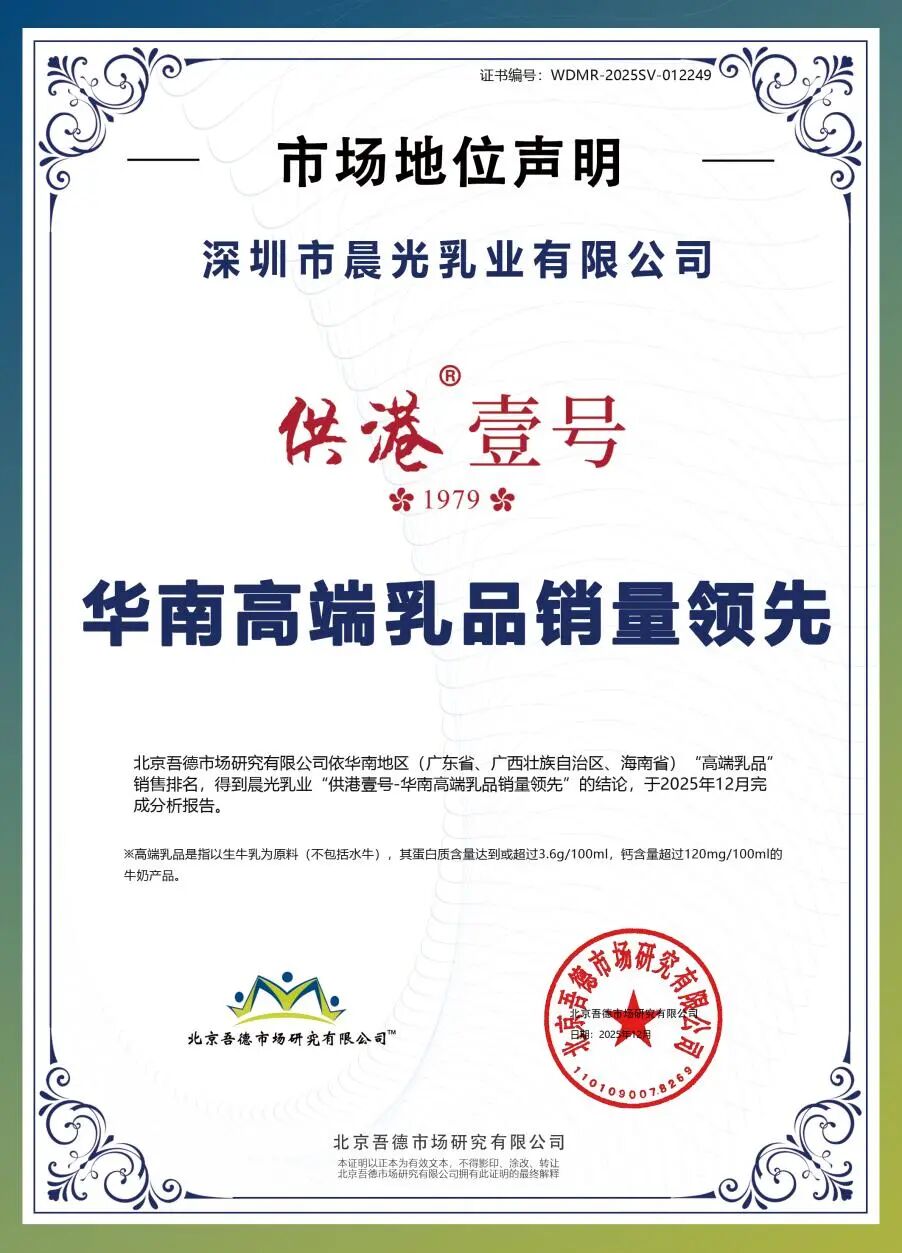
品质领航!供港壹号获“华南高端乳品销量领先”认证
Chang Jiang Shang Bao· 2025-12-31 04:51
近日,晨光乳业旗下高端品牌"供港壹号"凭借在华南高端乳品市场的卓越表现,正式斩获北京吾德研究有限公司授予的"华南高端乳品销量领先"权威认 证。 有市场观点认为,此次"华南高端乳品销量领先"认证的授予,不仅以客观数据有力证实了供港壹号在华南高端乳品细分市场中销量占据显著优势,稳固了 其区域市场领导者的地位,更深度洞察到在当下消费升级持续深化、居民健康意识不断提升的大背景下,华南消费者对于高端乳品的需求结构正发生深刻 变化。他们不再仅仅满足于基本的营养供给,而是对产品的品质纯净度、营养成分含量、生产工艺先进性以及品牌信誉度等方面提出了更为严苛且多元化 的要求。 华南地区作为我国经济发达、消费升级趋势显著的区域之一,消费者对高端乳品的需求日益旺盛,对产品品质、营养、口感等方面的要求也更为严苛。供 港壹号精准洞察华南消费者的需求,不断优化产品矩阵,2025年推出了供港壹号4.1蛋白纯牛奶、供港壹号哞咘咘儿童奶等契合区域消费习惯的高端乳 品。无论是满足日常营养需求的纯牛奶系列,还是注重品质与健康的有机/高钙系列,都凭借出色的产品力赢得了消费者的广泛好评。 当前,高端乳品竞争已进入"品质为王"的新阶段。供港壹号此次获"华 ...

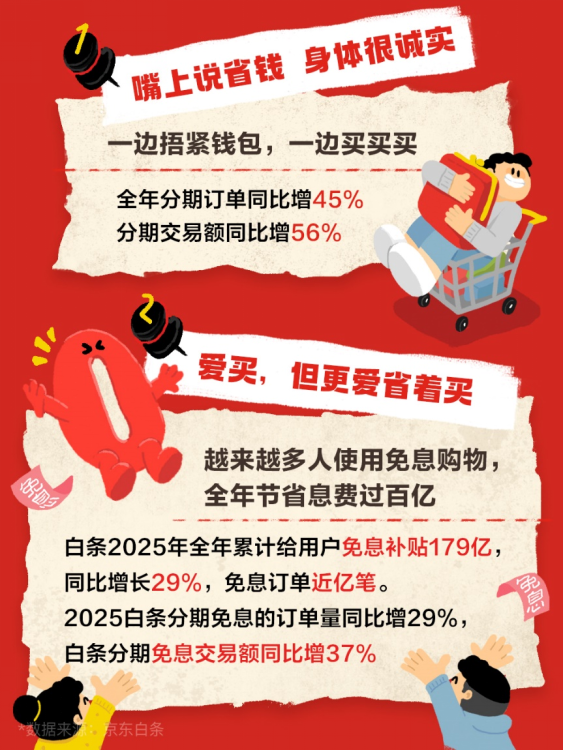
账单里的省钱故事:3位普通人的白条消费日常,见证 3 亿京东白条用户的获得感
Jin Rong Jie Zi Xun· 2025-12-31 02:42
Core Insights - JD.com and JD Finance have launched the "White Bar Annual Bill" query service, allowing users to review their annual consumption history and savings from interest-free and government-subsidized measures [1] - The "2025 JD White Bar Consumption Report" indicates that in 2025, JD White Bar provided over 17.9 billion yuan in interest subsidies, a 29% year-on-year increase, with nearly 100 million interest-free orders [1] - The implementation of the national consumer loan interest subsidy policy on JD's platform has created a combined effect of "policy benefits + platform subsidies," significantly enhancing consumer purchasing power [3] Summary by Sections Consumer Experience - Consumers have reported significant savings through the use of interest-free installments and subsidies, with one user saving approximately 5,200 yuan over the year by utilizing these benefits for various household appliances [5] - Another consumer, a young office worker, was able to purchase a 65-inch smart TV with a monthly payment of only 200-300 yuan after applying the national subsidy and interest-free installment plan [5] - A rural farmer upgraded his production equipment using the White Bar service, benefiting from a manageable monthly payment of 1,000 yuan, which improved his farming efficiency [6] Market Trends - The data shows that 43% of interest-free transaction amounts come from third-tier cities and below, indicating a clear trend of consumption upgrades in these markets [6] - Categories such as large home appliances and maternal and infant products have seen a 32% year-on-year increase in installment orders, reflecting a growing demand for quality consumer goods [6] Industry Analysis - Industry experts highlight that the annual bill data from 300 million consumers demonstrates the significant impact of the "policy guidance + platform support" model on boosting consumption [8] - The annual bill serves as both a personal consumption summary and a direct reflection of the stable recovery of the consumer market [8]

重庆解放碑商圈:商脉贯古今 消费添新韵
Ren Min Wang· 2025-12-31 01:13
Core Viewpoint - The Liberation Monument business district in Chongqing is evolving into a vibrant cultural and commercial hub, blending historical significance with modern consumer experiences, thereby driving new vitality in the consumption market [3][5][6]. Group 1: Historical Significance and Development - The Liberation Monument area has a rich history, with significant commercial milestones such as the opening of Chongqing's first department store in 1950 and the establishment of the first foreign enterprise in 1989 [4]. - The area has been recognized as a national demonstration pedestrian street and a national-level night cultural and tourism consumption gathering area, highlighting its importance in Chongqing's economic landscape [5]. Group 2: Cultural and Commercial Integration - Recent developments have transformed historical sites into modern attractions, such as the Chongqing Financial History Museum and cultural exchange venues, integrating history into contemporary commercial life [6]. - The area features over 30 cultural relics and more than 20 popular tourist attractions, making it a rich cultural resource and a key area for historical preservation [5]. Group 3: New Consumption Trends - The business district is diversifying its offerings with new consumption formats, including unique bars, entertainment venues, and flagship stores of international brands, enhancing the consumer experience [7][8]. - The introduction of over 200 flagship stores and hosting of numerous international events have positioned the area as a key player in the "first release economy" and night economy [8]. Group 4: Internationalization and Economic Growth - The Liberation Monument area serves as a vital trade window for Chongqing, leveraging its status as a free trade zone and aiming to create a world-class business environment [9][10]. - The district has attracted over 700 foreign enterprises and is recognized for its consumer-friendly environment, with significant international engagement through various economic activities [10]. Group 5: Future Development Plans - Future initiatives aim to enhance the area's commercial upgrade and international appeal, establishing it as a leading destination for global commerce and cultural exchange [10].
2026 年国补方案正式出炉:手机、平板、家电等补贴 15%
Ju Chao Zi Xun· 2025-12-30 14:09
Group 1 - The core viewpoint of the news is the announcement of a new policy by the National Development and Reform Commission and the Ministry of Finance to implement large-scale equipment updates and a trade-in policy for consumer goods in 2026, which aims to enhance the coverage and effectiveness of subsidies for green and smart products [1][2] Group 2 - The policy expands the scope of trade-in subsidies to include smart glasses and smart home products, alongside existing categories like automobiles and home appliances [1] - Specific subsidies for digital and smart products will cover smartphones, tablets, smartwatches, and smart glasses, with local governments responsible for detailing the subsidy rules [1] - The policy emphasizes targeted adjustments in subsidy standards to improve precision and effectiveness [1][2] Group 3 - The government has allocated 62.5 billion yuan in special long-term bonds to support the trade-in policy, ensuring timely implementation to meet consumer demand during traditional peak seasons [2] - The updated policy also includes support for installing elevators in old residential areas, enhancing safety in elderly care institutions, and improving commercial facilities, reflecting a focus on social welfare and safety [2] Group 4 - The subsidy for automobile trade-ins will shift from a fixed amount to a percentage of the new car sales price, while maintaining the upper limit [3] - For home appliances, the subsidy will be 15% of the sales price for energy-efficient products, with a cap of 1,500 yuan per item for each consumer [3] - The subsidy for digital and smart products will also be 15% of the sales price, with a limit of 500 yuan per item for each consumer [3]
补贴额度未减、与车价“强关联”乘联分会:明年车市将实现“开门红”
Feng Huang Wang· 2025-12-30 13:26
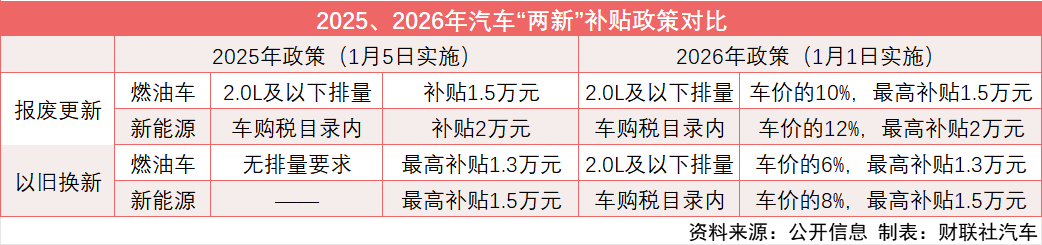
以旧换新方面,转让旧车购买新能源车的,可获得新购车车价8%的补贴,最高不超过1.5万元;购买2.0L及以下排量燃油车的,可获得新购车车价 6%的补贴,最高不超过1.3万元。以此计算,以旧换新购买新能源车价格大于等于18.75万元的可拿满补贴,购买油车价格大于等于21.67万元的可拿 满补贴。 "(与车价关联)这意味着同样资金量可以补贴更多车。"中国汽车流通协会副秘书长郎学红认为。 值得注意的是,为抢抓元旦、春节消费旺季,国家发展改革委会同财政部已向地方提前下达2026年第一批625亿元超长期特别国债,支持消费品以旧 换新资金计划。这意味着从明年1月1日开始,购买新车或即可享受新国补。 12月30日,在今年取得积极成效后,汽车"两新"补贴延续政策终于落地。业界普遍认为,2026年"两新"补贴政策超出预期,将有利于稳定明年车市 增长。 12月30日,国家发展改革委、财政部发布《关于2026年实施大规模设备更新和消费品以旧换新政策的通知》(下称《通知》),将继续支持汽车报 废更新与汽车置换更新。 "政府产业消费政策的稳定性和延续性,对行业继续健康发展是个利好。"有头部新势力车企高管向智通财经记者表示。 不同于202 ...
2025年A股十大最惨板块,跌麻了
Ge Long Hui· 2025-12-30 11:30
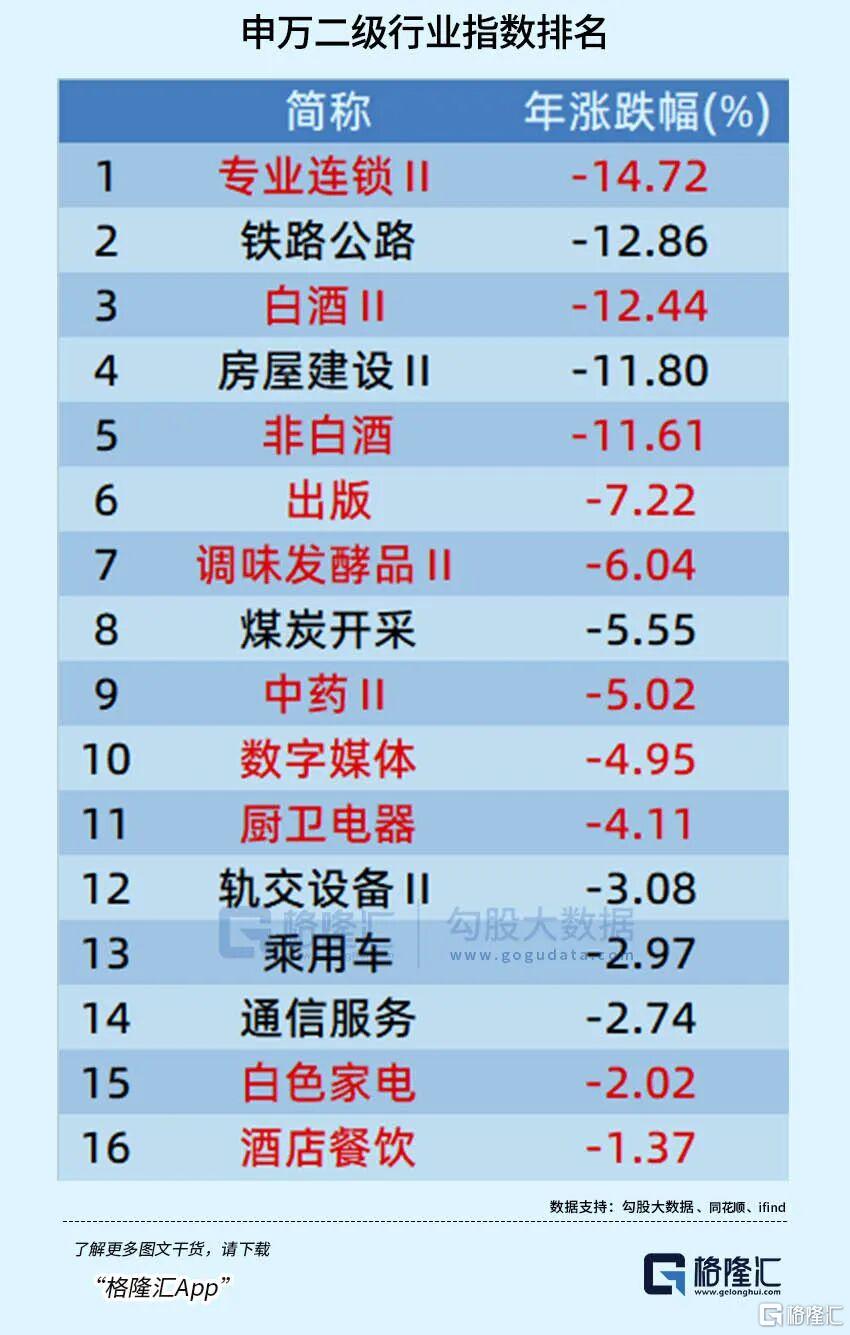
Core Viewpoint - The consumer sector has faced significant challenges in the past year, with many sub-sectors experiencing declines despite overall market growth. The focus on domestic demand and consumption has not translated into positive performance for many consumer-related industries [1][5]. Consumer Sector Performance - In the first half of the year, 10 out of 16 declining industries were from the consumer sector, indicating a broader trend of underperformance [1]. - The white liquor sector, a key component of the consumer market, has seen a year-to-date decline of 12.44%, with major brands like Wuliangye experiencing significant drops in revenue and profit [6][9]. - The professional chain sector has been particularly hard-hit, with a year-to-date decline of 14.72%, exemplified by the struggles of companies like Renrenle [16][20]. White Liquor Sector - The white liquor industry is facing its eighth consecutive year of production decline, with both volume and price dropping simultaneously [10]. - Wuliangye reported a 10.26% decline in revenue and a 13.72% drop in net profit for the first three quarters, marking its first negative growth in a decade [9]. - The industry is shifting from a growth-driven model to one focused on consumer choice, with a need for companies to adapt to changing consumer preferences [15]. Professional Chain Sector - The professional chain sector is experiencing a crisis, with many physical stores closing and traditional business models failing [16][20]. - Renrenle, once a leading private supermarket, has seen its market value plummet and is now facing delisting due to ongoing financial struggles [21][24]. - The shift towards online shopping and personalized consumer demands has further exacerbated the challenges faced by traditional retail chains [24][25]. Non-White Liquor Sector - The non-white liquor sector, including beer and wine, has also faced declines, with the beer segment seeing a notable drop in sales and profits [27][32]. - Budweiser APAC reported an 8.2% decline in domestic sales and a 24.4% drop in net profit, reflecting broader industry challenges [32][33]. - The market is witnessing a trend of cross-industry competition, with liquor companies diversifying into new beverage categories [34]. Publishing Sector - The publishing industry has shown resilience despite a 10.4% decline in the overall market for printed books, with listed companies managing to increase net profits by 14.65% [43][44]. - However, leading companies like Zhongwen Media are struggling, with significant revenue and profit declines due to changes in educational material procurement policies [45][48]. Seasoning Sector - The seasoning industry has faced a 6.04% decline, with companies like Qianhe Flavor struggling due to falling revenues and a loss of consumer trust [51][55]. - The industry is experiencing a shift in consumer preferences and increased competition, necessitating a reevaluation of business strategies [60]. Traditional Chinese Medicine Sector - The traditional Chinese medicine sector is facing challenges, with companies like Pian Zai Huang reporting significant declines in revenue and profit due to rising costs and regulatory pressures [61][66]. - The industry is undergoing a transformation as companies seek to innovate and diversify their product offerings [70]. Digital Media Sector - The digital media industry has seen a 4.95% decline, with companies like Mango TV reporting significant drops in revenue and profit due to changing consumer behaviors and market dynamics [71][74]. - The sector is grappling with the need to adapt to new content consumption trends while facing pressure from traditional advertising models [75]. Kitchen and Bathroom Appliances Sector - The kitchen and bathroom appliance sector has experienced a 4.11% decline, largely due to reduced demand from the real estate market [78][79]. - Companies like Boss Electric are facing revenue declines for the first time in years, highlighting the challenges of adapting to a changing market landscape [79][80]. White Goods Sector - The white goods sector has seen a 2.02% decline, with major players like Gree Electric facing significant revenue and profit pressures due to increased competition and market saturation [83][84]. - The industry is shifting towards a focus on product quality and brand strength as external stimuli diminish [88]. Hotel and Restaurant Sector - The hotel and restaurant sector has faced a 1.37% decline, with revenue pressures stemming from changing consumer spending habits and increased competition from online platforms [89][92]. - Companies are beginning to adopt more refined operational strategies to navigate the challenging market environment [96].




钢材&铁矿石日报:市场情绪趋弱,钢矿震荡回落-20251230
Bao Cheng Qi Huo· 2025-12-30 11:22
1. Report Industry Investment Rating No information provided. 2. Core Views of the Report - The main contract price of rebar oscillates with a daily decline of 0.10%, with decreasing volume and increasing open interest. Currently, the supply of rebar is increasing while the demand is seasonally weakening. The fundamentals are relatively weak, and the steel price in the off - season continues to face pressure. The relatively positive factor is cost support. It is expected that the steel price will continue to oscillate. Attention should be paid to the production situation of steel mills [5]. - The main contract price of hot - rolled coil oscillates weakly with a daily decline of 0.33%, with decreasing volume and increasing open interest. At present, the demand for hot - rolled coil is good, which improves the supply - demand pattern and supports the price. However, the demand toughness is questionable, and the inventory level is high. The upward driving force is expected to be weak. The subsequent trend will mainly continue to oscillate. Attention should be paid to the production situation of steel mills [5]. - The main contract price of iron ore oscillates at a high level with a daily decline of 0.44%, with decreasing volume and open interest. Currently, benefiting from the spot structural contradiction and the pre - holiday restocking expectation, iron ore runs strongly at a high level. However, the demand for ore is weakening while the supply remains high. The fundamentals continue to weaken, and the upward driving force is not strong. The subsequent trend is cautiously optimistic. Attention should be paid to the restocking situation of steel mills [5]. 3. Summary by Relevant Catalogs 3.1 Industry Dynamics - Shanghai's first publicly disclosed residential land acquisition: Lingang Holdings had a plot of land repurchased by the land reserve center for 2.625 billion yuan. The land area is about 78,700 square meters, and the above - ground floor area is 188,800 square meters [7]. - In 2026, the "national subsidy" for the household appliance industry will continue, and the industry will enter a new cycle of consumption upgrading and industrial upgrading. The new round of subsidy policy is expected to promote market consumption structure upgrading and the transformation of industries such as household appliances and automobiles to be green, intelligent, and high - end [8]. - South Korea extended the term of the provisional anti - dumping duty on carbon and alloy steel hot - rolled coils from China and Japan by 5 months, from September 23, 2025, to June 22, 2026 [9]. 3.2 Spot Market | Variety | Location | Specification | Price | Price Change | | ---- | ---- | ---- | ---- | ---- | | Rebar | Shanghai | HRB400E, 20mm | 3,270 | 0 | | Rebar | Tianjin | HRB400E, 20mm | 3,170 | 0 | | Rebar | National Average | HRB400E, 20mm | 3,326 | 1 | | Hot - Rolled Coil | Shanghai | 4.75mm | 3,280 | 0 | | Hot - Rolled Coil | Tianjin | 4.75mm | 3,190 | 10 | | Hot - Rolled Coil | National Average | 4.75mm | 3,294 | - 1 | | Tangshan Steel Billet | - | Q235 | 2,940 | 0 | | Zhangjiagang Heavy Scrap | - | ≥6mm | 2,080 | - 10 | | PB Powder | Shandong Port | - | 794 | - 5 | | Tangshan Iron Concentrate | - | Wet - basis | 782 | 0 | | Ocean Freight (Australia) | - | - | 8.80 | - 0.10 | | Ocean Freight (Brazil) | - | - | 23.28 | - 0.15 | | SGX Swap (Current Month) | - | - | 107.30 | 0.15 | | Platts Index (CFR, 62%) | - | - | 108.85 | 1.00 | | Coil - Rebar Price Difference | - | - | 10 | 0 | | Rebar - Scrap Price Difference | - | - | 1,190 | 10 | [10] 3.3 Futures Market | Variety | Active Contract | Closing Price | Daily Change (%) | High | Low | Volume | Volume Difference | Open Interest | Open Interest Difference | | ---- | ---- | ---- | ---- | ---- | ---- | ---- | ---- | ---- | ---- | | Rebar | - | 3,134 | - 0.10 | 3,148 | 3,128 | 635,547 | - 415,599 | 1,560,806 | 30,014 | | Hot - Rolled Coil | - | 3,282 | - 0.33 | 3,298 | 3,278 | 311,439 | - 200,543 | 1,283,319 | 7,022 | | Iron Ore | - | 789.0 | - 0.44 | 800.0 | 786.5 | 297,023 | - 164,905 | 613,601 | - 16,080 | [14] 3.4 Relevant Charts - **Steel Inventory**: It includes the weekly changes and total inventory (steel mill + social inventory) of rebar and hot - rolled coil [16][17][19]. - **Iron Ore Inventory**: It includes the inventory of 45 ports in China, its seasonal changes, the inventory of 247 steel mills, and the inventory of domestic mine iron concentrate [21][22][25]. - **Steel Mill Production**: It includes the blast furnace operating rate and capacity utilization rate of 247 sample steel mills, the operating rate of 87 independent electric furnaces, the proportion of profitable steel mills among 247 steel mills, and the profit and loss of 75 building material independent electric arc furnace steel mills [29]. 3.5 Market Outlook - **Rebar**: The supply and demand are weakly stable. The supply continues to rise but remains at a relatively low level, providing support for the steel price, but the positive effect is weakening. The demand continues to be weak and will seasonally decline, dragging down the steel price. The steel price is expected to continue to oscillate. Attention should be paid to the production of steel mills [37]. - **Hot - Rolled Coil**: The supply - demand pattern has improved, but the high inventory weakens the positive effect. The demand is good but the toughness is questionable. The upward driving force is not strong, and the subsequent trend will mainly be oscillatory. Attention should be paid to the production of steel mills [37]. - **Iron Ore**: The supply - demand pattern continues to weaken. The port inventory is rising. The demand is weakening while the supply remains high. The upward driving force is not strong. The subsequent trend is cautiously optimistic. Attention should be paid to the restocking of steel mills [38].
2万一个的“大路灯”,中产的育儿神器?
3 6 Ke· 2025-12-30 10:42
Core Insights - The "Big Road Lamp" has gained popularity in China as a high-end standing eye-care lamp, particularly among middle-class families, due to increased demand for eye protection during online learning periods [1][6][11] - The market for eye-care lamps has seen significant growth, with sales reaching 7.62 billion yuan in 2023, a year-on-year increase of 85.2%, and the "Big Road Lamp" segment growing by 185.2% [6][8] - The rise of the "Big Road Lamp" is linked to the alarming near-sightedness rates among Chinese youth, prompting parents to seek solutions for eye protection [11][13] Group 1: Product Evolution - The "Big Road Lamp," originally designed for office use in Western countries, has been rebranded in China as a must-have for child-rearing, transitioning from a cold office tool to a family essential [3][5] - Its unique features include a wider light coverage and a softer light that does not directly shine into the eyes, providing a more comfortable environment for reading and studying [5][6] Group 2: Market Performance - The "Big Road Lamp" has become a star product, significantly boosting the sales of various brands, including established companies like Haishi Bao and Xiaomi, which have introduced their own versions [10][18] - The product's success is reshaping consumer trends in the home lighting market, with parents increasingly viewing it as a blend of functionality and aesthetic appeal [16][18] Group 3: Consumer Behavior - The surge in interest for the "Big Road Lamp" is fueled by parental anxiety over children's eye health, with many parents feeling compelled to invest in such products to ensure their children's well-being [14][30] - Social media plays a crucial role in promoting the "Big Road Lamp," with numerous posts and discussions creating a perception of it as an essential item for responsible parenting [18][20] Group 4: Rational Consumption - Despite its popularity, there are concerns regarding the effectiveness of the "Big Road Lamp" in improving children's vision, with some consumers questioning whether it is merely a marketing gimmick [20][21] - There is currently no official national standard specifically for eye-care lamps, leading to a reliance on general lighting standards for consumers when making purchasing decisions [21][22]


年度盘点|高端化与政策红利加持,2025奶粉市场逆势回暖
Sou Hu Cai Jing· 2025-12-30 09:52
Core Insights - The Chinese infant formula market in 2025 is characterized by a dual landscape of challenges and opportunities, with declining birth rates and intense competition on one side, and a recovery in performance for several leading dairy companies on the other [1] - The recovery in the infant formula sector is attributed to strategic adjustments by companies, product innovation, and the implementation of supportive national policies [1] Company Performance - Major dairy companies like Yili, Ausnutria, and Beingmate have reported revenue and profit growth in the infant formula segment, reversing previous trends of slowing growth [2][4] - Yili's infant formula and dairy product revenue increased by 14.26% year-on-year, achieving a market share of 18.1%, while Ausnutria's revenue grew by 5.6% with a net profit increase of 24.1% [2][4] - The performance of foreign brands such as Danone and a2 Milk also showed positive growth, although some leading companies faced pressure, indicating structural differentiation within the industry [6] Market Trends - The retail market for infant formula is expected to grow at around 5% in 2025, driven by a rebound in birth rates and supportive policies [6] - The proportion of consumers purchasing premium infant formula (over 300 yuan) increased from 21% to 26%, reflecting a trend towards higher quality products among younger parents [6] Strategic Shifts - The industry is shifting from a focus on market share expansion to value creation, with companies investing in high-end and functionally differentiated products [10] - Companies are enhancing their supply chains and digital efficiencies to improve profitability, with examples like Ausnutria's EBITDA growth of 29.7% [13] Policy Impact - New national policies, including a cash subsidy for families with infants and free preschool education, are expected to stimulate demand in the infant formula market [15][18] - The implementation of these policies is anticipated to lower childcare costs and boost consumer confidence, leading to increased sales for dairy companies [15][18] Future Outlook - The industry is expected to transition from cyclical recovery to structural growth, with companies needing to diversify their growth strategies [19][21] - Product innovation is crucial, with a focus on specialized nutrition for various age groups and health needs, as well as digital transformation to enhance consumer engagement [20][21] - The consolidation of the industry may accelerate, with larger companies likely to acquire smaller firms to expand their market share [20][21]


2025没买房没买车,我的钱怎么还是没了? | 2025年轻人消费趋势大赏
后浪研究所· 2025-12-30 09:26
Group 1 - The core viewpoint of the article emphasizes that young consumers are redefining their spending habits, balancing between saving and spending for immediate gratification and experiences [4][5][8] - Young consumers are increasingly willing to spend on experiences that provide emotional satisfaction, such as concerts and travel, rather than just material goods [41][44] - The article identifies seven major trends in young consumer spending, highlighting a shift towards prioritizing personal enjoyment and emotional returns on investment [4][12][48] Group 2 - Over 50% of young people admit to a downgrade in consumption, yet 70% still believe they are upgrading their spending in certain areas [5][8] - Cities like Wuhan, Suzhou, and Changsha show the most significant signs of consumption upgrades among young people, with percentages reaching 84.6%, 81.8%, and 76.9% respectively [11][12] - Young consumers are increasingly focused on immediate happiness and personal experiences, valuing emotional ROI over long-term savings [12][14] Group 3 - The article notes that over 90% of young people have purchased plush toys as a form of emotional comfort, indicating a trend towards seeking low-risk emotional support through spending [17][23] - Young consumers are also engaging in "mystical consumption," where they turn to spiritual practices for psychological reassurance, reflecting a broader trend of seeking comfort in uncertain times [20][26] - Fitness has become an integral part of young people's lives, with a focus on enjoyment and stress relief rather than just physical appearance [29][32] Group 4 - The spending patterns of young men and women are evolving, with both genders increasingly investing in traditionally gendered categories, breaking down stereotypes [44][48] - Young consumers are prioritizing quality over brand loyalty, with 70% considering product quality when making purchases [46] - The article highlights that young people are not just passive consumers but are actively creating their own consumption rules, focusing on emotional value and rational spending [62][63]