
去美元化

Search documents
黄金止跌反弹 后市谨慎乐观
Qi Huo Ri Bao· 2026-02-04 03:23
2月3日,上期所黄金期货主力合约收涨0.63%,至1093.78元/克。 继上周五和本周一大幅下跌后,周二金价跌势缓和。贵金属价格上周五夜盘巨震,最主要的影响因素在于新 任美联储主席提名公布。美国总统特朗普1月30日通过社交媒体宣布,提名美联储前理事凯文·沃什为下一任 美联储主席。市场对美联储主席人选的预期此前长时间集中在凯文·沃什和白宫国家经济委员会主任凯文·哈 塞特两人。1月16日特朗普明确表示想让凯文·哈塞特"留在白宫",沃什最终获得提名并不意外,但预期落地 仍对市场情绪产生巨大冲击。沃什主张大幅削减央行资产负债表的"鹰派"立场可能与未来潜在的降息存在矛 盾,引发海外市场对未来货币政策走向的担忧。持仓拥挤、获利盘离场导致的技术性回调,与上述担忧叠 加,最终演变为对贵金属资产的恐慌性抛售。 随着贵金属价格波动加剧,国内外交易所相继收紧了风控措施。上海期货交易所于1月30日公告,自2月3日 (星期二)收盘结算时起,白银期货AG2605、AG2606、AG2607、AG2608、AG2609、AG2610、AG2611、 AG2612、AG2701合约的涨跌停板幅度调整为17%,套保持仓交易保证金比例调整为1 ...

贵金属行情巨幅波动的逻辑、影响与应对策略
Sou Hu Cai Jing· 2026-02-04 03:19
Group 1: Key Drivers of Volatility in Precious Metals - The sharp fluctuations in the precious metals market in early 2026 are driven by a combination of short-term policy shocks, mid-term supply-demand restructuring, and long-term monetary system changes [1] - Short-term triggers include concerns over policy shifts following the nomination of Kevin Warsh as the new Fed Chair, leading to a rebound in the dollar index and suppressing precious metal valuations [1] - Increased margin requirements by the Chicago Mercantile Exchange (CME) for gold and silver have exacerbated market volatility, forcing high-leverage long positions to liquidate [1] Group 2: Mid-term Structural Contradictions - The industrial demand for precious metals, particularly silver, is experiencing explosive growth due to the deepening of the renewable energy revolution, with silver demand for photovoltaic applications reaching 55% [2] - In contrast, mineral supply growth remains constrained, with South African platinum group metal production down 5% and Russian palladium export quotas reduced by 18.75% [2] - The tightening supply situation has led to a significant reduction in inventories, with LBMA gold stocks falling to 7,200 tons, covering less than 30 days of consumption [2] Group 3: Long-term Underlying Logic - The acceleration of de-dollarization is a core logic supporting the long-term value of precious metals, with global central bank gold reserves expected to rise to 15.1% by 2025 [2] - The deepening debt crisis in the U.S., with federal debt to GDP surpassing 126%, is driving demand for precious metals as a "ultimate trust anchor" [2] - Geopolitical tensions, such as the ongoing Russia-Ukraine conflict and escalating Middle East issues, are normalizing safe-haven demand, contributing 35% to gold price volatility in 2025 [3] Group 4: Characteristics of Precious Metal Volatility - Current market volatility in precious metals shows a high leverage characteristic, with silver futures leverage exceeding 20 times, making price fluctuations more sensitive compared to gold [4] - The sensitivity of the market to events is increasing, with significant impacts from Fed policy meetings and geopolitical conflicts, leading to daily volatility rates exceeding 15% in January 2026 [5] Group 5: Future Trends in Precious Metals - In the short term (Q2-Q3 2026), the precious metals market is expected to enter a phase of consolidation, with gold needing to break through $4,600 per ounce to confirm a trend reversal [6] - In the mid-term (Q4 2026-2027), a structural bull market is anticipated, supported by rigid supply-demand dynamics, with global central bank gold purchases expected to remain above 800 tons annually [8] - UBS forecasts gold prices to reach $6,350 per ounce and silver prices to potentially exceed $150 per ounce by 2027, although potential risks from technological advancements in hydrogen catalysts and photovoltaic materials could impact demand [8] Group 6: Investor Strategies - The core asset allocation strategy suggests positioning gold as a "ballast" in portfolios (5%-10%) and silver as a "satellite" position (3%-5%) [9] - Investors are advised to establish a "gold + oil" hedging strategy to mitigate geopolitical risks and utilize "silver-copper" spread trading to capture industrial demand elasticity [10] - Conservative investors should prioritize gold ETFs and physical gold to avoid leverage risks, while aggressive investors may consider gold mining stocks and silver futures with stop-loss measures [11]
情绪反转?贵金属再续“反攻”行情,机构称仍需关注短期波动风险
2 1 Shi Ji Jing Ji Bao Dao· 2026-02-04 03:00
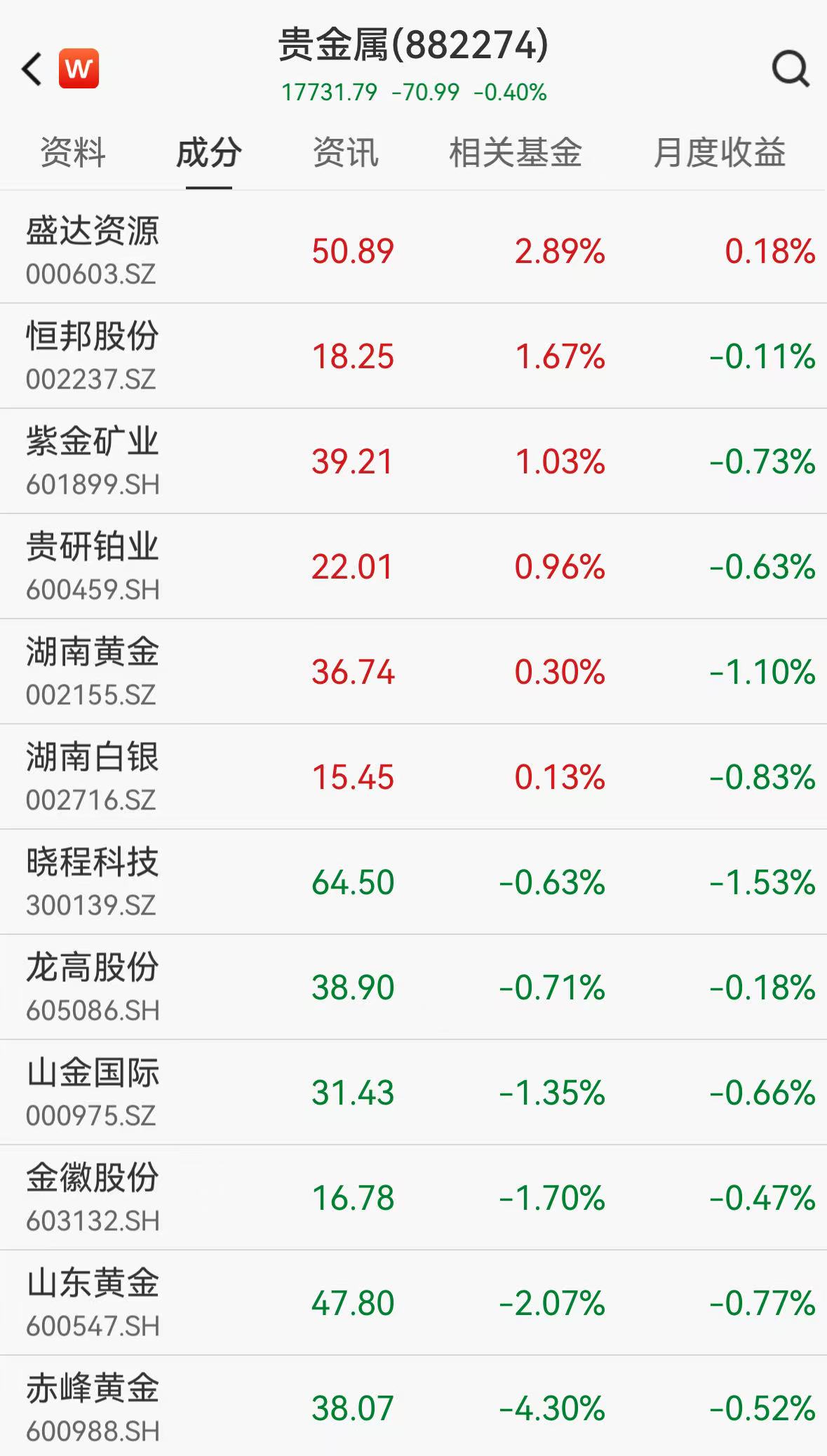
消息面上,在经历了1月30日、2月2日两个交易日的暴跌之后,现货黄金价格连续第二天反弹,重新站上5000美元大关。2月4日早盘交易中,现货黄金一度 涨超2%,前一交易日涨幅超过6%。 2月4日,A股贵金属板块开盘全线反弹后重挫翻绿,随后呈低位震荡走势。个股方面,截至10:14,盛达资源涨超2%,恒邦股份、紫金矿业、贵研铂业、湖 南黄金等多只贵金属概念股跟涨,昨日"一字"跌停的湖南白银也有反弹迹象。 对于本轮黄金反弹原因,中信建投期货在最新研报中表示,贵金属在经历了前期的快速下跌后,市场对沃什"鹰派"疑虑有所缓解,市场风险有所释放,再度 开启交易去美元化、地缘秩序变革等长线利多因素。 值得注意的是,中信建投警告投资者,贵金属日内波动仍然剧烈,投机资金进出仍然明显,市场风险依然存在。消息面,美伊谈判艰难,目前双方就谈判地 点仍未达成共识,地缘不确定性仍存。总体来看,当下贵金属行情受市场情绪影响较强,需关注短期波动风险,长期走势仍趋于乐观。 国信期货亦提示贵金属波动风险。短期内,在避险情绪与政策预期双重作用下,金银预计将维持高波动、宽幅震荡的格局。 策略方面,国信期货建议将风险控制置于绝对优先地位。已有黄金多单可继 ...





STARTRADER:金银强势反弹期金涨近8%银超10% 牛市重启还是死猫跳
Sou Hu Cai Jing· 2026-02-04 02:43
Core Viewpoint - The international precious metals market is experiencing a strong rebound, with significant price increases in gold and silver, leading to debates on whether this is a "dead cat bounce" or the start of a new bull market [1][3]. Group 1: Market Dynamics - Gold futures in New York surged nearly 8%, surpassing $5000 per ounce, while silver futures rose over 10%, reaching a peak of $89.10 [1]. - The rebound is attributed to multiple factors, including a sharp recovery from previous historical declines, with gold experiencing a maximum drawdown of over 21% and silver over 40% [3]. - The easing of pressure from increased margin requirements for precious metal futures has allowed previously liquidated funds to return, alongside short covering and retail investor buying, which significantly boosted trading volumes [3]. Group 2: Fundamental Support - Continued high levels of gold purchases by global central banks, particularly China, are reinforcing gold's monetary attributes amid a trend of de-dollarization [3]. - Silver benefits from robust industrial demand, particularly in sectors like photovoltaics and AI infrastructure, leading to a persistent supply-demand gap [3]. Group 3: Divergent Market Opinions - Optimists argue that the rebound signifies the restart of a bull market, supported by ongoing geopolitical risks and macroeconomic uncertainties, with central bank gold purchases remaining a long-term driver [4]. - The physical market shows strong retail demand, with reports of queues for gold bars in various locations, indicating a bullish sentiment [4][5]. - Conversely, skeptics view the rebound as a temporary technical correction, citing significant resistance levels for gold at $5100 and silver at $92, along with ongoing selling pressure from quantitative funds [5]. - Concerns about potential aggressive monetary policies from the Federal Reserve and geopolitical developments could further suppress gold and silver prices [5][6]. Group 4: Key Variables Influencing Future Trends - The evolution of technical recovery, adjustments in quantitative fund positions, and the pace of central bank gold purchases will shape the short-term volatility of precious metals [6]. - The direction of Federal Reserve policies, fluctuations in the U.S. dollar index, and developments in geopolitical situations will also impact market sentiment and the trajectory of gold and silver prices [6].

君研海外海外宏观及大类资产周度报告
2026-02-04 02:31
Summary of Key Points from the Conference Call Industry or Company Involved - The report is from Guotai Junan Futures, focusing on macroeconomic trends and major asset classes, particularly in the context of the U.S. economy and global markets [1][5][10]. Core Insights and Arguments Macroeconomic Trends - The report discusses the recent rebound of the U.S. dollar, attributing it to extreme overselling conditions and a divergence in economic growth between the U.S. and Europe [11][15]. - The narrative of "de-dollarization" is highlighted as a factor contributing to the dollar's weakness, but the report emphasizes the need for objective validation of this narrative in trading [15][25]. - The dollar index is expected to find support around the 96 level, with a potential rebound anticipated [15][42]. Monetary Policy and Market Reactions - The report notes that the U.S. bond market has remained relatively calm despite the discussions surrounding the nomination of Kevin Warsh as the Federal Reserve Chair, indicating a lack of consensus on monetary policy direction [22][42]. - The liquidity conditions in the U.S. money market are described as tight, which does not support a reduction in the Fed's balance sheet [25][42]. - The report suggests that the Fed's potential shift towards a more conservative stance under Warsh could impact market expectations regarding future interest rate movements [21][42]. Commodity and Currency Performance - The report provides a weekly performance overview of major commodities, noting significant fluctuations in prices, particularly in precious metals and energy [121][123]. - The performance of various currencies against the U.S. dollar is analyzed, with the report indicating a generally bullish sentiment towards Asian currencies, including the Chinese yuan [41][42]. - The report highlights the importance of monitoring the relationship between commodity prices and inflation expectations, particularly in the context of gold and silver [125][132]. Other Important but Possibly Overlooked Content - The report includes detailed data on U.S. Treasury yields, indicating a mixed performance across different maturities, with the 10-year yield at 4.24% and a slight increase of 1.03 basis points [46]. - It also discusses the implications of the current economic conditions on the credit market, noting that the high yield credit spread remains a critical indicator of market sentiment [66][70]. - The report emphasizes the need for investors to remain cautious and to consider the broader economic context when making investment decisions, particularly in light of potential volatility in the equity markets during earnings season [30][36]. This summary encapsulates the key points from the conference call, providing insights into macroeconomic trends, monetary policy implications, and market performance across various asset classes.
美元信用塌陷,人民币信用终将战胜黄金
2026-02-04 02:27
Summary of Conference Call on the Fabric Industry and Economic Trends Industry Overview - The discussion revolves around the fabric industry and macroeconomic trends, particularly focusing on the implications of the depreciation of the US dollar and the potential rise of the Chinese yuan and gold as alternative assets [1][2][3]. Core Insights and Arguments 1. **US Dollar Depreciation**: The speaker highlights a long-term trend of US dollar depreciation, suggesting that this trend is significant and will impact global economic dynamics [1][5][7]. 2. **Shift from Dollar to Yuan**: There is a belief that the Chinese yuan will strengthen as the US dollar weakens, indicating a potential shift in global economic power from the US to China [3][14][21]. 3. **Gold as an Investment**: While gold has been viewed as a safe haven, the speaker expresses uncertainty about its long-term viability as an investment compared to the yuan, suggesting that the yuan may become a more credible asset [2][19][21]. 4. **Global Economic Dynamics**: The discussion includes the complexities of global production, demand, and capital flows, emphasizing that the current economic order is unsustainable and will lead to significant changes in profit distribution globally [5][6][8]. 5. **Profit Distribution Inequality**: The speaker notes that the current system has led to unequal profit distribution, with the US capturing a disproportionate share compared to other economies, including China [6][8][12]. 6. **China's Economic Transition**: China is transitioning from a production-focused economy to one that seeks to capture more profits and enhance its global economic standing, which may lead to a rebalancing of global economic power [8][14][20]. 7. **Acceleration of Credit Expansion**: The yuan is expected to undergo an accelerated credit expansion, which could further enhance its global standing as the US dollar's influence wanes [17][27]. 8. **Impact of AI and Technology**: The speaker discusses the role of technology, particularly AI, in shaping future economic dynamics and the potential for the US to fall behind in technological advancements [25][26]. Other Important Points - **Non-linear Relationships**: The relationship between the depreciation of the dollar and the appreciation of the yuan is described as non-linear, indicating that changes in one do not directly correlate to linear changes in the other [3][4]. - **Global Trade Control**: The US's ability to control global trade dynamics is expected to diminish as its economic power declines, allowing for a more multipolar world where China plays a central role [15][20]. - **Financial Resource Allocation**: The discussion touches on the shifting allocation of financial resources, with a potential return of capital to China as the US's financial resource acquisition capabilities weaken [18][21]. - **Long-term Economic Predictions**: The speaker emphasizes that the current economic trends suggest a significant shift in global economic power, with China potentially emerging as the dominant economic force [14][27]. This summary encapsulates the key points discussed during the conference call, focusing on the implications of macroeconomic trends for the fabric industry and the broader global economy.
广发早知道:汇总版-20260204
Guang Fa Qi Huo· 2026-02-04 02:09
Report Industry Investment Rating No relevant content provided. Core Viewpoints of the Report - The report analyzes various futures markets, including financial derivatives, precious metals, shipping, non - ferrous metals, ferrous metals, agricultural products, and energy chemicals. It provides insights into the supply - demand situation, price trends, and investment strategies for each market [2][3][4] - Overall, the market is affected by multiple factors such as macro - economic policies, geopolitical events, and seasonal demand changes. Different commodities show different trends and investment opportunities [21][27][30] Summary by Directory Daily Selections - **Copper**: Overseas and domestic copper storage expectations are strengthening, and copper prices have stopped falling and stabilized. Short - term CL premium changes will affect copper prices, and the long - term view remains positive [2][21] - **Caustic Soda**: The fundamentals have not improved, and the market is expected to adjust weakly and stably. Attention should be paid to the procurement volume of major downstream industries and the fluctuations in liquid chlorine prices [3][114] - **Hot Rolled Coil**: It maintains de - stocking, and the price has fallen. There are short - term long opportunities at low prices. The steel price is expected to fluctuate, and the long position of the spread between hot - rolled coil and rebar can be held [4][57] - **Meal Products**: The supply is loose throughout February. The market is expected to decline, and attention should be paid to macro - economic changes [5][76] Macro - finance Stock Index Futures - The market sentiment has improved, and stock indexes have rebounded collectively. The four major stock index futures contracts have also risen, and the basis has recovered. It is recommended to control portfolio risks and hold bilateral call option positions [6][7][8] Treasury Bond Futures - The rally in the equity market has slightly dampened the sentiment of long - term bonds. The central bank's operations support the short - end. It is recommended to operate within the range, pay attention to the narrowing of the spread between ultra - long - term and other varieties, and arrange position transfers in advance [9][10][11] Precious Metals - The持仓 of silver ETF has increased significantly, and the market sentiment has improved. Precious metals have stopped falling and rebounded. Gold is expected to gradually establish a bottom, and silver may fluctuate widely. Platinum and palladium are expected to follow the upward trend of gold in the long - term but may enter a consolidation phase in the short - term [12][14][15] Shipping Index (European Line) - The futures price has risen. In the long - term, the price is in a downward range, but the 04 contract price is currently at a low level, and it is expected to show a volatile trend in the short - term. It is recommended to observe cautiously [16][17] Non - ferrous Metals - **Copper**: Overseas and domestic storage expectations are strengthening, and copper prices have rebounded. The short - term price may be determined by fundamentals, and a long position can be considered at low prices [17][21] - **Alumina**: Due to maintenance and supply contraction expectations, the futures price is strong, but high inventory suppresses the price. It is expected to fluctuate widely around the cost line [22][24] - **Aluminum**: The price has high volatility. It is recommended to establish long positions after the price stabilizes, paying attention to the support level [25][27] - **Aluminum Alloy**: The price follows the fluctuation of aluminum, and it is expected to fluctuate in a high - level range. An arbitrage strategy of long AD03 and short AL03 can be considered [28][30] - **Zinc**: The price has retreated from a high level. The supply is tight at the mine end, and the demand is weak. The price is expected to fluctuate, and a long position can be considered at low prices [31][34] - **Tin**: The price has rebounded. The supply is gradually recovering, and the demand is differentiated. It is recommended to be cautious in the short - term and consider a long position at low prices in the long - term [35][39] - **Nickel**: The price has rebounded slightly and then fluctuated. The macro - economic situation and mine - end expectations affect the price, and it is expected to fluctuate widely [40][42] - **Stainless Steel**: The price has oscillated and recovered. The cost provides support, but the demand is weak. It is expected to adjust weakly in the short - term [43][46] - **Lithium Carbonate**: The price has rebounded at a low level. The supply may decline, and the demand is resilient. It is expected to adjust widely [47][50] - **Polysilicon**: The production enterprises have a strong willingness to support prices, and the price has risen. It is expected to be weak in February, and attention should be paid to post - holiday demand recovery [51][52] - **Industrial Silicon**: The price has risen and then oscillated. The supply and demand are expected to decline in February, and it is expected to fluctuate at a low level [53][55] Ferrous Metals - **Steel**: The price is expected to fluctuate. The hot - rolled coil maintains de - stocking, and a long position can be considered at low prices. The long position of the spread between hot - rolled coil and rebar can be held [56][57] - **Iron Ore**: The price is under pressure. The supply is at a high level, and the demand is weak before the Spring Festival. It is expected to fluctuate weakly in the short - term [58][60] - **Coking Coal**: The price has oscillated and declined. The supply is increasing, and the demand is weak. It is expected to oscillate within a range, and an arbitrage strategy of long coking coal and short coke can be considered [61][64] - **Coke**: The price has oscillated and declined. The supply is slightly reduced, and the demand is weak. It is expected to oscillate within a range, and an arbitrage strategy of long coking coal and short coke can be considered [65][66] - **Silicon Iron**: The supply and demand have no major contradictions. The price is expected to fluctuate widely, and attention should be paid to macro - economic sentiment [67][69] - **Manganese Silicon**: The price is weak. The supply is slightly reduced, and the demand is weak. It is expected to fluctuate widely, and attention should be paid to macro - economic sentiment [70][72] Agricultural Products - **Meal Products**: The supply is loose, and the market is expected to decline. Attention should be paid to macro - economic changes [73][76] - **Hogs**: The supply is increasing, and the supply - demand game is intensifying. The spot price may be supported, but the futures price is expected to oscillate at the bottom [77][78] - **Corn**: The price is expected to oscillate narrowly. Attention should be paid to the grain sales rhythm and policy release [79][81] - **Sugar**: The international sugar market is expected to have a reduced surplus. The domestic market is expected to follow the macro - economic sentiment, and it is recommended to observe in the short - term [82][84] - **Cotton**: The price is expected to oscillate widely. Attention should be paid to the support level at 14,500 [84][86] - **Eggs**: The supply - demand situation has become looser, and the price is expected to oscillate weakly [87][88] - **Oils and Fats**: It may enter a phase of stopping the decline and adjusting. Different oils have different trends, and attention should be paid to support levels [89][91] - **Jujubes**: The supply - demand pattern is loose, and the price is expected to oscillate at the bottom [92][93] - **Apples**: The price is expected to oscillate at a high level. Attention should be paid to post - holiday inventory [94][96] Energy Chemicals - **PX**: The cost - side risks have been released, and the supply - demand situation is expected to improve. The price has support at a low level, and a long position can be considered at low prices [97][98] - **PTA**: The cost - side risks have been released, and the supply - demand situation is expected to improve in the medium - term. The price has support at a low level, and a long position can be considered at low prices [99][100] - **Short - fiber**: The supply - demand situation is weak, and the price follows the raw materials. It is recommended to operate in the same way as PTA and reduce the processing margin at high levels [101] - **Bottle Chips**: The supply is expected to increase in February, and the demand will weaken seasonally. The processing margin is expected to be suppressed, and it is recommended to operate in the same way as PTA and pay attention to reducing the processing margin at high levels [102][103] - **Ethylene Glycol**: The supply - demand situation is weak in the near - term and strong in the long - term. The price is under pressure. It is expected to oscillate within a range, and a positive spread strategy can be considered [104][105] - **Pure Benzene**: The supply - demand situation has improved slightly, but high inventory restricts its self - driving force. The price follows the raw materials and downstream styrene. It is recommended to hold short positions and reduce the spread between styrene and pure benzene at high levels [106] - **Styrene**: New export news and strong oil prices boost the price in the short - term, but the high valuation and weak supply - demand expectations limit the rebound space. It is recommended to hold short positions and reduce the spread between styrene and pure benzene at high levels [107][109] - **LLDPE**: Hedging continues to build positions, and the trading volume is neutral. The supply is expected to increase, and the demand is limited. It is recommended to stop the profit of previous long positions and observe [110][111] - **PP**: The supply - demand situation is weak, and the price oscillates. Attention should be paid to the implementation of maintenance plans. It is recommended to observe [111][112] - **Methanol**: The trading volume is average, and the basis has strengthened slightly. The supply - demand situation is weak, and it is recommended to observe and stop the profit of previous long positions [112][113] - **Caustic Soda**: The fundamentals have not improved, and the market is expected to adjust weakly and stably. Attention should be paid to the procurement volume of major downstream industries and the fluctuations in liquid chlorine prices [113][114] - **PVC**: The price is strong. The supply - demand situation improves slightly before the Spring Festival, and the cost provides support. It is expected to oscillate strongly in the short - term [115][116] - **Urea**: The trading atmosphere before the Spring Festival is weak, and new orders are slow to follow. The supply is sufficient, and the price is expected to oscillate weakly. Attention should be paid to the factory's pre - holiday order - receiving strategy and agricultural fertilizer demand [118][119] - **Soda Ash**: The supply is strong, and the demand is weak. The price is expected to oscillate in the short - term, and attention should be paid to post - holiday production line changes and downstream glass production [120][124] - **Glass**: The supply - demand situation is in a weak balance. The price is expected to oscillate in the short - term, and attention should be paid to production line changes, inventory, and macro - policies [120][125] - **Natural Rubber**: The commodity atmosphere has improved, and the rubber price has rebounded. The supply is decreasing, and the cost provides support. It is recommended to try a long position with a light position [125][128] - **Synthetic Rubber**: BR has rebounded with the commodities. The cost provides support, and the demand is expected to improve. The supply inventory is at a high level. It is recommended to pay attention to the support level at 12,500 [128][129]
2026年02月04日申万期货品种策略日报-铂、钯:申万期货品种策略日报-铂、钯-20260204
Shen Yin Wan Guo Qi Huo· 2026-02-04 02:05
1. Report Industry Investment Rating - The report maintains a bullish outlook on platinum and palladium [4] 2. Core View of the Report - The long - term core logic for platinum and palladium remains unchanged, but short - term fluctuations are intensified due to technical corrections and Fed personnel changes. Despite short - term disturbances, the long - term bullish logic persists [4] 3. Summary by Relevant Catalogs Futures Market - Platinum (pt2606, pt2608, pt2610): The current prices are 572.95, 563.10, and 557.85 respectively. The price increases are 19.60, 16.05, and 9.45, with corresponding increases of 3.54%, 2.93%, and 1.72%. The trading volumes are 27866, 1548, and 772, and the open interests are all 11507 [1] - Palladium (pd2606, pd2608, pd2610): The current prices are 450.55, 444.50, and 432.25 respectively. The price increases are 35.75, 31.85, and 24.15, with corresponding increases of 8.62%, 7.72%, and 5.92%. The trading volumes are 15449, 313, and 199, and the open interests are all 4112 [1] Spot Market - Platinum: The Shanghai platinum price increased by 50.39 to 566.81, with an increase of 0.098%. The London platinum price increased by 102.00 to 2247.00, with an increase of 0.048%. The prices of Zhou Dafu and Lao Fengxiang platinum are 870.00 and 960.00 respectively, with increases of 46.00 and 0.00, and increases of 0.056% and 0.000% [1] - Palladium: The Chinese palladium price increased by 10.00 to 425.00, with an increase of 0.024%. The Russian palladium price decreased by 173.15 to 4333.76, with a decrease of 0.038% [1] Inventory - Platinum: The NYMEX inventory decreased by 49923.2 ounces to 605258.93 ounces, and the registered warehouse receipts decreased by 11451.9 ounces to 326637.95 ounces. The trading volume on the Gold Exchange increased by 323.2 ten - thousand yuan to 6991.16 ten - thousand yuan, and the trading volume increased by 2.0 kilograms to 124.00 kilograms [1] - Palladium: The NYMEX inventory decreased by 15565.3 ounces to 208455.89 ounces, and the registered warehouse receipts remained unchanged at 142716.91 ounces [1] Related Derivatives - The current values of platinum/palladium, Shanghai platinum/London platinum, pt2608 - pt2606, pt2610 - pt2606, Chinese palladium/Russian palladium, and pd2608 - pd2606 are 1.33, 1.09, - 9.85, - 15.10, 1.07, and - 6.05 respectively, with corresponding previous values of 5.04, 2.13, - 6.80, - 3.95, - 0.63, and - 3.10 [1] - For related derivatives such as Shanghai Gold and Shanghai Silver, the current prices, previous closing prices, and price changes are provided, for example, the current price of Shanghai Gold 2604 is 1093.78, with an increase of 85.18 compared to the previous closing price [1] Macroeconomic News - The Fed maintains the benchmark interest rate at 3.50% - 3.75%, pausing after three consecutive 25 - basis - point interest rate cuts, which is in line with market expectations. Fed Chair candidate Waller supports a 25 - basis - point interest rate cut, consistent with Trump - nominated director Milan's position [2] - Trump nominates former Fed governor Kevin Warsh as the next Fed chair, but the nomination needs Senate approval. Some senators oppose the nomination [2] - In January 2026, China's manufacturing market demand tightened, but production expanded, and the industrial structure continued to optimize. The manufacturing PMI was 49.3%, a decrease of 0.8 percentage points from the previous month. The PMIs of the equipment manufacturing and high - tech manufacturing industries were 50.1% and 52% respectively, showing stable and positive development [2] - The People's Bank of China requires promoting the high - quality development of the modern payment system in 2026, including accelerating the construction of the RMB cross - border payment system, strengthening regulatory measures, and improving service quality [3] Comments and Strategies - The short - term decline in platinum and palladium prices is mainly due to Trump's nomination of Kevin Warsh. The market short - term monetary policy expectations are in a state of continuous game. In the long - term, there are still many positive factors, such as the weakening of the US dollar's credit, the continuous gold - buying spree of global central banks, and the clear supply - demand gap in the platinum and palladium industries [4]
金价深V反弹,还能持有吗?
Sou Hu Cai Jing· 2026-02-04 01:57
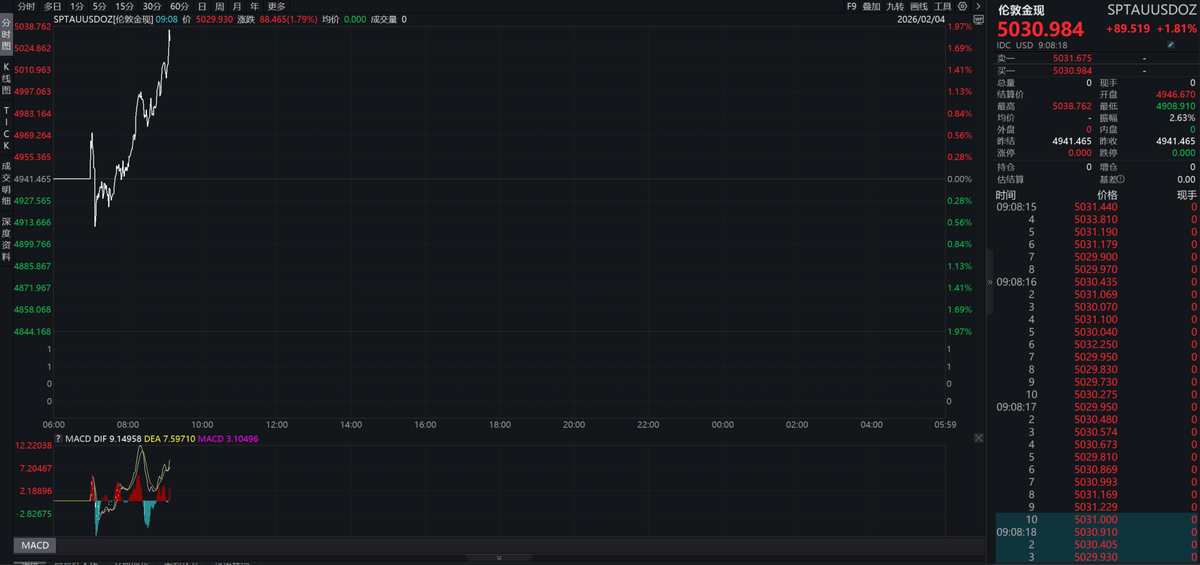
持续突破历史新高纪录后,国际金价近期走出"过山车"行情。 1月31日,现货黄金盘中大跌超12%,创40年来最大单日跌幅,最低触及4682美元/盎司;2月2日市场延续下跌趋势,最低触及4402美元/盎司,年内涨幅从 30%骤降至4%,前期涨势近乎抹平;而时至今日,国际金价在经历连续巨震后,上演深V反弹,重新站上5000美元/盎司关口,震荡行情加剧。 这场惊心动魄的行情,让此前持续加速上涨的贵金属市场瞬间降温,更让全球投资者陷入对"避险资产神话"的重新审视。当避险资产成为风险来源,投资者 还能持有黄金吗?黄金的上涨趋势是否还能延续? 巨震溯源 1、导火索:沃什获提名,鹰派预期升温 黄金本轮暴跌的直接触发因素是特朗普提名凯文·沃什(Kevin Warsh)为下任美联储主席。 从凯文·沃什的主张来看,其过往以坚定的通胀鹰派著称,曾公开反对量化宽松并主张快速缩表,被视为美联储独立性的捍卫者;但近年来其立场转向务 实,公开支持降息,称不降息才是对美联储信誉的最大威胁,这一调整与特朗普希望更快降息的诉求形成表面契合,形成鹰派框架结合鸽派信号的独特组 合。即便如此,市场仍聚焦于其鹰派历史立场,担忧其上台后将推动"降息+缩表" ...
早间评论-20260204
Xi Nan Qi Huo· 2026-02-04 01:55
1. Report Industry Investment Ratings No relevant content provided. 2. Core Views of the Report - The macro - economic recovery momentum needs to be strengthened, and the monetary policy is expected to remain loose. The yield of treasury bonds is at a relatively low level, and the stock index is expected to gradually move up. The precious metals market may have significant fluctuations. The prices of steel products, iron ore, and other commodities have different trends, and corresponding investment strategies are proposed for each commodity [6][9][11]. 3. Summary by Directory Treasury Bonds - On the previous trading day, most treasury bond futures closed higher, with the 30 - year main contract down 0.10% at 111.960 yuan, the 10 - year main contract up 0.02% at 108.260 yuan, the 5 - year main contract up 0.06% at 105.905 yuan, and the 2 - year main contract up 0.03% at 102.414 yuan. The central bank conducted 105.5 billion yuan of 7 - day reverse repurchase operations, and the net withdrawal was 296.5 billion yuan. It is expected that treasury bond futures still face certain pressure, and caution is advised [5][6]. Stock Index Futures - On the previous trading day, stock index futures showed mixed trends. The main contract of CSI 300 stock index futures (IF) rose 1.28%, the main contract of SSE 50 stock index futures (IH) rose 0.91%, the main contract of CSI 500 stock index futures (IC) rose 3.82%, and the main contract of CSI 1000 stock index futures (IM) rose 2.87%. In January 2026, 4.9158 million new A - share accounts were opened, with a month - on - month increase of 89% and a year - on - year increase of 213%. It is expected that the volatility center of the stock index will gradually move up, and previous long positions can be held [8][9]. Precious Metals - On the previous trading day, the closing price of the gold main contract was 1,093.78, with a gain of 8.45%; the closing price of the silver main contract was 21,446, with a gain of - 13.64%. The global trade and financial environment is complex, which is beneficial to the allocation and hedging value of gold. However, the recent sharp rise in precious metals has led to a significant increase in speculative sentiment. It is expected that market volatility will significantly increase, and long positions can be liquidated and wait and see [11]. Steel Products (Rebar and Hot - Rolled Coil) - On the previous trading day, rebar and hot - rolled coil futures continued to correct. In the medium term, the price of finished products is dominated by the industrial supply - demand logic. The demand for rebar is in a year - on - year decline, and the market will enter the off - season. The supply pressure increases, and the inventory is higher than that of the same period last year. It is expected that the rebar price may continue the weak shock. The hot - rolled coil may have a similar trend. Investors can pay attention to the opportunity of buying on dips and manage positions carefully [13]. Iron Ore - On the previous trading day, iron ore futures fell slightly. The national hot metal daily output is below 2.3 million tons, and the demand for iron ore is at a low level. The import volume of iron ore increased by 1.8% year - on - year in 2025, and the domestic raw ore output is lower than that of the same period in 2024. The port inventory is rising, and the supply - demand pattern is weak. It is expected that the iron ore futures may continue the shock pattern in the short term. Investors can pay attention to the opportunity of buying on dips and manage positions carefully [15]. Coking Coal and Coke - On the previous trading day, coking coal and coke futures fell slightly. The production of domestic coking coal is stable, but the supply will decrease during the Spring Festival. The demand from downstream coking enterprises is weak. It is expected that the coking coal and coke futures may continue the shock pattern in the medium term. Investors can pay attention to the opportunity of buying at low levels and manage positions carefully [17][18]. Ferroalloys - On the previous trading day, the manganese - silicon main contract fell 0.51% to 5,836 yuan/ton, and the silicon - iron main contract fell 0.71% to 5,620 yuan/ton. The supply of manganese ore is gradually recovering, and the cost of ferroalloys fluctuates in a narrow range at a low level. The production of ferroalloys is at a low level, and the demand is weak. After a decline, investors can consider long positions in the low - level range [20]. Crude Oil - On the previous trading day, INE crude oil opened lower and fluctuated slightly, breaking below the 10 - day moving average. Speculators increased their net long positions in US crude oil futures and options. The number of active oil and gas rigs in the US increased. OPEC+ may maintain the decision to suspend production increase in March. It is expected that after a correction, crude oil is expected to regain strength. Investors can pay attention to the opportunity of going long on the main contract [21][22]. Fuel Oil - On the previous trading day, fuel oil opened lower and fluctuated, closing near the 10 - day moving average. The supply of high - sulfur fuel oil in Singapore is limited, and the inventory has decreased. The cost - end crude oil correction has led to a correction in fuel oil prices. After the correction, there is still room for fuel oil prices to rise. Investors can pay attention to the opportunity of going long on the main contract [24][25]. Polyolefins - On the previous trading day, the PP market in Hangzhou saw some price drops, and the LLDPE price in Yuyao fell. As the Spring Festival approaches, the demand for polyolefin products weakens, and the industry's operating rate may continue to decline. Investors can pay attention to the opportunity of going long [27]. Synthetic Rubber - On the previous trading day, the synthetic rubber main contract rose 0.96%. The price of raw materials has increased, the supply has slightly shrunk, the demand has improved year - on - year, and the inventory has increased. It is expected to show a strong shock [29][30]. Natural Rubber - On the previous trading day, the main contract of natural rubber rose 0.25%, and the 20 - number rubber main contract rose 0.54%. The global supply of natural rubber is seasonally shrinking, the demand from tire enterprises is mixed, and the inventory has slightly decreased. It is expected to show a strong operation in the short term [32]. PVC - On the previous trading day, the PVC main contract rose 0.30%. The price is supported by export orders and cost, but the contradiction between high inventory and weak demand remains. The industry's operating rate is stable, and the demand is weak. It is expected to show a strong shock [34][35]. Urea - On the previous trading day, the urea main contract fell 1.06%. The short - term urea price will maintain a strong shock, mainly driven by export demand and cost support. The industry's operating rate has increased, the demand is good, and the profit has increased. The inventory is higher than expected [38]. PX - On the previous trading day, the PX2603 main contract fell significantly by 1.37%. The PXN spread and short - process profit have been slightly compressed, the PX operating rate has slightly increased, and the cost support has weakened. It is expected to be mainly in a shock adjustment, and investors should participate cautiously [40][41]. PTA - On the previous trading day, the PTA2605 main contract fell 1.08%. The PTA processing fee has risen to the average level of previous years, the supply has changed little, the demand has decreased seasonally, and the cost support has slightly weakened. It is expected to be in a shock operation, and investors should operate cautiously [42]. Ethylene Glycol - On the previous trading day, the ethylene glycol main contract fell 1.98%. The domestic operating rate has increased, the port inventory has continued to accumulate, the cost has weakened, and the downstream polyester has entered the seasonal maintenance period. It is expected to maintain a shock bottom - building pattern, and investors should operate cautiously [43][44]. Short - Fiber - On the previous trading day, the short - fiber 2603 main contract fell 1.31%. As the Spring Festival approaches, the supply of short - fiber has shrunk, and the terminal factories are mainly digesting raw material inventories. It is expected to follow the cost - end logic, and investors should wait and see cautiously [45]. Bottle Chips - On the previous trading day, the bottle - chip 2603 main contract fell 1%. The bottle - chip processing fee has risen to around 560 yuan/ton. The supply is expected to shrink, the export growth rate has increased, and it is expected to follow the cost - end operation. Investors should participate cautiously before the Spring Festival [46][47]. Soda Ash - On the previous trading day, the main 2605 contract closed at 1,201 yuan/ton, down 1.15%. The fundamentals are still loose, the production has increased, the inventory has slightly increased, and the downstream demand is weak. It is expected to be in a light and stable arrangement before the Spring Festival, and investors should be cautious [48]. Glass - On the previous trading day, the main 2605 contract closed at 1,072 yuan/ton, up 0.28%. The fundamentals are still in a loose pattern, the inventory in the factory has improved slightly, and the inventory of traders has increased. It is expected to be in a shock before the Spring Festival [50][52]. Caustic Soda - On the previous trading day, the main 2603 contract closed at 1,969 yuan/ton, down 2.19%. The supply is at a high level, the inventory is increasing, the price is weak, and the demand is weak. It is expected to maintain a high - supply pattern [53]. Pulp - On the previous trading day, the main 2605 contract closed at 5,276 yuan/ton, down 0.45%. The inventory has continued to accumulate, the downstream demand is limited, and some holders are selling at a discount to raise funds. It is expected that the pre - festival market will have limited fluctuations [54]. Lithium Carbonate - On the previous trading day, the lithium carbonate main contract rose 4.63% to 148,100 yuan/ton. The market sentiment has improved. The supply is at a high level, the demand from the energy - storage and power - battery sectors has improved, and the inventory has decreased. The price has strong support below, but the short - term volatility may increase [55]. Copper - On the previous trading day, the Shanghai copper main contract closed at 105,180 yuan/ton, down 3.49%. Geopolitical events have stimulated the hedging demand, and the market's expectation of the Fed's interest - rate cut remains unchanged. The mine supply is disturbed, the consumption has entered the off - season, and the inventory has increased. The copper price is expected to be adjusted before the Spring Festival [57]. Aluminum - On the previous trading day, the Shanghai aluminum main contract closed at 23,865 yuan/ton, up 1.47%; the alumina main contract closed at 2,806 yuan/ton, down 0.14%. The alumina supply is loose, the electrolytic aluminum production growth space is limited, the demand is weak, and the inventory has increased. The aluminum price is expected to be under pressure in the short term [59][60]. Zinc - On the previous trading day, the Shanghai zinc main contract closed at 24,805 yuan/ton, down 0.4%. The supply has tightened, the demand is weak, and the inventory has not started to accumulate significantly. The zinc market shows a pattern of weak supply and demand, and the zinc price is expected to enter an adjustment period [62]. Lead - On the previous trading day, the Shanghai lead main contract closed at 16,615 yuan/ton, down 0.15%. The supply and demand are both weak, and the lead price is expected to maintain a range - bound shock [64][65]. Tin - On the previous trading day, the Shanghai tin main contract rose 6.64% to 398,100 yuan/ton. The mine supply is tight, the demand has certain resilience, the inventory has decreased, and the tin price has support below. However, the short - term volatility may increase [66]. Nickel - On the previous trading day, the Shanghai nickel main contract rose 2.34% to 135,770 yuan/ton. The US plans to start a strategic mineral reserve project, and the nickel production cost is expected to rise. The nickel mine price is stable, the downstream demand is weak, and the refined nickel is in an oversupply pattern. Investors should pay attention to relevant policies in Indonesia [67]. Soybean Oil and Soybean Meal - On the previous trading day, the soybean meal main contract fell 1.05% to 2,727 yuan/ton, and the soybean oil main contract fell 1.08% to 8,086 yuan/ton. The US bio - fuel tax credit policy has an impact on the market. The domestic soybean import has slowed down, the oil - mill profit has improved, and the cost support has decreased. The demand for soybean meal is growing moderately, and the demand for soybean oil has improved slightly. Investors can pay attention to the long - position opportunity in the low - cost support range for soybean meal and wait and see after the soybean oil price leaves the low - cost range [68][69]. Palm Oil - The Malaysian palm oil continued to decline after the weekend holiday, but the strong export data limited the decline. Indonesia plans to restrict the export of palm - oil waste. The domestic palm - oil import has decreased, and the inventory has slightly decreased. Investors can consider the opportunity of going long after the correction [70][71]. Rapeseed Meal and Rapeseed Oil - The Canadian rapeseed has risen slightly. The US bio - fuel tax credit policy has an impact on the market. China has adjusted the tariff on Canadian rapeseed. The rapeseed meal inventory has decreased, and the rapeseed oil inventory has increased. Investors should wait and see for the time being [73]. Cotton - On the previous trading day, the domestic Zhengzhou cotton rebounded with a reduction in positions. The external - internal price difference is large, and the short - term upward space of the domestic market may be limited. The USDA supply - demand report is favorable to the market. The domestic cotton production is high, but the inventory accumulation is lower than expected, and the future supply is expected to be tight. The downstream consumption is resilient. It is expected that the cotton price will be strong in the medium and long term, but the domestic market has pressure in the short term. Investors can buy in batches at low prices after a full correction [75][76]. Sugar - On the previous trading day, the Zhengzhou sugar contract fell with an increase in positions. The Indian sugar production is expected to increase, and the Brazilian new - season sugar is also expected to be in a good harvest. The domestic sugar supply is sufficient, and the import volume is high. It is expected to be bearish in the medium and long term [78]. Apples - On the previous trading day, the domestic apple futures fluctuated. The market is at the end of the Spring Festival stocking period, and it is expected to enter a small - range shock. The current inventory is at a low level in recent years, and the new - season apple production and quality have declined. It is expected that the price will be strong in the medium and long term. Investors can go long in batches after a correction [80][81]. Pigs - On the previous trading day, the main contract fell 0.98% to 11,160 yuan/ton. The market supply is abundant, and the pig price has fallen. The supply may still face great pressure in the first quarter, and investors should wait and see [83][84]. Eggs - On the previous trading day, the main contract fell 0.74% to 2,953 yuan/500kg. The egg supply is expected to remain at a high level in February, and the far - month supply improvement prospect is worrying. Investors should wait and see for the time being [85]. Corn and Corn Starch - On the previous trading day, the corn main contract rose 0.09% to 2,267 yuan/ton, and the corn - starch main contract fell 0.20% to 2,509 yuan/ton. The US bio - fuel tax credit policy has an impact on the market. The domestic corn is basically in balance between production and demand, and the corn - starch demand has improved slightly. The corn - starch may follow the corn market [86][87]. Logs - On the previous trading day, the main 2603 contract closed at 801.0 yuan/ton, up 0.50%. The supply has slightly shrunk, the downstream procurement has improved, the inventory has decreased, and the cost has slightly increased. The short - term market is strong, but the fundamental improvement needs time. Investors should pay attention to the external - market quotation, holiday progress, and shipping dynamics [88][89].