地缘政治

Search documents
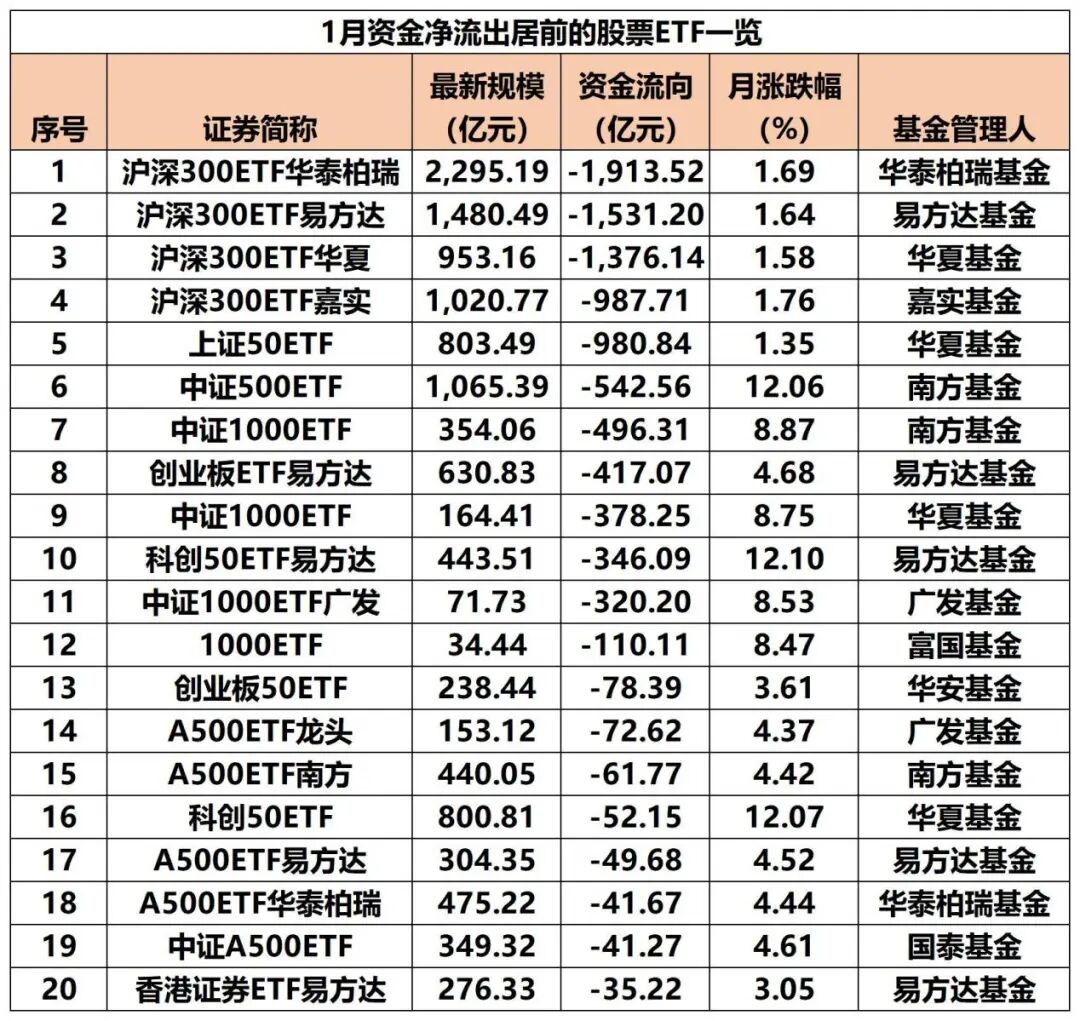
净流出超7900亿元!
Zhong Guo Ji Jin Bao· 2026-02-02 06:24
Core Viewpoint - In January, the stock ETF market experienced significant outflows, totaling over 790 billion yuan, with a notable net outflow of 37.20 billion yuan on January 30 alone [1][5][3]. Group 1: ETF Market Performance - On January 30, the Shanghai Composite Index fell over 2%, closing down 0.96% at 4117 points, with most industry sectors declining, while communication, electronics, and agriculture sectors showed gains [2][3]. - The total net outflow for all stock ETFs (including cross-border ETFs) in January reached 795.67 billion yuan [5]. - The largest inflows were seen in thematic ETFs such as non-ferrous metals, chemicals, electric grid equipment, and satellite ETFs, while broad-based ETFs like the CSI 300 ETF and SSE 50 ETF faced significant outflows [6][7]. Group 2: Specific ETF Data - On January 30, the SGE Gold 9999 index had the highest net inflow of 16.24 billion yuan, while the CSI 300 index saw the largest outflow of 73.23 billion yuan [3]. - Over the past five days, the SGE Gold 9999 index attracted over 20.2 billion yuan, and the chemical sector saw inflows exceeding 9.9 billion yuan [3]. - Leading fund companies like Huaxia Fund reported significant inflows in their non-ferrous metals ETF and chip ETF, with net inflows of 1.134 billion yuan and 430 million yuan, respectively [3]. Group 3: Sector Insights - The chemical industry ETF from E Fund saw a net inflow of 390 million yuan, while the chip ETF from E Fund had a net inflow of 170 million yuan [4]. - Analysts suggest that geopolitical uncertainties and rising nationalism may drive resource commodities into a super cycle, with metals like gold, silver, copper, aluminum, tungsten, and cobalt being particularly noteworthy [9]. - Investment opportunities are identified in sectors such as steel, building materials, chemicals, and silicon materials, which are expected to benefit from demand recovery [9].

广发宏观:高频数据下的1月经济:价格篇
GF SECURITIES· 2026-02-02 06:01
Price Trends - The Business Price Index (BPI) reached a one-year high of 956 points as of January 30, reflecting a month-on-month increase of 6.3% compared to December 2022[3] - The energy index increased by 1.5% month-on-month, while the non-ferrous index surged by 21.7%[4] - The geopolitical threat index averaged 242.0 points, marking a month-on-month rise of 66.3%, the highest since March 2020[3] Commodity Prices - In the commodity price rankings for the week of January 26-30, 15 non-ferrous products saw price increases, with 8 of them rising over 5%, accounting for 36.4% of the monitored products[4] - Notable price increases included neodymium metal (11.14%), praseodymium oxide (10.07%), and neodymium oxide (9.69%)[4] - The South China Comprehensive Index rose by 8.6% month-on-month, with a year-on-year increase of 8.8% compared to 3.0% in December[5] Real Estate Market - The second-hand housing price index for major cities showed mixed results, with Beijing and Guangzhou experiencing a narrowing decline of -0.5% and -1.0% respectively, while Shenzhen saw a slight increase of 0.4%[5] - The average listing prices for second-hand homes in Beijing, Shanghai, Guangzhou, and Shenzhen were 143.1, 180.3, 153.8, and 222.1 respectively, with varying month-on-month changes[5] Emerging Industries - The photovoltaic industry composite index (SPI) increased by 10.3% month-on-month, driven by rising prices in battery cells and silicon wafers[7] - Lithium carbonate futures prices surged by 27.6% month-on-month, while the DRAM industry composite index (DXI) rose by 25.8%, reaching a historical high[7] Logistics and Transportation - The China Export Container Freight Index (CCFI) increased by 2.5% month-on-month, with the Shanghai-Los Angeles and Shanghai-New York indices recording changes of 2.6% and -3.4% respectively[8] - The Baltic Dry Index (BDI) rebounded by 14.4% month-on-month, following a decline of -26.7% in December[9] Food Prices - The average wholesale price of pork rose by 5.8% month-on-month, while the prices of 28 key vegetables fell by 0.2%[10] - The non-food price index (ICPI) recorded a slight decrease of -0.07% month-on-month, with transportation and communication services showing the highest increases[10]
大越期货原油周报-20260202
Da Yue Qi Huo· 2026-02-02 05:54
原油周报 (1.26-1.30) 大越期货投资咨询部 金泽彬 从业资格证号:F3048432 投资咨询证号: Z0015557 联系方式:0575-85226759 重要提示:本报告非期货交易咨询业务项下服务,其中的观点和信息仅作参考之用,不构成对任何人的投 资建议。 我司不会因为关注、收到或阅读本报告内容而视相关人员为客户;市场有风险,投资需谨慎。 交易咨询业务资格:证监许可【2012】1091号 CONTENTS 目 录 1 回顾 2 相关资讯 3 展望 4 基本面数据 5 持仓数据 回顾与要闻 上周,原油震荡走高。纽约交易所主力轻质原油期货价格收于每桶65.74美元,周涨7.28%;伦敦布伦特原油主力期货价格收于每桶69.83美元, 周涨6.71%;中国原油期货SC主力合约收至470元/桶,周涨6.36%。美国总统特朗普重申对伊朗的威胁,一支舰队正驶向伊朗,希望伊朗能同美 国达成协议。伊朗方面则表示,邻国领土若被用于针对伊朗的敌对行动,这些邻国将被视为敌对方。此外,俄乌局势方面,周内乌克兰、美国 和俄罗斯代表团在阿布扎比举行三方会谈,与会各方在军事问题上取得一定进展,但在领土问题上仍未达成任何决定。地缘 ...
特朗普急了,发文称从未见过这样的情况,他想从中国大赚一笔
Sou Hu Cai Jing· 2026-02-02 05:21
Group 1 - The article discusses Trump's claims about the decline of China's share in U.S. imports, stating it has reached its lowest point since 2001, but this narrative may not reflect the full reality [3][5] - Official data indicates that China's trade surplus is projected to reach $1.2 trillion by 2025, while the U.S. is expected to have a global trade deficit exceeding $1.2 trillion in the same year [3][5] - Trump's urgency in addressing these issues is linked to ongoing legal challenges regarding tariffs, which could result in the U.S. needing to refund approximately $300 billion in tariffs if he loses [5][9] Group 2 - The article highlights that the decline in Chinese exports is not a sign of defeat but rather a result of the accelerated restructuring of global supply chains, with orders shifting to Southeast Asia, Africa, and Latin America [7][19] - Trump's approach to economic policy includes a potential collaboration between the Treasury and the Federal Reserve to devalue the dollar, which has raised concerns in the market, leading to significant declines in stock and gold prices [9][11] - The U.S. Treasury's report claims that the Chinese yuan is undervalued by 15%, pressuring China to allow more fluctuation in its currency, but China's current stance is less accommodating than in previous years [11][13] Group 3 - The article discusses the geopolitical implications of U.S. actions, including legal challenges to Chinese investments and strategic moves in Latin America, particularly regarding Venezuela and the Panama Canal [15][17] - The U.S. strategy appears to be aimed at creating logistical challenges for Chinese shipping, which could increase costs significantly [17][19] - China's response to U.S. pressure is characterized by a more strategic and nuanced approach, focusing on building a robust network rather than direct confrontation [19][21]
中辉能化观点-20260202
Zhong Hui Qi Huo· 2026-02-02 04:59
1. Report Industry Investment Rating - The report does not explicitly provide an overall industry - wide investment rating. However, for individual varieties, ratings such as "cautious short", "bullish rebound", "sideways with a bullish bias", etc. are given [1][2][4] 2. Core Views of the Report - **Crude Oil**: Short - term, the price is volatile and bullish due to high geopolitical uncertainty in the Middle East, but there is still downward pressure in the long - term as the supply - surplus pattern remains and the demand off - season arrives [1][7] - **LPG**: Cost - side factors drive a rebound, with geopolitical impacts on oil prices and Saudi's CP contract price increase [1] - **L**: The uptrend continues as the inventory of the upstream is at a relatively low level, but attention should be paid to geopolitical and cold wave changes [14][17] - **PP**: The uptrend continues before the Spring Festival, with high - level maintenance reducing upstream inventory, but the fundamental supply - demand is weak [18][21] - **PVC**: It is sideways with a bullish bias in the short - term due to strong export orders, but there is a weakening expectation in the long - term [22][25] - **PTA**: The fundamental expectation is positive, and it is recommended to buy on dips [26][28] - **MEG**: Supply - demand is loose, and it is advisable to be cautious about chasing up [29][30] - **Methanol**: There is a game between weak reality and strong expectation, and it is recommended to buy on dips [32][34] - **Urea**: It rebounds in the short - term with cost support and strong supply - demand, but be cautious about chasing up as the downstream demand enters the off - season [37][38] - **LNG**: The impact of the cold wave is weakening, and the upside of gas prices is limited [41][43] - **Asphalt**: The valuation of the futures is high, and there may be a short - term correction [45][48] - **Glass**: The supply - demand is weak, and it is in a range - bound oscillation [50][53] - **Soda Ash**: The operation is bearish and sideways with a decline in the operating rate [54][57] 3. Summary by Variety Crude Oil - **Market Performance**: On the previous Friday, international oil prices fluctuated within a range. WTI decreased by 0.32%, Brent decreased by 0.39%, and domestic SC increased by 3.40% [6] - **Basic Logic**: Short - term, geopolitical factors in the Middle East lead to an increase in geopolitical premium; in the long - term, the supply is in surplus during the off - season, and global crude oil inventories are accumulating rapidly [7] - **Fundamentals**: OPEC+ maintained its production policy unchanged in the February 1st meeting and continued to suspend production increases in March. The geopolitical uncertainty in the Middle East has increased. The impact of the cold wave in the US is decreasing, and US crude oil production is gradually rising. India's diesel exports to West Africa reached a record high in December, and its crude oil imports in December increased by 1.6% month - on - month [8] - **Strategy Recommendation**: In the medium - to - long - term, the supply - demand fundamentals will improve after the first quarter. In the short - term, it is expected to rebound. Pay attention to the geopolitical situation in the Middle East. The range for SC is [460 - 480] [9] LPG - **Market Performance**: On January 30th, the PG main contract closed at 4353 yuan/ton, a 0.97% increase. Spot prices in Shandong, East China, and South China were 4480 (+60) yuan/ton, 4428 (+15) yuan/ton, and 4840 (-10) yuan/ton respectively [11] - **Basic Logic**: The price is mainly determined by the cost - side oil price. In the short - term, the oil price rebounds due to geopolitical disturbances, but is under pressure in the long - term. The supply is stable, and the downstream chemical demand is weak with inventory accumulation [12] - **Strategy Recommendation**: In the medium - to - long - term, the price has room for further compression as the upstream crude oil supply exceeds demand. In the short - term, the cost - side oil price is uncertain. The range for PG is [4300 - 4400] [13] L - **Market Performance**: The L05 contract price decreased by 0.5%. The L05 basis was - 174 yuan/ton, and the L59 spread was - 55 yuan/ton [15][16] - **Basic Logic**: The inventory of Sinopec and PetroChina has dropped to a low level in the same period. The uptrend continues, but attention should be paid to geopolitical and cold wave changes. The production is expected to increase this week, and the basis has dropped to a low level in the same period [17] - **Strategy Recommendation**: The range for L is [7000 - 7200] [17] PP - **Market Performance**: The PP05 contract price decreased by 0.7%. The PP05 basis was - 108 yuan/ton, and the PP59 spread was - 33 yuan/ton [19][20] - **Basic Logic**: Before the Spring Festival, the market is mainly trading on expectations. High - level maintenance has significantly reduced upstream inventory, and the uptrend continues. The current supply - demand is weak, and the parking ratio is 21%, reducing supply pressure [21] - **Strategy Recommendation**: The range for PP is [6800 - 7000] [21] PVC - **Market Performance**: The V05 contract price increased by 3.4%. The V05 basis was - 283 yuan/ton, and the V59 spread was - 122 yuan/ton [23][24] - **Basic Logic**: Export orders are strong, and enterprise inventory has dropped to a low level in the same period. In the short - term, it is sideways with a bullish bias. The spot price of liquid caustic soda has been falling, and the cost support of marginal devices has improved. However, there is a weakening expectation in the long - term [25] - **Strategy Recommendation**: The range for PVC is [5000 - 5200] [25] PTA - **Market Performance**: As of January 30th, TA05 closed at 5270, at the 90.5% quantile level in the past three months. The basis was 20 (+102) yuan/ton, and the TA5 - 9 spread was - 12 (+6) yuan/ton [28] - **Basic Logic**: The PTA device is under planned maintenance with a relatively high intensity. Downstream demand is seasonally weak, and there is seasonal inventory accumulation in January and February. However, the fundamental expectation is positive [28] - **Strategy Recommendation**: Pay attention to the opportunity to buy the 05 contract on dips. The range for TA05 is [5220 - 5420] [28] MEG - **Market Performance**: The EG05 contract price decreased by 37 yuan/ton. The basis was - 99 (+21) yuan/ton, and the 5 - 9 spread was - 105 (-8) yuan/ton [29] - **Basic Logic**: The low - valuation has been repaired. Domestic production capacity utilization has increased, and overseas devices have slightly increased their loads. Downstream demand is seasonally weak, and port inventory is accumulating [30] - **Strategy Recommendation**: Pay attention to the opportunity to short on rebounds. The range for EG05 is [3860 - 3980] [31] Methanol - **Market Performance**: The methanol main contract is at a high valuation in the past three months. The comprehensive profit is - 235 yuan/ton, and the East China basis is - 60 (+20) [34] - **Basic Logic**: Domestic methanol device operating rates are high, while overseas devices have significantly reduced their loads. Demand has weakened significantly. Although the fundamentals are relatively loose, geopolitical conflicts and cold weather in North America have led to a short - term increase in overseas natural gas costs, which is bullish [34] - **Strategy Recommendation**: Hold long positions. The range for MA05 is [2280 - 2350] [36] Urea - **Market Performance**: The urea main contract closed at 1788 (+12) yuan/ton, at the 73.3% quantile level in the past year. The Shandong small - particle basis was - 28 (-2) yuan/ton, and the UR5 - 9 spread was 25 yuan/ton [39] - **Basic Logic**: The absolute valuation is not low. The supply is under pressure as the production of previously maintained devices has resumed. Demand is strong in the short - term, but the downstream demand is entering the off - season [38][39] - **Strategy Recommendation**: Be cautious about chasing up. The range for UR05 is [1780 - 1810] [40] LNG - **Market Performance**: On January 29th, the NG main contract closed at 3.878 US dollars/million British thermal units, a 4.16% increase [42] - **Basic Logic**: The impact of the cold wave in the US on gas prices has weakened, and the upside of gas prices is limited. The supply is relatively sufficient, and the demand is in the peak season [43] - **Strategy Recommendation**: The range for NG is [3.556 - 4.050] [44] Asphalt - **Market Performance**: On January 30th, the BU main contract closed at 3424 yuan/ton, a 1.55% decrease. The market prices in Shandong, East China, and South China increased [47] - **Basic Logic**: The cost of asphalt raw materials has increased, and the oil price has rebounded due to geopolitical factors, but the basis is weak, and there is a risk of a short - term correction [48] - **Strategy Recommendation**: Pay attention to risks due to geopolitical uncertainties. The range for BU is [3400 - 3500] [49] Glass - **Market Performance**: The FG05 contract price decreased by 2.9%. The FG05 basis was - 36 yuan/ton, and the FG59 spread was - 112 yuan/ton [51][52] - **Basic Logic**: The supply - demand is weak, and the inventory of enterprises has slightly decreased at a high level. The futures price is oscillating at a low level. Attention should be paid to the reduction in supply [53] - **Strategy Recommendation**: Be cautious about chasing up. The range for FG is [1050 - 1100] [53] Soda Ash - **Market Performance**: The SA05 contract price decreased by 1.6%. The SA05 basis was - 34 yuan/ton, and the SA59 spread was - 62 yuan/ton [55][56] - **Basic Logic**: Some devices are planned for maintenance, and the operating rate has decreased. The demand for heavy soda ash is insufficient, and the supply is under pressure [57] - **Strategy Recommendation**: Be cautious about chasing up. The range for SA is [1200 - 1250] [57]
大越期货沪铜周报-20260202
Da Yue Qi Huo· 2026-02-02 03:43
重要提示:本报告非期货交易咨询业务项下服务,其中的观点和信息仅作参考之用,不构成对任何人的投资建议。 我司不会因为关注、收到或阅读本报告内容而视相关人员为客户;市场有风险,投资需谨慎。 交易咨询业务资格:证监许可【2012】1091号 沪铜周报(1.26~1.30) 大越期货投资咨询部:祝森林 从业资格证号:F3023048 投资咨询证号: Z0013626 联系方式:0575-85226759 目录 一、行情回顾 二、基本面(库存结构) 三、市场结构 上周回顾 沪铜周评: 上周沪铜冲高回落,沪铜主力合约上涨2.31%,收报于103680元/吨。宏观面看,地缘政治扰动铜价, 全球不稳定因素仍存,印尼铜矿出险不可抗力和贵金属大涨,对铜价有明显支撑作用,全球不确定行 仍存。国内方面,消费淡季,目前来看下游消费意愿一般。产业端,国内现货交易一般,整体还是刚 需交易为主。库存方面,铜库存LME库存174975吨,上周小幅增加,上期所铜库存较上周增7067吨至 233004吨。 期货主力 数据来源:博易大师 基本面 1、PMI 2、供需平衡表 3、库存 PMI 数据来源:Wind 供需平衡 | | | 中国年度供需平衡 ...
伊朗推动地缘溢价进一步上升
Zhong Guo Neng Yuan Wang· 2026-02-02 03:24
国金证券近日发布石油化工行业研究:基本面依然供过于求,前期支撑原油价格的利好寒潮以及哈萨克 斯坦产量减少的供应下降已经开始修复。同时俄乌达成停火一周协议,泽连斯基确认停止袭击俄罗斯能 源设施,关注俄乌近一步进展。地缘问题仍是市场交易核心,伊朗问题是主要焦点。 以下为研究报告摘要: 原油:本周原油快速上行,原油继续计价美伊开战风险,市场担忧伊朗封锁霍尔木兹海峡。我们预计当 前地缘风险溢价计价伊朗问题8-10美元/桶。基本面依然供过于求,前期支撑原油价格的利好寒潮以及 哈萨克斯坦产量减少的供应下降已经开始修复。同时俄乌达成停火一周协议,泽连斯基确认停止袭击俄 罗斯能源设施,关注俄乌近一步进展。地缘问题仍是市场交易核心,伊朗问题是主要焦点。我们预计伊 朗问题落地前原油价格短期或继续保持强势。如果伊朗烈度低于预期或者伊朗未发生实际冲突,交易中 心重回供需则预计价格将回落。截止1月29日,WTI现货收于65.42美元,环比+6.06美元;BRENT现货 收于72.57美元,环比+6.6美元。EIA1月23日当周商业原油库存环比-229.5万桶,前值+360.2万桶。其中 库欣原油环比-27.8万桶,前值+147.8万桶 ...
长安期货范磊:地缘不定波动率高涨,关注能源期权多配机会
Xin Lang Cai Jing· 2026-02-02 03:01
Financial Aspects - The Federal Reserve paused interest rate hikes as expected, indicating a stable approach before Powell's departure, with the U.S. economy showing steady expansion and a stabilizing unemployment rate, although inflation remains slightly high [3][13] - The Fed's statement removed references to rising "downside risks to employment" while emphasizing risks related to both employment and inflation, suggesting ongoing concerns about uncontrollable inflation [3][13] - Trump's nomination of Kevin Walsh as the next Fed Chair, who has promised to consider rate cuts, may lead to market volatility, especially with some Congressional opposition to the nomination [3][13] - Recent tariff changes include raising tariffs on certain goods from South Korea to 25% and imposing new tariffs on countries selling oil to Cuba, which could contribute to financial market instability [3][13] Political Aspects - The focus remains on U.S.-Iran relations, with Trump convening discussions with Saudi and Israeli representatives, interpreted as a sign of Gulf states' concerns about potential conflict [4][14] - Trump's comments on the nuclear deal negotiations indicate a narrowing window for resolution, with Iran facing a choice between abandoning nuclear ambitions or facing U.S. military action, heightening market expectations for conflict [4][14] - Trump's request to Putin to halt attacks on Kyiv has led to a temporary ceasefire, potentially easing tensions in Eastern Europe [4][14] Fundamental Aspects - The overall market performance showed no significant changes, with ongoing disputes over nuclear energy between the U.S. and Iran, and concerns about the Strait of Hormuz, where a potential escalation could disrupt nearly 20% of global oil flow [6][17] - The U.S. has increased its focus on South America, which may affect oil flows in and out of the region [6][17] Inventory Aspects - For the week ending January 23, API crude oil inventory decreased by 247,000 barrels, while EIA crude oil inventory fell by 2.295 million barrels, attributed to rising U.S. crude exports and a slight decline in domestic production [7][18] - Gasoline inventory increased for the 11th consecutive week, while refined oil inventory also rose, indicating continued accumulation that may pressure downstream prices [7][18] Options Market - Geopolitical disturbances have led to increased oil price volatility, with expectations that any escalation in U.S.-Iran conflict could further heighten volatility and impact option prices [9][20] - Oil prices have recently surged, breaking past highs since September, with significant upward movement observed over the past month and a half [9][20] - The energy sector is experiencing heightened volatility due to geopolitical factors, suggesting cautious trading strategies in the short term while considering options strategies [9][20]

集运早报-20260202
Yong An Qi Huo· 2026-02-02 02:44
Group 1: Contract Information - EC2602 had a closing price of 1716.7, a decline of -0.05%, a basis of 142.6, a trading volume of 453, an open interest of 2551, and an open interest change of -261 [2][28] - EC2604 had a closing price of 1227.0, a decline of -1.82%, a basis of 632.3, a trading volume of 25237, an open interest of 35881, and an open interest change of -3788 [2][28] - EC2606 had a closing price of 1542.8, a decline of -2.11%, a basis of 316.5, a trading volume of 5606, an open interest of 12303, and an open interest change of 997 [2][28] - EC2608 had a closing price of 1607.0, a decline of -2.33%, a basis of 252.3, a trading volume of 694, an open interest of 1594, and an open interest change of -72 [2][28] - EC2610 had a closing price of 1122.5, a decline of -2.49%, a basis of 736.8, a trading volume of 2674, an open interest of 8134, and an open interest change of -799 [2][28] Group 2: Month - Spread Information - The month - spread of EC2502 - 2604 was 489.7 the previous day, with a daily increase of 21.9 and a weekly decrease of -36.8 [2][28] - The month - spread of EC2504 - 2606 was -315.8 the previous day, with a daily increase of 10.5 and a weekly decrease of -68.4 [2][28] Group 3: Index Information - The spot price of the European line was 1859.31 points on January 26, 2026, a decline of -4.86% from the previous period [2][28] - The SCFI of the European line was 1418 dollars/TEU on January 30, 2026, a decline of -11.10% from the previous period [2][28] Group 4: Market Analysis and Recommendations - Geopolitical tensions, stable Maersk quotes in February, and the expectation of rush shipments in March may prevent the short - term market from falling [3][29] - For the near - term contracts, it is recommended to be cautious when short - selling the 04 contract, and pay attention to whether there is a significant premium in the market. In the future, focus on the PA alliance's quotes and geopolitical situations [3][29] - For the far - term contracts, it is recommended to short the 10 contract on rallies, mainly based on the logic of off - season and tax - refund negatives. The valuations of 06 and 08 are difficult to determine, and they will fluctuate widely within a reasonable range. It is recommended to operate with caution under geopolitical uncertainties [3][29] Group 5: European Line Spot Situation - This week, downstream customers are booking shipping space for early February (week 6 - 7). Currently, the overall cargo - receiving situation of ships is good, but the pressure to attract cargo has increased, and shipping companies need to attract cargo for ships departing during the Spring Festival holiday [4][30] - The price center in week 7 is 2140 US dollars, equivalent to 1500 points on the futures market. MSK's price for week 8 - 9 is 1950 US dollars (unchanged from the previous period), and other shipping companies' quotes are also mainly unchanged [4][30] Group 6: News - On February 1, Iranian officials said that media reports about the Iranian Revolutionary Guard's plan to hold a military exercise in the Strait of Hormuz were false, and the Revolutionary Guard had not issued an official statement on the matter [5][31] - On February 2, the US released a signal to negotiate with Iran, and the two sides may hold talks in Turkey. However, experts believe that although both sides have the intention to negotiate, there are still serious differences on many key issues, and the negotiation prospects are difficult [6][32]
光大期货:2月2日有色金属日报
Xin Lang Cai Jing· 2026-02-02 02:17
Macro Overview - The Federal Reserve's January meeting did not result in an interest rate cut, which was expected, but the market is now focused on the nomination of the next Fed Chair, Kevin Warsh, which has shifted expectations for future monetary policy and strengthened the dollar, impacting the copper market [3][17] - Geopolitical tensions, particularly the Greenland incident, have widened the rift between the US and Europe, leading to a sell-off in US Treasuries and affecting market sentiment [3][17] - In January, China's manufacturing PMI was reported at 49.3%, with a seasonal decline in economic activity, although high-tech manufacturing remains strong, raising expectations for policy measures to stabilize growth [3][17] Copper Market Fundamentals - Domestic TC quotes for copper concentrate remain at historically low levels, indicating persistent tightness in supply, which supports the current market fundamentals [4][18] - Estimated electrolytic copper production for February is 1.1435 million tons, a 0.3% decrease month-on-month but an 8.1% increase year-on-year [4][18] - In December, net imports of refined copper fell by 48.44% year-on-year to 201,800 tons, while scrap copper imports increased by 14.81% month-on-month [4][18] - As of January 30, global visible copper inventories rose by 180,000 tons to 1.094 million tons, with LME and Comex inventories also increasing [4][18] Market Sentiment and Price Outlook - The copper market is currently characterized by a "strong expectation" versus "weak reality" dynamic, particularly as the Chinese New Year approaches and copper prices remain high [5][19] - The recent adjustments in precious metals have also impacted copper prices, which are expected to face short-term downward pressure due to weak fundamentals and increasing inventories [5][19] - The market may test support levels of 95,000 to 100,000 yuan per ton, but strong demand and supply constraints could attract long-term investment, providing a solid foundation for future price increases [5][19] Nickel and Stainless Steel Market - The FOB price for nickel ore from the Philippines has surged, with expectations for domestic nickel ore premiums rising [20][21] - February's estimated electrolytic nickel production is expected to decline by 5% to 35,800 tons, while domestic nickel pig iron production is projected to drop by 12% to 20,000 tons [20][21] - Market sentiment has weakened, leading to a decline in nickel prices, but strong fundamentals in nickel ore and nickel pig iron prices suggest ongoing supply concerns [20][21] Aluminum Market Dynamics - In January, domestic metallurgical-grade alumina production was 7.49 million tons, a 0.4% month-on-month decline, while electrolytic aluminum production increased by 3.1% to 3.98 million tons [22][23] - The average operating rate of downstream aluminum processing enterprises was reported at 60.2%, with variations across different product categories [22][23] - Inventory levels for alumina and aluminum ingots have increased, indicating a buildup ahead of the holiday season, with expectations for a potential recovery in demand post-holiday [22][23] Silicon and Polysilicon Market - Industrial silicon futures have shown a slight decline, with January production estimated at 333,000 tons, a 6.4% month-on-month decrease [11][24] - Polysilicon production has also decreased significantly, with January output down 28.9% month-on-month [11][24] - The market sentiment remains pessimistic, with ongoing discussions about production cuts and pricing pressures affecting the overall outlook for silicon materials [11][24] Lithium Carbonate Market - Weekly lithium carbonate production has decreased, with expectations for a decline in battery-grade lithium carbonate output in February [14][26] - Demand for lithium materials remains strong, but market sentiment has weakened, leading to price volatility [14][26] - The recent policy changes regarding energy pricing may provide some support for the lithium market, but overall sentiment remains cautious [14][27]