电动化

Search documents
深读100:面对SUV挤兑,轿车如何保住市场?
Mei Ri Jing Ji Xin Wen· 2025-09-07 13:57
Group 1: Automotive Industry - The shift in consumer preference towards SUVs among the "post-85" and "post-90" generations necessitates that sedans adapt through electrification and smart technology to meet diverse usage scenarios [1] Group 2: Group Buying Market - The group buying market is projected to reach a scale of 15 billion yuan by 2025, but practitioners face challenges such as rapid updates, high workload, low salaries, and difficulty in contract termination [2] - The industry is expected to enter a 2.0 era through platform regulation and self-discipline [2] Group 3: Banking Sector - By September 2025, Agricultural Bank of China’s A+H share total market value is expected to surpass that of Industrial and Commercial Bank of China for the first time, although ICBC still leads in core indicators [3] - The banking industry is becoming increasingly competitive, entering a new development phase [3] Group 4: Pharmaceutical Industry - Domestic players are rapidly increasing the number of similar drugs to semaglutide, which previously required overseas purchasing [4] - Future competition among related pharmaceutical companies will focus on production capacity and commercialization capabilities [4]
车展观察丨青年主导、智电提速,齐鲁车展摩托展台呈现新趋势
Qi Lu Wan Bao· 2025-09-07 10:38
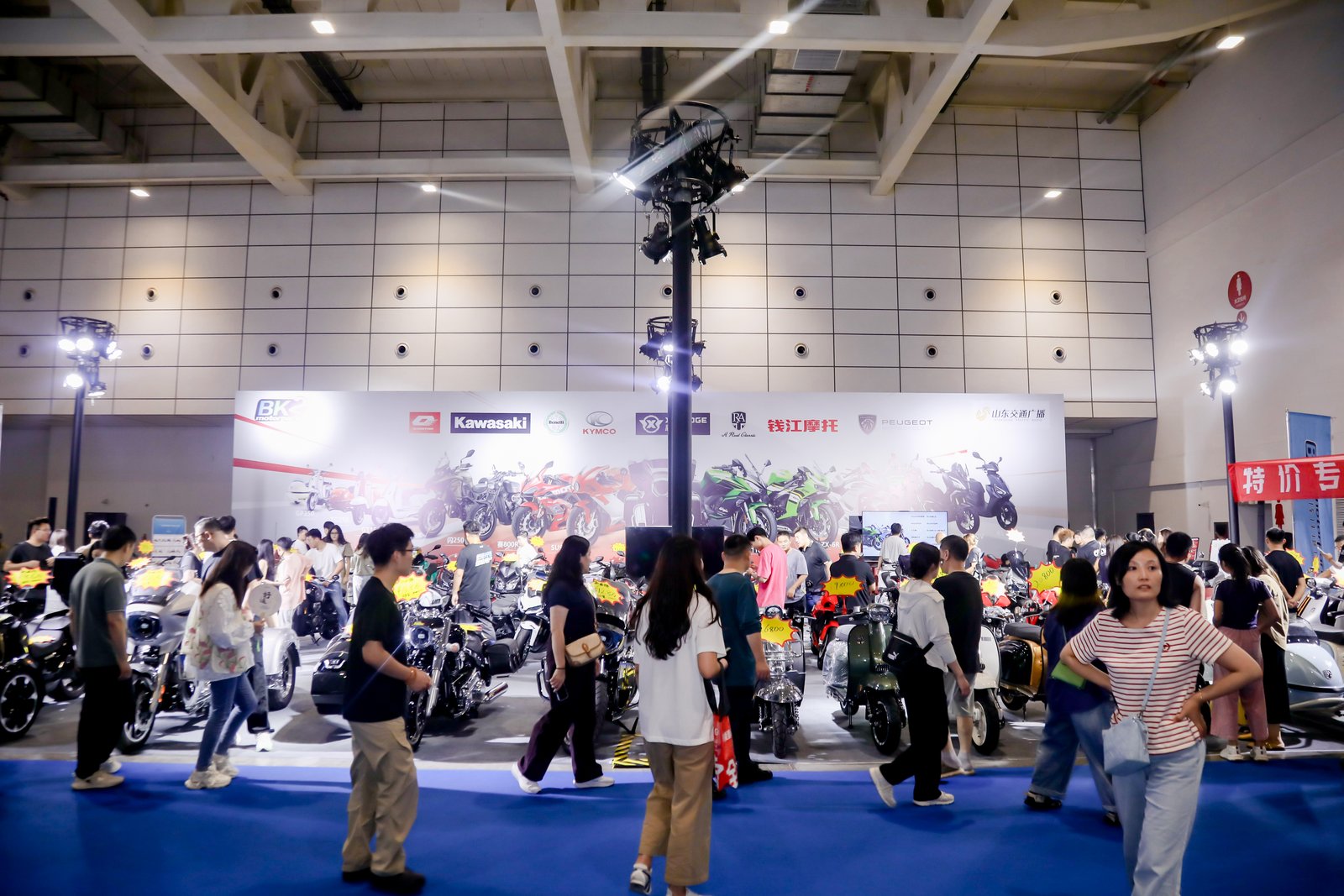
齐鲁晚报·齐鲁壹点记者 管悦 鹿青松 于泊升 张雪 朱洪蕾 9月7日,2025齐鲁秋季车展迎来周末客流量新一轮高峰,位于山东国际会展中心2号馆的摩托车展示区域格外热闹,街车、仿赛、踏板等热门车型齐聚,吸 引大量市民驻足体验、交流询价。 这一火热场景背后,是中国摩托车行业的转型。在细分领域深耕与智能化布局的推动下,摩托车已从传统通勤工具逐渐延伸至休闲、社交领域,呈现出年轻 化、智电化与国际化趋势,更成为年轻人彰显个性的生活方式载体。 追求"一车多用" 齐鲁车展的摩托车展台每日人流络绎不绝,销售气氛热烈,往往车展刚启幕,该展区便迅速聚集起高涨人气。不少消费者直奔心仪摩托车展车,与销售人员 深入沟通车辆性能、配置细节及优惠政策。记者询问发现,人群中既有刚考取驾照、筹备首辆摩托车的"新手车主",也有专程来看心仪车型的骑行爱好者, 一眼望过去,20-30岁区间的年轻面孔已成为消费主力。 "想找一辆既能城市通勤,又能周末跑山的车。"在川崎展区试坐的"95后"王先生道出了不少年轻消费者的需求。"摩托车通勤更灵活",作为刚步入职场的年 轻人,他选择摩托车不仅是为应对早晚高峰的拥堵,更看重其能拓展生活半径的属性,"周末和朋友一 ...

再见!保时捷燃油718正式停售,纯电版马上就到
3 6 Ke· 2025-09-06 23:50
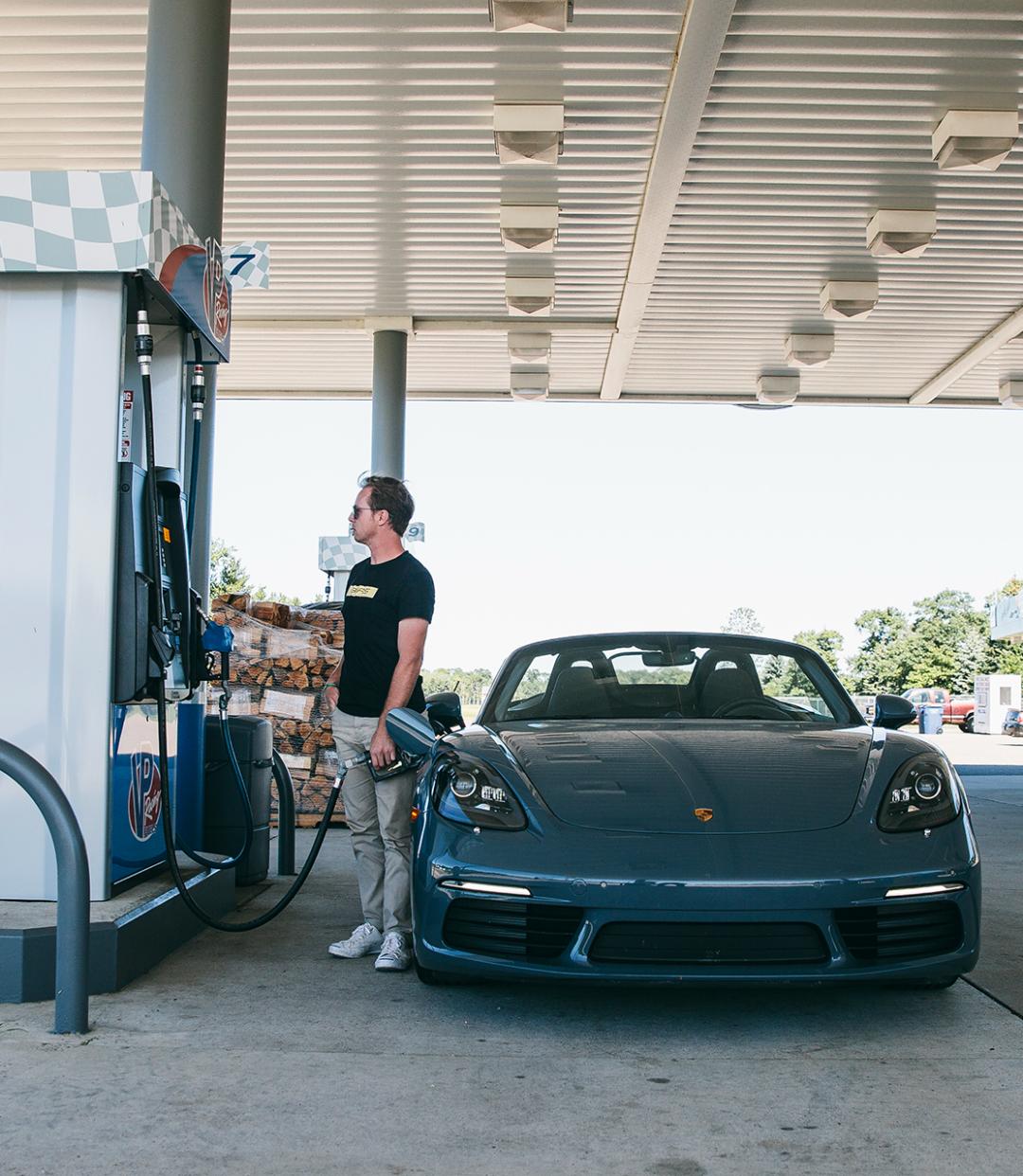
Core Insights - Porsche has officially closed the order channel for the gasoline versions of the 718 Boxster and Cayman globally, marking the end of an era for these models [2][4] - The decision aligns with the EU's stringent regulations that necessitate the withdrawal of gasoline models from the market, with production lines continuing to fulfill existing orders until 2026 [4][6] - The transition from gasoline to electric is not just a regulatory response but also a strategic pivot for Porsche, as the electric successor has faced delays due to supply chain issues [6][12] Group 1: Transition to Electric - The gasoline 718's discontinuation is primarily driven by the UN's Regulation No. 155, which mandates a comprehensive cybersecurity management system for vehicles [8][10] - Porsche's decision to abandon the costly modifications required to meet new regulations reflects a rational business strategy, redirecting resources to the development of the next-generation electric model [10][12] - The electric 718 is expected to be unveiled in 2025, with testing vehicles already spotted, indicating that Porsche is accelerating its development efforts [12][18] Group 2: Market Challenges - The automotive landscape has dramatically changed, particularly in China, where Porsche's sales have seen significant declines, with a nearly 9% drop globally and a 23% and 28% decrease in Germany and China, respectively [29][31] - The electric 718 will face intense competition from emerging high-performance electric vehicles from Chinese brands, which offer superior performance and design at lower prices [31][32] - The success of the electric 718 is critical not only for its technical performance but also for its ability to carve out a market presence amidst fierce competition [32][34]
宁德时代退出芬兰Valmet:电动化放缓与自主战略的双重博弈
高工锂电· 2025-09-06 12:22
Core Viewpoint - CATL has recently sold its 20.6% stake in Valmet Automotive, marking the end of its 8-year overseas investment, which reflects a strategic shift in its European ambitions and the completion of Valmet's "nationalization" [3][9]. Group 1: Valmet Automotive's Transition - Valmet has accelerated its battery system (EVS) business, with its battery module production line in Salo starting operations in 2019, achieving a production capacity of 800,000 units in 2023 and surpassing 2 million units cumulatively [4][5]. - In 2023, Valmet's EVS business revenue exceeded €1 billion for the first time, despite a 21.8% year-on-year decline in its traditional automotive contract manufacturing (VCM) revenue due to the termination of the Mercedes GLC production line in June 2022 [5][6]. Group 2: Market Challenges and Opportunities - The demand for fuel vehicles in Europe is declining, and while electric vehicle contract manufacturing has higher profit margins, Valmet faces insufficient new orders due to slower electrification progress and an overall downturn in the European automotive market [6]. - In 2024, European BEV sales are projected to be 1.993 million units, a 1.3% year-on-year decrease, with Finland's BEV sales dropping by 30.3% [6]. - Finland's electric vehicle average price remains higher than traditional fuel vehicles, and the country offers less subsidy and tax incentives compared to neighboring countries like Sweden and Denmark, impacting growth [6]. Group 3: Finland's Strategic Positioning - Finland is among the first countries to release a national battery strategy, focusing on building a complete value chain from raw materials to battery manufacturing and recycling [7]. - The extreme environment in Finland has driven battery technology innovation, and the high penetration of renewable energy is promoting large-scale energy storage [8]. - Valmet plans to spin off its battery business into a separate subsidiary, IONCOR, which will further enhance its position as a leading independent battery system supplier in Europe [8]. Group 4: Government Involvement and Future Prospects - The nationalization of Valmet reflects the Finnish government's intention to gain greater influence in the electrification sector, with the government already holding a 70% stake in IONCOR and committing an additional €20 million investment [9]. - Collaborative projects, such as the Keliber lithium project, aim to establish local production of battery-grade lithium hydroxide, providing essential materials for electric vehicle battery production [10]. Group 5: Implications for Chinese Enterprises - The strategic adjustments in Finland suggest that Chinese companies need to adopt more flexible strategies to enter the European market, including joint ventures and technology licensing to meet EU localization requirements [11][12]. - Long-term strategies should involve integrating compliance requirements into the entire lifecycle of product design, production, and recycling, as well as establishing R&D centers and brand ecosystems [12].
保时捷718不卖了,小网红们又要找新的座驾了
Hu Xiu· 2025-09-06 00:10
Core Viewpoint - Porsche's 718 gasoline version will be discontinued in October 2025, transitioning to an electric model, which may impact its current market appeal and customer base [4][42]. Group 1: Discontinuation of 718 - Porsche's 718 gasoline version will cease production in October 2025, as confirmed by Albrecht Reimold [4]. - Existing orders for the 718 will still be fulfilled, but new orders will be difficult to place after the discontinuation [5]. - The future 718 model is expected to follow the electric vehicle trend, similar to the Taycan [6]. Group 2: Market Position and Appeal - The 718 is considered an entry-level sports car for Porsche, but its performance and specifications may not attract wealthy buyers or those seeking value [11][12]. - The 718 has been popular among social media influencers and micro-business owners, often seen as a status symbol rather than a performance vehicle [16][18]. - The car's design and performance characteristics, such as its mid-engine layout and flat-six engine, contribute to its appeal, despite its mixed reputation [21][25]. Group 3: Historical Context and Financial Implications - The 718 name has historical significance, originating from the 718 RSK race car, and has been crucial for Porsche's financial recovery in the past [22][35]. - The introduction of the 718 aimed to reduce production costs by sharing components with the 911, making it more affordable [33]. - The 718's production was also a response to financial difficulties faced by Porsche in the early 1990s, where losses reached 2.4 billion German Marks (approximately 10 billion RMB) [31]. Group 4: Regulatory and Technological Challenges - New EU regulations on cybersecurity (UN R155) pose challenges for older gasoline models like the 718, as their electronic architecture does not meet the new standards [37][39]. - The cost of updating the 718's systems to comply with these regulations is nearly equivalent to developing a new vehicle, leading to the decision to discontinue the model [40]. - The shift to electric vehicles is seen as a necessary evolution for Porsche to remain competitive in the automotive market [51].
深蓝汽车人事调整:邓承浩升任董事长,姜海荣出任首席执行官
YOUNG财经 漾财经· 2025-09-05 11:11
Core Viewpoint - Deep Blue Automotive is undergoing significant leadership changes with Jiang Hairong appointed as CEO and Deng Chenghao elevated to Chairman, signaling a strategic focus on the integration of new energy and technology [2]. Group 1: Leadership Changes - Jiang Hairong, previously the Chief Marketing Officer for Honor in China, has joined Deep Blue Automotive as CEO, bringing extensive experience in global market branding and ICT product development [2][3]. - Deng Chenghao, the former CEO of Deep Blue Automotive, has been promoted to Chairman after serving in various leadership roles within Changan Automobile and Deep Blue Automotive [2]. Group 2: Strategic Focus - Deep Blue Automotive is committed to rapid and high-quality development in electrification and intelligence, reflecting its ambition in the new energy sector [2]. - The appointment of Jiang Hairong is seen as a strategic move to enhance the company's capabilities in the integration of new energy and technology [2].

拓邦股份(002139) - 002139拓邦股份投资者关系管理信息20250905
2025-09-05 09:06
Group 1: Impact of Tariffs and Globalization - The company has established a global production base in Vietnam, India, Mexico, and Romania to mitigate the direct impact of tariffs on exports, achieving growth in the tools segment despite adverse conditions [2][3] - Short-term cost increases may arise from fixed asset investments and cross-regional supply chain coordination, but mid to long-term strategies include passing reasonable cost pressures to downstream customers [3][4] - Companies with mature overseas production capabilities and resilient supply chains are expected to gain long-term trust from major clients and capture market share amid supply chain integration [3][4] Group 2: Electric Tools Market Trends - The electrification and cordless trends are driving the penetration rate of electric tools, with the company focusing on high-value industrial and professional-grade products [4][5] - The company aims to expand its customer base and product categories to generate new incremental contributions [4][5] Group 3: Smart Automotive Business Growth - The acceleration of smart automotive trends is expected to increase demand for intelligent modules, with the company implementing strategies to expand both customer and product offerings [5][6] - The company’s laser radar motors are positioned as key components for L2+ level smart driving systems, with a focus on high precision and reliability [6][7] Group 4: Commercial Cooking Machines - The company’s commercial cooking machines utilize advanced control algorithms for precise temperature control and intelligent frying, holding multiple industry patents [8][9] - The market potential for commercial cooking machines is expanding due to rising demands for efficiency and standardization in the restaurant industry, particularly with the entry of major players like Meituan and JD [8][9] Group 5: Robotics Sector Strategy - The company offers a range of products in the robotics sector, including components and complete machines, with a focus on industrial and commercial applications [10] - The commercial cooking robot has seen a doubling in shipment volume, driven by the demand for cost reduction and efficiency in the restaurant industry [10] - The company is positioned to capture market share in humanoid robotics by focusing on core components and validating products for specific applications [10]

宇通客车行业龙头地位稳固“电动化”前景广阔出口增量可期
Zhong Guo Jing Ji Wang· 2025-09-05 08:51
Core Viewpoint - Yutong Bus (600066.SH) reported a revenue of 16.129 billion yuan for the first half of 2025, with a net profit attributable to shareholders increasing by 15.64% to 1.936 billion yuan, indicating strong performance and market leadership in the bus industry [1] Group 1: Financial Performance - In the first half of 2025, Yutong Bus achieved a total bus sales volume of 21,321 units, a year-on-year increase of 3.73% [1][2] - The company has maintained its position as the industry leader in the production and sales of large and medium-sized buses [3] Group 2: Market Outlook - Analysts from Huatai Securities are optimistic about Yutong Bus's profit elasticity in the second half of the year, attributing profit growth to high-value bus exports and economies of scale [9] - Southwest Securities noted that Yutong Bus's overseas expansion is deepening, with expected growth in export sales [9] Group 3: Export and Global Presence - Yutong Bus has exported over 110,000 buses to more than 60 countries and regions, establishing a significant global footprint [4] - The company has achieved substantial sales in Europe, Africa, and Central Asia, with notable repeat orders from Norway and Greece [4] Group 4: New Energy Bus Development - Yutong Bus has exported over 8,000 new energy buses, contributing to global carbon reduction efforts [5] - The industry saw a year-on-year increase of 16.51% in the export volume of large and medium-sized buses, with continued growth expected in the second half of the year [5] Group 5: R&D and Innovation - In the first half of 2025, Yutong Bus invested 746 million yuan in R&D, accounting for 4.63% of its revenue, reflecting a strong commitment to innovation [7] - The company focuses on key technologies such as electric drive, control, and battery systems, driving high-quality development across its product lines [8] Group 6: Shareholder Returns - Yutong Bus has distributed a total of 27.13 billion yuan in dividends over its 28 years of listing, with a cumulative dividend payout ratio of 76.7% [6][7] - The company ranks second in dividend yield among A-share listed companies [7]

宇通客车(600066)点评:8月出口交付加速带动环比高增 三季度业绩提升预期增强
Xin Lang Cai Jing· 2025-09-05 04:33
Group 1 - The company reported a significant increase in bus sales for August 2023, achieving 4,260 units sold, which represents a year-on-year growth of 16.8% and a month-on-month increase of 32.3% [1] - The production for August was 4,165 units, showing a slight decline of 0.6% year-on-year but an increase of 8.2% month-on-month [1] - Cumulative sales from January to August reached 29,000 units, reflecting a year-on-year growth of 4.5%, indicating a continuous expansion in sales momentum [1] Group 2 - The company has successfully tested its new generation pure electric intercity bus IC12E in Italy, marking its entry into the European electric intercity bus market [2] - The IC12E has been delivered to the V.I.T.A. transport company in Italy and is now in operation, contributing to the company's comprehensive electric product matrix [2] - The company signed four cooperation agreements in Chile, totaling over 300 million RMB, further solidifying its presence in the Latin American market [2] Group 3 - Revenue forecasts for the company from 2025 to 2027 are projected to be 43.04 billion, 52.74 billion, and 61.94 billion RMB, respectively, with net profits expected to be 4.90 billion, 6.22 billion, and 7.62 billion RMB [3]
透视全球车企财报 看懂中国车企的弯道超车
2 1 Shi Ji Jing Ji Bao Dao· 2025-09-04 15:48
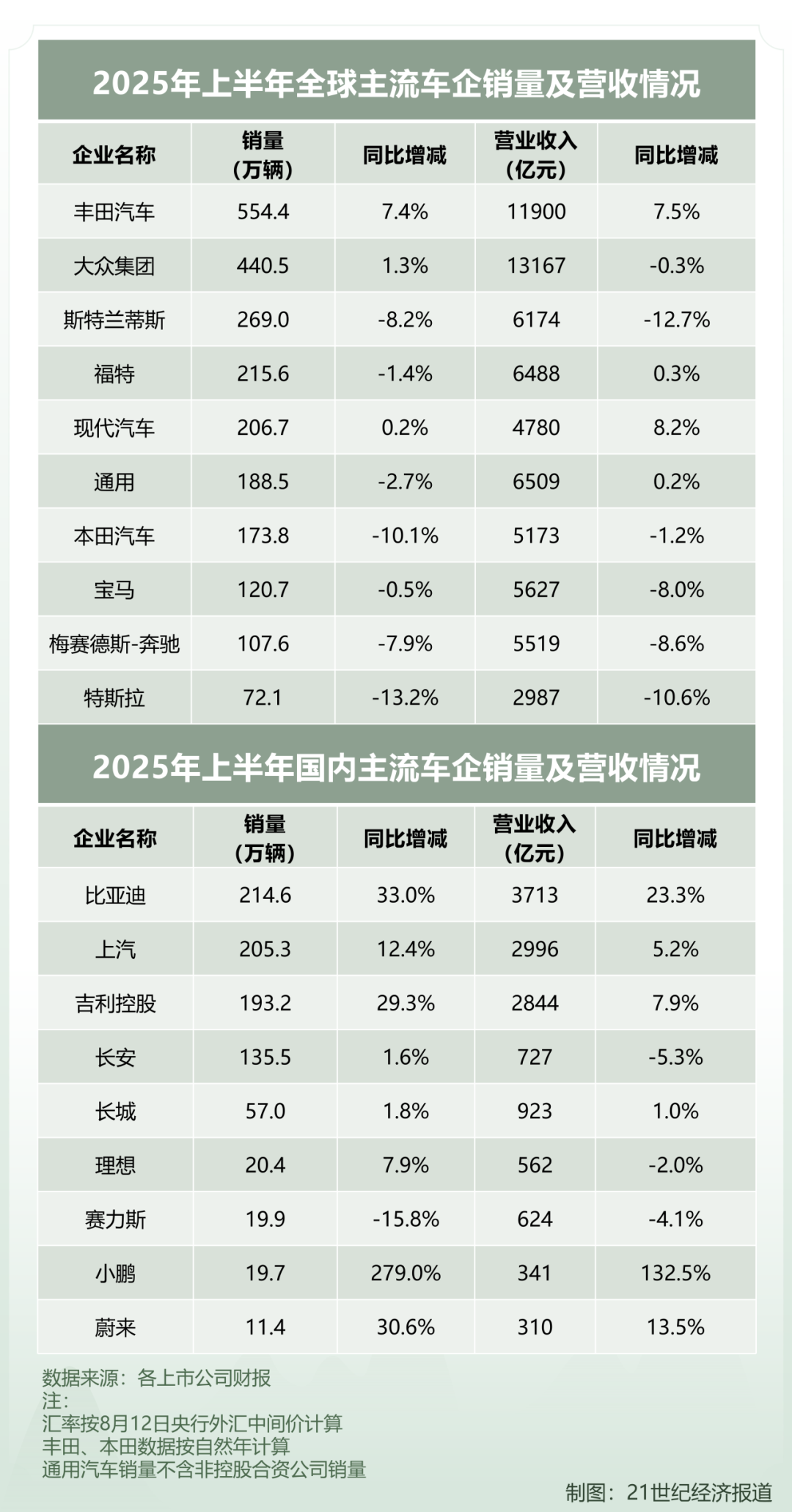
Core Insights - The global automotive industry is witnessing a shift, with Chinese automakers transitioning from technology followers to market leaders, driven by innovations in electrification and intelligence [1][7] - While many overseas automakers face stagnation or decline, Chinese companies are experiencing growth, particularly in sales and revenue [2][7] Sales and Revenue Performance - Chinese automakers are closing the gap with overseas giants in terms of sales and revenue, with significant growth rates [2] - In the first half of 2025, major global automakers like Toyota and Volkswagen reported modest sales growth of 7% and 1%, respectively, while several others, including Stellantis and Tesla, experienced declines [3][7] - In contrast, leading Chinese companies such as BYD and SAIC reported substantial sales increases, with BYD achieving a 33% rise in sales [4][7] Profitability and R&D Investment - Overseas automakers are facing significant profit declines, with companies like Toyota and Volkswagen seeing net profit drops of over 30%, while Ford's profit fell by 86% [12] - Chinese automakers, particularly BYD, have shown resilience in profitability, with BYD's net profit increasing by 14% [12] - R&D investments are rising among both domestic and international players, with BYD's R&D spending increasing by 53%, the highest among the top ten global automakers [13] Debt and Financial Health - Chinese automakers are actively optimizing their debt structures, with companies like BYD and Changan reducing their debt ratios, indicating a shift towards lower leverage and enhanced financial stability [17] - A healthier debt structure allows these companies to invest more in R&D and technology, supporting sustainable growth [17]