基建投资

Search documents
2025年11月PMI分析:出口仍在带动生产
Yin He Zheng Quan· 2025-11-30 06:58
Group 1: PMI and Economic Indicators - The manufacturing PMI for November 2025 is 49.2%, an increase of 0.2 percentage points from the previous month, indicating an improvement in economic conditions[1] - The production index rose to 50% from 49.7%, returning to the expansion zone, while the new orders index increased to 49.2% from 48.8%[2] - The new export orders index improved significantly by 1.7 percentage points to 47.6%, suggesting a recovery in external demand[2] Group 2: Price and Inventory Trends - The purchasing price index for raw materials rose by 1.1 percentage points to 53.6%, while the factory price index increased by 0.7 percentage points to 48.2%[3] - The inventory index for finished products decreased by 0.8 percentage points to 47.3%, indicating a passive destocking trend among enterprises[4] - Raw material inventory remained stable at 47.3%, while procurement volume increased by 0.5 percentage points to 49.5%[4] Group 3: Sector Performance - The construction industry index rose by 0.5 percentage points to 49.6%, driven by year-end project completions[6] - The service industry index fell by 0.7 percentage points to 59.5%, reflecting a seasonal decline in consumer-related services[6] - Significant increases in export orders were noted in textiles, non-metallic minerals, general equipment, pharmaceutical manufacturing, and non-ferrous metals[2]
基建投资有望带动机械设备需求,机床ETF(159663)涨1.15%
Sou Hu Cai Jing· 2025-11-28 06:28
Group 1 - The core viewpoint is that the CNC machine tool market in China is experiencing rapid growth driven by downstream demand, with a projected market size of approximately 432.5 billion yuan in 2024 and expected to exceed 450 billion yuan by 2025 [1] - The domestic production rate of high-end CNC machine tools is only 6%, indicating significant room for domestic production growth in this segment [1] Group 2 - Increased policy support is expected to boost equipment demand, particularly with infrastructure investments, such as the commencement of the Yaxia hydropower project, which will drive demand for large excavators and other equipment [2] - The internationalization, electrification, and intelligentization processes are advancing, with electric loader sales increasing by 157.2% year-on-year, and intelligent applications like unmanned forklifts and mining equipment are anticipated to break through first [2] - The nuclear fusion industry is entering a phase of capital expenditure expansion, focusing on high-value components such as magnet systems, vacuum chambers, and power systems [2] - The low-altitude economy policy emphasizes safety, health, and high-quality development, with a positive outlook on infrastructure construction and low-altitude equipment research and application [2]

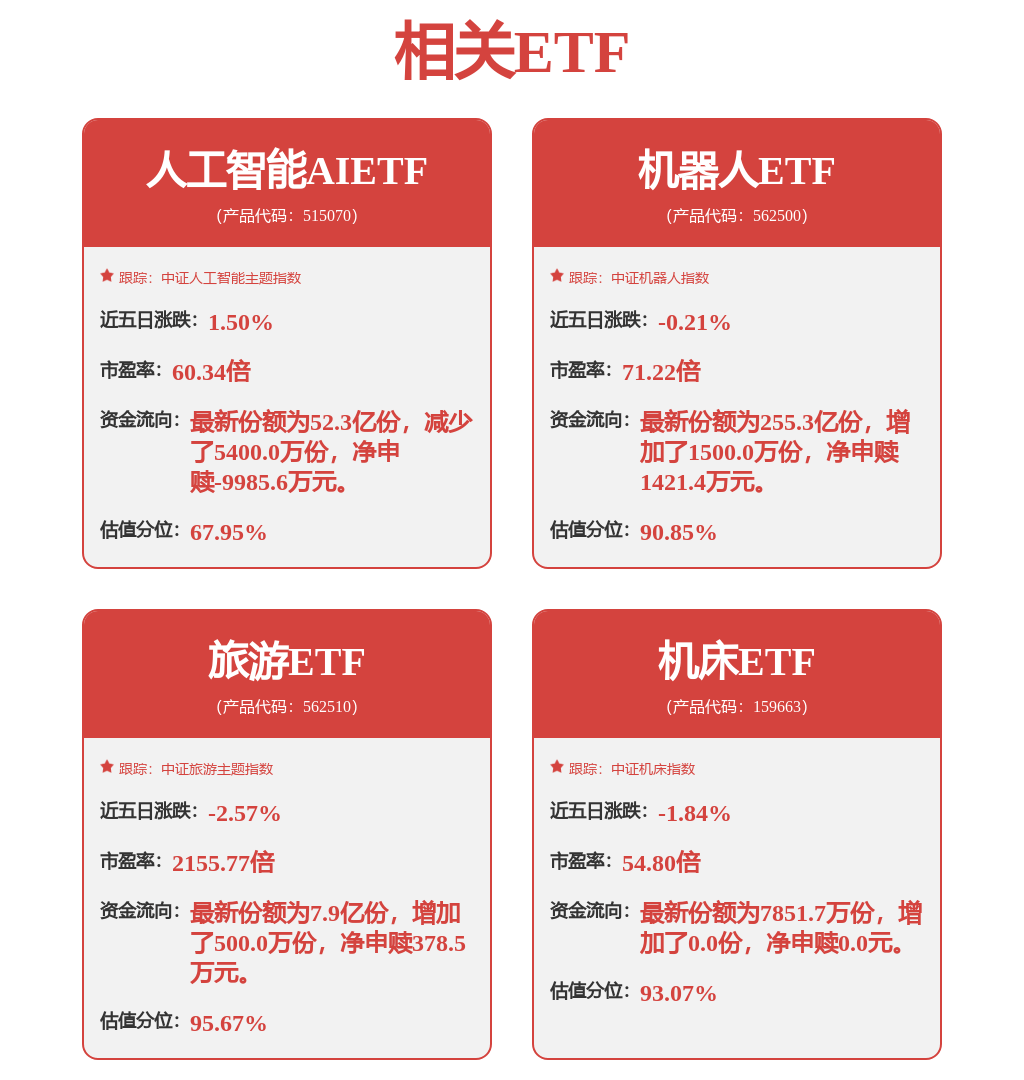
工业母机ETF(159667)盘中涨超1.4%,政策支持力度加大,基建投资有望带动设备需求
Mei Ri Jing Ji Xin Wen· 2025-11-27 07:00
Core Viewpoint - The article highlights the increasing policy support for infrastructure investment, which is expected to drive equipment demand, particularly for large excavators due to the commencement of the Yaxia Hydropower Project [1] Group 1: Infrastructure Investment and Equipment Demand - Enhanced policy support is anticipated to boost infrastructure investment, leading to increased demand for equipment [1] - The initiation of the Yaxia Hydropower Project is expected to further stimulate the demand for large excavators and related machinery [1] Group 2: Industry Trends - The internationalization, electrification, and intelligentization processes are advancing, with electric loader sales experiencing a year-on-year growth of 157.2% [1] - Intelligent applications such as unmanned forklifts and unmanned mining are expected to achieve breakthroughs [1] Group 3: Capital Expenditure in Fusion Industry - The nuclear fusion industry is entering a phase of capital expenditure expansion, with a focus on high-value components such as magnet systems, vacuum chambers, and power systems [1] Group 4: Low-altitude Economy - Policies related to the low-altitude economy emphasize safety, health, and high-quality development, with optimism surrounding infrastructure construction and low-altitude equipment research and application [1] Group 5: ETF Overview - The Industrial Mother Machine ETF (159667) tracks the China Securities Machine Tool Index (931866), which selects 50 listed companies involved in machine tool manufacturing and key component supply, covering various manufacturing sectors [1]
瑞银中国首席经济学家汪涛:地方融资应做到“堵后门”和“开前门”并举
Mei Ri Jing Ji Xin Wen· 2025-11-24 04:09
Core Viewpoint - The infrastructure investment in China has shown a year-on-year growth of 7.3% in the first half of 2018, but the growth rate has decreased by 2.1 percentage points compared to the first five months of the year. There is a need for local governments to increase the issuance of debt and special bonds to avoid hidden financing methods while controlling local government debt [1][2]. Group 1: Financing Situation - The tightening of financing platforms and local government financing has led to a noticeable decline in infrastructure investment growth. Although bank loan growth remains strong, off-balance-sheet and entrusted loans have decreased, indicating a tighter control in line with deleveraging measures [2]. - The control of local government debt is deemed necessary to reduce financial risks, but it is essential to balance this with the normal financing needs of local governments, especially for infrastructure projects [2]. Group 2: Measures for Increasing Debt Issuance - To effectively "open the front door" for financing, it is suggested to narrow the channels for shadow credit and expand financing sources for local governments. The issuance of corporate bonds and local government bonds, including special bonds, is expected to increase in the second half of the year [3]. - The approved scale for new local government bonds this year is 2.18 trillion yuan, with only over 300 billion yuan issued by mid-year, indicating significant room for increased issuance [3].
国泰海通:预计2026年狭义财政赤字率仍需突破4%,新增地方专项债或在4.6万亿左右
Sou Hu Cai Jing· 2025-11-23 06:25
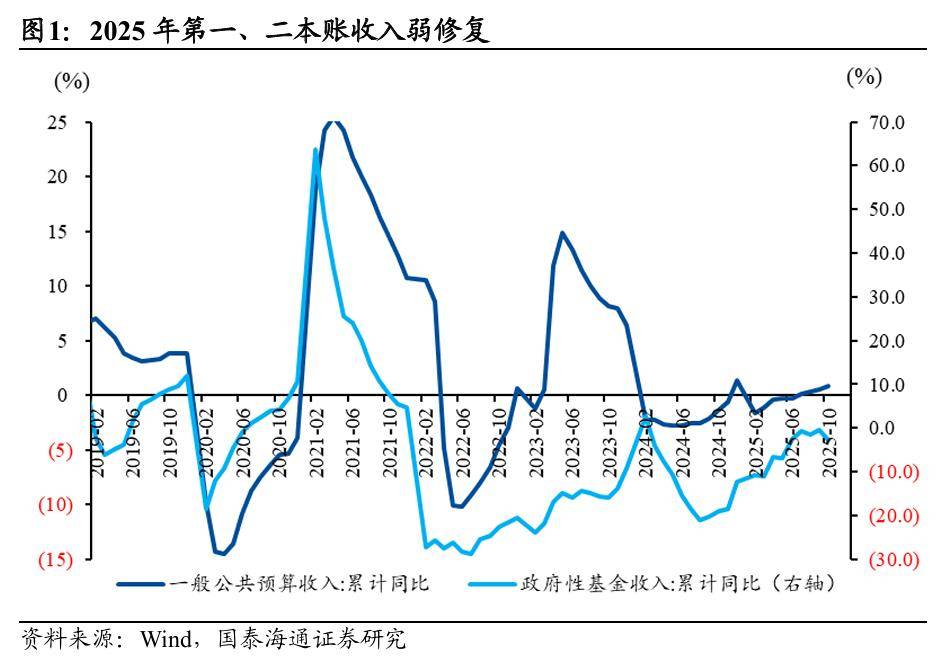
Core Viewpoint - The fiscal policy for 2026 will focus on promoting stable growth, improving people's livelihoods, and managing risks under the "15th Five-Year Plan," with a projected narrow fiscal deficit rate exceeding 4% and new local special bonds around 4.6 trillion yuan [1][5][43]. Group 1: Fiscal Policy Characteristics - The core feature of China's fiscal policy in 2025 is a shift towards a "people-oriented" expenditure structure, which is reflected in the resilience of consumption and the decline in infrastructure investment since July [1][5]. - On the revenue side, there is a weak recovery in the two accounts, with tight constraints still present. The income from individual income tax and securities transactions has improved, while land transfer income has seen a narrowing decline [5][11]. - On the expenditure side, there is a moderate expansion in total fiscal spending, with a structural shift towards social welfare. The central government's financial support is increasing, but the alignment of financial resources and responsibilities still needs optimization [1][11][15]. Group 2: Key Tasks for 2026 - The fiscal policy for 2026 will focus on three key tasks: promoting the synergy between social welfare and consumption incentives, addressing the slowdown in external demand, and resolving funding constraints for infrastructure investment [1][21][22]. - Policies such as trade-in programs and childbirth subsidies are expected to continue and be enhanced, with a focus on service consumption, projecting a retail sales growth rate of around 4.5% [2][25]. Group 3: Infrastructure Investment and Debt Management - For infrastructure investment and debt management, it is essential to clarify the scale and path of debt management funding, with an estimated need for around 3 trillion yuan in special bonds for debt management and clearing overdue accounts in 2026 [3][29]. - The pressure of interest payments after debt replacement is expected to be manageable due to a low-interest environment, which will help offset the visible interest payment pressure [3][37]. - The growth rate of infrastructure investment is projected to be around 3.5% in 2026, influenced by the constraints of debt management and the pursuit of effective investment [3][41]. Group 4: Fiscal Data Projections for 2026 - The growth rate of broad fiscal spending is expected to be around 4.6%, with a narrow fiscal deficit rate still needing to exceed 4%, and new local special bonds projected at approximately 4.6 trillion yuan [5][43][49]. - The general public budget revenue growth rate is estimated at about 1%, while government fund revenue is expected to decline by around 5% [43][46].

经观月度观察|“稳中求进”基调不变 重点转向激发内需与修复工业品价格
Jing Ji Guan Cha Bao· 2025-11-21 14:49
Core Insights - The macroeconomic data for October indicates a short-term increase in economic downward pressure, with a focus on stimulating domestic demand and repairing industrial product prices while maintaining the overall principle of "seeking progress while maintaining stability" [1] CPI - The Consumer Price Index (CPI) rose to 0.2% in October from -0.3% in the previous month, marking a 0.5 percentage point increase [2] - The month-on-month increase was 0.2%, up 0.1 percentage points from the previous month, driven by rising prices of fruits and vegetables [2] PPI - The Producer Price Index (PPI) decreased by 2.1% year-on-year in October, improving from a decline of 2.3% in September, with the mining sector providing significant support [3] - The prices of production materials increased by 0.1%, with mining prices up by 1% [3] PMI - The Manufacturing Purchasing Managers' Index (PMI) fell to 49% in October from 49.8% in September, indicating a contraction in manufacturing activity [4] - The decline in PMI is attributed to high inventory levels, a weakening demand structure, and reduced investment demand due to accelerated debt repayment [5] Fixed Asset Investment - Fixed asset investment (FAI) decreased by 1.7% year-on-year in October, worsening from a decline of 0.5% in September [6] - The decline in infrastructure investment is influenced by multiple factors, including accelerated debt repayment and insufficient project reserves [6] Credit - New credit issuance in October was 220 billion yuan, a decrease of 280 billion yuan compared to the same period last year [7] - The total social financing (TSF) increased by 815 billion yuan, but the growth rate has slowed down [7] M2 - The M2 money supply grew by 8.2% year-on-year in October, down from 8.4% in September, influenced by a rebound in fiscal deposits [8] - The central government allocated 500 billion yuan to local governments to support effective investment and address existing debt issues [9]
Nano Banana Pro 之后,谷歌 CEO Pichai 要的不是“好看”,是好用
3 6 Ke· 2025-11-21 00:57
Core Insights - Google CEO Sundar Pichai envisions a future where AI transitions from dialogue to completing real tasks, exemplified by the launch of Nano Banana Pro (Gemini 3 Pro Image), which serves as an AI workstation capable of data processing and task completion rather than just image creation [1][3][11] - Pichai emphasizes that the current AI investment wave is not a bubble but a rational, unprecedented infrastructure investment, with Google alone spending over $90 billion this year on AI infrastructure, contributing to an industry total exceeding $1 trillion [7][9][26] - To make AI truly useful, Google must address three key challenges: energy consumption, copyright issues, and trust in AI outputs [25][30] Group 1: AI Transition and Product Development - The focus of AI is shifting from conversation to action, with expectations that AI will perform more complex tasks in the next 12 months [12][13] - Nano Banana Pro represents a significant shift in the role of image AI, moving beyond mere inspiration to becoming a comprehensive tool that integrates with Google Search and other applications [3][20] - Pichai's goal is to create tools that are not just visually appealing but practically useful, enabling users to accomplish tasks efficiently [4][8] Group 2: Infrastructure Investment - Pichai describes the current AI investment phase as a "building endurance race," with a focus on substantial infrastructure development [5][6] - The industry is investing heavily in AI infrastructure, with Google leading the charge, indicating a long-term commitment to building foundational capabilities [7][9] - This investment is seen as a necessary step to meet real customer demands, which are currently outpacing the industry's ability to fulfill them [6][10] Group 3: Challenges Ahead - The first challenge is energy consumption, with Pichai acknowledging that data centers' energy use could surpass that of entire countries, while Google aims for net-zero carbon by 2030 [26][27] - The second challenge involves copyright, as Pichai discusses the need for a framework that respects content creators while training AI models [28][29] - The third challenge is trust, where Pichai highlights the importance of ensuring AI-generated information is accurate and reliable, integrating AI with Google Search to enhance credibility [30][31] Group 4: Future of Image AI - Nano Banana Pro aims to transform how users interact with images, making it a gateway rather than a standalone application [20][24] - The tool is designed to assist users in expressing complex information clearly and efficiently, thereby enhancing productivity [23][32] - Pichai's vision for Nano Banana Pro is to enable users to navigate complex data with ease, making AI a practical tool for everyday tasks [32][33]

德国通过一项突破性财政改革,“5000亿基建基金”吸引在德中企关注
Huan Qiu Shi Bao· 2025-11-20 22:42
Group 1 - Germany has established a groundbreaking infrastructure fund worth €500 billion to address economic challenges, marking the largest investment project in decades [1] - A survey conducted by the German Chamber of Commerce in China and KPMG revealed that 40% of Chinese enterprises in Germany see new business opportunities arising from this fund [1] - Key areas of interest for Chinese companies include digitalization (51%), energy (48%), and electric vehicles (35%) [1] Group 2 - Despite the fund's potential, actual investments have been limited, with only 15% of surveyed Chinese companies seeking partnerships in Germany and 10% planning to participate in public tenders [1] - High labor costs and strict labor regulations are viewed as the biggest challenges by 73% of respondents, while 53% cite regulatory complexity as a serious issue [1] - The fund's implementation has been criticized for slow progress and potential misallocation of resources, raising concerns about trust in fiscal policy [2]
国泰海通|宏观:财政将如何发力——2026年财政政策展望
国泰海通证券研究· 2025-11-20 12:46
Core Insights - The article emphasizes that the fiscal policy in the first year of the "14th Five-Year Plan" will focus on balancing active and sustainable requirements to promote stable growth, improve people's livelihoods, and mitigate risks [1][2] Fiscal Policy Overview - In 2026, the narrow fiscal deficit rate is expected to exceed 4%, with new local special bonds around 4.6 trillion and long-term special government bonds issued at approximately 1.5 trillion [1][3] - The core feature of China's fiscal policy in 2025 is a shift in expenditure structure towards "people's livelihood," which is linked to the resilience of consumption and the decline in infrastructure investment since the third quarter [2] Revenue and Expenditure Dynamics - On the revenue side, there is a weak recovery in the two accounts, with continued tight constraints [2] - On the expenditure side, broad fiscal spending is expected to moderately expand, with a structural shift towards social welfare and a decline in infrastructure investment contributing to a drag of at least 2 percentage points [2][3] Key Tasks for 2026 - The fiscal policy will focus on three key tasks: 1. Promoting the synergy between social welfare and consumption incentives 2. Addressing the growth continuity issues due to external demand slowdown 3. Resolving funding constraints for infrastructure investment [2] Infrastructure Investment and Debt Management - For infrastructure investment and debt management, three key questions need to be clarified: 1. The scale and path of debt management funding, with around 3 trillion in special bonds needed for debt management and clearing [3] 2. The potential increase in interest payment pressure post-debt replacement, which may rise but remain manageable due to a low interest rate environment [3] 3. The funding sources and performance of infrastructure investment, with an expected growth rate of around 3.5% in 2026 [3] Overall Fiscal Growth Projections - The overall growth rate of broad fiscal spending is projected to be around 4.6% in 2026, with the narrow fiscal deficit rate needing to exceed 4% [3]

中国铁建(601186):2025三季报点评:Q3 归母净利润增 8.3%,海外订单快速增长
GUOTAI HAITONG SECURITIES· 2025-11-20 10:00
Investment Rating - The report maintains a rating of "Buy" for China Railway Construction Corporation (CRCC) [3][9]. Core Views - The report highlights a significant reduction in net cash outflow from operating activities and a rapid increase in overseas orders, indicating strong demand in the infrastructure sector [2][5]. - The forecast for EPS has been adjusted downward for 2025-2027, now projected at 1.55, 1.56, and 1.59 yuan, reflecting a decrease of 5.0% for 2025 [3][4]. - The target price is set at 12.04 yuan, based on a PE ratio of 7.8 times for 2025 [3][9]. Financial Performance Summary - For Q1-Q3 2025, the net profit attributable to shareholders was 14.8 billion yuan, a decrease of 5.6% year-on-year, while revenue fell by 3.9% to 728.4 billion yuan [4][5]. - The gross profit margin for Q1-Q3 2025 was 8.77%, down 0.39 percentage points, with a net profit margin of 2.03% [4][6]. - The company reported a significant increase in accounts receivable, which rose by 20.2% year-on-year to 246.16 billion yuan [4][5]. Order and Contract Insights - New contracts signed in Q1-Q3 2025 totaled 1.5188 trillion yuan, a year-on-year increase of 3.1%, with overseas contracts surging by 94.5% [5][19]. - The report notes that the company has a strong presence in various infrastructure sectors, including railways, highways, and airports, with significant growth in new contracts for these areas [5][6]. Valuation Metrics - The current dividend yield is 3.8%, with a PB ratio of 0.39, indicating a low valuation compared to historical levels [2][6]. - The report provides a comparison of CRCC's valuation metrics with peers, showing a PE of 5.1 for 2025, which is below the industry average [3][22].