
多品牌战略

Search documents
百胜中国(9987.HK):同店及利润率表现强韧 门店扩张优质
Ge Long Hui· 2025-11-11 13:25
Core Insights - The company reported Q3 2025 operating performance with revenue of $3.206 billion, a year-on-year increase of 4%, and adjusted net profit of $282 million, a year-on-year decrease of 5% [1] - Same-store and restaurant profit margins continued to show strong performance, with rapid store openings; KFC's store opening speed reached a historical high by Q3 this year, and Pizza Hut surpassed 4,000 stores [1][2] - The company is steadily advancing shareholder returns and model iteration, enhancing core brand competitiveness [1][3] Financial Performance - Q3 2025 system sales increased by 4% year-on-year, driven by a 4% net new store contribution and same-store sales growth [1] - Same-store sales grew by 1%, with same-store transaction volume increasing by 4%, marking the 11th consecutive quarter of growth [1] - Core operating profit reached $399 million, up 8% year-on-year, with a core operating profit margin of 12.5%, an increase of 0.4 percentage points year-on-year [2] Restaurant Performance - Restaurant profit margin was 17.3%, up 0.3 percentage points year-on-year, primarily due to reduced costs in food, packaging, rent, and other operating expenses [2] - KFC's restaurant profit margin was 18.5%, up 0.2 percentage points, while Pizza Hut's was 13.4%, up 0.6 percentage points [2] - Delivery sales increased by 32% year-on-year, accounting for 51% of restaurant revenue, with digital order revenue making up 95% [2] Store Expansion - The company maintained a rapid store expansion pace, with a net addition of 536 stores in Q3 2025, a year-on-year increase of 22.4% [2] - KFC's store opening speed reached a historical high, and the company exceeded its original plan with over 1,800 K Coffee stores [2] - The KPRO brand, focusing on energy bowls and superfood smoothies, has opened over 100 locations in high-tier cities [2] Membership and Sales - The combined membership for KFC and Pizza Hut reached approximately 575 million, a year-on-year increase of 13% [2] - Membership sales accounted for 57% of the total system sales for KFC and Pizza Hut [2] Future Outlook - The company plans to add approximately 1,600 to 1,800 new stores in 2025, with franchise stores expected to account for 40%-50% of KFC's and 20%-30% of Pizza Hut's new stores [3] - Capital expenditure for the 2025 fiscal year is projected to be between $600 million and $700 million, with stable expectations for shareholder returns [3] - The company anticipates achieving net profits of $928 million, $1.002 billion, and $1.071 billion for the years 2025 to 2027, with current stock prices corresponding to PE ratios of 17X, 16X, and 15X respectively [3]
老板电器(002508):Q3收入与利润均实现增长,盈利能力持续增强
Changjiang Securities· 2025-11-09 23:30
Investment Rating - The investment rating for the company is "Buy" and is maintained [7]. Core Insights - In the first three quarters of 2025, the company achieved operating revenue of 7.312 billion yuan, a year-on-year decrease of 1.14%. The net profit attributable to the parent company was 1.157 billion yuan, down 3.73% year-on-year. The net profit excluding non-recurring items was 1.060 billion yuan, a decrease of 1.37% year-on-year. In Q3 2025, the company reported operating revenue of 2.704 billion yuan, a year-on-year increase of 1.42%, and a net profit of 446 million yuan, up 0.65% year-on-year [4][11]. Summary by Sections Financial Performance - For the first three quarters of 2025, the company's gross margin was 51.80%, an increase of 1.37 percentage points year-on-year. In Q3 2025, the gross margin was 54.12%, up 0.94 percentage points year-on-year. The operating profit for the first three quarters was 1.140 billion yuan, a year-on-year increase of 3.15%, with an operating profit margin of 15.59%, up 0.65 percentage points year-on-year [11][16]. Market Strategy - The company has optimized its channels and implemented a multi-brand strategy, which has begun to show results. The company is focusing on retail channels while reducing high-risk engineering channel business. The overseas market has also performed well, mitigating the impact of the decline in engineering channels. The product matrix includes high, medium, and low-end products under the brands "Boss," "Mingqi," and "Xingchen," effectively addressing diverse consumer needs [11][16]. Future Outlook - The company is expected to explore new product directions, including dishwashers and integrated stoves, leveraging its channel resources to further open up incremental markets. The projected net profits attributable to the parent company for 2025-2027 are 1.662 billion, 1.747 billion, and 1.847 billion yuan, corresponding to PE ratios of 11.12, 10.58, and 10.00 times, respectively [11][16].

上美股份(2145.HK):2026年度投资峰会速递-韩束维持快增 多品牌势能强劲
Ge Long Hui· 2025-11-07 22:05
Core Insights - The company presented at the 2026 strategy meeting, focusing on the main brand Han Shu's category positioning, structural changes, and future expansion directions, along with updates on multiple brand incubations and overseas plans [1] Brand Performance - The main brand Han Shu continues to grow rapidly, with the GMV of the Hongbai Wan Yao product set optimized to below 50% in October, and the annual GMV proportion of secondary products nearing 15% [1] - The company is diversifying its product structure, with men's, personal care, body, and makeup categories accounting for approximately 20% of GMV [1] - Future expansions include new product series for the Hongbai Wan Yao set, continuous exploration of new ingredient additions for secondary products, and promising collaborations in the makeup category [1] Multi-Brand Development - New brands such as Newpage, Juguangbai, Anminyou, and Jifang show strong potential for growth, with Newpage achieving over 100 million GMV in October and aiming for 800-1,000 million for the full year [2] - Juguangbai reached around 30 million GMV in October and has achieved profitability, while Anminyou's GMV approached 40 million with significant profit margin improvements [2] - The company emphasizes maintaining profitability through refined operations and efficient investment flow [2] Organizational Efficiency - The company adopts a strategy of attracting top talent and building a strong organizational culture, which supports the incubation of differentiated multi-brands [3] - A robust self-broadcasting system has been established, with nearly 85% self-broadcasting ratio achieved in 2025, indicating high operational precision [3] - The company possesses a self-owned supply chain that is highly automated, cost-effective, and exhibits significant economies of scale [3] International Expansion - The company is steadily advancing its overseas strategy, with plans to enter the Indonesian market in 2026, leveraging local operations and the brand's competitive pricing and content marketing capabilities [3] - The new spokesperson Wang Jiaer is expected to enhance brand recognition in Southeast Asia [3] Financial Forecast and Valuation - The company maintains its net profit forecasts for 2025-2027 at 1.101 billion, 1.379 billion, and 1.717 billion respectively, with corresponding EPS of 2.77, 3.46, and 4.31 [4] - The company is assigned a target price of 121.67 yuan based on a 32x PE for 2026, reflecting the stable growth of the main brand and validated operational capabilities [4]
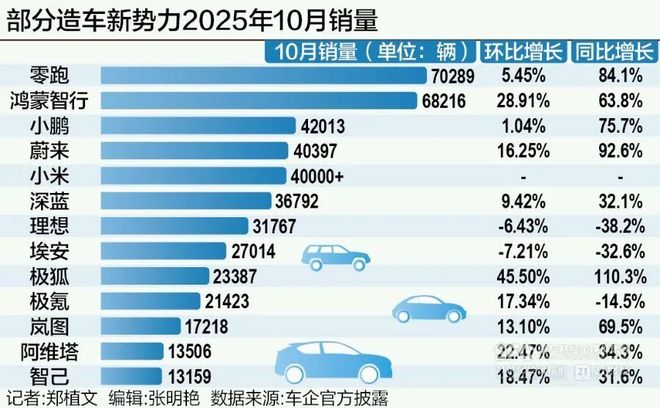
零跑首次月销破7万辆,理想销量下滑寻纯电突破
Xin Lang Cai Jing· 2025-11-07 12:10
Core Insights - Overall sales in October showed positive trends, with some brands achieving historic breakthroughs while others faced growth bottlenecks [1] - Leap Motor's sales stood out with approximately 70,200 units delivered, marking an 84% year-on-year increase, and it was the first time the company surpassed 70,000 monthly sales [1][2] - Traditional automakers also demonstrated steady performance in the new energy vehicle sector, with BYD selling over 440,000 units in October and a cumulative total of over 3.7 million units from January to October [1] Group 1: Company Performance - Leap Motor's success is attributed to the strong performance of its C11 and C10 models, which account for 70% of deliveries in the 150,000 to 200,000 yuan price range [2] - Xpeng and NIO maintained stable sales around 40,000 units, with NIO achieving a 92.6% year-on-year growth and surpassing 40,000 monthly sales for the first time [1][2] - Li Auto faced challenges with a significant decline in sales, delivering only about 31,700 units in October, a nearly 40% year-on-year drop [1][3] Group 2: Market Trends - The market for range-extended vehicles has shifted from a "blue ocean" to a "red ocean," with a notable decline in sales growth for these vehicles [3] - The cancellation of free green plates for range-extended vehicles in major cities has impacted demand, indicating a clear market turning point [3] - The multi-brand strategy has become a mainstream trend in the new energy vehicle market, allowing leading brands to capture various market segments while reducing R&D costs through technology sharing [6] Group 3: Future Outlook - Li Auto is focusing on upgrading its range-extended vehicles to compete in the pure electric market, aiming to create a popular model for family users [4] - The introduction of the i6 model at a competitive price point of 249,800 yuan aims to fill the gap in the family-oriented pure electric SUV market [5] - Brands like NIO and BYD are leveraging their sub-brands to enhance user engagement and brand loyalty, with NIO's sub-brand Lada achieving significant sales growth [5][6]
上美股份(02145):2026年度投资峰会速递:韩束维持快增,多品牌势能强劲
HTSC· 2025-11-06 07:37
Investment Rating - The report maintains a "Buy" rating for the company with a target price of HKD 121.67 [7]. Core Insights - The main brand, Han Shu, continues to grow rapidly, with the GMV of the Hongbai waist set products optimized to below 50% in October, and the annual GMV of the secondary products category nearing 15% [2]. - The company has a strong multi-brand potential, with significant growth expected from brands like Newpage, 聚光白, 安敏优, and 极方, contributing to overall revenue growth [3]. - The organization is efficient and flexible, with a robust online capability and a well-structured team that supports the continuous incubation of differentiated multi-brands [4]. - The overseas expansion is progressing steadily, with plans to enter the Indonesian market in 2026, leveraging local strategies and the brand's competitive advantages [4]. Summary by Sections Brand Performance - Han Shu maintains rapid growth, with a diversified product structure and significant contributions from various categories, including men's care and cosmetics [2]. - New product launches, such as the upgraded 白蛮腰 series, are anticipated to drive future growth [2]. Multi-Brand Development - Newpage achieved over HKD 100 million in GMV in October, with a target of HKD 800-1,000 million for 2025 [3]. - 聚光白 has shown profitability and potential in the whitening segment, while 安敏优 is experiencing accelerated growth post-adjustment [3]. Organizational Efficiency - The company emphasizes a strategy of attracting top talent and building a strong organizational culture, which supports its multi-brand strategy [4]. - The self-broadcasting system on platforms like Douyin has been established with a large team, achieving a self-broadcasting ratio of nearly 85% in 2025 [4]. Overseas Strategy - The company is preparing for its entry into the Southeast Asian market, particularly Indonesia, with a focus on localized operations and leveraging the brand's quality-price advantage [4]. Financial Forecast - The company forecasts net profits of RMB 1.101 billion, RMB 1.379 billion, and RMB 1.717 billion for 2025, 2026, and 2027 respectively, with corresponding EPS of RMB 2.77, RMB 3.46, and RMB 4.31 [5].
海尔智家(600690):内外销稳健增长 期间费用优化
Xin Lang Cai Jing· 2025-11-05 00:24
Core Insights - The company reported a revenue of 234.05 billion yuan for Q1-Q3 2025, a year-on-year increase of 9.98%, and a net profit attributable to shareholders of 17.37 billion yuan, up 14.68% year-on-year [1] - In Q3 2025, the company achieved a revenue of 77.56 billion yuan, reflecting a 9.51% year-on-year growth, with a net profit of 5.34 billion yuan, an increase of 12.69% year-on-year [1] Domestic Market Performance - The domestic home appliance market faced short-term pressure with a retail sales decline of 3.2% year-on-year in Q3 2025, while the company's revenue in China grew by 10.8% [2] - The air conditioning segment saw a significant revenue increase of 30% year-on-year in Q3 2025 [2] - The multi-brand strategy contributed to growth, with the Casarte brand increasing by 18% and the Leader brand by 25% in the first three quarters [2] - The company enhanced its product competitiveness with popular series like the Leader "lazy wash," achieving cumulative sales of over 200,000 units by the end of September [2] - The digital transformation of channels and marketing has improved operational efficiency, with the direct delivery order ratio increasing from 26% to 74% [2] International Market Performance - The overseas market revenue grew by 8.25% year-on-year in Q3 2025, with a cumulative increase of 10.5% for Q1-Q3 2025 [3] - The U.S. market showed resilience, while the European market expanded its high-end product offerings and logistics network, with HVAC business revenue growing over 30% year-on-year in Q3 [3] - Emerging markets also performed well, with South Asia up 25%, Southeast Asia up 15%, and the Middle East and Africa up 60% year-on-year for Q1-Q3 2025 [3] Profitability and Cost Management - The company reported a gross margin of 27.88% in Q3 2025, a decrease of 3.44 percentage points year-on-year [3] - The expense ratios for sales, management, R&D, and financial costs were 11.64%, 3.74%, 4.43%, and 0.12%, respectively, showing slight year-on-year changes [3] - The net profit margin for Q3 2025 was 6.91%, down 0.26 percentage points year-on-year [3] Investment Outlook - The company is projected to achieve revenues of 309.72 billion yuan, 329.85 billion yuan, and 349.64 billion yuan for 2025-2027, with year-on-year growth rates of 8.30%, 6.50%, and 6.00% respectively [4] - Expected net profits for the same period are 21.15 billion yuan, 23.53 billion yuan, and 26.17 billion yuan, with growth rates of 12.86%, 11.23%, and 11.22% respectively [4] - The projected price-to-earnings ratios for 2025-2027 are 11.89, 10.69, and 9.61 times [4]

海尔智家(600690):经营韧性强劲 业绩再超预期
Ge Long Hui· 2025-11-04 20:45
Core Viewpoint - The company reported a revenue of 77.6 billion yuan in Q3 2025, a year-on-year increase of 10%, with a net profit attributable to shareholders of 5.3 billion yuan, up 13% year-on-year, and a net profit excluding non-recurring items of 5.2 billion yuan, up 15% year-on-year [1] Group 1: Overseas Market Performance - Revenue from overseas markets continued to grow, with a year-on-year increase of 8.25% in Q3 2025 and a cumulative growth of 10.5% in the first three quarters [1] - In North America, despite a weak real estate market and cautious consumer trends, the company maintained operational resilience through product structure upgrades and expansion in air and water businesses [1] - In Europe, the quality of white goods business in Western and Eastern Europe improved, with market share steadily expanding, particularly in the UK, Italy, France, and Spain [1] - Emerging markets saw significant revenue growth in the first three quarters, with South Asia, Southeast Asia, and the Middle East and Africa growing by 25%, 15%, and 60% respectively [1] Group 2: Domestic Market Resilience - The domestic market showed significant resilience, outperforming the industry, with the Chinese home appliance industry retail sales down 3% year-on-year in Q3 2025, while the company’s domestic revenue increased by 11% [2] - The air conditioning sector saw a notable increase, with home air conditioning revenue up over 30% year-on-year in Q3 2025, while other sectors like refrigerators and washing machines achieved stable growth [2] - The growth resilience is attributed to the continuous development of popular products, competitive suite products, and deepening digital inventory and marketing optimization [2] Group 3: Financial Performance - The gross profit margin for the first three quarters of 2025 was 27.2%, up 0.1 percentage points year-on-year, with a focus on extreme cost control in the domestic market and a commitment to a high-end brand strategy in overseas markets [2] - The sales expense ratio was 10.6%, optimized by 0.1 percentage points year-on-year, with digital transformation efforts in the domestic market and global resource integration in overseas markets [2] - The net operating cash flow for the first three quarters was 17.5 billion yuan, a year-on-year increase of 21%, indicating robust growth [2] Group 4: Profit Forecast and Valuation - The company is positioned as a leading global home appliance brand, with expectations for steady increases in market share both domestically and internationally [3] - The forecast for net profit attributable to shareholders for 2025-2027 is 21.5 billion, 24.3 billion, and 27.3 billion yuan respectively, with corresponding PE ratios of 12, 10, and 9 times [3] - The target price is maintained at 35.54 yuan, with a "buy" rating [3]
海尔智家(600690):经营韧性强劲,业绩再超预期:——海尔智家(600690.SH)2025年三季报业绩点评
EBSCN· 2025-11-04 10:28
Investment Rating - The report maintains a "Buy" rating for Haier Smart Home, with a target price of 35.54 CNY, compared to the current price of 26.81 CNY [4][6]. Core Insights - Haier Smart Home demonstrated strong operational resilience, with Q3 2025 revenue reaching 77.6 billion CNY, a year-on-year increase of 10%, and net profit attributable to shareholders of 5.3 billion CNY, up 13% year-on-year [1][2]. - The company continues to see growth in overseas markets, with Q3 2025 overseas revenue increasing by 8.25% year-on-year, and a cumulative growth of 10.5% for the first three quarters [2]. - In the domestic market, Haier outperformed the industry, achieving a 11% year-on-year increase in domestic revenue in Q3 2025, while the overall home appliance industry saw a decline of 3% [3]. Summary by Sections Financial Performance - Q3 2025 revenue was 776 billion CNY, with a year-on-year growth of 10% - Net profit attributable to shareholders was 53 billion CNY, up 13% year-on-year - Non-net profit was 52 billion CNY, reflecting a 15% increase year-on-year [1]. Overseas Market Growth - Q3 2025 overseas revenue grew by 8.25% year-on-year, with a cumulative growth of 10.5% for the first three quarters - North America showed resilience despite a weak real estate market, with product upgrades and cost optimization strategies - In Europe, market share in major countries like the UK, Italy, France, and Spain increased in key product categories [2]. Domestic Market Resilience - The domestic market saw a 11% year-on-year revenue increase in Q3 2025, contrasting with a 3% decline in the overall home appliance industry - Key product categories such as air conditioning saw over 30% growth, while high-end brands like Casarte and Leader grew by 18% and 25% respectively [3]. Profitability and Cash Flow - Gross margin for the first three quarters of 2025 was 27.2%, a slight increase of 0.1 percentage points year-on-year - Operating cash flow for the first three quarters was 17.5 billion CNY, reflecting a 21% year-on-year increase [3]. Earnings Forecast and Valuation - The report forecasts net profit attributable to shareholders for 2025-2027 to be 21.5 billion CNY, 24.3 billion CNY, and 27.3 billion CNY respectively - The corresponding price-to-earnings ratios are projected to be 12, 10, and 9 times for the respective years [4].
10月新势力销量爆发:零跑首破7万辆,小米稳超4万辆,理想猛跌38%
2 1 Shi Ji Jing Ji Bao Dao· 2025-11-03 14:40
Core Insights - The new energy vehicle market is experiencing a significant recovery, with most brands reporting both year-on-year and month-on-month sales growth during October, traditionally a peak sales season [1][3]. Sales Performance - Leading the sales chart, Leap Motor achieved a record monthly delivery of 70,289 units, marking an 84.1% increase year-on-year and a 5.45% month-on-month growth [2][6]. - Homtruck followed closely with 68,216 units delivered, reflecting a 63.8% year-on-year increase and a substantial 28.91% month-on-month growth [2][7]. - Xiaopeng and Xiaomi both maintained monthly deliveries above 40,000 units, with Xiaopeng achieving 42,013 units (75.7% year-on-year growth) and Xiaomi exceeding 40,000 units [4][8]. - NIO delivered 40,397 units, a 92.6% increase year-on-year, with its sub-brand contributing significantly to this growth [8][9]. - In contrast, Li Auto faced challenges, delivering 31,767 units, which represented a 38.2% year-on-year decline [7]. Market Dynamics - The market is undergoing structural adjustments, with traditional leaders like "Wei Xiaoli" being challenged by new entrants like Leap Motor, which is adopting a "technology for all" strategy [6][12]. - The second-tier brands, such as Extreme Fox and Lantu, are showing significant growth, with Extreme Fox's deliveries soaring by 110.3% year-on-year [4][11]. - The competitive landscape is shifting, with brands needing to focus on technology development, supply chain management, and cost optimization to maintain their market positions [12]. Strategic Initiatives - Leap Motor's success is attributed to its effective implementation of the LEAP 3.5 technology architecture, allowing for cost control while maintaining product performance [6]. - Li Auto is currently facing a transition period, adjusting its annual sales target downwards due to competitive pressures and production challenges [7]. - Xiaopeng's growth is supported by its product iteration strategy and the introduction of self-developed technology, such as the Turing chip [8]. - NIO's multi-brand strategy is beginning to show results, expanding its consumer base and enhancing its battery swap network [9]. Future Outlook - The competitive environment is expected to intensify as the penetration rate of new energy vehicles continues to rise, posing challenges for brands that have not achieved scalable profitability or lack core technological advantages [12].


珀莱雅业绩失速冲击港股IPO谋变 近四年砸154亿销售费为研发24倍
Chang Jiang Shang Bao· 2025-11-03 03:09
Core Viewpoint - Proya, a leading beauty brand with annual revenue exceeding 10 billion, is seeking to list on the Hong Kong Stock Exchange, aiming to become the first beauty company with both A and H shares amid a slowing domestic market and increasing competition [1] Group 1: Financial Performance - Proya's main brand experienced its first negative growth in five years, with revenue of 3.979 billion in the first half of 2025, a slight decline of 0.08% year-on-year [3] - For the first three quarters of 2025, Proya's revenue reached 7.098 billion, with a net profit of 1.026 billion, showing only 1.89% and 2.65% growth respectively, significantly slowing compared to the same period in 2024 [2] - The company's sales expenses from 2022 to the first three quarters of 2025 totaled 15.443 billion, while R&D expenses were only 654 million, indicating a sales-to-R&D expense ratio of 23.61 times [6] Group 2: Brand and Market Dynamics - The revenue share of Proya's main brand has been declining, from 82.74% in 2022 to 74.27% in the first half of 2025, raising concerns about its competitive strength [3] - Proya has been implementing a multi-brand strategy, with significant growth in its sub-brands, such as a 21.11% increase in the彩棠 brand and a 102.52% surge in Off&Relax, but these brands still account for less than 25% of total revenue [3] - The company heavily relies on online sales, with 95.39% of revenue coming from online channels in the first half of 2025, but it faced a decline in customer numbers on major platforms like Tmall and Vipshop [3][4] Group 3: Management and Strategic Changes - Proya's management team has undergone significant changes since the second generation took over in 2024, with multiple high-level positions being filled by individuals with international backgrounds from major beauty companies [7][8] - The company announced a substantial cash dividend of 315 million, representing nearly 40% of its net profit for the first half of 2025, raising questions about the necessity of seeking additional financing through the Hong Kong listing [7]
