
期货套保

Search documents
纯苯苯乙烯周报:苯乙烯检修量级仍可,但下旬投产继续释放-20251012
Hua Tai Qi Huo· 2025-10-12 11:18
Report Industry Investment Rating No information provided. Core Viewpoints - The escalation of the Sino-US trade war has dragged down the entire chemical sector. For pure benzene, although the port inventory has decreased after the holiday and downstream提货 is okay, there are still doubts about the long - term procurement sustainability of some downstream products, and the concentrated maintenance of styrene in late October will drag down the demand. Overseas, the pressure of South Korean pure benzene being shipped to China has increased, and the driving force for continuous destocking is not strong. - For styrene, the port inventory has slightly accumulated again after the holiday, and the inventory pressure persists. The downstream提货 performance is still average. The supply side has some devices under maintenance, but there are also new device startups. Overseas demand is weak, and the import pressure from Europe and the US to China will increase. Styrene inventory pressure continues. - The strategy includes short - selling BZ and EB on rallies for hedging, and doing reverse spreads on the EB2511 - EB2512 spread on rallies [4][5]. Summary by Directory 1. Pure Benzene and Styrene Futures and Spot Prices, Basis, and Inter - period Spreads No specific data or analysis content provided other than the figure names, such as "Pure Benzene Main Futures Contract", "Pure Benzene East China Spot Price", etc. [10][11] 2. Styrene Supply - East China styrene arrival volume is 39,200 tons (+ 0.09), and the port提货 volume is 34,800 tons (+ 0.75). - Styrene plant operating rate is 73.61% (+ 2.37%), with East China at 68.07% (+ 2.72%), Shandong at 75.54% (+ 0.43%), and South China at 82.70% (+ 7.62%) [1]. 3. Styrene Downstream Demand - EPS operating rate is 40.74% (- 2.37%), PS operating rate is 54.60% (- 1.70%), ABS operating rate is 72.50% (+ 1.50%), UPR operating rate is 20.00% (- 8.00%), and butadiene - styrene rubber operating rate is 70.40% (+ 0.03%). - EPS sample enterprise inventory is 30,500 tons (- 800), PS sample enterprise inventory is 108,700 tons (+ 19,340), ABS sample enterprise inventory is 251,000 tons (+ 7,400), and butadiene - styrene rubber sample enterprise inventory is 20,500 tons (+ 0) [1]. 4. Styrene Inventory - Styrene East China port inventory is 201,900 tons (+ 4,400), and styrene plant inventory is 193,863 tons (- 9,411) [1]. 5. Pure Benzene Supply and Inventory - Pure benzene East China port inventory is 91,000 tons (- 15,000). - Pure benzene operating rate is 79.29% (+ 0.55%), and hydro - benzene operating rate is 63.24% (- 0.75%) [2]. 6. Pure Benzene Downstream Demand - Non - styrene downstream: Caprolactam operating rate is 96.00% (+ 0.00%), phenol - acetone operating rate is 78.00% (- 1.00%), aniline operating rate is 77.16% (+ 1.12%), and adipic acid operating rate is 66.90% (+ 4.00%). - CPL industry chain: Caprolactam CPL operating rate is 96.00% (+ 0.00%), CPL plant inventory is 50,000 tons (+ 0.00); PA6 operating rate is 78.21% (+ 2.17%), PA6 conventional spinning plant inventory days is 7.00 days (+ 0.00 days); nylon filament operating rate is 78.00% (+ 0.00%), nylon filament plant inventory days is 34.50 days (+ 0.00 days). - Phenol - acetone industry chain: Phenol - acetone operating rate is 78.00% (- 1.00), Jiangyin phenol port inventory is 7,000 tons (+ 1,000), Jiangyin acetone port inventory is 30,500 tons (+ 7,500); bisphenol A operating rate is 74.67% (+ 1.22); PC operating rate is 80.92% (- 2.50), epoxy resin operating rate is 50.89% (+ 1.13). - Aniline industry chain: Aniline operating rate is 77.16% (+ 1.12); polymer MDI operating rate is 96.00% (+ 0.00), polymer MDI plant inventory is 72,000 tons (+ 0.00), pure MDI operating rate is 96.00% (+ 0.00), pure MDI plant inventory is 7,000 tons (+ 0.00). - Adipic acid industry chain: Adipic acid operating rate is 66.90% (+ 4.00); spandex operating rate is 77.50% (+ 0.00), spandex plant inventory days is 50.00 days (+ 0.00); PA66 operating rate is 60.45% (- 0.82); polyurethane elastomer operating rate is 53.50% (+ 1.21) [2][3].
玻璃纯碱产业风险管理日报-20251012
Nan Hua Qi Huo· 2025-10-12 00:57
Report Summary 1. Report Industry Investment Rating There is no information provided about the report industry investment rating in the given content. 2. Report's Core View - **Core Contradictions**: There are policy expectations (such as coal - to - gas conversion in Shahe and environmental protection) and cost increase expectations for the far - month, which cannot be falsified for now. The near - term reality is average, with mediocre production and sales, and the mid - stream's inventory reduction ability during the peak season needs to be observed [2]. - **Lido Interpretation**: Cost still has an upward expectation, affecting far - month pricing. Policy expectations cannot be completely ruled out, and supply - side stories may be repeatedly traded [2]. - **Risks Interpretation**: High inventories in the upper and middle reaches of glass and soda ash, doubts about downstream承接力, and uncertainty about peak - season performance. There is still an expectation of glass production line ignition [2]. - **Summary of Glass Situation**: On the fundamental side, the upper and middle - stream inventories of glass are at a high level, and weak real - world demand limits price increases. There are still differences in whether there will be an unexpected reduction in supply in the fourth quarter. The near - term supply - strong and demand - weak pattern remains unchanged, with high mid - stream inventories in Shahe and Hubei and weak phased restocking ability. In terms of valuation, there are still profits for coal - gas and petroleum - coke production lines, and the willingness to ignite may increase if prices rise [4]. - **Summary of Soda Ash Situation**: The second phase of Yuanxing has been ignited and entered the commissioning stage, and the long - term supply pressure of soda ash continues. The downstream of light and heavy soda ash mainly conducts rigid restocking, and the upper - stream alkali plants are reducing inventories at a high level, with some relief of plant pressure. The expectation of high - level long - term supply of soda ash remains unchanged, and normal maintenance continues. The fundamentals of photovoltaic glass have further improved, and the inventory of photovoltaic glass products has been reduced to a relatively low level. The rigid demand for soda ash is stable, with no expectation of weakening, and the heavy - soda balance remains in surplus. However, soda ash exports in August exceeded 200,000 tons, better than expected, which alleviated domestic pressure to some extent. High overall inventories in the upper and middle reaches limit soda ash prices, and the supply - strong and demand - weak pattern remains unchanged [4]. 3. Content Summarized by Relevant Catalogs 3.1 Price Forecast - **Glass**: The monthly price range is predicted to be 1000 - 1400 yuan/ton, with a current 20 - day rolling volatility of 31.16% and a historical percentile (3 - year) of 81.8% [1]. - **Soda Ash**: The monthly price range is predicted to be 1100 - 1500 yuan/ton, with a current 20 - day rolling volatility of 22.56% and a historical percentile (3 - year) of 26.4% [1]. 3.2 Hedging Strategies - **Glass Inventory Management**: For high - level finished - product inventory and concerns about price drops, short glass futures (FG2601) at a 50% ratio when the price is 1400 yuan/ton, and sell call options (FG601C1300) at a 50% ratio when the price is 40 - 50 yuan to lock in profits and reduce costs [1]. - **Glass Procurement Management**: For low - level procurement inventory and the need to purchase according to orders, buy glass futures (FG2601) at a 50% ratio when the price is 1100 - 1150 yuan/ton, and sell put options (FG601P1100) at a 50% ratio when the price is 50 - 60 yuan to lock in procurement costs [1]. - **Soda Ash Inventory Management**: For high - level finished - product inventory and concerns about price drops, short soda ash futures (SA2601) at a 50% ratio when the price is 1550 - 1600 yuan/ton, and sell call options (SA601C1400) at a 50% ratio when the price is 50 - 60 yuan to lock in profits and reduce costs [1]. - **Soda Ash Procurement Management**: For low - level procurement inventory and the need to purchase according to orders, buy soda ash futures (SA2601) at a 50% ratio when the price is 1200 - 1250 yuan/ton, and sell put options (SA601P1200) at a 50% ratio when the price is 40 - 50 yuan to lock in procurement costs [1]. 3.3 Price and Spread Data - **Glass Futures Price**: On October 10, 2025, the prices of glass 05, 09, and 01 contracts were 1334, 1407, and 1207 yuan/ton respectively, with daily changes of - 4, 0, and - 11 yuan/ton and daily change rates of - 0.3%, 0%, and - 0.9% respectively [5]. - **Soda Ash Futures Price**: On October 10, 2025, the prices of soda ash 05, 09, and 01 contracts were 1332, 1406, and 1240 yuan/ton respectively, with daily changes of - 12, - 3, and - 10 yuan/ton and daily change rates of - 0.89%, - 0.21%, and - 0.8% respectively [7]. - **Glass Spot Price**: On October 10, 2025, the average price of glass in Shahe was 1235 yuan/ton, with a daily increase of 6.8 yuan/ton. Regional prices in North China, Northwest China, and Shandong increased slightly [6]. - **Soda Ash Spot Price**: On October 10, 2025, the prices of heavy and light soda ash in various regions remained mostly stable, with a decrease of 10 yuan/ton in the heavy - soda price in Shahe [9].
油料产业风险管理日报-20251009
Nan Hua Qi Huo· 2025-10-09 11:17
Report Summary 1. Report Industry Investment Rating No relevant information provided. 2. Core Viewpoints - The current focus of soybean meal futures trading is on the export demand of US soybeans under the background of China - US negotiations. The market will remain in a narrow bottom - range oscillation until actual Chinese purchase orders emerge. The short - term impact of the quarterly inventory report during the holiday is neutral, and attention should be paid to whether the October USDA report will adjust the previous yield. The Brazilian soybean planting progress is recovering, and there are no major yield issues for the new crop. The upside of the domestic soybean complex is constrained by high near - term inventory, and the domestic market is expected to be under pressure, but there are opportunities for long - position valuation repair supported by costs. The domestic rapeseed complex is mainly affected by China - Canada negotiation results and is influenced by supply recovery expectations and soybean meal in the short term [4]. - There is still a bullish sentiment for far - month contracts due to supply - demand gaps, and the Brazilian export premium supports far - month contract prices from the cost side. However, the near - term supply is high, with high port and oil - mill inventories of imported soybeans in China, increasing oil - mill crushing volumes, and a seasonal inventory build - up trend for soybean meal. Rapeseed meal follows soybean meal but is slightly stronger. After the concentrated cancellation of warehouse receipts, the pressure on soybean and rapeseed meal warehouse receipts has increased again, making the near - term supply pressure the dominant factor in the market [5][6]. 3. Summary by Related Catalogs 3.1 Oilseed Price Range Forecast - The monthly price range forecast for soybean meal is 2800 - 3300, with a current 20 - day rolling volatility of 13.8% and a 3 - year historical percentile of 28.4%. The monthly price range forecast for rapeseed meal is 2350 - 2750, with a current 20 - day rolling volatility of 18.5% and a 3 - year historical percentile of 38.6% [3]. 3.2 Oilseed Hedging Strategy - For traders with high protein inventory worried about price drops, they can short soybean meal futures (M2601) with a 25% hedging ratio at an entry range of 3300 - 3400 to lock in profits and cover production costs [3]. - For feed mills with low inventory and wanting to purchase based on orders, they can buy soybean meal futures (M2601) with a 50% hedging ratio at an entry range of 2850 - 3000 to lock in procurement costs in advance [3]. - For oil mills worried about excessive imported soybeans and low soybean meal selling prices, they can short soybean meal futures (M2601) with a 50% hedging ratio at an entry range of 3100 - 3200 to lock in profits and cover production costs [3]. 3.3 Oilseed Futures Prices | Futures Contract | Closing Price | Daily Change | Percentage Change | | --- | --- | --- | --- | | Soybean Meal 01 | 2939 | 11 | 0.38% | | Soybean Meal 05 | 2755 | 17 | 0.62% | | Soybean Meal 09 | 2863 | 16 | 0.56% | | Rapeseed Meal 01 | 2435 | 14 | 0.58% | | Rapeseed Meal 05 | 2334 | 17 | 0.73% | | Rapeseed Meal 09 | 2415 | 12 | 0.5% | | CBOT Yellow Soybeans | 1029.75 | 0 | 0% | | Off - shore RMB | 7.1527 | 0.0096 | 0.13% | [6][8] 3.4 Bean - Rapeseed Meal Price Spreads - The M01 - 05 spread of soybean meal is 184 with a daily change of - 6, and the RM01 - 05 spread of rapeseed meal is 101 with a daily change of - 3. - The M05 - 09 spread of soybean meal is - 108 with a daily change of 1, and the RM05 - 09 spread of rapeseed meal is - 81 with a daily change of 5. - The M09 - 01 spread of soybean meal is - 76 with a daily change of 5, and the RM09 - 01 spread of rapeseed meal is - 20 with a daily change of - 2. - The spot price of soybean meal in Rizhao is 2950 with a daily change of 10, and the basis is 11 with a daily change of - 1. - The spot price of rapeseed meal in Fujian is 2540 with no daily change, and the basis is 105 with no daily change. - The spot price spread between soybean meal and rapeseed meal is 410 with a daily change of 10, and the futures price spread is 504 with a daily change of - 3 [9]. 3.5 Oilseed Import Costs and Crushing Profits | Import Item | Price (Yuan/ton) | Daily Change | Weekly Change | | --- | --- | --- | --- | | US Gulf Soybean Import Cost (23%) | 4471.4503 | - 32.1737 | 0.031 | | Brazilian Soybean Import Cost | 3975.71 | 67.65 | 65.91 | | Cost Difference between US Gulf (3%) and US Gulf (23%) | - 727.0651 | - 12.6593 | - 12.0831 | | US Gulf Soybean Import Profit (23%) | - 622.9153 | - 32.1737 | - 44.9143 | | Brazilian Soybean Import Profit | 30.936 | - 5.1388 | - 0.2864 | | Canadian Rapeseed Import Futures Profit | 1027 | 29 | 188 | | Canadian Rapeseed Import Spot Profit | 1247 | 49 | 211 | [10]

特种钢丝绳生产企业的“套保经”
Qi Huo Ri Bao Wang· 2025-09-30 02:17
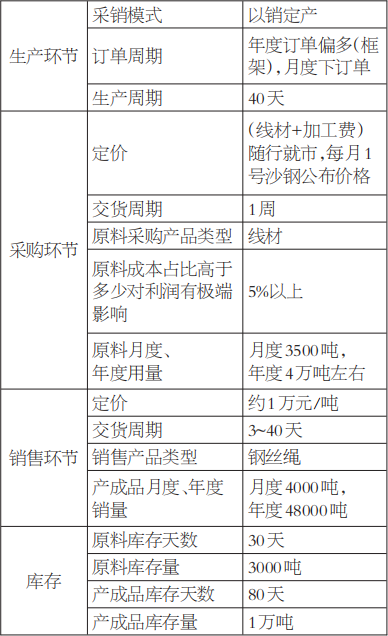
Core Viewpoint - The company is a leading domestic manufacturer of special steel wire ropes, catering to various industries such as elevators, construction machinery, ports, marine engineering, and shipping, establishing a strong brand reputation in the steel wire rope sector [1] Production and Sales Situation - The company adopts a sales-driven production model, coordinating production and raw material procurement based on market orders [2] - The company has a robust annual order volume, with a production cycle of 40 days from raw material input to finished product output [3][4] - The average monthly raw material usage is 3,500 tons, with an annual usage of approximately 40,000 tons, and a delivery cycle of one week [3][4] - The pricing model for raw materials is based on "wire rod price + processing fee," referencing the benchmark price published by Shagang on the first of each month [3][4] - The finished product, steel wire rope, is priced at approximately 10,000 yuan per ton, with a monthly average sales volume of 4,000 tons, leading to an annual sales volume of 48,000 tons [4] Inventory Management - The company maintains a raw material inventory cycle of 30 days, corresponding to a stock of 3,000 tons, and a finished product inventory cycle of 80 days, corresponding to a stock of 10,000 tons [5][4] Risk Exposure Analysis - The company faces two main price risk exposures: rising raw material costs due to increasing wire rod prices and the devaluation risk of raw material and finished product inventories during price declines [6] Futures Hedging Strategy - In response to declining steel demand and prices, the company can implement futures selling hedges for its finished product inventory and buying hedges for raw materials during price rebounds [7][10] - The company is advised to use rebar futures for hedging due to the stable price difference with wire rods [10] Price Volatility Characteristics - Historical price trends indicate that rebar prices fluctuate significantly, typically within a range of 30% to 40% annually, allowing for potential profits of 500 to 800 yuan per ton if half of the volatility is captured [11] Futures Hedging Backtesting - Backtesting of futures hedging strategies from 2023 to 2024 shows a total capital usage of 16 million yuan, with cumulative hedging gains of 8.27 million yuan, resulting in a total return rate of 52% [13] Inventory Selling Hedge - The inventory selling hedge strategy is designed to minimize losses from inventory depreciation, achieving a reduction of 4.86 million yuan in potential losses during the hedging period [17] Raw Material Buying Hedge - The raw material buying hedge strategy is projected to increase profits by 3.41 million yuan, equating to an additional profit of 487 yuan per ton [19]

南华豆一产业风险管理日报-20250926
Nan Hua Qi Huo· 2025-09-26 11:20
Report Summary 1. Report Industry Investment Rating No relevant content provided. 2. Core Viewpoints - New grain seasonal supply is abundant, putting pressure on spot prices later; soybean No. 1 futures are supported by short - covering, leading to a second - day rebound; the resumption of auctions increases market supply pressure, and attention should be paid to transaction volume [4]. - There are potential policy support and short - covering factors that are favorable, while the resumption of auctions is a negative factor [4]. 3. Summary by Relevant Catalogs 3.1 Price Range Prediction - The price range prediction for the soybean No. 1 11 - contract in the month is 3850 - 4000, with a current 20 - day rolling volatility of 10.16% and a historical percentile of 31.4% [3]. 3.2 Risk Strategies - **Inventory Management for Sellers**: For those with long spot positions such as planting entities with high autumn harvest selling needs and facing short - term selling pressure, it is recommended to short soybean No. 1 futures (A2511) with a 30% hedging ratio when the price is in the range of 4000 - 4050; also, sell call options (A2511 - C - 4050) with a 30% ratio when the option price is in the range of 30 - 50 to increase the selling price [3]. - **Procurement Management for Buyers**: For those worried about rising raw material prices and increasing procurement costs, it is recommended to mainly wait to purchase spot in the medium - term, focus on forward procurement management, and wait for the price to bottom out in the fourth quarter, with long positions in A2603 and A2605 [3]. 3.3 Core Contradictions and Market Analysis - **Core Contradictions**: New grain supply is seasonally abundant, pressuring spot prices; futures are supported by short - covering; the resumption of auctions intensifies supply pressure [4]. - **Likely Positive Factors**: On September 25, the Ministry of Agriculture and Rural Affairs held a video conference on increasing the large - scale yield per unit of grain and oil crops and "Three Autumn" production, which may lead to relevant policies; the short - side of the 11 - contract continued to reduce positions significantly, supporting the futures price to rebound continuously; the acquisition demand driven by the return - grain operation in the first half of 2025 provided phased support to the market [4]. - **Likely Negative Factors**: On September 26, 2025, the e - commerce platform of Sinograin organized a domestic soybean auction with a sales volume of 19349 tons, and Liangda.com planned two auctions on the same day, increasing the pressure on the spot market [4]. 3.4 Price Changes - From September 24 to September 25, 2025, the closing prices of soybean No. 1 contracts (11, 01, 03, 05, 07, 09) all increased, with daily increases ranging from 0.38% to 0.56% [4][6].
玻璃纯碱产业风险管理日报-20250926
Nan Hua Qi Huo· 2025-09-26 10:35
1. Report Industry Investment Rating No relevant information provided. 2. Core Viewpoints of the Report - There is a contradiction between macro - expectations and industrial logic. There are policy and cost - increase expectations for the far - month contracts, which cannot be falsified yet. The near - term reality is average, and the mid - stream's inventory - reduction ability during the peak season needs to be observed [2]. - For glass, supply disruptions are emerging again, and expectations are leading. Glass prices are prone to rise and hard to fall, but the high inventory in the upper and middle reaches and weak real - world demand limit price increases. The near - term pattern of strong supply and weak demand remains unchanged. From a valuation perspective, there are still profits in coal - gas and petroleum - coke production lines. The cumulative apparent demand from January to September is estimated to decline by 6% - 6.5%, and the spot market is in a state from weak balance to weak surplus [4]. - For纯碱, market sentiment and focus will fluctuate, increasing price volatility. The second - phase ignition of Yuangxing has entered the test - run stage, and the long - term supply pressure continues. The rigid demand for replenishment in the middle and lower reaches is the main factor, and the pressure on alkali factories has been somewhat relieved. The long - term supply of soda ash is expected to remain high, and normal maintenance continues. The fundamentals of photovoltaic glass have improved, and the inventory of finished products has been reduced. The rigid demand for soda ash is stable, and the heavy - soda balance remains in surplus. In August, soda ash exports exceeded 200,000 tons, which alleviated domestic pressure to some extent [4]. 3. Summary According to Related Catalogs 3.1 Glass and Soda Ash Price Forecast - Glass price monthly forecast is in the range of 1000 - 1400, with a current 20 - day rolling volatility of 32.42% and a historical percentile of 83.6% over three years. Soda ash price monthly forecast is in the range of 1100 - 1500, with a current 20 - day rolling volatility of 22.39% and a historical percentile of 25.7% over three years [1]. 3.2 Glass and Soda Ash Hedging Strategies 3.2.1 Glass Hedging - **Inventory Management**: When the finished - product inventory is high and worried about price drops, short - sell FG2601 glass futures at 50% ratio with an entry point of 1400 to lock in profits and cover production costs. Also, sell FG601C1400 call options at 50% ratio with an entry range of 40 - 50 to collect premiums and reduce costs [1]. - **Procurement Management**: When the procurement inventory is low, buy FG2601 glass futures at 50% ratio with an entry range of 1100 - 1150 to lock in procurement costs. Sell FG601P1100 put options at 50% ratio with an entry range of 50 - 60 to collect premiums and reduce costs [1]. 3.2.2 Soda Ash Hedging - **Inventory Management**: When the finished - product inventory is high and worried about price drops, short - sell SA2601 soda ash futures at 50% ratio with an entry range of 1550 - 1600 to lock in profits and cover production costs. Also, sell SA601C1500 call options at 50% ratio with an entry range of 50 - 60 to collect premiums and reduce costs [1]. - **Procurement Management**: When the procurement inventory is low, buy SA2601 soda ash futures at 50% ratio with an entry range of 1200 - 1250 to lock in procurement costs. Sell SA601P1200 put options at 50% ratio with an entry range of 40 - 50 to collect premiums and reduce costs [1]. 3.3 Glass and Soda Ash Price and Market Data 3.3.1 Glass - **Futures Prices**: On September 26, 2025, the glass 05 contract was 1372, down 11 (- 0.8%) from the previous day; the 09 contract was 1436, down 10 (- 0.69%); the 01 contract was 1252, down 18 (- 1.42%) [5]. - **Spot Prices**: On September 26, 2025, the average price of glass in Shahe was 1225, up 20.4 from the previous day. Different regions had different price changes, with some remaining stable and some rising slightly [6]. 3.3.2 Soda Ash - **Futures Prices**: On September 26, 2025, the soda ash 05 contract was 1384, down 20 (- 1.42%) from the previous day; the 09 contract was 1439, down 20 (- 1.37%); the 01 contract was 1293, down 22 (- 1.67%) [7][8]. - **Spot Prices**: On September 26, 2025, the heavy - soda and light - soda prices in different regions remained mostly stable, with some regions having a price difference between heavy and light soda [9].
南华豆一产业风险管理日报-20250925
Nan Hua Qi Huo· 2025-09-25 02:01
1. Report Industry Investment Rating - No industry investment rating is provided in the report. 2. Core Viewpoints of the Report - New grain seasonal supply is abundant, putting pressure on spot prices later [4]. - New grain listing has increased slightly, and the mainstream price of raw grain has dropped to 1.85 - 1.88 yuan per catty [4]. - The soybean No. 1 futures continue the rhythm of volume - increasing decline and volume - decreasing rebound, and attention should be paid to the rebound strength [4]. - The resumption of auctions intensifies the market supply pressure, and attention should be paid to the transaction situation [4]. 3. Summary by Relevant Catalogs 3.1 Price Range Forecast - The price range forecast for the soybean No. 1 11 - contract in the month is 3850 - 4000 yuan per ton, with a current volatility (20 - day rolling) of 10.16% and a current volatility historical percentile of 31.4% [3]. 3.2 Risk Strategies 3.2.1 Inventory Management - For planting entities with high demand for selling new grains in autumn but facing large short - term selling pressure, it is recommended to take advantage of the futures price rebound to appropriately lock in planting profits by short - selling soybean No. 1 futures (A2511) with a hedging ratio of 30% and a suggested entry range of 4000 - 4050 (holding) [3]. - When there is a concentrated listing and the seller's bargaining power weakens, it is recommended to sell call options (A2511 - C - 4050) to increase the grain - selling price, with a hedging ratio of 30% and a suggested entry range of 30 - 50 (holding) [3]. 3.2.2 Procurement Management - For those worried about the rise in raw grain prices and the increase in procurement costs, it is recommended to mainly wait for spot procurement in the medium term and focus on long - term procurement management. Long positions in A2603 and A2605 are recommended, waiting for the price to bottom out in the fourth quarter [3]. 3.3 Market Situation Analysis 3.3.1 Bullish Factors - There was widespread rainfall in the Heilongjiang production area, delaying the harvesting operation in some areas [4]. - The short - side of the 11 - contract significantly reduced positions, leading to a large - scale rebound in the futures price [4]. 3.3.2 Bearish Factors - The e - commerce platform of China National Grain Reserves Corporation will organize a special session for the competitive sale of domestic soybeans on September 26, 2025, with a sales volume of 19349 tons. The resumption of auctions increases the pressure on the spot market, and the futures market may have priced in this bearish factor [4]. - On September 24, Liangda.com planned to auction 7330 tons of raw soybeans from Rongtong Company, with a starting price of 3820 - 3930 yuan per ton, and all auctions failed [4]. 3.4 Market Price Data | Contract | 2025 - 09 - 23 Close Price | 2025 - 09 - 24 Close Price | Daily Change | Change Rate | | --- | --- | --- | --- | --- | | Soybean No. 1 11 | 3878 | 3907 | 29 | 0.75% | | Soybean No. 1 01 | 3871 | 3893 | 22 | 0.57% | | Soybean No. 1 03 | 3877 | 3894 | 17 | 0.44% | | Soybean No. 1 05 | 3920 | 3928 | 8 | 0.20% | | Soybean No. 1 07 | 3924 | 3927 | 3 | 0.08% | | Soybean No. 1 09 | 3932 | 3934 | 2 | 0.05% | [4]
纯苯苯乙烯日报:EB基差进一步走弱-20250924
Hua Tai Qi Huo· 2025-09-24 05:11
Report Industry Investment Rating - Not provided in the given content Core Viewpoints of the Report - For pure benzene, domestic attention is on the commissioning progress of Yulong Cracking Unit 2. The operation of domestic existing plants has slightly declined, and the rhythm of imports has slowed down. Downstream提货 and procurement for stocking before the festival have increased the de - stocking rate of port inventories. The downstream operation of pure benzene has rebounded from the bottom, but the overall operation is still low, and the sustainability of downstream procurement is questionable [3]. - For styrene, the downstream提货 volume has declined during the peak season, and the arrival of EB has been concentrated, leading to the re - accumulation of port inventories. The absolute level of port inventories is still high, and the EB basis has further weakened. The operation of EB has gradually recovered since late September. Among the downstream of EB, the operation of ABS and PS has slightly declined, while the operation of EPS before the National Day was acceptable, and the inventory pressure of ABS is relatively large. Overseas, the operation of EB in Europe and the United States is still low, but the price difference between EB in Europe and the United States and China has continued to weaken, and the paper - cargo locked import window for EB has been opened [3]. Summary According to Relevant Catalogs I. Pure Benzene and EB's Basis Structure and Inter - Period Spread - The pure benzene main contract basis is - 30 yuan/ton (+36), and the spot - M2 spread is 0 yuan/ton (+20 yuan/ton). The EB main contract basis is 0 yuan/ton (- 42 yuan/ton) [1]. II. Production Profits and Internal - External Price Differences of Pure Benzene and Styrene - Pure benzene CFR China processing fee is 132 US dollars/ton (- 3 US dollars/ton), and FOB Korea processing fee is 114 US dollars/ton (- 2 US dollars/ton). The US - Korea price difference of pure benzene is 37.5 US dollars/ton (- 3.0 US dollars/ton). The non - integrated production profit of styrene is - 562 yuan/ton (- 87 yuan/ton) and is expected to gradually compress [1]. III. Inventories and Operating Rates of Pure Benzene and Styrene - Pure benzene port inventory is 10.70 million tons (- 2.70 million tons), and the operating rate has a slight decline. Styrene East China port inventory is 186,500 tons (+27,500 tons), East China commercial inventory is 98,500 tons (+20,500 tons), and the operating rate is 73.4% (- 1.5%) [1]. IV. Operating Rates and Production Profits of Styrene Downstream - EPS production profit is 249 yuan/ton (- 1 yuan/ton), PS production profit is - 1 yuan/ton (- 1 yuan/ton), and ABS production profit is 16 yuan/ton (+81 yuan/ton). EPS operating rate is 61.74% (+0.72%), PS operating rate is 61.20% (- 0.70%), and ABS operating rate is 69.80% (- 0.20%) [2]. V. Operating Rates and Production Profits of Pure Benzene Downstream - Caprolactam production profit is - 1890 yuan/ton (- 85), phenol - acetone production profit is - 196 yuan/ton (+0), aniline production profit is 62 yuan/ton (+91), and adipic acid production profit is - 1306 yuan/ton (- 12). Caprolactam operating rate is 88.69% (+2.48%), phenol operating rate is 71.00% (+2.00%), aniline operating rate is 71.95% (+6.74%), and adipic acid operating rate is 62.60% (- 1.60%) [1] Strategies - Unilateral: Short - hedge BZ and EB on rallies [4] - Basis and inter - period: None [4] - Cross - variety: None [4]
玻璃纯碱产业风险管理日报-20250919
Nan Hua Qi Huo· 2025-09-19 10:44
Report Industry Investment Rating - No relevant content provided Core Viewpoints - There is a contradiction between macro expectations and industrial logic, with a divergence in far - month pricing and uncertainty about near - term direction, which depends on the downstream destocking ability during the peak season [2] - For glass, the inventory of the upper and middle reaches remains high, the phased restocking ability is weak, some production lines may have ignition plans, and policy expectations fluctuate. The daily melting on the supply side is around 160,000 tons with a slight increase expected. The cumulative apparent demand from January to August is estimated to decline by 6 - 7%, and the spot market is in a state from weak balance to weak surplus [2][3] - For纯碱, the medium - to - long - term supply is expected to remain high, normal maintenance continues, and attention should be paid to the commissioning of Yuangxing Phase II in the fourth quarter. The fundamentals of photovoltaic glass have improved, and there is an expectation of price increase. The overall rigid demand for纯碱 is stable, and the supply - strong and demand - weak pattern remains unchanged [3] Summary by Related Catalogs Glass and Soda Ash Price Range Forecast - The monthly price range forecast for glass is 1000 - 1400, with a current 20 - day rolling volatility of 27.60% and a historical percentile of 74.3% over 3 years. For soda ash, the price range is 1100 - 1500, with a volatility of 19.07% and a historical percentile of 13.9% [1] Glass and Soda Ash Hedging Strategies - **Glass Inventory Management**: For high glass product inventory, short FG2601 futures at 1400 with a 50% ratio and sell FG601C1400 call options at 40 - 50 with a 50% ratio [1] - **Glass Purchase Management**: For low glass purchase inventory, buy FG2601 futures at 1100 - 1150 with a 50% ratio and sell FG601P1100 put options at 50 - 60 with a 50% ratio [1] - **Soda Ash Inventory Management**: For high soda ash product inventory, short SA2601 futures at 1550 - 1600 with a 50% ratio and sell SA601C1500 call options at 50 - 60 with a 50% ratio [1] - **Soda Ash Purchase Management**: For low soda ash purchase inventory, buy SA2601 futures at 1200 - 1250 with a 50% ratio and sell SA601P1200 put options at 40 - 50 with a 50% ratio [1] Glass and Soda Ash Market Data Glass - On September 19, 2025, the prices of glass 05, 09, and 01 contracts were 1343, 1405, and 1216 respectively, with daily increases of 1.13%, 1.3%, and 0.66% [4] - The spot prices of glass in most regions remained stable on September 19, 2025, with only slight declines in some brands in the Shahe area [5] Soda Ash - On September 19, 2025, the prices of soda ash 05, 09, and 01 contracts were 1407, 1454, and 1318 respectively, with daily increases of 0.5%, 0.83%, and 0.92% [6] - The spot prices of heavy and light soda ash in most regions remained unchanged on September 18, 2025, except for a 12 - unit increase in the Shahe heavy - soda price [7]
南华豆一产业风险管理日报-20250918
Nan Hua Qi Huo· 2025-09-18 02:22
Report Summary 1. Industry Investment Rating No industry investment rating is provided in the report. 2. Core Viewpoints - The supply of soybeans is currently in a stage of loose supply, causing the spot price to decline [4]. - Mid - and downstream players are waiting for lower prices, resulting in low purchasing enthusiasm and a bearish sentiment [4]. - The soybean futures market has broken through key levels, with increased positions and trading volume in active contracts, strengthening the bearish trend [4]. 3. Summary by Directory Price Forecast and Risk Strategy - **Price Range Forecast**: The price range of the soybean No. 1 11 - contract is predicted to be between 3850 - 4000, with a current 20 - day rolling volatility of 10.16% and a historical percentile of 31.4% [3]. - **Risk Strategies**: - For inventory management of planting subjects, when there is a large demand for selling new soybeans in autumn but significant selling pressure, it is recommended to short the A2511 soybean futures contract at a hedging ratio of 30% in the price range of 4000 - 4050 to lock in planting profits [3]. - When there is a concentrated listing of soybeans and the seller's bargaining power weakens, it is advisable to sell the A2511 - C - 4050 call option at a hedging ratio of 30% in the range of 40 - 50 (holding) to increase the selling price [3]. - For procurement management, when worried about rising raw material prices and increasing procurement costs, it is mainly recommended to wait to purchase spot goods in the medium - term and focus on forward procurement management. Consider going long on A2603 and A2605 contracts, waiting for price guidance in autumn [3]. Market Analysis - **Likely Positive Factors**: - Uncertainty in Sino - US trade. If soybean imports from the US continue to be halted or delayed in Q4, it may create a demand window for domestic soybeans [4]. - The suspension of this week's auctions, with attention on subsequent auction arrangements [4]. - There is an expected recovery in the demand for edible soybeans starting from September [4]. - **Negative Factors**: - The supply of soybeans is in a stage of loose supply, which is the core factor affecting the market [4][6]. - Purchasers are still waiting for lower prices, pushing the market to seek a new balance downwards [4][6]. - The closing prices of soybean No. 1 contracts on September 17, 2025, all declined compared to September 16, with daily declines ranging from 28 - 30 and daily decline rates from 0.70% - 0.76% [5].