算力基建

Search documents
捆绑OpenAI,英伟达掀起算力基建“风暴”
第一财经· 2025-09-23 04:50
Core Viewpoint - OpenAI has announced a strategic partnership with NVIDIA to deploy a total of at least 10GW of AI computing systems, with NVIDIA providing up to $100 billion in funding support, indicating a significant investment in AI infrastructure and a potential shift in the industry towards a "compute as capital" model [3][5][6]. Group 1: Partnership Details - OpenAI plans to phase in the deployment of NVIDIA's AI computing systems over several years, involving millions of GPUs [3]. - The partnership is still in the intention stage, with discussions ongoing regarding investment forms, equity structures, and delivery timelines [3][5]. - The collaboration is expected to create a closed-loop ecosystem where capital, computing power, and models drive each other, marking a new phase in AI development [5][6]. Group 2: Market Context and Trends - The AI industry is experiencing rapid growth, with a projected annual growth rate of over 40% for AI data center construction in China over the next two to three years, eventually stabilizing around 10% by 2030 [6]. - The complexity of AI training and inference tasks is increasing, leading to higher power requirements for data centers, with single cabinet power moving from 50kW to 300kW or more [8]. - International projects are achieving higher power densities, with leading projects reaching 120-150kW per cabinet, while domestic projects are currently at 40-60kW per cabinet [8]. Group 3: Challenges and Solutions - The industry faces challenges related to energy consumption approvals and supply uncertainties due to chip export controls [8]. - There is a growing need for green energy solutions in data center construction, as the demand for computing power increases, leading to potential conflicts with energy supply stability [9]. - A proposed solution involves adding a layer of energy storage within computing centers to ensure stable output despite variable energy input, although this model has yet to be implemented in the domestic market [9].



捆绑OpenAI,英伟达掀起算力基建“风暴”
Di Yi Cai Jing· 2025-09-23 03:42
Core Insights - Major companies are forming a closed-loop AI ecosystem through capital and technology partnerships, exemplified by the collaboration between OpenAI and NVIDIA, which involves a strategic agreement for a 10GW AI data center [1][3] - The investment model termed "compute as capital" is emerging, where each additional GW of computing power leads to further investment and equity stakes, creating a stronger alliance among these firms [3][4] Group 1: Partnership and Investment - OpenAI has signed a strategic cooperation agreement with NVIDIA to deploy a total of no less than 10GW of NVIDIA AI computing systems over the coming years, involving millions of GPUs [1] - NVIDIA is set to provide up to $100 billion in funding to OpenAI based on the rollout of computing infrastructure, indicating a significant financial commitment [1][3] - The partnership is seen as a precursor to the next leap in AI development, with both companies having a history of mutual advancement over the past decade [3] Group 2: Market Dynamics and Trends - The demand for AI infrastructure is rapidly increasing, with projections indicating that domestic AI data center (AIDC) construction will maintain an annual growth rate of over 40% for the next two to three years [4] - The complexity of AI training and inference tasks is driving the need for higher power density in data centers, with international projects achieving power densities of 120-150kW per cabinet [6] - The U.S. market is supported by high-end chips, ample capital, and mature power grids, but faces challenges such as energy consumption approvals and chip export controls [6] Group 3: Challenges and Solutions - The industry is encountering challenges related to energy demands, as data centers require significant power while also needing to transition to greener energy sources [6][7] - A proposed solution involves integrating energy storage within computing centers to stabilize power output, addressing the fluctuating nature of renewable energy sources [7]

摩尔线程IPO倒计时,半导体产业ETF(159582)盘初大涨超2%,长川科技涨停
Sou Hu Cai Jing· 2025-09-23 02:14
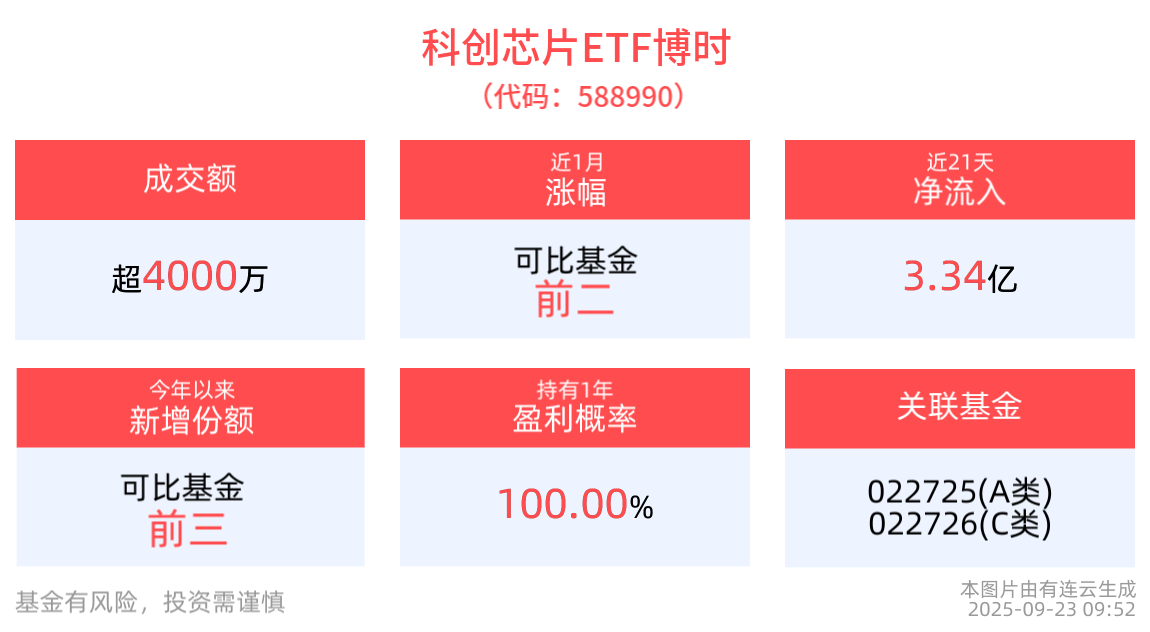
Market Performance - The semiconductor industry index rose by 1.43% as of September 23, 2025, with notable gains from companies like Changchuan Technology (up 20.00%) and Huafeng Measurement Control (up 8.54%) [1] - The semiconductor industry ETF (159582) increased by 1.42%, reaching a price of 2.07 yuan, and has seen a cumulative increase of 9.79% over the past week [1] - The ChiNext chip index experienced a slight decline of 0.05%, with mixed performance among constituent stocks [3] - The new materials index on the ChiNext fell by 0.58%, with some stocks like Tonglian Precision gaining while others like Debang Technology declined [5] Investment Trends - Nvidia and OpenAI announced a partnership, with Nvidia planning to invest up to $100 billion in data centers, leading to a nearly 4% increase in Nvidia's stock price [6] - Domestic chip companies are making progress, with Moer Thread set to debut on the ChiNext and Muxi Co. entering the second round of inquiries for its IPO, focusing on high-performance GPU development [6] Technology Advancements - DeepSeek announced an upgrade to its model, enhancing language consistency and agent capabilities, while Yushu Technology showcased its humanoid robot's strong anti-interference abilities [7] - The continuous iteration of AI and robotics technology indicates ongoing optimization in AI application capabilities [8] ETF Insights - The semiconductor industry ETF has a recent scale of 255 million yuan, marking a six-month high, despite a net outflow of 602.22 million yuan recently [9] - The ChiNext chip ETF has seen a net outflow of 337.66 million yuan, with a total inflow of 334 million yuan over the past 21 trading days [10] - The new materials ETF has experienced a significant scale increase of 212 million yuan over the past year, ranking first among comparable funds [10]


光模块产业链多家上市公司谋求扩产
Zheng Quan Ri Bao· 2025-09-22 16:14
Core Viewpoint - The announcement by Huylv Ecological Technology Group regarding the lease agreement for a photonic module production base reflects the overall expansion trend in the photonic module industry, driven by the surging demand for AI computing power [1] Industry Expansion - The photonic module industry is experiencing a wave of expansion, with major companies increasing production capacity to meet the growing demand for 400G and 800G modules, while 1.6T modules are expected to become a key growth driver in the next three years [2] - Huylv Ecological has signed a contract for a production base capable of producing 450 million photonic modules with a total investment of 700 million yuan, indicating significant enhancements in scale, technology, and research capabilities [2] - Other companies like Shanghai Cambridge Technology and Zhongji Xuchuang are also ramping up production, focusing on high-end products like 1.6T and 800G modules to maintain delivery capabilities amid rising industry demand [2] Market Demand and Growth - The demand for photonic modules is being fueled by an exponential increase in AI computing needs, with the industry poised for a comprehensive growth phase driven by technological upgrades and market dynamics [3] - The global photonic module market is projected to grow from $11.2 billion in 2020 to $17.8 billion in 2024, with a compound annual growth rate (CAGR) of 12.2%, and is expected to reach $23.5 billion by 2025 [3] - In China, the photonic module market is anticipated to grow to approximately 70 billion yuan by 2025, reflecting a year-on-year increase of 12.22% in 2024 [3] Performance Metrics - Leading domestic photonic module companies have reported significant sales growth, with New Yisong's sales volume reaching 6.95 million units in the first half of 2025, a year-on-year increase of 112.5% [4] - Huagong Technology reported a revenue of 3.744 billion yuan from its connectivity business in the first half of 2025, marking a 124% increase, with expectations of substantial growth in AI-related module shipments [4] Supporting Factors - The demand for photonic modules is further supported by the ongoing construction of computing infrastructure both domestically and internationally, with major tech companies like Nvidia and Google driving the need for high-speed module procurement [5] - Policy support from the Chinese government, including guidelines for enhancing data infrastructure, is expected to facilitate the growth of the photonic module market [5] - The long-term opportunities in the photonic module industry are attributed to the synergy of continuous AI technology iterations, expanding demand, and supportive policies [5]


致尚科技(301486):深耕精密制造,“光+算”布局开新篇
HUAXI Securities· 2025-09-22 11:49
Investment Rating - The report gives a "Buy" rating for the company, marking its first coverage [4][6]. Core Views - The company has deepened its focus on precision manufacturing and has established a key position in the gaming console manufacturing sector by closely serving major clients like Sony and Meta. The sales of gaming consoles are cyclical, but with new products launched by core clients, the company is expected to benefit continuously as new materials are introduced [1]. - The optical communication business has seen rapid growth since the company entered the fiber connector market in 2019, becoming a qualified supplier for SENKO in 2020. This segment is anticipated to experience a surge in demand due to the acceleration of global computing infrastructure [2]. - The company plans to acquire Hengyang Data, which specializes in intelligent computing and data processing solutions. This acquisition aims to transition the company from a component supplier to a "light + computing" solution provider, thereby expanding its customer base [3]. Summary by Sections 1. Company Overview - The company has been deeply involved in precision manufacturing since its establishment in 2009 and has expanded its business into the optical communication and automation equipment sectors. It has established a solid foundation by collaborating with major clients like Foxconn and has diversified its product offerings [14][24]. 2. Gaming Console Components - The gaming console market is stable, with the Nintendo Switch2 experiencing strong sales. The company has been providing various precision components for major clients, including N Company and Sony, and is well-positioned to benefit from the sales of new generation gaming consoles [38][50][55]. 3. Optical Fiber Connectors - The company has developed a comprehensive range of optical fiber connector products and has established a strong partnership with SENKO. The demand for these products is expected to rise significantly due to the ongoing expansion of computing clusters and advancements in new technologies [63][79]. 4. Financial Forecast and Valuation - The company is projected to achieve revenues of 1.012 billion, 1.813 billion, and 2.201 billion yuan for 2025, 2026, and 2027, respectively, with year-on-year growth rates of 3.84%, 79.20%, and 21.42%. The net profit attributable to shareholders is expected to be 223 million, 204 million, and 248 million yuan for the same years [4][9].
【大公报】AI发展提速 芯片等概念股看俏
Xin Lang Cai Jing· 2025-09-22 03:53
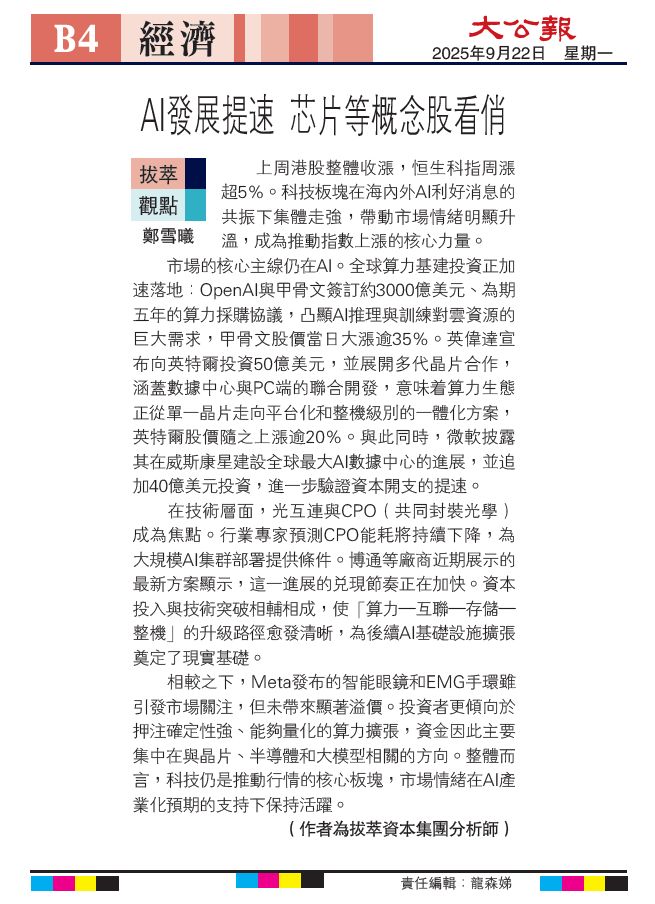
Group 1 - The Hong Kong stock market saw an overall increase, with the Hang Seng Tech Index rising over 5% last week, driven by strong performance in the technology sector due to favorable AI news both domestically and internationally [1][3]. - The core focus of the market remains on AI, with significant investments in global computing infrastructure accelerating. OpenAI signed a $300 billion, five-year computing procurement agreement with Oracle, highlighting the immense demand for cloud resources for AI inference and training, resulting in Oracle's stock surging over 35% [1][3]. - NVIDIA announced a $5 billion investment in Intel, initiating multi-generation chip collaborations that encompass joint development for data centers and PCs, indicating a shift in the computing ecosystem from single chips to platform and system-level integration, leading to a 20% increase in Intel's stock [1][3]. Group 2 - Microsoft disclosed progress on building the world's largest AI data center in Wisconsin, along with an additional $4 billion investment, further validating the acceleration of capital expenditures in the AI sector [1][3]. - Technological advancements in optical interconnects and Co-Packaged Optics (CPO) are becoming focal points, with industry experts predicting a continuous decrease in CPO energy consumption, facilitating large-scale AI cluster deployments. Recent demonstrations by companies like Broadcom indicate that the pace of these advancements is accelerating [1][3]. - The combination of capital investment and technological breakthroughs is clarifying the upgrade path for "computing - interconnect - storage - systems," laying a solid foundation for future expansion of AI infrastructure [1][3]. Group 3 - In contrast, Meta's release of smart glasses and EMG wristbands garnered market attention but did not result in significant premium pricing. Investors are more inclined to bet on strong, quantifiable computing expansion, leading to a concentration of funds in chip, semiconductor, and large model-related sectors [2][4]. - Overall, technology remains the core sector driving market sentiment, which remains active under the expectations of AI industrialization [2][4].





存储芯片:周期属性凸显,AI基建打开新空间
Tebon Securities· 2025-09-19 09:29
Market Overview - The storage chip market is the second largest segment in the semiconductor industry, with a projected market size of $165.5 billion in 2024, accounting for 26% of the total semiconductor market of $630.5 billion[8] - In 2023, the storage chip market size was $92.3 billion, a year-on-year decline of 29%, while it is expected to grow by 79% to $165.5 billion in 2024[5][8] Industry Characteristics - The storage chip industry exhibits strong cyclical characteristics, typically operating on a 3-4 year cycle[8] - The market is dominated by 3-5 major players, with over 90% market share in both DRAM and NAND Flash segments[19] Historical Cycles - The storage industry has experienced three cycles since 2016, with the current cycle driven by AI infrastructure demand, differing from previous cycles that were more reliant on consumer electronics[14][20] - The first cycle (2016-2019) was driven by the transition to DDR4, while the second cycle (2020-2023) benefited from increased demand for laptops and smartphones during the pandemic[14][15] Future Outlook - The new cycle starting in 2024 is expected to be sustained by AI infrastructure, with significant demand for DDR5 and HBM memory chips[20] - According to WSTS, the storage chip market is projected to grow to $184.8 billion in 2025 and $214.8 billion in 2026, with year-on-year growth rates of 12% and 16% respectively[20] Company Performance - In Q2 2025, DRAM industry revenue reached $31.63 billion, a quarter-on-quarter increase of 17.1%, while NAND Flash revenue from the top five brands grew by 22% to $14.67 billion[22][24] - Major companies like SK Hynix and Micron reported significant revenue growth, with SK Hynix's DRAM revenue increasing by 57.9% year-on-year in Q2 2025[26][30] Risks - The industry faces risks including market competition, macroeconomic fluctuations, and potential delays in research and development progress[36]

AI 成为美股投资最大主题:“这不是 ROI 问题,是生存问题”
晚点LatePost· 2025-09-17 11:17
Core Insights - The article emphasizes that despite the search for new investment stories, the majority of funds are still directed towards leading companies in computing infrastructure [3][18] - Oracle's recent quarterly report showed a significant increase in contracts, particularly with OpenAI, indicating a strong demand for computing power [3][4] - The article discusses the potential risks associated with the massive $3 trillion investment in AI, highlighting that AI contributed to 40% of U.S. economic growth in the past year [5][6] Investment Trends - Major tech companies are engaged in a "survival battle" regarding AI investments, viewing it as essential for maintaining their core business [7][8] - The article notes that the current investment landscape favors companies with strong computing infrastructure, such as NVIDIA and Broadcom, due to their monopolistic market positions [18][19] - The investment strategies of funds like Coatue, Whale Rock, and Altimeter reflect a focus on computing infrastructure, with Coatue investing in AI cloud companies [15][19] Financial Metrics - The expected return on investment (ROI) for AI-related capital expenditures is projected to be around 45%, with significant contributions from advertising revenue [9][10] - The article outlines that by 2025, AI-related revenue is estimated to reach $128 billion, with advertising being the largest contributor [10][12] - The capital expenditures for major players in the AI space are substantial, with AWS, Azure, and GCP expected to generate significant revenue from AI-related services [12][14] Market Dynamics - The article highlights the cyclical nature of the semiconductor industry, where demand fluctuations can lead to significant stock price volatility [26][28] - It discusses the importance of timing in investments, particularly in the context of potential downturns in the AI sector [26][31] - The article also mentions that many funds have reduced their focus on Chinese companies due to valuation concerns and a lack of research support [21][22] Future Outlook - The article suggests that the future of AI investments will depend on actual corporate actions and capital expenditure guidance [7][9] - It indicates that while the current focus is on computing infrastructure, there is potential for growth in application-level companies if they can demonstrate long-term value [22][25] - The need for continuous investment in AI infrastructure is underscored, as companies aim to avoid becoming "pipeline" providers with low valuations [8][19]



博大数据 CEO 张永健:资本追逐、政策红利、人才短缺,东南亚智算市场是机会还是陷阱?丨智算想象力十人谈
雷峰网· 2025-09-16 10:20
Core Viewpoint - The article emphasizes that success in Southeast Asia's data center market relies more on localized teams and customer structures than on capital and scale [3]. Group 1: Market Opportunity in Southeast Asia - Southeast Asia is a critical battleground for data centers, with the Philippines identified as the first stop due to its large population and accelerating digital transformation [5][6]. - The Philippine government is actively promoting digital economy initiatives, planning to connect 20-30 submarine cables in the coming years, which could lead to a 5-10x growth in the data center industry [5]. - Investment returns in Southeast Asia are generally 2-3% higher than in domestic markets, making it an attractive option for data center firms [5][6]. Group 2: Strategic Approach of Companies - Companies like Boda Data are adopting a mixed service strategy to balance core revenue from large clients while also catering to smaller, scattered customers to mitigate risks [7]. - The CEO of Boda Data, Zhang Yongjian, has extensive experience in international business, which informs the company's strategy to establish a resilient business model in overseas markets [7][8]. Group 3: Challenges in Overseas Expansion - High construction costs for data centers in Southeast Asia can be double that of domestic costs, but the expected internal rate of return (IRR) is still favorable [18][19]. - Talent shortages pose a significant challenge, as local expertise is limited; Boda Data's solution involves a dual approach of bringing in experienced personnel while training local talent [22][24]. - Cultural integration is highlighted as a critical yet often overlooked factor in successful overseas operations, impacting team efficiency and organizational health [25]. Group 4: Customer Dynamics and Market Strategy - The customer base for overseas data centers includes local governments, enterprises, multinational corporations, and domestic clients, each requiring tailored market entry strategies [28]. - Boda Data's strategy in the Philippines aims to serve local needs while also positioning itself as a regional hub, with plans to expand into other Southeast Asian and Central Asian markets [29][30].

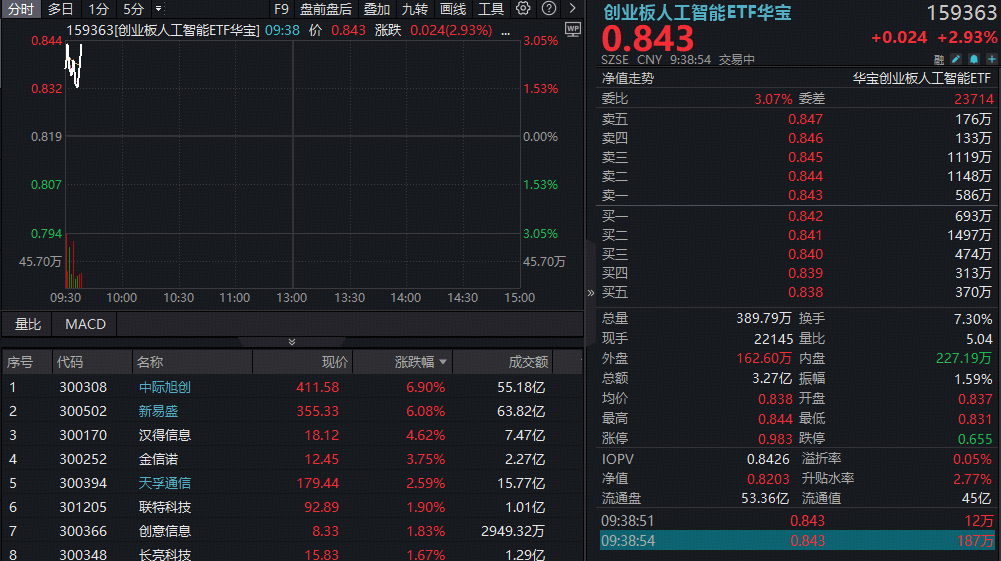
海外算力巨头引爆!光模块龙头强者恒强,创业板人工智能ETF(159363)猛涨3%,逆市领跑全市场
Sou Hu Cai Jing· 2025-09-11 02:14
Core Viewpoint - The AI computing sector is experiencing significant growth, driven by strong performance in related stocks and ETFs, particularly in the context of rising global AI investment enthusiasm following Oracle's impressive financial results [1][2][3]. Group 1: Stock Performance - High-performance computing stocks, particularly in the AI sector, saw substantial gains, with Zhongji Xuchuang rising over 6%, Xinyi Sheng increasing over 5%, and Tianfu Communication up over 2% [1]. - The Huabao ChiNext AI ETF (159363) surged nearly 3% at the opening, leading the market with a trading volume exceeding 300 million yuan, indicating a notable increase in market activity [1][2]. Group 2: Market Sentiment and Investment Trends - Oracle's recent earnings call revealed a remarkable increase in remaining performance obligations (RPO) to $455 billion, a year-on-year surge of 359%, which has fueled market enthusiasm for AI-driven growth [1][3]. - Analysts from Guojin Securities and Guosheng Securities express a positive outlook on the computing sector, emphasizing the synergy of "computing power + models + applications" and the ongoing capital expenditure increases from both domestic and international cloud service providers [3]. Group 3: Investment Recommendations - The report suggests focusing on the AI computing opportunities centered around optical modules, recommending the first ChiNext AI ETF (159363) and related funds, which have over 70% of their portfolio in computing power and over 20% in AI applications [3].