
即时零售

Search documents
淘宝闪购已迈入新增长阶段:经济效益提高,客单价和用户粘性持续上升
IPO早知道· 2025-11-26 02:01
Core Viewpoint - Alibaba Group has entered a new growth phase for its Taobao Flash Sales business, focusing on efficiency optimization while maintaining market scale after rapid expansion [2]. Group 1: Financial Performance - For the three months ending September 30, 2025, the instant retail business revenue grew by 60% year-on-year [2]. - The unit economic efficiency of the instant retail business has significantly improved due to enhanced logistics efficiency, high customer retention rates, and increased average order value [2]. Group 2: Business Strategy - Alibaba's CEO of the China e-commerce division, Jiang Fan, indicated that the platform has seen an increase in high-value orders, with non-tea drink orders rising to over 75% [2]. - The company plans to focus on user experience, high-value user management, and retail category development in the next phase [2]. Group 3: Service Enhancements - Taobao Flash Sales has launched new features such as the "Hot Stores" channel, which promotes higher-priced meal vendors, and services like "25 Yuan Large Red Packets" and "Free Delivery for Late Orders" [3]. - These enhancements aim to provide quality offerings and certainty in service, while also helping high-ticket merchants attract more valuable customers [3].



三场硬仗,阿里进击
3 6 Ke· 2025-11-26 01:13
阿里迎来了一个多项指标超出预期的财季。 集团整体营收达2478亿元,剔除高鑫零售和银泰后,同比增长15%,超出市场预期。云业务增长强劲,同比增速高达34%,大幅超出市场预期。 中国电商集团收入同比增长也达到16%。 财报发布后,阿里美股盘前涨超3%。受多项AI相关市场消息刺激,财报发布的前2天,阿里股价一直呈上涨趋势。 市场持续对阿里AI进展的高度关注之下,财报会上,阿里CEO吴泳铭还首次强调了新的AI战略:阿里正在AI to B和AI to C两大方向齐发力——在 AI to B领域,做世界领先的全栈AI服务商,服务千行百业不断增长的AI需求;在AI to C领域,基于性能领先的AI模型和阿里生态优势,打造面向 C端用户的AI超级原生应用,推动AI从千行百业到人人可用。 他进一步解释称:"这将激发核心业务产生更大的协同效应,成为驱动阿里持续增长、迈向新高度的动能引擎。" 财报会上,吴泳铭还透露,目前看来,AI服务器上架速度跟不上客户订单的增长,不排除进一步增投的可能。 今年以来,阿里在AI+云基建、即时零售、千问AI to C三场激烈的战争中,持续坚定的投入,并集中资源打仗,这也使得其保持了凶猛的增长势 头 ...
商务部研究院:预计“十五五”期间即时零售行业年均增速达到12.6%
Zhong Guo Qing Nian Bao· 2025-11-25 21:50
商务部研究院电子商务研究所所长杜国臣指出,前置仓的规模化与数字化发展显著提升了履约效率,已 成为支撑即时零售生态的关键环节,贡献了全渠道一半以上的交易额。展望未来,"全域下沉"与"多场 景拓展"成为即时零售增长的主引擎,国内县域市场存在巨大增长空间。同时,人工智能与大数据将全 面赋能,贯穿于选品、补货、配送、营销、售后各个环节。 来源:中国青年报客户端 报告指出,2026年我国即时零售规模将突破1万亿元,预计到2030年,将达到2万亿元,"十五五"期间年 均增速达到12.6%。据测算,2024年我国即时零售规模达7810亿元,同比增长20.15%,比同期全国网络 零售增速高出12.95个百分点,比同期社会消费品零售总额增速高出16.65个百分点,即时零售已成为我 国零售业增长的新动能。 报告指出,目前即时零售用户对健康消费高度关注,约80%的消费者愿意为健康属性产品支付溢价。从 平台数据看,有70.7%的即时零售消费者觉得0添加产品更可靠。健康产品及其定制服务将成为即时零 售的重要增长点。 即时零售平台加快拓展县域市场,成为即时零售增长的重点领域。报告以美团闪购举例,目前,美团闪 购已覆盖了全国2800个县市 ...


四个季度狂撒1200亿元 净利润承压 阿里持续“豪赌”AI与即时零售值不值?
Mei Ri Jing Ji Xin Wen· 2025-11-25 18:17
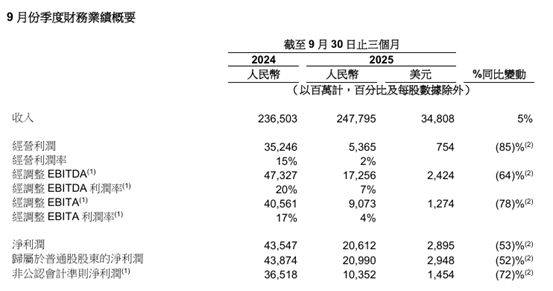
| | | 截至9月30日止三個月 | | | | --- | --- | --- | --- | --- | | | 2024 | 2025 | | | | | 人民幣 | 人民幣 | 美元 | %同比變動 | | | | (以百萬計,百分比及每股數據除外) | | | | 收入 | 236,503 | 247,795 | 34,808 | 5% | | 經營利潤 | 35,246 | 5,365 | 754 | (85)%(2) | | 经营利潤率 | 15% | 2% | | | | 绿調整 EBITDA(1) | 47.327 | 17,256 | 2.424 | (64)%(2) | | 經過整 EBITDA 利潤率() | 20% | 7% | | | | 經調整 EBITA(1) | 40,561 | 9.073 | 1,274 | (78)%(2) | | 經濃鬆 EBITA 利潤率(1) | 17% | 4% | | | | 淨利潤 | 43.547 | 20,612 | 2.895 | (53)%(2) | | 歸屬於普通股股東的淨利潤 | 43,874 | 20,990 | 2.948 ...
阿里云季度收入增速创新高
Shang Hai Zheng Quan Bao· 2025-11-25 18:14
Core Insights - Alibaba Group reported Q2 FY2026 revenue of 247.795 billion yuan, exceeding market expectations, with a year-on-year growth of 15% after excluding divested businesses [1] - The company continues to invest in AI and cloud strategies, leading to strong growth in core businesses, with Alibaba Cloud achieving a record revenue growth rate [1][3] - CEO Wu Yongming emphasized the dual focus on AI to B and AI to C, which is expected to enhance synergies and drive sustainable growth [1][3] Financial Performance - Alibaba's e-commerce customer management revenue grew by 10% year-on-year, while instant retail revenue surged by 60%, driven by increased order volume from Taobao Flash Purchase [2] - The e-commerce segment has seen significant improvements in unit economics since September, with higher user retention and average order values [2] - The company’s CFO reported that the Whale Entertainment Group has achieved profitability for three consecutive quarters, primarily due to improved operational efficiency at Youku [2] AI Strategy - Alibaba aims to become a leading full-stack AI service provider, addressing the growing AI demands across various industries [3] - The company has launched the Qianwen App, which has already surpassed 10 million downloads in its first week, indicating strong market interest [3] - Alibaba Cloud has maintained a leading position in the AI cloud market, with its market share exceeding that of the second to fourth competitors combined [3][4] Business Ecosystem - The synergy between AI and Alibaba's e-commerce, mapping, and local services is expected to create significant opportunities for innovation [4] - The Qwen3-Max model has reached a global leading level in intelligence and tool utilization, enhancing Alibaba's competitive edge [4]
四个季度狂撒1200亿元,净利润承压 阿里持续“豪赌”AI与即时零售值不值?
Sou Hu Cai Jing· 2025-11-25 18:11
Core Viewpoint - Alibaba's Q2 FY2026 results show a revenue increase of 5% year-on-year, driven by significant growth in cloud services and AI-related products, despite a notable decline in net profit due to heavy investments in these areas [1][4][10]. Financial Performance - Total revenue for the quarter reached 247.8 billion RMB, with a 5% year-on-year growth. Excluding disposed businesses, the revenue growth was 15% [1][2]. - Net profit decreased by 53% year-on-year to 20.61 billion RMB, while adjusted EBITA fell by 78% [2][4]. - Operating cash flow was 10.1 billion RMB, down 68% from the previous year, indicating significant cash outflow due to investments [8][9]. Business Segments - Cloud Intelligence Group revenue grew by 34% year-on-year to 39.82 billion RMB, primarily driven by public cloud services [7]. - Instant retail business revenue surged by 60% year-on-year to 22.91 billion RMB, attributed to the launch of "Taobao Flash Purchase" [6][10]. - Customer management revenue increased by 10% to 78.93 billion RMB, supported by improved take rates [5][6]. Investment Strategy - Alibaba's CFO indicated that the company is focusing on long-term growth by investing heavily in AI and cloud infrastructure, with approximately 120 billion RMB spent over the past four quarters [4][10]. - The company plans to maintain high investment levels in AI and cloud services, with a potential increase in the previously announced 380 billion RMB investment over three years [10][11]. AI and Future Outlook - Alibaba is pursuing both AI to B and AI to C strategies, aiming to become a leading full-stack AI service provider [11][14]. - The integration of AI into Alibaba's ecosystem is expected to enhance operational efficiency and drive future growth, although current monetization of AI remains limited [14][15]. - The company is committed to leveraging AI to improve customer engagement and operational capabilities across its platforms [14][16].
阿里第二财季实现收入超2477亿元
Zheng Quan Ri Bao· 2025-11-25 16:48
本报记者 梁傲男 本季度,阿里电商客户管理收入同比增长10%,即时零售业务收入同比增长60%,用户留存率提升,平均订单价格提高, 业务规模持续增长,并带动淘宝App的月活跃消费者快速增长。 阿里生态多个业务加速接入即时零售。截至10月31日,约3500个天猫品牌将其线下门店接入即时零售。在协同效应 下,"双11"期间,天猫淘宝App的消费者实现同比双位数增长,近600个品牌成交额破亿元,天猫品牌即时零售日均订单环比9 月份增长198%。 网经社电子商务研究中心分析师陈礼腾认为,阿里正通过技术与商业模式的深度融合,构建一个更具韧性和联动性的大消 费生态,逐步提升用户黏性与活跃度。本季度的业绩体现出其生态协同效应的集中释放。 具体来看,在AI需求推动和公共云收入增长带动下,阿里云本季度收入同比增长34%,AI相关产品收入连续9个季度实现 三位数同比增长。 报告期内,阿里云持续投入全栈AI能力提升。在今年的云栖大会期间,阿里云发布从AI基础模型到高性能AI基础设施的全 栈AI升级。 依托全栈AI能力,阿里云持续引领中国蓬勃发展的AI云市场。Omdia报告显示,2025年上半年,阿里云在中国AI云市场的 份额达35. ...
即时零售拖累利润,阿里猛攻美团值得吗
Bei Jing Shang Bao· 2025-11-25 16:40
Core Insights - Alibaba's Q2 FY2026 financial report highlights significant growth in its instant retail and cloud businesses, with instant retail revenue increasing by 60% year-on-year, marking a pivotal shift in the company's growth strategy [1][3] - The company's overall revenue reached 2,477.95 billion yuan, reflecting a 5% year-on-year increase, and a 15% increase when excluding divested businesses [4] Instant Retail Business - Instant retail has emerged as Alibaba's most aggressive growth area, with revenue reaching 22.9 billion yuan in Q2 FY2026, surpassing the growth rate of international e-commerce for the first time [3] - The growth in instant retail is attributed to the launch of Taobao Flash Purchase in April, which significantly boosted order volume [3] - Customer management revenue grew by 10% to 78.93 billion yuan, while wholesale business revenue increased by 13%, contributing to a 16% overall growth in domestic e-commerce revenue [3] International E-commerce Performance - International e-commerce growth has slowed, with revenue growth dropping from 19% in the previous quarter to 10%, totaling 34.8 billion yuan [3] - Despite the revenue fluctuations, international business achieved adjusted EBITA profitability for the first time, turning a loss of 2.9 billion yuan from the previous year into a profit of 1.62 million yuan [3] Cloud Business Stability - Alibaba Cloud revenue grew by 34% to 39.82 billion yuan, driven by strong demand for AI and public cloud services, with AI-related product revenue achieving triple-digit year-on-year growth for nine consecutive quarters [3] Profitability and Investment - The company's operating profit fell by 85% to 5.365 billion yuan due to substantial investments in instant retail and user experience [5] - Sales and marketing expenses increased significantly, rising from 13.7% to 26.8% of total revenue, amounting to 66.5 billion yuan [5] - Cash flow from operating activities decreased by 68% to 10.1 billion yuan [5] Competitive Landscape - The competition among Alibaba, JD.com, and Meituan in the instant retail market has intensified, with all players investing heavily, leading to a general decline in profitability [7] - The focus is shifting from price wars to operational efficiency and ecosystem collaboration, with Alibaba integrating various services to enhance customer experience [7] Long-term Strategy - Experts suggest that despite short-term profit pressures, Alibaba's investments in instant retail and AI technology are strategically aimed at long-term value creation [8] - The integration of instant retail and traditional e-commerce is expected to solidify Alibaba's market leadership, with significant potential for future growth in customer lifetime value [8]

外卖大战,冷暖自知
Bei Jing Shang Bao· 2025-11-25 16:40
外卖不是新兴行业,自身讲不出新故事。算不上风口,比不了AI,几乎成为电商零售线上最便宜的赛 道,但如今,几个巨头却愿意为了争夺几杯奶茶,打一场最贵的商战。 巨头,都不是什么"冤大头"。 外卖大战大半年后,阿里交出了利润跳水的业绩答卷。11月25日,阿里最新财报显示,报告期内阿里收 入同比微增5%。但同时,盈利显著承压,公司期内经营利润同比大幅下滑85%。 外卖大战和AI基建投入让阿里付出大笔现金流,但"淘宝闪购"也带动即时零售收入大增60%,淘宝App 月活显著提升。 淘宝闪购4月30日升级上线,在这场近年来最大的商战中,阿里入局越来越深,京东声量渐弱,而美团 一直都在。 尽管最新的财报尚未集齐,但从上个季度数据已经能清晰看到得失。 横向对比,在外卖大战的帮助下,阿里、京东、美团的营收均稳步攀升,但净利润却双位数下滑,业绩 冰火,冷暖自知。 三季度是外卖大战炮火猛烈的阶段,阿里猛攻美团为主线,三家巨头几个月烧掉数百亿,将外卖行业的 订单峰值从一天1个亿做大到2.5亿。 大力出奇迹。若放在大平台身上,这是聚焦短期目标的合理战术。用巨资补贴冲高任何单一数字,打外 卖战更是立竿见影。 在一个格外注重性价比的时代,对 ...

阿里财报出炉!“3800亿投入还是提少了”
Zhong Guo Zheng Quan Bao· 2025-11-25 15:34
Core Insights - Alibaba reported a revenue of 247.795 billion yuan for Q2 of FY2026, marking a 5% year-on-year increase, and a 15% increase when excluding the impact of divested businesses [1] - The company experienced a significant decline in profits due to investments in instant retail, user experience, and technology, with operating profit down 85% to 5.365 billion yuan and net profit down 53% to 20.612 billion yuan [1] - CEO Wu Yongming stated that an AI bubble is unlikely in the next three years, with demand for AI resources expected to exceed supply [1] Financial Performance - Operating profit decreased to 5.365 billion yuan, a drop of 85% year-on-year [1] - Adjusted EBITA fell 78% to 9.073 billion yuan [1] - Free cash flow shifted from a net inflow of 13.735 billion yuan in the same quarter last year to a net outflow of 21.84 billion yuan [1] Strategic Investments - Alibaba plans to invest 380 billion yuan over the next three years in AI and cloud infrastructure, with 120 billion yuan already spent in the past four quarters [2] - The company is focusing on building AI technology and infrastructure platforms, as well as integrating life services with e-commerce [2] - CFO Xu Hong stated that the core business revenue remains strong, with AI revenue from external commercialization increasing [2] Cloud Business Growth - Alibaba Cloud's revenue reached 39.824 billion yuan, a 34% year-on-year increase, with AI-related product revenue growing for nine consecutive quarters [3] - The company holds a 35.8% market share in China's AI cloud market, surpassing the combined share of its next three competitors [3] - Alibaba Cloud is expanding its international operations, with new data centers announced in Brazil, France, and the Netherlands [3] E-commerce Performance - The Chinese e-commerce group's revenue was 132.578 billion yuan, a 16% year-on-year increase, with the e-commerce business growing 9% to 102.933 billion yuan [6] - Instant retail revenue surged 60% to 22.906 billion yuan, driven by increased order volume from Taobao Flash Purchase [6] - The adjusted EBITA for the e-commerce group fell 76% to 10.497 billion yuan due to significant investments in instant retail [6] Instant Retail Developments - Taobao Flash Purchase has seen a significant improvement in unit economic efficiency, with losses per order halved compared to previous months [7] - The average order value for Taobao Flash Purchase has increased, contributing to overall GMV growth [7] - The company aims to achieve a transaction volume of one trillion yuan through the Flash Purchase platform in three years [7] International Digital Business - The International Digital Commerce Group (AIDC) reported a 10% year-on-year revenue increase to 34.799 billion yuan, with adjusted EBITA turning profitable at 162 million yuan [8] - The improvement in operational efficiency of AliExpress has been a key driver for this growth [8]