
智能驾驶

Search documents
【快讯】每日快讯(2026年1月7日)
乘联分会· 2026-01-07 08:41
Domestic News - The Ministry of Commerce announced that China aims to achieve 18.3 million vehicle trade-ins from 2024 to 2025, with nearly 60% being new energy vehicles, contributing to a consumer sales increase of 3.92 trillion yuan, benefiting 494 million consumers [3] - Shanghai has issued measures to encourage foreign investment enterprises to reinvest domestically, allowing various methods for reinvestment, including using undistributed profits [4] - Beijing plans to implement a "no-cost first aid" policy for traffic accident victims, ensuring they receive immediate medical care without upfront costs [5] - Guangdong is optimizing insurance services for new energy vehicles and exploring the development of smart driving liability insurance products to support the growth of the new energy vehicle industry [6] - NIO has officially rolled out its one millionth production vehicle, a new ES8, and has signed a five-year strategic cooperation agreement with CATL to enhance technology and market collaboration [8] - Qianli Zhijia and Geely have jointly launched a new smart driving brand, G-ASD, which covers intelligent driving capabilities from L2 to L4 levels, with the first version already installed in 16 models [9] - Chery Group has set a sales target of 3.2 million vehicles for 2026, representing a year-on-year increase of 14.03% [10] - Hesai Technology announced plans to double its lidar production capacity to 4 million units by 2026 to meet the growing demand in ADAS and robotics [11] International News - Canadian automotive sales are projected to rebound to pre-pandemic levels by 2025, with an estimated 1.9 million light vehicle sales, a 2% increase from 2024 [12] - NVIDIA plans to test its L4 autonomous taxi service in 2027, following initial road tests in 2026 [13] - Sony and Honda's joint venture will launch its first electric vehicle, "AFEELA1," in Japan in the first half of 2027 [14] - Hyundai Motor Group intends to deploy Boston Dynamics' humanoid robots in its U.S. factories starting in 2028 [15] Commercial Vehicles - Proton Motors aims to sell 13,000 vehicles in 2026, following a successful year where it sold over 8,000 vehicles [16][17] - FAW Jiefang has initiated public road demonstrations for its liquid hydrogen heavy truck, marking a significant step in commercializing hydrogen technology [18] - BYD's T4 electric truck has received a recommendation award from industry opinion leaders for its performance and customer recognition [19] - Shaanxi Automobile's X6000 tractor has received EU certification, allowing it to enter the European market, showcasing its compliance with stringent safety and emissions standards [20]







汽车行业点评报告:英伟达发布推理智驾模型Alpamayo,智驾功能有望加速“平权”
KAIYUAN SECURITIES· 2026-01-07 07:42
Investment Rating - The industry investment rating is "Overweight" (maintained) [1] Core Insights - The report highlights the significant advantages of robotics in enhancing the growth potential of automotive companies, particularly in the context of the ongoing transition to electric vehicles and autonomous driving technologies [3][6] - The introduction of Nvidia's Alpamayo model and its open-source tools is expected to accelerate the maturity and deployment of autonomous driving technologies, making it easier for developers to create and implement advanced driving algorithms [5][6] - The demand for intelligent driving features is becoming a critical factor for consumers when choosing vehicles, with expectations for these features to penetrate mid- to high-end models [7] Summary by Sections Industry Overview - The intelligent driving sector is poised for continued growth in 2026, driven by both supply and demand factors [7] - Nvidia's advancements in AI and autonomous driving are expected to lower development barriers and enhance the ecosystem for autonomous vehicle deployment [6] Key Opportunities - The report suggests focusing on companies within the intelligent driving supply chain, including Desay SV, Huayang Group, and XPeng Motors, among others, which are likely to benefit from the growth in this sector [8] - Specific beneficiaries identified include companies like Cobot, Bertel, and Horizon Robotics, which are positioned to capitalize on the advancements in intelligent driving technologies [8]

从大连到新加坡,中车电动为何能接连斩获国内外大单?
第一商用车网· 2026-01-07 07:39
Core Insights - In 2025, CRRC Electric achieved significant market expansion, securing six major orders worth over 100 million yuan and numerous orders exceeding 10 million yuan, primarily in the fields of new energy buses and intelligent connected vehicles [1][3][13] Group 1: Major Orders - CRRC Electric's notable orders include a 6.03 billion yuan contract for 541 electric buses in Dalian, aimed at replacing old fuel buses and reducing operational energy consumption and emissions [3][5] - The company also won a 4.06 billion yuan bid for a vehicle update project in Shenyang and a 4.01 billion yuan order for 400 electric buses in Lanzhou, marking key breakthroughs in the northwest market [5][6] - Additional significant contracts include over 1.2 billion yuan for a large electric bus procurement project in Qingdao and 1.5 billion yuan for a low-carbon bus update project in Haikou [5][6] Group 2: International Achievements - CRRC Electric made strides in the international market, winning a contract for 660 electric buses in Singapore, with an estimated contract value of approximately 625 million yuan [6][7] Group 3: Intelligent Driving and Regional Development - The company made progress in intelligent driving, securing a 11.89 million yuan order for autonomous buses in Chengdu, which is part of a pilot project for autonomous public transport [7][9] - In 2025, CRRC Electric's bus orders surged, showcasing a multi-faceted growth strategy across various regions and sectors [9][11] Group 4: Future Outlook - With a focus on new energy buses and advancements in intelligent technology, CRRC Electric is positioned to lead high-quality development in the industry, leveraging its technological expertise and comprehensive market strategy for future breakthroughs [13][19]
十年新高!沪指创史上最长连阳纪录,A股这波上涨行情能否延续?
Sou Hu Cai Jing· 2026-01-07 04:59
Market Performance - On January 6, A-shares saw all three major indices rise, with the Shanghai Composite Index increasing by 1.50% to 4083.67 points, marking a ten-year high [1] - The market's total trading volume exceeded 2.83 trillion yuan, an increase of over 260 billion yuan compared to the previous trading day, with more than 4100 stocks rising [1] - The Shanghai Composite Index recorded a 13-day consecutive rise, setting a historical record, surpassing the previous 12-day record held for 33 years [1] Sector Performance - The commercial aerospace sector continued to surge, with over ten constituent stocks hitting the daily limit, including Lushin Investment, which achieved six limit-ups in eight days [1] - The brain-computer interface concept maintained its strong performance, with stocks like Sanbo Brain Science and Meihao Medical achieving consecutive limit-ups [1] - The financial sector collectively rose, with Huayin Securities and Dazhihui hitting the daily limit [1] - The intelligent driving sector also showed strength, with multiple stocks like Wanjitech and Luchang Technology hitting the daily limit [1] - The chemical sector saw gains, with stocks such as Zhongtai Chemical and Luhua Technology hitting the daily limit [1] - The non-ferrous metals sector was active, with companies like Luoyang Molybdenum and Zijin Mining reaching historical highs [1] Market Outlook - Factors supporting the current bull market remain unchanged, including policy support and a shift of household savings to the capital market, with increasing foreign investment interest in China's technological innovation [2] - Goldman Sachs has recommended overweighting Chinese stocks for 2026, predicting a 15% to 20% annual increase in the Chinese stock market for 2026 and 2027 due to significant valuation discounts compared to global peers [2] - The market is expected to transition from a cross-year trend to a spring offensive, with increased credit issuance in January likely to bring additional funds into the capital market [3] - The overall sentiment suggests that 2026 will be a year of significant opportunities, with expectations of improved market performance and investor sentiment [3] Policy Environment - Future policies may include more proactive fiscal measures and moderately loose monetary policies, with the Federal Reserve expected to continue its rate-cutting cycle, creating favorable conditions for China's central bank [5] - In a declining interest rate environment, equity assets are likely to perform well, and the renminbi is expected to appreciate, attracting more foreign capital into Chinese assets [5] Investor Sentiment - The spring offensive has begun, and investors are encouraged to maintain confidence and patience, focusing on quality stocks or funds to capitalize on the slow bull market opportunities [6] - The number of new A-share accounts has continued to rise, reflecting the market's vitality, with 27.44 million new accounts opened in 2025, a 9.75% increase from 2024 [6]

午评:沪指涨0.29%逼近4100点 半导体产业链集体走强
Xin Hua Cai Jing· 2026-01-07 04:00
Market Overview - A-shares indices collectively rose on January 7, with the Shanghai Composite Index closing at 4095.54 points, up 0.29%, and the Shenzhen Component Index at 14071.35 points, up 0.35% [1] - The total trading volume in the Shanghai and Shenzhen markets reached 1.84 trillion yuan, an increase of 53.8 billion yuan compared to the previous trading day [1] Sector Performance - The semiconductor industry chain showed strong performance, with stocks like Nanda Optoelectronics and Guofeng New Materials hitting the daily limit [1] - The controllable nuclear fusion sector was active, with companies such as China Nuclear Engineering and Wangzi New Materials also reaching the daily limit [1] - The rare earth permanent magnet sector saw gains, with stocks like Zhong Rare Earth and Greeenmei hitting the daily limit [1] - Conversely, the brain-computer interface concept experienced a decline, with stocks like Mcland and Chengyitong dropping over 8% [1][2] Institutional Insights - CITIC Securities noted that the Ministry of Commerce's strengthened export controls on dual-use items to Japan could benefit Chinese zirconia powder manufacturers by expanding their market share [3] - Open Source Securities highlighted that Elon Musk's Neuralink plans to begin large-scale production this year, which aligns with China's "14th Five-Year Plan" for brain-computer interfaces, indicating a competitive landscape in this sector [4] Logistics and E-commerce - The State Post Bureau reported that China's express delivery business volume surpassed 200 billion pieces in 2025, supporting online retail sales exceeding 14 trillion yuan [5] - The logistics network has improved significantly, with rural express service coverage continuing to rise and the establishment of 1.3 million intermodal postal routes [5][6] AI and Technology Collaboration - NVIDIA and Lenovo announced a partnership to launch an "AI Cloud Super Factory," utilizing NVIDIA's Vera Rubin technology to enhance AI deployment speed and scalability [7]
安波福安波福亮相CES 2026:智能边缘解决方案赋能智能驾驶等多领域智能升级
Zhong Guo Qi Che Bao Wang· 2026-01-07 03:46
Core Insights - The article highlights the significant presence of Aptiv at CES 2026, showcasing its core capabilities in smart edge solutions that leverage advanced computing and AI technologies for real-time perception, decision-making, and execution across various critical sectors such as transportation, robotics, and aerospace [1][3]. Automotive Innovations - Aptiv introduced a next-generation end-to-end AI-powered Advanced Driver Assistance Systems (ADAS) platform aimed at enhancing L2++ level hands-free driving performance in both highway and urban scenarios, utilizing AI for comprehensive optimization of perception, fusion, and behavior planning [3][4]. - The platform is supported by Aptiv's eighth-generation radar series, which offers industry-leading detection range, resolution, and target recognition accuracy, combined with advanced machine learning algorithms to provide reliable technical support for diverse driving scenarios [4][5]. Digital Cockpit Enhancements - Aptiv unveiled its latest digital cockpit technology solutions focused on improving safety and user experience in both passenger and commercial vehicles, ensuring efficient collaboration between drivers and vehicles during hands-free driving scenarios [6]. - The Driver Monitoring System (DMS) and Cabin Monitoring System (CMS) utilize advanced visual and radar sensing technologies to accurately assess the status of cabin occupants, providing reliable data for critical safety decisions [6][7]. Connectivity and Ecosystem Development - The collaboration between Aptiv and Verizon to explore the potential of Cellular Vehicle-to-Everything (C-V2X) technology is a key highlight, aiming to enhance road safety through the integration of 5G connectivity, edge computing, and automotive innovations [8]. - The LINC™ platform, designed for complex real-time embedded functions, serves as a modular solution that supports software-defined vehicles, offering diverse functionalities such as communication middleware and edge intelligence [8]. Cross-Industry Applications - Aptiv's showcase included diverse hardware and software solutions for robotics and aerospace, demonstrating its strategic expansion from the automotive sector to multi-terminal markets [9][10]. - Key exhibits featured AI collaborative robots and next-generation autonomous mobile robots, leveraging Aptiv's expertise in real-time perception and decision control to provide high-reliability and high-performance support for critical applications across various industries [10].


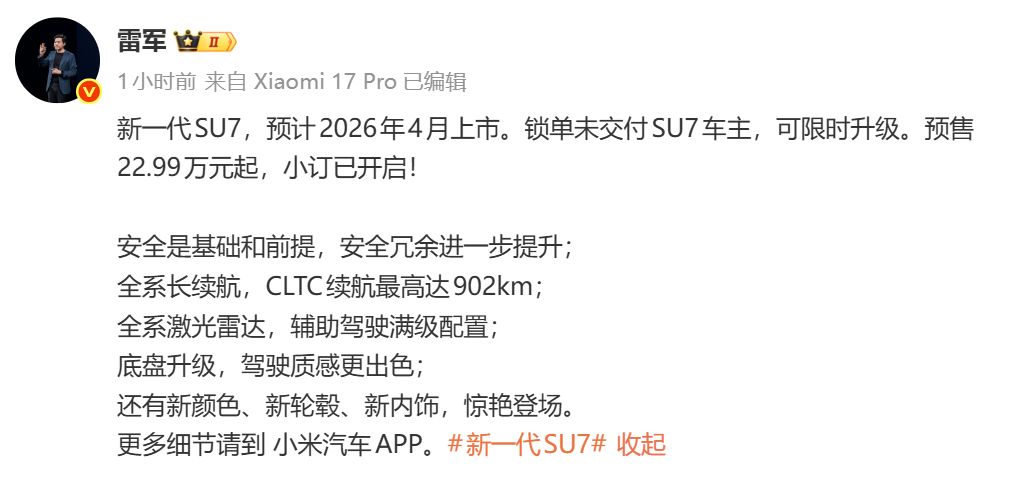
涨价超1万元!新一代小米SU7开启预售 雷军:预计2026年4月上市
Mei Ri Jing Ji Xin Wen· 2026-01-07 03:44
Core Insights - Xiaomi Auto has launched the new generation SU7 with pre-sale prices starting at 229,900 yuan for the standard version, 259,900 yuan for the Pro version, and 309,900 yuan for the Max version, reflecting price increases of 14,000 yuan for the standard and Pro versions, and 10,000 yuan for the Max version compared to the previous model [1][3] - The new SU7 is expected to be officially launched in April 2026, with an upgrade option available for existing SU7 owners who have not yet received their vehicles [1] - The new SU7 features advanced technology including laser radar and 4D millimeter-wave radar, along with a flagship chip providing 700 TOPS computing power for precise environmental recognition in all conditions [3] Delivery and Performance - Xiaomi's SU7 has achieved significant delivery milestones, with over 360,000 units delivered in just 21 months, averaging more than 17,000 units per month [3] - As of January 1, 2025, Xiaomi Auto reported that its monthly delivery volume exceeded 50,000 units for the first time, following three consecutive months of deliveries over 40,000 units [3] - The total cumulative delivery for 2025 has surpassed 410,000 units, with a target of 550,000 units set for 2026 [3]

新一代小米SU7预售 欲成为纯电轿车新标杆
Zheng Quan Shi Bao Wang· 2026-01-07 03:28
Core Viewpoint - The launch of the new generation Xiaomi SU7 marks a significant step for Xiaomi in the electric vehicle market, with strong initial demand and a focus on safety and technology upgrades [1][2]. Group 1: Product Launch and Demand - The new generation Xiaomi SU7 is set to be released in April 2026, with a starting price of 225,900 yuan [1]. - The initial response to the SU7 has been remarkable, with over 50,000 orders placed within 27 minutes and nearly 89,000 orders within 24 hours [1]. - The SU7 is projected to top the sales chart for electric sedans priced above 200,000 yuan in 2025, establishing its benchmark status in the electric sedan market [1]. Group 2: Safety and Design Enhancements - The new generation SU7 will undergo comprehensive upgrades in design quality, comfort, safety, assisted driving, and battery life [1]. - Safety is a top priority, with the new SU7 adhering to the "China-Europe five-star" safety standard and utilizing upgraded materials, including 2200Mpa ultra-high-strength steel for its body structure [1][2]. - The battery pack features enhanced protection with a bulletproof coating and a 1500Mpa anti-scratch bottom beam to improve safety in complex road conditions [2]. Group 3: Intelligent Driving and Performance - The new generation SU7 will come standard with advanced driving assistance hardware, including laser radar and 4D millimeter-wave radar, supported by a flagship chip with 700 TOPS computing power for precise environmental recognition [2]. - The range of the new SU7 has been improved, with the standard version increasing from 700 km to 720 km, the Pro version from 830 km to 902 km, and the Max version from 810 km to 835 km, making the Pro version the longest-range electric sedan currently available [2]. - The new SU7 will be available in three versions with pre-sale prices of 229,900 yuan for the standard version, 259,900 yuan for the Pro version, and 309,900 yuan for the Max version [2].
海外Robotaxi产业链深度梳理
2026-01-07 03:05
Summary of Key Points from the Conference Call Industry Overview - The report focuses on the **Robotaxi industry**, highlighting the involvement of major players like **NVIDIA**, **Xpeng Motors**, and **Horizon Robotics** in the transition from L2 to L4 autonomous driving technology [1][2][4]. Market Segmentation - The **overseas Robotaxi market** is divided into four main regions: **North America**, **Europe**, **Middle East**, and **Southeast Asia**. Each region has distinct characteristics affecting the Robotaxi business model and growth potential [1][5]. North America - Dominated by **Uber** and **Lyft**, creating a duopoly with low tolerance for non-local companies. **Waymo** is the largest Robotaxi operator with commercial operations in place [5][10]. - The market has evolved through three phases: spontaneous development (2010-2013), price wars (2014-2017), and regulatory establishment (2018-present) [9]. Europe - Characterized by fragmented regulations and varying local market conditions. Local companies have advantages due to regulatory differences [5][13]. - The profitability of Robotaxis is higher in developed areas like the UK and UAE, with per kilometer prices reaching approximately **$66** [8]. Middle East - High customer spending, strong policy support, and significant infrastructure investment make it an ideal testing ground for Robotaxis. Chinese companies like **WeRide** and **Pony.ai** have made notable progress [5][17]. Southeast Asia - Infrastructure challenges and a low tolerance for four-wheeled vehicles hinder growth. Singapore is expected to lead in commercial deployment, but overall growth remains limited [5][18]. Market Projections - By **2030**, the projected Robotaxi penetration rates are as follows: - **China**: 5% - **North America**: 20% - **Europe**: 5% - **Middle East**: Rapid growth expected - **Southeast Asia**: Low penetration [7]. Key Players and Business Models - **NVIDIA** is positioned as a leading player in the autonomous driving ecosystem, enhancing the transition to L4 technology [2]. - **Xpeng Motors** is highlighted as a key player in the Hong Kong market, while **Horizon Robotics** is noted for its role in the hardware segment [4]. - Traditional automakers have struggled in the ride-hailing market due to conflicting interests and slow adaptation to market changes [14]. Financial Insights - In high-price areas of Europe, the gross profit per vehicle is estimated at **$55,000** in the UAE, **$16,000** in the UK, and **$17,000** in the US [3][8]. Regulatory Environment - North America has stringent regulations limiting non-local companies, while Europe has a more fragmented regulatory landscape that can benefit local players [6][13]. Future Outlook - The European shared mobility market is expected to reach **$55 billion** by **2025**, with the Robotaxi market projected to grow to **$6 billion** by **2030** [16]. Conclusion - The Robotaxi industry is poised for significant growth, particularly in North America and the Middle East, driven by technological advancements and evolving regulatory landscapes. However, challenges remain in Europe and Southeast Asia due to regulatory fragmentation and infrastructure limitations [1][5][17].



英伟达加速进军智驾业务-继续重点推荐智能汽车板块
2026-01-07 03:05
Summary of Conference Call on NVIDIA and the Smart Automotive Sector Industry Overview - The conference call focuses on the smart automotive sector, particularly the advancements in autonomous driving technology led by NVIDIA in collaboration with Mercedes-Benz [1][2]. Key Points and Arguments - **NVIDIA and Mercedes-Benz Collaboration**: This partnership signifies a major advancement in the autonomous driving field, with a clear production timeline set for 2026. Testing will begin in the U.S. in Q1 2026, followed by deployment in Europe in Q2, and expansion into Asia later in the year. By the end of 2026, the vehicles are expected to have urban operational vehicle (OV) capabilities, positioning NVIDIA as a potential third-party leader in the global autonomous driving market [1][2]. - **Impact on Competition**: The collaboration is expected to have a significant demonstration effect in overseas markets, potentially attracting more automotive companies to accelerate their efforts to catch up with Tesla. This will intensify competition in the Chinese market and promote the development of Robotaxi services, which is particularly crucial for non-Chinese markets where competition is currently limited [1][3]. - **Investment Recommendations**: - For H-shares, the focus should be on XPeng (closest to Tesla's model) and Horizon Robotics (best mapping). Additionally, companies like Pony.ai and WeRide, which are purely focused on L4 Robotaxi, are highlighted for their potential. - For A-shares, Desay SV Automotive is noted as the best mapping object, while Qianli Technology is recognized as the only company actively engaged in Robotaxi-related business. Other small to mid-cap stocks like Beijing Junzheng and Dazhongnan are also recommended for investment [1][4]. Future Catalysts - Key future catalysts that may influence the smart automotive sector include: - The introduction of L3/L4 national standards - Full domestic rollout of Tesla's Full Self-Driving (FSD) technology - Launch of new models by XPeng and iterations of the second-generation Vehicle Operating Architecture (VOA) - Doubling of sales targets by companies like Pony.ai, LoBot, and WeRide - Continued progress by third-party players like Horizon Robotics and Momenta in L4 development - The implementation of electrification policies, which will alleviate overall concerns and shift the focus of autonomous driving to B-end applications [1][5]. Market Outlook for 2026 - The outlook for the smart automotive sector in 2026 is increasingly centered on L4 autonomous vehicle scenarios, particularly the Robotaxi market, which is expected to be the largest and most accommodating for various players. Since September, numerous catalysts, including Tesla's record highs and new model launches from XPeng, indicate that the industry is in a phase of positive development. Investors are advised to closely monitor NVIDIA, Tesla, and related mapping stocks like XPeng, Horizon Robotics, Pony.ai, and WeRide, while keeping an eye on upcoming policies and technological advancements to seize investment opportunities [1][6][7].