
经济增长

Search documents
债市基本面高频数据跟踪报告:钢材累库速度加快:2025年8月第1周
SINOLINK SECURITIES· 2025-08-06 13:50
Report Industry Investment Rating No relevant content provided. Core Viewpoints of the Report The report analyzes the economic growth, inflation, and related price trends in multiple industries. It shows that steel inventory is accumulating faster, power plant daily consumption is rising moderately, and there are various changes in the prices of agricultural products, industrial products, and energy commodities [1][3]. Summary by Related Catalogs 1. Economic Growth: Faster Accumulation of Steel Inventory 1.1 Production: Moderate Increase in Power Plant Daily Consumption - Power plant daily consumption increased moderately. On August 5, the average daily consumption of 6 major power - generation groups was 89.0 tons, up 0.9% from July 29. On August 1, the daily consumption of power plants in eight southern provinces was 223.1 tons, up 0.3% from July 24 [5][12]. - Blast furnace operating rate fluctuated at a high level. On August 1, the national blast furnace operating rate was 83.5%, unchanged from July 25; the capacity utilization rate was 90.2%, down 0.6 percentage points from July 25. The blast furnace operating rate of Tangshan steel mills was 93.3%, up 1.3 percentage points from July 25 [15]. - Tire operating rate declined slightly. On July 31, the operating rate of truck full - steel tires was 61.1%, down 3.9 percentage points from July 24; the operating rate of car semi - steel tires was 74.5%, down 1.4 percentage points from July 24. The operating rate of looms in Jiangsu and Zhejiang was weakly stable [17]. 1.2 Demand: Faster Accumulation of Steel Inventory - New home sales in 30 cities turned negative month - on - month. From August 1 - 5, the average daily sales area of commercial housing in 30 large and medium - sized cities was 162,000 square meters, down 20.1% from July, 21.2% from August last year, and 40.6% from August 2023 [23]. - The auto market retail was stable and relatively strong. In July, retail sales increased by 7% year - on - year, and wholesale sales increased by 12% year - on - year [24]. - Steel prices corrected. On August 5, the prices of rebar, wire rod, hot - rolled coil, and cold - rolled coil changed by - 2.3%, - 2.0%, - 1.4%, and + 0.4% respectively compared with July 29 [5][31]. - Cement prices declined at a low level. On August 5, the national cement price index fell 0.6% from July 29. The cement prices in East China and the Yangtze River region fell 1.3% and 0.2% respectively [32]. - Glass prices fell further. On August 5, the active glass futures contract price was 1,073 yuan/ton, down 9.2% from July 29 [36]. - The container shipping freight index continued to decline. On August 1, the CCFI index decreased by 2.3% and the SCFI index decreased by 2.6% compared with July 25 [38]. 2. Inflation: Agricultural Product Price Index at the Second - Lowest Level in the Same Period of the Past 5 Years 2.1 CPI: Agricultural Product Price Index at the Second - Lowest Level in the Same Period of the Past 5 Years - Pork prices remained weak. On August 5, the average wholesale price of pork was 20.3 yuan/kg, down 0.8% from July 29. In August, the average wholesale price of pork decreased month - on - month and the year - on - year decline widened [45]. - The agricultural product price index was at the second - lowest level in the same period of the past 5 years. On August 5, the agricultural product wholesale price index rose 0.7% from July 29. By variety, vegetables (+2.5%) > chicken (+0.9%) > beef (+0.4%) > pork (-0.8%) > eggs (-1.0%) > mutton (-1.1%) > fruits (-2.4%) [49]. 2.2 PPI: Oil Price Decline - Oil prices declined. On August 5, the spot prices of Brent and WTI crude oil were 69.6 and 65.2 dollars/barrel respectively, down 2.7% and 5.9% from July 29 [54]. - Copper and aluminum prices fell. On August 5, the prices of LME 3 - month copper and aluminum decreased by 1.4% and 1.6% respectively compared with July 29 [58]. - Most industrial product prices rose. Since August, most industrial product prices increased month - on - month, and most of them increased year - on - year. The prices of cement and glass decreased month - on - month, while other industrial products generally increased [62].
拉加经委会预计2025年拉美和加勒比地区经济增长2.2%
Xin Hua She· 2025-08-06 10:24
Core Insights - The United Nations Economic Commission for Latin America and the Caribbean (ECLAC) forecasts economic growth for the region at 2.2% in 2025 and 2.3% in 2026, influenced by external factors such as geopolitical conflicts and tightening financial conditions, as well as internal factors like weak consumer demand [1] Economic Growth Projections - South America is expected to grow by 2.7% this year, driven by strong performances from Argentina, Ecuador, and Colombia, surpassing the regional average [1] - Central America and Mexico are projected to grow by only 1.0%, a significant decline due to reduced demand from the United States [1] - The Caribbean region (excluding Guyana) is anticipated to grow by 1.8%, showing a slowdown compared to the previous year [1] Employment and Inflation Outlook - Economic growth slowdown is expected to limit employment growth in the Latin American region [1] - Inflation rates in the region are projected to remain around 3% from 2025 to 2026, with upward pressure and risks due to potential increases in international food and energy prices [1] Recommendations for Development Financing - The report suggests enhancing development financing capabilities in Latin America through improved efficiency in fiscal spending, optimized tax management, reforms in the international financial system, better sovereign debt resolution mechanisms, and strengthening the role of development banks in resource mobilization [2]
免费学前教育落地,蕴含怎样的“民生经济学”
Xin Jing Bao· 2025-08-06 08:09
Group 1 - The core viewpoint of the news is the implementation of free preschool education in China, starting from the fall semester of 2025, which aims to alleviate the financial burden on families and enhance educational equity [1][3]. - The government emphasizes increasing fiscal education funding as a crucial measure to support the priority development of education and to ensure quality education for the public [1][3]. - The gradual implementation of free preschool education is expected to boost demand for education services, particularly benefiting low-income families and enhancing overall educational satisfaction [2][3]. Group 2 - Increased fiscal education funding is projected to have a significant positive impact on economic growth, with effects lasting even a decade after the initial investment [2]. - The move towards free preschool education is anticipated to create more job opportunities in the education sector, particularly for graduates in related fields [2][3]. - By reducing education expenses, free preschool education is likely to stimulate consumer spending in other areas, thereby contributing to broader economic growth [2][3].
金荣中国:俄罗斯据称考虑空中停火,金价扩大回落震荡收涨
Sou Hu Cai Jing· 2025-08-06 01:51
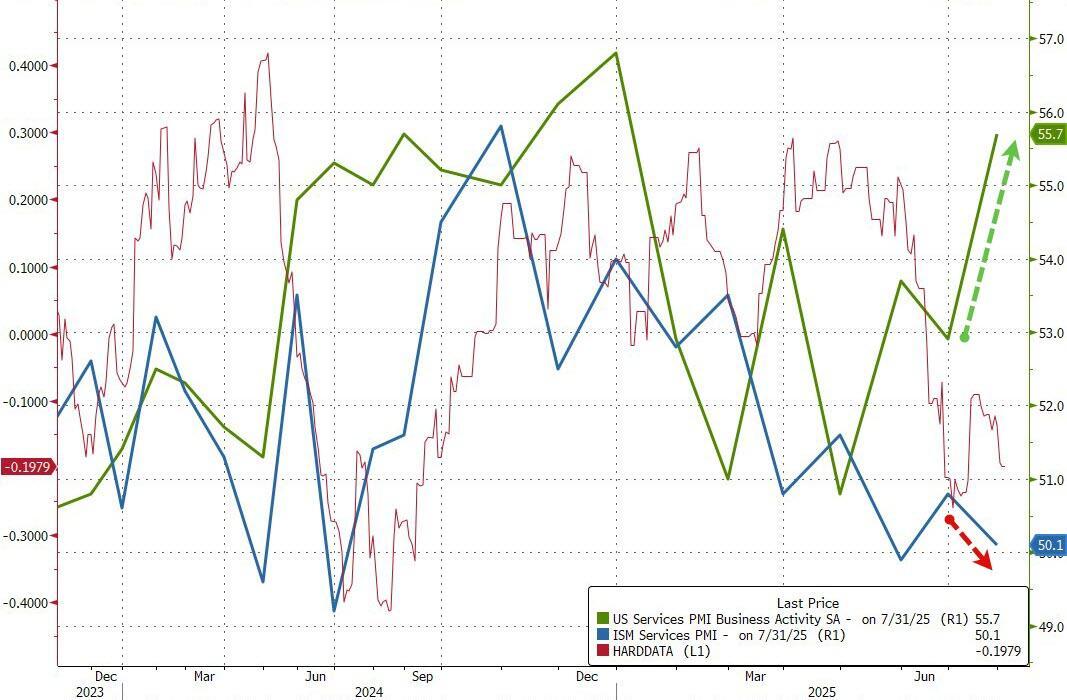
行情回顾: 国际黄金周二(8月5日)扩大回落再度收涨,开盘价3374.28美元/盎司,最高价3390.03美元/盎司,最低价 3349.78美元/盎司,收盘价3389.49美元/盎司。 消息面: 周二公布的美国7月ISM非制造业PMI录得50.1,低于市场预期51.5,前值位50.8;美国7月标普全球服务业PMI 终值录得55.7,高于市场预期55.2,前值位55.2。 标准普尔全球首席商业经济学家:7月份,美国服务业商业活动的强劲增长帮助抵消了制造业的放缓,表明第 三季度初经济增长强劲,令人鼓舞。虽然2025年上半年的GDP平均增速为1.25%,但7月份的PMI显示,经济增 速将翻一番,达到2.5%左右。 美国银行CEO莫伊尼汉:我们的经济学家认为美联储将在2026年降息。我们的经济学家认为美联储(今年)不 会降息,因为通胀回落需要更长时间。我们的经济学家认为今年美国经济将增长约1%到1.5%。我们的经济学 家认为不会出现经济衰退。 地缘局势: 尽管俄罗斯仍坚定地继续推进其军事行动,克里姆林宫正在权衡向美国总统特朗普作出让步,其中可能包括与 乌克兰达成空中停火协议,试图避免遭到二级制裁。知情人士表示,尽管外 ...


美国7月ISM服务业PMI仅50.1,就业萎缩,价格创2022年10月新高
Hua Er Jie Jian Wen· 2025-08-05 22:28
Core Viewpoint - The ISM services PMI data indicates a stagnating U.S. services sector due to weak demand and rising costs, leading to a reduction in workforce [1][4]. Group 1: PMI Data Analysis - The ISM non-manufacturing index for July is reported at 50.1, below the expected 51.5 and the previous value of 50.8, indicating near stagnation [1]. - The new orders index has dropped to 50.3, approaching a standstill [2]. - The employment index has decreased to 46.4, marking the fourth contraction in five months and one of the lowest levels since the pandemic [2]. Group 2: Price and Inventory Trends - The prices index for raw materials and services has risen to 69.9, the highest level since October 2022 [2]. - Backlogged orders have decreased for the fifth consecutive month, and inventory expansion has slowed, with the inventory sentiment index falling nearly 4 points to 53.2, the lowest since October of the previous year [2]. Group 3: Economic Context and Market Reaction - Analysts suggest that the ISM PMI data reflects a weak U.S. services economy grappling with higher tariffs, cautious consumer attitudes, and uncertainties from government policies [4]. - Following the PMI data release, U.S. stock markets turned negative, with the Nasdaq 100 dropping nearly 0.7% after previously gaining [5]. - The divergence between the ISM services PMI and the stronger Markit services PMI, which reported a final value of 55.7, indicates contrasting economic signals [5][6]. Group 4: Future Outlook - The overall business sentiment has declined, with manufacturing and services confidence weakening, suggesting potential downward risks for growth in the coming months [9]. - Despite the current economic challenges, there are indications of a potential rebound in growth driven by increased demand in the technology sector and financial services [8].
继续攀升!乘联分会:今年新能源车渗透率将达56%
Nan Fang Du Shi Bao· 2025-08-05 15:15
Group 1 - The China Automobile Circulation Association has revised its forecast for the annual passenger car retail volume, expecting a slight increase of 6% [1] - The wholesale sales of new energy passenger vehicles are projected to grow nearly 30% to 15.48 million units, with a penetration rate of 56% [1] - In the first half of 2025, the cumulative retail volume of passenger cars and new energy passenger vehicles increased by 10.8% and 33.3%, respectively [1] Group 2 - The total wholesale volume of automobiles in China is expected to reach 34.04 million units in 2025, representing an 8% growth [2] - The automotive industry has become the primary pillar of the national economy, surpassing other industries in output value [2] - The automotive market is facing multiple pressures, including domestic competition and uncertainties from international tariffs [2]
中共中央政治局召开会议;资金面均衡偏松,债市明显回暖
Dong Fang Jin Cheng· 2025-08-05 13:24
Monetary Policy and Economic Outlook - The Central Political Bureau of the Communist Party of China decided to hold the Fourth Plenary Session of the 20th Central Committee in October to discuss the 15th Five-Year Plan for economic and social development, emphasizing the need for stable and flexible policies[5] - The government plans to allocate approximately 90% of the 90 billion yuan budget for childcare subsidies from the central finance[6] Market Trends - The bond market showed signs of recovery, with the yield on the 10-year government bond decreasing by 2.75 basis points to 1.7200%[16] - The U.S. Federal Reserve maintained the federal funds rate at 4.25% to 4.5%, marking the fifth consecutive meeting without changes, while the U.S. GDP grew at an annualized rate of 3% in Q2, surpassing expectations[8][9] Financial Market Performance - The bond market experienced a net cash injection of 158.5 billion yuan on July 30, following a 3,090 billion yuan reverse repurchase operation by the central bank[12] - The weighted average interest rates for various repo transactions showed a downward trend, with DR001 and DR007 rates falling to 1.315% and 1.518%, respectively[13][14] Commodity Prices - International crude oil prices increased, with WTI rising by 1.36% to $70.99 per barrel, while natural gas prices fell by 1.89% to $3.016 per MMBtu[10] Bond Issuance and Trading - The bond auction results indicated a competitive bidding environment, with the 1-year agricultural development bond receiving a bid-to-cover ratio of 2.3[18] - The convertible bond market saw a decline, with major indices dropping, and a total trading volume of 84.376 billion yuan, down by 5.53 billion yuan from the previous day[24]



江苏十三市半年报:苏州GDP超1.3万亿,淮安增速继续领跑
Xin Hua Ri Bao· 2025-08-05 11:42
Economic Overview - The province achieved a GDP of 66,967.8 billion yuan in the first half of the year, reflecting a year-on-year growth of 5.7% at constant prices [1] - Five cities surpassed a GDP of 5,000 billion yuan, indicating stable economic development [1] - Seven cities exceeded the provincial growth rate of 5.7%, while three cities maintained this growth rate [1] Leading Cities - Suzhou led the province with a GDP of 13,002.35 billion yuan, the only city to exceed 10,000 billion yuan in the first half [1] - Nanjing followed with a GDP of 9,179.18 billion yuan, ranking second [1] - Wuxi ranked third with a GDP of 7,735.15 billion yuan [1] Economic Strategies - Suzhou's industrial development focused on both quantity and quality, maintaining stable internal and external demand [1] - The city implemented the "1030" industrial system and "1840" service system, along with the "Suzhou Intelligent Manufacturing Ten Actions" [1] - Industrial added value in Suzhou grew by 8.0% year-on-year, consistently maintaining above 8% growth [1] Foreign Trade Performance - Suzhou's foreign trade reached 12,958.8 billion yuan, marking a historical high with a growth of 5.7% [2] Other Notable Cities - Nantong and Changzhou also exceeded 5,000 billion yuan in GDP, with figures of 6,581.19 billion yuan and 5,079.13 billion yuan, respectively [3] - Xuzhou's GDP reached 4,509.30 billion yuan, positioning it as a potential "trillion city" [3] Growth Leaders - Huai'an led the province with a growth rate of 6.8%, continuing its first-quarter position [3] - Xuzhou and Suqian followed with growth rates of 6.2% and 6.1%, respectively [3] Huai'an's Economic Performance - Huai'an's industrial production saw significant growth, with industrial added value increasing by 8.9% [4] - The city achieved a revenue of 2,062.58 billion yuan from industrial enterprises, reflecting an 8.1% year-on-year increase [4] - Fixed asset investment in Huai'an grew by 5.3%, with industrial investment rising by 17.2% [4]
ETF Asset Report of the Month of July
ZACKS· 2025-08-05 11:31
Market Performance - Wall Street showed moderate performance in July, with SPDR S&P 500 ETF Trust (SPY) increasing by approximately 2.2%, SPDR Dow Jones Industrial Average ETF Trust (DIA) rising by about 0.1%, and Invesco QQQ Trust, Series 1 (QQQ) gaining around 2.4% [1] Earnings Reports - Microsoft and Meta reported strong earnings in July, while Amazon exceeded Q2 earnings and revenues but saw a decline in shares due to weak Q3 guidance. Apple shares, however, increased following its earnings report [1] U.S. Economic Indicators - The U.S. economy rebounded in Q2 2025 with a GDP growth rate of 3%, surpassing the forecast of 2.6% [2] - July jobs data revealed a nonfarm payroll increase of only 73,000, significantly below the expected 100,000, with prior months' figures revised downwards, indicating a prolonged labor market slowdown [3] Eurozone Economic Performance - Eurozone economic growth exceeded expectations, with GDP rising by 0.1% sequentially, driven by strong performances from Spain, France, and Ireland, despite contractions in Germany and Italy [4][5] U.S. Housing Market - New single-family home sales in the U.S. rose by just 0.6% to an annual rate of 627,000 units in June, falling short of the expected 650,000 units due to high mortgage rates [6] ETF Asset Flows - In July, significant asset inflows were noted in various ETFs, including Vanguard S&P 500 ETF (VOO) with $12.68 billion, SPDR S&P 500 ETF Trust (SPY) with $7.12 billion, and iShares Core S&P 500 ETF (IVV) with $5.65 billion [8] - Cryptocurrency ETFs also performed well, with iShares Bitcoin Trust ETF (IBIT) attracting about $5.31 billion and iShares Ethereum Trust ETF (ETHA) adding approximately $4.34 billion [9] - Financial Select Sector SPDR Fund (XLF) gained about $3.15 billion in assets due to positive earnings [10] - International markets saw inflows with Vanguard Total International Stock ETF (VXUS) and iShares Core MSCI Emerging Markets ETF (IEMG) adding about $2.44 billion and $2.35 billion, respectively [11] - Conversely, small-cap ETFs like iShares Russell 2000 ETF (IWM) experienced a decline of about $3.7 billion, while Vanguard Small Cap ETF (VB) lost approximately $126 billion [12] - Corporate bond ETFs underperformed, with iShares iBoxx $ Investment Grade Corporate Bond ETF (LQD) and Vanguard Long-Term Corporate Bond ETF (VCLT) losing about $3.92 billion and $3.20 billion, respectively [13]



柬埔寨经济更新 2025年6月:应对不确定性:特别关注为柬埔寨的未来增强收入
Shi Jie Yin Hang· 2025-08-05 09:02
Economic Performance - Cambodia's economy shows strong but uneven performance, with manufacturing and services growth driven by stable exports, particularly in garments and tourism[35] - Agricultural sector employment remains significant, supporting 3.1 million jobs, but its contribution to GDP growth is limited, only 0.2 percentage points in 2024[36] - Total rice production increased by 11.0% in 2024, but structural challenges persist, including reliance on weather conditions and price volatility[36] Trade and Investment - Exports to the US, especially garments, remain strong, with a year-on-year growth of 11.6% in Q1 2025, contributing significantly to consumer confidence[38] - Foreign Direct Investment (FDI) inflows are primarily from China, accounting for 65.5% of total net FDI, while domestic investment approvals have sharply declined by 96.7% year-on-year[39][43] - Total goods exports reached $26.673 billion in 2024, with a significant contribution from the garment, travel goods, and footwear sectors[43] Inflation and Monetary Policy - Inflation rose to 3.7% in March 2025, driven mainly by food price increases, while broad money supply growth reached 19.0%[38] - The banking sector reported a non-performing loan (NPL) rate of 7.9% by the end of 2024, indicating deteriorating asset quality[40] Fiscal Policy and Public Debt - Central government revenue increased by 11.2% year-on-year in Q1 2025, primarily due to significant growth in VAT and non-tax revenues[40] - Public debt remains low at 25.9% of GDP as of the end of 2024, with a projected fiscal deficit of 2.7% of GDP for 2025[41] Social Impact and Inequality - Economic recovery has been uneven, with household consumption per capita growing by 8% from 2021 to 2023, but disparities exist between income groups[42] - The poorest 20% saw a 7% increase in consumption, while the wealthiest 20% experienced a 10% increase, highlighting income inequality[42]