
能源转型

Search documents
海洋能逐步进入规模化利用阶段
Zhong Guo Jing Ji Wang· 2025-12-28 06:45
Group 1 - The marine energy sector in China is gaining attention with the establishment of a national marine energy industry alliance aimed at enhancing innovation, technology sharing, and risk management [1] - The proposal for a "Marine Energy Conversion System Standard System and Roadmap" has been approved for international standardization, marking China's first initiative to lead in setting international standards in the new energy sector [1] - A significant project in Zhoushan, Zhejiang, has been signed to build China's largest tidal energy power station with a total installed capacity of 100 megawatts, which is expected to enhance the scale of tidal energy utilization and reduce costs across the entire industry chain [1] Group 2 - The marine energy sector is entering a phase of large-scale utilization against the backdrop of energy transition and low-carbon development, with marine energy being a renewable resource derived from natural phenomena such as tides and waves [2] - Policies have been introduced to promote marine energy, aiming for an installed capacity of 400,000 kilowatts by 2030, along with the establishment of multi-energy complementary power systems and demonstration projects [2] - The National Standardization Administration has released standards for the identification of new technologies in wave and tidal energy conversion devices, providing a unified framework for technological assessment [2] Group 3 - The development of a third-generation million-kilowatt pneumatic wave energy generation device is underway, recognized as a major technological equipment in the energy sector [3] - Hainan Province has initiated a multi-energy complementary pilot project focusing on integrating marine energy with hydrogen production, marine ranching, and underwater data centers [3] - The International Energy Agency predicts that global marine energy installed capacity will reach 70 million kilowatts by 2030 and 350 million kilowatts by 2050, with various countries planning developments in marine energy [3]
奋勇争先,决战决胜“十四五”︱人民日报头版:新型能源体系加快建设
国家能源局· 2025-12-28 04:07
Core Viewpoint - The article emphasizes the accelerated construction of a new energy system in China, highlighting the importance of transitioning to renewable energy sources and enhancing energy security to support economic development and carbon neutrality goals [15][16][19]. Group 1: New Energy Development - The Ningxia Tengger Desert New Energy Base has successfully launched its first batch of 3 million kilowatts of solar capacity, showcasing a significant expansion in renewable energy production [17]. - The Ningxia-Hunan UHV project, spanning over 1,600 kilometers, can transmit green electricity in approximately 0.0054 seconds, significantly enhancing energy distribution efficiency [17]. - The project is expected to deliver over 36 billion kilowatt-hours of electricity annually to Hunan, with renewable energy accounting for over 50% of this supply [17][18]. Group 2: Energy Supply Structure - During the "14th Five-Year Plan" period, China's renewable energy generation capacity is projected to increase from 40% to around 60%, marking a substantial shift in the energy supply structure [21]. - The share of non-fossil energy in national energy consumption is expected to exceed the 20% target set for the "14th Five-Year Plan," with green electricity accounting for nearly 40% of total electricity consumption [21]. Group 3: Technological Innovations - China has developed a 26-megawatt offshore wind turbine with a rotor diameter exceeding 310 meters, capable of generating 62 kilowatt-hours per rotation, representing a significant technological advancement in renewable energy [20]. - The country is also implementing various innovative energy solutions, including the first domestic 220 kV flexible low-frequency transmission project and the world's first grid-connected sodium-ion energy storage system [23]. Group 4: Fossil Energy Transition - The domestic oil and gas production capacity has reached over 400 million tons, maintaining a rapid growth trend, while efforts are being made to enhance the efficiency and environmental sustainability of fossil fuel usage [22]. - The implementation of energy-saving and carbon-reduction modifications in coal-fired power plants is part of the broader strategy to transition towards greener energy sources [22].


贵金属“狂欢”
Guo Ji Jin Rong Bao· 2025-12-27 04:51
Core Insights - The global precious metals market is experiencing a historic surge, with gold prices surpassing $4500 per ounce and silver prices exceeding $72 per ounce, marking significant annual increases [1] - Economic concerns are rising as the dollar's credit system faces severe challenges, highlighted by the rare phenomenon of silver being more expensive than oil, which has not occurred in 45 years [1] Supply and Demand Imbalance - Gold has become a key asset in global portfolios amid geopolitical risks and macroeconomic uncertainties, with central bank purchases supporting its price [2] - Silver prices have tripled since their 2022 low, driven by industrial demand from sectors like solar energy and electric vehicles, alongside a persistent supply shortage [3] Platinum and Palladium Market Dynamics - Platinum has shown remarkable performance, with prices increasing over 150% this year, driven by demand from the hydrogen energy sector [4] - Palladium is also facing supply constraints, with a projected shortfall of approximately 200,000 ounces by 2025, further supporting its price [4] Copper Price Surge - Copper prices have reached historical highs, driven by strong demand from energy transition and infrastructure investments, while supply disruptions have tightened the market [5] Dollar Credibility Concerns - The rise in precious metal prices reflects a shift in investor confidence regarding the stability of traditional currency systems, particularly the dollar [7] - Concerns over U.S. government debt, which has exceeded $38.5 trillion, are prompting investors to seek refuge in physical assets like gold [8] Economic Crisis Signals - The current ratio of silver to oil prices has reached its highest level since 1990, often indicating impending economic crises [10] - Historical patterns suggest that significant disparities between silver and oil prices can signal structural economic risks [11] Regulatory and Market Dynamics - The potential for regulatory interventions, such as increased margin requirements for silver trading, could lead to significant price corrections [12] - The current market environment mirrors past crises, raising concerns about the sustainability of price increases in precious metals [12]
独家专访中国气候变化事务特使刘振民:全球推进气候合作B计划
2 1 Shi Ji Jing Ji Bao Dao· 2025-12-27 01:49
Group 1 - The announcement of the U.S. withdrawal from the Paris Agreement has prompted countries to develop a "Plan B" to continue global energy transition and climate change efforts [1] - Liu Zhenmin emphasized that international cooperation can still progress despite the U.S. absence, particularly in addressing funding challenges for climate change initiatives [2] - The U.S. exit from the Paris Agreement has led to a revival of support for traditional energy companies, while subsidies for renewable energy firms have ceased, impacting the operations of domestic renewable energy companies [2] Group 2 - The inconsistency in U.S. energy policy has affected its energy transition process and international obligations, but Liu Zhenmin believes that changes in a single country's energy policy will not hinder the global energy transition momentum [3] - The next decade will see energy transition as a key area for global economic cooperation and investment opportunities, with developed countries needing to fulfill their obligations to assist developing nations [3]
内外盘齐创历史新高!今年银称霸明年换铜?沪铜站上10万大关,纽铜盘中涨超5%
Hua Er Jie Jian Wen· 2025-12-26 23:30
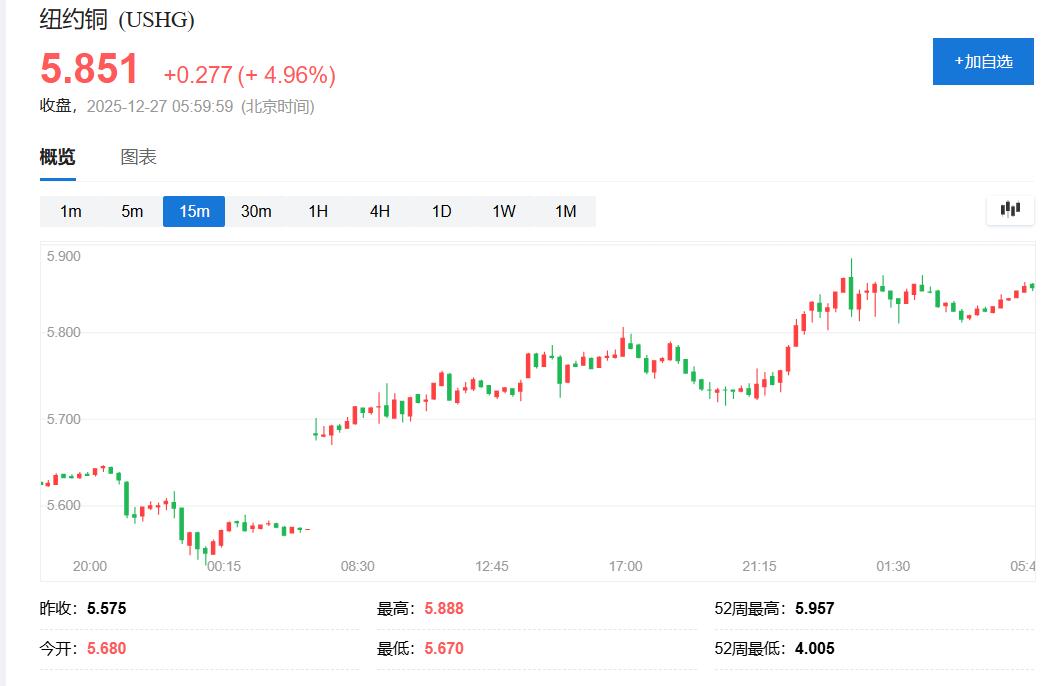
Core Viewpoint - The recent surge in copper prices is driven by a combination of supply concerns and a weakening dollar, with expectations for tighter global copper supply in 2026, positioning copper as a potential outperformer in the metals market next year [1][4][8]. Group 1: Copper Price Performance - On December 26, the Shanghai copper futures broke the 100,000 RMB mark for the first time, closing up over 3.3% [1]. - The New York copper futures also saw significant gains, with the March contract closing above $5.8510 per pound, marking a nearly 5% increase from the previous trading day [1]. - Year-to-date, New York copper has risen approximately 45%, Shanghai copper over 40%, and London copper nearly 39%, driven by supply disruption fears and increased demand from energy transition [3]. Group 2: Market Dynamics - The decline of the Bloomberg Dollar Spot Index by nearly 0.8% this week has made dollar-denominated commodities cheaper for buyers, contributing to the rise in copper prices [4]. - Concerns over potential tariffs on copper imports and geopolitical uncertainties have heightened market risk aversion, further supporting the demand for copper and other precious metals [4][7]. Group 3: Broader Metal Market Trends - The overall precious metals market has seen significant gains, with silver up over 170%, gold up over 70%, and platinum up 133% this year, reflecting a broader bullish trend in commodities [5]. - The market is experiencing a physical silver squeeze, with investors selling paper silver contracts to buy physical silver, indicating a tight supply situation [6]. Group 4: Future Outlook - Wall Street analysts are optimistic about copper's performance in 2026, citing severe supply disruptions and weak inventories outside the U.S. as key factors [8][10]. - UBS has a positive outlook on copper and aluminum, suggesting that while gold's risk-reward profile has become less favorable, copper remains a strong investment opportunity [9].
派能科技(688063):首次覆盖报告:受益国内大储+海外小储+两轮车换电需求向上,公司出货量正加速增长
Shanghai Aijian Securities· 2025-12-26 11:44
Investment Rating - The report assigns an "Accumulate" rating for the company, indicating a positive outlook for its stock performance [7]. Core Insights - The company is expected to benefit from domestic large-scale storage, overseas small-scale storage, and the demand for battery swapping in two-wheeled vehicles, leading to accelerated growth in shipment volumes [1]. - The company is positioned as the fourth largest in China's global household storage system shipments in 2024, with a competitive edge in vertical integration across the entire industry chain, global presence, and continuous R&D investment [7]. - The report highlights the significant growth potential in both domestic and international commercial storage products and lightweight power battery businesses, driven by global energy transformation and favorable policies in emerging markets [7]. Financial Data and Profit Forecast - Revenue projections for the company are as follows: - 2023: 3,299 million CNY - 2024: 2,005 million CNY - 2025E: 2,722 million CNY - 2026E: 5,341 million CNY - 2027E: 9,036 million CNY - The expected year-on-year growth rates are: - 2023: -45.1% - 2024: -39.2% - 2025E: 35.8% - 2026E: 96.2% - 2027E: 69.2% [6]. - The projected net profit for the company is: - 2023: 516 million CNY - 2024: 41 million CNY - 2025E: 90 million CNY - 2026E: 334 million CNY - 2027E: 468 million CNY - The report anticipates a significant recovery in profitability, with net profit growth rates expected to be: - 2024: -92.0% - 2025E: 119.3% - 2026E: 270.9% - 2027E: 40.0% [6]. Industry and Company Situation - The company focuses on overseas household storage, domestic and international commercial storage, and lightweight power battery products, with future growth primarily driven by commercial storage and lightweight battery businesses [7]. - The report notes that the household storage industry is expected to recover due to global energy transformation and emerging market policy benefits, while commercial storage will benefit from global grid upgrades [7]. - The company has established a strong presence in approximately nine countries and regions, focusing on Southeast Asia, Africa, and the Middle East, effectively diversifying regional risks [7]. Key Assumptions - Domestic large-scale storage and commercial storage assumptions include shipment volumes of 1.5/2.0/9.0 GWh from 2025 to 2027, with a unit price of 0.4 CNY/Wh and expected gross margins of 9%/10%/10% [7]. - For overseas household storage and commercial storage, the assumptions are 1.5/4.0/5.0 GWh shipments with unit prices of 1.1/0.8/0.73 CNY/Wh and gross margins of 30%/29%/28% [7]. - Lightweight power battery assumptions include shipments of 1.0/3.5/4.8 GWh with a unit price of 0.4 CNY/Wh, with expected gross margins improving due to scale effects [7].

2026年全球经济分化中求稳,AI从资本开支走向价值兑现 | 界面预言家④
Xin Lang Cai Jing· 2025-12-26 09:46
Core Insights - The global economy is expected to experience a "weak recovery with strong uncertainty" in 2026, with a projected growth rate of around 3% [1][3] - The economic landscape will be characterized by significant regional disparities, with the US leveraging its AI advantages for resilience, while emerging Asian economies lead growth [1][4] - Inflation is anticipated to decline overall, but with notable regional differences, as global monetary policies gradually move away from high-interest rates [1][6] Economic Growth Projections - Global economic growth is forecasted to slow slightly from 3.3% in 2024 to 3.1% in 2026, with developed economies maintaining around 1.5% growth and emerging markets slightly above 4% [3][4] - The International Monetary Fund (IMF) attributes the resilience of global growth to technological advancements, particularly in AI, and the expansion of domestic demand in Asian emerging markets [3][4] Regional Economic Disparities - The US is expected to maintain steady growth due to its tech sector, while the Eurozone and the UK face structural challenges leading to weaker growth [4][5] - Emerging markets, particularly in Asia (India, ASEAN), are projected to be the main growth engines, contrasting with some Latin American and African countries facing high debt and low growth [4][5] Inflation Trends - Global inflation is predicted to decrease from 2024 to 2026, primarily due to falling energy prices, with the World Bank forecasting a 12% drop in commodity prices in 2025 and an additional 5% in 2026 [6] - However, inflation trends will vary significantly by region, with the US facing potential "second inflation" risks due to tariffs and labor supply issues, while Europe has largely controlled inflation [6][7] Monetary and Fiscal Policy Outlook - Global monetary policy is expected to shift towards moderate easing, with the US Federal Reserve likely to continue lowering interest rates in 2026, although the pace may vary [8][9] - Fiscal policy is anticipated to take a more prominent role in driving economic growth, focusing on strategic investments and resource allocation amid high global debt levels [9][10] Risks to Economic Growth - The global economy faces multiple risks, including geopolitical tensions, trade policy uncertainties, and potential financial market bubbles, particularly concerning AI investments and cryptocurrencies [10][11] - Concerns about a fragile job market and rising interest rates could pose significant challenges to economic stability and growth [11]

议题更新!3月19-20日 常州 2026锂电关键材料及应用市场高峰论坛
鑫椤锂电· 2025-12-26 06:19
-广告- 关注公众号,点击公众号主页右上角" ··· ",设置星标 "⭐" ,关注 鑫椤锂电 资讯~ 2026锂电关键材料及应用市场高峰论坛 会议背景 会议主办: 鑫椤资讯 会议时间: 2026年3月19-20日 会议地点: 江苏·常州 会议咨询: 13248122922(微信同) 据鑫椤资讯的预测,2025年全球锂电池产量将达到2250Gwh,2026年的增长率将达到30%,其中储能 领域增速更是有望达到48.3%,呈现出"海内外需求双轮驱动、上下游产业链协同爆发"的盛况。如此爆 发式的市场需求,对电芯及上游四大主材的需求产生了巨大的拉动作用。 然而,从当前有效产能情况来看,电芯及各种材料的远期供应存在着一定的缺口。面对明确的供应缺 口,如何保障稳定、高效的供应链,将成为抓住这轮确定性增长的关键。 为把握锂电行业这一轮发展机遇,鑫椤资讯将于 2026年3月19日-20日 (19日报到)举办 2026锂电关键 材料及应用市场高峰论坛 。本届论坛将聚焦三大核心议题: 一:前沿技术及市场供需深度研讨 会议设置"锂电关键材料主论坛"、"动力电池用关键材料分论坛"和"储能电池用关键材料分论坛"三大专 题论坛,邀请专家 ...

2026 能源双碳年度展望
Zhong Xin Qi Huo· 2025-12-26 02:12
1. Report Industry Investment Rating No relevant content provided. 2. Core Viewpoints - Traditional energy: The slowdown in crude oil supply growth may help prices bottom out; tight thermal coal supply is expected to push up coal price levels; LNG supply growth acceleration is exerting downward pressure on global gas price levels [2][3]. - Carbon market: In 2026, China's carbon market is expected to return to a supply - tight state, and carbon prices may rise with fluctuations; European carbon prices are expected to fluctuate within a range, with the central level possibly slightly declining following natural gas prices [3][4]. 3. Summary by Related Catalogs 3.1 Crude Oil - Supply: The supply growth rate has slowed, with geopolitical issues posing risks. OPEC+ continues to increase production but at a slower pace, halting production increases in Q1 2026; US production has entered a plateau phase and may face production cuts later. Non - US and non - OPEC+ supply increase expectations have also decreased. Overall supply remains loose, but the oversupply pressure has eased, and sanctioned countries' supply may decline periodically [9]. - Demand: Global oil demand growth continues to slow. Developed countries and China's oil demand have entered a plateau phase. Terminal demand lacks highlights, but structural contradictions in overseas refined oil markets and inventory replenishment in some regions support demand [10]. - Price: In a weak supply - demand scenario, the oil price center in 2026 may experience volatile bottom - building. The oversupply pressure will be relatively higher in H1, and the price may be lower in H1 and higher in H2 [11]. 3.2 Coal - Market situation: Since 2021, the coal market has been affected by multiple factors. Coal prices bottomed out in H1 2025, with clear cost support. In the medium - to - long - term, prices are likely to move within a range due to peaking coal demand during the energy transition [15]. - Supply control: To adapt to future coal demand changes and ensure energy security, coal supply needs to be controlled through stable production, safety supervision, and environmental monitoring [16]. - Demand: Coal demand remains resilient. New electricity demand, extreme weather, and the role of thermal power in the power system, as well as coal's use in the chemical industry, contribute to this resilience. Coal demand may peak between 2025 - 2027 and then enter a consumption plateau [17]. - Price: In 2026, coal supply has limited upward elasticity, and demand is moderately resilient. The fundamentals will shift from loose to balanced, with the price center potentially moving up to Rmb700 - 900 per tonne. Key factors include policy evolution and energy transition progress, and price dynamics are affected by unusual weather, speculative demand, market sentiment, and policy changes [18]. 3.3 Natural Gas 3.3.1 LNG - 2025 situation: Global supply growth exceeded 4%, but demand growth was less than 3%. By mid - Nov 2025, new production capacity added 42mn t, with a full - year expectation of over 46mn t. The actual supply increase exceeded 18mn t, with a growth rate over 4%, while the trade volume increase for the first ten months was only 9mn t, with a growth rate less than 3%. This led to a price trend of being higher in H1 and lower in H2 [22]. - 2026 outlook: The supply growth rate is expected to exceed 10%, while demand growth will be significantly lower. Capacity utilization will decline, and gas prices will face sustained pressure. Global production capacity is forecast to accelerate to over 60mn t, with actual supply increases potentially exceeding 40mn t, a growth rate of nearly 10%. The incremental output will mainly come from the US, Mexico, Qatar, and Nigeria. The global LNG trade growth rate in 2026 may be 3 - 4% or below 7% [23]. 3.3.2 Regional Market - Europe: The natural gas supply tends to ease due to global LNG capacity addition. Although Russian gas imports face uncertainty, the global supply increase can cover potential gaps. Residential and commercial gas usage will remain stable, and industrial gas consumption may slightly recover but is limited by energy transition. The gas price center faces downward pressure, and inventory replenishment pace is a key variable for seasonal prices [28]. - US: The market maintains a tight balance. Supply growth is expected to slow down, with some regions still having production potential, but associated gas production growth may decline. Domestic commercial and residential gas consumption may weaken, while industrial and power - sector demand are resilient. Exports will continue to grow strongly. The market is expected to continue inventory drawdown, with the price center staying at relatively high levels and regional structural contradictions becoming more pronounced [29]. 3.4 Carbon 3.4.1 Chinese Market - CEA: In 2026, the "tightening constraint" on quota carryovers in the national carbon market will disappear, and the market may return to the "reluctance to sell" logic. The net surplus of quotas will further decrease, and new demand from three new sectors may lead to carbon prices rising with fluctuations [31][32][33]. - CCER: The national CCER market is accelerating its "expansion". By Nov 6, 2025, 13 projects have completed emission reduction registration, with an initial volume of approximately 15.0428mt, and 11 projects are expected to complete registration in the next 6 months, adding about 7.5276mt of CCERs. The Ministry of Ecology and Environment has released more methodologies, and more may be issued in the future [34][35][38]. 3.4.2 European Market - EUA: European carbon prices will fluctuate within a range, with the central level potentially following natural gas prices to a slight downward adjustment. In 2026, natural gas supply will be more relaxed, and demand will be moderate. In the long - term, as the EU reduces the cap on allowances, carbon prices are likely to have a floor support [37].
储能与锂电2026年度策略:能源转型叠加AI驱动,周期反转步入繁荣期
2025-12-26 02:12
Summary of Key Points from the Conference Call Industry Overview - The conference call focuses on the energy storage and lithium battery industry, highlighting the expected growth and transformation driven by energy transition and AI demand [1][2][3]. Core Insights and Arguments - **AI and Energy Storage Demand**: The demand for energy storage in data centers is expected to surge due to the rapid increase in AI computing power and the slow expansion of the power grid in Europe and the US. By 2026, the AI-related energy storage demand in the US is projected to reach 59 GWh, with 46 GWh for front-of-the-meter and 13 GWh for behind-the-meter applications [1][2][11]. - **Shift in Data Center Energy Needs**: Data centers are transitioning from using energy storage primarily as backup power to utilizing it for peak shaving, frequency regulation, and grid support. Current requirements include at least 2 hours of storage, with some aggressive setups using lithium batteries for 6-8 hours of power [4]. - **Global Energy Storage Market Growth**: The global energy storage market is expected to reach 438 GWh by 2025, with China accounting for 250 GWh, reflecting a 67% year-on-year growth. The US market is projected to reach 70 GWh, and Europe 51 GWh [7][8]. - **Impact of US Trade Policies**: The US "Inflation Reduction Act" has introduced new standards that limit foreign ownership in companies participating in subsidy programs, pushing the US market to seek supply chains outside of China, although reliance on Chinese supply chains will remain high in 2026 [6][11]. Additional Important Insights - **European Net Zero Industrial Act**: This act encourages the use of local production capacities and scores non-EU supply chains, benefiting Chinese companies establishing factories in Europe. The cost of solar plus storage has fallen below that of gas turbines, leading to an expected installation growth rate of over 70% in 2026 [3][10]. - **Lithium Battery Industry Recovery**: The lithium battery industry is in a recovery phase, with expected shipment growth of 30-50% in 2026. The industry is projected to enter a prosperous phase, with a 25% overall growth rate, driven by a 15% increase in power demand and a 56% increase in storage demand [3][22]. - **Emerging Markets**: Regions such as Australia, the Middle East, and Latin America are showing strong growth potential in energy storage, with Australia increasing its capacity targets and significant projects underway in the Middle East and Chile [12][13]. - **Supply Chain Dynamics**: The supply chain for lithium battery materials is expected to see significant price increases, particularly in lithium hexafluorophosphate and separators, which are crucial for battery production. The current market conditions suggest a tight balance in supply and demand for these materials [27][29]. Recommendations for Investment - Companies to watch include CATL, EVE Energy, and Xinwangda, which are positioned well in the energy storage and lithium battery markets. The separator sector is also highlighted as a key area for investment due to its high profit margins and limited new capacity until 2028 [24][25]. This summary encapsulates the critical insights and projections discussed during the conference call, providing a comprehensive overview of the energy storage and lithium battery industry's current state and future outlook.


