
困境反转

Search documents
首批基金三季报来了
中国基金报· 2025-10-17 11:36
【导读】首批基金三季报出炉 基金经理调仓换股更看重成长性 中国基金报记者 若晖 首批 2025 年基金三季报出炉。部分基金的规模变动、基金经理调仓换股情况浮出水面。 数据显示,三季度,受益于份额增长及基金单位净值上涨,部分跟踪人工智能指数的 ETF 及 主投新能源、电子等领域的基金规模的增长。 基金经理操作方面,增持锂电产业链、港股互联网、以及有色板块内部的铜类资源股为调仓 的主要方向。 部分基金业绩、规模 " 双丰收 " 今年三季度, A 股市场在算力等科技板块带动下,走出一波极致的上涨行情,部分基金的规 模也跟着水涨船高。 基金三季报显示,赵诣管理的泉果旭源三年持有期混合基金规模从二季度末的 130.81 亿元 增长至三季度末的 190.69 亿元,单季度规模增长近 60 亿元。份额变化方面,该基金三季 度份额增长约 0.15% ,规模增长主要靠基金单位净值上涨带动。 Wind 数据显示,该基金 A 类份额三季度单位净值增长 45.58% ,今年前三季度单位净值上涨 48.80% 。 跟着人工智能指数的 ETF 在三季度获得基民踊跃申购。三季度数据显示,华富中证人工智能 产业 ETF 三季度末规模达到 8 ...


首批基金三季报来了
Zhong Guo Ji Jin Bao· 2025-10-17 11:31
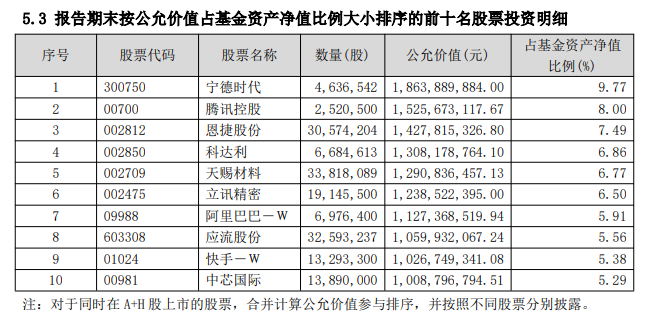
Core Insights - The first batch of 2025 fund Q3 reports reveals that fund managers are increasingly focusing on growth potential in their stock selections [1][4] Fund Performance and Scale - In Q3, A-share market experienced a significant rally driven by technology sectors, leading to substantial growth in fund sizes [2] - The fund managed by Zhao Yi, Quan Guo Xu Yuan, saw its scale increase from 13.081 billion to 19.069 billion, a growth of nearly 6 billion in a single quarter, with a unit net value increase of 45.58% [2] - The Hua Fu CSI Artificial Intelligence Industry ETF reached a scale of 8.079 billion, growing over 125% in Q3, driven by a unit net value increase of 73.86% and over 1.1 billion units in net subscriptions [2] Bond Fund Growth - Some bond funds also experienced significant scale increases, such as the Bei Xin Rui Feng Ding Sheng Short-Duration Bond Fund, which grew from less than 20 million to 17.115 billion, primarily due to institutional investor subscriptions [3] Stock Selection Focus - Fund managers are actively adjusting their portfolios to align with market trends, focusing on high-end manufacturing sectors like new energy, electronics, and military industry [4] - Zhao Yi's report indicates a dual focus on technology AI and sectors experiencing turnaround, particularly in the lithium battery supply chain, with an emphasis on segments like hexafluorophosphate and separators [4] - The military industry is expected to see an upturn in orders starting Q3 2024, driven by domestic recovery and increased overseas demand due to geopolitical conflicts [4] Changes in Top Holdings - The top ten holdings of Quan Guo Xu Yuan include Ningde Times, Tencent Holdings, and Enjie Co., with significant reductions in holdings like Keda Li and increases in lithium and chip sectors [5] - Fund managers are focusing on strategic emerging industries represented by AI and increasing positions in domestic computing while reducing exposure to overseas supply chains [5] - The Bei Xin Rui Feng Research Select Fund has increased its focus on copper stocks due to better growth prospects compared to aluminum, reflecting a shift towards growth-oriented stock selection [5]
招商证券:港股市场先抑后扬 聚焦四进攻+两底仓
智通财经网· 2025-10-17 07:58
Core Viewpoint - The Hong Kong stock market is expected to experience a "first decline, then rise" trend in the fourth quarter, with short-term fluctuations due to a lack of incremental positive factors, but potential upward support from easing tariff issues, new economic policies, and expectations of U.S. Federal Reserve interest rate cuts [1][2] Group 1: Market Outlook - Short-term fluctuations in the Hong Kong stock market are anticipated due to a lack of new positive factors [1] - Marginal positive factors expected to accumulate include: 1) Continuous innovation breakthroughs in China's technology sector; 2) Low probability of high tariffs being implemented, leading to potential easing of China-U.S. tariff issues; 3) Discussions on the "15th Five-Year Plan" at the Fourth Plenary Session, boosting risk appetite; 4) Ongoing strengthening of expectations for U.S. Federal Reserve interest rate cuts [1] - In the medium to long term, a "dual easing" policy from China and the U.S. is expected to drive continuous capital inflow, improving fundamentals and profit expectations, leading to a slow bull trend in the Hong Kong stock market [1] Group 2: Investment Focus - The "four offensive" sectors include: 1) Non-ferrous metals driven by U.S. dollar depreciation, low interest rates, and liquidity; 2) Technology stocks benefiting from rapid advancements in AI and high demand in new industries; 3) Power sector focusing on themes like controllable nuclear fusion and equipment exports; 4) Insurance sector with improved equity investment returns due to rising stock markets [2] - The "two bottom warehouse" strategy is suitable for long-term investment and risk aversion, focusing on: 1) "Dilemma reversal" strategy in essential consumption sectors showing initial supply-demand turning points; 2) High dividend strategy with a stable dividend yield of 6.29% in the Hang Seng High Dividend Yield Index, driven by increasing demand for "fixed income+" products [2]

招商证券国际:港股边际利好积聚 AI与有色共舞
智通财经网· 2025-10-15 09:13
Core Viewpoint - The market is expected to experience a "first dip, then rise" pattern in Q4, with potential for upward movement driven by accumulating marginal positive factors [1][3] Market Factors - The marginal positive factors supporting the Hong Kong stock market include basic economic conditions, policy developments, liquidity, and valuation [2] - Despite a slowing macroeconomic environment in China, the new economy, particularly technology, shows strong growth with a reported profit growth rate of 31.7% in the first half of the year [2] - The U.S.-China tariff situation is anticipated to be a short-term disturbance, with a likelihood of easing tensions in the future [2] - The upcoming Fourth Plenary Session of the Communist Party is expected to introduce new policies that will enhance fiscal and monetary effectiveness, particularly in technology innovation and domestic demand [2] Liquidity and Interest Rates - U.S. inflation is stabilizing, leading to expectations of "preventive rate cuts" by the Federal Reserve, with predictions of two rate cuts in Q4 and three in the following year [2] - The inflow of foreign capital into the Hong Kong market is expected to continue, supported by the anticipated easing of U.S. monetary policy [2] Market Style - The market style is characterized by a balance between large-cap and small-cap stocks, with a relative preference for growth stocks due to the current liquidity conditions [4] Investment Strategy - The recommended investment strategy includes "four offensive sectors" (metals, technology, electricity, insurance) and "two defensive positions" (turnaround stocks, dividend stocks) [5] - The offensive sectors focus on resilient varieties, with specific attention to the AI industry and its potential for growth [5] - Defensive positions are aimed at long-term investments and risk mitigation, particularly in essential consumer goods and high-dividend stocks [6]
东方雨虹20251011
2025-10-13 01:00
Summary of Dongfang Yuhong Conference Call Company Overview - **Company**: Dongfang Yuhong - **Industry**: Waterproofing materials within the construction materials sector Key Points and Arguments Industry Dynamics - The waterproofing industry has experienced a significant supply-side clearing, primarily due to the implementation of new waterproofing regulations and the collective procurement model during the real estate bubble, which led to excessive investments and pressure on balance sheets and cash flows [2][4][5] - The industry is expected to transition into an oligopoly, with leading companies like Dongfang Yuhong, Beixin Building Materials, and Keshun Holdings controlling approximately 40% of the market share [2][6][7] Company Performance - Dongfang Yuhong has increased its market share to 22% as of 2024, positioning itself as a leader in the industry [2][5][8] - The company has implemented price increases since early 2025, which have been followed by other leading firms, contributing to improved profit margins [6][9] - The company is expected to see a recovery in profitability, with projections indicating that operational profits could exceed 2 billion in 2025, and potentially reach between 2.5 billion to 3 billion in 2026 due to overseas expansion [13] Future Growth Potential - Dongfang Yuhong has significant growth potential through optimizing product structure, enhancing service quality, and adjusting pricing strategies [2][8] - The company is focusing on channel transformation, with retail channels accounting for 36% of total sales, and plans to expand its special mortar business, which currently contributes over 15% to total revenue [10][12] - The anticipated recovery in the waterproofing industry is expected to reach a turning point in 2025, similar to trends observed in the cement industry [9] Strategic Initiatives - Future strategies include enhancing the proportion of engineering and retail channels, which currently make up 70%-80% of total sales [11] - The company plans to expand its product categories, including special mortars and construction sealants, and is actively pursuing overseas market opportunities, such as the acquisition of a Chilean building materials retail supermarket [12] Market Outlook - The overall market for waterproofing materials is expected to stabilize and gradually recover over the next two years, with leading companies likely to benefit from collaborative price increases [7][9] Additional Important Insights - The competitive landscape is shifting, making it increasingly difficult for smaller companies to gain market share, thereby solidifying the position of leading firms like Dongfang Yuhong [7][8] - The company’s resilience and strategic adjustments have positioned it favorably to navigate the current market challenges and capitalize on future opportunities [10][13]

2025年10月量化行业配置月报:微观结构再平衡:消费补涨-20251011
ZHESHANG SECURITIES· 2025-10-11 10:50
- The report introduces a **comprehensive allocation strategy model** that is updated monthly based on industry prosperity signals. The model allocates weights to industries with upward or stable prosperity signals, with stable industries receiving half the weight of upward industries. The strategy aims to optimize sector allocation by focusing on industries with low crowding levels and favorable prosperity trends. [4][33] - The **industry crowding monitoring indicator** is used to identify sectors with high crowding levels. As of October 9, 2025, five industries—non-ferrous metals, machinery equipment, electronics, communication, and comprehensive—triggered crowding signals, with their crowding indicators exceeding the 95% warning threshold. This suggests a cautious approach to these sectors. [3][30][31] - The report highlights the **industry divergence degree indicator**, calculated as the difference between the average growth rate and the median growth rate of the Shenwan first-level industry index. The 20-day moving average of this indicator reached the 93.7% percentile as of October 9, 2025, indicating historically high divergence. The report suggests that industry divergence tends to revert to the mean over time, implying potential for low-performing sectors to rebound. [1][11][13] - The **basic quantitative model for industry prosperity** is applied to assess the outlook for various sectors. For example, the automotive industry is expected to benefit from both domestic and international demand recovery, driven by macroeconomic improvements and global fiscal expansion. Similarly, the home appliance sector is projected to experience growth due to reduced production costs and increased export demand. The agriculture, forestry, animal husbandry, and fishery sector is highlighted for potential recovery due to the recent negative profitability in pig farming, which may accelerate capacity reduction and stimulate a turnaround. [17][18][22][24] - **Performance metrics of the comprehensive strategy model**: Over the last month (2025/9/7-2025/9/30), the strategy achieved a return of 0.1%, with excess returns of -4.6% and -4.3% relative to the industry equal-weight index and CSI 800, respectively. Over the last three months, the strategy returned 13.6%, compared to 26.3% for the equal-weight index and 19.3% for CSI 800. Over the last six months, the strategy returned 25.6%, compared to 40.1% for the equal-weight index and 32.1% for CSI 800. Year-to-date (2025/1/2-2025/9/30), the strategy returned 14.1%, compared to 29.5% for the equal-weight index and 20.9% for CSI 800. [4][33][36]
黄金暴涨53%,散户为何总慢半拍?
Sou Hu Cai Jing· 2025-10-09 13:24
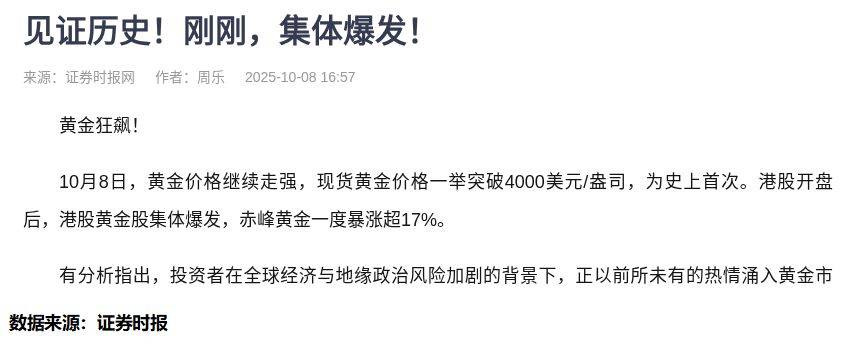
Core Insights - The recent surge in gold prices has reached a historic high of over $4000 per ounce, with a year-to-date increase of 53.6% [3][4] - Institutional investors have capitalized on this trend, while ordinary investors are still contemplating their next moves [1][3] Market Dynamics - The rise in gold prices is attributed to various factors including U.S. government shutdowns, global political instability, and risks associated with tech stock corrections [3][4] - The concept of "expectation difference" plays a crucial role in market movements, where future expectations outweigh current realities [4] Information Asymmetry - There exists a significant information gap between institutional investors and ordinary investors, with the former having access to advanced research tools and data [5][8] - Early movers in the market often capitalize on information that is not yet widely available, as seen in the case of the Yaxia Hydropower Station stocks [5][8] Quantitative Analysis - Quantitative data serves as a valuable tool for ordinary investors to navigate information asymmetry and identify market trends [8][14] - The trading behavior of stocks like "Tibet Tianlu" and "Poly United" indicates institutional activity prior to price surges, highlighting the importance of monitoring such data [10][12] Investment Strategy - The focus should not solely be on whether to buy gold now, but rather on the ability to assess market expectation changes [14][15] - Recommendations for ordinary investors include building a diverse information network, emphasizing quantitative data, monitoring institutional behavior, and maintaining independent thought [15][16]



策略观点:以时间换空间-20250930
China Post Securities· 2025-09-30 09:23
Market Performance Review - The major stock indices showed a mixed performance in September, with growth style leading the way. As of September 26, the Shanghai Composite Index fell by 0.77%, while the Shenzhen Component Index rose by 4.04%, and the ChiNext Index increased by 9.04% [6][17] - The overall market index rose by 1.31%, with the mid-cap index up by 3.62% and the small-cap index down by 0.30%. The "茅" index increased by 3.25%, and the "宁" combination rose by 9.44% [6][17] - External disturbances were minimal, and the A-share market experienced a rebound after an initial decline following the September 3 military parade. The internal economic data remained stable, and the Federal Reserve's interest rate cut aligned with market expectations [6][17] A-Share High-Frequency Data Tracking - The dynamic HMM timing model indicated that the current market potential returns do not cover risks, leading to a recommendation for a reduced position [28] - The personal investor sentiment index showed a slight recovery, with a 7-day moving average of -4.56% as of September 27, significantly down from 15.96% on September 20 [33] - Financing sentiment has improved, maintaining a net inflow trend, with financing transactions accounting for over 20% of A-share trading volume [38] Future Outlook and Investment Views - The report suggests a "time for space" strategy, waiting for the next policy trigger. Since the market rally began on June 23, the A-share market has accumulated significant gains, and a technical stagnation is observed [7][46] - The expectation is that domestic economic policies will focus on implementing existing plans, with the "15th Five-Year Plan" policies anticipated to trigger the next market rally [7][46] - In terms of asset allocation, Hong Kong stocks are seen as having better value, and the report emphasizes the importance of identifying individual stocks with "turnaround" logic in the A-share market [8][46]
招商证券国际:港股震荡加剧 聚焦AI+有色金属两大结构主线
智通财经网· 2025-09-30 03:04
Group 1 - The core viewpoint of the report indicates that while the Hong Kong stock market is experiencing short-term volatility, the long-term upward trend remains intact, suggesting a focus on structural themes rather than index points [1] - The report identifies AI technology and non-ferrous metals as the two main investment themes, with Alibaba (09988) being the preferred choice in the AI sector due to its full-stack AI capabilities, and attention on copper price upward opportunities in the non-ferrous metals sector [1] - The report recommends increasing allocation to sectors experiencing a reversal of difficulties, such as essential consumption, high dividend strategies, and undervalued innovative pharmaceutical stocks, while avoiding excessive concentration risk in holdings [1] Group 2 - Last week (September 22-26), the Hong Kong stock market saw a general decline, with the Hang Seng Index dropping by 1.57% and the Hang Seng Tech Index falling by 1.58%, while the AH premium significantly widened to 120 [1] - From an industry perspective, most major sectors in the Hong Kong stock market experienced declines, with only the materials sector showing an increase, while sectors such as conglomerates, real estate, and essential consumption led the declines [1] - In terms of micro-funding, there was a net outflow of Hong Kong capital, while both southbound and foreign capital saw net inflows: 1) Southbound capital had a total net inflow of HKD 44 billion, primarily flowing into non-essential consumption and information technology; 2) Foreign capital net bought USD 555 million through ETFs; 3) Local Hong Kong ETFs also saw a net inflow of HKD 7.7 billion, totaling a net inflow of HKD 59.6 billion year-to-date [1]

以时间换空间
China Post Securities· 2025-09-30 02:30
Market Performance Review - In September, major stock indices showed a mixed performance, with growth style leading the way. As of September 26, the Shanghai Composite Index fell by 0.77%, while the Shenzhen Component Index rose by 4.04%, and the ChiNext Index increased by 9.04% [4][12] - The overall market sentiment was stable, with A-shares experiencing a rebound after an initial decline following the military parade on September 3. The internal economic data remained stable, and the Federal Reserve's interest rate cut aligned with market expectations, indicating that market movements were primarily driven by internal dynamics [4][12] Future Outlook and Investment Views - The report suggests a strategy of "waiting for space by using time," anticipating the next policy trigger. Since the market rally began on June 23, A-shares have accumulated significant gains, and a technical stagnation has been observed. The HMM timing model indicates a reduction in positions as the market awaits domestic policy support for the next rally [5][33] - The report highlights that Hong Kong stocks present better value, and A-shares should focus on individual stocks with "turnaround" logic. Hong Kong stocks are more sensitive to international liquidity, and the current situation resembles the 2007 A-share bull market, where Hong Kong stocks outperformed A-shares post-interest rate cuts [5][33] - The report emphasizes the importance of focusing on individual stock alpha opportunities rather than relying on broad market trends, especially given the lack of mainline opportunities in the 2025 interim report season [5][34] High-Frequency Data Tracking - The dynamic HMM timing model suggests that the current market's potential returns do not justify the risks, leading to a recommendation for a cash position. The model has demonstrated excellent risk control and upward-following capabilities since the beginning of 2024 [20][22] - Personal investor sentiment has slightly improved, with the sentiment index showing a significant decline from 15.96% on September 20 to -4.56% as of September 27. This indicates a strong correlation between market movements and investor sentiment [25][26] - Financing sentiment has also warmed, with financing transactions maintaining over 20% of total A-share trading volume, indicating a continued net inflow of funds [28][29] Sector Performance - In September, the TMT and financial sectors led the gains, while consumer sectors experienced notable pullbacks. The top-performing industries included communication (11.97%), non-ferrous metals (9.13%), and non-bank financials (8.84%), while food and beverage (-6.34%) and beauty care (-4.57%) lagged [16][19] - The report notes that the trading dynamics in the new energy sector, particularly in battery technology and photovoltaic policies, are influencing market performance, with a focus on domestic and international capital expenditures [16][19]