人民币国际化

Search documents
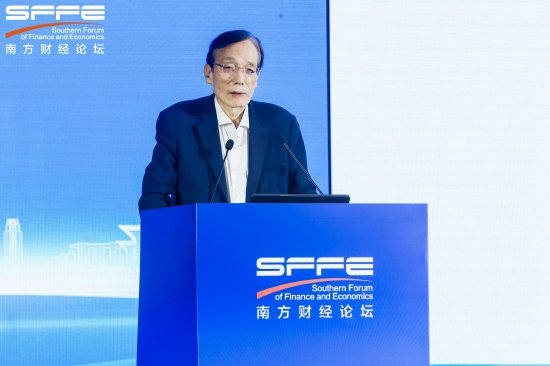
刘世锦:要更关注中低收入阶层,我国消费市场规模将实现倍增
Xin Lang Cai Jing· 2025-12-05 03:23
Core Insights - The "Southern Finance Forum 2025" held on December 5-6 in Guangzhou focuses on the theme "The Power of Consensus - Innovation Surge, China's Asset Revaluation" [1][7] - Liu Shijun, a key speaker, highlighted three major advantages of China's economy: catch-up potential, new technology revolution focusing on digital and green technologies, and the advantage of a super-large market economy [3][9][10] Economic Advantages - The first advantage is the catch-up potential, which refers to opportunities in service sector development driven by consumption structure upgrades, as well as the transformation of traditional manufacturing and agriculture [3][9] - The second advantage is the new technology revolution, emphasizing digital and green technologies [3][9] - The third advantage is the super-large market economy, with a focus on the 9 billion low-income individuals who could transition into the middle-income group, potentially creating a consumption market of 800-900 million [10] Strategic Goals - China needs to implement strategies to become a manufacturing powerhouse, a consumer powerhouse, and a financial powerhouse [10] - The goal for manufacturing is to cultivate large innovative enterprises that can lead globally, while the consumer powerhouse aims to become the largest consumption market worldwide [10] - The financial powerhouse is essential for achieving the first two goals, acting as a bridge to facilitate their realization [10] Financial Development - High-quality development requires a strong capital market and robust currency, with finance serving the real economy by selecting viable projects to enhance resource allocation efficiency [10] - Liu emphasized the importance of a strong currency, citing historical examples of strong currencies like the British pound and the US dollar, which were backed by substantial economic and financial systems [4][11] - Currently, China's GDP accounts for 18% of the global total, with manufacturing at 30%, but the currency's functional roles are below 10% [11] Currency Internationalization - Liu proposed increasing the offshore RMB supply to achieve economies of scale in its international use, addressing the mismatch between China's economic standing and its currency's global role [4][11] - He suggested a significant adjustment in China's foreign trade strategy to balance imports and exports while using RMB for settlements, potentially converting a trade surplus of nearly $1 trillion into over 7 trillion RMB for offshore use [5][12] - The expansion of offshore RMB financial products, including bonds, stocks, and derivatives, is crucial for enhancing liquidity and facilitating the RMB's internationalization [12]

五年新坐标|共享开放机遇 勾勒全球经济发展新蓝图
Xin Hua Wang· 2025-12-05 01:21
Core Viewpoint - The article emphasizes the importance of openness as a defining characteristic of Chinese modernization, highlighting the role of China Bank in supporting the new development pattern through enhanced financial services and international engagement [1]. Group 1: Financial Supply and Trade Dynamics - During the "14th Five-Year Plan" period, China's foreign trade has not only expanded in scale but also strengthened in structure, accelerating the construction of a trade power [2]. - China Bank focuses on facilitating domestic and international dual circulation, improving the quality and efficiency of cross-border financial supply, and creating diverse platforms for domestic and foreign enterprises to share market opportunities [2]. - As of the end of Q3 2025, China Bank's domestic institutions processed over $3.3 trillion in international settlements and 13.2 trillion yuan in cross-border RMB settlements, maintaining the leading market share in the industry [2]. Group 2: Enhancing RMB Internationalization - China Bank has established a cross-border RMB usage network in 58 countries and regions, serving as a RMB clearing bank in 16 countries, maintaining a leading position in cross-border RMB settlement and offshore RMB bond businesses [3]. - The bank supports foreign institutional investors entering China's capital market through various channels, enhancing RMB settlement in commodities, panda bonds, and international syndicated loans, with continuous growth in cross-border RMB settlement volumes [3]. - The bank has published the "RMB Internationalization White Paper" and indices for thirteen consecutive years, hosting forums in major financial centers to promote RMB internationalization [3]. Group 3: Service Quality and Global Integration - China Bank has established branches in 45 countries involved in the Belt and Road Initiative, following up on over 1,300 corporate credit projects and providing more than $400 billion in credit support to enhance connectivity and improve livelihoods [4]. - The bank promotes the "Invest in China" brand by offering comprehensive financial services for key foreign investment projects and facilitating policies for foreign enterprises investing domestically [4]. - China Bank has built over a thousand cross-border cash pools for multinational corporations, leading the market in client numbers and transaction volumes, and has optimized its global service support mechanism for seamless financial service experiences [4]. Group 4: Future Outlook - Looking ahead to the "15th Five-Year Plan," China Bank aims to leverage both international and domestic markets and resources, enhancing its global, comprehensive, digital, and professional financial service capabilities to facilitate trade and investment [4].

金融珍珠港,俄打响第一枪,中国减持美债,人民币或重回6时代?
Sou Hu Cai Jing· 2025-12-04 23:07
Group 1 - Russia is set to issue its first-ever RMB-denominated sovereign bonds with a target coupon rate of 6.25%-6.5% for a 3.2-year bond and a maximum rate of 7.5% for a 7.5-year bond [1][7] - The issuance of RMB bonds is a strategic move for Russia to access financing amid Western sanctions that limit its ability to obtain USD and EUR financing, while also utilizing its substantial RMB assets [6][21] - The trend of "de-dollarization" is gaining momentum, as evidenced by China's reduction of its US Treasury holdings to $765.4 billion, the lowest level since 2009, and a continuous decline over the past 18 months [1][9] Group 2 - Moody's has downgraded the US sovereign rating to Aa1, reflecting market concerns over US debt credit risk, while China's reduction of US Treasury holdings is seen as a proactive measure against potential debt crises [5][21] - The RMB has become the second most used currency in global trade financing, accounting for 8.5% of all transactions, indicating a structural shift in the global financial landscape [9][21] - China's gold reserves have increased to $243.6 billion, with a rising proportion in its foreign exchange reserves, highlighting a strategic shift towards a more resilient reserve system amid geopolitical risks [11][13] Group 3 - The RMB's appreciation against the USD has been driven by both internal economic factors and external environment changes, with the currency breaking the 7.07 mark, the highest in over a year [15][17] - International institutions like Goldman Sachs predict that the RMB exchange rate may approach 6.85 in the next 12 months, supported by positive economic indicators such as a 5.3% year-on-year GDP growth in Q3 [19][21] - The global financial system is undergoing a reconstruction of trust, as evidenced by Russia's bond issuance, China's asset reallocation, and IMF warnings about asset overvaluation risks [21][22]
等你来投!《清华金融评论》2026年1月刊 加速推进数字人民币,建设自主可控的人民币跨境支付体系
清华金融评论· 2025-12-04 08:59
当前,全球数字货币研发与应用进入快车道,主要经济体纷纷加快 央 行 数 字 货 币 ( CBDC ) 布 局 。 与 此 同 时 , 国 际 地 缘 格 局 深 刻 演 变,金融基础设施安全成为国家安全的重要组成部分。党的二十大 报告明确提出"有序推进人民币国际化","十五五"规划建议提出, 推进人民币国际化,提升资本项目开放水平,建设自主可控的人民 币跨境支付体系。当前,我国多渠道、广覆盖的人民币跨境支付体 系基本建成。在此基础上,人民币跨境支付体系建设进一步凸显"自 主可控",对于保障金融安全、支撑人民币国际化以及提升国际金融 话语权具有重要战略意义。为此《清华金融评论》编辑部特地展开 征稿活动 。 《清华金融评论》 2026 年第 1 期专题 加速推进数字人民币,建设自主可控的人民币跨境支付体系 当前,全球数字货币研发与应用进入快车道,主要经济体纷纷加快央行数字货币(CBDC)布局。与此同时, 国际地缘格局深刻演变,金融基础设施安全成为国家安全的重要组成部分。党的二十大报告明确提出"有序推进 人民币国际化","十五五"规划建议提出,推进人民币国际化,提升资本项目开放水平,建设自主可控的人民币 跨境支付体 ...
德银:从“点心”到“主菜”--人民币点心债市场面临大发展机遇
美股IPO· 2025-12-04 08:19
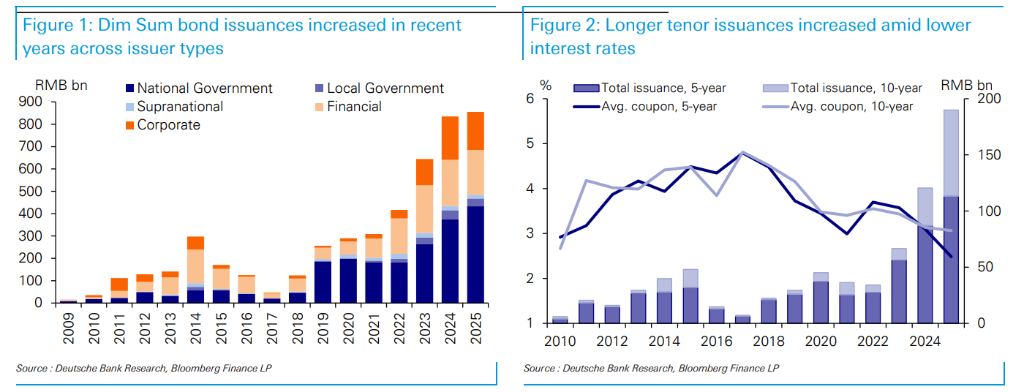
Core Viewpoint - The report from Deutsche Bank indicates that the RMB dim sum bond market is transitioning from a marginalized "niche market" to a mainstream asset class, driven by significant changes in both supply (low interest rates attracting global issuers) and demand (real trade settlement and the introduction of "Southbound Bond Connect" bringing in domestic funds) [1][3][4]. Group 1: Supply and Demand Dynamics - The supply side is experiencing an explosion, with various issuers, from Chinese tech giants to countries along the Belt and Road, entering the dim sum bond market to lower financing costs and manage currency risks [4]. - The demand side has shifted from speculative to transactional, with the stable growth of offshore RMB funds now primarily driven by real cross-border trade and capital settlement needs, providing a solid foundation for the market [4][8]. - The macro environment is also supportive, as global investors seek alternatives to USD assets, enhancing the attractiveness of dim sum bonds amid expectations of RMB appreciation [4]. Group 2: Market Growth and Participation - The dim sum bond market has shown remarkable growth, with annual issuance in RMB terms skyrocketing from 300 billion RMB in 2021 to an expected 900 billion to 1 trillion RMB in 2025, with a current market size of 1.8 trillion RMB [6]. - The participation base is expanding, with foreign issuers like the Kazakhstan Development Bank and the Indonesian government entering the market, indicating a shift from a solely Chinese issuer base to a more international one [6]. - The low interest rate environment has also led to an increase in the issuance of long-term bonds, with the issuance of bonds with maturities of 15 to 30 years rising significantly [6]. Group 3: Policy Support and Future Outlook - The Chinese government's push for RMB internationalization is providing strong support for the dim sum bond market, with a shift in policy focus towards more aggressive promotion [10]. - The "Southbound Bond Connect" has played a crucial role in alleviating demand bottlenecks by allowing mainland banks to invest directly in dim sum bonds, with a cumulative scale reaching 600 billion RMB [10]. - Looking ahead, the strong RMB is expected to further enhance the attractiveness of RMB assets, with predictions of continued appreciation, making dim sum bonds a significant opportunity for global investors [12][13].

2026年宏观与政策展望—万里豁晴川(PPT)
2025-12-04 04:47
Summary of Key Points from the Conference Call Industry and Company Overview - The conference call primarily discusses the macroeconomic outlook for 2026, focusing on the implications of U.S.-China relations, domestic consumption, and the modernization of the industrial system in China. Core Insights and Arguments U.S.-China Relations - U.S.-China relations are expected to maintain a phase of "controlled conflict" in 2026, with potential for multiple high-level meetings throughout the year, which may lead to a muted market reaction [5][7][8] - The U.S. midterm elections in November 2026 will significantly influence Trump's foreign policy focus, with potential disturbances in the first and fourth quarters of 2026, while the second and third quarters may see a calmer external environment [7][8] Economic and Policy Outlook - The macroeconomic outlook for 2026 anticipates a stable economic growth rate, with a focus on expanding service consumption and effective investment strategies [59][61] - The "15th Five-Year Plan" emphasizes the need to maintain a reasonable proportion of manufacturing in GDP, as the share has been declining over the past two decades [27][30] - The modernization of the industrial system is aimed at enhancing investment in emerging industries, with a notable increase in the share of advanced manufacturing sectors by 2024 [62][67] Domestic Consumption - The report highlights the low consumer spending rate in China compared to other countries, indicating significant potential for growth in service consumption [60][72] - Policies are expected to shift from focusing on supply-side measures to emphasizing demand-side strategies, particularly in boosting household consumption rates [61][70] Investment Trends - There is a notable increase in overseas revenue for Chinese companies, with a growth rate of 11.24% in the first half of 2025, significantly outpacing overall revenue growth [23] - The report suggests that the trend of Chinese companies expanding internationally is a strategic response to rising global trade protectionism [23] Currency and Financial Markets - The internationalization of the Renminbi (RMB) is projected to accelerate, driven by increased cross-border trade and financing activities [24][25] - The RMB has become the third-largest payment currency globally, with significant growth in its use for international transactions [25] Other Important but Potentially Overlooked Content - The report discusses the implications of the U.S. Supreme Court's decisions on tariffs, which could reshape negotiation dynamics between the U.S. and other countries [14] - The "destructive reconstruction" of global order under Trump's administration is expected to lead to significant shifts in international relations and economic policies [15][19] - The need for a balanced approach in domestic policies, including social security reforms and income distribution adjustments, is emphasized as crucial for enhancing consumer confidence and spending [68][70] This summary encapsulates the key points from the conference call, providing insights into the macroeconomic landscape, U.S.-China relations, and the strategic direction for Chinese industries and consumption patterns.
从“点心”到“主菜”--人民币点心债市场面临大发展机遇
Hua Er Jie Jian Wen· 2025-12-04 03:15
Core Viewpoint - The renminbi dim sum bond market is evolving from a marginalized niche to a mainstream asset with significant allocation value, marking a historic opportunity window [1] Group 1: Market Growth and Expansion - The dim sum bond market has shown remarkable growth, with annual issuance in renminbi terms skyrocketing from 300 billion yuan in 2021 to an estimated 850 billion yuan in 2024, and projected to reach between 900 billion to 1 trillion yuan in 2025 [2] - The current market size has reached 1.8 trillion yuan, driven by the strong appeal of renminbi as a financing currency, particularly in a low interest rate environment [2] - Notable issuers include major Chinese tech companies like Alibaba, Baidu, and Tencent, as well as international entities such as the Kazakhstan Development Bank and the Indonesian government, indicating a broadening issuer base [2] Group 2: Demand Dynamics - Historically, insufficient investor demand has been a major bottleneck for the dim sum bond market, but recent resilience has been observed despite depreciation pressures on the renminbi [4] - The nature of offshore renminbi deposits has fundamentally changed, with growth closely linked to cross-border renminbi payment volumes, indicating a shift from speculative to transactional demand [4] - The share of renminbi in current account payments has increased from 18% in 2021 to 28% in the first half of 2025, providing a more stable liquidity foundation for the dim sum bond market [4] Group 3: Supply and Policy Support - The low interest rate environment has led to unprecedented enthusiasm from various issuers, including Chinese tech giants and entities along the Belt and Road Initiative, to enter the dim sum bond market [6] - The demand side has transformed, with stable growth in offshore renminbi funds driven by real cross-border trade and capital settlement needs, supported by policy tools like the "Southbound Bond Connect" [6] - The Chinese government's commitment to accelerating renminbi internationalization, as indicated in the upcoming 14th Five-Year Plan, is providing strong support for the dim sum bond market [8] Group 4: Global Investment Opportunities - A favorable opportunity window has emerged as high dollar interest rates suppress demand for dollar-denominated bonds, with the share of dollar-denominated bonds in Asian international issuance dropping from 83% in 2020 to 67% in 2024, while renminbi-denominated bonds have increased to 11% [11] - The renminbi is expected to strengthen further, having appreciated approximately 4% against the dollar since 2025, enhancing the attractiveness of renminbi assets, including dim sum bonds, for global investors [11] - The dim sum bond market is poised to enter a self-reinforcing virtuous cycle, where increased market size and liquidity attract more issuers, ultimately solidifying the renminbi's status as a value storage tool [12]
中美经贸关系新阶段意味着什么
2025-12-04 02:21
中美经贸关系新阶段意味着什么 20251203 摘要 2016 年中美经济互补共赢,美国提供资本技术,中国提供劳动力市场。 2017 年后,美国对华关税导致两国进入竞争对抗。2025 年,中美经贸 关系进入战略相持的脆弱平衡阶段,结构性矛盾犹存,需防范风险。 中美虽达成停火,如中国购美大豆、美国降芬太尼关税,但平衡脆弱。 未来或现"汇率换税率",即人民币升值实现经济再平衡,减少贸易摩 擦。资产配置需保持防守策略。 中美脆弱性源于"安全困境螺旋",崛起国实力接近守城国,引发后者 恐惧,信息不对称加剧紧张。稳定需减少信息不对称,管控经贸分歧。 全球货币秩序正朝多元化、碎片化发展。美元在全球外汇储备占比下降, 美债安全属性降低,加速国际货币体系重构。特朗普时期加征关税时, 美元指数走强,而近期类似情况下美元指数却下跌,人民币升值。 碎片化表现为资金流动回归本土,如中国大陆持有美股市值下降,美国 资金撤出,中国资金回流。多元化体现在全球主动配置资金中,美国资 产占比远高于中国,欧美资金低配中国。 Q&A 中美两国的脆弱性主要来源于"安全困境螺旋"。这一理论由格拉汉姆·艾利森 教授提出,描述了守城国(美国)和崛起国(中 ...
西方硬炒 “货币战争”,人民币却被多国疯抢,谎话掩盖不了事实
Sou Hu Cai Jing· 2025-12-03 23:16
Group 1 - The issuance of the first RMB-denominated sovereign bonds in Moscow by Russia is seen as a significant event in the internationalization of the RMB, reflecting a broader trend of countries adopting the currency for settlement, reserves, and financing [1][2] - Over 80 countries and regions have included RMB in their foreign exchange reserves, totaling $247 billion, with its share rising to 2.18%, an increase of 1.1 percentage points since its inclusion in the SDR in 2016 [2] - Countries like Kazakhstan, Kenya, Slovenia, and Pakistan are increasingly issuing RMB-denominated bonds or converting debts to RMB, indicating a recognition of the stability of RMB assets [5][7] Group 2 - The global preference for RMB is a rational response to the imbalances in the current international monetary system, particularly in light of the politicization of the SWIFT system and financial sanctions by the U.S. [9][11] - The stability of RMB assets is highlighted by China's 10-year government bond yield at around 2.8%, which offers a clear advantage over negative-yielding assets in the Eurozone and Japan [13] - The internationalization of RMB is driven by market forces, with the IMF indicating that this trend will continue as China's role in the global economy and trade strengthens [15] Group 3 - China maintains a calm and steady approach to RMB internationalization, emphasizing market-driven principles and avoiding the pursuit of currency hegemony [16][17] - The Chinese government is actively enhancing the convenience of cross-border RMB usage through financial opening and institutional improvements, including the issuance of RMB bonds in Hong Kong [19] - The central bank plans to continue developing policies for cross-border RMB use and increasing risk hedging tools to support various market participants in conducting trade financing and overseas loans in RMB [19]

宋清辉:俄罗斯发行人民币主权债券,有利于人民币国际化更进一步
Sou Hu Cai Jing· 2025-12-03 22:33
Core Insights - Russia is advancing the issuance of its first RMB-denominated sovereign bonds, driven by limited access to Western capital markets due to sanctions and a significant trade surplus with China, which has resulted in a large accumulation of RMB within Russia [3][4][5] Group 1: Economic Context - The ongoing Russia-Ukraine conflict and subsequent Western sanctions have obstructed Russia's access to Euro and Dollar-denominated financing, making RMB a viable alternative for financing and settlement [4][5] - The trade surplus with China has led to a substantial amount of RMB being retained in Russia, while local enterprises lack sufficient compliant investment channels for RMB, creating a demand for RMB sovereign bonds [4][5] Group 2: Bond Issuance Details - The Russian Ministry of Finance has begun accepting subscriptions for RMB bonds, which will be issued in two parts: a 3.2-year portion with a target coupon rate of 6.25% to 6.5%, and a 7.5-year portion capped at 7.5% [3][4] - The issuance of RMB sovereign bonds is expected to facilitate the internationalization of the RMB and provide a benchmark for local RMB interest rates [4][5] Group 3: Implications for RMB Internationalization - The issuance of RMB sovereign bonds by Russia is seen as a significant step towards the internationalization of the RMB, potentially influencing other countries to follow suit, especially those with large trade surpluses with China [5][7] - The demand for local RMB financing in Russia may drive the development of cross-border payment, clearing, and settlement infrastructure, supporting broader RMB usage [5][7] Group 4: Global Trends - Other countries, particularly those with significant trade surpluses with China or limited access to dollar financing, may emulate Russia's approach to issuing RMB-denominated bonds [6][7] - The trend of sovereign entities issuing RMB debt is increasing, with a record issuance of RMB bonds by foreign governments reaching 13 billion this year, indicating a growing acceptance of RMB in global finance [5][6]