有色金属投资

Search documents
2025Q3有色板块重仓股持仓环比增长,铜、锡增持明显:有色金属行业基金重仓股数据点评
EBSCN· 2025-10-29 05:03
Investment Rating - The report maintains an "Increase" rating for the non-ferrous metals sector [5]. Core Views - The non-ferrous metals sector has seen a significant increase in fund holdings, with a notable rise in copper and tin stocks. The total market value of non-ferrous metal heavy stocks held by active equity funds reached approximately 117.8 billion yuan, representing a 1.43 percentage point increase from the previous quarter [1][2]. - Key companies in the sector include Zijin Mining, Luoyang Molybdenum, and China Hongqiao, all of which are recommended for investment due to their strong performance and market positioning [3][4]. Summary by Sections Fund Holdings - In Q3 2025, the non-ferrous metals heavy stock holdings accounted for 5.72% of total fund heavy stock holdings, up from 4.29% in Q2 2025, indicating a growing interest in this sector [1]. - The top ten heavy stocks by market value are dominated by copper and gold, with Zijin Mining leading at 32.9 billion yuan [1]. Stock Increases and Decreases - Significant increases in holdings were observed in copper and tin sectors, with Jiangnan New Materials showing the largest increase in shareholding [2]. - Conversely, reductions were primarily in aluminum and lithium stocks, with Guangsheng Nonferrous Metals experiencing the largest decrease [2]. Investment Recommendations - Copper prices are expected to rise due to supply constraints and improving demand in Q4 2025. Recommended stocks include Zijin Mining, Luoyang Molybdenum, and Western Mining [3]. - The aluminum sector is nearing a production capacity ceiling, with China Hongqiao recommended for investment [3]. - Gold is expected to benefit from a weakening dollar and a potential interest rate cut, with a positive outlook for stocks like Chifeng Jilong Gold Mining [3]. - The rare earth sector is supported by supply-demand imbalances, with Northern Rare Earth recommended [3].

3连涨后首跌!要逢跌布局有色龙头ETF吗?楚江新材逆市涨停!三大逻辑驱动,或是中长期布局时机!
Xin Lang Ji Jin· 2025-10-28 05:55
Group 1 - The core viewpoint is that the recent pullback in the non-ferrous metals sector after three days of strong gains may present a mid-to-long-term investment opportunity, driven by three main investment logic points [1][2][3]. Group 2 - Strategic positioning is being elevated from "cyclical commodities" to "strategic assets," with China holding a leading position in the rare earth sector, accounting for 61% of global mining share in 2024 and over 90% of the refining process concentrated in China [1]. - The supply-demand dynamics are tightening, with limited supply and rigid demand supporting prices, particularly for copper, which is nearing historical highs due to factors like grid upgrades and AI, alongside a significant reduction in supply from the Grasberg mine in Indonesia [2]. - The monetary attributes of industrial metals are becoming more pronounced, with expectations of a potential interest rate cut by the Federal Reserve, which could enhance liquidity and support industrial metal prices [3]. Group 3 - On the market front, the non-ferrous metals ETF (159876) experienced a decline of 2.89% after three consecutive days of gains, indicating a potential buying opportunity for investors [4]. - Among the constituent stocks, Chujiang New Material saw a limit-up increase, while companies like Western Superconducting and Innovation New Materials also performed well, contrasting with declines in stocks like Tongling Nonferrous Metals and Huayou Cobalt [4]. Group 4 - The non-ferrous metals sector is characterized by varying degrees of prosperity and driving factors, suggesting that a diversified investment approach through ETFs tracking the non-ferrous metals index could mitigate risks and enhance returns [7].


金属行业周报:看好有色长周期投资价值-20251026
CMS· 2025-10-26 06:24
Investment Rating - The report maintains a positive investment rating for the non-ferrous metals sector, highlighting long-term investment value [1]. Core Views - The non-ferrous metals sector is expected to benefit from new consumption patterns and structural changes, driven by the emphasis on technological self-reliance and new productive forces [1]. - A significant adjustment in gold prices is viewed as a technical correction, with the long-term upward trend remaining intact [1]. - The report emphasizes that the narrative surrounding non-ferrous metals, particularly copper, remains strong, with resource stocks trading at historically low price-to-earnings ratios, presenting attractive valuation opportunities [1]. Industry Overview - The non-ferrous metals sector includes 236 listed companies with a total market capitalization of 5,951.5 billion [2]. - The sector's performance over different time frames shows an absolute return of 7.3% over one month, 47.1% over six months, and 55.0% over twelve months [3]. - The report identifies key metals to focus on, including copper, gold, silver, aluminum, cobalt, rare earths, tungsten, uranium, and antimony [1]. Market Dynamics - Copper inventories in major regions increased by 0.41 thousand tons to 181.6 thousand tons, while total inventories decreased by 3.8 thousand tons compared to the previous year [3]. - The report notes a significant supply disruption in cobalt due to export restrictions from the Democratic Republic of Congo, leading to a tightening of global supply and increased prices [3]. - The aluminum market is experiencing a decline in inventories, with a notable reduction in production capacity due to unexpected cutbacks in major aluminum plants [4]. Price Trends - Cobalt prices increased by 3.7% this week, driven by strong demand from the electric vehicle and consumer electronics sectors [3]. - Silver prices fell by 6.65% due to a stronger dollar and rising real interest rates, which diminished the appeal of non-yielding assets [3]. - Lithium carbonate prices showed a slight increase, reflecting robust demand in the battery and energy storage markets [4]. Strategic Focus - The report suggests a focus on companies involved in new materials related to technological advancements, particularly in nuclear fusion and lithium battery production [5]. - It highlights the strategic importance of rare earth elements and their potential for price appreciation in the medium to long term [5].
黄金一夜暴跌6%,稀土过山车!有色的投资逻辑彻底变了?
Sou Hu Cai Jing· 2025-10-23 22:13
Core Insights - The recent volatility in precious metals, including a 6% drop in gold prices, indicates a potential shift in investment logic for non-ferrous metals, prompting investors to reassess opportunities amidst market fluctuations [1][2][6]. Group 1: Precious Metals - Gold experienced a dramatic decline after reaching a historical high of $4380 per ounce, with a notable single-day drop of 6% on October 21, 2025, highlighting the risks in the current market [1][6]. - The price of silver is supported by its dual role as both an industrial and financial asset, with a projected global supply-demand gap of 4633 tons in 2024, primarily driven by solar energy demand [8][10]. - The investment logic for gold is influenced by three main factors: expectations of Federal Reserve interest rate cuts, rising geopolitical risks, and ongoing central bank purchases, which provide structural support [5][6]. Group 2: Industrial Metals - Copper is viewed as a critical component in the global green energy transition and AI technology revolution, with expectations that its price could exceed $10,000 per ton by 2026 [11]. - The recent fluctuations in rare earth prices, which rose by 12.72% and then fell by 11.69% in October, underscore their strategic importance in modern technology and industrial applications [12]. Group 3: Investment Strategies - Investors are encouraged to utilize professional tools and resources to navigate the complexities of the non-ferrous metals market, with options like actively managed funds and ETFs providing different exposure strategies [13][16]. - The combination of active and passive investment strategies is recommended for investors to capture overall industry opportunities while focusing on high-potential segments [17].
创金合信基金黄超:有色金属板块具备长期投资价值 贵金属投资机会或更突出
Xin Lang Ji Jin· 2025-10-20 02:05
Core Viewpoint - The non-ferrous metal sector has shown strong performance with a return of 69.59% as of October 17, driven by limited long-term supply and favorable low interest rates, indicating long-term investment value in this sector [1] Group 1: Performance Drivers - The non-ferrous metal sector, particularly precious metals, industrial metals like copper, and minor metals, has performed strongly this year due to various factors [1] - Precious metals have benefited from ongoing monetary expansion and expectations of interest rate cuts by the Federal Reserve, leading to a sustained increase in gold and silver prices [1] - Industrial metals, especially copper, have seen supply disruptions that have reduced availability and increased prices, while minor metals have gained strategic value amid geopolitical tensions [1] Group 2: Growth Potential - Compared to traditional cycles, the non-ferrous metal sector exhibits better growth potential, with lower dependency on the real estate sector, which is currently under pressure [2] - Demand for copper is bolstered by sectors like electricity and AI, while aluminum benefits from reduced reliance on real estate and increased demand for lightweight applications [2] Group 3: Future Outlook - The non-ferrous metal sector is expected to maintain long-term investment value due to constrained supply and attractive valuations, especially in a low-risk yield environment [3] - Close attention should be paid to the Federal Reserve's interest rate decisions, as they significantly impact the sector's performance [3] - Short-term trading in the non-ferrous metal sector has been vigorous, but there may be risks of price corrections due to accumulated gains and potential valuation adjustments [3] Group 4: Investment Opportunities - Strong performance has been noted in minor metals, precious metals, and copper, with minor metals benefiting from geopolitical factors and copper from favorable supply-demand dynamics [4] - Precious metals are on an upward trend due to monetary expansion and interest rate cut expectations, indicating further opportunities ahead [4] Group 5: Impact of Policy Changes - The upgrade of rare earth export controls allows for more comprehensive management of the sector, potentially affecting China's dominance in rare earth processing [5] - Short-term increases in foreign rare earth prices may lead to the development of foreign processing capabilities, which could diminish China's influence in the long run [5]
基金经理解读有色板块投资机会
Zhong Guo Ji Jin Bao· 2025-10-19 07:49
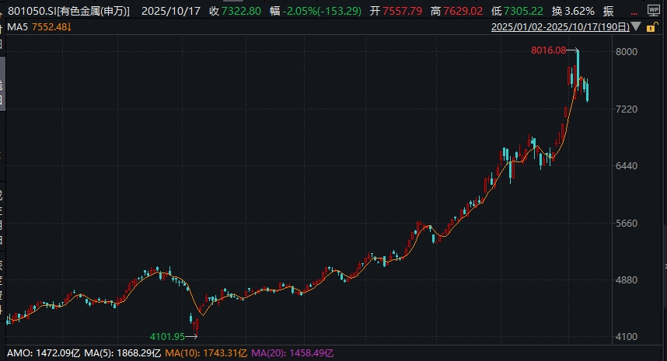
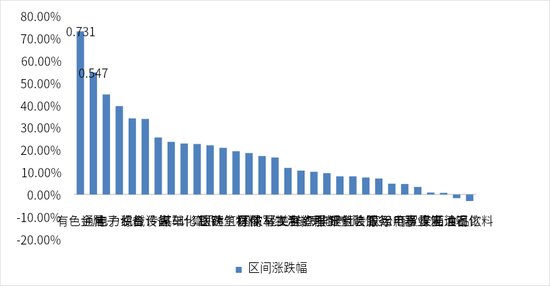
Core Viewpoint - The non-ferrous metal sector has emerged as one of the strongest performing sectors in the market since 2025, with the Zhongzheng Shenwan Non-ferrous Metals Index leading 31 first-level sub-industries with a nearly 70% increase [1][3]. Group 1: Driving Factors Behind Sector Strength - The recent strength in the non-ferrous metal sector is attributed to multiple factors including macroeconomic easing, supply-demand dynamics, market sentiment, and sector rotation effects [13][12]. - Expectations of Federal Reserve interest rate cuts and a globally loose liquidity environment have weakened the dollar, enhancing the appeal of non-ferrous metals as a hedge against currency depreciation [13][12]. - Supply constraints coupled with rising demand from emerging sectors such as electric vehicles and photovoltaics have led to a tight supply-demand balance, driving prices higher [13][12]. - The valuation of the non-ferrous metal sector remains below historical averages, attracting capital inflows as other sectors face valuation pressures [13][12]. Group 2: Market Performance and Valuation Dynamics - The non-ferrous metal sector has experienced a "Davis Double Play" this year, where rising metal prices significantly boost corporate profit expectations while the sector's valuation was at historical lows, allowing for upward correction [15][12]. - The sector's performance is supported by a long-term reassessment of the global monetary system and the strategic value of non-ferrous metals in an uncertain global environment [16][12]. Group 3: Long-term Growth Potential - Compared to traditional cyclical sectors, the non-ferrous metal sector shows greater growth potential due to its alignment with high-end manufacturing demands, particularly in electronics, military, semiconductors, and renewable energy [17][12]. - The ongoing energy revolution is expected to create structural, long-term demand for metals like copper, aluminum, lithium, and rare earths, freeing them from traditional cyclical constraints [18][12]. Group 4: Strategic Value of Rare Earths - The recent tightening of rare earth export controls is expected to enhance China's competitive advantage in the global supply chain, solidifying its pricing power [22][12]. - The strategic value of rare earths is increasingly recognized, particularly in high-tech industries, which will support their long-term market performance [22][12]. Group 5: Investment Opportunities and Risks - The non-ferrous metal sector is viewed as having solid long-term investment value, driven by supply constraints and favorable valuation dynamics, although short-term volatility risks are acknowledged [19][12]. - Key signals to monitor include Federal Reserve interest rate decisions, supply disruptions, domestic growth policies, and signs of stabilization in the Producer Price Index (PPI) [20][12].
“最强板块”,突然调整!刚刚,解读来了
中国基金报· 2025-10-19 04:20
Core Viewpoint - The non-ferrous metal sector has emerged as one of the strongest performing sectors in the market since 2025, with the China Securities Shenyin Wanguo Non-Ferrous Metals Index leading 31 first-level sub-industries with a nearly 70% increase [2][4]. Group 1: Driving Factors Behind Sector Strength - The recent strength in the non-ferrous metal sector is attributed to multiple factors including macroeconomic easing, supply-demand dynamics, market sentiment, and sector rotation effects [17][18]. - The expectation of interest rate cuts by the Federal Reserve and a globally loose liquidity environment have weakened the dollar, enhancing the appeal of non-ferrous metals as a hedge against currency depreciation [17][18]. - Supply constraints coupled with rising demand from emerging sectors such as electric vehicles and photovoltaics have led to a tight supply-demand balance, driving prices higher [17][18]. - The valuation of the non-ferrous metal sector remains below historical averages, attracting capital inflows as other sectors face valuation pressures [17][18]. Group 2: "Davis Double Play" Phenomenon - The non-ferrous metal sector has experienced a "Davis Double Play" phenomenon this year, characterized by rising metal prices leading to significant improvements in corporate profit expectations, alongside a recovery in valuations from historically low levels [20][21]. - The sector's strong performance is further supported by its high beta characteristics and the strategic value of physical assets in an inflationary environment [20][21]. Group 3: Growth Potential Compared to Traditional Cycles - The non-ferrous metal sector exhibits better growth potential compared to traditional cyclical sectors, driven by demand from high-end manufacturing and strategic industries such as electronics, military, and renewable energy [23][24]. - The sector's demand is less reliant on real estate, which is currently under pressure, allowing for more stable growth prospects [23][24]. Group 4: Long-term Investment Value - The non-ferrous metal sector is viewed as having solid long-term investment value due to constrained supply and attractive valuations, especially in a low-risk yield environment [26][27]. - Key signals to monitor include the pace of Federal Reserve interest rate cuts, mining disruptions, domestic growth policies, and signs of stabilization in the Producer Price Index (PPI) [27][28]. Group 5: Strategic Value of Rare Earths - The recent tightening of rare earth export controls is expected to enhance China's competitive advantage in the global supply chain, reinforcing the strategic value of rare earths in high-tech industries [30][31]. - The strategic importance of rare earths is being re-evaluated, with their role in key sectors like electric vehicles and renewable energy expected to support long-term demand [30][31]. Group 6: Internal Logic and Investment Opportunities - The non-ferrous metal sector has significant internal logic differences, with precious metals driven by safe-haven demand, while industrial and energy metals benefit from macroeconomic recovery and energy transition [33][34]. - Investment opportunities may arise from sectors with strong demand certainty and clear supply constraints, as well as from rotational opportunities within sub-sectors [33][34].
有色金属“领涨”,你也挖到矿了吗?
Xin Lang Ji Jin· 2025-10-17 09:38
Core Insights - The article discusses the significant rise in the non-ferrous metals sector, driven by macroeconomic, industrial, and geopolitical factors, highlighting a "metal market boom" [1][3] - The Shenyin Wanguo non-ferrous metals industry index has seen a year-to-date increase of 73.14% as of October 16, 2025, leading among 31 primary industries [1][3] Industry Overview - Non-ferrous metals are defined as metals excluding iron, manganese, and chromium, categorized into five types: industrial metals, minor metals, energy metals, precious metals, and new metal materials [5] - The current market dynamics indicate a strong performance in the non-ferrous metals sector, with ongoing investment opportunities [10] Investment Strategies - Longview Fund's Chen Ziyang focuses on the non-ferrous metals sector, with a portfolio that includes leading companies in industrial metals, precious metals, minor metals, and new materials [5][12] - The Longview Cycle Select Fund has a significant allocation to non-ferrous metals, with top holdings reflecting a broad exposure to key segments [8][12] Market Drivers - Industrial metals are benefiting from a Federal Reserve interest rate cut cycle, which is expected to increase demand and prices, particularly for copper [11] - Minor metals like rare earths are gaining strategic importance due to recent export controls by the Ministry of Commerce, indicating a potential for value reassessment [13] - Energy metals are projected to enter a super cycle driven by the rapid growth of green industries, with demand for key metals expected to increase significantly by 2040 [13] Precious Metals Outlook - The price of gold is anticipated to remain strong, supported by central banks increasing their gold reserves amid a weakening dollar [14] - The article suggests that the current market conditions may present an opportune time for investors to consider gold investments [14]
“铜博士”依然坚挺,白银有色逆市涨停!资金逢跌抢筹,有色龙头ETF(159876)获资金净申购1.16亿份!
Xin Lang Ji Jin· 2025-10-10 11:47
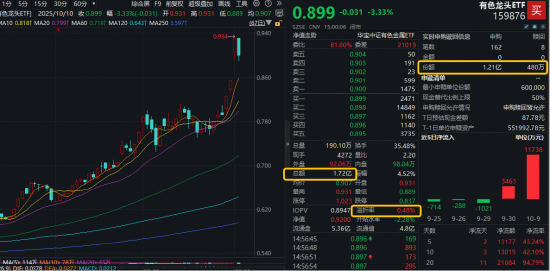
Core Viewpoint - The market is experiencing a consolidation phase, with the non-ferrous metal sector ETF (159876) seeing a price drop of 3.33% while achieving a record trading volume of 1.72 billion yuan, indicating strong investor interest despite the downturn [1] Fund Flows and Performance - The non-ferrous metal ETF (159876) saw a net subscription of 116 million units, with a total inflow of 117 million yuan on the previous day and a cumulative inflow of 210 million yuan over the past 20 days [1][3] - As of October 9, the latest scale of the non-ferrous metal ETF reached 493 million yuan, marking a new historical high [1] Sector Analysis - The "Copper Doctor" remains strong, with Jiangxi Copper rising over 7% and Yunnan Copper increasing by more than 1%. Silver stocks also performed well, with a limit-up increase [1] - Conversely, companies like Hanrui Cobalt and Western Gold fell over 9%, dragging down the index performance [1] Market Drivers - Gold prices have fluctuated due to a ceasefire agreement between Israel and Hamas, with Bank of America indicating a potential bull market for gold lasting until 2026, following a nearly 50% increase this year [3] - Copper prices surged due to supply constraints from the Grasberg copper mine incident, igniting investor enthusiasm [3] - The recent export control regulations on rare earths by the Ministry of Commerce are expected to maintain strong pricing in the rare earth sector [3][4] Industry Outlook - The non-ferrous metal industry maintains a high level of prosperity, with precious metals benefiting from Federal Reserve rate cuts and geopolitical tensions, leading to gold prices surpassing the 4000 USD mark [4] - Industrial metals like copper and aluminum are experiencing price increases due to supply constraints and a weak dollar environment [4] - The rare earth sector is expected to see continued valuation and performance growth due to tightening export controls [4] Investment Strategy - The non-ferrous metal ETF (159876) and its linked funds provide a diversified exposure to various metals, including copper (27.6%), gold (14.5%), aluminum (13.1%), rare earths (10.4%), and lithium (8.4%), making it suitable for risk diversification in investment portfolios [6]



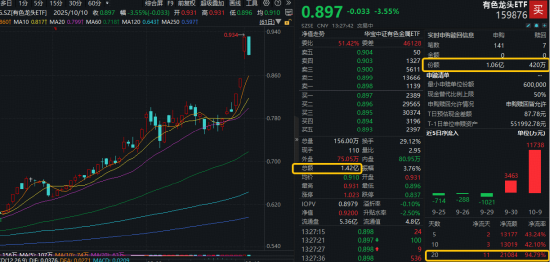
有色龙头ETF获资金净申购超1亿份!“铜茅”紫金矿业本轮拉升158%!三大优势凸显,有色成增配最多行业
Xin Lang Ji Jin· 2025-10-10 05:49
Core Viewpoint - The market is currently consolidating, with the Nonferrous Metal Leader ETF (159876) experiencing a decline of 3.55%. However, there is significant buying interest as evidenced by a net subscription of 102 million units, indicating strong investor confidence in the sector [1][4]. Market Performance - The Nonferrous Metal Leader ETF (159876) has seen a total inflow of 2.1 billion yuan over the past 20 days, reaching a record high of 493 million yuan as of October 9 [1]. - The ETF has increased by 85.30% since its low point on April 8, outperforming major indices such as the Shanghai Composite Index (27.04%) and the CSI 300 (31.2%) [4][6]. Sector Analysis - The nonferrous metals sector is gaining traction among institutional investors, with a notable increase in weight for this sector in October's brokerage recommendations, rising by 2.71% compared to September [3]. - The expected net profit growth rate for the Nonferrous Metal Leader ETF's underlying index is projected at 63% for 2025, indicating strong future performance expectations [4]. Stock Performance - Key stocks within the ETF have shown significant gains, with notable performers including Luoyang Molybdenum (up 279%), Xinyi Silver (up 203%), and Ganfeng Lithium (up 197%) [6]. - The ETF's component stocks are primarily driven by high growth expectations in their respective sectors, particularly in rare earths and precious metals [4][9]. Macro Drivers - The nonferrous metals industry is benefiting from high demand and favorable macroeconomic conditions, including the impact of U.S. Federal Reserve interest rate cuts and geopolitical tensions that have driven gold prices above $4,000 [8][10]. - Supply constraints, particularly in copper and aluminum due to production halts in Indonesia, are contributing to a tight supply-demand balance, further supporting price increases [9][10]. Investment Strategy - The Nonferrous Metal Leader ETF (159876) offers a diversified exposure to various metals, including copper, gold, aluminum, and rare earths, making it suitable for investors looking to mitigate risks while capitalizing on sector growth [10].