
结构性货币政策工具

Search documents
LPR连续8个月“按兵不动” 今年房贷利率仍有下探空间
Bei Ke Cai Jing· 2026-01-20 09:25
Core Viewpoint - The Loan Prime Rate (LPR) remains unchanged for the eighth consecutive month, with the 1-year rate at 3.0% and the 5-year rate at 3.5%, reflecting a stable monetary policy environment [1][6][12]. Group 1: LPR Stability - The LPR has not changed since May 2025, indicating a period of stability in interest rates [2]. - The People's Bank of China (PBOC) has indicated that there is still room for interest rate cuts in 2026, particularly in relation to consumer and mortgage loan rates [3][14]. - The current LPR pricing is influenced by stable market rates, including the 7-day reverse repurchase rate, which remains at 1.4% [7][9]. Group 2: Factors Influencing LPR - Multiple factors are constraining the LPR, including stable financing costs for commercial banks and pressures to maintain net interest margins [10][12]. - The recent stability in the LPR is attributed to strong export performance and rapid development in high-tech manufacturing sectors [12]. - Analysts suggest that the marginal effect of interest rate cuts is diminishing, making it less urgent to lower the LPR at this time [11]. Group 3: Future Outlook - There is a consensus among market participants that there is still potential for further reductions in consumer and mortgage loan rates, as they are currently at historical lows [14]. - Predictions indicate that the LPR may have room to decrease in 2026, supported by lower deposit rates and a potential reduction in the reserve requirement ratio by the PBOC [15][16]. - External factors, such as the U.S. Federal Reserve's interest rate cuts, may ease constraints on China's market rates, potentially leading to broader monetary policy adjustments [17].

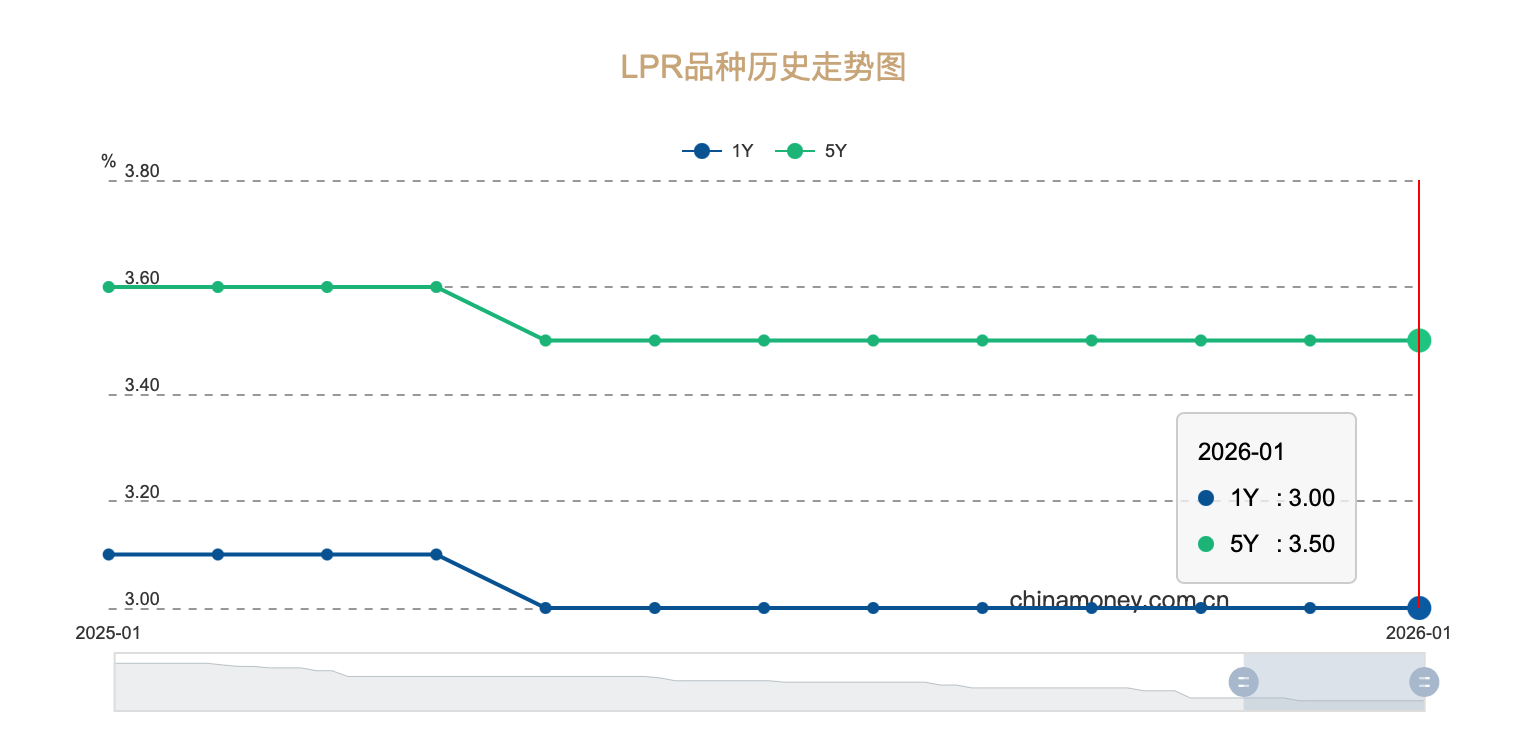
LPR连续8个月“按兵不动” 降准降息仍待有利时机
2 1 Shi Ji Jing Ji Bao Dao· 2026-01-20 05:07
Core Viewpoint - The latest Loan Prime Rate (LPR) remains unchanged at 3.00% for the 1-year term and 3.50% for terms over 5 years, marking eight consecutive months of stability since the last reduction in May 2025 [1][9] Group 1: LPR Mechanism and Current Status - The LPR is determined by adding a spread to the 7-day reverse repurchase rate, which is currently at 1.40%, indicating limited potential for LPR reduction [1][9] - The net interest margin of commercial banks has stabilized at 1.42%, but there is pressure to maintain this margin while reducing costs for the real economy [1][9] Group 2: Monetary Policy and Future Expectations - The People's Bank of China (PBOC) has lowered the interest rates on various structural monetary policy tools by 0.25 percentage points, which could encourage banks to increase lending in key areas [4][12] - Despite the current stability of the LPR, there is potential for a reduction later in the year due to decreasing costs of bank liabilities and expected reserve requirement ratio (RRR) cuts [5][13] Group 3: Structural Monetary Policy Tools - The PBOC announced an increase in the quotas for agricultural and small business loans by 500 billion yuan and for technological innovation loans by 400 billion yuan [5][12] - The impact of structural monetary policy tools on overall bank funding costs is limited, with a total balance of only 6 trillion yuan compared to the total liabilities of 372 trillion yuan [4][12] Group 4: Financial Stability and Policy Coordination - The average statutory deposit reserve ratio is currently at 6.3%, indicating room for further RRR cuts [6][13] - The coordination between monetary and fiscal policies is crucial, with a focus on stabilizing net interest margins and monitoring market volatility in the bond and stock markets [8][14][15]
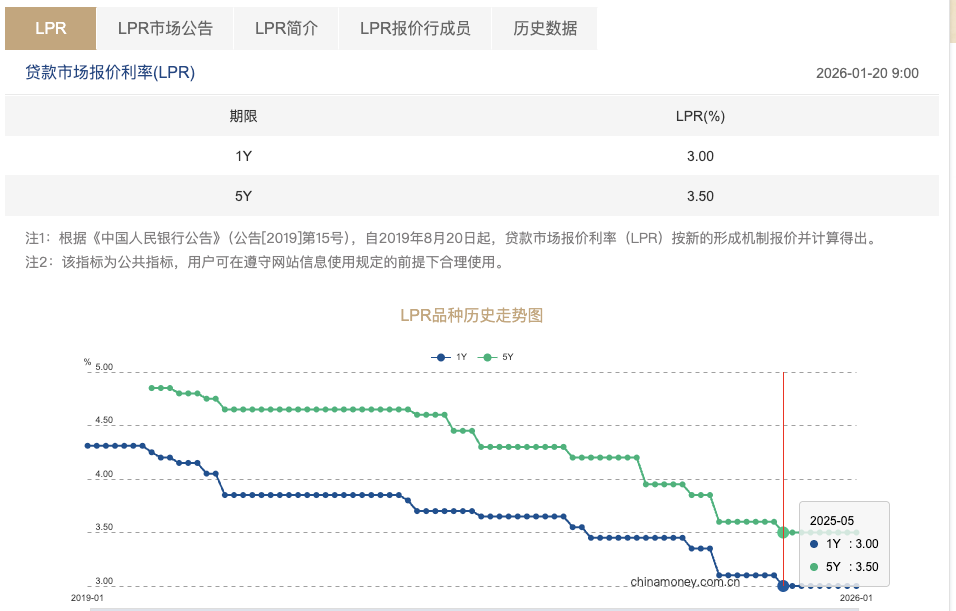
LPR连续8个月不变,降准降息仍待有利时机
21世纪经济报道· 2026-01-20 04:45
Core Viewpoint - The latest Loan Prime Rate (LPR) remains unchanged at 3.00% for the 1-year term and 3.50% for the 5-year term, marking eight consecutive months of stability since the last decline in May 2025 [1][4]. Group 1: LPR Mechanism and Current Status - The LPR is determined by adding points to the 7-day reverse repurchase rate, which is currently at 1.40%, indicating limited potential for LPR reduction [1][4]. - Despite signs of stabilization in net interest margins, banks face pressure to maintain these margins while reducing costs for the real economy, limiting their motivation to lower LPR quotes [1][4]. Group 2: Structural Monetary Policy and Its Impact - Recent adjustments in structural monetary policy tools, including a reduction in the one-year re-lending rate from 1.50% to 1.25%, aim to encourage banks to increase lending in key areas, although the overall impact on banks' funding costs is minimal [5][8]. - The balance of structural monetary policy tools is approximately 6 trillion yuan, which is small compared to the total liabilities of commercial banks at 372 trillion yuan, resulting in a limited effect on overall funding costs [5][8]. Group 3: Future Expectations for LPR Adjustments - There is potential for LPR adjustments later in the year due to expected declines in banks' funding costs as a significant amount of fixed-term deposits mature [6][8]. - External factors, such as the U.S. Federal Reserve's interest rate cuts, may also ease constraints on domestic monetary policy, providing room for potential LPR reductions [6][8]. Group 4: Broader Monetary Policy Context - The average statutory reserve requirement ratio for financial institutions is currently at 6.3%, indicating room for further reserve requirement cuts [8]. - The stability of the RMB exchange rate and the ongoing U.S. interest rate cuts suggest that external pressures on monetary policy are lessening, allowing for potential future rate cuts [8][9]. Group 5: Key Considerations for Financial Stability - Monitoring the pace of fiscal policy implementation and government bond issuance is crucial, as government bonds accounted for 38.9% of total social financing in 2025 [9]. - Continued stability in banks' net interest margins is essential, especially with significant long-term deposits maturing in 2026 [9]. - Attention to market volatility in the bond and stock markets is necessary to avoid sharp fluctuations that could impact financial stability [9].

盘中,涨停!A股,突然异动!
中国基金报· 2026-01-20 04:35
【导读】 上午A股 三大指数 高开低走,商业航天、通信设备板块重挫,大金融、食品饮料逆市拉升 中国基金报记者 张舟 大家好, 今天是周二, 基金君和你 继续 关注市场行情! 1月20 日上午,A股三大股指 高开低走。 截至午间收盘,沪指 报4101.62点,跌0.3 %,深证成指 跌1.22 %,创业板指 跌1.83 %。 科 创创业50指数、创业板50指数均跌超2%。 | 4101.62 | 2 2 2010 11 | 14119.95 | Annuanna W | 3276.64 | VWO | | --- | --- | --- | --- | --- | --- | | 上证指数 -0.30% | | 深证成指 -1.22% | | 创业板指 -1.83% | | 个股 跌多涨少,全 市场 共有3396 只个股下跌 ,1912 只个股上涨, 54 只个股涨停 。成交额方面,沪深两市半日成交额为1.85万亿 元,较上个交易日放量568亿元。 从板块 来 看, 通信设备、航天军工、电子元器件、基本金属、能源设备等板块纷纷下挫;银行保险板块异动拉升,食品饮料、房地产、 半导体板块逆市上涨。 银行保险板块异动 ...

LPR连续8个月按兵不动,解读来了
Sou Hu Cai Jing· 2026-01-20 04:27
Core Viewpoint - The Loan Prime Rate (LPR) remains unchanged for eight consecutive months, with the one-year LPR at 3.0% and the five-year LPR at 3.5%, indicating stability in monetary policy and lending conditions [1][3]. Group 1: LPR Stability - The LPR has not changed since May 2025, when it was reduced by 10 basis points for both terms [1]. - The stability of the LPR is attributed to the unchanged policy interest rates, particularly the central bank's 7-day reverse repurchase rate, which serves as a pricing basis for LPR [1][3]. - Major medium to long-term market interest rates, including the one-year interbank certificate of deposit yield, have remained stable, limiting banks' motivation to lower LPR quotes [1]. Group 2: Monetary Policy Context - On January 15, the People's Bank of China announced a reduction in various structural monetary policy tool rates by 0.25 percentage points, making borrowing from the central bank cheaper [3]. - The average interest rates for new corporate loans and personal housing loans are at historical lows, reflecting a decrease in overall financing costs, which suggests that guiding LPR down is not an immediate priority [3]. - The central bank is expected to continue increasing liquidity and using flexible open market operations to maintain ample liquidity while adjusting the yield curve through government bond transactions [4].
1 月 LPR 报价出炉,5 年期和 1 年期利率均维持不变,如何解读?
Sou Hu Cai Jing· 2026-01-20 02:34
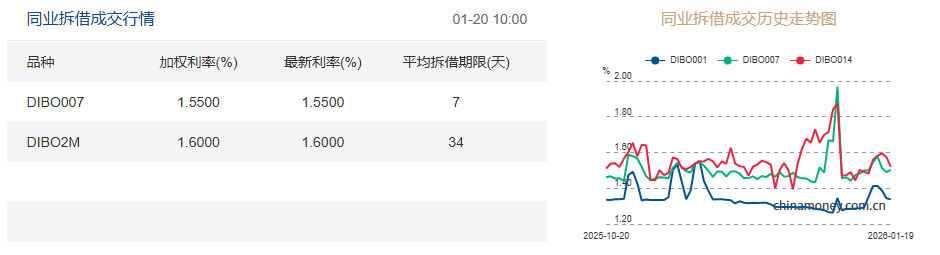
Group 1: LPR Stability and Economic Context - The latest LPR quotes show that the 1-year rate remains at 3.0% and the 5-year rate at 3.5%, unchanged for 8 months, which aligns with expectations [1][3] - The increase in personal deposits and disposable income, with a per capita disposable income of 43,377 yuan (up 5% year-on-year), indicates a trend of "more saving, less borrowing" in asset allocation [1] - The current economic environment reflects a weak recovery, with GDP growth at 5% and M2 growth at 8.5%, suggesting that money is being held in fixed deposits rather than circulating in the economy [1][9] Group 2: Banking Profitability and LPR Implications - Maintaining the LPR is crucial for stabilizing bank profit margins, with the current net interest margin at 1.42%, which is at a historical low [3][6] - The pressure on banks' net interest margins and the need to avoid disrupting pricing systems suggest that there is little incentive for banks to lower the LPR further [6][11] - The central bank's focus on structural tools to provide targeted relief rather than broad rate cuts reflects a strategic approach to monetary policy [10][11] Group 3: Macroeconomic Indicators and Policy Direction - Positive macroeconomic data for 2025, including signs of stabilization in the real estate market, reduces the urgency for a broad interest rate cut [9][10] - The recent adjustments in structural monetary policy tools, such as a 0.25 percentage point reduction in certain rates, indicate a preference for targeted measures over general rate cuts [11][12] - The potential for further adjustments in the LPR remains, particularly if economic pressures increase or if the U.S. Federal Reserve continues to lower rates [10][12]
找准金融“支点” “撬动”科技创新
Jin Rong Shi Bao· 2026-01-20 01:39
Core Viewpoint - The Chinese financial sector is increasingly focusing on supporting technological innovation through various financial instruments and policies, particularly emphasizing low-cost credit and the development of a dedicated bond market for technology enterprises [1][2][3][6]. Group 1: Financial Support for Innovation - The People's Bank of China (PBOC) has prioritized enhancing financial services for high-quality development in the real economy, specifically targeting technological innovation [1]. - The PBOC has increased the quota for re-loans for technological innovation and technological transformation from 800 billion to 1.2 trillion yuan, expanding support to private small and medium-sized enterprises with high R&D investment [3][6]. - Banks are innovating products such as intellectual property pledge financing and specialized loans for equipment upgrades to better meet the financing needs of technology enterprises [4][5]. Group 2: Low-Cost Credit and Its Impact - Low-cost credit is crucial for technology companies, especially during R&D and capacity expansion phases, with structural monetary policy tools facilitating this support [2]. - As of the end of Q3 2025, 275,400 technology-oriented small and medium-sized enterprises received loans, with a loan balance of 3.56 trillion yuan, reflecting a year-on-year growth of 22.3% [2]. Group 3: Innovation in Credit Evaluation - Traditional credit assessment models struggle to meet the financing needs of technology enterprises, which often rely on intellectual assets rather than physical assets [4][5]. - Banks are adopting new evaluation systems that consider intellectual property, R&D investment, and core team capabilities to facilitate financing for technology firms [5]. Group 4: Development of Technology Bonds - The introduction of technology innovation bonds provides a new channel for direct financing, addressing the mismatch in financing terms for technology enterprises [6]. - Since the launch of the technology bond market, 1.8 trillion yuan in technology innovation bonds have been issued, with significant participation from various financial institutions [6][7].
A股指数集体高开:沪指微涨0.06%,玻纤、能源金属等板块涨幅居前
Feng Huang Wang Cai Jing· 2026-01-20 01:33
Group 1: Market Overview - The three major indices opened higher, with the Shanghai Composite Index up 0.06%, the Shenzhen Component Index up 0.09%, and the ChiNext Index also up 0.09%. Sectors such as fiberglass, small metals, and energy metals showed significant gains [1] Group 2: Banking Sector Insights - Galaxy Securities maintains a positive outlook on the banking sector, citing structural monetary policy tools and interest rate cuts as beneficial for banks, supporting their net interest margins and aiding key areas of the real economy [2] - There are signs of marginal improvement in RMB credit, with a recovery in financing demand from real enterprises, which is expected to support bank credit growth [2] - The first batch of listed banks reported stable performance, indicating a recovery trend, and the bank sector's dividend attributes are expected to continue due to factors like low interest rates and concentrated dividends [2] Group 3: Currency and Exchange Rate Analysis - CICC reports that the recent strengthening of the RMB is partly due to seasonal increases in foreign exchange settlement demand, particularly in December and January, when corporate funding needs rise [3] - Historically, the RMB has appreciated by an average of 0.5% and 0.8% against the USD in December and January, respectively, with high probabilities of appreciation during these months [3] Group 4: Uranium Market Outlook - Huatai Securities indicates that the expectation of the U.S. natural uranium replenishment cycle is strengthening, which is likely to further support the uranium mining sector [4] - The combination of strong demand and rigid supply-side constraints suggests that uranium prices are expected to remain in an upward trend [4] Group 5: Film Industry Projections - CITIC Construction Investment expresses optimism for the 2026 Spring Festival film box office, highlighting trends from 2025, including the success of animated films and the importance of IP commercialization [5] - Anticipated high-grossing sequels such as "Fast Life 3" and "Boonie Bears 12" are set for release, with strong casts and past performance suggesting a positive outlook for the Spring Festival box office [5] - The supply of imported films is expected to remain robust, with major IP sequels likely to be introduced in 2026, contributing to a favorable box office performance for imported films [5]

2025全年GDP增长5.0%;国常会:研究加快培育服务消费新增长点等促消费举措|每周金融评论(2026.1.12-2026.1.18)
清华金融评论· 2026-01-19 10:33
Key Points - The core viewpoint of the article emphasizes the steady growth of China's economy in 2025, with a GDP growth rate of 5.0%, despite facing multiple pressures and challenges [8][9]. Group 1: Economic Growth - The preliminary calculation shows that the GDP for 2025 reached 14,018.79 billion yuan, reflecting a 5.0% increase from the previous year [8]. - The first industry added value was 933.47 billion yuan (3.9% growth), the second industry was 499.65 billion yuan (4.5% growth), and the third industry was 808.79 billion yuan (5.4% growth) [8]. - Quarterly GDP growth rates were 5.4% in Q1, 5.2% in Q2, 4.8% in Q3, and 4.5% in Q4, with a quarter-on-quarter growth of 1.2% in Q4 [8]. Group 2: Policy Initiatives - The State Council meeting highlighted the need to accelerate the cultivation of new growth points in service consumption and implement measures to boost consumption [9][10]. - The meeting emphasized the importance of improving the quality of service consumption and addressing issues related to credit, standards, and safety management [9][10]. - A long-term mechanism for promoting consumption will be established, including the "15th Five-Year Plan" for consumption expansion and urban-rural resident income increase plans [10]. Group 3: Financial Regulation - The Financial Regulatory Bureau's 2026 work meeting focused on summarizing 2025's work and planning key tasks for 2026, emphasizing risk prevention and high-quality development [11][13]. - The meeting underscored the importance of enhancing financial services to support economic stability and growth, with a focus on structural support and long-term capital guidance [13]. Group 4: Monetary Policy - The People's Bank of China announced several monetary policies aimed at supporting high-quality economic development, including a 0.25 percentage point reduction in various structural monetary policy tool rates [14]. - The policies aim to lower financing costs for the real economy and guide financial resources towards key sectors such as technology innovation and green transformation [14]. Group 5: Market Stability - The China Securities Regulatory Commission emphasized maintaining market stability and preventing extreme fluctuations, with a focus on long-term value investment [15]. - Measures will be taken to strengthen market monitoring and prevent market manipulation, ensuring a stable trading environment [15]. Group 6: Commodity Prices - International gold and silver prices reached historical highs, with gold at $4,671.07 per ounce and silver at $93.194 per ounce, driven by economic uncertainty and inflation pressures [16][17]. - The demand for gold and silver as safe-haven assets is expected to continue increasing, reflecting market concerns about future economic prospects [17]. Group 7: Hainan Free Trade Port - Hainan's offshore duty-free sales reached 4.86 billion yuan in the first month of closure, marking a 46.8% year-on-year increase [18]. - The strong performance of the duty-free market indicates robust consumer enthusiasm and highlights Hainan's role in promoting high-level opening-up [18].

盛松成:结构性“降息”更为精准和适宜
Di Yi Cai Jing· 2026-01-19 06:53
Group 1 - The core viewpoint is that China's monetary policy is focusing on structural measures to support high-quality economic development, particularly in key sectors like technology innovation and green economy [1][5][6] - The People's Bank of China (PBOC) has announced a reduction in the rates of structural monetary policy tools, which is distinct from traditional interest rate cuts, aiming to lower financing costs in targeted areas [1][2][3] - The structural monetary policy tools are designed to provide low-cost funding to commercial banks, effectively allowing the PBOC to "share profits" with banks rather than simply lowering market interest rates [3][4] Group 2 - The structural monetary policy tools are linked to specific sectors and industries, providing incentives for banks to increase credit supply in targeted areas, thus promoting lower financing costs for enterprises [2][5] - The balance between supporting the real economy and maintaining the health of the financial sector is crucial, as indicated by the current net interest margin of commercial banks being at a historical low of 1.42% [4][7] - The use of structural monetary policy tools is part of a broader strategy to enhance the effectiveness of fiscal policy, with recent measures including the establishment of new policy financial tools to stimulate consumption and emerging industries [8][9]