
科技成长

Search documents
券商马年投资展望:这些板块不能错过
Zhong Guo Zheng Quan Bao· 2026-02-21 04:37
Market Outlook - The A-share market is expected to experience a low-volatility trend with a long-term decline in market volatility [2] - The upward trend in the stock market is not yet over, indicating further potential for growth [2] - A-shares are anticipated to maintain a fluctuating upward trend, with the importance of fundamentals increasing after a valuation adjustment [2][3] Capital Flow - The demand for asset allocation among domestic residents has been activated by profit effects, with various medium- to long-term funds entering the market, suggesting an active capital flow in 2026 [2][3] - Incremental capital is expected to cover a broader range, driven by increasing motivation among individual investors to enter the market [3] - Public funds and insurance capital are likely to continue increasing their allocation to equity assets, reshaping global capital flow logic [4] Key Investment Sectors - Key sectors to focus on include: - Non-ferrous metals, chemicals, and new energy [2] - Technology growth, manufacturing expansion, cyclical consumption transformation, and U.S. stocks [2] - New energy, non-ferrous metals, basic chemicals, oil and petrochemicals, non-bank financials, military industry, and machinery [3] - AI, new energy, military industry, innovative pharmaceuticals, price increase chains, and overseas expansion chains [4] - Technology innovation themes and consumption sectors [4] - TMT and advanced manufacturing sectors, with potential shifts towards cyclical and financial sectors [4]


蛇年收官
第一财经· 2026-02-13 11:06
Core Viewpoint - The A-share market experienced a collective decline on the last trading day before the Spring Festival, with major indices showing a shrinking adjustment and structural differentiation, primarily influenced by weak performances in financial and real estate sectors [5]. Market Performance - The Shanghai Composite Index failed to maintain the integer mark, with the Shenzhen Component Index and the ChiNext Index also adjusting, the latter experiencing the largest decline due to adjustments in technology growth stocks and consumer electronics [5]. - A total of 1,537 stocks rose while 3,824 stocks fell, indicating a significant structural differentiation in market performance [6]. Trading Volume - The total trading volume across both markets was approximately 1 trillion yuan, reflecting a decrease of 7.43%, indicative of a "pre-holiday shrinking" trend. The Shenzhen market's trading volume was significantly higher than that of the Shanghai market, suggesting a preference for technology growth stocks [8]. Capital Flow - There was a net outflow of institutional funds, while retail investors showed net inflows. Institutions demonstrated a defensive reallocation of assets, focusing on sectors such as semiconductors, consumer electronics, and shipbuilding (military) [9][10]. - Retail participation was notably active in certain hot sectors like military and semiconductor equipment, although overall participation remained cautious [10]. Investor Sentiment - Retail investor sentiment was reported at 75.85%, with 30.43% of investors increasing their positions, 15.13% reducing their positions, and 54.44% remaining unchanged [11][14]. - The average position held by investors was 68.93%, with 50.75% fully invested and 10.05% in cash [17]. Profitability Status - Among investors, 6.46% reported profits exceeding 50%, while 5.63% had profits between 20% and 50%. Conversely, 37.25% were facing losses of less than 20% [19].

沪指近十年春节后上涨概率达70%!有股民用年终奖补仓
Xin Lang Cai Jing· 2026-02-11 06:24
有股民用年终奖补仓,业内普遍看好节后行情。"刚发了5万元年终奖,马上就用来补仓了。"一名来自 江苏的股民张生称,目前其重仓持有某上市银行股票,打算"持股过节",虽然目前持仓为浮亏状态,但 其仍看好银行的后市表现,"就当是存定期了,股息率现在看起来也还可以。" 苏商银行研究员付一夫表示,当前市场行情下,建议保留一定仓位过节。对投资者而言,持股过节还是 持币过节,做出选择的核心依据更应该着眼于对市场中长期趋势的判断,目前,支撑A股"慢牛"的逻辑 并未改变。 据时代周报,从历史行情来看,A股市场存在显著的春节"日历效应"。 据Wind数据,过去十年以来,A股有较大概率上涨,上证指数在节后5个交易日和节后10个交易日上涨 概率达到70%。 一是科技成长主线,包括AI应用、半导体、人形机器人等; 二是新能源高景气板块,如HJT电池、储能等。 他指出,对于风险承受能力强、投资周期3个月以上的投资者来说,建议维持70%以上的仓位,核心逻 辑是把握节后盈利验证期的成长机会。 重点可布局两大方向: ...
超六成私募欲重仓过节 看好A股后市表现
Zhong Guo Zheng Quan Bao· 2026-02-10 22:03
Core Viewpoint - The A-share market is experiencing a shift in investment focus as private equity firms show confidence in holding high positions during the upcoming Spring Festival, with over 62% indicating a preference for heavy or full positions, reflecting a positive outlook for the market post-holiday [2][5]. Group 1: Market Sentiment and Positioning - A significant 62.16% of private equity firms plan to hold heavy or full positions during the Spring Festival, contrasting with the recent market's reduced trading volume [2]. - The average position of private equity firms for the holiday is projected to be 75.68%, indicating a strong bullish sentiment among professional investors [2]. - Analysts believe that the confidence in high positions stems from the resolution of recent risk events and the market's ability to absorb uncertainties [2][5]. Group 2: Investment Strategies - The preferred investment strategy among private equity firms is a "barbell" approach, with 41.18% favoring a combination of undervalued blue-chip stocks and technology growth [3]. - 29.41% of private equity firms are optimistic about technology growth as a core market theme, while 17.65% are focused on resource stocks, indicating a diverse investment outlook [3]. - The barbell strategy aims to balance defensive blue-chip stocks with high-growth technology sectors to achieve superior returns [3]. Group 3: Post-Festival Market Expectations - A total of 69.23% of surveyed private equity firms hold an optimistic view of the A-share market's performance after the Spring Festival, anticipating a stabilization and potential upward movement [5][6]. - Historical data supports this optimism, showing that A-shares have a greater than 70% probability of rising in the five trading days following the Spring Festival [6]. - Some private equity firms express a neutral stance, acknowledging mixed market factors, while only 9.62% are cautious due to concerns over structural valuation bubbles [6].
廖市无双:马年春节,持币还是持股?
2026-02-10 03:24
Summary of Conference Call Notes Company/Industry Involved - The conference call primarily discusses the Chinese stock market and investment strategies, with a focus on various sectors including consumer goods, technology, and financial services. Core Points and Arguments 1. **Market Sentiment and Predictions** - The market is expected to experience a "small red envelope" rally before the Spring Festival, indicating a bullish sentiment for holding stocks [3][4][5] - The Shanghai Composite Index has shown signs of weakness, breaking below the 20-day and 5-week moving averages, suggesting a potential end to the previous upward trend [4][5][10] 2. **Market Structure and Adjustments** - The market is undergoing a significant adjustment phase, with a possible three-part correction structure (A-B-C) anticipated [5][9][14] - The recent market volatility has led to a shift in investment style, favoring large-cap stocks over small-cap growth stocks [6][7][21] 3. **Sector Performance** - Consumer sectors, particularly food and beverage, have shown strong performance, while resource and technology sectors have underperformed [11][12][28] - The financial sector, particularly brokerage firms, is expected to enter a bullish phase starting February 4, 2024, although immediate large gains are not anticipated [8][24] 4. **Investment Strategy Recommendations** - Investors are advised to maintain positions but reduce exposure to high-volatility sectors, focusing instead on sectors with lower risk and higher potential for recovery [21][22][23] - Specific sectors to watch include securities, consumer services, and building materials, which are expected to perform well in the current market environment [23][24][28] 5. **Market Dynamics and Future Outlook** - The market is likely to remain in a volatile but upward-trending phase leading up to the Spring Festival, with potential for a rebound after the holiday if no significant negative events occur [15][16][20] - The overall market sentiment remains cautiously optimistic, with expectations of continued sector rotation and a focus on value-oriented investments [19][21][28] Other Important but Possibly Overlooked Content 1. **Historical Context** - The market has experienced significant growth over the past two years, with a rise of over 2500 points, leading to concerns about sustainability and potential corrections [25][26] 2. **Sector Rotation and Investment Behavior** - There is a clear trend of funds reallocating from previously high-performing sectors (like technology and resources) to more stable sectors as investors seek to mitigate risk [22][28] 3. **Technical Analysis Insights** - The analysis indicates that the current market structure is not conducive to a straightforward upward trend, suggesting that investors should be prepared for fluctuations and adjust their strategies accordingly [10][12][25] 4. **Emerging Themes and Indices** - New themes in the market include traditional industries and sectors like electric equipment and consumer services, which are gaining traction as investors seek stability [28][30][31] 5. **Investor Sentiment and Behavior** - There is a noted disconnect between past market performance and current investor expectations, with many still expecting continuous growth despite recent volatility [25][26]
【公募基金】节前震荡下行,风格短期切换——公募基金指数跟踪周报(2026.02.02-2026.02.06)
华宝财富魔方· 2026-02-09 09:27
Equity Market Review and Outlook - The Shanghai Composite Index fell by 1.27%, the CSI 300 dropped by 1.33%, and the ChiNext Index decreased by 3.28% during the week of February 2-6, 2026, amid significant volatility in global resource futures and earnings disclosures from major US tech companies [1][4] - A-shares experienced increased volatility, with a notable drop of 100 points on Monday, followed by a recovery on Tuesday, and a shift to a fluctuating market for the rest of the week, influenced by upstream resource stocks and internet giants [4][5] - The market's risk appetite was constrained, with an average daily trading volume of 24,032 billion, reflecting a decrease from the previous week [4] - The technology sector is becoming increasingly sensitive to negative news, with potential pressure on tech styles as positive factors may be realized following the Two Sessions after the Spring Festival [5] Fixed Income Market Review and Outlook - The bond market saw a flattening yield curve during the week, with the 1-year government bond yield rising by 1.80 basis points to 1.32%, while the 10-year and 30-year yields fell to 1.81% and 2.25%, respectively [2][6] - The bond market is currently experiencing a strong oscillation, with some risk-averse funds flowing into bonds due to increased stock market volatility before the holiday [6][7] - The People's Bank of China has been actively injecting liquidity, with a net injection of 700 billion yuan through MLF in January, and the bond market is expected to remain stable without significant fluctuations in the short term [7] REITs Market Overview - The CSI REITs total return index fell by 0.91% to 1,042.84 points during the week, with most sectors declining, particularly consumption, data centers, and industrial parks [8] - Four new public REITs made progress in the primary market, indicating ongoing developments in the sector [8] Fund Index Performance Tracking - The monetary enhancement strategy index increased by 0.03% for the week, while the short-term bond fund index rose by 0.04% [11] - The mid-to-long-term bond fund index saw a gain of 0.09%, while the low-volatility fixed income plus fund index decreased by 0.04% [11] - The REITs fund index experienced a significant drop of 1.86%, reflecting the overall market trend [11] Investment Strategy Indices - The active stock fund selection index focuses on 15 funds with equal weight, emphasizing performance competitiveness and style stability [12] - The value stock fund selection index includes deep value and quality value styles, assessing companies based on absolute valuation levels and cash flow efficiency [14] - The growth stock fund selection index aims to capture high-growth opportunities, focusing on companies with significant future potential [17] Industry Theme Indices - The pharmaceutical stock fund selection index is constructed based on the intersection of fund holdings and representative indices, ensuring a minimum purity of 60% [19] - The consumer stock fund selection index targets funds with significant holdings in consumer-related sectors, maintaining a minimum purity of 50% [21] - The technology stock fund selection index is based on funds with substantial investments in technology sectors, also ensuring a minimum purity of 60% [24] Other Fixed Income Indices - The convertible bond fund selection index focuses on funds with a high proportion of convertible bonds, assessing performance and risk management [43] - The QDII bond fund selection index includes overseas bonds, prioritizing funds with stable returns and good risk control [44] - The REITs fund selection index emphasizes funds with stable cash flows from quality infrastructure projects [46]

“申”度解盘 | 本周金融市场不平静,贵金属短期巨震,马年春节休市前后怎么看
申万宏源证券上海北京西路营业部· 2026-02-04 03:15
Core Viewpoint - The precious metals market experienced a dramatic reversal, with gold prices nearing $5,600 per ounce and silver prices exceeding $120 per ounce, both reaching historical highs before a sudden crash on January 30, where gold fell by 11.39% and silver by 31.37%, marking the worst single-day performance since 1980 [1][6][7]. Group 1: Market Overview - The financial market this week was characterized by a stark contrast, described as "ice and fire," with A-shares showing stability while international precious metals faced significant volatility [6][7]. - The A-share market saw minor declines, with the Shanghai Composite Index and ChiNext Index both dropping less than 1%, indicating a typical pre-holiday consolidation phase [7]. - The market sentiment shifted towards value stocks, with previous growth sectors cooling off due to profit-taking, while large-cap blue-chip stocks demonstrated stronger resilience [7]. Group 2: Precious Metals Market Dynamics - The precious metals market's sharp decline was primarily driven by the nomination of hawkish Kevin Walsh as the next Federal Reserve Chair, leading to expectations of a slower pace of interest rate cuts and a rebound in the dollar [7][10]. - The gold and silver prices' significant drop resulted in a complete reversal of their weekly gains, highlighting the volatility and risks associated with high positions in the market [7][10]. Group 3: Investment Outlook and Risks - The upcoming Chinese New Year presents both opportunities and risks, with historical data suggesting a 70% probability of market gains during this period under a bull market context [9]. - Investors are advised to focus on stocks with pre-announced earnings growth, particularly in technology and consumer sectors, as these are expected to be key drivers of the "red envelope market" during the holiday [9]. - Caution is advised regarding potential profit-taking pressures before the holiday and the risk of a gap down in the market post-holiday due to external factors affecting international prices [10].

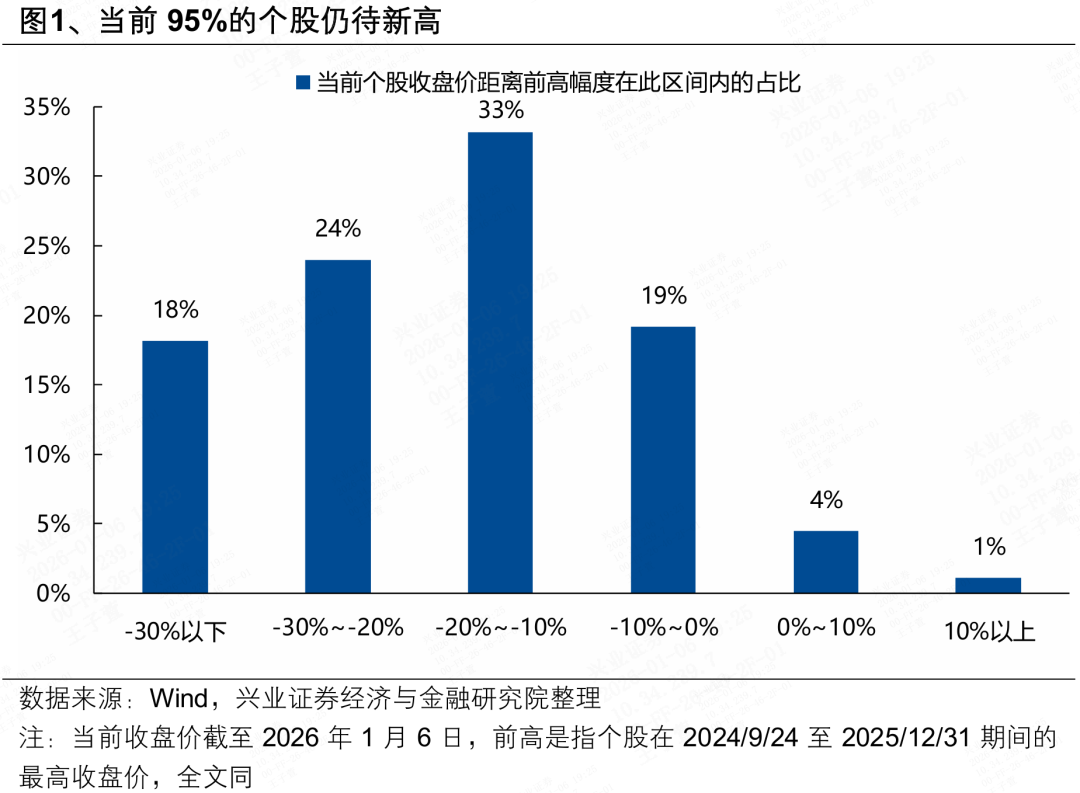
兴业证券:95%个股仍待新高 市场或存在结构性机会
智通财经网· 2026-01-06 12:43
Core Viewpoint - As of January 6, 95% of individual stocks have not broken their previous highs, despite major indices reaching new highs, indicating potential structural opportunities in the market [1][2]. Group 1: Market Overview - Major indices such as the Shanghai Composite Index, All A-shares, CSI 300, and CSI 800 have all reached new highs, but only 5% of individual stocks have surpassed their previous highs [2]. - The previous high for individual stocks is defined as the highest closing price from September 24, 2024, to December 31, 2025, with most stocks still down by over 10% from these highs [2]. Group 2: Sector Performance - The sectors that have broken through previous highs are concentrated in a few segments, particularly in large financials represented by insurance, and sectors benefiting from price increases such as non-ferrous metals, chemicals, petrochemicals, and construction materials [1][5]. - Other sectors that have seen new highs include military, machinery, and home appliance components driven by commercial aerospace and robotics [1][5]. Group 3: Sectors Near Previous Highs - Sectors that have not yet broken their previous highs but are close include technology growth (commercial vehicles, semiconductors, communication equipment), cyclical industries (steel raw materials, renovation materials), and consumer sectors (animal health, textiles, agriculture) [10]. - Industries with significant gaps to their previous highs include technology growth (motors, software, batteries, photovoltaics), dividend sectors (electricity, white goods, banks), and consumer sectors (food and beverage, social services, retail) [13].

方正证券:港股市场将迎风险偏好修复 建议关注高景气新兴产业补涨机会
Zhi Tong Cai Jing· 2026-01-03 12:58
A-share Market Insights - The market is expected to transition from "consolidation" to "spring rally" as the year-end approaches, with high-quality A-share assets offering attractive value globally [1][2] - Key investment directions include: 1) long-term opportunities in technology growth assets, 2) cyclical sectors with strong pricing power driven by supply-demand imbalances, and 3) blue-chip assets favored by long-term institutional investors [2] Hong Kong Market Insights - The influx of southbound capital is accelerating, providing solid financial support for the Hong Kong market [2] - The easing of US-China trade tensions is likely to boost market risk appetite, while the anticipated December interest rate cut and balance sheet expansion by the Federal Reserve will enhance global liquidity, benefiting Hong Kong stocks [2] US Market Insights - Despite stable earnings projections for US stocks in 2025, valuation and market concentration have returned to historical highs, indicating potential for increased volatility [2] - Earnings growth in 2026 is expected to continue, driven by sustained AI demand, reduced tariff risks, and accommodative monetary and fiscal policies [2] - Investment strategies may focus on two main themes: 1) ongoing narratives in technology stocks, particularly in AI, and 2) recovery opportunities in cyclical sectors, especially in midstream manufacturing and essential consumer goods [2] Domestic Bond Market Insights - The domestic bond market is entering a phase characterized by "weak economic recovery, stable yet easing policies, and central bank caution against excessive moves" [3] - The central bank's commitment to maintaining stable interest rates will limit the downward movement of long-term rates, leading to a range-bound market [3] - Investors are advised to shift focus from capital gains to coupon income and liquidity management, while closely monitoring potential signals from the central bank regarding long-term yield guidance [3] Commodity Market Insights - The ongoing anti-involution policies warrant attention to the actual implementation of capacity reduction measures [4] - Oil prices are under short-term pressure due to geopolitical tensions easing and OPEC+ shifting towards supply expansion [4] - Industrial metals are expected to see demand recovery driven by improved global economic growth forecasts, with supply-side disruptions likely to reshape the supply-demand landscape [4] - Gold's monetary attributes may continue to be favorable amid ongoing government leverage, particularly in the US, where long-term deficit rates are challenging to reduce [4]

新老经济的平衡-2026年A股市场策略展望
2025-12-29 01:04
Summary of Conference Call Records Industry Overview - The focus is on the A-share market in China, particularly the balance between new and traditional economies as of 2026 [1][4]. Key Points and Arguments Economic Environment - China's GDP has maintained a nominal growth rate of around 4% since the second half of 2023 [1][2]. - The broad asset management strategy has shifted from being long on bonds and short on stocks to being long on stocks and short on bonds, indicating an increase in risk asset allocation [1][2]. Market Outlook for 2026 - A systemic rebalancing between new (currently 18% weight) and traditional economies is anticipated, similar to the adjustments seen between new energy and traditional energy from 2019 to 2021 [1][4]. - High valuation and high volatility assets may not sustain long-term market support, necessitating a style switch for stable development [4][6]. - The market is expected to enter a positive driving phase by 2026, characterized by a "long on stocks, short on bonds" trend, leading to a dual rise in both stock prices and equity allocation [5]. Valuation and Performance - High valuation and high volatility assets may perform well in the short term but are likely to see a decline in long-term returns, with a potential decrease in Sharpe ratios [6][7]. - The technology growth sector contributed significantly to the CSI 300 index returns in Q3, but its weight was only 25%, indicating structural imbalance and a potential shift towards value styles [6][7]. Nominal Economic Predictions - The expected rise in the deflation index will likely improve nominal economic conditions, increasing inflationary pressures and enhancing corporate profitability, which may provide more investment opportunities in traditional industries [8][9]. Market Characteristics and Trends - The market is transitioning from recessionary trading to a stagflation or shallow recovery pattern, benefiting undervalued, high-quality assets [3][8]. - The anticipated bull market in 2026 is expected to see index growth and reduced volatility, with value and quality assets playing a more sustained role in market support [9][12]. Investment Style Dynamics - In a pro-cyclical environment, high valuation and high volatility assets perform well, but in a counter-cyclical phase, precise stock selection becomes crucial for excess returns [10]. - A divergence followed by a convergence trend is expected among different stock types over the next two years, with value stocks experiencing valuation expansion and quality stocks facing compression [11][12]. Other Important Insights - The overall market dynamics suggest that policy guidance will play a significant role in balancing new and traditional economies, facilitating a smoother transition towards a more stable economic environment [12].