芯片设备

Search documents
机械行业周报:燃机巨头订单旺盛,机器人基础模型 Pi06 鲁棒性提升-20260303
GUOTAI HAITONG SECURITIES· 2026-03-03 08:55
股 票 研 究 燃机巨头订单旺盛,机器人基础模型 Pi 06 鲁棒性提升 [Table_Industry] 机械行业 机械行业周报 | [姓名table_Authors] | 电话 | 邮箱 | 登记编号 | | --- | --- | --- | --- | | 肖群稀(分析师) | 0755-23976830 | xiaoqunxi@gtht.com | S0880522120001 | | 刘麒硕(分析师) | 0755-23976666 | liuqishuo@gtht.com | S0880525080005 | 本报告导读: 上周(2026/2/24-2026/2/27)机械设备指数涨跌幅为+4.40%。燃机巨头订单旺盛,GEV 排产达 2029 年,地缘政治动荡推升油服设备景气上行。 投资要点: [Table_Report] 相关报告 机械行业《春节后气体整体表现偏弱;广钢气体 中标海南商业航天发射场氦气采购项目》 2026.03.01 机械行业《具身模型 Pi 06 鲁棒性大幅提升,国 内人形初创百亿估值俱乐部增加至 6 家》 2026.02.28 机械行业《出口链月度跟踪:主要航线海运费同 ...
刷新纪录!美国GDP第一次突破30万亿,中国占比却卡在六成?
Sou Hu Cai Jing· 2026-02-22 11:07
美国2025年GDP冲上30万亿美元,消息一出,很多人第一反应是:中国还差多远? 账面数字摆在那里,中国只有它的六成多,这是不是意味着差距又被拉开了? 很多人盯着30万亿这个关口,像是在看一场比分定格的比赛。可真正决定胜负的,不是这一刻的数字,而是接下来几年谁跑得更稳。 美国现在体量大,步子自然放慢,年增速在2%左右徘徊。中国还保持在4到5之间,这个差距要是持续几年,账面比例就会悄悄发生变化。 关键还不只是增速,而是增速背后的质量。美国这些年把重心压在高利润的领域,芯片设备、操作系统、云服务、人工智能底层算法,哪一块都是全球定价 权所在。 全球市值前列的公司,多数挂着美国国旗,它们每天收的不是单笔利润,而是长期订阅和专利分成。这种收入模式,扩张慢一点,利润却厚得多。 中国的情况更像是在升级阶段,制造底盘扎实,产业链完整,新能源、通信设备、高端制造在往上爬。 研发投入这些年节节走高,专利申请量也不低。差距在于,核心技术和标准的话语权还没完全到位。谁掌握标准,谁就能决定利润往哪边流。 历史上看,大国竞争往往不是靠某一年翻盘,而是靠一轮产业浪潮。上世纪美国崛起,靠的是工业革命后的技术红利和美元体系的建立。 今天的新 ...

通胀重新点燃美联储降息希望 金价测试5000关口支撑
Jin Tou Wang· 2026-02-16 06:50
Market Overview - Gold prices experienced a decline, with the latest price reported at $4986.47 per ounce, down 0.65% from an opening price of $5019.14 per ounce, reaching a high of $5030.62 and a low of $4954.42 [1] - The U.S. inflation data for January was below expectations, reigniting hopes for a Federal Reserve rate cut this year, overshadowing the strong employment data from the previous week [1] - The S&P 500 index saw a slight increase due to favorable inflation data, while the Nasdaq index declined under pressure from major tech stocks [2] - The market is cautious ahead of the U.S. Presidents' Day holiday, with significant volatility expected as midterm elections approach and potential changes in Federal Reserve leadership loom [2] Gold Market - Gold prices rose over 2% last Friday, closing the week higher at $5022.06 per ounce, with a weekly increase of 1.2% [3] - The easing inflation concerns have alleviated market tensions, leading to a bullish sentiment for gold, with expectations of a cumulative rate cut of 63 basis points this year, the first cut anticipated in July [3] - Demand for gold remains strong in China ahead of the Spring Festival, while the Indian market has shifted to a discount [3] - ANZ has raised its second-quarter gold price forecast to $5800 per ounce, citing increased attractiveness of gold as a safe-haven asset [3] Oil Market - International oil prices saw a slight increase, with Brent crude futures rising by 0.3% to $67.75 per barrel, and U.S. crude futures up by 0.08% to $62.89 per barrel [4] - Despite the slight rebound, both benchmarks recorded weekly declines, influenced by concerns over OPEC+ potentially resuming production increases [4] - The U.S. inflation data has improved risk appetite, which may positively impact economic growth and energy demand [4] Currency Market - The U.S. dollar remained stable against major currencies, with January inflation data suggesting the Federal Reserve may keep interest rates unchanged [5] - The Japanese yen experienced its strongest weekly gain in about 15 months, supported by political stability following the recent election [6] - The Australian dollar has shown significant performance, becoming the best-performing major currency of 2026 so far, despite a slight decline at the end of the New York session [7]
2月16日财经早餐:通胀重新点燃美联储降息希望,金价测试5000关口支撑
Xin Lang Cai Jing· 2026-02-15 23:55
Market Overview - Gold prices traded around $5018 per ounce, with a significant increase of over 2% last Friday, driven by lower-than-expected U.S. inflation data, which reignited hopes for interest rate cuts by the Federal Reserve this year [1][5][27] - U.S. crude oil was trading at approximately $62.85 per barrel, with OPEC+ leaning towards resuming production increases from April to meet summer demand, while geopolitical risks related to U.S. support for Israeli airstrikes on Iran provided additional support for oil prices [1][10][15] Economic Indicators - The U.S. Consumer Price Index (CPI) rose by 0.2% in January, below the expected 0.3%, indicating a stabilization in inflation and potentially leading to lower interest rates, which could positively impact economic growth and energy demand [10][34] - Market participants are currently anticipating a cumulative interest rate cut of 63 basis points this year, with the first cut expected in July [7][29] Commodity Market - The demand for gold remains strong, particularly in China ahead of the Lunar New Year, while Indian markets have shifted to a discount [7][29] - Other precious metals also saw price increases, with silver rising by 3.4% to $77.70 per ounce, while platinum and palladium recorded gains despite weekly declines [7][29] Oil Market - International oil prices experienced a slight increase, with Brent crude futures up 0.3% to $67.75 per barrel, and U.S. crude futures rising 0.08% to $62.89 per barrel, although both benchmarks recorded weekly declines [8][10][31] - OPEC+ is expected to discuss production increases in their upcoming meeting on March 1, as they aim to address summer fuel demand amid ongoing geopolitical tensions [15][37] Stock Market - U.S. stock markets showed mixed results, with the S&P 500 index slightly up due to favorable inflation data, while the Nasdaq index declined under pressure from major tech stocks like Nvidia and Apple [4][26] - Defensive sectors such as utilities and real estate outperformed, while healthcare stocks benefited from strong earnings reports [4][26] Currency Market - The U.S. dollar remained stable against major currencies, reflecting market adjustments as investors await signals on interest rate direction from the Federal Reserve [10][32] - The Japanese yen saw significant appreciation, recording nearly a 3% increase against the dollar, marking its strongest weekly performance in over a year [35]

科磊发布2026财年第三财季业绩指引,机构维持买入评级
Jing Ji Guan Cha Wang· 2026-02-11 14:38
近期机构如花旗集团(Citigroup)在2026年2月2日维持"买入"评级,目标价1800美元;摩根大通在2025 年12月11日维持"增持"评级,目标价1485美元,预计2026年营收有望超预期。 行业状况 AI基础设施和高带宽内存(HBM)需求持续推动芯片设备销售,但设备采购节奏可能出现波动。科磊 在先进制程逻辑芯片和存储器领域保持强劲支出,台积电等大客户扩产计划可能影响未来订单。 机构观点 经济观察网 科磊发布2026财年第三财季业绩指引,预计收入约33.5亿美元,非GAAP每股收益约9.08美 元。该指引因增长幅度温和,未能满足市场对AI驱动加速增长的期待,引发股价波动。 业绩经营情况 科磊在2026年1月29日发布的第二财季财报中,对截至2026年3月31日的第三财季给出业绩指引,预计收 入约为33.5亿美元(上下浮动1.5亿美元),非GAAP每股收益约为9.08美元(上下浮动0.78美元)。 股票近期走势 科磊股价在财报发布后出现调整,例如2026年2月2日成交额22.67亿美元,股价下跌1.22%。市场关注估 值高位和营收增速放缓风险。 以上内容基于公开资料整理,不构成投资建议。 ...
机械行业周报:工程机械销量高增,SpaceX规划给予光伏设备增量空间
GUOTAI HAITONG SECURITIES· 2026-02-08 07:25
Investment Rating - The report assigns an "Overweight" rating for the machinery industry [4]. Core Insights - The machinery equipment index increased by 0.57% from February 2 to February 6, 2026, with significant sales growth in excavators and loaders [2][3]. - SpaceX's acquisition of xAI and plans to deploy one million satellites open new opportunities in the space photovoltaic sector, potentially increasing demand for high-end manufacturing and customized equipment [3]. - The report highlights strong performance in the engineering machinery sector, with excavator sales reaching 18,708 units in January 2026, a year-on-year increase of 49.5%, and loader sales at 11,759 units, up 48.5% year-on-year [3]. Summary by Sections 1. Market Overview - The machinery equipment sector outperformed the CSI 300 index, ranking 11th among 31 sectors with a 0.57% increase [7]. - The machinery industry index has risen by 55.02% since the beginning of 2025, compared to a 21.55% increase in the CSI 300 index [10]. 2. Key Macro Data - The manufacturing PMI for January 2026 was reported at 49.3% [15]. - The production index and order index for January 2026 were 50.6% and 49.2%, respectively [20]. 3. Sub-industry Data Summary 3.1 Engineering Machinery - Excavator sales in January 2026 were 18,708 units, with domestic sales at 8,723 units (up 61.4% year-on-year) and exports at 9,985 units (up 40.5% year-on-year) [3]. - Loader sales reached 11,759 units, with domestic sales at 5,293 units (up 42.8% year-on-year) and exports at 6,466 units (up 53.4% year-on-year) [3]. 3.2 AI Infrastructure - Recommended stocks in the AI infrastructure sector include Ice Wheel Environment and Han Zhong Precision [4]. 3.3 Space Photovoltaics - SpaceX's plans to deploy satellites are expected to drive demand for advanced manufacturing and customized equipment [3]. 3.4 Controlled Nuclear Fusion - A joint laboratory was established between Guoli Electronics and Hefei Energy Research Institute to focus on critical technologies for energy security [3]. 4. Company Profit Forecasts - The report provides a detailed valuation summary for key machinery companies, recommending stocks such as Sany Heavy Industry and XCMG Machinery [4].



君諾金融:存储芯片企业业绩亮眼,AI算力需求能否持续?
Sou Hu Cai Jing· 2026-01-26 02:49
本周全球金融市场进入关键观察期,多重事件叠加形成重要时间窗口。美联储货币政策会议、科技巨头财报密集披露、存储芯片行业业绩发布以及美联储主 席人选预期,共同构成市场关注焦点。 美联储将于周三公布利率决议。根据CME美联储观察工具数据,利率期货交易员押注维持现有利率区间的概率达到98%。市场更为关注的是政策声明措辞及 鲍威尔新闻发布会释放的信号。摩根士丹利预计美联储可能采取"鸽派暂停"策略,即在暂停降息的同时保留后续宽松倾向。值得关注的是,关于下任美联储 主席人选,预测市场数据显示贝莱德全球固定收益首席投资官瑞克·里德胜选概率已升至54%,领先于其他候选人。 科技板块迎来财报密集披露期。苹果、微软、Meta、特斯拉四家占据美股主要指数高权重的科技企业将于本周发布业绩。同期,光刻机制造商阿斯麦、芯 片设备商泛林集团、德州仪器等产业链企业也将披露财务数据。更值得关注的是存储芯片行业,三星电子、SK海力士以及闪迪、西部数据、希捷科技等企 业的业绩发布,将为AI算力基础设施建设需求提供重要验证数据。 存储芯片板块近期表现突出。闪迪股价在过去五个月涨幅接近十倍,2026年以来累计上涨超过110%。分析师对其2026年每股收 ...

万类霜天竞自由——兴银基金2026年度权益投资策略展望
Sou Hu Cai Jing· 2026-01-15 02:53
Group 1: Macro Trends and Investment Focus - The investment team at Xingyin Fund emphasizes deep research and value discovery amidst market uncertainties, focusing on macro trends and core industries such as new energy, technology, consumption, and pharmaceuticals for 2026 [1] - The AI sector remains a key growth engine globally, driven by significant capital expenditure from overseas giants, with a focus on the application side's revenue generation to create a closed loop [3][9] - The cyclical recovery strategy combines anti-involution and capacity cycles, prioritizing sectors with natural upward trends even without specific policies [3] Group 2: Consumption and Pharmaceuticals - The central economic work conference highlights expanding domestic demand as a primary task, indicating a need for a higher-level perspective on consumption in 2026 [4] - The consumption sector has faced downward pressure but is at a reasonable valuation after years of decline, with potential for a Davis double-click if upward momentum is found [4][5] - The consumption sector is categorized into traditional, new, and overseas consumption, with traditional consumption recovery linked to supply-side changes and new consumption benefiting from evolving consumer habits [5][6] Group 3: Technology Sector Insights - The technology sector is expected to thrive in 2026, with AI leading the charge, although the overall market valuations have risen significantly, indicating potential volatility [9][10] - Capital expenditure in AI is projected to increase, with a focus on the application of AI technologies and the performance of related companies [10] - Key areas of interest include consumer electronics, AI application software, chip equipment, nuclear power, aerospace, quantum technology, and innovative medical technologies [10] Group 4: Capital Market Outlook - The capital market is anticipated to play a crucial role in China's economic development over the next five years, driven by increased competition among major economies and a shift towards financial assets [12] - The transition from real estate to stock and fund-based wealth generation is expected to enhance consumer willingness and capacity [12] - The capital market may mitigate external risks through deeper openness and allow overseas capital to benefit from China's manufacturing strength [12]

日股破顶、汇债双杀!“高市交易”卷土重来
Jin Shi Shu Ju· 2026-01-13 07:43
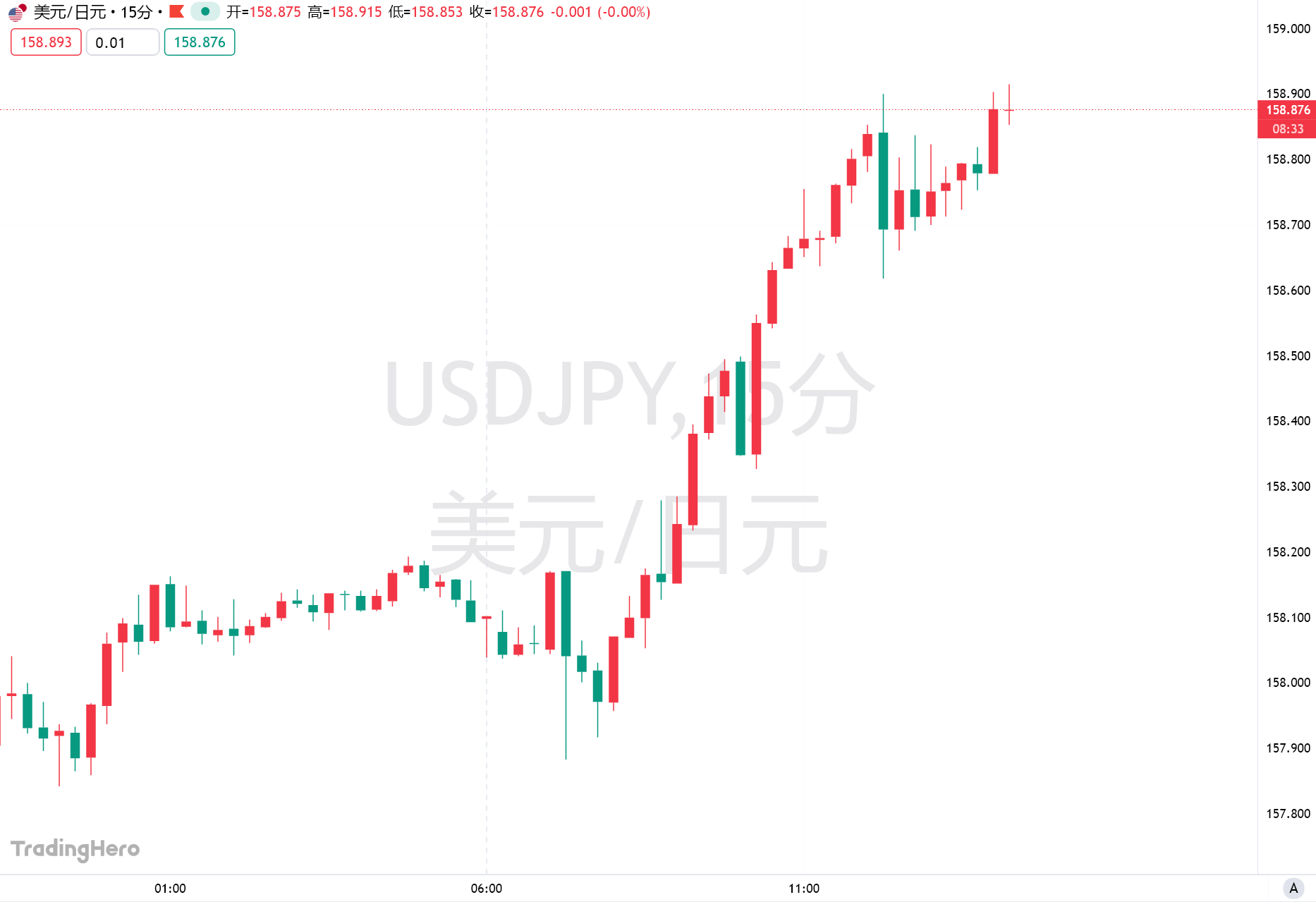
Core Viewpoint - Speculation about Japanese Prime Minister Sanae Takaichi announcing an early election has led to a surge in the Japanese stock market, reaching historical highs, while the yen and Japanese government bonds have significantly declined [1][3]. Market Reaction - The Nikkei 225 index closed up 1,609.27 points, a 3.10% increase, reaching 53,549.16 points, marking a historical high [1]. - The yen fell 0.5% against the US dollar, hitting its lowest level since July 2024 [1]. - The yield on Japan's 30-year government bonds surged by 12 basis points to 3.52% [1]. Political Context - Takaichi has informed senior members of the ruling Liberal Democratic Party (LDP) about her intention for an early election, which has raised market expectations for further fiscal expansion [3]. - The LDP currently holds a minority position in both houses of parliament, but the possibility of gaining a majority is seen as realistic [3]. Investment Opportunities - Sectors expected to benefit from Takaichi's spending policies include defense, artificial intelligence, and nuclear power, leading to significant stock price increases in companies like Kawasaki Heavy Industries (up over 10%) and Tokyo Electron (up over 9%) [4]. - The weakening yen is favorable for Japanese export companies, with Toyota Motor Corporation's stock rising over 7% and Hitachi's stock increasing by 3.8% [4]. Analyst Insights - Analysts predict that "Takaichi stocks," including those related to energy and space, will see substantial gains in the short term [5]. - However, there are concerns about internal divisions within the LDP regarding the election, which may lead to a temporary recovery of the "Takaichi trade" [5]. - The ongoing depreciation of the yen has become a politically sensitive issue in Japan, contributing to rising food and energy prices [5]. Economic Outlook - Some analysts view Japan's debt situation as more optimistic, noting that inflation rates exceed interest rates, leading to a decline in net debt [6]. - Despite expectations of further interest rate hikes by the Bank of Japan, the yen continues to weaken, attributed to fiscal concerns and the slow pace of rate increases [5][6].
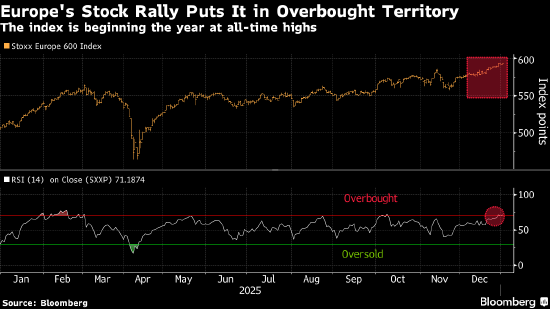
欧股2026年开局创纪录高位 英国富时100指数突破10000点大关
Xin Lang Cai Jing· 2026-01-02 17:30
Group 1 - European stock markets reached historical highs at the beginning of the new year, driven by optimistic economic growth expectations and rising commodity prices benefiting mining stocks [1][4] - The Stoxx Europe 600 index closed up 0.7%, with automotive and technology stocks performing particularly well, while real estate and media stocks lagged [1][4] - The blue-chip Stoxx Europe 50 index reached a record high, and the UK FTSE 100 index broke the 10,000-point barrier for the first time since 2009, following its best annual performance since 2009 [1][4] Group 2 - European major benchmark indices rose 17% last year, marking the largest annual increase since 2021, driven by resilient economic growth and expectations of increased fiscal spending [1][4] - Joachim Klement, a strategist at Panmure Liberum, noted that the biggest uncertainty in the US market is the fate of AI stocks, while infrastructure investment in Germany and defense spending across Europe are expected to boost economic growth and stock market performance [5] Group 3 - In individual stock performance, Swedish Mont Group's shares surged 12% after securing orders for data center equipment in the US [3][7] - Other individual stocks such as BE Semiconductor Industries and ASM International also saw share price increases, benefiting from the rise in Asian technology stocks [3][7]