贵金属等

Search documents
大反击 | 谈股论金
水皮More· 2026-03-16 09:37
Core Viewpoint - The article discusses the recent performance of the Hang Seng Technology Index and its impact on the A-share market, highlighting three core reasons for the index's strong performance and the subsequent market recovery [5][6][7]. Market Performance - The A-share market showed mixed results, with the Shanghai Composite Index down 0.26% at 4084.79 points, while the Shenzhen Component Index rose 0.19% to 14307.58 points, and the ChiNext Index increased by 1.41% to 3357.02 points. The total trading volume in the Shanghai and Shenzhen markets was 2.34 trillion, a decrease of 77.4 billion from the previous trading day [3][8]. Reasons for Hang Seng Technology Index Performance - The first reason for the strong performance of the Hang Seng Technology Index is the resolution of negative market sentiment, which had been driven by concerns over AI investment returns, intensified price wars among delivery platforms, and liquidity issues. The significant outflow of 27.7 billion from the Hong Kong Stock Connect on March 5 marked the end of this negative sentiment [6][7]. - The second reason is the endorsement from Michael Burry, known as Wall Street's "big short," who expressed optimism about the Hang Seng Technology Index, suggesting that the prior adjustments had been sufficient and that the fundamentals of related companies had not deteriorated [7]. - The third reason is the continuous inflow of foreign capital into A-shares and H-shares, amounting to approximately 22 billion USD this year, which is significantly higher than other emerging markets. The ongoing geopolitical tensions in the Middle East are likely to drive capital back to the Hong Kong market due to safety concerns [7]. Technical Analysis - The Shanghai Composite Index has completed a three-pin bottoming technical pattern, supporting the market's judgment of "water receding and stones emerging" [8].


大类资产配置全球跟踪2026年3月第1期:资产概览:中东紧张局势推升贵金属 原油价格
GUOTAI HAITONG SECURITIES· 2026-03-02 02:35
Asset Overview - The geopolitical tensions in the Middle East have driven up prices of precious metals and crude oil during the period from February 13 to February 27, with COMEX silver leading at a 19.8% increase, significantly outperforming gold at 5.0%[7] - Brent crude oil rose by 7.0% and WTI crude oil by 6.6% due to supply concerns stemming from the geopolitical situation[7] Equity Markets - The South Korean stock market has shown strong performance, with the KOSPI index increasing by 13.4%, marking a year-to-date gain of 48.2%[16] - Emerging markets have outperformed developed markets, with the MSCI global index rising by 1.3% during the same period[16] - A-shares performed well, with the Wind All A index up by 2.7%, and small-cap stocks like the CSI 500 and CSI 1000 both rising by 4.3%[16] Bond Markets - The Chinese bond market exhibited a "bear flattening" trend, with the yield curve shifting upward and the 10Y-2Y spread narrowing to 0.42%[24] - In the U.S., the bond market showed a "bull flattening" trend, with the yield curve moving downward and the 10Y-2Y spread also narrowing[24] Commodity and Currency Trends - The S&P 500 index increased by 0.6%, while the Dow Jones fell by 1.1% during the same period[16] - The U.S. dollar index rose by 0.8%, with the Chinese yuan appreciating by 0.8% against the dollar, while the Japanese yen depreciated by 2.2%[7] - The South China commodity index increased by 3.6%, with significant gains in precious metals and crude oil[7] Risk Indicators - The correlation between A-shares and Hong Kong stocks has slightly decreased from 0.73 to 0.72, while the correlation between U.S. stocks and Hong Kong stocks has increased from 0.33 to 0.37[7] - The report highlights potential risks including data timeliness, significant macroeconomic changes, and unexpected asset price movements[7]
商品期权周报-20260301
Guo Tai Jun An Qi Huo· 2026-03-01 11:49
1. Report Industry Investment Rating No relevant information provided. 2. Core Viewpoints of the Report - After the holiday, the overall volatility of the commodity options market decreased. The trading volume of agricultural product options increased due to contract roll - over. Some varieties in the black and non - ferrous sectors experienced increased volatility and higher open interest. The geopolitical risks over the weekend led to increased expected volatility in the precious metals, non - ferrous metals, and chemical sectors. Considering the high implied volatility of call options, a bull call spread strategy can be considered for long positions, and the strike price of the long call option can be gradually raised to reduce the maximum risk of the position [5]. 3. Summary by Directory 3.1 Market Overview - The overall volatility of the commodity options market decreased after the holiday. The trading volume of agricultural product options increased during the contract roll - over. Some varieties in the black and non - ferrous sectors saw increased volatility and higher open interest. Due to weekend geopolitical risks, the expected volatility of precious metals, non - ferrous metals, and the chemical sector increased. A bull call spread strategy can be used for long positions, and the strike price of the long call option can be gradually raised to reduce the maximum risk of the position [5]. - Market data shows that the trading volume of the entire market decreased by 0.67% to 5,512,888.0, while the open interest increased by 0.09% to 7,701,848. Among different sectors, the trading volume of agricultural products increased by 0.06% to 1,422,480.75, and the open interest decreased by 0.14% to 2,507,785; the trading volume of energy and chemicals decreased by 0.43% to 2,419,537.25, and the open interest increased by 0.23% to 3,144,995; the trading volume of the black sector increased by 3.82% to 488,594.0, and the open interest increased by 0.13% to 766,022; the trading volume of precious metals decreased by 2.71% to 307,045.75, and the open interest increased by 0.2% to 309,152; the trading volume of non - ferrous and new energy decreased by 1.33% to 875,230.25, and the open interest increased by 0.46% to 973,894 [6]. 3.2 Market Data 3.2.1 Market Overview - The report provides the implied volatility, 60 - day percentile of implied volatility, skew, and 60 - day percentile of skew for various commodity options, including corn, soybean meal, rapeseed meal, etc. For example, the implied volatility of corn is 9.97%, and the skew is 7.54% [12]. 3.2.2 - 3.2.61 Option Data for Each Commodity - For each commodity option (such as corn, soybean meal, etc.), the report details the closing price, price change, remaining trading days, trading volume (including call and put trading volume, and total trading volume), trading volume PCR, open interest (including call and put open interest, and total open interest), open interest PCR, implied volatility, historical volatility (HV - 10 days and HV - 20 days), and skew of the main and secondary contracts, as well as the overall contract data [13 - 74].
A股三大指数集体收涨:商业航天概念爆发
Guan Cha Zhe Wang· 2026-02-03 07:34
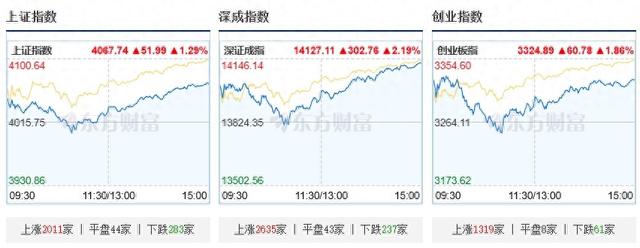
Market Performance - The A-share market saw a collective rise in the three major indices on February 3, with the Shanghai Composite Index increasing by 1.29% to close at 4067.74 points, the Shenzhen Component Index rising by 2.19% to 14127.11 points, and the ChiNext Index up by 1.86% to 3324.89 points [1] - The total trading volume in the Shanghai and Shenzhen markets was 25,658 billion, showing a slight decrease of 411 billion compared to the previous day [1] Sector Performance - The industry sectors exhibited a broad-based rally, with significant gains in shipbuilding, photovoltaic equipment, minor metals, glass fiber, engineering machinery, communication equipment, and aerospace sectors, while banking, insurance, and liquor industries experienced declines [2] - Over 4,800 stocks rose, with more than 80 stocks hitting the daily limit [2] Notable Stocks and Concepts - The commercial aerospace concept surged, with stocks like Jili Suoju, Tongyu Communication, Shenjian Co., and Zhongchao Holdings hitting the daily limit [2] - The space photovoltaic concept continued to strengthen, with Guosheng Technology, Jinjing Technology, Zerun New Energy, and Haiyou New Materials also reaching the daily limit [2] - The chemical sector was active, with Hongbaoli achieving two consecutive limits in three days and Wanfeng Co. hitting four consecutive limits [2] - The precious metals concept rebounded, with Hunan Gold achieving six limits in seven days [2] - The AI application concept remained active, with Zhewen Huli hitting five limits in eleven days [2]
大宗压力显现,股指高位巨震
Dong Zheng Qi Huo· 2026-02-01 13:50
Report Industry Investment Rating - The investment rating for stock index futures is "oscillation" [1] Core Viewpoint of the Report - The A-share market is expected to experience a short - term correction, while the mid - term performance depends on economic and policy efforts. A long - term and stable bull market also requires fundamental support [2][10] Summary by Directory 1. One - week View and Overview of Macro Key Events - **Next - week View**: The stock market faces short - term adjustment pressure. The recent sharp correction will calm the market, and the weakening PMI in January indicates that the domestic economic recovery is still full of twists and turns [10] - **This - week Key Events**: - On January 26, Premier Li Qiang held a symposium to listen to opinions on the "Government Work Report" [11] - On January 27, it was announced that the industrial enterprise profits in December 2025 increased by 5.3% year - on - year [12] - On January 29, Chinese leaders met with the British Prime Minister, and both sides agreed to develop a long - term and stable comprehensive strategic partnership [13][14] - On January 29, the State Council issued a plan to cultivate new growth points in service consumption [15] - On January 30, it was reported that in December 2025, China had a goods trade surplus of 853.3 billion yuan and a service trade deficit of 96.6 billion yuan [16] 2. One - week Market Quotes Overview - **Global Stock Market Weekly Overview**: From January 26 to January 30, the global stock market denominated in US dollars rose. The MSCI Global Index rose 0.65%, with emerging markets (+1.80%) > developed markets (+0.50%) > frontier markets (-0.13%). The South Korean stock market rose 8.0%, while the Canadian stock market fell 2.03% [17] - **Chinese Stock Market Weekly Overview**: From January 26 to January 30, Chinese equities declined. In terms of different markets, Hong Kong stocks > A - shares > Chinese concept stocks. The average daily trading volume of the Shanghai, Shenzhen, and Beijing stock markets was 3.0636 trillion yuan, a decrease of 264.4 billion yuan compared with last week. Most of the A - share broad - based indexes fell, with the Shanghai 50 Index rising 1.13% and the Beijing Stock Exchange 50 Index falling 3.59% [20] - **Weekly Overview of GICS Primary Industries in Chinese and Foreign Stock Markets**: Most of the global GICS primary industries rose this week, with the energy industry leading (+4.16%) and the optional consumption industry having the largest decline (-1.33%). In the Chinese market, the energy industry had the largest increase (+6.42%), and the optional consumption industry lagged (-4.21%) [23] - **Weekly Overview of China A - share CITIC Primary Industries**: Among the A - share CITIC primary industries, 10 rose (20 last week) and 20 fell (10 last week). The petroleum and petrochemical industry had the largest increase (+6.92%), and the national defense and military industry had the largest decline (-7.60%) [24] - **Weekly Overview of China A - share Styles**: The large - cap value style outperformed this week [29] - **Overview of Index Futures Basis**: Information about the basis of IH, IF, IC, and IM in the past 6 months is provided [30][33] 3. Overview of Index Valuation and Earnings Forecast - **Broad - based Index Valuation**: The report provides the PE and PB of various broad - based indexes this week, their eight - year percentile, and the changes compared with the beginning of the year [40] - **Primary Industry Valuation**: The report provides the PE and PB of various primary industries this week, their eight - year percentile, and the changes compared with the beginning of the year [41] - **Broad - based Index Equity Risk Premium**: The ERP of the CSI 300 decreased slightly this week, while the ERP of the CSI 500 and CSI 1000 increased slightly [42][47] - **Consensus Earnings Growth Rate of Broad - based Indexes**: The expected earnings growth rate of the CSI 300 in 2025 was raised to 8.35%, and in 2026 to 9.63%; the expected earnings growth rate of the CSI 500 in 2025 was lowered to 25.66%, and in 2026 was raised to 23.00%; the expected earnings growth rate of the CSI 1000 in 2025 was lowered to 27.37%, and in 2026 was raised to 24.03% [48] 4. Liquidity and Capital Flow Tracking - **Interest Rates and Exchange Rates**: This week, the 10 - year Treasury yield declined, the 1 - year yield rose, and the spread narrowed. The US dollar index was 97.1, and the offshore RMB exchange rate was 6.96 [57] - **Trading - type Capital Tracking**: The average daily trading volume of northbound funds increased by 50.6 billion yuan compared with last week, and the margin trading balance increased by 14.7 billion yuan [56] - **Tracking of Funds Flowing in through ETFs**: The share of ETFs tracking the CSI 300 decreased by 51.8 billion shares, the share of ETFs tracking the CSI 500 decreased by 51.8 billion shares, the share of ETFs tracking the CSI 1000 decreased by 13.2 billion shares, and the share of ETFs tracking the CSI A500 decreased by 3.2 billion shares [61][65] 5. Tracking of Domestic Macro High - frequency Data - **Supply Side**: The tire operating rate recovered after the Spring Festival [67] - **Consumption Side**: The second - hand housing transactions increased seasonally [73] - **Inflation Observation**: The prices of production materials declined, while the prices of agricultural products rebounded [83]
A股再度陷入调整,有这些原因
Mei Ri Jing Ji Xin Wen· 2026-01-20 09:17
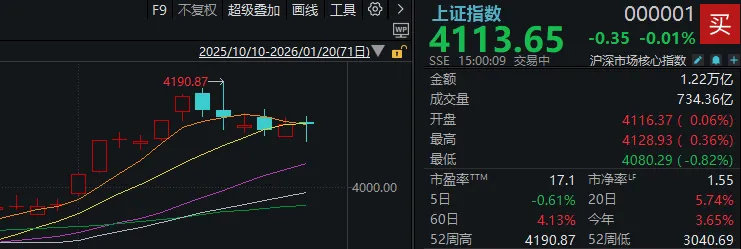
Market Overview - The three major indices in the A-share market collectively declined, with the ChiNext index dropping over 2% at one point. The Shanghai Composite Index closed down 0.01%, the Shenzhen Component Index down 0.97%, and the ChiNext Index down 1.79% [1] - Over 3,100 stocks in the market experienced declines, with total trading volume reaching 2.78 trillion yuan, an increase of 694 billion yuan compared to the previous trading day [1] Sector Performance - The chemical sector showed strong performance, while precious metals continued their upward trend, and the real estate sector was active. Conversely, sectors such as computing hardware and commercial aerospace saw significant declines [1] - The average stock price across the A-share market recorded its second bearish signal for 2026, indicating a cooling trend [3] External Influences - Concerns from the U.S. stock market, particularly due to negative sentiment stemming from news related to Japan and Greenland, affected the Asia-Pacific markets [4] - Japan's Prime Minister announced the dissolution of the House of Representatives for elections, leading to a sell-off in long-term Japanese government bonds and rising yields [5] - The impending U.S. tariffs on Greenland are contributing to increasing trade tensions, which may impact demand for U.S. assets and accelerate declines in global bond prices [5] A-share Market Dynamics - The financing buy-in amount for A-shares dropped to 267.4 billion yuan on January 19, down 20.35% from the previous Friday and 40.68% from the peak of 450.8 billion yuan on January 14 [6] - There has been a significant outflow of funds from stock ETFs, with over 400 billion yuan net outflow recorded, marking the third consecutive day of substantial outflows [8] Stock Trends - The market has seen a shift in trading dynamics, with a notable cooling in aggressive short-term trading styles. The number of consecutive daily limit-up stocks has decreased from six to three [9] - Technology stocks, particularly in computing hardware and AI applications, have generally retreated, while sectors like precious metals and chemicals have shown gains [9] Policy and Industry Insights - The Ministry of Industry and Information Technology and other departments have issued guidelines to promote zero-carbon factory construction, which is expected to support the green transformation and high-quality development of the chemical industry [11] - Analysts suggest that the Chinese chemical industry may experience a revaluation due to reduced capacity expansion, potentially leading to higher dividend yields and a shift from being a cash-consuming sector to a cash-generating one [11]
收评:沪指涨0.47% 造纸板块强势
Zhong Guo Jing Ji Wang· 2025-12-25 07:34
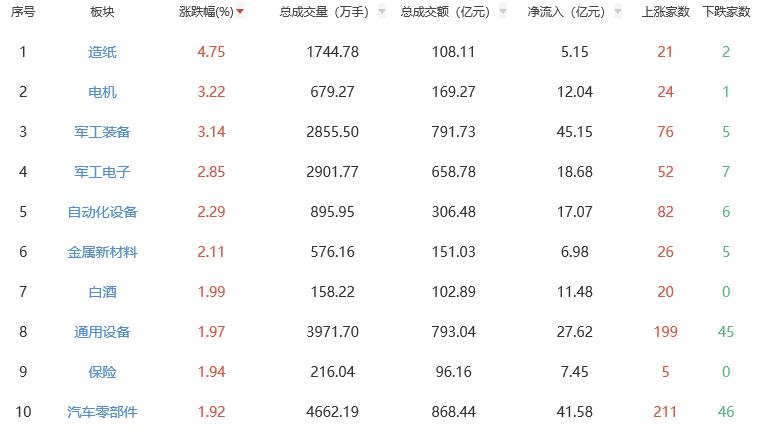
Market Overview - The A-share market saw all three major indices close higher, with the Shanghai Composite Index at 3959.62 points, up 0.47%, and a total trading volume of 7850.19 billion yuan [1] - The Shenzhen Component Index closed at 13531.41 points, increasing by 0.33%, with a trading volume of 11395.04 billion yuan [1] - The ChiNext Index ended at 3239.34 points, rising by 0.30%, with a trading volume of 5262.93 billion yuan [1] Sector Performance - The paper, electric machinery, and military equipment sectors led the gains, with paper up 4.75%, electric machinery up 3.22%, and military equipment up 3.14% [2] - The military electronics sector had the highest increase at 5.85%, with a trading volume of 2901.77 million hands and a net inflow of 18.68 billion yuan [2] - Conversely, sectors such as energy metals and small metals experienced declines, with the energy sector down 1.44% and small metals down 0.62% [2]
午评:沪指涨0.29% 造纸板块涨幅居前
Zhong Guo Jing Ji Wang· 2025-12-25 03:42
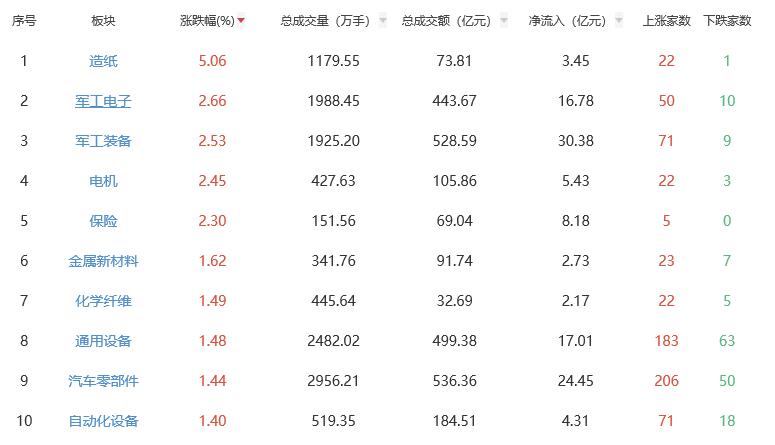
Core Viewpoint - The A-share market showed mixed performance in early trading, with the Shanghai Composite Index slightly up by 0.29%, while the Shenzhen Component and ChiNext Index experienced declines of 0.11% and 0.37%, respectively [1] Market Performance - As of the midday close, the Shanghai Composite Index stood at 3952.50 points, reflecting a gain of 0.29% [1] - The Shenzhen Component Index was reported at 13472.22 points, down by 0.11% [1] - The ChiNext Index closed at 3217.47 points, showing a decrease of 0.37% [1] Sector Performance - The leading sectors in terms of gains included: - Paper industry with a rise of 5.06%, total trading volume of 1179.55 million hands, and a net inflow of 3.45 billion [2] - Military electronics increased by 2.66%, with a trading volume of 1988.45 million hands and a net inflow of 16.78 billion [2] - Main industrial aggregates rose by 2.53%, with a total trading volume of 1925.20 million hands and a net inflow of 30.38 billion [2] - Electric machinery gained 2.45%, with a trading volume of 427.63 million hands and a net inflow of 5.43 billion [2] - Insurance sector increased by 2.30%, with a trading volume of 151.56 million hands and a net inflow of 8.18 billion [2] - The sectors that faced declines included: - Energy metals decreased by 2.68%, with a trading volume of 228.14 million hands and a net outflow of 19.82 billion [2] - Precious metals fell by 2.67%, with a trading volume of 309.80 million hands and a net outflow of 9.64 billion [2] - Small metals dropped by 1.13%, with a trading volume of 635.51 million hands and a net outflow of 8.07 billion [2] - Industrial metals declined by 1.07%, with a trading volume of 1719.83 million hands and a net outflow of 17.05 billion [2]
国诚投顾:美联储降息预期再升温,矿冶博弈刺激铜价上涨
Sou Hu Cai Jing· 2025-12-04 08:52
Market Overview - As of November 28, the Shanghai Composite Index increased by 1.40% to 3888.6 points, while the CSI 300 Index rose by 1.64% to 4526.66 points. The SW Nonferrous Metals Industry Index saw a significant increase of 3.37% to 7396.64 points [1] - Within the nonferrous metals sector, the sub-industries of industrial metals, precious metals, minor metals, energy metals, and new metal materials experienced changes of 3.46%, 4.86%, 4.20%, 0.91%, and 4.49% respectively [1] Key Metal Price Data - Last week, the prices for copper, aluminum, zinc, lead, nickel, and tin on the Shanghai Futures Exchange were 87,430 CNY/ton, 21,610 CNY/ton, 22,425 CNY/ton, 17,090 CNY/ton, 117,080 CNY/ton, and 305,040 CNY/ton, with changes of 1.66%, 0.68%, -0.31%, -0.64%, 1.99%, and 4.19% respectively [2] - Gold and silver prices were reported at 953.92 CNY/gram and 12,727 CNY/kilogram, reflecting increases of 2.00% and 6.56% respectively [2] - Prices for praseodymium neodymium oxide, terbium oxide, dysprosium oxide, and sintered neodymium iron boron N35 were 568,000 CNY/ton, 6,505,000 CNY/ton, 1,470,000 CNY/ton, and 142.5 CNY/kilogram, with changes of 3.56%, -0.31%, -1.01%, and 3.64% respectively [2] - Battery-grade lithium carbonate, industrial-grade lithium carbonate, battery-grade lithium hydroxide, and Australian lithium concentrate were priced at 93,500 CNY/ton, 91,500 CNY/ton, 84,000 CNY/ton, and 1,000 USD/ton, with changes of 0.54%, 1.10%, 1.20%, and -8.26% respectively [2] - Domestic electrolytic cobalt, cobalt tetroxide, and cobalt sulfate prices were 405,500 CNY/ton, 347,500 CNY/ton, and 89,500 CNY/ton, with changes of 0.75%, 0.00%, and 0.00% respectively [2] Investment Insights - Recent dovish comments from the New York Fed President Williams regarding increased risks of employment downturn and reduced inflation risks have led to a renewed expectation of a rate cut by the Federal Reserve in December, with market probabilities exceeding 80% [3] - The ongoing rate cut cycle and liquidity pressures may continue to support rising prices for gold and silver [3] - Global copper production is expected to face significant uncertainty due to frequent accidents at major copper mines, leading to a downward revision of production forecasts [3] - Codelco, the world's largest copper producer, has proposed a substantial increase in the annual contract premium for refined copper to Chinese smelters, rising from 89 USD/ton in 2025 to 335-350 USD/ton in 2026, marking an increase of over 275% [3] - The China Smelters Purchase Team (CSPT) has agreed to reduce copper concentrate production capacity by over 10% for 2026, aiming to improve the supply-demand balance [3] - Potential tariffs on copper by the U.S. and the ongoing liquidity expansion by the Federal Reserve are expected to further drive copper prices upward [3]

全球市场波动,我们该如何应对?|第418期精品课程
银行螺丝钉· 2025-12-01 13:59
Group 1 - Recent fluctuations in stocks, bonds, and gold have been observed, indicating a liquidity crisis that is relatively rare when all asset classes decline simultaneously [4][7][18] - The liquidity crisis is primarily driven by uncertainty surrounding the Federal Reserve's interest rate decisions, particularly the potential for a rate cut in December [8][9][14] - The U.S. national debt has reached $38.33 trillion, with interest payments projected to exceed $870 billion in 2024, raising concerns about the dollar's stability and the high yield on 10-year Treasury bonds [11][12] Group 2 - The uncertainty regarding the timing of future rate cuts may lead to prolonged periods of market volatility, with potential intervals of several months between cuts [13][14] - Historically, liquidity crises occur every 3-5 years, with notable instances during the onset of the COVID-19 pandemic and significant rate hikes by the Federal Reserve [17][21] - During periods of liquidity tightness, investors tend to sell long-term risk assets, leading to increased correlation among different asset classes [18][22] Group 3 - To navigate the current market volatility, investors should assess their holdings for undervalued assets and ensure that the underlying companies are still profitable [24][25] - Short-term fluctuations may present opportunities to invest in undervalued assets, as seen during previous market downturns [27][29] - Suitable investment options currently include undervalued index funds, actively managed portfolios, and fixed-income plus products that incorporate a small amount of equities [30][32]