能源

Search documents
日「赚」8000,好多人想摆摊了
Sou Hu Cai Jing· 2025-11-20 18:41
Core Insights - The article emphasizes the importance of understanding cash flow, profit, and income in business operations, highlighting that cash flow is a critical indicator of financial health [4][5][15]. Group 1: Cash Flow Understanding - Cash flow thinking differentiates between "how much is earned" and "how much is retained," which is crucial for business sustainability [5][12]. - The example of a street vendor illustrates that while the vendor may have a monthly income of 50,000 yuan, the actual cash flow after expenses is only 8,000 yuan, which is the true free cash flow available for discretionary spending [6][8][12]. Group 2: Free Cash Flow Index - The article introduces the concept of free cash flow indices, which are designed to identify companies with strong cash flow generation capabilities [16][18]. - Two main indices in China are highlighted: the Guozheng Free Cash Flow Index and the Zhongzheng Free Cash Flow Series, both of which exclude financial and real estate sectors to focus on cash flow quality [18][21]. Group 3: Historical Performance - Historical data shows that the Guozheng Free Cash Flow Index has an annualized return of approximately 18% from 2013 to 2025, with a maximum drawdown of about 21% [19][23]. - The performance of these indices is attributed to their selection of high cash flow generating companies and their avoidance of sectors that faced significant downturns, such as finance and real estate [23][24]. Group 4: Investment Considerations - The article notes a growing interest in cash flow indices due to declining interest rates and the reduced liquidity of real estate investments, prompting investors to seek more stable returns [27][28]. - It suggests that investors should clarify their preferences between the two indices, as they have different sector focuses, and consider factors like tracking error, fees, and fund management experience when selecting funds [30][34].


和展能源:混塔生产基地均处于北方,低温对混塔生产有一定影响
Zheng Quan Ri Bao Zhi Sheng· 2025-11-20 11:08
Core Viewpoint - The company, Hezhan Energy, has acknowledged that low temperatures in northern regions may impact the production of mixed towers, but it has accounted for these temperature effects in its production goals and scheduling, ensuring that all operational activities are proceeding normally [1] Group 1 - The production base for mixed towers is located in northern regions, where low temperatures can have a certain impact on production [1] - The company has considered temperature effects when formulating production targets and scheduling plans for mixed towers [1] - All production operations are reported to be functioning normally despite the temperature considerations [1]

港股国企ETF(159519)涨超1%,港股市场与A股的联动性增强
Mei Ri Jing Ji Xin Wen· 2025-11-20 06:21
Core Insights - The Hong Kong stock market is experiencing increased correlation with the A-share market, driven by policy expectations and strong earnings performance, particularly benefiting mainland enterprises listed in Hong Kong, such as those in the energy and financial sectors [1] - The value reassessment driven by mainland policies is expected to continue, with energy and financial sectors likely to remain market stabilizers [1] - Tourism-related industries are performing well due to economic data, with service prices rising month-on-month and strong travel demand [1] Group 1: Market Dynamics - The Hong Kong stock market is seeing enhanced linkage with the A-share market, influenced by style rotation from the mainland [1] - Mainland policies are expected to sustain a value reassessment trend, particularly favoring energy and financial sectors [1] Group 2: Sector Performance - Energy and financial sectors are attracting significant capital due to favorable policy expectations and robust earnings [1] - Tourism-related sectors are benefiting from increased travel demand and rising service prices [1] Group 3: Index and ETF Information - The Hong Kong National Enterprises ETF (159519) tracks the mainland state-owned enterprises index (H11153), focusing on large-cap state-owned enterprises primarily in traditional sectors like finance and energy [1] - The index emphasizes high dividend yields and stable cash flows, reflecting the overall market performance of state-owned enterprises listed in Hong Kong [1]
宏观日报:关注中游数字化转型进展-20251120
Hua Tai Qi Huo· 2025-11-20 03:00
Industry Overview Upstream - Black: Glass prices continue to decline [3] - Non-ferrous: Nickel prices fall [3] - Agriculture: Egg prices correct [3] - Infrastructure: Building materials index rises slightly [3] Midstream - Chemicals: Urea production starts to pick up [4] - Energy: Coal inventory in power plants decreases [4] - Infrastructure: Asphalt production starts to decline [4] Downstream - Real estate: Seasonal decline in commercial housing sales in second- and third-tier cities [4] - Services: Slight decline in domestic flight schedules [4] Medium-term Event Summary Production Industry - On November 19, the mobilization meeting of the First Central Ecological and Environmental Protection Inspection Team for inspecting Beijing was held, marking the full deployment of the fifth batch of 10 central ecological and environmental protection inspection teams in the third round. This batch of inspections will form 8 routine inspection teams to conduct routine inspections on 3 provinces (municipalities) including Beijing, Tianjin, and Hebei, and 5 central enterprises including China Huadian Corporation, National Energy Investment Group Co., Ltd., Ansteel Group Co., Ltd., China Baowu Steel Group Co., Ltd., and China National Coal Group Corporation [1] - From November 16 to 19, Zhang Guoqing, a member of the Political Bureau of the CPC Central Committee and Vice Premier of the State Council, investigated the digital and intelligent transformation and upgrading of the manufacturing industry and the innovation and development of state-owned enterprises in Guizhou and Chongqing. He emphasized that state-owned enterprises should continuously improve their independent innovation capabilities, cultivate new productive forces and build new competitive advantages through the in-depth integration of scientific and technological innovation and industrial innovation. They should improve the institutional arrangements for promoting original innovation in state-owned enterprises, increase the proportion of R & D investment in basic research, accelerate the layout and construction of original technology sources, and make more breakthroughs in key core technologies, key common technologies, and frontier technologies [1] Service Industry - On November 19, the Ministry of Finance issued an announcement stating that on November 18, the Ministry of Finance of the People's Republic of China, on behalf of the central government, successfully issued 4 billion euros of sovereign bonds in Luxembourg. Among them, 2 billion euros were issued for a 4 - year term at an issue rate of 2.401%, and 2 billion euros were issued for a 7 - year term at an issue rate of 2.702%. Standard Chartered Bank, as the joint lead underwriter, bookrunner, and settlement and delivery bank, supported the successful issuance of the 4 - billion - euro sovereign bonds by the Chinese Ministry of Finance in Luxembourg [2] Key Industry Price Indicators | Industry Name | Indicator Name | Frequency | Unit | Update Time | Value | YoY | Past 5 - day Trend | | --- | --- | --- | --- | --- | --- | --- | --- | | Agriculture | Spot price: Corn | H | Yuan/ton | 11/19 | 2185.7 | 1.12% | | | | Spot price: Egg | Day | Yuan/kg | 11/19 | 6.2 | - 4.62% | | | | Spot price: Palm oil | H | Yuan/ton | 11/19 | 8820.0 | 1.26% | | | | Spot price: Cotton | H | Yuan/ton | 11/19 | 14787.3 | - 0.22% | | | | Average wholesale price: Pork | Day | Yuan/kg | 11/19 | 17.9 | - 1.10% | | | Non - ferrous metals | Spot price: Copper | Day | Yuan/ton | 11/18 | 86020.0 | - 0.95% | | | | Spot price: Zinc | Day | Yuan/ton | 11/18 | 22304.0 | - 1.52% | | | | Spot price: Aluminum | H | Yuan/ton | 11/18 | 21473.3 | - 0.14% | | | | Spot price: Nickel | H | Yuan/ton | 11/18 | 117383.3 | - 2.92% | | | Ferrous metals | Spot price: Aluminum | H | Yuan/ton | 11/18 | 17188.8 | - 1.36% | | | | Spot price: Rebar | H | Yuan/ton | 11/18 | 3161.3 | 1.05% | | | | Spot price: Iron ore | Day | Yuan/ton | 11/18 | 805.2 | 1.71% | | | | Spot price: Wire rod | Day | Yuan/ton | 11/18 | 3320.0 | 0.23% | | | Non - metals | Spot price: Glass | H | Yuan/square meter | 11/19 | 13.7 | - 2.14% | | | | Spot price: Natural rubber | Day | Yuan/ton | 11/19 | 14891.7 | 0.06% | | | | China Plastic City price index | H | - | 11/19 | 767.6 | - 0.35% | | | Energy | Spot price: WTI crude oil | Day | US dollars/barrel | 11/19 | 60.7 | - 0.49% | | | | Spot price: Brent crude oil | H | US dollars/barrel | 11/19 | 64.9 | - 0.41% | | | | Spot price: Liquefied natural gas | H | Yuan/ton | 11/19 | 4182.0 | - 0.48% | | | | Coal price: Coal | H | Yuan/ton | 11/19 | 831.0 | - 0.36% | | | Chemicals | Spot price: PTA | H | Yuan/ton | 11/18 | 4628.8 | - 0.18% | | | | Spot price: Polyethylene | Day | Yuan/ton | 11/18 | 7005.0 | 0.41% | | | | Spot price: Urea | Day | Yuan/ton | 11/18 | 1630.0 | 0.15% | | | | Spot price: Soda ash | H | Yuan/ton | 11/18 | 1218.6 | 0.53% | | | Real estate | Cement price index: National | H | - | 11/19 | 136.2 | - 0.15% | | | | Building materials composite index | H | Points | 11/19 | 113.8 | 1.41% | | | | Concrete price index: National index | Day | Points | 11/19 | 90.8 | - 0.03% | | [38]
能源化工期权:能源化工期权策略早报-20251120
Wu Kuang Qi Huo· 2025-11-20 01:43
Group 1: Report Overview - The report is an early morning strategy report on energy and chemical options dated November 20, 2025 [1] - It covers various energy and chemical option types, including energy (crude oil, LPG), polyolefins (PP, PVC, etc.), polyesters (PX, PTA, etc.), alkali chemicals (caustic soda, soda ash), and others (rubber) [2] - The recommended strategy is to construct option portfolio strategies mainly as sellers and spot hedging or covered strategies to enhance returns [2] Group 2: Underlying Futures Market Overview - The report provides the latest prices, price changes, trading volumes, and open interest of multiple underlying futures contracts, such as crude oil (SC2601), LPG (PG2601), and methanol (MA2601) [3] Group 3: Option Factors - Volume and Open Interest PCR - It presents the volume and open interest PCR of different option varieties, which are used to describe the strength of the option underlying market and the turning point of the underlying market [4] Group 4: Option Factors - Pressure and Support Levels - The pressure and support levels of option underlyings are analyzed from the strike prices with the largest open interest of call and put options [5] Group 5: Option Factors - Implied Volatility - The report shows the implied volatility data of various options, including at - the - money implied volatility, weighted implied volatility, and the difference between implied and historical volatility [6] Group 6: Strategy and Recommendations Crude Oil Options - Fundamental analysis shows that US crude oil inventories have different changes, with an increase in total, strategic, and commercial inventories and a decrease in Cushing inventories [7] - The price trend has been volatile, with different trends in each month from August to November [7] - Option factor research indicates that the implied volatility is above the average, the open interest PCR is below 0.80, and the pressure and support levels are 540 and 460 respectively [7] - Recommended strategies include a volatility strategy of selling a bearish call + put option combination and a spot long - hedging strategy of constructing a long collar [7] LPG Options - The LPG market is firm, with supply tightening recently. The price trend has also been volatile from August to November [9] - Option factors show that the implied volatility has dropped to below the average, the open interest PCR is around 0.80, and the pressure and support levels are 4500 and 4250 [9] - Recommended strategies include a volatility strategy of selling a neutral call + put option combination and a spot long - hedging strategy of constructing a long collar [9] Methanol Options - The supply of methanol may increase, and the price has shown a weak trend since August [9] - Option factors indicate that the implied volatility is around the historical average, the open interest PCR is below 0.80, and the pressure and support levels are 2500 and 2000 [9] - Recommended strategies include a directional strategy of constructing a bearish put spread, a volatility strategy of selling a bearish call + put option combination, and a spot long - hedging strategy of constructing a long collar [9] Ethylene Glycol Options - The supply of ethylene glycol has increased, and the price has been weak. Option factors show that the implied volatility is below the average, the open interest PCR is around 0.70, and the pressure and support levels are 4500 and 4050 [10] - Recommended strategies include a directional strategy of constructing a bearish put spread, a volatility strategy of shorting volatility, and a spot long - hedging strategy [10] Polypropylene Options - The production of polypropylene has increased, and the price has been weak. Option factors show that the implied volatility has dropped to around the average, the open interest PCR is around 0.70, and the pressure and support levels are 7000 and 6300 [10] - Recommended strategies include a directional strategy of constructing a bearish put spread and a spot long - hedging strategy [10] Rubber Options - The tire production capacity utilization rate has different changes, and the rubber price has been in a weak consolidation. Option factors show that the implied volatility has dropped to below the average, the open interest PCR is below 0.60, and the pressure and support levels are 16000 and 15000 [11] - Recommended strategies include a volatility strategy of selling a bearish call + put option combination [11] PTA Options - The PTA load has been adjusted, and the price has shown a rebound with pressure. Option factors show that the implied volatility is above the average, the open interest PCR is around 0.70, and the pressure and support levels are 4700 and 4300 [11] - Recommended strategies include a volatility strategy of selling a neutral call + put option combination [11] Caustic Soda Options - The production capacity utilization rate of caustic soda has changed regionally, and the price has been weak. Option factors show that the implied volatility is at a high level, the open interest PCR is below 0.80, and the pressure and support levels are 3000 and 2200 [12] - Recommended strategies include a directional strategy of constructing a bearish spread and a spot long - hedging strategy of constructing a long collar [12] Soda Ash Options - The inventory of soda ash has increased year - on - year, and the price has been in a low - level weak consolidation. Option factors show that the implied volatility is at a relatively high historical level, the open interest PCR is below 0.60, and the pressure and support levels are 1860 and 1100 [12] - Recommended strategies include a directional strategy of constructing a bearish spread, a volatility strategy of shorting volatility, and a spot long - hedging strategy of constructing a long collar [12] Urea Options - The enterprise inventory of urea has decreased, and the price has shown a rebound from low - level consolidation. Option factors show that the implied volatility is around the historical average, the open interest PCR is below 0.60, and the pressure and support levels are 1800 and 1600 [13] - Recommended strategies include a volatility strategy of selling a neutral call + put option combination and a spot long - hedging strategy [13] Group 7: Option Charts - The report includes various option charts for different underlying assets, such as price trend charts, trading volume and open interest charts, open interest PCR and trading volume PCR charts, and implied volatility charts for crude oil, LPG, methanol, etc. [14][35][55]
研究所晨会观点精萃-20251120
Dong Hai Qi Huo· 2025-11-20 01:21
Report Investment Ratings - The report does not provide an overall industry investment rating. However, specific ratings for different asset classes are as follows: - Index: Short - term shock, short - term cautious wait - and - see [2][3] - Treasury bonds: Short - term shock, cautious long [2] - Commodity sectors: - Black metals: Short - term shock, short - term cautious wait - and - see [2] - Non - ferrous metals: Short - term shock, short - term cautious wait - and - see [2] - Energy and chemicals: Short - term shock, cautious wait - and - see [2] - Precious metals: Short - term shock, short - term cautious wait - and - see, long - term buy on dips [3] Core Views - The global market is affected by the Fed's monetary policy expectations, domestic economic growth, and policy stimulus. The short - term upward drive of the macro - economy has weakened, and different asset classes show short - term shock characteristics. Attention should be paid to domestic economic growth and the implementation of incremental policies [2][3] Summary by Categories Macro Finance - Overseas, the Fed's meeting minutes showed serious differences, and many thought it was not suitable to cut interest rates in December. The market expected no rate cut this year, leading to a rise in the US dollar and Treasury yields, and an increase in global risk appetite. Domestically, China's October economic data slowed down year - on - year and fell short of expectations, and the central bank restarted Treasury bond trading to release liquidity. The short - term macro - upward drive has weakened, and the index will be in short - term shock [2] - Index: Driven by sectors such as precious metals, it rose slightly. Affected by economic data and the Fed's hawkish signals, the short - term upward drive has weakened, and it will be in short - term shock. Short - term cautious wait - and - see [3] - Precious metals: The market rose slightly at night on Wednesday. Affected by the Fed's possible inaction in December and the strong US dollar, short - term shock, long - term upward pattern remains. Short - term cautious wait - and - see, long - term buy on dips [3] Black Metals - Steel: The spot and futures markets declined on Wednesday. Demand continued to weaken, inventory decreased, and production decreased. There are no new contradictions, and the price is expected to fluctuate in a range [4][6] - Iron ore: The spot price fell slightly on Wednesday, and the futures price remained strong. The bottom of iron - making water production is uncertain, supply has changed slightly, and it is expected to fluctuate in a range [6] - Silicon manganese/silicon iron: The spot price was flat on Wednesday, and the futures price was affected by coal. Demand is still poor, and the futures price is expected to fluctuate in a range [7] - Soda ash: The main contract was weak on Wednesday. Supply decreased marginally but remained loose, and demand improved marginally. Short - term range shock, long - term bearish [8] - Glass: The main contract was weak on Wednesday. Supply was stable, demand improved marginally, and inventory was at a high level. It is expected to run weakly in the short term [8] Non - ferrous Metals and New Energy - Copper: Overnight, LME copper rebounded slightly. Supply concerns still exist, but US and domestic inventories are high, and there is a risk of price decline [10] - Aluminum: On Wednesday, Shanghai aluminum prices rebounded. Technically, there may be room for further rebound, but inventory is at a three - year high, and there may be a large correction later [10] - Tin: Supply is tight, demand is weak, inventory has increased for two consecutive weeks, and the price is expected to fluctuate at a high level [11] - Lithium carbonate: The main contract rose on Wednesday. The price of lithium ore increased, and the trading volume increased. Hold long positions cautiously [12] - Industrial silicon: The main contract rose on Tuesday. The organic silicon industry plans to reduce emissions and support prices. Pay attention to the continuation of funds and buy on dips [12] - Polysilicon: The main contract rose on Tuesday. There is a game between strong policy expectations and weak reality. It is expected to fluctuate in a high - level range [13][14] Energy and Chemicals - Crude oil: EIA data showed an increase in US refined oil inventories, and the hope of restarting peace talks between Russia and Ukraine led to a decline in oil prices. It is expected to remain under pressure [15] - Asphalt: The price remained low. Inventory was decreasing slightly, but demand was weak, and the over - supply pressure was high. Pay attention to the fluctuation of crude oil [15] - PX: The import from Japan is uncertain, and PTA demand provides some support. It is in a tight supply situation, and pay attention to cost changes [16] - PTA: The import of PX is uncertain, and downstream demand is weak. The supply is high, and the long - term bearish pressure is large [16] - Ethylene glycol: Port inventory has accumulated significantly, downstream demand is weakening, and the price is expected to remain low and fluctuate [16] - Short fiber: It rebounded slightly in the short term, but the later pressure is large. The terminal orders are decreasing seasonally, and it can be shorted on highs in the medium term [17] Agricultural Products - US soybeans: The overnight market declined. Brazil's November export volume is expected to increase, and there is an export order to China [19] - Soybean and rapeseed meal: The supply and demand of domestic oil mills are loose, the basis is weak, and there may be a phased correction [19] - Soybean and rapeseed oil: The price was boosted by EPA biodiesel news. The supply of domestic soybean oil is strong, and rapeseed oil inventory is at a low level [20] - Palm oil: The Malaysian futures market continued to rise, but domestic inventory increased, and it is expected to fluctuate widely [20] - Corn: The price in Northeast China remained stable. Inventory is low, and there is a willingness to buy in the market. The futures may repair the basis [20] - Live pigs: The morning price was stable and strong. Supply is excessive, and the futures may continue to decline [21]
沙特与美国签署人工智能战略合作伙伴关系
Hua Er Jie Jian Wen· 2025-11-19 21:01
Group 1 - The core viewpoint of the article is the formal signing of a strategic partnership agreement between the United States and Saudi Arabia focused on artificial intelligence, which aims to enhance cooperation in semiconductor supply, AI infrastructure development, and high-value investments [1] - The partnership is seen as a new milestone in the strategic relationship between the two countries, reflecting a strong commitment to advancing innovation and technological progress [1] - The agreement encompasses advanced semiconductor supply, AI application development, AI infrastructure construction, national capability building, and the expansion of bilateral high-value investments, which are expected to boost productivity and innovation, leading to economic and social returns for both nations [1] Group 2 - The strategic AI partnership will leverage Saudi Arabia's competitive advantages, including abundant land resources, energy reserves, and a favorable geographic location, which are conducive to building AI technology clusters to meet local, regional, and global demands for AI and cloud computing services [2] - The partnership will utilize the unique technological ecosystem of the United States as an engine for economic growth, emphasizing the importance of strengthening economic ties between Saudi and American enterprises in future technology sectors [3] - The collaboration aims to develop innovative and promising solutions across multiple key industries, including healthcare, education, energy, mining, and transportation, indicating a commitment to translating advancements in AI technology into broader economic impacts [3]
2025年上市公司可持续发展交流会召开 发布四大ESG报告与210个最佳实践案例
Zheng Quan Shi Bao Wang· 2025-11-19 12:34
Core Insights - The 2025 Sustainable Development Conference for Listed Companies, organized by the China Listed Companies Association, aims to enhance understanding and recognition of listed companies by domestic and international institutions, promoting corporate mission fulfillment and social responsibility [1] Group 1: Conference Objectives and Achievements - The conference emphasizes the resilience and vitality of listed companies in a complex market environment, highlighting their progress towards high-quality and sustainable development [1] - Significant advancements in ESG (Environmental, Social, and Governance) practices among listed companies have been noted, with a stronger motivation for sustainable development [1] - The conference released four research reports on ESG development, industry standards, value accounting, and ratings, along with 210 best practice case studies for sustainable development [2] Group 2: Expert Contributions and Discussions - Experts from various companies shared their insights on sustainable development, including strategies for zero-carbon initiatives and integrating sustainability into corporate strategy [2] - A roundtable discussion addressed core issues in sustainable development, focusing on management, practices, strategies, and the challenges of information disclosure faced by listed companies [3]
11月全球市场暴跌,资产抛售潮的底层逻辑
Sou Hu Cai Jing· 2025-11-19 12:02
Core Viewpoint - The global financial markets experienced significant volatility in mid-November 2025, characterized by a synchronized sell-off across various asset classes, driven by three main factors: a shift in Federal Reserve policy, valuation concerns in the AI sector, and geopolitical debt issues in Japan [1][9][13]. Market Performance - The stock market was heavily impacted, with developed markets suffering greater declines than emerging markets. The U.S. stock market saw a four-day decline, with the Dow Jones Industrial Average dropping 498.5 points to 46091.74, a decrease of 1.07%, and the Nasdaq Composite falling 275.22 points to 22432.85, a drop of 1.21% [2][3]. - European markets also fell, with the Euro Stoxx 50 index down 1.85% and the UK FTSE 100 down 1.27% on November 18 [3]. - In the Asia-Pacific region, the Nikkei 225 index dropped 3.22%, marking its largest single-day decline since April, while the A-share market showed relative resilience with smaller declines [3]. Cryptocurrency Market - The cryptocurrency market, particularly Bitcoin, experienced a dramatic decline, falling below $90,000 for the first time in seven months, erasing all gains for the year. This decline was attributed to tightening macro liquidity and changing regulatory expectations [4]. Commodity Market - The commodity market saw a broad decline, with both risk and safe-haven assets under pressure. Gold prices fell below $4,000 per ounce, driven by reduced expectations for interest rate cuts and a stronger dollar [5][6]. - Industrial metals also faced declines, reflecting concerns over global economic slowdown, while energy markets were an exception, with oil prices rising due to geopolitical tensions [7]. Bond Market - The bond market experienced significant volatility, particularly in Japan, where the 10-year government bond yield rose to 1.751%, the highest since 2008. This was driven by concerns over Japan's fiscal sustainability amid a proposed large-scale economic stimulus plan [8]. Core Drivers of the Sell-off - The shift in Federal Reserve policy was a primary driver, with expectations for rate cuts diminishing sharply from 90% to 44% for December, leading to increased market volatility [9][10]. - Valuation concerns in the AI sector, particularly surrounding Nvidia's upcoming earnings report, prompted institutional investors to reduce their positions, reflecting fears of overvaluation [11][12]. - Japan's geopolitical tensions and debt concerns acted as a "black swan" event, exacerbating global market volatility and impacting capital flows [13][14]. Industry Performance - Defensive sectors such as healthcare and utilities showed relative resilience, while technology and growth sectors, particularly those related to AI, faced significant declines [15][16]. - Some segments within the semiconductor and AI application sectors experienced gains, indicating structural opportunities despite broader market declines [16]. Fund Flows - There was a notable shift in fund flows, with significant outflows from high-valuation tech stocks and inflows into defensive sectors. The S&P 500 saw $40.5 billion in outflows, while energy and healthcare sectors attracted investments [17]. Market Sentiment - Investor sentiment turned increasingly fearful, with the VIX index rising to around 20, indicating heightened concerns over market volatility [18]. Historical Comparison - The current market conditions share similarities with past crises, particularly in terms of the impact of Federal Reserve policy shifts, but differ in the underlying causes and market dynamics [19][20]. Unique Aspects of the Current Sell-off - The current market downturn is marked by the unique factors of AI valuation bubbles and the potential unraveling of yen carry trades, which have not been prominent in previous crises [21]. Outlook - Key upcoming events, including Nvidia's earnings report and U.S. non-farm payroll data, will be critical in determining whether the current market volatility represents a short-term correction or a more significant trend reversal [22]. - Mid-term risks include Japan's debt situation and the potential for global economic slowdown, which could further impact market dynamics [23]. Investment Strategy - Investors are advised to adopt a defensive approach, reducing exposure to high-valuation tech stocks while seeking opportunities in defensive sectors and structural growth areas [24][25].
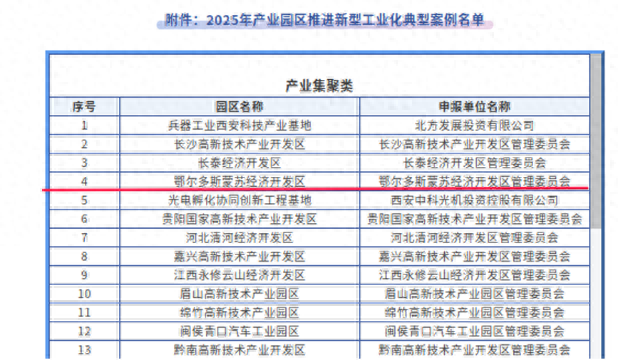
鄂尔多斯蒙苏经济开发区入选全国新型工业化典型案例
Nei Meng Gu Ri Bao· 2025-11-19 10:54
Core Viewpoint - The Ordos Mengsu Economic Development Zone has been selected as a typical case for promoting new industrialization in 2025, highlighting its role in energy transition and industrial upgrading in Inner Mongolia [1][4]. Group 1: Development Zone Overview - The Ordos Mengsu Economic Development Zone is recognized as a model for the transformation and upgrading of industrial parks in Inner Mongolia, serving as a benchmark for high-quality development driven by new industrialization [4][7]. - The development zone is focusing on creating a zero-carbon industrial park and building a "wind-solar-hydrogen-storage-vehicle" industrial cluster, along with establishing a clean fuel demonstration base from coal [4][7]. Group 2: Policy and Support - The Inner Mongolia Autonomous Region's Ministry of Industry and Information Technology has implemented various supportive policies to enhance the quality and efficiency of industrial parks, emphasizing the importance of infrastructure and management systems [7]. - Future efforts will include encouraging other parks to learn from the advanced experiences of the Ordos Mengsu Economic Development Zone in areas such as infrastructure, green energy, and circular economy [7].