原油

Search documents
宝城期货原油早报-20251010
Bao Cheng Qi Huo· 2025-10-10 01:13
Report Summary 1. Report Industry Investment Rating - No information provided on the investment rating of the industry in the report. 2. Core View of the Report - The domestic crude oil futures contract 2511 is expected to run weakly, with a short - term outlook of weak oscillation, a medium - term outlook of oscillation, and an intraday outlook of decline. Overall, it is expected to maintain a weakly oscillating trend on Friday [1][5]. 3. Summary by Related Content Market Situation of Crude Oil Futures 2511 - Short - term: Weak oscillation; Medium - term: Oscillation; Intraday: Decline; Overall view: Weak operation [1]. Core Logic - Macro factors have weakened as the US federal government shutdown due to the failure of the two parties to reach an agreement has led to a significant increase in global financial market risk - aversion sentiment, pressuring risk assets [5]. - The supply pressure in the oil market has increased again as eight OPEC+ oil - producing countries decided to maintain the production increase measure in November, increasing crude oil production by 137,000 barrels per day [5]. - The "war premium" that previously supported oil prices has subsided as the geopolitical situation in the Middle East has shown signs of easing, with Israel and Hamas signing the first - stage agreement of the "20 - point plan" [5]. - The domestic crude oil futures 2511 contract opened lower and ran weakly on Thursday, and the weak pattern continued at night. It is expected to maintain a weakly oscillating trend on Friday [5].
长假消费增势良好 -20251010
申银万国期货研究· 2025-10-10 01:09
Group 1 - The consumption market during the National Day and Mid-Autumn Festival holidays showed strong growth, with total domestic travel expenditure reaching 809 billion CNY, an increase of 108.19 billion CNY compared to the same period in 2024 [1] - Daily sales revenue in consumption-related industries increased by 4.5% year-on-year, with goods and service consumption growing by 3.9% and 7.6% respectively [1] - The market for digital products and automobiles experienced rapid growth during the holiday period [1] Group 2 - Precious metals maintained a strong performance during the holiday but saw a significant decline afterward, likely due to profit-taking from a rapid short-term increase [2] - Geopolitical tensions eased with the announcement of a ceasefire agreement between Israel and Hamas, which may have influenced market sentiment [2] - Concerns over the U.S. fiscal deficit and debt continue to drive demand for gold as a safe-haven asset, with central banks, particularly in China, increasing their gold reserves [2] Group 3 - The U.S. stock indices experienced a decline, while the first trading day after the National Day holiday saw a positive opening for stock indices, led by the non-ferrous metals sector [3] - The financing balance decreased by 34.06 billion CNY to 2.37839 trillion CNY as of September 30 [3] - The domestic liquidity environment is expected to remain loose, with increased allocation to equity assets by residents and potential inflows of external capital due to anticipated interest rate cuts by the Federal Reserve [3] Group 4 - The double coke market showed fluctuating trends, with inventory levels remaining stable despite a significant increase in social inventory due to the holiday [4] - The increase in inventory was primarily driven by rebar, and there are concerns about the market's acceptance of high-priced resources post-holiday [4] - Upcoming policy expectations related to "anti-involution" are anticipated to provide support for prices in the double coke market [4] Group 5 - The industrial sector for small and medium enterprises in China showed stable economic performance in the first eight months of the year, with an increase in value-added output of 7.6%, outperforming large enterprises by 3.3 percentage points [8] - The development of specialized and innovative small and medium enterprises has been particularly strong, with a year-on-year increase of 8.7% in value-added output [8] Group 6 - The National Development and Reform Commission announced measures to regulate price competition and maintain a fair market price order, emphasizing the need for businesses to adhere to fair pricing principles [9]


能源化工日报-20251010
Wu Kuang Qi Huo· 2025-10-10 00:45
Report Industry Investment Rating - Not provided in the given content Core Viewpoints - For crude oil, although the geopolitical premium has dissipated and OPEC's production increase is minimal with supply not yet surging, oil prices are not easy to be overly bearish in the short - term. A low - buy and high - sell range strategy is maintained, but it's advisable to wait and see for now, waiting for a decline in OPEC exports to confirm the price trend [1][2] - For methanol, with装置集中回归, domestic supply is high, demand is weak, and port and enterprise inventories are high. However, short - selling has low cost - effectiveness, and there may be short - term long opportunities after a decline [4][5] - For urea, after the holiday, the futures price dropped significantly. Supply pressure has increased, demand is average, and market sentiment is weak. It's recommended to consider long positions at low prices [7][8][9] - For rubber, the rubber price has stabilized, and it's recommended to set a stop - loss and enter short - term long positions on pullbacks. A partial position in the RU2601 - RU2511 hedging strategy is also recommended [12][16] - For PVC, the supply is strong, demand is weak, and export expectations are poor. The short - term valuation has dropped to a low level, and it's advisable to consider short - selling on rallies in the medium - term [18][20] - For pure benzene and styrene, the BZN spread has room for upward repair. With the approaching of the seasonal peak season, the price may stop falling [22][23] - For polyethylene, the cost has some support, and the price may oscillate upward in the long - term [25][26] - For polypropylene, there is supply pressure, and the overall inventory pressure is high. There is no prominent short - term contradiction [28][29] - For PX, the load remains high, and there is a lack of driving force. It's recommended to wait and see in the short - term [29][30] - For PTA, the supply has high unexpected maintenance, and the demand is expected to remain high. It's recommended to wait and see in the short - term [30][31] - For ethylene glycol, the supply is high, and it's expected to accumulate inventory in the fourth quarter. It's recommended to wait and see in the short - term [32][33] Summary by Related Catalogs Crude Oil - **Market Information**: The main INE crude oil futures closed down 9.50 yuan/barrel, a 1.98% decline, at 471.00 yuan/barrel. US EIA weekly data showed that commercial crude oil inventories increased by 3.72 million barrels to 420.26 million barrels, a 0.89% increase; SPR increased by 0.29 million barrels to 406.99 million barrels, a 0.07% increase; gasoline inventories decreased by 1.60 million barrels to 219.09 million barrels, a 0.73% decrease; diesel inventories decreased by 2.02 million barrels to 121.56 million barrels, a 1.63% decrease; fuel oil inventories increased by 0.54 million barrels to 21.17 million barrels, a 2.62% increase; aviation kerosene inventories decreased by 0.07 million barrels to 44.27 million barrels, a 0.16% decrease [1] - **Strategy Viewpoint**: Maintain a low - buy and high - sell range strategy, but wait and see in the short - term [2] Methanol - **Market Information**: The price in Taicang dropped 29 yuan, in Inner Mongolia dropped 12 yuan, in southern Shandong dropped 10 yuan. The 01 contract on the futures market dropped 38 yuan, closing at 2290 yuan/ton, with a basis of - 77. The 1 - 5 spread changed by - 22, at - 56 [4] - **Strategy Viewpoint**: The domestic supply is high, demand is weak, and inventories are high. Short - selling has low cost - effectiveness, and consider short - term long positions after a decline [5] Urea - **Market Information**: The spot price in Shandong dropped 40 yuan, in Henan dropped 20 yuan. The 01 contract on the futures market dropped 61 yuan, closing at 1609 yuan, with a basis of - 49. The 1 - 5 spread changed by - 21, at - 68 [7] - **Strategy Viewpoint**: Supply pressure has increased, demand is average, and market sentiment is weak. Consider long positions at low prices [8][9] Rubber - **Market Information**: The rubber price has stabilized. The futures price of natural rubber has different views from bulls and bears. Tire开工率 decreased during the National Day holiday. As of October 9, 2025, the operating load of all - steel tires in Shandong was 46.38%, 6.08 percentage points lower than last week and 3.30 percentage points lower than the same period last year; the operating load of semi - steel tires was 50.87%, 9.10 percentage points lower than last week and 23.72 percentage points lower than the same period last year. Semi - steel tire exports have slowed down. As of September 21, 2025, China's natural rubber social inventory was 111.2 tons, a 1% decrease month - on - month; the total inventory of dark - colored rubber was 66.7 tons, unchanged; the total inventory of light - colored rubber was 44.6 tons, a 0.3% decrease month - on - month. As of September 28, 2025, the inventory of natural rubber in Qingdao was 44.93 (- 0.44) tons [12][13][14] - **Strategy Viewpoint**: Set a stop - loss and enter short - term long positions on pullbacks. Partially build a position in the RU2601 - RU2511 hedging strategy [16] PVC - **Market Information**: The PVC01 contract dropped 70 yuan, closing at 4769 yuan. The spot price of Changzhou SG - 5 was 4640 (- 60) yuan/ton, with a basis of - 129 (+ 10) yuan/ton, and the 1 - 5 spread was - 323 (- 3) yuan/ton. The cost of calcium carbide in Wuhai decreased to 2400 (- 150) yuan/ton, the price of medium - grade semi - coke was 730 (0) yuan/ton, and the price of ethylene was 810 (0) US dollars/ton. The overall PVC operating rate was 81.4%, a 2.5% increase; among them, the calcium carbide method was 82.1%, a 2.8% increase; the ethylene method was 79.8%, a 1.6% increase. The overall downstream operating rate was 47.8%, a 1.5% decrease. Factory inventory was 31.8 tons (+ 1.2), and social inventory was 98.2 tons (+ 1) [18] - **Strategy Viewpoint**: The supply is strong, demand is weak, and export expectations are poor. Consider short - selling on rallies in the medium - term [20] Pure Benzene and Styrene - **Market Information**: The cost of pure benzene in East China remained unchanged at 5795 yuan/ton. The spot price of styrene dropped 125 yuan/ton to 6800 yuan/ton, and the closing price of the active contract dropped 17 yuan/ton to 6818 yuan/ton, with a basis of - 18 yuan/ton, a weakening of 108 yuan/ton; the BZN spread was 126.25 yuan/ton, an increase of 3.5 yuan/ton; the profit of non - integrated EB plants was - 564.05 yuan/ton, unchanged; the EB consecutive 1 - consecutive 2 spread was 69 yuan/ton, a narrowing of 19 yuan/ton. The upstream operating rate was 73.2%, a 0.20% decrease; the inventory at Jiangsu ports increased by 0.44 tons to 20.19 tons. The weighted operating rate of three S products was 45.44%, a 0.46% increase; the operating rate of PS was 62.50%, a 0.60% increase, the operating rate of EPS was 61.50%, a 0.48% increase, and the operating rate of ABS was 71.00%, a 1.00% increase [22] - **Strategy Viewpoint**: The BZN spread has room for upward repair. With the approaching of the seasonal peak season, the price may stop falling [23] Polyethylene - **Market Information**: The closing price of the main contract dropped 76 yuan/ton to 7077 yuan/ton, and the spot price dropped 75 yuan/ton to 7100 yuan/ton, with a basis of 23 yuan/ton, a strengthening of 1 yuan/ton. The upstream operating rate was 83.6%, a 2.80% increase. In terms of weekly inventory, the production enterprise inventory decreased by 7.56 tons to 38.27 tons, and the trader inventory decreased by 0.43 tons to 4.67 tons. The average downstream operating rate was 45%, a 0.87% increase. The LL1 - 5 spread was - 29 yuan/ton, a widening of 10 yuan/ton [25] - **Strategy Viewpoint**: The cost has some support, and the price may oscillate upward in the long - term [26] Polypropylene - **Market Information**: The closing price of the main contract dropped 107 yuan/ton to 6745 yuan/ton, and the spot price dropped 70 yuan/ton to 6725 yuan/ton, with a basis of - 20 yuan/ton, a strengthening of 37 yuan/ton. The upstream operating rate was 77.29%, a 0.05% decrease. In terms of weekly inventory, the production enterprise inventory decreased by 3.03 tons to 52.03 tons, the trader inventory decreased by 0.11 tons to 18.72 tons, and the port inventory increased by 0.47 tons to 6.65 tons. The average downstream operating rate was 52%, a 0.15% increase. The LL - PP spread was 332 yuan/ton, a widening of 31 yuan/ton [28] - **Strategy Viewpoint**: Supply pressure is high, and the overall inventory pressure is high. There is no prominent short - term contradiction [29] PX - **Market Information**: The PX11 contract increased by 16 yuan, closing at 6586 yuan. The PX CFR increased by 5 US dollars, closing at 809 US dollars. After conversion according to the central parity of the RMB, the basis was 44 yuan (- 12), and the 11 - 1 spread was 24 yuan (+ 12). In terms of PX load, the load in China was 86.4%, a 0.3% decrease; the Asian load was 78%, a 0.2% decrease. Tianjin Petrochemical was restarting, overseas plants in Malaysia and South Korea's Hanwha were restarting, and a 26 - ton plant of Japan's Eneos was under maintenance. The PTA load was 74.4%, a 2.7% decrease. In September, South Korea's PX exports to China were 37.9 tons, a year - on - year increase of 0.3 tons. The inventory at the end of August was 391.8 tons, a month - on - month increase of 1.9 tons. In terms of valuation cost, PXN was 217 US dollars (+ 7), and the naphtha crack spread was 107 US dollars (- 11) [29] - **Strategy Viewpoint**: The PX load remains high, and there is a lack of driving force. Wait and see in the short - term [30] PTA - **Market Information**: The PTA01 contract dropped 10 yuan, closing at 4584 yuan. The spot price in East China dropped 35 yuan, closing at 4500 yuan, with a basis of - 63 (0), and the 1 - 5 spread was - 48 (- 8). The PTA load was 74.4%, a 2.7% decrease. The downstream load was 91.7%, a 0.2% increase. Terminal draw - texturing load remained flat at 81%, and the weaving machine load decreased by 1% to 69%. In terms of inventory, on September 26, the social inventory (excluding credit warehouse receipts) was 210.7 tons, a 1.1 - ton increase. In terms of valuation and cost, the spot processing fee of PTA decreased by 38 yuan to 151 yuan, and the processing fee on the futures market decreased by 13 yuan to 279 yuan [30] - **Strategy Viewpoint**: The supply has high unexpected maintenance, and the demand is expected to remain high. Wait and see in the short - term [31] Ethylene Glycol - **Market Information**: The EG01 contract dropped 49 yuan, closing at 4158 yuan. The spot price in East China dropped 51 yuan, closing at 4224 yuan, with a basis of 70 yuan (+ 2), and the 1 - 5 spread was - 77 yuan (- 2). The supply - side ethylene glycol load was 75.1%, a 1.6% increase; among them, the syngas method was 78.8%, a 4.5% increase; the ethylene - based load remained flat at 72.9%. The syngas - based plants such as Tianye were restarted, and Shenhua Yulin increased its load; in the petrochemical sector, Satellite Petrochemical was restarted, Yulong Petrochemical had a short - term shutdown, and Sanjiang increased its load. The downstream load was 91.7%, a 0.2% increase. The terminal draw - texturing load remained flat at 81%, and the weaving machine load decreased by 1% to 69%. The import arrival forecast was 23.4 tons, and the average daily departure from East China ports during the National Day was 0.6 tons. The port inventory was 50.7 tons, a 9.8 - ton increase. In terms of valuation and cost, the profit of naphtha - based production was - 723 yuan, the profit of domestic ethylene - based production was - 639 yuan, and the profit of coal - based production was 560 yuan. The cost of ethylene remained flat at 810 US dollars, and the price of raw coal fines at Yulin pithead remained flat at 620 yuan [32] - **Strategy Viewpoint**: The supply is high, and it's expected to accumulate inventory in the fourth quarter. Wait and see in the short - term [33]
博时宏观观点:流动性和风险偏好支撑有色与成长
Xin Lang Ji Jin· 2025-10-09 11:09
Market Overview - The profit cycle remains weak, but liquidity and risk appetite factors have improved, making the market relatively attractive in the medium term [1] - The Federal Reserve's interest rate cuts are favorable for gold, copper, and growth styles [1] - Global stock indices have risen, with gold surpassing $4000 per ounce, while oil prices remain weak [1] Economic Indicators - In September, the manufacturing PMI marginally increased to 49.8% from 49.4% in August, while the non-manufacturing business activity index slightly decreased to 50% from 50.3% [1] - The production side shows stronger improvement compared to the demand side, indicating a high market risk appetite [1] Market Strategy - In the bond market, interest rates are expected to fluctuate at high levels before the holiday, with intense long-short battles [1] - The central bank is expected to maintain a supportive monetary policy stance, but cautious liquidity measures indicate a focus on preventing capital turnover [1] - The bond market may remain in a volatile pattern due to upcoming events such as the Fourth Plenary Session and US-China negotiations [1] A-Share Market - Despite the National Day consumption not exceeding expectations, the market is still in a window period for the Federal Reserve's interest rate cuts [1] - Anticipation of new domestic demand policies from the Fourth Plenary Session and the Central Economic Work Conference suggests limited downside risk for indices [1] - The technology growth sector is expected to continue outperforming, driven by domestic and international AI industry catalysts [1] Hong Kong Stock Market - Following the Federal Reserve's preemptive interest rate cuts, the Hong Kong stock market typically shows strong resilience [2] Oil Market - Oil demand is expected to remain weak over the next 25 years, with continuous supply release putting downward pressure on oil prices [3] Gold Market - A positive long-term outlook for gold prices is anticipated, with short-term upward pressure from events such as the US government shutdown [4]
国庆假期结束,外盘变动?何?
Guo Fu Qi Huo· 2025-10-09 09:23
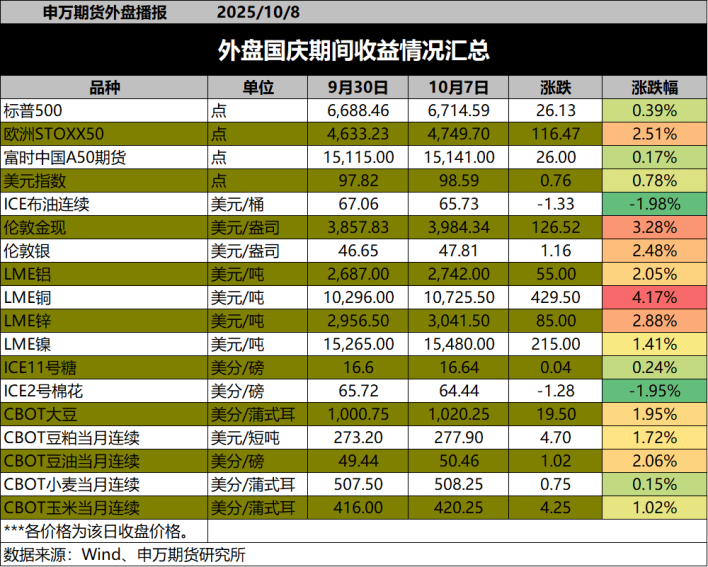
Report Summary 1. Report Industry Investment Rating No relevant information provided. 2. Core Viewpoints The report comprehensively analyzes the changes in the external market during the 2025 National Day holiday, including the fluctuations of various financial and commodity indices, as well as the supply - demand situation of the international and domestic agricultural and energy industries, and international and domestic macro - economic news. 3. Summary by Related Contents External Market Fluctuations during National Day - The US dollar index rose from 97.82 to 98.84, with a 1.04% increase; the Dow Jones Industrial Average rose 0.44%, and the Nasdaq Composite Index rose 1.69% [1]. - Among agricultural products, BMD Malaysian palm oil rose 4.48%, CBOT US soybeans rose 2.90%, and ICE US cotton fell 1.19% [1]. - In the energy sector, NYMEX US fuel oil fell 1.36%, NYMEX US crude oil fell 0.21%, and ICE Brent fell 0.11% [1]. - Among non - ferrous metals, COMEX gold rose 4.45%, COMEX silver rose 3.42%, and LME copper rose 3.93% [1]. International Supply - Demand Situation - **Palm Oil**: Malaysia's September palm oil inventory is expected to decline by 2.5% compared to August, production is expected to decline by 3.3%, and exports are expected to increase by 7.7%. Indonesia's 2025/26 palm oil production is expected to decline by 1%, and Malaysia's is expected to decline by 1%. Global palm oil imports are expected to increase by 4.6% [2][3]. - **Soybeans**: S&P Global lowered the US soybean yield forecast. As of September 1, 2025, the US old - crop soybean inventory was 3.16 billion bushels. Brazilian soybean planting progress is faster than in previous years, and the 2025/26 production is expected to increase. Argentina's 2025/26 soybean production is expected to be 4850 tons, and corn production is expected to be 5800 tons [4][5][7]. - **Other Crops**: Canada's 2025/26 rapeseed production is expected to be 2002.8 tons, and exports are expected to be 700 tons. Ukraine has approved new export documents for tax - exempt rapeseed and soybean exports [13][14]. Domestic Supply - Demand Situation - On September 30, the total trading volume of domestic edible oils decreased by 71% compared to the previous trading day. The trading volume of soybean meal decreased, and the oil mill operating rate dropped by 6.41%. The national soybean oil port inventory decreased by 0.7 tons [16]. International Macro - news - The US ADP employment in September decreased by 32,000, the Challenger job - cuts in September were 54,064, and the ISM non - manufacturing PMI was 50. The US government shutdown continued, and the release of some economic data was postponed [18][19]. - OPEC + will increase production by 137,000 barrels per day in November. The eurozone's October Sentix investor confidence index was - 5.4 [19]. Domestic Macro - news - On September 30, the US dollar/renminbi exchange rate was adjusted downwards (the renminbi appreciated). The central bank conducted 242.2 billion yuan of 7 - day reverse repurchase operations, with a net withdrawal of 33.9 billion yuan. On October 9, the central bank will conduct 1.1 trillion yuan of 3 - month (91 - day) outright reverse repurchase operations [22]. - In September, China's manufacturing PMI was 49.8%, up 0.4 percentage points from the previous month; the non - manufacturing business activity index was 50.0%, down 0.3 percentage points; the composite PMI output index was 50.6%, up 0.1 percentage point [22].
薛鹤翔:降息预期驱动大宗上涨——国庆假期全球市场动态
Sou Hu Cai Jing· 2025-10-09 03:45
Domestic Macro - The domestic macroeconomic landscape shows distinct characteristics in consumption and industrial policy, with a shift towards rational travel decisions during the National Day holiday, as overall travel intensity was lower than during the May Day holiday [1][6] - The tourism market is evolving towards diversification and personalization, with traditional attractions losing some popularity while niche tourism options like "inter-provincial border tours" and "border tourism" are gaining traction [1][6] - The expansion of visa-free travel has stimulated outbound tourism, reflecting the release of domestic residents' international travel demand and the positive effects of national tourism opening policies [1][6] Foreign Macro - During the National Day holiday, the U.S. ADP employment and services PMI data were weaker than expected, with a decrease of 32,000 jobs in September, significantly below the expected increase of 51,000 [1][13] - The U.S. services PMI fell to 50, indicating a slowdown in business activity and new orders, which may impact global market sentiment [1][13] Precious Metals - Gold prices reached a historical high, surpassing $4,000 per ounce, driven by concerns over U.S. debt sustainability and demand for risk hedging against the dollar [2][17] - The overall trend for gold remains bullish, supported by expectations of continued market easing following the initial interest rate cuts [2][17] Oil Market - International oil prices fluctuated during the holiday, ultimately stabilizing around pre-holiday levels, influenced by ongoing supply increases and insufficient demand [2][18] - OPEC+ announced an increase in production by 137,000 barrels per day, reflecting a focus on maintaining market share amid competitive pressures [2][18] Film Industry - The National Day box office exceeded 1.5 billion yuan, with several films surpassing 100 million yuan in ticket sales, indicating a strong recovery in cultural consumption [8] - The diversity of content, including various genres, has driven demand, with family-oriented films performing particularly well [8] Industrial Policy - The release of growth stabilization plans by seven major industries before the holiday marks a significant shift towards quality and efficiency improvement rather than mere scale expansion [11] - The focus on supply-demand balance and the integration of artificial intelligence aligns with current technological trends, promoting high-end and intelligent industrial development [11] Overall Economic Outlook - The current domestic macroeconomic environment is characterized by structural optimization and diversified demand in consumption, alongside a commitment to high-quality development in industrial policy, which together create a favorable environment for economic growth [12][12] Key Commodity Trends - LME copper prices rose by 2.85% during the holiday, driven by supply concerns from Indonesia and ongoing tightness in the copper market [19] - LME zinc prices increased by 3.7%, supported by declining inventories and stable processing fees [19] - LME aluminum prices continued to rise, reflecting a tight supply-demand balance and positive macro sentiment [20] Agricultural Products - U.S. cotton prices weakened during the holiday due to market information delays caused by the government shutdown, while domestic cotton prices face pressure from new crop expectations [21] - International sugar prices are expected to remain weak due to increased supply from Brazil, while domestic sugar prices are supported by low inventory levels [22] Shipping Industry - During the National Day holiday, shipping rates increased significantly, with major shipping lines raising prices for the second half of October [48] - The market is expected to enter a phase of competition for the year-end peak season, with attention on the impact of shipping rate adjustments [48]
宝城期货原油早报-20251009
Bao Cheng Qi Huo· 2025-10-09 02:27
Report Summary 1. Report Industry Investment Rating No investment rating information is provided in the report. 2. Report's Core View - The crude oil 2511 contract is expected to run weakly, with short - term weak oscillation, medium - term oscillation, and an intraday decline [1][5]. 3. Summary According to Related Contents a. Price Movement and View Classification - For price movement calculation, for varieties with night trading, the night - trading closing price is the starting price; for those without, the previous day's closing price is used. The daily daytime closing price is the end price to calculate the rise - fall range [2]. - A decline greater than 1% is considered a fall, a decline of 0 - 1% is weak oscillation, a rise of 0 - 1% is strong oscillation, and a rise greater than 1% is an increase. Strong/weak oscillation only applies to intraday views, not short - and medium - term views [3][4]. b. Crude Oil Market Analysis - Core logic: During the National Day holiday, the unexpected shutdown of the US federal government led to a significant increase in global financial market risk - aversion sentiment. Gold futures strengthened, and other commodities were generally under pressure. Eight OPEC+ oil - producing countries decided to increase production by 137,000 barrels per day in November, increasing the supply pressure in the oil market. Although eight foreign ministers called for an end to the Gaza war, Israel's combat state remains unchanged. The US WTI and Brent crude oil futures prices dropped by about 1% during the holiday. With geopolitical premium support weaker than systematic risks, the domestic crude oil 2511 contract is expected to show a weakly oscillating trend on the first trading day after the holiday [5].
能源化策略:原油延续动荡格局,化?以对冲套利为主
Zhong Xin Qi Huo· 2025-10-09 02:25
1. Report Industry Investment Rating The report does not explicitly provide an overall industry - wide investment rating. However, it offers individual outlooks for each energy and chemical product, which can be summarized as follows based on the rating standard: - **Oscillating**: PX, PTA, short - fiber, polyester bottle - chips, methanol, urea, LLDPE, PP, PL, PVC, caustic soda [11][12][18][19][22][25][26][27][29] - **Oscillating Weakly**: crude oil, asphalt, high - sulfur fuel oil, low - sulfur fuel oil, pure benzene, styrene, ethylene glycol [6][7][9][10][13][14][16] 2. Core Viewpoints - The crude oil price is in a volatile pattern during the National Day holiday. OPEC+ continues to increase production, and geopolitical factors still cause disruptions. The rebound space of crude oil is limited due to the weakening crack spread of refined oil [1][2]. - The prices of basic chemical products changed little during the National Day holiday. The industrial chain lacks a clear trend due to the volatile crude oil and the low valuation of chemicals. Investors can try positive spreads for severely loss - making products [2]. - Different energy and chemical products have different market trends. For example, asphalt prices are under pressure due to the expected increase in production; high - sulfur and low - sulfur fuel oils follow the trend of crude oil; methanol shows a slight inventory build - up during the holiday and oscillates [2]. 3. Summary by Related Catalogs 3.1 Market News and Main Logic of Crude Oil - **Market News**: EIA raises the 2025 and 2026 US oil production forecasts. OPEC+ eight oil - producing countries will further increase production by 137,000 barrels per day in November. There are ongoing conflicts between Russia and Ukraine, and the Hamas reaches an agreement to end the Gaza war [6]. - **Main Logic**: During the holiday, oil prices first fell and then rose. OPEC+ continues to increase production, and the supply surplus pressure remains. The conflict between Palestine and Israel eases, and the geopolitical disturbances are mainly from the Russia - Ukraine conflict. The US commercial crude oil inventory and production increase, and the refinery operating rate rises. If geopolitical disturbances weaken, the oil price center may move down [7]. 3.2 Situation of Other Energy and Chemical Products - **Asphalt**: The expected increase in production puts pressure on asphalt futures prices. The geopolitical premium declines, and the supply tension eases. The asphalt price is over - valued compared to other products [9]. - **High - sulfur Fuel Oil**: The premium turns negative, and it follows the trend of crude oil. The demand has some improvement, but the major drivers are weakening [10]. - **Low - sulfur Fuel Oil**: It oscillates weakly following crude oil. It faces pressure at the 3500 level, and there are supply and demand challenges [10]. - **Methanol**: The inventory slightly accumulates during the holiday. The inland inventory pressure is limited, but the port inventory pressure is high. There may be short - term low - buying opportunities [22]. - **Urea**: The supply - demand pattern is loose. The impact of the Indian tender during the holiday is limited, and the short - term fundamentals are weak. The market may oscillate and wait for policy adjustments and the progress of autumn sowing [23]. - **PX**: The supply increases while the demand is weak, and the processing fee is under pressure. The inventory is expected to accumulate slightly in November and December [11]. - **PTA**: The cost side stabilizes, and attention should be paid to the implementation of downstream production cuts. The mid - term inventory accumulation is expected [12]. - **Ethylene Glycol**: The supply pressure is large during the National Day due to smooth device restarts. The port arrival volume increases, and the price is expected to oscillate weakly [16]. - **Short - fiber**: The cost guidance and self - supply - demand drive are limited. The inventory and profit remain within a certain range [18]. - **Polyester Bottle - chips**: Attention should be paid to whether factories strictly follow the production - cut plan after profit repair. The processing fee expansion space is limited [19]. - **Styrene**: The cost support gradually appears, but the high inventory of upstream and downstream is difficult to reduce. The profit is at a low level, and one can try to widen the profit [15]. - **LLDPE**: There are geopolitical disturbances during the holiday. The impact of oil prices on the opening of polyolefins is limited. The fundamental support is weak, and it is advisable to hold short positions [25]. - **PP**: OPEC+ increases production, and oil prices fluctuate widely during the holiday. The supply side has an incremental trend, and the inventory pressure exists. It oscillates in the short term [26]. - **PL**: Some devices stop during the holiday, and the market trading atmosphere is cautious. The volatility may increase [27]. - **PVC**: The fundamental pressure exists. The upstream production is expected to increase, and the downstream demand is stable. The cost change is expected to be small [29]. - **Caustic Soda**: The spot price is weak, and the futures price may continue to be weak. Attention should be paid to downstream stocking and upstream production changes [29]. 3.3 Variety Data Monitoring - **Inter - period Spread**: Different products have different inter - period spread values and changes, such as Brent M1 - M2 at 0.37 with a change of 0.07, and PX 1 - 5 months at - 40 with a change of - 8 [31]. - **Basis and Warehouse Receipts**: Each product has corresponding basis values, changes, and warehouse receipt quantities. For example, the basis of asphalt is 76 with a change of 42, and the warehouse receipt is 44,430 [32]. - **Inter - variety Spread**: There are different inter - variety spread values and changes, like 1 - month PP - 3MA at - 132 with a change of 42, and 1 - month TA - EG at 387 with a change of - 41 [34]. 3.4 Commodity Index - The comprehensive index of commodities is 2224.82, down 0.46%; the commodity 20 index is 2499.78, down 0.42%; the industrial products index is 2219.36, down 0.85% [276]. - The energy index on September 30, 2025, is 1199.36, with a daily decline of 2.25%, a 5 - day decline of 0.27%, a 1 - month decline of 1.59%, and a year - to - date decline of 2.33% [278].
能源化工日报 2025-10-09-20251009
Wu Kuang Qi Huo· 2025-10-09 01:28
Report Industry Investment Rating No relevant content provided. Core Viewpoints - OPEC shows a hesitant attitude with a slightly stronger willingness to support prices than to expand market share, and the slight increase plan will continue to suppress the upside space of oil prices. Crude oil is expected to remain volatile in the short term [1]. - The fundamentals of methanol have marginally improved, and the downside space is expected to be relatively limited. It is recommended to focus on short - long opportunities on dips [3]. - Urea is currently in a situation of low valuation and weak drivers. With no effective positive factors in reality, it is suggested to focus on going long on dips at low prices [5]. - For rubber, the medium - term view is bullish, but it has broken down in the short term. It is recommended to set stop - losses and enter short - long positions opportunistically, and to partially re - establish the hedge position of buying RU2601 and selling RU2511 [12]. - The fundamentals of PVC are poor, with strong domestic supply and weak demand, and the export outlook is weak. In the short term, the valuation has declined to a low level, and it is recommended to focus on short - selling opportunities on rallies in the medium term [14]. - The spot and futures prices of pure benzene and styrene are falling, and the basis is weakening. The BZN spread has a large upward repair space, and the price of styrene may stop falling when the downstream starts to rise and the port inventory is depleted [17]. - The price of polyethylene may oscillate upward in the long term as the long - term contradiction shifts from cost - driven decline to the Korean ethylene clearance policy. In the short term, it may gap down at the opening [20]. - For polypropylene, there is a large supply pressure, and the downstream start - up rate rebounds seasonally at a low level. There is no prominent short - term contradiction, and the high number of warehouse receipts suppresses the price [23]. - For PX, the current load is high, and the expected inventory accumulation period continues. It is recommended to wait and see in the short term [26]. - For PTA, the supply - side unexpected maintenance volume is still high, and the inventory depletion pattern continues. However, the processing fee space is limited. It is recommended to wait and see in the short term [27]. - For ethylene glycol, the domestic supply is high, and the port inventory is expected to be low in the short term but will turn to inventory accumulation in the fourth quarter. It is recommended to short on rallies under the weak outlook, but beware of the risk of the weak expectation not being realized [29]. Summary by Industry Crude Oil - **Market Information**: As of October 8, 2025, the WTI crude oil main contract was quoted at $62.33/barrel, and the Brent crude oil main contract was quoted at $65.89/barrel. The US API data showed that the Cushing inventory decreased by 1.15 million barrels, and the overall inventory situation was still healthy. The OPEC meeting ended on October 5, with a final decision of a "principled low - speed production increase" of 137,000 barrels per day [1]. - **Strategy**: OPEC's hesitant attitude will suppress the upside space of oil prices, and crude oil is expected to remain volatile in the short term [1]. Methanol - **Market Information**: During the holiday, overseas crude oil first fell and then rose, with a slight overall decline. Most other commodities rose more than they fell. Before the holiday, the price in Taicang fell by 11 yuan, the price in Inner Mongolia rose by 5 yuan, and the price in southern Shandong remained flat. The 01 contract of the futures price fell by 31 yuan to 2328 yuan/ton, with a basis of - 86 yuan. The 1 - 5 spread changed by - 5 to - 34 [3]. - **Strategy**: The supply - side start - up has declined, and the enterprise profit is low. The domestic supply is expected to increase marginally. The demand - side port olefin plants have restarted and increased their loads, and the traditional demand has generally seen an increase in start - up, but the profit is still low. The overall demand has marginally improved. The inventory has decreased at a high level in ports and at a low level year - on - year in inland enterprises. It is recommended to focus on short - long opportunities on dips [3]. Urea - **Market Information**: During the holiday, the ex - factory price in Shandong remained stable, the ex - factory price in Henan fell by 20 yuan, and the market price generally continued the weak trend. Before the holiday, the 01 contract of the futures price rose by 7 yuan to 1670 yuan, with a basis of - 70 yuan. The 1 - 5 spread changed by + 4 to - 47 [5]. - **Strategy**: The futures price has stabilized at a low level. The domestic supply has returned, the start - up has increased significantly, and the enterprise profit is still low, with increased supply pressure. The demand for compound fertilizers has seen more shutdowns, and the agricultural demand is in the off - season, with general demand and weak market sentiment. The enterprise inventory continues to increase. It is recommended to focus on going long on dips at low prices [5]. Rubber - **Market Information**: During the holiday, commodities were generally positive. Japanese rubber and Singapore rubber rose slightly. In Thailand's spot market, the prices were mixed. The total inventory of natural rubber in China decreased marginally. The start - up load of all - steel tires in Shandong increased slightly, while that of semi - steel tires decreased slightly. The export orders of semi - steel tires slowed down, and the domestic sales market demand was weak [8][9][10]. - **Strategy**: The medium - term view is bullish, but it has broken down in the short term. It is recommended to set stop - losses and enter short - long positions opportunistically, and to partially re - establish the hedge position of buying RU2601 and selling RU2511 [12]. PVC - **Market Information**: The PVC01 contract fell by 57 yuan to 4839 yuan, the spot price of Changzhou SG - 5 was 4700 (- 30) yuan/ton, the basis was - 139 (+ 27) yuan/ton, and the 1 - 5 spread was - 320 (- 10) yuan/ton. The cost side remained stable, the overall start - up rate of PVC increased, the downstream start - up rate decreased, and the factory and social inventories increased [12]. - **Strategy**: The enterprise comprehensive profit has continued to decline, the valuation pressure has further decreased, the maintenance volume is small, the production is at a historical high, and new devices will be tested in the short term. The domestic downstream start - up has declined, the domestic demand is weak, and the export outlook is poor. It is recommended to focus on short - selling opportunities on rallies in the medium term [14]. Pure Benzene and Styrene - **Market Information**: The cost - side price of pure benzene in East China remained unchanged at 5885 yuan/ton, the spot price of styrene fell by 50 yuan to 6850 yuan/ton, the closing price of the active contract of styrene fell by 7 yuan to 6932 yuan/ton, the basis weakened, the BZN spread decreased, the non - integrated device profit of EB increased, and the spread between EB contracts decreased. The upstream start - up rate decreased, the port inventory in Jiangsu increased, and the demand - side start - up rate of three S decreased overall, except for ABS [16]. - **Strategy**: The spot and futures prices are falling, and the basis is weakening. The BZN spread has a large upward repair space. The cost - side supply is still abundant, the supply - side start - up of styrene continues to rise, the port inventory has increased significantly, and the demand - side start - up rate has decreased. The price of styrene may stop falling when the downstream starts to rise and the port inventory is depleted [17]. Polyethylene - **Market Information**: The closing price of the main contract of polyethylene rose by 18 yuan to 7181 yuan/ton, the spot price remained unchanged at 7160 yuan/ton, the basis weakened by 18 yuan to - 17 yuan/ton. The upstream start - up decreased, the production enterprise and trader inventories decreased, the downstream average start - up rate increased slightly, and the LL1 - 5 spread expanded [19]. - **Strategy**: The price may gap down at the opening due to the large decline in crude oil prices during the holiday. The cost side still has support, the spot price has fallen, the PE valuation has limited downward space, but the high number of warehouse receipts suppresses the price. The supply is limited, the inventory has decreased at a high level, the seasonal peak season may come, and the price may oscillate upward in the long term [20]. Polypropylene - **Market Information**: The closing price of the main contract of polypropylene rose by 3 yuan to 6903 yuan/ton, the spot price remained unchanged at 6795 yuan/ton, the basis weakened by 3 yuan to - 102 yuan/ton. The upstream start - up increased, the production enterprise and trader inventories decreased, the port inventory increased, the downstream average start - up rate increased, and the LL - PP spread expanded [22]. - **Strategy**: There is a large supply pressure, the downstream start - up rate rebounds seasonally at a low level. There is no prominent short - term contradiction, and the high number of warehouse receipts suppresses the price [23]. PX - **Market Information**: The PX11 contract fell by 100 yuan to 6570 yuan, the PX CFR rose by 3 dollars to 804 dollars, the basis increased by 32 yuan to 56 yuan, the 11 - 1 spread decreased by 16 yuan to 12 yuan. The PX load in China and Asia decreased slightly. Some domestic and overseas devices had maintenance or restart delays. The PTA load increased slightly, and the import volume of Korean PX to China decreased in mid - and early - September. The inventory increased in late August, and the PXN and naphtha crack spread increased [25]. - **Strategy**: The current PX load is high, the downstream PTA has many unexpected maintenance in the short term, the overall load center is low, and the expected inventory accumulation period continues. It is recommended to wait and see in the short term [26]. PTA - **Market Information**: The PTA01 contract fell by 58 yuan to 4594 yuan, the East China spot price fell by 55 yuan to 4535 yuan, the basis decreased by 8 yuan to - 63 yuan, the 1 - 5 spread increased by 6 yuan to - 40 yuan. The PTA load increased slightly, some devices had maintenance or restart, the downstream load increased, the terminal load increased, the social inventory increased slightly, and the spot and futures processing fees decreased [26]. - **Strategy**: The supply - side unexpected maintenance volume is still high, and the inventory depletion pattern continues. However, the processing fee space is limited. It is recommended to wait and see in the short term [27]. Ethylene Glycol - **Market Information**: The EG01 contract fell by 17 yuan to 4207 yuan, the East China spot price fell by 20 yuan to 4275 yuan, the basis increased by 1 yuan to 68 yuan, the 1 - 5 spread decreased by 12 yuan to - 75 yuan. The supply - side load increased slightly, some domestic and overseas devices had maintenance, restart, or load adjustment. The downstream load increased, the import arrival forecast was 234,000 tons, the East China departure was 13,600 tons on September 29, the port inventory decreased by 58,000 tons to 409,000 tons. The naphtha - based and domestic ethylene - based profits were negative, and the coal - based profit was positive. The cost side remained stable [28]. - **Strategy**: The domestic supply is high, and the port inventory is expected to be low in the short term but will turn to inventory accumulation in the fourth quarter. It is recommended to short on rallies under the weak outlook, but beware of the risk of the weak expectation not being realized [29].
2025国庆财经大事记震撼来袭!十大核心资讯,一文读懂假期全球市场,开市必读!
Sou Hu Cai Jing· 2025-10-08 16:00
Group 1: Global Market Trends - Global capital markets are experiencing a strong rally, with technology and AI sectors leading the charge. Major US indices reached record closing highs, driven by significant gains in AI chip companies like Nvidia and AMD [2] - The US Federal Reserve's interest rate cut expectations have risen, with a 99% probability of a 25 basis point cut in October, contributing to a weaker US dollar and benefiting emerging market currencies [6] - OPEC+ announced a modest production increase of 137,000 barrels per day, which led to initial oil price gains but was followed by concerns over potential oversupply, causing prices to fluctuate [4][18] Group 2: Domestic Economic Developments - The domestic consumption market is showing strong recovery, particularly in the cultural tourism and new energy vehicle sectors, supported by consumer policies and improved living standards [7][10] - The introduction of the "mortgage transfer" policy has facilitated over 560,000 transactions, streamlining the real estate process and potentially boosting the second-hand housing market [15] - Tesla reported a record delivery of 497,000 vehicles in Q3, but its stock price fell over 5%, reflecting market concerns about slowing growth in the electric vehicle sector [13][17] Group 3: Political and Economic Factors - The election of Japan's first female Prime Minister, Sanae Takaichi, may lead to continued dovish monetary policy, impacting the yen and benefiting Japanese exporters [9][11] - The US government shutdown has delayed the release of key economic data, heightening market risk aversion and potentially undermining confidence in the US economic recovery [3]