房地产

Search documents
恒隆地产(00101)将于6月15日派发末期股息每股0.4港元
智通财经网· 2026-01-30 04:41
智通财经APP讯,恒隆地产(00101)发布公告,该公司将于2026年6月15日派发末期股息每股0.4港元。 ...

午评:通信独秀 vs 有色雪崩,后市怎么看?
Sou Hu Cai Jing· 2026-01-30 04:18
Core Viewpoint - The A-share market is experiencing significant structural differentiation, with major indices generally declining while the ChiNext index shows a slight increase, indicating a preference for technology growth sectors like telecommunications and a rejection of cyclical sectors such as non-ferrous metals [1][2]. Market Performance - The Shanghai Composite Index fell by 1.19%, and the Shenzhen Component Index decreased by 0.96%, while the ChiNext Index rose by 0.80, demonstrating relative resilience [1]. - The total trading volume for the day was 19.329 trillion yuan, maintaining a high level despite a slight decrease compared to previous sessions, reflecting active market participation and clear directional choices [1]. Sector Analysis - The telecommunications sector led the market with a gain of 2.58%, supported by strong demand driven by AI and infrastructure investments, indicating a clear preference for sectors with tangible growth prospects [2]. - In contrast, the non-ferrous metals sector experienced a sharp decline of 8.39%, influenced by external macroeconomic factors and a crowded trading environment, leading to significant profit-taking and technical adjustments [2]. Future Outlook - The current market structure is expected to persist, characterized by growth sectors outperforming while cyclical sectors face pressure. The technology sector, particularly telecommunications and computing power, is likely to remain active [3]. - Non-ferrous metals and other cyclical sectors may require stabilization of the strong dollar and improvement in internal trading structures for recovery [3]. - Investors are advised to focus on sectors with clear industrial logic and solid support, while being cautious with volatile assets [3].
A股午评:沪指跌1.19%,超3800股下跌,有色金属板块大幅回调
Ge Long Hui· 2026-01-30 03:38
Market Performance - The three major A-share indices showed mixed results, with the Shanghai Composite Index down 1.19% at 4108.46 points, the Shenzhen Component Index down 0.96%, while the ChiNext Index rose by 0.8% and the North Star 50 Index increased by 0.18% [1] - The trading volume in the Shanghai and Shenzhen markets reached 19.514 billion yuan, a decrease of 836 million yuan compared to the previous day, with over 3,800 stocks declining across the market [1] Sector Performance - Gold and silver prices experienced a significant drop, with spot gold falling below 5,200 USD per ounce, leading to a substantial correction in the non-ferrous metals sector, with stocks like Chifeng Jilong Gold Mining, Shandong Gold Mining, and Silver Base all hitting the daily limit down [1] - The cultivated diamond, photovoltaic equipment, and real estate sectors saw declines, while the agriculture, film and television, and CPO sectors performed well against the trend [1]
煤焦:利多氛围支撑盘面阶段性反弹
Hua Bao Qi Huo· 2026-01-30 03:29
Group 1 - The investment rating of the coal and coke industry is not mentioned in the report [1][2][3] Group 2 - The current supply - demand contradiction in the coal and coke market is general, with little inventory pressure, which supports prices to some extent. However, due to the off - season effect, there is no continuous upward drive, and prices fluctuate with market sentiment changes [4] Group 3 Market Performance - Coal and coke futures prices fluctuated strongly, rising for two consecutive days, and opened and closed higher at night. In the spot market, some steel mills in Hebei and Tianjin regions implemented the first round of coking price increases, while the coking coal market prices were generally weak and stable [3] Driving Factors - India declared coking coal as a key strategic mineral. As a country with continuous growth in the steel industry and high dependence on coking coal imports, it is expected to remain a key driver of global coking coal demand. News about real - estate policies stimulated the stock market's real - estate sector, and the continuous rise of precious and non - ferrous metal prices created a positive atmosphere for the strength of black - series futures [3] Fundamental Situation - Near the Spring Festival, coal production decreased slightly this week due to safety inspections and other factors, with raw coal and clean coal production at 1.978 million tons and 771,000 tons respectively. It is expected that coal mines will start to have holidays on February 5, with an average of 10.1 days, similar to last year. The planned production cuts involve about 744 million tons of production capacity, affecting 18.68 million tons of raw coal output. The expected reduction in coal supply supports coal prices, but the production cuts are in line with past years' patterns, and downstream industries have stocked up in advance [3]
高盛消费者研究-与高盛消费行业专家及交易员的对话
Goldman Sachs· 2026-01-30 03:12
Investment Rating - The report indicates a constructive outlook for the U.S. consumer sector, with a focus on the anticipated impact of tax refunds and lower withholding tax policies, which are expected to increase disposable income by $100 billion [2][10]. Core Insights - The consumer sector is benefiting from a rotation in market sentiment, although investor positions remain low. The upcoming $100 billion tax refund is expected to provide strong support from February to April, but caution is advised for potential declines at the end of Q1 [1][10]. - Investors are optimistic about the consumer sector but have not significantly increased their positions due to uncertainties in the job market and pressures from AI in the second half of the year. Funds are flowing more into interest-sensitive large consumer sectors like industrials and real estate [1][4]. - Companies such as Ralph Lauren, Capri, Levi's, and Macy's are favored by investors, while Walmart and Dick's Sporting Goods face more scrutiny [5]. Summary by Sections Consumer Market Attitude - Investors generally hold a constructive attitude towards the U.S. consumer market at the beginning of 2026, driven by expected tax refunds and a robust fourth-quarter performance. The consumer discretionary sector has risen by 7% year-to-date, while the housing sector has increased by 10% [2]. Retail Performance - Discount retailers Ross and TJ Maxx are expected to deliver strong performance, with comparable sales projected to exceed 7% and 6%, respectively [6]. Conversely, Best Buy has seen negative sentiment since Black Friday, with expectations of continued low performance [7]. Technology Sector Dynamics - The technology sector's developments, including layoffs at Amazon, are noted as potential influences on the retail sector. Market differentiation remains high, with a significant drop in the spread between hedge fund VIP and short portfolios [8]. Tax Refund Impact - The anticipated $100 billion tax refund is expected to significantly support consumer spending, particularly among low-income groups, with spending trends likely to continue into April or May 2027 [10]. Company Preferences - Investors currently favor companies like Ralph Lauren, Wayfair, and Warby Parker, while companies like Walmart and Dick's Sporting Goods are viewed with skepticism due to valuation concerns [5][11]. Valuation Concerns - There are notable valuation concerns regarding Tapestry, with suggestions to buy discount retail stocks on pullbacks rather than chasing high prices [11]. Market Sentiment Post-ICR Conference - Despite some disappointing earnings reports, investor sentiment remains positive towards certain sectors, with a focus on individual stock potential rather than overall sector trends [12].
地产和白酒等板块上涨,踏准板块轮动节奏
British Securities· 2026-01-30 02:03
Core Views - The report emphasizes the importance of sector rotation in the A-share market, highlighting the rebound of indices such as the Shanghai Composite and CSI 300, and suggests focusing on undervalued sectors like real estate, rare earths, and chemicals for potential investment opportunities [1][8][10] - The report notes a dual logic behind the current market rotation: the natural recovery potential of underperforming sectors and the need for previously strong sectors to consolidate after significant gains [1][9] Market Overview - On Thursday, the A-share market showed mixed performance with the Shanghai Composite index fluctuating, while sectors like precious metals, cultural media, and real estate saw gains, contrasting with the semiconductor sector which faced adjustments [4][5] - The overall market sentiment was subdued, with a notable decrease in individual stock performance, leading to a situation where investors are "earning indices but not profits" [2][9] Sector Analysis - The consumer sector, particularly alcohol and food and beverage stocks, is experiencing upward momentum, driven by government policies aimed at stimulating consumption and shifting focus towards domestic demand [6][7] - The precious metals sector has shown strong performance, attributed to factors such as the onset of a Federal Reserve rate cut cycle, geopolitical tensions, and increased demand from central banks [7][8] Investment Strategy - Investors are advised to focus on structural opportunities within low-recovery sectors like real estate and alcohol, while maintaining caution regarding high valuation sectors such as precious metals and AI applications [2][9] - The report suggests a careful approach to trading, emphasizing the importance of managing positions and timing in response to market fluctuations [2][9]
【早盘三分钟】1月30日ETF早知道
Xin Lang Cai Jing· 2026-01-30 01:52
Core Insights - The article highlights a significant surge in the food and beverage sector, particularly driven by the performance of high-end liquor brands like Moutai, which is expected to benefit from increased demand during the upcoming Spring Festival [4][16] - The real estate sector also experienced a notable increase, with the index tracking the real estate market rising by 5.43%, indicating a positive market sentiment and potential policy support in 2026 [7][18] Market Overview - The market temperature gauge indicates that the Shanghai Composite Index and Shenzhen Component Index are at high valuation percentiles, with 99.92% and 93.91% respectively, suggesting a bullish sentiment in the market [1] - The food and beverage sector saw a price increase of 7.1%, recovering multiple moving averages, reflecting strong market performance [4][19] Sector Performance - The media sector led the market with a net inflow of 7.508 billion, followed by food and beverage with 3.734 billion, while the electronic sector faced the largest outflow of 24.368 billion [2][14] - The real estate sector's strong performance is attributed to anticipated supportive policies, with analysts recommending a focus on potential policy developments throughout the year [7][18] ETF Performance - The food and beverage ETF showed a 7.10% increase, while the real estate ETF rose by 5.43%, indicating strong investor interest in these sectors [15] - The consumption leader ETF and banking ETF also reported positive performance, with increases of 3.32% and 1.70% respectively [15] Investment Recommendations - Analysts suggest that investors should consider positioning themselves in the real estate sector, anticipating favorable policy changes that could enhance market conditions [7][18] - The food and beverage sector is also recommended for investment, particularly due to the expected demand surge during the festive season [4][16]


万亿GDP之城扩容,城市价值重估的信号已经出现
3 6 Ke· 2026-01-30 01:52
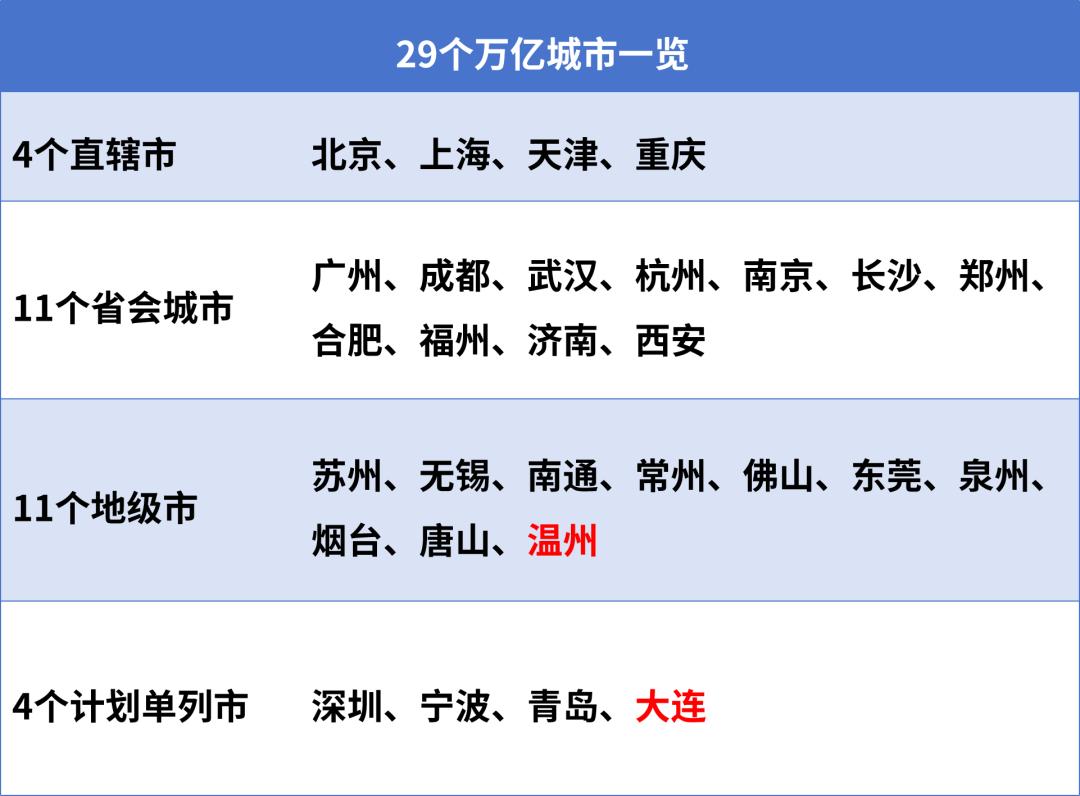
Core Insights - The GDP data for 2025 has been released across various cities, revealing significant milestones such as Guangdong and Jiangsu surpassing 14 trillion yuan, and Shandong becoming the first northern province to reach 10 trillion yuan [1] - The Yangtze River Delta region's GDP totals nearly 35 trillion yuan, accounting for about one-quarter of the national total, with all provinces showing growth rates exceeding the national average [1] - The number of cities with GDP exceeding 1 trillion yuan has increased to 29, with Wenzhou and Dalian recently joining this elite group [1][2] GDP Milestones - Wenzhou officially announced its GDP surpassed 1 trillion yuan, reaching 10,213.9 million yuan, making it the third trillion-yuan city in Zhejiang [1] - Dalian also declared its entry into the trillion-yuan club, becoming the first in Northeast China [1] - Xuzhou is projected to become the 30th trillion-yuan city, with a growth estimate of 5.8% for 2024 [2] Economic Distribution - Jiangsu leads with six trillion-yuan cities, while Guangdong has four, and both Zhejiang and Shandong have three each [9] - The Yangtze River Delta's "cluster advantage" is evident, with 11 trillion-yuan cities, representing over one-third of the total [9] Real Estate Market Insights - GDP remains a key metric for city development, but real estate market capacity is emerging as a crucial indicator of urban vitality [10] - The top five cities in terms of GDP growth also lead in real estate market performance, with Chengdu showing the highest growth rate [10] - Shanghai leads in real estate transaction volume, with a total of 12,816 million yuan in transactions, significantly surpassing other cities [10][12] City Rankings and Performance - Shanghai's GDP for 2025 is projected at 56,708.71 million yuan, with a growth rate of 5.4% [6][12] - Beijing's GDP is expected to reach 52,073.4 million yuan, also growing at 5.4% [6][12] - The real estate market in Shenzhen and Suzhou, despite high GDP, shows lower transaction volumes, categorizing them as second-tier cities [11]
冠通期货资讯早间报-20260130
Guan Tong Qi Huo· 2026-01-30 01:30
Report Summary 1. Industry Investment Rating No investment rating information is provided in the report. 2. Core Viewpoints - Geopolitical risks, including the potential US - Iran conflict and Iran's military exercises, are driving up prices in the precious metals and oil markets [5][47]. - The financial markets are showing mixed trends, with A - shares having a narrow - range consolidation, and different sectors performing differently [34]. - Various industries are experiencing different developments, such as the "anti - involution" in the photovoltaic industry, and new product launches in the domestic AI model competition [37]. 3. Summary by Directory Overnight Night - Market Trends - International precious metals futures generally rose, with COMEX gold up 1.32% to $5410.80 per ounce and COMEX silver up 1.98% to $115.78 per ounce [5][47]. - US oil and Brent oil prices increased, with US oil up 3.64% to $65.51 per barrel and Brent oil up 3.43% to $69.68 per barrel [5][47]. - London base metals were mixed, with LME copper up 4.73% to $13705 per ton, LME zinc up 2.65% to $3453 per ton, LME nickel up 1.37% to $18520 per ton, and LME tin down 2.6% to $54500 per ton [5][48]. - Most domestic futures contracts closed higher, with BR rubber up over 5%, and many other commodities having significant increases [7]. Important News - **Macro News**: Trump is considering a new major strike on Iran; the PBOC governor met with the head of Goldman Sachs; the market regulator will strengthen product quality management; exchanges remind of risk management; Iran warns of military exercises in the Strait of Hormuz; Trump calls for interest - rate cuts; an agreement is reached to avoid a government shutdown; CME adjusts gold and aluminum futures margins; progress is made in the Russia - Ukraine negotiation [9][11][12]. - **Energy and Chemical Futures**: Domestic soda ash inventory increased slightly; methanol inventory in East China ports rose; Singapore's fuel oil and middle - distillate inventories decreased while light - distillate inventory increased; glass production line restarted, with开工率 up but production unchanged; float - glass inventory decreased; LPG port inventory decreased, and ethylene glycol demand declined [14][15][17][18]. - **Metal Futures**: A Guinean mine will lower the long - term contract price; global gold demand in 2025 hit a record high; the Bank of China adjusted silver contract margins; lithium carbonate production decreased slightly while inventory increased; copper production of some companies changed; India plans to provide incentives for lithium and nickel processing; a strike in a Guinean bauxite mine has little impact on shipments; a Swiss company plans to restart a nickel mine; the government emphasizes "anti - involution" in the photovoltaic industry [20][23][24][25][26]. - **Black - Series Futures**: The capacity utilization rate of coking coal mines decreased slightly, with changes in coal production and inventory; rebar production increased slightly, inventory accumulated, and apparent demand decreased; the tender quantity of HeSteel's 75B ferrosilicon decreased [28][29]. - **Agricultural Product Futures**: The physical inventory of 36 sample points decreased; Brazil's soybean, soybean meal, and corn exports are expected to increase [31]. Financial Markets - **Finance**: A - shares had a narrow - range consolidation, with some sectors like liquor stocks rising; the Hong Kong Hang Seng Index rose; resource - related LOFs had a涨停 wave; the first three commercial real - estate REITs were submitted; a knowledge - sharing platform will clean up illegal financial content [34][35]. - **Industry**: The government emphasizes "anti - involution" in the photovoltaic industry; mortgage interest rates and housing - tax policies are announced; Shanghai plans to build a "Rocket City"; domestic AI model competition intensifies; football "fake - gambling - black" issues are rectified; airlines' seat - reservation rules are to be regulated [37][38]. - **Overseas**: The US government faces a "shutdown" risk; Trump announces a cease - fire in the Russia - Ukraine conflict and plans to nominate a new Fed chairman; the US trade deficit increased in November 2025; Iran will hold military exercises; South Africa may impose high tariffs on vehicle imports; Sweden may ban students from using mobile phones in class [40][41]. - **International Stock Markets**: US stocks had mixed results, with some large - tech stocks having significant changes; European stocks were also mixed; Asian - Pacific stocks had different performances; Samsung's Q4 2025 profit increased significantly; Norway's sovereign wealth fund had a good investment return in 2025 [42][43][44]. - **Commodity**: CME raised copper and gold futures margins; global gold demand in 2025 reached a record high; precious metals and oil prices rose; Venezuela reformed its oil law; London base metals were mixed [45][47][48]. - **Bond**: The domestic bond market was volatile, and US bond yields had different trends [49]. - **Foreign Exchange**: The on - shore and offshore RMB depreciated against the US dollar; the US added 10 economies to the foreign - exchange monitoring list; the US dollar index declined [51]. Economic Data and Events - **Economic Data**: A series of economic data from various countries, including Japan, Australia, France, Germany, etc., will be released on January 30, 2026 [53]. - **Events**: The Ministry of Transport will hold a press conference; there are central - bank open - market operations; there are corporate earnings reports and new - stock subscriptions; a Fed official will speak [55].
上海涉外经济创新高,北证50下跌1.69%
Soochow Securities· 2026-01-30 00:46
证券研究报告·北交所报告·北交所定期报告 北交所定期报告 20260130 执业证书:S0600520090004 zhujieyu@dwzq.com.cn 证券分析师 易申申 执业证书:S0600522100003 yishsh@dwzq.com.cn 证券分析师 余慧勇 执业证书:S0600524080003 yuhy@dwzq.com.cn 研究助理 武阿兰 执业证书:S0600124070018 wual@dwzq.com.cn 研究助理 陈哲晓 执业证书:S0600124080015 sh_chenzhx@dwzq.com.cn 上海涉外经济创新高,北证 50 下跌 1.69% 2026 年 01 月 30 日 证券分析师 朱洁羽 相关研究: 《沪深北交易所提高融资保证金最低 比例,北证 50 上涨 0.98%》 2026-01-14 《工信部印发<推动工业互联网平台 高质量发展行动方案(2026—2028 年)>,北证 50 下跌 2.50%》 2026-01-13 东吴证券研究所 1 / 8 请务必阅读正文之后的免责声明部分 [Table_Tag] [Table_Summary] ◼ 资本市场新 ...