
农产品

Search documents
2026年1月4日青岛市重要民生商品价格监测日报告
Zhong Guo Fa Zhan Wang· 2026-01-05 08:03
Core Insights - The overall price of essential goods in Qingdao is stable, with no significant disruptions or abnormal price fluctuations reported [1] Price Trends - Rice prices have decreased, with the average retail price of first-grade long-grain rice at 3.24 yuan per 500 grams, down 0.61% from the previous day [1] - Peanut oil (5-liter) remains at 133.20 yuan, and flour (special grade) is stable at 2.36 yuan, unchanged from the previous day [1] - Meat prices show slight fluctuations, with pork belly at 14.13 yuan (up 0.36%), lean pork at 14.44 yuan (down 1.61%), while lamb and beef prices remain stable at 41.40 yuan and 37.59 yuan respectively [1] - Egg prices are stable at an average of 3.53 yuan, unchanged from the previous day [1] - Vegetable prices have increased, with a 10.83% decrease in transaction volume at wholesale markets, while the overall price has risen to 2.51 yuan, up 0.80% from the previous day [1] - Seafood prices remain stable, with mackerel at 11 yuan, oysters at 7.5 yuan, and average prices for hairtail at 15 yuan, shrimp at 34 yuan, shrimp skin at 35 yuan, and dried kelp at 19.67 yuan, all unchanged from the previous day [1]
“吉字号”农产品火出圈
Huan Qiu Wang· 2026-01-05 08:00
Group 1 - Jilin Province has intensified brand cultivation efforts, forming a preliminary brand matrix of "region + enterprise + product" with over 90 regional public brands such as Fushun Ginseng and Jilin Rice [1] - The influence of the "Ji" brand is expanding, with seven major "Ji" brands including Changbai Mountain Ginseng and Jilin Rice, and the total industrial chain output value exceeding 100 billion yuan [1] - Eleven brands, including Tonghua Ginseng and Huan Dian Yellow Cattle, have been included in the 2025 National Agricultural Brand Boutique Cultivation Plan [1] Group 2 - The Jilin Provincial Agricultural and Rural Affairs Department has utilized agricultural fairs to provide platforms for cooperation and exchange, facilitating numerous production and sales cooperation projects [2] - Over 300 agricultural enterprises participated in 13 themed exhibitions to expand the recognition and influence of the "Ji" brand [2] - Inter-provincial cooperation has been actively promoted to expand into high-end consumer markets such as Beijing-Tianjin-Hebei and the Guangdong-Hong Kong-Macao Greater Bay Area [2] Group 3 - The "Ji" brand has leveraged e-commerce platforms and social media to promote products through various methods, achieving sales of 52 million yuan during the Agricultural Expo [3] - The rural e-commerce retail sales in Jilin reached 31.158 billion yuan in the first half of 2025, with a growth rate of 14.51%, leading in Northeast China [3] - Comprehensive advertising campaigns have been launched across multiple media to enhance recognition and acceptance of the "Ji" brand [3]

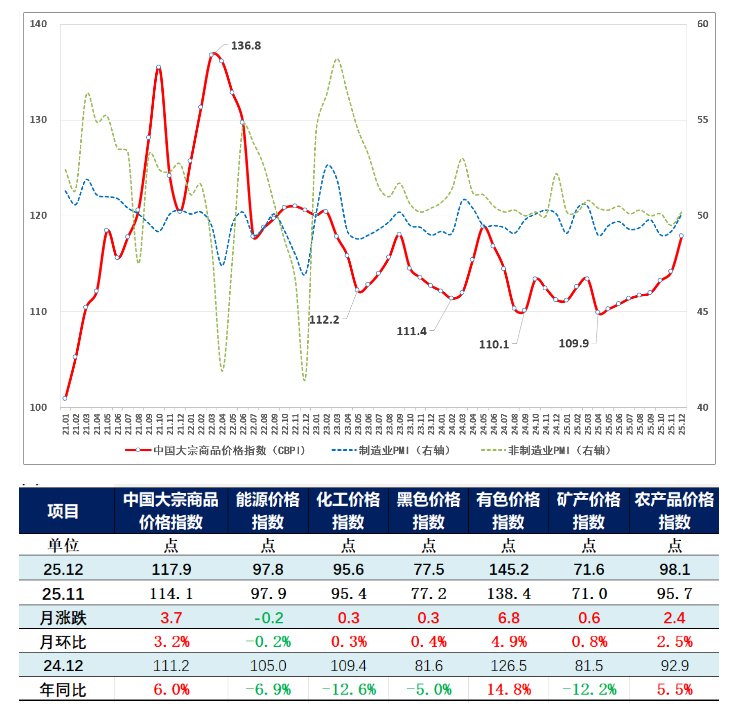
中物联:2025年12月中国大宗商品价格指数为117.9点 环比上涨3.2%
智通财经网· 2026-01-05 07:08
Core Viewpoint - The China Commodity Price Index (CBPI) for December 2025 reached 117.9 points, reflecting a month-on-month increase of 3.2% and a year-on-year increase of 6%, indicating a recovery in the commodity market driven by improved supply and demand dynamics and increased business confidence [1][3]. Summary by Category Overall Market Performance - The CBPI has shown a continuous month-on-month increase for eight consecutive months, reaching its highest level since June 2024, suggesting a strengthening of economic growth momentum [1]. - The outlook for 2026 indicates potential challenges from global economic recovery, but supportive macroeconomic policies and structural economic upgrades in China are expected to foster new demand for commodities [1]. Price Index Breakdown - The price indices for various categories in December 2025 are as follows: - Energy Price Index: 97.8 points, down 0.2% month-on-month, down 6.9% year-on-year - Chemical Price Index: 95.6 points, up 0.3% month-on-month, down 12.6% year-on-year - Black Metal Price Index: 77.5 points, up 0.4% month-on-month, down 5% year-on-year - Non-ferrous Metal Price Index: 145.2 points, up 4.9% month-on-month, up 14.8% year-on-year - Mineral Price Index: 71.6 points, up 0.8% month-on-month, down 12.2% year-on-year - Agricultural Product Price Index: 98.1 points, up 2.5% month-on-month, up 5.5% year-on-year [3][4]. Commodity Price Changes - Among 50 monitored commodities, 31 (62%) saw price increases, while 19 (38%) experienced declines in December 2025. The top three commodities with the highest month-on-month price increases were lithium carbonate (up 15.5%), refined tin (up 11.7%), and apples (up 8.5%). The largest declines were seen in caustic soda (down 7.2%), ethylene glycol (down 6.8%), and coking coal (down 6.5%) [5].

广东36个入选!2025第三批全国名特优新农产品名录发布
Nan Fang Nong Cun Bao· 2026-01-05 07:02
Core Viewpoint - The recent announcement by the Ministry of Agriculture and Rural Affairs of China highlights the inclusion of 36 agricultural products from Guangdong in the third batch of the National List of Special High-Quality New Agricultural Products for 2025, emphasizing the importance of developing high-quality agricultural products to enhance supply and promote sustainable agricultural practices [4][5]. Group 1: Inclusion of Products - Guangdong has successfully included 36 agricultural products in the 2025 National List, covering categories such as grains and oils, fruits and vegetables, seafood, tea, and nuts [4]. - To date, Guangdong has a total of 70 products recognized across three batches, with previous inclusions of 9 and 25 products in earlier rounds [5]. Group 2: Product Characteristics - The national list identifies agricultural products that are produced in specific regions, showcasing significant regional characteristics and unique nutritional qualities, with stable supply and high market recognition [9][10]. Group 3: Product Cancellations - The Ministry has also announced the cancellation of 63 products from the national list, including six from Guangdong, such as Deqing pineapple and Lekang snow chicken, due to various reasons including failure to meet certification conditions [13][14]. Group 4: Certification Mechanism - The criteria for the cancellation of products from the national list include changes in production conditions, failure to undergo annual confirmation, significant quality safety issues, voluntary withdrawal by the certificate holder, and non-compliance with recognition conditions after rectification [16][17][18].

2025年12月中国大宗商品价格指数创近一年半来新高
Zhong Guo Xin Wen Wang· 2026-01-05 06:54
Group 1 - The core viewpoint of the articles indicates that the China Commodity Price Index (CBPI) reached a new high since June 2024, standing at 117.9 points in December 2025, with a month-on-month increase of 3.2% and a year-on-year increase of 6% [1] - The index has shown a continuous month-on-month recovery for eight consecutive months, reflecting improved market supply and demand, as well as increased confidence among enterprises regarding future market development [1] - The analysis of the index by industry shows significant increases in the non-ferrous price index, an expanded increase in the agricultural product price index, a continued recovery in the mineral price index, a rebound in the black series price index, a slight increase in the chemical price index, and a slight decline in the energy price index [1] Group 2 - In December 2025, among the 50 monitored commodities, 31 (62%) saw price increases while 19 (38%) experienced price declines, with the top three commodities in price increase being lithium carbonate, refined tin, and apples, and the top three in price decline being caustic soda, ethylene glycol, and coking coal [1] - The Vice President of the China Logistics and Purchasing Federation's Commodity Trading Market Circulation Association stated that despite external uncertainties such as global economic recovery pressures and geopolitical tensions, the overall Chinese commodity market remains stable and shows positive trends, highlighting the resilience and potential of the Chinese economy [2] - Looking ahead to 2026, while facing multiple challenges, proactive macroeconomic policies are expected to support the continued recovery of the domestic economy and commodity market, alongside accelerated structural transformation and upgrading of the Chinese economy, which will create new demand for commodities [2]
长江期货粕类油脂月报-20260105
Chang Jiang Qi Huo· 2026-01-05 06:34
1. Report Industry Investment Rating There is no information about the industry investment rating in the provided content. 2. Core Views of the Report 2.1. Soybean Meal - The pattern of near - term strength and long - term weakness continues under the expectation of inventory reduction. The 03 contract is strong but with limited upside, while the 05 contract is weak but with strengthened bottom support due to geopolitical risks [5][8]. 2.2. Oils and Fats - In the short term, the rebound of oils and fats is limited. In the long term, there is a possibility of bottom - touching and rebound, but there are uncertainties and the supply of rapeseed oil is expected to be more abundant [75][216][217]. 3. Summary by Relevant Catalogs 3.1. Soybean Meal 3.1.1. Period and Spot Ends - As of December 31, the East China spot price was 3050 yuan/ton, up 30 yuan/ton monthly; the M2605 contract closed at 2749 yuan/ton, up 96 yuan/ton monthly; the basis was 05 + 300 yuan/ton, down 70 yuan/ton. The US soybean price was weak, while the domestic spot price was strong due to customs clearance delays and inventory reduction expectations [8][10]. 3.1.2. Supply End - The global soybean supply - demand pattern has tightened slightly. The 2025/26 global soybean output is 422 million tons, a year - on - year decrease of 5.39 million tons. China's soybean imports in 2025/26 are expected to be 112 million tons, a year - on - year increase of 4 million tons. The supply will first tighten and then loosen [8]. 3.1.3. Demand End - The current demand for soybean meal remains high. As of December 26, the national soybean inventory was 6.5444 million tons, a month - on - month decrease of 605,500 tons (8.41%); the soybean meal inventory of full - sample oil mills was 1.1675 million tons, a month - on - month increase of 16,100 tons (1.35%) [8]. 3.1.4. Cost End - The cost of Brazilian soybeans in 2025/26 is 950 cents/bushel. The domestic soybean meal cost from May to August is estimated to be 2580 yuan/ton, and from July to September it is 2760 yuan/ton. The cost of US soybeans in the second half of 2025/26 is 1000 cents/bushel, and the domestic import cost is 3000 yuan/ton. The Brazilian soybean crushing profit is around 30 yuan/ton [8]. 3.1.5. Global Soybean Supply - Demand - The global soybean output is expected to be 426 million tons, and the output - consumption difference has shrunk to 690,000 tons [16]. 3.1.6. US Soybean Inventory - Sales Ratio and Export - The US soybean inventory - sales ratio has tightened to 6.74%. As of December 18, 2025, the US soybean export inspection volume was 870,199 tons, with 386,010 tons to the Chinese mainland, accounting for 44.36% [26]. 3.1.7. Brazilian Export Sales - As of the latest data, the sales progress of Brazilian MT is 38.42%, lower than 41.09% of the same period last year, but the overall sales progress is good due to the large increase in production [27]. 3.1.8. Sowing Progress in South America - As of December 12, the sowing in the central and northern regions of Brazil was completed, and the sowing progress in the southern Rio Grande do Sul was 92%. The sowing progress in Argentina was 75.5% [37]. 3.1.9. South American Weather - Argentina will have less precipitation in the next two weeks, which is not conducive to soybean growth, while the precipitation in the main Brazilian producing areas is normal, which is beneficial to soybean growth [43]. 3.1.10. US Soybean Planting Cost - The planting cost of US soybeans in 25/26 is 1148 cents/bushel, and the bottom price is expected to be around 1000 cents/bushel. The US soybean price has strong bottom support [45]. 3.1.11. Premium Quotes - The Brazilian premium quotes have stabilized recently. As of February, the Brazilian premium quote was 150H cents/bushel. The crushing profit of imported soybeans was a loss of about - 30 yuan/ton [52]. 3.1.12. Import Cost - Based on the US soybean planting cost of 1000 cents/bushel, the US soybean premium of 230 cents/bushel, the exchange rate of 7.1, and the oil - meal ratio of 2.7, the domestic soybean import cost is 3000 yuan/ton. The domestic soybean meal cost from February to March is 3200 yuan/ton, and the Brazilian cost is 2580 yuan/ton [54]. 3.1.13. Ship - Buying Progress - Driven by the import crushing profit, the domestic ship - buying progress is relatively fast. The procurement progress for the January shipment has reached 100%. After January, the domestic arrival may decrease, which may lead to a phased increase in prices [59]. 3.1.14. Soybean Arrival - The domestic soybean arrival will first decrease and then increase. The 2025 - 2026 first - quarter import volume will decline seasonally, which is conducive to inventory reduction, but the soybean auction by CGC will slow down the inventory reduction of soybean meal [61][207]. 3.1.15. Soybean Meal Inventory - The domestic soybean meal inventory reduction is slow. As of December 19, the soybean inventory was 7.22 million tons (a year - on - year increase of 24.86%), and the soybean meal inventory was 1.12 million tons (a year - on - year increase of 17.9%) [207]. 3.2. Oils and Fats 3.2.1. Period and Spot Ends - As of December 31, the palm oil 05 contract decreased by 42 yuan/ton to 8584 yuan/ton, the soybean oil 05 contract decreased by 178 yuan/ton to 7862 yuan/ton, and the rapeseed oil 05 contract decreased by 670 yuan/ton to 9087 yuan/ton. The decline of rapeseed oil was the most significant [77]. 3.2.2. Palm Oil - In the short term, the export of Malaysian palm oil in December decreased, and the production decreased slightly. The ending inventory may increase to over 3 million tons. In the long term, the traditional production - reduction season from January to February 2026 and the pre - Ramadan stocking in India are conducive to inventory reduction [77]. 3.2.3. Soybean Oil - In the short term, the fundamental support is weak. The US soybean export demand is uncertain, and the South American soybean is expected to have a good harvest. However, the current US soybean price is lower than the planting cost, and the US biodiesel policy may limit the downside. In the long term, it will fluctuate widely [77]. 3.2.4. Rapeseed Oil - In the short term, the domestic situation is strong in reality but weak in expectation. The supply is decreasing, and the inventory is accelerating reduction. In the long term, the global rapeseed supply is more abundant, and the domestic supply may become more relaxed [77]. 3.2.5. Key Data Tracking: Spreads - The report shows the historical spreads of different oil contracts, such as the 5 - month spreads between rapeseed oil and soybean oil, rapeseed oil and palm oil, and soybean oil and palm oil [84][85][86]. 3.2.6. Key Data Tracking: Warehouse Receipts - As of December 31, the registered warehouse receipts of palm oil were 260 lots, a decrease of 92 lots from the end of last month; the registered warehouse receipts of soybean oil were 28,264 lots, an increase of 28,264 lots; the registered warehouse receipts of rapeseed oil were 3297 lots, a decrease of 668 lots [91]. 3.2.7. Palm Oil Supply - Demand in Malaysia - In November 2025, the Malaysian palm oil production was 1.94 million tons, a month - on - month decrease of 5.3%; the export was 1.21 million tons, a month - on - month decrease of 28.13%; the inventory was 2.84 million tons, a month - on - month increase of 13.04%. It is expected to continue to accumulate inventory slightly in December [98]. 3.2.8. Palm Oil Supply - Demand in Indonesia - In October 2025, the Indonesian palm oil production increased, the export decreased, and the domestic consumption increased. The ending inventory decreased to 2.33 million tons. It is expected that the inventory will remain low in 2025 [104][105]. 3.2.9. Palm Oil Import in India - In November 2025, the Indian soybean oil import decreased by 10.6% to 370,700 tons, the sunflower oil import decreased by 44.49% to 143,000 tons, the palm oil import increased by 6.34% to 630,500 tons, and the total vegetable oil import decreased by 13.3% to 1.1509 million tons. The inventory decreased. There is a possibility of an increase in imports for pre - Ramadan stocking [119]. 3.2.10. Key Data Tracking of Palm Oil - The report provides high - frequency export and production data of Malaysian palm oil, as well as price data such as the domestic CPO spot price and the average price of fresh fruit bunches [121][122][123]. 3.2.11. Key Data Tracking of Palm Oil (Continued) - It shows the spreads between soybean oil and palm oil, palm oil and diesel, and the export tax trend of Indonesian palm oil [127][129][130]. 3.2.12. Soybean Oil Supply - Demand: US Soybean - The estimated US soybean output in 25/26 is 115.75 million tons (a year - on - year decrease of 2.77%). The demand has uncertainties, and the ending inventory and inventory - sales ratio are at the median level in the past five years [140]. 3.2.13. Soybean Oil Supply - Demand: South American Soybean - The market maintains the expectation of a good harvest in South America. The 2025 - January - to - November Brazilian soybean export was 106 million tons (a year - on - year increase of 10.44%), and the January - to - October Argentine soybean export was 9.3 million tons (a year - on - year increase of 126.5%). The total export demand will remain high [149]. 3.2.14. Key Data Tracking of Soybean Oil - The report provides data on the US soybean shipment, net sales, export to China, and the non - commercial net long positions of US soybean and soybean oil [151][153][154]. 3.2.15. Rapeseed Oil Supply - Demand - The estimated global rapeseed output in 25/26 is 92.273 million tons (a year - on - year increase of 7.30%), and the supply is more abundant. The domestic rapeseed import is affected by policies, and the supply may change depending on future policies [180][208]. 3.2.16. Cost: Oilseed Crushing Profit and Import Profit - As of December 31, the near - month Brazilian soybean crushing profit decreased by 52 yuan/ton to 65.5 yuan/ton, the US Gulf soybean crushing profit increased by 13 yuan/ton to - 422.56 yuan/ton, and the Canadian rapeseed crushing profit decreased by 32 yuan/ton to 744 yuan/ton. The import profit of Argentine soybean oil and Malaysian palm oil increased [192]. 3.2.17. Domestic Palm Oil - In 2025, the domestic palm oil import decreased due to poor import profit. After December, the supply may decrease, which is conducive to inventory reduction. As of December 19, the inventory was 700,000 tons [198]. 3.2.18. Domestic Soybean Oil - In 2025, the domestic soybean import increased, and the soybean oil consumption decreased slightly. The inventory remained high. The seasonal decrease in import from the fourth quarter of 2025 to the first quarter of 2026 is conducive to inventory reduction, but the soybean auction will slow down the process [207]. 3.2.19. Domestic Rapeseed Oil - The domestic rapeseed import is affected by policies. The supply may become more relaxed in the future, depending on policies such as the import of Australian rapeseed and Canadian rapeseed [208]. 3.2.20. Driving Summary - In the short term, the oils and fats will fluctuate at a low level. In the long term, there is a possibility of bottom - touching and rebound, but there are uncertainties [216][217]. 3.2.21. Valuation - The current price of the palm oil 05 contract is at a historical high, while the prices of the soybean oil and rapeseed oil 05 contracts are at a historical low [218].
特朗普登机访华前,美国全球通报:中国已购入800万吨大豆
Sou Hu Cai Jing· 2026-01-05 06:25
Core Insights - China has resumed significant purchases of U.S. agricultural products, specifically committing to buy at least 8 million tons of soybeans, signaling a potential thaw in U.S.-China trade relations after a tumultuous period [1][3] - The agreement reached during the trade talks in Kuala Lumpur on October 25-26, 2025, aims to expand agricultural trade and restore soybean imports, which had drastically declined since the trade war began in 2018 [1][3] Group 1: Trade Agreement Details - The U.S. farmers initially felt relieved after the agreement, but concerns arose when reports indicated that China was not purchasing as much as expected [3] - Following a period of halted purchases, Chinese buyers needed time to adjust their supply chains and were waiting for market stability before making further decisions [3] - The agreement stipulates that China will purchase approximately 25 million tons of soybeans annually over the next three years, with a target of 12 million tons for 2025, of which 8 million tons have already been secured [3][5] Group 2: Political Context - The agricultural trade agreement is seen as a strategic move by the Trump administration to alleviate pressures from the farming community ahead of the 2026 midterm elections [5] - Improving trade relations with China is viewed as a key initiative for demonstrating economic management capabilities and addressing farmer dissatisfaction [5] Group 3: Market Dynamics and Challenges - The international soybean market remains volatile, and competition from countries like Brazil and Argentina continues to pose challenges for U.S. soybean exports [7][8] - The future of U.S.-China trade relations, particularly in the soybean sector, is uncertain, as underlying historical tensions and frequent frictions have not been fully resolved [8] - Establishing a more robust trust and understanding between the two nations will be crucial for future trade cooperation beyond mere transaction volumes [8]

中国大宗商品价格指数连续8个月环比上升
Xin Lang Cai Jing· 2026-01-05 06:23
Group 1 - The core viewpoint of the articles indicates that China's commodity price index reached 117.9 points in December 2025, reflecting a month-on-month increase of 3.2% and a year-on-year increase of 6%, marking the highest level since June 2024 and demonstrating improved supply and demand in the commodity market [1][2] - Among the 50 monitored commodities, 31 saw price increases in December 2025, with lithium carbonate, refined tin, and apples showing the largest increases of 15.5%, 11.7%, and 8.5% respectively [1] - The non-ferrous metals price index rose significantly by 4.9% month-on-month, while agricultural product prices increased by 2.5% due to seasonal demand and adverse weather conditions affecting storage and transportation [1] Group 2 - The overall trend of China's commodity market in 2025 is stable and improving, showcasing the resilience and potential of the Chinese economy despite external uncertainties such as global economic pressures and geopolitical tensions [2] - Looking ahead to 2026, while challenges remain, proactive macroeconomic policies are expected to support the continued recovery of the domestic economy and commodity market, alongside structural transformation that will create new demand for commodities [2]
商务部等9部门发文实施绿色消费推进行动!推动供应链全过程、全链条、全环节绿色发展
Qi Huo Ri Bao Wang· 2026-01-05 03:13
Group 1 - The core viewpoint of the news is the implementation of a green consumption promotion action plan by the Ministry of Commerce and other departments, which includes 20 specific measures across seven areas [1][2] Group 2 - In terms of enriching the supply of green products, the plan encourages the expansion of green food, organic agricultural products, and high-quality goods, as well as the establishment of dedicated sales areas for green agricultural products [1] - The plan promotes green consumption in the automotive sector by supporting the purchase of new energy vehicles and exploring the potential of the used car market and new consumption models such as RV camping and self-driving tours [1] Group 3 - The plan emphasizes the innovation of green consumption models by promoting green supply chains and encouraging the use of environmentally friendly products and packaging [2] - It also calls for increased policy support, including enhanced credit support for green consumption loans and collaboration between financial institutions and trade enterprises [2] - The plan encourages the development of innovative financial products to support green consumption, including insurance and the establishment of a project library for green infrastructure [2]
商务部等9部门联合印发《关于实施绿色消费推进行动的通知》
Shang Wu Bu Wang Zhan· 2026-01-05 03:01
Core Viewpoint - The Ministry of Commerce and nine other departments have jointly issued a notice to implement green consumption initiatives, aiming to promote a green transformation in economic and social development during the 14th Five-Year Plan period [1][2]. Group 1: Green Consumption Initiatives - The notice outlines 20 specific measures across seven areas, focusing on various sectors such as agricultural products, home appliances, and hospitality [1]. - It emphasizes the importance of enhancing the supply of green products, including increasing the availability of green agricultural products and promoting green home appliances and automotive consumption [1][2]. Group 2: Green Supply Chain and Consumer Engagement - The notice encourages the development of a green supply chain, including carbon footprint evaluations and the promotion of green procurement and packaging [2]. - It proposes the establishment of a universal green consumption points system that can be used both online and offline, along with the promotion of green product certifications [2]. Group 3: Environmental Optimization and Public Awareness - The notice calls for the optimization of the green consumption environment by promoting energy-saving facilities and prioritizing the use of green electricity [2]. - It highlights the need for public awareness campaigns to advocate for green consumption practices, such as reducing single-use plastics and encouraging the use of reusable items [2]. Group 4: Future Actions - The Ministry of Commerce will collaborate with relevant departments to guide local initiatives for promoting green consumption and to summarize effective practices to further expand green consumption [3].