
有色金属

Search documents
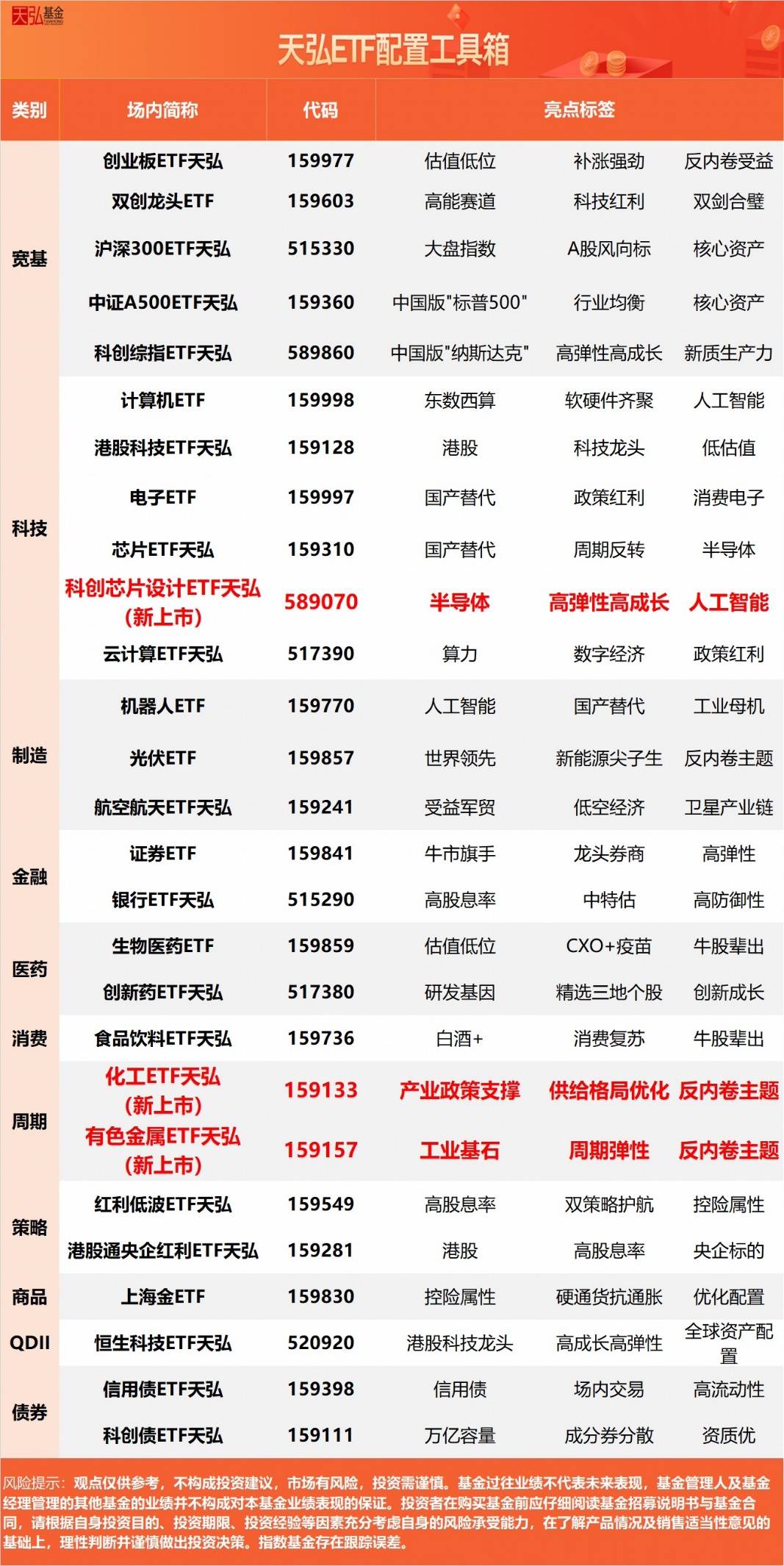
有色金属ETF天弘(159157)标的指数五连阳,较区间最低点涨超12%,近5日净流入超8亿元
Sou Hu Cai Jing· 2026-02-13 01:47
Core Viewpoint - The Tianhong Nonferrous Metals ETF (159157) has seen significant growth, with a more than 12% increase from its recent low and a trading volume of 2.13 billion yuan, indicating active market participation [1][2]. Group 1: ETF Performance - As of February 12, 2026, the Tianhong Nonferrous Metals ETF reached a new high in size at 19.33 billion yuan and a total of 1.924 billion shares, marking a record since its inception [1]. - The ETF has experienced continuous net inflows over the past five days, totaling 8.23 billion yuan, with a peak single-day inflow of 2.69 billion yuan [2]. Group 2: Product Highlights - The Tianhong Nonferrous Metals ETF closely tracks the Industrial Nonferrous Metals Index (H11059.CSI), selecting 30 large-cap companies involved in copper, aluminum, rare earths, lead-zinc, tungsten, and molybdenum, with copper and aluminum accounting for over 50% of the index weight [3]. Group 3: Market Trends - The demand for copper is expected to surge due to the dual drivers of AI and new energy, with significant increases in retail and wholesale sales of new energy vehicles by 42% and 39% respectively in early February, indicating rapid market expansion [5]. - The tightening supply of copper, combined with optimistic market sentiment regarding demand in the new energy sector, is likely to push up copper prices further [5]. Group 4: Institutional Insights - Citic Securities emphasizes the importance of capitalizing on the copper sector's pullback opportunities, citing supply-side production cuts and steady demand as foundational elements for a favorable copper price outlook in 2026 [6].

光大期货:2月13日有色金属日报
Xin Lang Cai Jing· 2026-02-13 01:30
Copper - Recent fluctuations in copper prices have been observed, with domestic refined copper imports maintaining losses [3][12] - A potential geopolitical shift is indicated by a Russian government memo suggesting a return to the dollar settlement system, which may influence market dynamics [3][12] - The recent decline in U.S. stock markets has raised concerns about market liquidity, affecting copper prices [3][12] - The current copper price trend shows a correlation with overseas financial markets and precious metals, suggesting reliance on financial attributes and market sentiment [3][12] - A strategy of buying on dips is recommended, but caution is advised due to upcoming holiday-related geopolitical risks [3][12] Nickel & Stainless Steel - LME nickel prices fell by 4.51% to $17,250 per ton, while SHFE nickel dropped by 3.74% to ¥135,070 per ton [4][13] - LME nickel inventory increased by 636 tons to 286,386 tons, while SHFE warehouse receipts remained at 52,027 tons [4][13] - Approved nickel ore production quotas in Indonesia are significantly lower than last year's targets, raising concerns about supply tightness [4][13] - Demand for stainless steel is expected to weaken due to seasonal factors, although cost support remains strong [4][13] Aluminum & Alumina - Alumina prices showed a slight decline, with AO2605 settling at ¥2,811 per ton, down 0.46% [6][15] - SHFE aluminum prices also decreased, with AL2603 at ¥23,395 per ton, down 0.91% [6][15] - The market is experiencing pressure from inventory accumulation and the upcoming holiday, leading to a bearish outlook for aluminum prices [6][15] Industrial Silicon & Polysilicon - Industrial silicon prices decreased slightly, with the main contract at ¥8,335 per ton, down 0.42% [7][16] - Polysilicon prices showed a slight increase, with the main contract at ¥49,015 per ton, up 0.44% [7][16] - The market is facing a lack of new orders as production slows down ahead of the holiday, leading to a weak market sentiment [7][16] Lithium Carbonate - Lithium carbonate futures rose by 3.66% to ¥149,420 per ton, with significant increases in both battery-grade and industrial-grade lithium carbonate prices [8][17] - Weekly production of lithium carbonate decreased by 560 tons, while social inventory saw a reduction of 2,531 tons [8][17] - The market sentiment is shifting positively due to expectations of increased demand post-holiday, although caution is advised regarding potential supply pressures [8][17]

港股早评:大幅低开!恒指跌1.45%,科技股下挫,海致科技首日高开204%
Ge Long Hui· 2026-02-13 01:28
Market Overview - US stock market experienced a significant decline, with major indices dropping sharply, leading to a 3% decrease in the China concept index [1] - On the last trading day of the Year of the Snake, Hong Kong's three major indices opened lower, with the Hang Seng Index down 1.45%, the National Index down 1.23%, and the Hang Seng Tech Index down 1.59% [1] Sector Performance - Major technology stocks in Hong Kong faced collective declines, with Baidu down 3.6%, Alibaba down 2.9%, and both Tencent and JD.com also experiencing losses [1] - Precious metals saw a sharp sell-off, with gold and silver prices plummeting, leading to declines in gold stocks and a broad drop in the non-ferrous metals sector, as well as in automotive, banking, and biopharmaceutical stocks [1] Notable Events - Haizhi Technology Group, dubbed the "first AI stock to remove illusions," saw its shares surge 204% on the first day of trading in Hong Kong, positively impacting some AI application concept stocks [1]
有色套利早报-20260213
Yong An Qi Huo· 2026-02-13 01:27
Report Industry Investment Rating - Not provided Core View - The report presents cross - market, cross - period, and cross - variety arbitrage tracking data for non - ferrous metals including copper, zinc, aluminum, nickel, lead, and tin on February 13, 2026 [1][3][4] Summary by Related Catalogs Cross - Market Arbitrage Tracking - **Copper**: Spot price is 102025 domestically and 13124 on LME with a ratio of 7.74; March price is 102680 domestically and 13219 on LME with a ratio of 7.76. The equilibrium ratio for spot import is 7.83 and the profit is - 823.81; the profit for spot export is - 207.25 [1] - **Zinc**: Spot price is 24470 domestically and 3399 on LME with a ratio of 7.20; March price is 24670 domestically and 3428 on LME with a ratio of 4.88. The equilibrium ratio for spot import is 8.22 and the profit is - 3474.11 [1] - **Aluminum**: Spot price is 23350 domestically and 3095 on LME with a ratio of 7.55; March price is 23690 domestically and 3127 on LME with a ratio of 7.53. The equilibrium ratio for spot import is 8.28 and the profit is - 2263.87 [1] - **Nickel**: Spot price is 139150 domestically and 17710 on LME with a ratio of 7.86. The equilibrium ratio for spot import is 7.98 and the profit is - 1212.86 [1] - **Lead**: Spot price is 16600 domestically and 1941 on LME with a ratio of 8.54; March price is 16700 domestically and 1988 on LME with a ratio of 12.33. The equilibrium ratio for spot import is 8.49 and the profit is 101.54 [3] Cross - Period Arbitrage Tracking - **Copper**: The spreads of next - month, March, April, and May relative to the spot month are 590, 940, 1170, and 1230 respectively, while the theoretical spreads are 611, 1119, 1637, and 2155 [4] - **Zinc**: The spreads of next - month, March, April, and May relative to the spot month are 115, 135, 185, and 190 respectively, while the theoretical spreads are 226, 357, 489, and 621 [4] - **Aluminum**: The spreads of next - month, March, April, and May relative to the spot month are 25, 105, 160, and 220 respectively, while the theoretical spreads are 229, 359, 489, and 619 [4] - **Lead**: The spreads of next - month, March, April, and May relative to the spot month are 45, 50, 90, and 135 respectively, while the theoretical spreads are 208, 313, 417, and 521 [4] - **Nickel**: The spreads of next - month, March, April, and May relative to the spot month are 1020, 1240, 1570, and 1590 respectively [4] - **Tin**: The spread of 5 - 1 is - 650, and the theoretical spread is 8044 [4] Spot - Futures Arbitrage Tracking - **Copper**: The spreads of the current - month and next - month contracts relative to the spot are - 290 and 300 respectively, while the theoretical spreads are 87 and 735 [4] - **Zinc**: The spreads of the current - month and next - month contracts relative to the spot are 65 and 180 respectively, and the theoretical spreads are 106, 248 (also 119, 261) [4][5] - **Lead**: The spreads of the current - month and next - month contracts relative to the spot are 50 and 95 respectively, while the theoretical spreads are 91 and 202 [5] Cross - Variety Arbitrage Tracking - The ratios of copper/zinc, copper/aluminum, copper/lead, aluminum/zinc, aluminum/lead, and lead/zinc in Shanghai (three - continuous) are 4.16, 4.33, 6.15, 0.96, 1.42, and 0.68 respectively; in London (three - continuous) are 3.82, 4.15, 6.51, 0.92, 1.57, and 0.59 respectively [5]
渤海证券研究所晨会纪要(2026.02.13)-20260213
BOHAI SECURITIES· 2026-02-13 00:31
Macro and Strategy Research - The PPI year-on-year decline continues to narrow, with a January PPI decrease of 1.4% and a month-on-month increase of 0.4, indicating improvements in supply-demand structures in key sectors and rising prices in some industries due to international metal prices [4][7] - The CPI for January increased by 0.2% both year-on-year and month-on-month, with a marginal decline in the year-on-year growth rate attributed to high base effects from the previous year and falling energy prices [3][4] - The central bank's monetary policy report emphasizes continued implementation of a moderately loose monetary policy, focusing on stabilizing economic growth and reasonable price recovery, with no immediate expectations for rate cuts or reserve requirement ratio reductions [4] Industry Research - Significant capital expenditure growth is observed among overseas cloud vendors, with projected capital expenditures reaching $660 billion in 2026, a 60% increase from 2025, indicating strong demand for AI computing power [11] - The AI application sector is approaching a commercialization inflection point, with notable advancements in products like ByteDance's AI video generation model Seedance 2.0, which shows significant improvements in core metrics and is expected to enhance content production efficiency [11] - The computer industry saw a 1.72% increase in the week from February 5 to February 11, with all sub-sectors experiencing growth, highlighting a positive market trend [9]
金银深夜闪崩,黄金一度跌破4900美元
2 1 Shi Ji Jing Ji Bao Dao· 2026-02-13 00:13
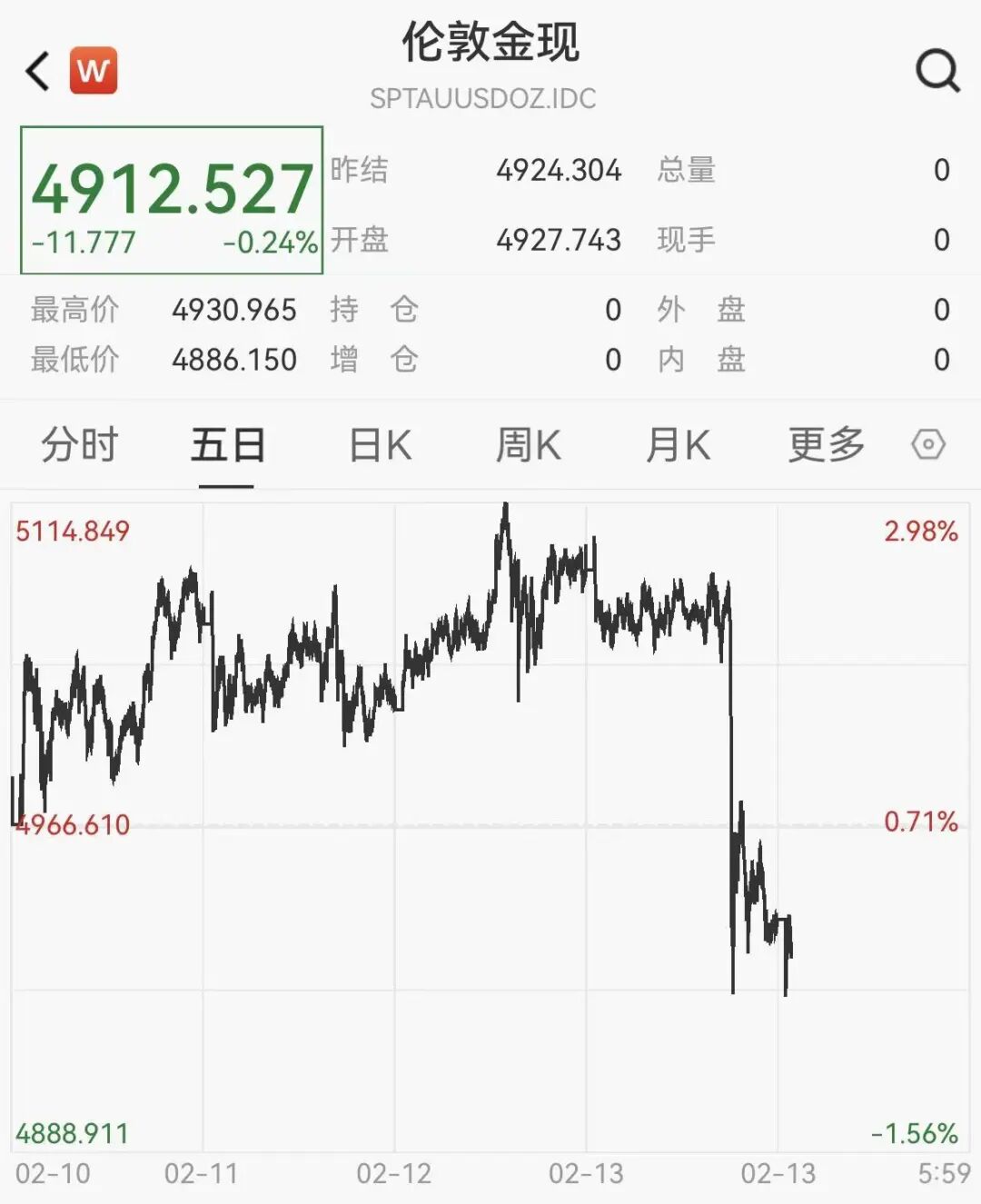
Group 1 - The recent sharp decline in gold and silver prices, with spot gold dropping over 3% and spot silver experiencing a decline of up to 11% [1] - As of February 13, spot gold fell below $4900, currently reported at $4912.5 per ounce, while spot silver decreased by over 0.6%, now at $74.7 per ounce [1] Group 2 - According to the chief analyst of non-ferrous metals at CITIC Securities, the upward trend in gold is not yet over, with liquidity expectations being the core driver of gold price movements [4] - Ongoing geopolitical conflicts provide a phase of safe-haven demand for gold, supporting its price [4] - A potential economic recovery in China and globally over the next 6-12 months could boost market demand, leading to a rebound in metal prices after adjustments [4] - Copper is viewed positively in the medium to long term due to its liquidity drivers and potential supply-demand improvements [4] - Caution is advised for smaller metal varieties that have seen price increases driven by speculative demand, as they may face price volatility risks [4] - The non-ferrous metals sector follows a unique valuation logic of "buy high PE, sell low PE," contrary to traditional industries [4] - A strategy of "holding" and "partial profit-taking" is recommended to balance returns and risks at the current market stage [4]
调仓换基增配价值品种基金投顾开年布局求稳
Zhong Guo Zheng Quan Bao· 2026-02-12 20:26
Group 1 - In January 2026, fund advisors accelerated their portfolio adjustments, with 178 out of nearly 650 fund advisor combinations making changes, primarily increasing allocations to undervalued value-type funds [1] - Major funds that saw the highest increase in allocation include Yongying Rong'an, HFT Investment's Hongli Low Volatility ETF, and others [1] - Fund advisors generally increased their positions in A-shares and bonds while reducing cash assets, U.S. stocks, and Hong Kong stocks [1][2] Group 2 - Specific sector adjustments included increasing allocations to non-ferrous metals, electronics, and communications, while reducing exposure to biomedicine, automotive, and banking sectors [2] - Jia Shi Wealth's portfolio adjustments included increasing holdings in funds related to economic recovery and reducing exposure to high-performing products like the CSI 500 [2] - Silver Hua Fund's portfolio rebalancing involved increasing bond fund allocations from 39% to 44% and reducing mixed and equity fund allocations [3] Group 3 - The focus on the technology sector included increasing the weight of the communications industry while reducing the weight of the computer industry, reflecting a strategic shift in response to market conditions [4] - The investment strategy emphasizes a dual focus on "overseas expansion + technology," suggesting a balanced approach to mitigate risks and smooth volatility [4][5] - The Hong Kong stock market is viewed as having a favorable investment window due to its low valuation and improving liquidity, with historical data indicating better performance post-Chinese New Year [5][6]
从“十四五”收官到“十五五”奠基,沪市公司2025业绩预告透露哪些新信号?
Zhong Guo Jing Ying Bao· 2026-02-12 15:05
Core Insights - The number of companies in the Shanghai Stock Exchange (SSE) announcing positive earnings forecasts for 2025 is increasing, indicating a recovery in performance and a solid foundation for the "14th Five-Year Plan" period [1][7][9] Group 1: Performance Highlights - As of February 9, 2026, 271 companies on the SSE main board have issued positive earnings forecasts for 2025, with 168 expecting profit increases and 85 companies turning losses into profits [1] - The performance of companies is particularly strong in the non-ferrous metals and electronics sectors, with leading companies maintaining high profit levels [2][8] - In the non-ferrous metals sector, companies are experiencing a "volume-price resonance," with both production increases and rising prices contributing to profit growth [2][8] Group 2: Sector-Specific Insights - Non-ferrous metal companies are benefiting from rising prices and increased production, with Zijin Mining expected to achieve a net profit of 51-52 billion yuan, a year-on-year increase of 59%-62% [2] - The electronics sector is driven by AI demand, with companies like Huaqin Technology forecasting a revenue increase of 54.7%-56.1% and a net profit increase of 36.7%-38.4% [3] - The AIoT market is rapidly growing, with companies like Rockchip expecting significant revenue and profit growth due to increased demand in automotive electronics and AI servers [3] Group 3: Industry Trends - The semiconductor and biopharmaceutical sectors on the STAR Market are showing signs of recovery, with nearly 60% of companies reporting profit growth [5][6] - The integrated circuit industry is benefiting from AI applications, with 87 companies reporting a combined net profit increase of approximately 99.49 billion yuan [5][8] - The biopharmaceutical sector is experiencing a resurgence, with innovative drug companies reporting significant revenue growth and improved profitability [6] Group 4: Future Outlook - The earnings forecasts reflect structural optimization and profitability recovery, indicating a strong foundation for the Chinese economy amid complex challenges [7][9] - The focus on innovation and structural optimization will be crucial for the next five years, with SSE companies playing a key role in driving economic stability [9][10] - The continuous improvement of the capital market environment is expected to attract long-term investment, fostering a positive cycle between technological innovation and capital support [10]
节前最后交易日,A股如何操作?
Guo Ji Jin Rong Bao· 2026-02-12 14:40
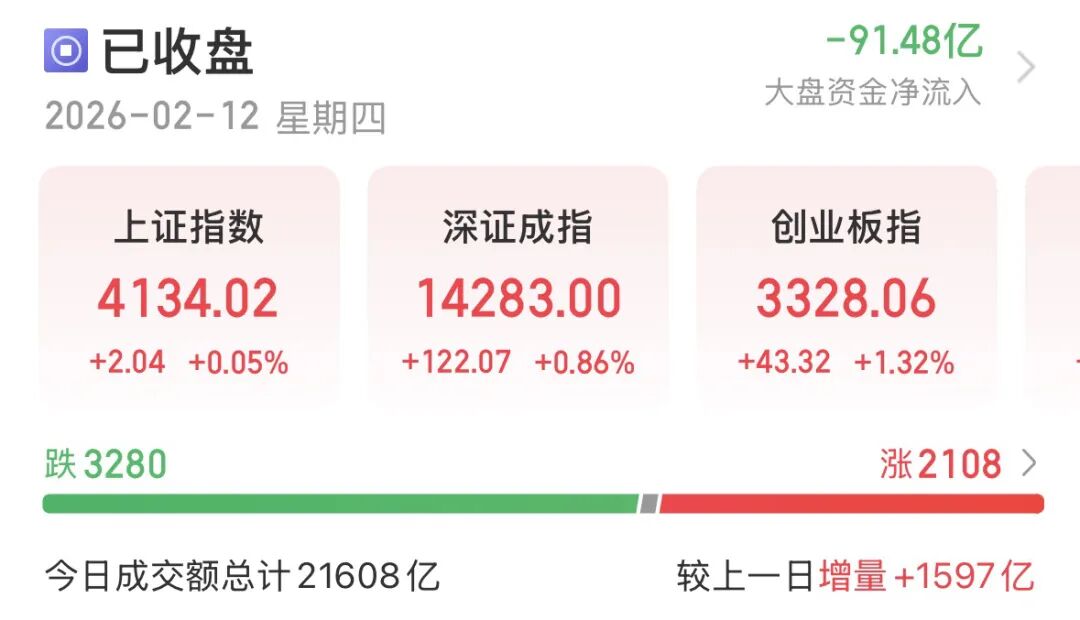
Market Overview - A-shares continued to show a fluctuating and differentiated trend, with major indices mostly closing slightly higher and trading volume increasing to 2.16 trillion yuan [1][4] - The market saw 2,108 stocks rise, with notable performances from technology stocks in communications, electronics, and military industries, as well as resource stocks like non-ferrous metals and steel [1][4] Trading Dynamics - The balance of margin financing decreased to 2.64 trillion yuan, indicating a continued decline in leveraged funds [4] - The trading activity was characterized by 3,280 stocks declining, with 22 hitting the daily limit down, while 69 stocks reached the daily limit up [5] Sector Performance - The technology sector, particularly in areas like AI applications and commercial aerospace, showed strong performance, while consumer sectors such as beauty care and retail experienced declines of over 1% [8][10] - Specific stocks like Tianfu Communication and Kunlun Wanwei saw significant gains, with Tianfu Communication rising over 14% [5][6] Investor Sentiment - Analysts suggest that the current market is undergoing structural adjustments rather than a broad influx of new capital, with funds shifting from defensive sectors to aggressive technology growth sectors [14] - The upcoming trading day before the Spring Festival is expected to see a narrow fluctuation and stabilization of indices, with a generally optimistic outlook for post-holiday market performance [3][15] Future Outlook - Post-holiday, the market is anticipated to experience a "opening red" scenario, driven by policy expectations and fundamental factors, despite potential volatility [17][19] - Investment strategies are recommended to focus on sectors with solid fundamentals and reasonable valuations, particularly in technology and cyclical resources, while maintaining a balanced portfolio to mitigate risks [20]
沪市有色“量价齐升”,电子AI“多点开花”
Bei Jing Ri Bao Ke Hu Duan· 2026-02-12 12:24
Group 1: Overall Market Performance - Over 270 companies on the Shanghai Stock Exchange have issued positive performance forecasts for 2025, indicating a robust outlook for the market [1] - Nearly 60% of companies on the Sci-Tech Innovation Board have reported year-on-year profit growth, showcasing the dual dimensions of quality and quantity in the economic trajectory of China [1] Group 2: Nonferrous Metals Industry - The nonferrous metals industry is experiencing a boom driven by resource prices and industrial upgrades, with industrial added value growth of 6.9%, surpassing the national average [2] - The total profit for ten major nonferrous metals reached 528.45 billion yuan, a year-on-year increase of 25.6%, marking a historical peak [2] - Leading companies like Zijin Mining are expected to see significant profit increases, with projected net profits of 51 to 52 billion yuan, reflecting a growth of 59% to 62% [2] Group 3: Electronic Industry - The electronic industry is witnessing growth driven by AI demand, with companies like Huaqin Technology expected to achieve revenues of 170 to 171.5 billion yuan, a year-on-year increase of 54.7% to 56.1% [4] - Shengyi Technology anticipates a net profit increase of 87% to 98%, benefiting from rising sales and improved product structure in the copper-clad laminate sector [4] - Companies are leveraging AI advancements to enhance their product offerings, with firms like Rockchip expected to see revenue growth of 71.97% to 85.42% [5] Group 4: Sci-Tech Innovation Board - The Sci-Tech Innovation Board is showing strong innovation momentum, particularly in the integrated circuit and biopharmaceutical sectors, with a projected net profit increase of approximately 99.49 billion yuan across 87 companies [6] - Companies in the AI chip sector are expected to see revenue growth exceeding 100%, with significant improvements in profitability [6] - The biopharmaceutical industry is transitioning towards commercialization, with notable collaborations and product approvals driving growth [6]




