
橡胶

Search documents
浅议“反内卷”驱动下的产业范式重构路径
Qi Huo Ri Bao Wang· 2025-09-15 00:32
Group 1: Concept and Causes of "Involution" - The concept of "involution" refers to a cultural pattern that becomes increasingly complex without transitioning to a new form, leading to inefficient competition among peers for market share without significant gains [2] - The causes of "involutionary" competition can be summarized into five aspects: macroeconomic supply-demand mismatch, industry reliance on international markets for raw materials and technology, short-term profit focus by enterprises, local government performance pressures, and external trade friction [3] Group 2: Dangers of "Involutionary" Competition - "Involutionary" competition leads to cost-cutting measures that result in thin or negative profits, reduced innovation capacity, and lower product quality, ultimately harming consumer interests [4] - It disrupts the entire industry ecosystem by causing inefficient resource allocation, hindering innovation, and damaging industry reputation and consumer trust [4] - On a macro level, it results in a failure of market elimination mechanisms, waste of social resources, and potential long-term sustainability issues [4] Group 3: Impact on the Rubber Industry - The rubber industry is experiencing "involutionary" competition characterized by low-quality, homogeneous products and overcapacity, leading to thin or negative profits [5] - In the first half of 2025, the rubber industry saw an increase in production, inventory, sales revenue, and export value, but profits decreased by 0.63%, indicating a troubling trend despite higher sales [5] - The fundamental cause of "involution" in the rubber industry is identified as a supply-demand mismatch, with minimal product differentiation leading to price wars [5] Group 4: "Anti-Involution" Initiatives - The "anti-involution" initiative aims to regulate low-price disorderly competition and guide enterprises to enhance product quality while phasing out outdated production capacity [13] - The government has introduced various policies to combat "involutionary" competition, including amendments to the Anti-Unfair Competition Law and directives for key industries like automotive and chemicals [13][14] - The "anti-involution" measures are expected to improve market conditions, enhance pricing power for leading firms, and promote industry consolidation [17] Group 5: Long-term Effects of "Anti-Involution" on the Rubber Industry - The "anti-involution" policies are anticipated to lead to increased industry concentration, improved profitability, and a focus on research and technological innovation [15][18] - Companies are expected to prioritize sustainable development and shift from short-term profit pursuits to long-term value creation [19] - The industry is likely to expand its global footprint to mitigate risks associated with trade policies and enhance operational efficiency [20]



赣州悦晨新材料有限公司成立 注册资本10万人民币
Sou Hu Cai Jing· 2025-09-13 03:46
Group 1 - A new company, Ganzhou Yuechen New Materials Co., Ltd., has been established with a registered capital of 100,000 RMB [1] - The legal representative of the company is Jin Xiaoming [1] - The business scope includes manufacturing and sales of synthetic materials, rubber products, and plastic products, as well as processing and sales of mechanical parts [1]
中航期货橡胶周度报告-20250912
Zhong Hang Qi Huo· 2025-09-12 12:08
Report Summary - The rainfall in the main natural rubber producing areas in Southeast Asia decreased from September 10th to 16th, 2025, compared with the previous period. The impact on rubber tapping was reduced in most areas north of the equator and increased in some areas south of the equator [5] - The rubber market oscillated weakly this week, giving back last week's gains. The market was significantly affected by external macro - factors, while the fundamental factors had limited impact, and the market remained range - bound [6] - In 2026 and 2027, the purchase tax on new energy vehicles will be restored but with a 50% discount. The European Central Bank kept its policy unchanged, and traders reduced bets on its easing policies. China will closely monitor Mexico's tariff - raising move [7] Multi - Empty Focus Bullish Factors - Weather disturbances made rubber raw material prices stable and slightly stronger, providing cost support [10] - Rubber inventory decreased slightly [10] - Tire operating rates rebounded [10] Bearish Factors - Weak US economic data affected overseas demand expectations [10] - Mexico's proposed tariff increase affected China's tire re - exports [10] - The inventory reduction of semi - steel tire enterprises was difficult [10] Data Analysis Natural Rubber Raw Material Prices - As of September 11th, the prices of fresh glue and cup rubber in Thailand, and glue in Yunnan and Hainan were reported. The raw material prices were stable and slightly stronger due to rainfall disturbing rubber tapping [11] Natural Rubber Inventory - As of September 5th, 2025, China's natural rubber social inventory decreased by 0.7 million tons. The inventory reduction in Qingdao increased [14] Butadiene Price - This week, the domestic butadiene price fluctuated narrowly. The theoretical production loss of butadiene rubber was 190 yuan/ton, and the production profit was still under pressure [15] Butadiene Rubber Inventory - As of the week of September 12th, the in - factory and trader inventories of butadiene rubber increased. The output decreased, and the overall inventory reduction was difficult [18] Tire Capacity Utilization - As of the week of September 12th, the capacity utilization rates of all - steel and semi - steel tires rebounded slightly. The inventory of all - steel tire factories continued to decrease, while the semi - steel tire market atmosphere was still weak [19] Rubber Contract Spreads - As of September 11th, the spreads of the three major rubber contracts were relatively stable, indicating that the internal supply - demand fundamentals of rubber were not significantly differentiated [21] Market Outlook - From a macro perspective, weak US economic data affected overseas demand, and Mexico's tariff policy affected China's tire exports. From a fundamental perspective, raw material prices provided cost support, inventory decreased slightly, and tire capacity utilization rates rebounded. Overall, the rubber market was mainly range - bound [25]
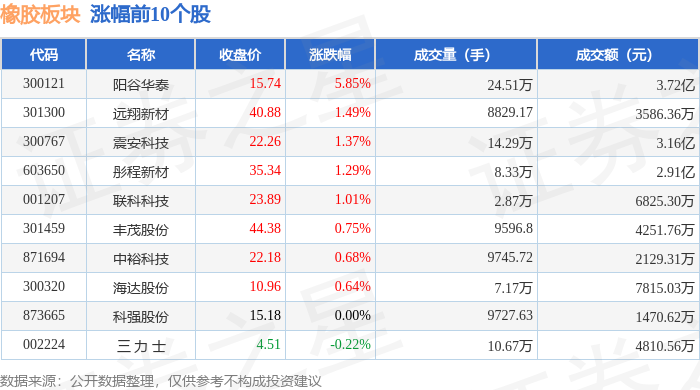
橡胶板块9月12日跌0.61%,利通科技领跌,主力资金净流出727.72万元
Zheng Xing Xing Ye Ri Bao· 2025-09-12 08:31
Market Overview - On September 12, the rubber sector declined by 0.61%, with Li Tong Technology leading the drop [1] - The Shanghai Composite Index closed at 3883.69, up 0.22%, while the Shenzhen Component Index closed at 12996.38, up 0.13% [1] Stock Performance - Notable gainers in the rubber sector included: - Yanggu Huatai (300121) with a closing price of 15.74, up 5.85% and a trading volume of 245,100 shares, totaling 372 million yuan [1] - Yuanxiang New Materials (301300) closed at 40.88, up 1.49% with a trading volume of 8,829 shares, totaling 35.86 million yuan [1] - Zhen'an Technology (300767) closed at 22.26, up 1.37% with a trading volume of 142,900 shares, totaling 316 million yuan [1] Fund Flow Analysis - The rubber sector experienced a net outflow of 7.28 million yuan from main funds, while retail funds saw a net inflow of 48.35 million yuan [2] - The overall net outflow from retail investors was 41.07 million yuan [2] Individual Stock Fund Flow - Key stocks with significant fund flow included: - Yanggu Huatai (300121) had a main fund net inflow of 29.59 million yuan, while retail investors had a net outflow of 24.07 million yuan [3] - Zhen'an Technology (300767) saw a main fund net inflow of 18.52 million yuan, with retail investors experiencing a net outflow of 19.85 million yuan [3] - Longxing Technology (002442) had a main fund net inflow of 4.65 million yuan, while retail investors had a net outflow of 2.56 million yuan [3]


广州帕特纳包装有限公司成立 注册资本20万人民币
Sou Hu Cai Jing· 2025-09-12 07:10
Core Insights - Guangzhou Partner Packaging Co., Ltd. has been established with a registered capital of 200,000 RMB [1] - The company’s business scope includes sales of packaging materials and products, food-grade plastic packaging containers, packaging equipment, electronic products, and baby products [1] Business Scope - The company is involved in the sales of various packaging materials and products, including specialized packaging equipment [1] - It also engages in the retail and wholesale of clothing and accessories, as well as sales of technical glass products and daily-use glass products [1] - The company’s operations extend to the sales of non-ferrous metal alloys, metal wire ropes, rubber products, sanitary ware manufacturing, and plastic products [1] - Additionally, it is involved in import and export activities, as well as internet sales excluding items that require special licenses [1]
广发期货日评-20250912
Guang Fa Qi Huo· 2025-09-12 06:44
1. Report Industry Investment Ratings No specific industry investment ratings are provided in the report. 2. Core Views - In September, the direction of the second - half monetary policy is crucial for the equity market. A - shares may enter a high - level shock pattern after a large increase, and the risk has been largely released [2]. - The 10 - year Treasury bond interest rate has strong gaming power around 1.8%, and an incremental drive is needed to choose a direction. The bond market shows a differentiated trend with the long - end being weak and the short - end being strong [2]. - The U.S. employment market continues to weaken, the ECB keeps policy unchanged, and gold shows a sideways consolidation. Silver is in the $40 - 42 range for short - term trading [2]. - The shipping index (European line) is in a weak shock, and a 12 - 10 spread arbitrage can be considered [2]. - Steel prices are suppressed by factors such as falling apparent demand and coking coal resumption. Iron ore prices are strong, while coking coal and coke prices are weak [2]. - The U.S. core CPI meets expectations, and the expectation of interest rate cuts heats up again. The prices of base metals such as copper, aluminum, and zinc are affected by different factors [2]. - The oil market is worried about marginal supply increments, dragging oil prices down. The chemical products market has different supply - demand situations and price trends [2]. - The agricultural products market is affected by factors such as production expectations and supply - demand contradictions, with different price trends for different varieties [2]. - Special commodities like soda ash, glass, and rubber have different market performances and trading suggestions [2]. - In the new energy sector, polysilicon has a rising price due to increasing production cut expectations, and lithium carbonate maintains a tight balance [2]. 3. Summary by Related Catalogs Financial - **Stock Index**: After a large increase, A - shares may enter a high - level shock. Sell near - month put options at support levels to collect premiums [2]. - **Treasury Bond**: The 10 - year Treasury bond interest rate is at a critical point. Adopt a wait - and - see strategy and focus on changes in the capital market, equity market, and fundamentals in the short term [2]. - **Precious Metals**: For gold, buy cautiously at low prices or sell out - of - the - money options. For silver, conduct short - term band trading in the $40 - 42 range and sell out - of - the - money options at high volatility [2]. Black - **Steel**: Steel prices are suppressed. Adopt a wait - and - see strategy [2]. - **Iron Ore**: Buy iron ore 2601 contracts at low prices in the range of 780 - 830 and consider an iron ore - coking coal long - short strategy [2]. - **Coking Coal**: Sell coking coal 2601 contracts at high prices in the range of 1070 - 1170, and the iron ore - coking coal long - short strategy is favorable [2]. - **Coke**: Sell coke 2601 contracts at high prices in the range of 1550 - 1650, and the iron ore - coke long - short strategy is favorable [2]. Non - ferrous Metals - **Copper**: The futures price is close to the mainstream cost range, and the short - term downward space is limited. The main contract reference range is 79500 - 81500 [2]. - **Aluminum and Related Alloys**: Aluminum prices are affected by macro - factors and cost support, with different reference ranges for different contracts [2]. - **Zinc**: The expectation of interest rate cuts improves, boosting zinc prices. The main contract reference range is 21500 - 23000 [2]. - **Tin**: The fundamentals remain strong, and the tin price is in a high - level shock. The operating range is 285000 - 265000 [2]. Energy and Chemicals - **Crude Oil**: Concerns about marginal supply increments drag oil prices down. Adopt a short - side strategy and pay attention to support levels [2]. - **Urea**: High short - term supply pressure drags down the price. Adopt a wait - and - see strategy and pay attention to the support level of 1630 - 1650 yuan/ton [2]. - **PX and PTA**: The supply - demand expectations in September are different, and the prices are in a shock range. For PTA, consider a TA1 - 5 rolling reverse spread strategy [2]. - **Other Chemical Products**: Each chemical product has different supply - demand situations and trading suggestions, such as short - fiber, bottle - grade polyester, ethylene glycol, etc. [2] Agricultural Products - **Grains and Oils**: Different grains and oils are affected by factors such as production expectations and supply - demand contradictions, with different price trends and trading suggestions [2]. - **Sugar and Cotton**: Sugar prices are affected by overseas supply prospects, and cotton has low old - crop inventories, with different trading suggestions [2]. - **Livestock and Poultry Products**: The livestock and poultry products market is affected by factors such as supply - demand contradictions and sales rhythms, with different price trends [2]. Special Commodities - **Soda Ash**: The market lacks a main trading logic and is in a narrow - range shock. Adopt a short - selling strategy on rebounds [2]. - **Glass**: The market is affected by production lines and spot market sentiment. Adopt a wait - and - see strategy [2]. - **Rubber**: The macro - sentiment fades, and rubber prices are in a shock - down trend. Adopt a wait - and - see strategy [2]. New Energy - **Polysilicon**: Due to increasing production cut expectations, the price is rising. Adopt a wait - and - see strategy [2]. - **Lithium Carbonate**: The market maintains a tight balance. Adopt a wait - and - see strategy, and the main contract reference range is 70000 - 72000 yuan [2].
化工日报:轮胎开工率环比回升-20250912
Hua Tai Qi Huo· 2025-09-12 05:28
1. Report Industry Investment Rating - Both RU and NR are rated as neutral. BR is also rated as neutral [7] 2. Core Viewpoints - For natural rubber, with less rainfall in major production areas, raw material prices are expected to rise, weakening cost - side support. After short - term maintenance of tire factories, the operating rate will rebound during the traditional peak season, and demand is expected to improve. Port and social inventories are currently decreasing but will rise again after downstream restocking. - For BR, with some device maintenance plans, supply is expected to decline. After tire factory maintenance, the operating rate will rebound during the peak season, and demand is expected to improve. The overall supply - demand situation shows a slight improvement, and prices are expected to rise, but the impact of weak crude oil on upstream raw materials should be noted [7] 3. Summary According to Related Catalogs Market News and Data - Futures: On the previous trading day, the closing price of the RU main contract was 15,905 yuan/ton, down 75 yuan/ton from the previous day; the NR main contract was 12,620 yuan/ton, down 95 yuan/ton; the BR main contract was 11,655 yuan/ton, down 65 yuan/ton [1] - Spot: The price of Yunnan - produced whole latex in the Shanghai market was 15,050 yuan/ton, down 50 yuan/ton; Qingdao Free Trade Zone Thai mixed rubber was 15,000 yuan/ton, unchanged; Thai 20 - standard rubber was 1,860 US dollars/ton, down 5 US dollars/ton; Indonesian 20 - standard rubber was 1,775 US dollars/ton, down 10 US dollars/ton; the ex - factory price of BR9000 of Sinopec Qilu Petrochemical was 11,900 yuan/ton, unchanged; the market price of BR9000 of Zhejiang Transfar was 11,550 yuan/ton, down 150 yuan/ton [1] Market Information - Import: In August 2025, China imported 664,000 tons of natural and synthetic rubber (including latex), a 7.8% increase from the same period in 2024. From January to August, the total import was 5.373 million tons, a 19% increase [2] - Export: From January to July 2025, Thailand exported 1.586 million tons of natural rubber (excluding compound rubber) to the world, a 5% year - on - year decrease. From January to July, Thailand exported 622,000 tons of natural rubber to China, a 7% year - on - year increase. From January to July 2025, China's rubber tire export volume reached 5.63 million tons, a 5.4% year - on - year increase, and the export value was 99.2 billion yuan, a 5.4% increase [2][3] - Sales: In August 2025, China's heavy - truck market sold about 84,000 vehicles, a 1% month - on - month decrease and a 35% year - on - year increase. From January to August, the cumulative sales volume was about 708,000 vehicles, a 13% year - on - year increase [2] Market Analysis Natural Rubber - Spot and spreads: On September 11, 2025, the RU basis was - 855 yuan/ton (+25), the spread between the RU main contract and mixed rubber was 905 yuan/ton (-75), the import profit of smoked sheet rubber was - 3,448 yuan/ton (-19.57), the NR basis was 592 yuan/ton (+54) [4] - Raw materials: Thai smoked sheet was 60.79 Thai baht/kg (-0.19), Thai latex was 56.20 Thai baht/kg (+0.20), Thai cup lump was 52.20 Thai baht/kg (-0.35), and the spread between Thai latex and cup lump was 4.00 Thai baht/kg (+0.55) [5] - Operating rate: The operating rate of all - steel tires was 66.31% (+5.57%), and that of semi - steel tires was 72.61% (+5.69%) [6] - Inventory: The social inventory of natural rubber was 1,257,715 tons (-7,183), the inventory of natural rubber at Qingdao Port was 592,275 tons (-10,020), the RU futures inventory was 162,230 tons (-16,410), and the NR futures inventory was 46,569 tons (+907) [6] Cis - polybutadiene Rubber (BR) - Spot and spreads: On September 11, 2025, the BR basis was - 105 yuan/ton (-35), the ex - factory price of butadiene of Sinopec was 9,350 yuan/ton (unchanged), the quoted price of BR9000 of Qilu Petrochemical was 11,900 yuan/ton (unchanged), the quoted price of BR9000 of Zhejiang Transfar was 11,550 yuan/ton (-150), the price of private - owned BR in Shandong was 11,500 yuan/ton (-80), and the import profit of BR in Northeast Asia was - 1,605 yuan/ton (-99) [6] - Operating rate: The operating rate of high - cis BR was 73.48% (-2.68%) [6] - Inventory: The inventory of BR traders was 8,210 tons (+950), and the inventory of BR enterprises was 26,300 tons (+1,650) [6] Strategy - RU and NR: Neutral. With less rainfall in major production areas, raw material prices are expected to rise, weakening cost - side support. The operating rate of tire factories will rebound, and demand is expected to improve. After downstream restocking, port inventory is expected to rise again [7] - BR: Neutral. Some BR devices will be under maintenance, and supply is expected to decline. The operating rate of tire factories will rebound, and demand is expected to improve. The overall supply - demand situation shows a slight improvement, and prices are expected to rise, but the impact of weak crude oil on upstream raw materials should be noted [7]
中信期货晨报:商品期货多数上涨,中小盘股指涨幅较好-20250912
Zhong Xin Qi Huo· 2025-09-12 05:11
1. Report Industry Investment Rating - No relevant content provided. 2. Core Viewpoints of the Report - The report notes that most commodity futures rose, and small - and mid - cap stock index futures had good gains. In the overseas market, the US labor market shows a clear slowdown trend, and the weak non - farm data increases the probability of a September interest rate cut. In the domestic market, the PPI is expected to see a slight increase in the central value, while the CPI may be slightly lower than the first - half level. Short - term domestic assets present mainly structural opportunities, with a higher probability of incremental policies in the fourth quarter. Overseas, the situation is generally favorable for gold. Long - term US fundamentals are fair, and a weak US dollar pattern continues [6]. 3. Summary by Related Catalogs 3.1 Market Performance - **Stock Index Futures**: The CSI 300 futures closed at 4562, up 2.92% daily, 2.37% weekly, 1.24% monthly, 17.40% quarterly, and 16.35% year - to - date. The SSE 50 futures closed at 2990.2, up 1.78% daily, 1.68% weekly, 0.34% monthly, 11.20% quarterly, and 11.66% year - to - date. The CSI 500 futures closed at 7124.6, up 3.81% daily, 3.28% weekly, 1.83% monthly, 21.52% quarterly, and 25.11% year - to - date. The CSI 1000 futures closed at 7387.8, up 3.31% daily, 2.24% weekly, 0.29% monthly, 20.15% quarterly, and 26.32% year - to - date [3]. - **Treasury Bond Futures**: The 2 - year Treasury bond futures closed at 102.41, up 0.06% daily, 0.02% weekly, - 0.01% monthly, - 0.22% quarterly, and - 0.55% year - to - date. The 5 - year Treasury bond futures closed at 105.59, up 0.16% daily, 0.00% weekly, 0.07% monthly, - 0.63% quarterly, and - 0.89% year - to - date. The 10 - year Treasury bond futures closed at 107.58, up 0.08% daily, - 0.34% weekly, - 0.21% monthly, - 1.24% quarterly, and - 1.23% year - to - date. The 30 - year Treasury bond futures closed at 114.74, down 0.02% daily, - 1.38% weekly, - 1.55% monthly, - 4.61% quarterly, and - 3.44% year - to - date [3]. - **Foreign Exchange**: The US dollar index was at 97.8433, unchanged daily, up 0.11% weekly, unchanged monthly, up 1.11% quarterly, and down 9.81% year - to - date. The euro - US dollar exchange rate was 1.1695, with 0 pips change daily, - 24 pips weekly, 9 pips monthly, - 93 pips quarterly, and 1342 pips year - to - date. The US dollar - yen exchange rate was 147.46, with 0 pips change daily, up 0.03% weekly, up 0.28% monthly, up 2.40% quarterly, and down 6.20% year - to - date [3]. - **Overseas Commodities**: NYMEX WTI crude oil was at $63.75, up 1.56% daily, 2.87% weekly, - 0.41% monthly, - 1.88% quarterly, and - 11.30% year - to - date. ICE Brent crude oil was at $67.6, up 1.61% daily, 2.94% weekly, 0.21% monthly, 1.46% quarterly, and - 9.66% year - to - date. COMEX gold was at $3680.4, up 0.45% daily, 1.12% weekly, 4.67% monthly, 11.02% quarterly, and 39.45% year - to - date [3]. 3.2 Macro Situation - **Overseas Macro**: The US released August non - farm data, with only 22,000 new jobs, lower than the previous value and expectations. The labor market's downward risk has increased, and wage growth has slowed. The number of initial and continued unemployment claims shows that the labor market slowdown is becoming more obvious [6]. - **Domestic Macro**: In August, the PPI rebounded from - 3.6% to - 2.9% year - on - year, while the CPI dropped from 0% to - 0.4% year - on - year. The tail - wagging effect had a large impact, and food prices dragged down the CPI. The PPI's month - on - month rebound to 0 and the core CPI's rise to 0.9% indicate that domestic policies are starting to take effect. The PPI central value is expected to rise slightly, and the CPI may be slightly lower than the first - half level [6]. 3.3 Asset Views - **Short - term**: Domestic assets mainly present structural opportunities. The market sentiment has cooled down after important domestic events this week. In the overseas market, the weak US non - farm data increases the probability of a September interest rate cut, which is favorable for gold. - **Long - term**: The US fundamentals are fair, and interest rate cuts are expected to boost the fundamentals. The weak US dollar pattern continues, and investors should be vigilant about volatility spikes and focus on non - US dollar assets [6]. 3.4 Viewpoint Highlights - **Financial Sector**: Stock index futures should adopt a dumbbell structure to deal with market differences; stock index options should continue the hedging and defensive strategy; the stock - bond seesaw may continue in the short term for Treasury bond futures. All are expected to be in a volatile state [7]. - **Precious Metals**: Driven by dovish expectations, the prices of gold and silver are expected to rise in a volatile manner, as the probability of a September interest rate cut in the US increases, and the risk of the Fed's loss of independence expands [7]. - **Shipping Sector**: For the container shipping to Europe route, attention should be paid to the game between peak - season expectations and price - increase implementation. Steel and iron ore are expected to be volatile, with the impact of production restrictions on steel weakening and iron ore showing an unexpected decline in molten iron production and a slight increase in port inventories [7]. - **Black Building Materials**: Despite the "anti - involution" impact, the prices of varieties in this sector are still supported during the peak season. However, most varieties are expected to be in a volatile state, such as coke starting the first - round price cut after the end of military parade - related production restrictions, and the supply of coking coal significantly decreasing [7]. - **Non - ferrous Metals and New Materials**: Affected by the better - than - expected July China's import and export data, non - ferrous metals were initially boosted. However, most varieties are expected to be volatile, with some facing downward pressure, such as copper due to the rising risk of overseas recession [7]. - **Energy and Chemicals**: The supply - demand situation of crude oil has weakened significantly, and coking coal's decline has dragged down the chemical industry. Most varieties in this sector are expected to be volatile, with some facing downward pressure, such as PP due to the increasing pressure of new production capacity [9]. - **Agricultural Sector**: The agricultural market is in a narrow - range volatile state, waiting for the results of field inspections. Most agricultural products are expected to be volatile, such as livestock products facing a supply - demand imbalance and rubber facing pressure from previous highs [9].
日评-20250912
Guang Fa Qi Huo· 2025-09-12 03:40
Report Summary 1. Report Industry Investment Ratings No specific industry investment ratings are provided in the report. 2. Core Views - In September, the direction of the second - half monetary policy is crucial for the equity market. After A - shares have accumulated significant gains, they may enter a high - level shock pattern, and the risk has been largely released [2]. - The 10 - year Treasury bond interest rate has strong gaming power around 1.8%, and an incremental driver is needed to choose a direction. The long - end of Treasury bonds is weak while the short - end is strong [2]. - The U.S. employment market continues to weaken, the ECB keeps policy unchanged, and gold shows a sideways consolidation [2]. - The container shipping index (European line) main contract is weakly volatile [2]. - Steel prices are suppressed by factors such as declining apparent demand and coking coal复产 [2]. - The U.S. core CPI meets expectations, and the expectation of interest rate cuts has heated up again [2]. - There is a high supply pressure in the short - term for some energy and chemical products, and the market needs to pay attention to industrial demand rhythm [2]. - For agricultural products, there are different supply - demand situations, such as the abundant supply expectation for sugar and the low inventory of old - crop cotton [2]. 3. Summary by Categories Financial - **Stock Index**: The stock index has a volume - increasing rise with the resonance of technology and finance. It is recommended to sell near - month put options at the support level to collect premiums [2]. - **Treasury Bond**: Uncertain about the direction, investors are advised to wait and see in the short - term, and pay attention to the capital market, equity market, and fundamentals [2]. - **Precious Metals**: Gold should be bought cautiously at low prices or sell out - of - the - money gold options. Silver should be traded in the range of 40 - 42 dollars and sell out - of - the money options at high volatility [2]. - **Container Shipping Index (European Line)**: Consider the 12 - 10 spread arbitrage as the main contract is weakly volatile [2]. Black - **Steel**: It is recommended to wait and see due to factors suppressing steel prices [2]. - **Iron Ore**: Buy the iron ore 2601 contract at low prices in the range of 780 - 830 and go long on iron ore and short on coking coal [2]. - **Coking Coal**: Short the coking coal 2601 contract at high prices in the range of 1070 - 1170 [2]. - **Coke**: Short the coke 2601 contract at high prices in the range of 1550 - 1650 [2]. Energy and Chemical - **Crude Oil**: Adopt a short - side thinking, with support levels for WTI at [61, 62], Brent at [64, 65], and SC at [465, 475] [2]. - **Urea**: Wait and see as the short - term high - supply pressure drags down the market [2]. - **PX**: Treat the short - term oscillation in the range of 6600 - 6900 [2]. - **PTA**: Oscillate in the range of 4600 - 4800 in the short - term and conduct TA1 - 5 rolling reverse arbitrage [2]. - **Short - fiber**: Follow the raw materials, with the processing fee oscillating in the range of 800 - 1100 [2]. - **Bottle Chip**: The supply and demand may both decline in September, and the processing fee fluctuates in the range of 350 - 500 yuan/ton [2]. - **Ethylene Glycol**: Look for EG1 - 5 reverse arbitrage opportunities [2]. - **Caustic Soda**: Wait and see [2]. - **PVC**: Hold short positions [2]. - **Pure Benzene**: Follow styrene and oil prices in the short - term [2]. - **Styrene**: Do low - buying operations on EB10 and expand the EB11 - BZ11 spread at a low level [2]. - **Synthetic Rubber**: The price fluctuates in the range of 11400 - 12500 [2]. - **LLDPE**: Oscillate in the short - term [2]. - **PP**: Stop profit on short positions at 6950 - 7000 [2]. - **Methanol**: Conduct range operations in the range of 2350 - 2550 [2]. Agricultural - **Soybean Meal**: Operate in the range of 3050 - 3150 for the 01 contract [2]. - **Hog**: The market has limited supply - demand contradictions, and pay attention to the subsequent slaughter rhythm [2]. - **Corn**: Short at high prices [2]. - **Oil**: The short - term P main contract may test the 9000 support [2]. - **Sugar**: Pay attention to the support at around 5500 [2]. - **Cotton**: Wait and see on a single - side basis [2]. - **Egg**: Control the position of previous short positions as the market rebounds [2]. - **Apple**: The main contract runs around 8100 [2]. - **Jujube**: The main contract fluctuates around 11000 [2]. Special Commodities - **Soda Ash**: Short on rebounds [2]. - **Glass**: Wait and see and pay attention to the spot market sentiment during the peak season [2]. - **Rubber**: Wait and see [2]. - **Industrial Silicon**: The price may fluctuate in the range of 8000 - 9500 yuan/ton, and pay attention to the silicon industry conference [2]. New Energy - **Polysilicon**: Wait and see as the production cut expectation rises and the price increases [2]. - **Lithium Carbonate**: Wait and see mainly, with the main contract running around 7 - 7.2 million [2].
光大期货能化商品日报-20250912
Guang Da Qi Huo· 2025-09-12 03:27
1. Report Industry Investment Rating No relevant content provided. 2. Core Viewpoints of the Report - The oil price is under pressure due to the increase in supply from OPEC+ and concerns about supply - overcapacity, with the IEA suggesting a possible surplus in 2026. The price of crude oil is expected to fluctuate [1]. - The fuel oil market is also in a state of oscillation. The high - sulfur fuel oil market is suppressed by factors such as weak demand before the refinery maintenance season and after the end of summer power generation demand. The low - sulfur fuel oil supply in Singapore may increase, and the market should focus on the cost - side fluctuations of crude oil [3]. - The asphalt price is expected to rise further as the supply pressure is limited and the seasonal demand in September and October is expected to increase. However, it is also necessary to pay attention to the cost - side fluctuations of oil prices [3]. - The polyester market is expected to be weak with oscillations. Although the fundamentals of PX are improving, TA and ethylene glycol still face challenges such as weak downstream demand and uncertain supply recovery [5]. - The rubber market is expected to oscillate. The demand is stable, the inventory is decreasing, but the weather in the production areas during the peak - production season needs to be closely monitored [7]. - The methanol price is expected to reach a temporary bottom. Although the supply will gradually increase, the demand from MTO devices in the East China region is expected to increase, and the port inventory will peak in the middle of the month [7]. - The polyolefin market is expected to oscillate weakly. Although the demand is picking up with the arrival of the peak season, the cost pressure restricts the price upward movement [7]. - The PVC market is expected to oscillate weakly. The supply remains high, the domestic demand recovers slowly, and the export is affected by anti - dumping policies, with large inventory pressure [9]. 3. Summary According to Relevant Catalogs 3.1 Research Views - **Crude Oil**: On Thursday, the oil price dropped. The IEA raised the global oil supply growth forecast for 2025 to 2.7 million barrels per day and predicted an increase of 2.1 million barrels per day in 2026. OPEC+ is increasing supply, which has led to concerns about overcapacity and pressured the oil price. The demand growth is slower than the supply growth, and the OPEC monthly report shows an increase in production in August [1]. - **Fuel Oil**: The main contract of high - sulfur fuel oil on the SHFE rose 0.47%, and the low - sulfur fuel oil main contract fell 0.53%. The supply in Singapore may increase, and the high - sulfur fuel oil market is affected by weak demand [3]. - **Asphalt**: The main contract of asphalt on the SHFE rose 0.76%. The domestic refinery asphalt inventory increased slightly, the social inventory decreased, and the device operating rate decreased. The supply pressure is limited, and the price may rise with the arrival of the demand peak season [3]. - **Polyester**: TA and EG prices fell, and PX prices rose slightly. The production and sales of polyester yarn in Jiangsu and Zhejiang are weak. Some production devices have maintenance or restart plans, and the market is expected to be weak with oscillations [5]. - **Rubber**: The prices of various rubber varieties dropped. The operating rate of tire enterprises in Shandong increased, the demand is stable, the inventory is decreasing, and the price is expected to oscillate [7]. - **Methanol**: The supply is at a temporary low due to domestic device maintenance, but it will gradually increase. The Iranian device has high load and stable shipping volume, but there is an expected maintenance. The MTO device in the East China region may start up, and the port inventory will peak in the middle of the month [7]. - **Polyolefin**: The prices of various polyolefin products show different trends. The supply will remain high, the demand is picking up with the peak season, but the cost pressure makes the market expected to oscillate weakly [7]. - **Polyvinyl Chloride**: The PVC market prices in different regions are adjusted slightly. The domestic real - estate construction is recovering, but the demand for pipes and profiles has limited growth. The supply is high, the export is affected by policies, and the inventory pressure is large, so the price is expected to oscillate weakly [9]. 3.2 Daily Data Monitoring - The report provides the spot price, futures price, basis, basis rate, and other data of various energy - chemical products on September 12, 2025, including crude oil, liquefied petroleum gas, asphalt, fuel oil, methanol, etc., and also shows the changes in these data compared with the previous period and their positions in historical data [11]. 3.3 Market News - The IEA raised the global oil supply growth forecast for 2025 and suggested a possible surplus in 2026 due to the increase in supply from OPEC+ and non - OPEC countries. The OPEC monthly report shows an increase in OPEC+ crude oil production in August [14][15]. 3.4 Chart Analysis - **4.1 Main Contract Prices**: The report presents the closing price trends of main contracts of various energy - chemical products from 2021 to 2025, including crude oil, fuel oil, low - sulfur fuel oil, asphalt, etc., through charts [17]. - **4.2 Main Contract Basis**: It shows the basis trends of main contracts of various products, such as crude oil, fuel oil, low - sulfur fuel oil, etc., through charts [35]. - **4.3 Inter - period Contract Spreads**: The report displays the spreads between different contracts of various products, such as fuel oil, asphalt, PTA, etc., through charts [48]. - **4.4 Inter - variety Spreads**: It presents the spreads and ratios between different varieties, such as crude oil internal and external markets, fuel oil high - low sulfur, etc., through charts [64]. - **4.5 Production Profits**: The report shows the production profit trends of products such as ethylene - glycol, PP, LLDPE, etc., through charts [75]. 3.5 Team Member Introduction - The report introduces the members of the light - period energy - chemical research team, including their positions, educational backgrounds, honors, research areas, and professional qualifications [79]. 3.6 Contact Information - The company's address, phone number, fax, customer service hotline, and postal code are provided [84].