
纺织服饰

Search documents
今日巨亏,被一件小事触动了~2025年12月9日 市场温度
Xin Lang Cai Jing· 2025-12-09 13:01
Group 1 - The recent market performance resembles early 2024, with a focus on the CSI 300 index while technology and Hong Kong stocks are declining sharply [2][4] - The Hong Kong Stock Exchange has launched the Hong Kong Stock Exchange Technology 100 Index, which tracks the performance of the 100 largest technology companies listed on the exchange [18][20] - The new index includes stocks that are eligible for the Stock Connect program, catering to both international and mainland Chinese investors [18][20] Group 2 - The performance of the Hong Kong Stock Exchange Technology 100 Index has slightly outperformed the Hang Seng Technology Index over the past three years [19] - The market temperature for A-shares is currently at 65.38, indicating a slight decrease, while the Hong Kong market temperature is at 38.83, also showing a decline [19][21] - The Hang Seng Technology Index consists of only 30 constituent stocks, whereas the new Technology 100 Index includes 100 stocks, providing a broader investment opportunity [20]


利好!中央政治局会议精神解读
2025-12-08 15:36
利好!中央政治局会议精神解读 20251208 摘要 政策聚焦基本面,消费端关注纺织服饰、轻工制造、家电和农业等板块 的阿尔法机会,供给侧关注有色金属、石油化工等上游资源品及钢铁、 水泥等 PPI 修复逻辑板块,以及机械设备和电力设备等中国制造。 优增量与盘活存量政策旨在推动新旧动能转换,重点发展新质生产力, 战略新兴产业和未来产业是两大方向,尤其关注量子科技、生物制造、 氢能、核聚变、脑机接口及 6G 等六大未来产业。 货币政策预计延续适度宽松,降准降息概率较低,倾向于通过买入回购 或购入国债保持流动性,一季度或配合财政发力降准一次,下半年可能 降息一次。财政政策保持连续性和平稳性,赤字率预计维持在 4%左右, 增加超长期国债和地方政府专项债额度。 扩大内需旨在提升消费和保持投资合理增长,以实现 5%左右的经济增 长目标,通过消费品以旧换新和服务消费专项方案提振消费,并以基建 为抓手稳定固定资产投资。 培育壮大新动能需推动科技创新与先进制造业发展,在中美暂缓期,加 快推进十四五规划中的科技加制造战略,支持科技研发,促进高质量的 新质造业发展。 Q&A 如何解读近期中央政治会议对 A 股市场的影响? 从整体框 ...
大消费行业周报(12月第1周):移动电源新标倒逼行业变革-20251208
Century Securities· 2025-12-08 15:21
Investment Rating - The report does not explicitly state an investment rating for the industry, but it suggests a focus on leading brands and potential opportunities in compliance-driven market shifts [1]. Core Insights - The new safety standards for mobile power banks are expected to drive industry transformation, increasing compliance costs and accelerating technological upgrades. This may lead to a shift from a fully competitive market to an oligopoly, benefiting leading brands with strong R&D capabilities [1]. - The "Cultural and Tourism Integration" policy is anticipated to positively impact the service consumption sector, enhancing travel services and creating new products and scenarios in the tourism industry [1]. Market Weekly Review - During the week of December 1-5, the consumer sector saw mixed performance, with home appliances rising by 1.84% while other sectors like food and beverage and beauty care declined by 1.90% and 2.00% respectively. Notable gainers included Anji Food (+50.23%) and Xiaosong Co. (+22.94%), while Rock Co. (-14.84%) and Yitian Intelligent (-7.88%) were among the biggest losers [3][13][14]. Industry News and Key Company Announcements - The Ministry of Culture and Tourism and the Civil Aviation Administration of China released an action plan for the integration of culture, tourism, and civil aviation, aiming for a higher quality of service and broader coverage of travel routes by 2027 [1][16]. - Gree Electric's silicon carbide chip factory is focusing on a strategy of "independent control and open foundry," with over 20 chip design companies as clients, indicating a significant expansion into various sectors including new energy and industrial control [1][16]. - New regulations in the food safety sector have been implemented, enhancing the supervision of liquid food transport and establishing stricter responsibilities for chain restaurants [1][17].
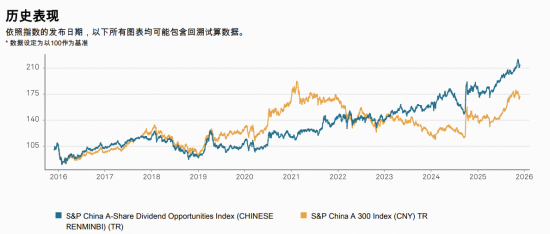
标普红利ETF(562060)标的指数11月月报出炉!今年以来总收益17.09%,市值中位数209亿元,最新股息率4.85%
Xin Lang Cai Jing· 2025-12-08 06:50
Core Viewpoint - The S&P China A-Share Dividend Opportunities Index has shown strong performance in recent periods, with notable annual returns and a solid dividend yield, indicating potential investment opportunities in the Chinese equity market [2][3][4]. Performance Summary - The index's total return for the past year is 17.09%, with a year-to-date return of 17.09% and a one-month return of 1.52% [2]. - The price return for the index is 11.64% year-to-date, with a one-month return of 1.34% [2]. - The benchmark index, S&P China A 300 Index, has a total return of 19.53% year-to-date, but a one-month return of -2.54% [2]. Annual Performance - The total return for the S&P China A-Share Dividend Opportunities Index in 2024 is 14.98%, compared to 14.21% in 2023 and -3.59% in 2022 [3]. - The price return for the index in 2024 is 8.18%, while the benchmark index has a total return of 15.81% in the same year [3]. Valuation and Dividend Yield - The historical price-to-earnings (P/E) ratio of the index is 11.57, with an expected P/E ratio of 10.67 [4]. - The dividend yield stands at 4.85%, indicating a favorable income potential for investors [4]. Index Composition Characteristics - The index comprises 100 constituent stocks, with an average market capitalization of CNY 128,766.74 million [5]. - The largest constituent stock has a market capitalization of CNY 2,566,723.46 million, while the smallest is CNY 3,997.07 million [5]. Top Ten Constituents - The top ten constituents include companies from various sectors, such as textiles, electrical equipment, and pharmaceuticals, with the largest being 002083.SZ (Jimu Co., Ltd.) in the textile sector [6][18]. - The top ten constituents account for 15.3% of the total index weight, with the largest single stock representing 2.4% [5][18]. Industry Distribution - The index is diversified across multiple industries, reflecting a broad exposure to the Chinese economy [19].
12月5日基础化工、电子、医药生物等行业融资净卖出额居前
Zheng Quan Shi Bao Wang· 2025-12-08 02:44
Summary of Key Points Core Viewpoint - As of December 5, the latest financing balance in the market is 24,641.11 billion yuan, showing a decrease of 23.78 billion yuan compared to the previous trading day. Industry Analysis - **Increase in Financing Balance**: - Eleven industries saw an increase in financing balance, with the computer industry leading with an increase of 9.99 billion yuan. Other notable increases were in the defense industry (5.19 billion yuan), machinery equipment (4.38 billion yuan), and banking (3.25 billion yuan) [1]. - **Decrease in Financing Balance**: - Twenty industries experienced a decrease, with significant reductions in basic chemicals (9.11 billion yuan), electronics (6.81 billion yuan), and pharmaceutical biology (5.11 billion yuan) [1][2]. - **Highest Growth Rate**: - The construction materials industry had the highest growth rate in financing balance at 1.80%, followed by agriculture, forestry, animal husbandry, and fishery (0.95%), and defense industry (0.63%) [1]. - **Largest Declines**: - The coal industry saw a decline of 1.21%, followed by household appliances (1.14%) and basic chemicals (0.91%) [1][2]. Detailed Financing Balance Changes - **Top Industries by Financing Balance**: - Computer: 1,785.70 billion yuan, +9.99 billion yuan, +0.56% - Defense Industry: 828.78 billion yuan, +5.19 billion yuan, +0.63% - Machinery Equipment: 1,302.23 billion yuan, +4.38 billion yuan, +0.34% - Banking: 758.49 billion yuan, +3.25 billion yuan, +0.43% [1]. - **Industries with Notable Decreases**: - Basic Chemicals: 988.44 billion yuan, -9.11 billion yuan, -0.91% - Electronics: 3,600.48 billion yuan, -6.81 billion yuan, -0.19% - Pharmaceutical Biology: 1,640.85 billion yuan, -5.11 billion yuan, -0.31% [2].
376只个股流通市值不足20亿元
Zheng Quan Shi Bao Wang· 2025-12-08 01:48
Group 1 - Small-cap stocks exhibit higher volatility and activity compared to large-cap stocks, making them more likely to become market leaders [1] - As of December 5, there are 932 stocks with a circulating market value below 3 billion yuan, and 376 of these have a circulating market value below 2 billion yuan [1] - A total of 1,653 stocks have a total market value below 5 billion yuan, with 530 stocks having a total market value below 3 billion yuan [1] Group 2 - The three stocks with the smallest circulating market values are Kuntai Co. at 663 million yuan, Kangliyuan at 689 million yuan, and Yangzhou Jinqian at 692 million yuan [1] - The three stocks with the smallest total market values are *ST Changyao at 729 million yuan, *ST Suwu at 881 million yuan, and *ST Aowei at 905 million yuan [1] - A detailed list of stocks with circulating market values below 2 billion yuan includes various sectors such as automotive, light manufacturing, and textiles [1][2]


市场进一步缩量,消费板块调整
Hua Tai Qi Huo· 2025-12-05 06:51
Report Summary 1. Report Industry Investment Rating No information provided. 2. Core Viewpoints - Overseas: Before the release of PCE data, market optimism has subsided, and the three major U.S. stock indexes showed mixed results [2]. - Domestic: The market remains in a state of shrinking volume and is in a volatile market with relatively low overall risks [2]. 3. Summary by Relevant Catalogs Market Analysis - Macro: China's Ministry of Commerce announced that the Chinese government is conducting export controls on rare - earth - related items in accordance with laws and regulations. Applications for civilian and compliant exports are approved in a timely manner. President Xi Jinping held talks with French President Macron, emphasizing mutual understanding and support on core interests and major concerns [1]. - Overseas: The number of initial jobless claims in the U.S. last week unexpectedly decreased by 27,000 to 191,000, the lowest level since September 2022. The three major U.S. stock indexes closed with mixed results, with the Nasdaq rising 0.22% to 23,505.14 points [1]. - Stock Indexes: The three major A - share indexes showed divergent trends. The Shanghai Composite Index fell 0.51% to 3878 points, and the ChiNext Index fell 1.12%. Most sector indexes declined. The machinery, electronics, and national defense and military industries led the gains, while the beauty care, social services, commercial retail, and textile and apparel industries led the declines. The trading volume of the Shanghai and Shenzhen stock markets was less than 1.6 trillion yuan [1]. - Futures Market: In the futures market, the basis of IC and IM continued to repair, and the trading volume and open interest of the four major stock index futures decreased simultaneously [1]. Strategy The overseas market's optimism has subsided before the PCE data release. The domestic market maintains a shrinking volume and is in a volatile state with low risks [2]. Macro Economic Charts - The report includes charts showing the relationship between the U.S. dollar index and A - share trends, the U.S. Treasury yield and A - share trends, the RMB exchange rate and A - share trends, and the U.S. Treasury yield and A - share style trends [6][7]. Spot Market Tracking Charts - Table 1 shows the daily performance of major domestic stock indexes on December 4 and 3, 2025, including the Shanghai Composite Index, Shenzhen Component Index, ChiNext Index, etc. For example, the Shanghai Composite Index decreased by 0.06% from 3878.00 to 3875.79 [12]. - Charts include the trading volume of the Shanghai and Shenzhen stock markets and the margin trading balance [13]. Stock Index Futures Tracking Charts - Table 2 shows the trading volume and open interest of stock index futures (IF, IH, IC, IM). For example, the trading volume of IF decreased by 5184 to 92574, and the open interest decreased by 3942 to 261904 [16]. - Table 3 shows the basis (futures - spot) of stock index futures for different contracts (current month, next month, current quarter, next quarter). For example, the current - month contract basis of IF is - 15.97 with a change of - 3.12 [40]. - Table 4 shows the inter - delivery spread of stock index futures, including spreads such as next month - current month, next quarter - current month, etc. For example, the next - month - current - month spread of IF is - 18.40 with a change of - 2.40 [46][47]. - Charts include the open interest of different contracts, the latest open - interest ratio, foreign - funded net open - interest quantity, basis, and inter - delivery spread of different stock index futures [17][20][28][30][31][38][41][43][51].
383只个股流通市值不足20亿元
Xin Lang Cai Jing· 2025-12-05 03:45
Core Insights - Small-cap stocks exhibit higher volatility and activity compared to large-cap stocks, making them more likely to become market leaders [1][2] - As of December 4, there are 947 stocks with a circulating market value below 3 billion yuan, and 383 of these have a circulating market value below 2 billion yuan [1][2] - In terms of total market value, there are 1,677 stocks with a total market value below 5 billion yuan, with 550 stocks having a total market value below 3 billion yuan [1][2] Market Data - The three stocks with the smallest circulating market values are: - Kuntai Co., Ltd. at 644 million yuan - Kangliyuan at 676 million yuan - Yangzhou Jinqian at 691 million yuan [1][2] - The three stocks with the smallest total market values are: - *ST Changyao (rights protection) at 785 million yuan - *ST Suwu (rights protection) at 881 million yuan - *ST Aowei (rights protection) at 954 million yuan [1][2] Stock Listings Under 2 Billion Yuan - A selection of stocks with circulating market values below 2 billion yuan includes: - Kuntai Co., Ltd. (6.44 billion yuan, PE ratio 46.83, Automotive) - Kangliyuan (6.76 billion yuan, PE ratio 34.99, Light Industry Manufacturing) - Yangzhou Jinqian (6.91 billion yuan, PE ratio 24.13, Textile and Apparel) [1][2] - Other notable stocks include: - *ST Changyao (7.85 billion yuan, PE ratio not available, Pharmaceutical) - *ST Suwu (8.81 billion yuan, PE ratio not available, Pharmaceutical) [1][2]

16个行业获融资净买入,汽车行业净买入金额最多
Zheng Quan Shi Bao Wang· 2025-12-03 02:21
Summary of Key Points Core Viewpoint - As of December 2, the market's latest financing balance reached 24,689.03 billion yuan, showing a day-on-day increase of 21.94 billion yuan, with 16 industries experiencing an increase in financing balance, particularly the automotive sector which saw the largest increase of 9.53 billion yuan [1]. Industry Analysis - **Industries with Increased Financing Balance**: - Automotive: 1,191.25 billion yuan, increased by 9.53 billion yuan, growth of 0.81% [1] - Communication: 1,135.14 billion yuan, increased by 6.03 billion yuan, growth of 0.53% [1] - National Defense and Military Industry: 818.49 billion yuan, increased by 5.98 billion yuan, growth of 0.74% [1] - Computer: 1,789.87 billion yuan, increased by 3.90 billion yuan, growth of 0.22% [1] - Environmental Protection: 192.18 billion yuan, increased by 1.79 billion yuan, growth of 0.94% [1] - **Industries with Decreased Financing Balance**: - Non-banking Financial: 1,859.55 billion yuan, decreased by 3.55 billion yuan, decline of 0.19% [2] - Public Utilities: 516.79 billion yuan, decreased by 3.55 billion yuan, decline of 0.68% [2] - Retail: 271.60 billion yuan, decreased by 2.15 billion yuan, decline of 0.79% [2] - Textile and Apparel: 80.87 billion yuan, decreased by 0.64 billion yuan, decline of 0.79% [2] - **Highest Growth Rates**: - Environmental Protection industry had the highest growth rate at 0.94% [1] - Other notable growth rates include Automotive (0.81%), Coal (0.77%), and National Defense and Military Industry (0.74%) [1] - **Significant Declines**: - The Textile and Apparel, Retail, and Public Utilities sectors experienced the most significant declines in financing balance, with respective decreases of 0.79%, 0.79%, and 0.68% [1][2]
深化芯片布局,打开业绩高成长空间
Yin He Zheng Quan· 2025-12-02 13:31
Investment Rating - The report maintains a "Buy" rating for the industry, indicating a positive outlook for investment opportunities [3]. Core Insights - The industry is expected to experience significant growth driven by deepening chip layouts, which will open up high growth potential for performance [1]. - The projected revenue for 2024 is 1,592 million, with a decline to 1,327 million in 2025, followed by a recovery to 1,738 million in 2026 and reaching 2,380 million by 2027, reflecting a compound annual growth rate (CAGR) of approximately 36.94% from 2025 to 2027 [2][7]. - The report highlights a strong commitment to performance, with expected EPS growth from 0.07 in 2025 to 0.35 in 2027, indicating a robust recovery and profitability trajectory [6][7]. Financial Projections - Revenue projections show a decline of 16.61% in 2025, followed by a rebound of 30.93% in 2026 and 36.94% in 2027 [2][7]. - EBITDA is expected to grow from 100 million in 2025 to 325 million in 2027, showcasing improved operational efficiency [7]. - The report anticipates a significant increase in net profit margin from 3.9% in 2025 to 12.3% in 2027, reflecting enhanced profitability [7]. Market Performance - The industry is projected to outperform the Shanghai and Shenzhen 300 index, with a relative performance graph indicating a positive trend [4][5]. - The report emphasizes the importance of strategic acquisitions and collaborations within the industry to enhance competitive positioning and market share [6]. Analyst Commentary - Analysts express confidence in the industry's growth potential, citing strong R&D capabilities and synergies with core business operations as key drivers for future success [6][9].
