科技

Search documents
矿业大佬收购ST亚振市值暴涨10倍,一批上市家居企业可能正在被跨界“借壳”
Guan Cha Zhe Wang· 2025-11-14 10:31
Core Viewpoint - The article discusses the dramatic rise in stock price of ST Yanzhen, a furniture company, which increased approximately tenfold within seven months despite ongoing financial losses and a warning of potential delisting [1][5][6]. Company Overview - ST Yanzhen, primarily engaged in mid-to-high-end furniture products, has faced significant challenges since 2020, including store closures and continuous performance declines, leading to multiple warnings of potential delisting [1][3]. - The company was officially marked as "ST Yanzhen" in April 2023 after reporting negative net profit for 2024 [1][3]. Stock Performance - From April 8, 2025, to November 11, 2025, ST Yanzhen's stock price surged by 1024.04%, with the stock experiencing 15 instances of abnormal trading fluctuations [1][5]. - The stock price rose from a low of 4.45 yuan per share to a peak of 50.02 yuan per share, resulting in a market capitalization exceeding 125 billion yuan [5][6]. Shareholder Changes - The controlling shareholder, Shanghai Yanzhen Investment Co., announced a significant change in control, planning to transfer approximately 30% of the company's shares for 448 million yuan [3][4]. - Following the acquisition by Wu Tao and his associates, who gained a 50.47% stake, the stock price began to rise significantly [3][4]. Strategic Shift - ST Yanzhen is undergoing a strategic transformation, including a planned acquisition of a 51% stake in Guangxi Zirconium Industry for 55.449 million yuan, marking its entry into the mineral sector [4][5]. - The company aims to optimize its equity structure and enhance its operational capabilities through this transformation [4][6]. Industry Trends - Other furniture companies facing financial difficulties, such as Dongyi Risheng, have also seen stock price increases following similar cross-industry investments, raising questions about the motivations behind these acquisitions [2][7]. - The trend of furniture companies being acquired by firms from unrelated industries suggests a potential strategy for these companies to leverage new capital and resources to stabilize and grow [2][9]. Market Implications - The rapid stock price increases of these companies have led to skepticism in the market regarding the sustainability of such valuations, especially given their ongoing financial struggles [5][7]. - Analysts suggest that these acquisitions may serve as a means for the acquiring companies to enter the A-share market through "backdoor listings," capitalizing on the low valuations of struggling firms [9][10].

2025深圳国际金融大会将于11月19日开幕
Zhong Guo Fa Zhan Wang· 2025-11-14 08:17
Core Insights - The 2025 Shenzhen International Financial Conference will be held from November 19 to 21, focusing on "Building a Financial Power and High-Level Opening of the Greater Bay Area" [1] Group 1: Conference Highlights - Highlight 1: The agenda is designed around the goal of "Financial Power" and the financial openness of the Guangdong-Hong Kong-Macao Greater Bay Area, featuring a "1+4+8" agenda system [3] - Highlight 2: The conference will gather a diverse and highly professional group of guests from various financial institutions and international organizations, providing a multi-dimensional international perspective [5] - Highlight 3: The conference emphasizes the synergy between finance and the real economy, inviting representatives from technology and manufacturing sectors to promote precise matching of industry needs and financial services [6] - Highlight 4: High-quality research reports will be released by authoritative institutions, analyzing key issues such as financial power construction and global financial governance, contributing to Shenzhen's financial innovation and sustainable development [6]


传奇落幕,巴菲特“最后一课”:那些穿越周期的智慧永不过时
Huan Qiu Wang· 2025-11-14 07:46
Core Insights - Warren Buffett's decision to "quietly exit" marks the end of an era in the investment world, having transformed Berkshire Hathaway from a struggling textile company into a multi-billion dollar investment empire over 60 years [1] - His investment philosophy emphasizes value, patience, and respect, rather than short-term speculation [1] Investment Philosophy - The concept of "circle of competence" is central to Buffett's investment strategy, focusing only on areas he understands, avoiding blind diversification [2] - Buffett's significant investments, such as the $13 billion purchase of Coca-Cola stock in 1988, were based on the company's strong brand and consumer loyalty rather than just financial metrics [2] - His investment in Apple was driven by observing consumer behavior rather than technical details, highlighting the importance of user engagement [2] Risk Management - Buffett's principle of "circle of competence" reflects a clear understanding of "unknown risks," emphasizing that many investment losses stem from overestimating one's judgment in unfamiliar areas [3] - His approach to investing during market crises, such as the 2008 financial crisis, showcases his ability to act decisively while maintaining a strong cash reserve, which amounted to $189 billion as of Q1 2024 [4] Long-Term Investment Strategy - The power of compounding is evident in Buffett's wealth accumulation, with 90% of his fortune made after age 60, demonstrating the effectiveness of long-term holding [5] - Buffett's investment returns have significantly outperformed the S&P 500, with a nearly 20% annualized return since 1965, turning an initial $1,000 investment into $44.7 million [5] - His philosophy of holding stocks for the long term is exemplified by his investments in American Express and Coca-Cola, which he has held for over 30 years [5] Personal Philosophy and Legacy - Buffett's personal life reflects simplicity and discipline, living in the same house since 1958 and maintaining a modest lifestyle despite immense wealth [8] - His commitment to philanthropy is evident in his plan to donate 99.5% of his wealth, leaving only enough for his children to lead fulfilling lives [8] - The wisdom he imparts emphasizes rationality, patience, and responsibility in both investing and life, encouraging individuals to adopt a straightforward investment approach [8]



拉银行稳大盘,大A已经明牌了
Sou Hu Cai Jing· 2025-11-14 06:14
Core Viewpoint - The current bull market in the A-share market is expected to continue, with the index unlikely to decline significantly. The market is being supported primarily by the banking and insurance sectors, despite fluctuations in the technology sector [1][3]. Banking Sector - Agricultural Bank of China (ABC) has seen its stock price rise, with a total market value reaching 3 trillion yuan. The bank's dividend last year was 2.419 yuan per ten shares, resulting in a current dividend yield of 2.8%, which is not significantly advantageous compared to the 1.61% interest on five-year large-denomination time deposits [1][3]. - The banking sector is expected to support the market index, especially as the technology sector experiences adjustments. The relationship between technology and banking has created a seesaw effect, where the performance of one influences the other [3][4]. Technology Sector - The technology sector has been experiencing a correction after a period of rapid growth, with some companies' price-to-earnings ratios exceeding 100. This adjustment is anticipated to continue, as the sector has seen significant gains [3][4]. - The recent fluctuations in the technology sector have led to a search for undervalued stocks, with traditional sectors like liquor suddenly gaining attention, although this is seen as a short-term market reaction rather than a long-term investment trend [3][4]. Market Outlook - The index is expected to hover around 4000 points for the next two to three months, with a potential long-term target of 5000 points. However, the current market dynamics suggest that only large-cap stocks and key sectors are driving the index, while individual stock performance may not improve compared to previous levels [4][6]. - Investors are advised to hold onto their positions, as selling may lead to unfavorable outcomes, but it is crucial to ensure that the investment direction is correct to avoid significant losses [6].

关税扰动下全球经济显韧性 中国科技与债市成配置焦点
2 1 Shi Ji Jing Ji Bao Dao· 2025-11-14 05:11
Core Viewpoint - The global economy demonstrates resilience despite tariff disruptions, with China's market benefiting from net exports and a shift in household savings, presenting investment opportunities [1][3]. Economic Outlook - The global GDP growth rate for 2025 is expected to exceed earlier predictions due to demand-driven factors like inventory replenishment and export competition, although a slowdown is anticipated in 2026 [1][3]. - Fiscal policies and labor market resilience are crucial for sustaining economic stability, with major economies increasing counter-cyclical measures [3][4]. Trade Dynamics - Recent U.S.-China trade developments, including the cancellation of certain tariffs, provide temporary relief, while the global supply chain is undergoing a restructuring towards high-value industries returning to the U.S. and low-value production moving to emerging markets [4][6]. Investment Trends - There is a notable trend of Chinese household savings shifting towards equity-like assets, with a reported increase of 73.7 trillion yuan in deposits from December 2019 to September 2025, reflecting a 55% growth [6][7]. - The Chinese technology sector, particularly in AI, chips, and automation, is highlighted as globally scarce and a key investment focus, emphasizing the importance of long-term commercial viability over short-term valuation [6][7]. Fixed Income Market - The global investment-grade bond market is experiencing significant inflows, with a historical net inflow recorded in August 2025, driven by institutional investors seeking yield [4][6]. - The current yield on global investment-grade bonds has risen to 4%-5%, providing stable returns and risk diversification during stock market volatility [6][7]. Asset Allocation Strategy - A diversified investment strategy across regions, asset classes, and industries is recommended to capitalize on technological advancements and capital rotation while mitigating risks associated with single markets [7]. - The ongoing opening of channels like Shanghai-Hong Kong Stock Connect is expected to accelerate foreign investment in Chinese assets, leveraging China's cost advantages and potential for widespread application [7].

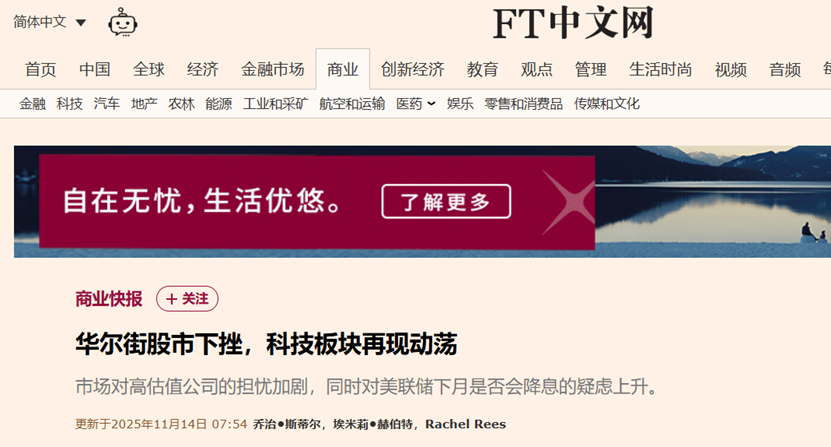
美股三大股指齐跌,科技股再度成为抛售核心
Huan Qiu Wang· 2025-11-14 01:06
周四的股市下跌,是美股三大股指自10月10日以来的最差表现。特别是科技股再度成为抛售核心,引发市场整体承 压。 【环球网财经综合报道】北京时间11月14日凌晨,美国三大股指全线收跌,道指跌1.65%报47457.22点,纳指跌2.29% 报22870.36点。万得美国科技七巨头指数跌2.28%,特斯拉跌超6%,英伟达跌逾3%。有分析人士称,市场正进行大规 模板块轮动,且投资者对利率前景的悲观情绪仍在加剧。 随着AI相关公司在过去一年持续上涨,部分投资者开始担心估值过高,在利率定价剧烈波动的环境中,高估值标的尤 其脆弱。 《金融时报》发文称,自4月初以来,纳斯达克综合指数涨幅超过50%,投资者曾乐观期待人工智能引领科技行业的繁 荣,然而近期这些乐观情绪受挫。 Laird Norton Wealth Management的首席投资官Ron Albahary认为,大规模AI资本开支最终会转化为真实经济表现,若 医疗、制造业、工业等领域开始明显受益于AI的生产力提升,将有助于巩固长期的投资逻辑,但短期估值的波动难以 避免。 ...


降息大消息:白宫施压,美联储官员表态,预期有变!金银再成市场关注焦点
Qi Huo Ri Bao· 2025-11-14 00:05
Market Overview - Gold prices experienced fluctuations, with spot gold closing at $4172.84 per ounce, down 0.54%, after reaching a high of $4245.23 earlier in the day [1] - The U.S. stock market saw declines across major indices, with the Dow Jones down 1.65% and the Nasdaq down 2.29%, reflecting a negative sentiment in the market [1] Economic Impact of Government Shutdown - The International Monetary Fund (IMF) indicated that the U.S. government shutdown would negatively impact the economy, predicting a lower GDP growth rate for Q4 than the previously forecasted 1.9% [1] - The White House's economic advisor projected a 1.5 percentage point decrease in GDP growth due to the shutdown, highlighting the potential for interest rate cuts [1][2] Federal Reserve's Interest Rate Outlook - Market expectations for a 25 basis point rate cut by the Federal Reserve in December are mixed, with probabilities slightly below 50% according to various derivatives [2] - A significant majority of economists (80%) anticipate a rate cut in December, reflecting a growing consensus on the need for monetary easing [2] Federal Reserve Officials' Statements - Federal Reserve officials have expressed caution regarding interest rate decisions, with some indicating the need for continued tightening to combat inflation [3][4] - The potential lack of key economic data due to the government shutdown could hinder the Fed's decision-making process [5][7] Precious Metals Market Dynamics - Recent trends show a resurgence in gold and silver prices, driven by expectations of a shift in the Federal Reserve's monetary policy [8] - The end of the government shutdown is seen as a catalyst for the release of delayed economic data, which may support the case for a rate cut [9] Silver Market Fundamentals - Silver prices are supported by a tight supply-demand dynamic, with decreasing inventories reported on major exchanges [10] - The industrial demand for silver, particularly in renewable energy sectors, is expected to drive long-term price increases [14] Central Bank Gold Purchases - Central banks have accelerated gold purchases, with net buying totaling 220 tons in Q3, reflecting a strategic diversification of reserves [12][13] - This trend indicates a shift towards gold as a stable asset amid fluctuating economic conditions, reinforcing its role as a long-term value reserve [14] Geopolitical and Economic Considerations - Ongoing geopolitical tensions and inflationary pressures are increasing demand for safe-haven assets like gold and silver [15] - The resolution of the government shutdown is expected to restore the release of critical economic data, influencing future monetary policy decisions [15]
美股大跌,道指狂泻近800点!中概股承压
第一财经· 2025-11-13 23:43
Market Overview - The US stock market experienced a significant decline, with the three major indices recording their largest single-day drop in over a month, primarily led by a downturn in AI stocks [3] - The Dow Jones Industrial Average fell by 797.6 points, closing at 47,457.22 points, a drop of 1.65%; the S&P 500 decreased by 1.66% to 6,737.49 points; and the Nasdaq Composite plummeted by 2.29% to 22,870.36 points [3] Sector Performance - All seven major tech giants faced pressure, with Microsoft down 1.54%, Amazon down 2.71%, Apple down 0.19%, Tesla down 6.64%, Nvidia down 3.58%, and Google A down 2.84%, while Meta saw a slight increase of 0.14% [3] - Among the 11 sectors in the S&P 500, 9 sectors declined, with the consumer discretionary sector leading the drop at 2.73%, followed by the information technology sector, which fell by 2.37% [3] Chinese Stocks - Chinese stocks also faced challenges, with the Nasdaq Golden Dragon China Index dropping by 1.59%. Baidu fell over 6%, Bilibili dropped nearly 5%, and both Xpeng Motors and NIO fell by over 3% [3] Company-Specific Developments - Cisco saw an increase of 4.6% after raising its full-year revenue and profit forecasts, benefiting from sustained demand for networking equipment [5] - Disney experienced a sharp decline of 7.8% due to warnings about a prolonged distribution dispute with YouTube TV, raising concerns about further pressures on its traditional television business [5] Commodity Prices - International oil prices rose on November 13, with WTI crude oil futures closing at $58.69 per barrel, up by $0.20 (0.34%), and Brent crude oil futures closing at $63.01 per barrel, up by $0.30 (0.48%) [5] - COMEX gold futures fell by $19.10 (0.45%), settling at $4,194.5 per ounce [5]




道指暴泻近800点!美联储降息预期跌至五成,美股大幅收低
Di Yi Cai Jing· 2025-11-13 23:25
Market Overview - The U.S. stock market experienced a significant decline, with the three major indices recording their largest single-day drop in over a month, driven by rising inflation concerns and cautious signals from multiple Federal Reserve officials regarding further easing [2] - The Dow Jones Industrial Average fell by 797.6 points, closing at 47,457.22 points, a decrease of 1.65%; the S&P 500 dropped by 1.66% to 6,737.49 points; and the Nasdaq Composite plummeted by 2.29% to 22,870.36 points [2] Technology Sector - Major technology stocks faced substantial pressure, with all seven tech giants declining. Microsoft fell by 1.54%, Amazon by 2.71%, Apple by 0.19%, Tesla by 6.64%, Nvidia by 3.58%, and Google A by 2.84%, while only Meta saw a slight increase of 0.14% [2] - The S&P 500's information technology sector declined by 2.37%, reflecting a shift of funds from overvalued tech stocks to defensive sectors [2] Chinese Stocks - Chinese stocks also faced challenges, with the Nasdaq Golden Dragon China Index dropping by 1.59%. Baidu fell over 6%, Bilibili nearly 5%, and both Xpeng Motors and NIO declined by over 3% [2] Economic Indicators - Following a record 43-day government shutdown, the overall economic sentiment remains weak, with significant data disruptions still affecting the market. The uncertainty surrounding Federal Reserve policy persists, as multiple decision-makers express caution regarding persistent inflation and a resilient labor market [3] - Market expectations for a 25 basis point rate cut in December have decreased to approximately 47%, down from 70% the previous week [3] Company-Specific Developments - Cisco saw a rise of 4.6% after raising its full-year revenue and profit forecasts, benefiting from sustained demand for networking equipment [3] - Disney experienced a sharp decline of 7.8% due to warnings about a prolonged distribution dispute with YouTube TV, raising concerns about further pressures on its traditional television business [3] Commodity Prices - As of November 13, international oil prices increased, with WTI crude oil futures rising by $0.20 to $58.69 per barrel, a gain of 0.34%, and Brent crude oil futures up by $0.30 to $63.01 per barrel, a rise of 0.48% [4] - COMEX gold futures fell by $19.10, or 0.45%, closing at $4,194.50 per ounce [4]
财经观察:“K型”分化严重,如何影响美国人生活
Huan Qiu Shi Bao· 2025-11-13 22:45
Group 1 - The term "K-shaped economy" describes the significant disparity in economic recovery among different social classes in the U.S., where some experience rapid recovery while others face stagnation or decline [2][7]. - In Seattle, the median household income has risen from $180,000 in 2019 to approximately $230,000 by 2025, while the median home price has surged to $1.6 million, highlighting the growing wealth gap [2][3]. - The consumption patterns of Coca-Cola reflect this economic divide, with sales growth driven by high-end products, while low-income consumers are increasingly shopping at discount stores [5][8]. Group 2 - Fast food chains like McDonald's are witnessing a decline in low-income customer visits, prompting them to introduce more special offers to attract this demographic [5][6]. - The automotive market shows a similar trend, with new car sales averaging over $50,000, while loan defaults and repossessions are rising among lower-income consumers [6][7]. - Airlines and hotel chains report a growing demand for premium services, with Delta Airlines noting that first-class and business-class revenues are expected to surpass economy class [6][7]. Group 3 - The economic policies post-pandemic, including unconventional monetary policies, have exacerbated wealth inequality, benefiting the affluent while low-income families face rising costs [7][10]. - The spending habits of the top 10% of income earners account for 49.7% of total consumer spending, the highest since 1989, indicating a growing reliance on this demographic for economic growth [9][10]. - The current economic climate has led to a pessimistic outlook among the general population regarding employment and the labor market, with concerns about long-term structural inequality [10].