
医药

Search documents
上证早知道|新加坡国家AI押宝阿里千问 ;支持3D人脸识别 华为上新;首批7只 本周五发行
Shang Hai Zheng Quan Bao· 2025-11-25 23:39
今日提示 ·11月25日,九成以上ETF上涨,其中银华中证5GETF、国泰中证游戏ETF、华夏中证游戏ETF、华泰柏 瑞游戏ETF等均涨逾4%;华夏5G通信ETF、易方达国证成长100ETF等涨逾3%。展望后市,万家基金表 示,中期维度看,跨年行情逻辑未变,科技与新产业依然是政策与资金共同瞄准的主线,具备中长期配 置价值。随着经济与政策周期逐步进入共振阶段,顺周期板块同样有望获得结构性机会。 上证聚焦 ·中国电影和华夏电影发行有限责任公司联合发行的《疯狂动物城2》定档11月26日上映。 ·2025科创大会将于11月26日至27日在上海召开。 ·2025年世界铜业会议(亚洲)将于11月26日至27日举办。 ·2025年智能网联汽车国际发展峰会将于11月26日在上海召开。 上证精选 ·税务部门与公安、商务、市场监管等部门紧密协作,持续加大对加油站涉税违法行为的查处力度,协 同规范行业秩序,促进市场公平竞争。2025年1月至10月,全国税务部门累计查处高风险加油站3904 户,查补税费款和加收滞纳金、罚款共计36.44亿元。 ·10月份,我国民航国际航线旅客运输量、货邮运输量同比增速均超过20%,货邮运输量月度历史 ...


A股年内累计回购超1300亿元 超百家实施公司股价翻倍
Zheng Quan Shi Bao· 2025-11-25 21:05
回购显著提振了上市公司的股价表现,股票回购指数年内大涨超27%,创出历史新高,表现远强于同期 上证指数。年内实施回购且股价翻倍的公司超过百家,胜宏科技以超530%的年内涨幅居于首位,腾景 科技、海科新源、瑞晟智能等均涨超3倍,浙江荣泰、振德医疗、德明利等均涨超两倍。 五大行业回购额均超百亿元 据证券时报·数据宝统计,以最新公告时间统计,2025年以来A股市场共有1400多家实施了回购,已回购 金额合计达到1342.25亿元。这是A股历史上第4次年度回购金额超过千亿元,2021年、2022年和2024年 回购金额分别为1206.89亿元、1019.08亿元和1658.77亿元。也就是说,今年A股回购金额将达到历史第 二高水平。 从回购公司数量来看,医药行业实施回购的公司数量居首,今年以来有156家公司实施了回购;电子、 机械设备、基础化工、电力设备等行业紧随其后,实施回购的上市公司数量分别为155家、146家、123 家和118家。 从回购金额来看,医药生物行业已回购金额居首,达到143.49亿元,电力设备、电子、家电、机械设备 等行业回购金额均超百亿元。 近年来,在政策鼓励和推动下,A股掀起了一波又一波回购潮 ...



“亚宝”“奇强”入选首批山西消费名品名单
Sou Hu Cai Jing· 2025-11-25 16:46
Core Points - The Shanxi Provincial Department of Industry and Information Technology officially announced the first batch of Shanxi Consumer Brands, which includes both regional and enterprise brands [1][4] - A total of 17 brands were selected across four core consumer sectors: food, pharmaceuticals, light industry, and textiles [4] - The selection process adhered to the "2025 Shanxi Consumer Brand Formation Implementation Plan," involving multiple stages such as self-declaration by companies, recommendations from counties, and initial reviews at the city level [4] Company Highlights - Yabao Pharmaceutical Group Co., Ltd. with its brand "Yabao" was selected [4] - Shanxi Coking Coal Yuncheng Salt Chemical Group Co., Ltd. with its brand "Qiqiang" was also included in the list [4] - The selection process ensured that the chosen brands possess both quality strength and market recognition through consultations with various departments, including the Provincial Department of Ecological Environment and the Provincial Department of Commerce [4]



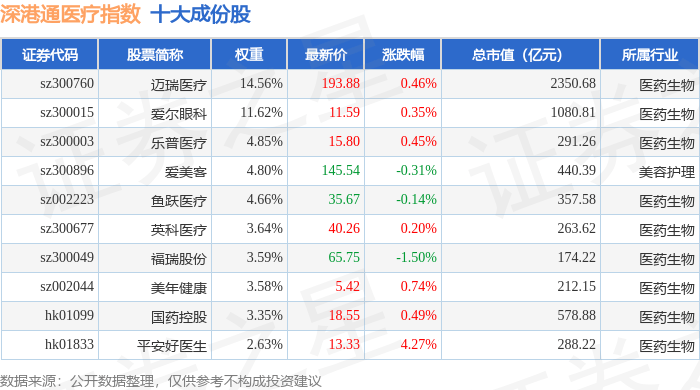
11月25日深港通医疗(983035)指数涨0.45%,成份股平安好医生(01833)领涨
Sou Hu Cai Jing· 2025-11-25 11:07
Core Viewpoint - The Shenzhen-Hong Kong Medical Index (983035) closed at 4488.12 points on November 25, with a 0.45% increase and a trading volume of 7.719 billion yuan, indicating a stable performance in the healthcare sector [1]. Group 1: Index Performance - On the same day, 40 out of the index's constituent stocks rose, with Ping An Good Doctor leading the gains at 4.27%, while 16 stocks declined, with Ruimaite leading the losses at 1.98% [1]. - The top ten constituent stocks of the Shenzhen-Hong Kong Medical Index include: - Mindray Medical (14.56% weight, market cap 235.068 billion yuan) [1] - Yier Eye Hospital (11.62% weight, market cap 108.081 billion yuan) [1] - Lejin Medical (4.85% weight, market cap 29.126 billion yuan) [1] - Aimeike (4.80% weight, market cap 44.039 billion yuan) [1] - Yuyue Medical (4.66% weight, market cap 35.758 billion yuan) [1] - Yingke Medical (3.64% weight, market cap 26.362 billion yuan) [1] - Furuishi (3.59% weight, market cap 17.422 billion yuan) [1] - Meinian Health (3.58% weight, market cap 21.215 billion yuan) [1] - China National Pharmaceutical (3.35% weight, market cap 57.888 billion yuan) [1] - Ping An Good Doctor (2.63% weight, market cap 28.822 billion yuan) [1]. Group 2: Capital Flow - The net outflow of main funds from the constituent stocks totaled 251 million yuan, while retail investors saw a net inflow of 199 million yuan [3]. - The detailed capital flow for selected stocks includes: - Aimeike: Main net inflow of 23.5405 million yuan, retail net outflow of 35.0461 million yuan [3]. - New Mileage: Main net inflow of 14.1523 million yuan, retail net outflow of 6.6983 million yuan [3]. - Jianfan Biological: Main net inflow of 4.5525 million yuan, retail net outflow of 8.5385 million yuan [3]. - A total of one stock was newly added to the Shenzhen-Hong Kong Medical Index in the last ten days [4].




华安基金:创业板50指数追“光”识“新”更掘“金”
Xin Lang Ji Jin· 2025-11-25 09:56
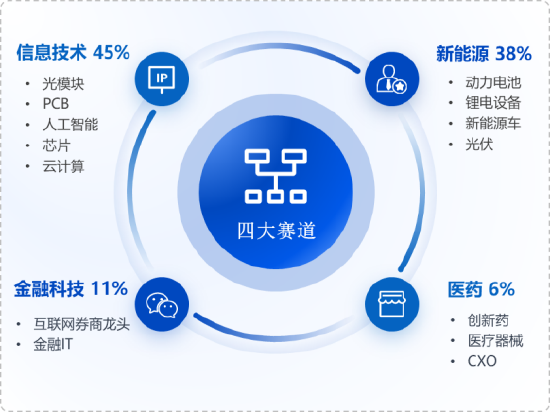
Market Overview - The A-share market experienced a downward trend last week, with major indices showing a general pullback: CSI 300 down 3.77%, CSI 500 down 5.78%, CSI 1000 down 5.80%, ChiNext 50 down 6.04%, and Sci-Tech 50 down 5.54% [1] - The average daily trading volume in the A-share market was around 1.87 trillion yuan, indicating active market participation [1] - Market hotspots showed rapid rotation, initially focusing on lithium batteries, AI applications, Fujian sector, and military industry, followed by semiconductors (photoresists), robotics, and aquaculture, with banks and photoresists gaining strength in the latter part of the week [1] ChiNext 50 Index Insights - The ChiNext 50 Index serves as a direct financing platform for growth-oriented innovative enterprises, focusing on four key sectors: information technology, new energy, financial technology, and pharmaceuticals [1] - The ChiNext 50 Index has a higher concentration of light modules, new energy, and financial technology compared to the ChiNext Index and mainstream broad-based indices [3] - The current valuation of the ChiNext 50 ETF is 37.44 times, placing it in the 32.83% percentile over the past decade [3] Sector Analysis Technology, AI, and Communication - The ChiNext 50 Index includes 45% of the information technology sector, with 19% weight in light modules, which experienced a slight pullback [3] - Google Cloud announced a plan to double computing power every six months, with the retail price of 1.6T light modules rising to $2,000 (up 67% from the listing price) [3] - Despite short-term funding divergence, the demand for 800G/1.6T iterations remains rigid, with LightCounting predicting a 48% growth in the global light module market by 2025 [3] New Energy and Power Equipment - The new energy photovoltaic sector saw a broad decline last week due to price wars and EU anti-dumping investigations, although cost pressures have eased [4] - The industry is experiencing multiple development opportunities, with domestic and international storage demand driving strong sales in lithium batteries and materials, leading to significant price increases for lithium hexafluorophosphate and lithium iron phosphate [4] - Policies in various countries emphasize integrating storage into grid planning, with the first green hydrogen coal chemical demonstration project in China now operational [4] Pharmaceuticals and Biotechnology - The pharmaceutical sector experienced a decline last week, with a focus on the rapid development of innovative drugs and medical devices [5] - The National Medical Products Administration approved several innovative drugs, including the world's first GCG/GLP-1 dual receptor agonist [5] - The first version of the "Commercial Insurance Innovative Drug Catalog" is set to be released, which will help broaden payment channels for innovative drug commercialization [5] ChiNext 50 ETF Performance - The ChiNext 50 ETF (code: 159949) tracks the ChiNext 50 Index and focuses on high-quality leading companies in five key technology sectors: new energy vehicles, biomedicine, electronics, photovoltaics, and internet finance [6] - The ETF has a substantial liquidity, with an average daily trading volume of 1.451 billion yuan over the past year, ranking among the top ETFs on the Shenzhen Stock Exchange [6] - As of November 21, 2025, the ETF's net value was 1.3811, with a total scale of 24.241 billion yuan and a trading volume of 7.909 billion yuan [7]

2026全球市场展望:锚定AI主线,布局三大市场机遇
Sou Hu Cai Jing· 2025-11-25 09:53
Group 1: Global Market Outlook for 2026 - The global GDP growth is projected to be only 2.4% in 2026, marking a near ten-year low, influenced by multiple cycles and policy factors [1] - The Federal Reserve's policy normalization is expected to maintain interest rates around 3%, leading to high-risk-free returns and impacting corporate profitability and stock valuations, particularly in financing-dependent sectors like technology and manufacturing [1] - China's economic recovery is crucial for global recovery, currently undergoing structural adjustments, with a focus on stabilizing employment and boosting consumer income through policies like tax cuts and interest rate reductions [2] Group 2: Challenges to Globalization - The global trade growth is anticipated to slow down to 0.8% in 2025, the lowest in nearly fourteen years, due to rising trade barriers and policy uncertainties, which may continue into 2026 [3] Group 3: Investment Opportunities in AI - The AI wave is seen as a long-term growth driver that transcends economic cycles, representing a significant opportunity for investment [4] - Different markets present varied investment strategies; A-shares, Hong Kong stocks, and Nasdaq require tailored approaches to capture opportunities effectively [5] Group 4: A-Share Market Insights - A-shares offer long-term investment value, with high-quality, stable earnings potential in sectors like high-end manufacturing and essential consumer goods, despite high valuations in the AI sector [6] - The potential for recovery in consumer sectors is supported by ongoing policy measures aimed at boosting consumption [6] Group 5: Hong Kong Market Insights - The Hong Kong market is characterized by lower valuations in AI-related companies compared to their A-share counterparts, making it an attractive investment area [7] - The AI industry is viewed as a growth engine for investment portfolios in the coming years [7] Group 6: Nasdaq Market Insights - Nasdaq is home to many leading AI companies, and historical trends suggest that the next AI leader will likely emerge from this market [8] - Investing in Nasdaq index products is recommended to capitalize on the potential growth from the AI revolution [8] Group 7: Gold as a Hedge - Gold has performed well in the past two years, but excessive reliance on its past performance for future gains is cautioned against, as all investments experience cycles [9] Group 8: Conclusion on Investment Strategy - The overarching theme for 2026 is to seek certainty amid uncertainty, with a focus on AI as a primary investment theme, complemented by strategic allocations in A-shares, Hong Kong stocks, and Nasdaq, along with a measured approach to gold for risk hedging [10]
市场订单持续增长 两面针投建生产基地项目
Zheng Quan Shi Bao Wang· 2025-11-25 08:59
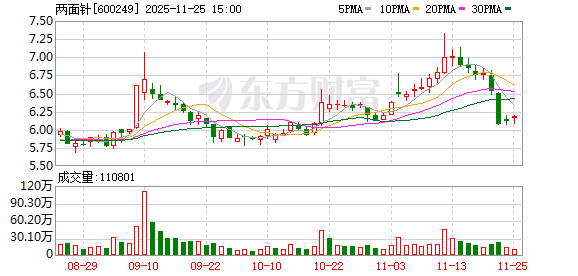
Core Viewpoint - The company is expanding its production capacity by investing in a new manufacturing base for functional oral care products in Jiangsu Province, aiming to enhance operational efficiency and product quality while integrating smart manufacturing technologies [2][4]. Group 1: Project Details - The total investment for the expansion project is estimated at 68.85 million yuan, with construction costs accounting for 45.39 million yuan and equipment and software purchases at 23.46 million yuan [3]. - The project will involve the construction of a six-story factory building with a total area of 22,749 square meters, including a toothpaste production workshop of 18,199 square meters and a hotel slipper production workshop of 4,550 square meters [2][3]. - The construction period is expected to last 14 months, with equipment purchases and capacity integration implemented in phases based on market conditions [3]. Group 2: Business Overview - The company operates in two main sectors: daily chemicals and pharmaceuticals, focusing on the "big consumption, big health" industry [3]. - The daily chemicals segment includes the development, production, and sales of oral care products, personal care items, and hotel supplies, with key brands such as Two-Mouth Needle and Mu Lan Ze [3]. - The pharmaceutical segment produces and sells various medications, including capsules and raw materials, managed by Yikang Pharmaceutical [3]. Group 3: Financial Performance - The Jiangsu company has shown stable operational performance, with projected revenues of 761 million yuan for 2024 and 437 million yuan for the first half of 2025, alongside net profits of 11.95 million yuan and 6.44 million yuan, respectively [3]. - The company has identified a growing need for capacity support and equipment efficiency improvements due to increasing market orders, which has impacted order fulfillment and limited sustainable growth [3][4]. Group 4: Strategic Implications - The project aims to overcome existing capacity bottlenecks by introducing advanced equipment and optimizing production processes, thereby enhancing automation and production efficiency [4]. - The establishment of a hotel slipper production line will reduce reliance on external suppliers and improve product offerings, thereby strengthening market share [4]. - The new facility is expected to provide better conditions for research and innovation, facilitating the iterative upgrade of herbal functional products to meet diverse market demands [4].

突然,崩了!利空,来袭!
Zhong Guo Ji Jin Bao· 2025-11-25 08:24
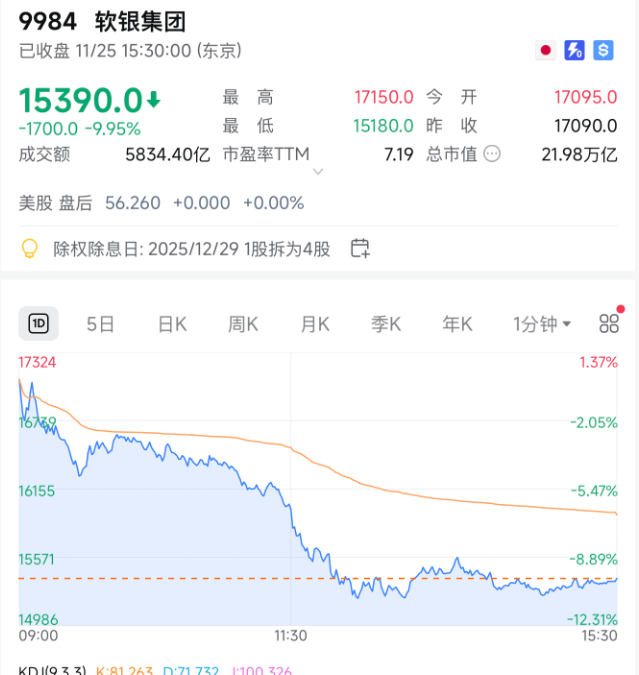
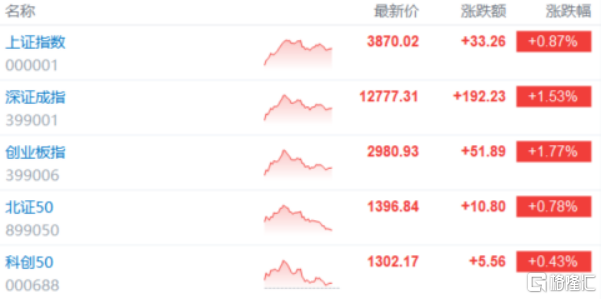
Group 1: Nvidia's Market Position - Nvidia's stock price declined by 2% following reports that Meta is in talks to invest billions in Google's AI chips, indicating a potential challenge to Nvidia's dominance in the AI accelerator market [3][4]. - Google's stock rose by 2.7% in after-hours trading, reflecting positive market sentiment regarding its Tensor Processing Units (TPUs) as a viable alternative to Nvidia's chips [4]. - The potential agreement with Meta, a major player in AI development, could significantly bolster the adoption of TPUs, which have been designed specifically for AI tasks [4]. Group 2: Impact on SoftBank - SoftBank Group's stock plummeted, reaching a two-and-a-half-month low, as concerns grew over increased competition for OpenAI from Google's newly launched Gemini AI model [5][6]. - The stock experienced a sharp decline of 11%, marking a notable downturn even for a typically volatile stock like SoftBank [6]. - SoftBank's market capitalization has fallen over 40% from its recent peak, where it briefly surpassed 40 trillion yen (approximately $255 billion) [9]. Group 3: Broader Market Trends - The A-share market saw a collective rebound, with major indices rising: Shanghai Composite Index up 0.87%, Shenzhen Component Index up 1.53%, and ChiNext Index up 1.77% [11]. - A total of 4,300 stocks rose, with 95 stocks hitting the daily limit up, indicating a strong market performance overall [12]. - Specific sectors, such as computing hardware and AI applications, showed significant gains, with stocks like Dekoli and Guangku Technology reaching their daily limit up [14][16].

A股收评:三大指数齐涨!创业板指劲升1.77%,CPO概念爆发
Ge Long Hui· 2025-11-25 07:38
Market Overview - The A-share market saw all three major indices rise, with the Shanghai Composite Index up 0.87% to 3870 points, the Shenzhen Component Index up 1.53%, and the ChiNext Index up 1.77% [1][2] - The total market turnover reached 1.83 trillion yuan, an increase of 85.8 billion yuan compared to the previous trading day, with 4300 stocks rising [1] Sector Performance - The CPO concept and optical communication module sectors experienced significant gains, with stocks like Dekeli and Yongding shares hitting the daily limit [4] - The F5G concept also surged, with stocks like TeFa Information reaching the daily limit [4] - The flu concept stocks were active, with stocks like TeYi Pharmaceutical hitting the daily limit, and others like Kangzhi Pharmaceutical rising over 13% [4][11] - The gaming sector saw a rise, with stocks like Giant Network hitting the daily limit and FuChun shares increasing over 14% [10] - Conversely, the shipbuilding sector declined, with Jianglong Shipbuilding dropping nearly 10%, and the aquaculture sector also fell, with stocks like ZhongShui Fishery hitting the daily limit [4][13] Notable Stocks - Dekeli's stock price rose to 142.56 yuan, up 20.00%, while Guangku Technology also hit the daily limit at 147.00 yuan [5] - The gold sector saw gains, with Western Gold rising over 5% and several other gold-related stocks also increasing [8] - In the gaming sector, Giant Network's stock price reached 40.61 yuan, up 9.99% [10] - Flu-related stocks like TeYi Pharmaceutical and Kangzhi Pharmaceutical saw significant increases, with TeYi hitting the daily limit [12] Economic Indicators - The Federal Reserve officials signaled a dovish stance, supporting a potential rate cut in December, with an 82.9% probability of a 25 basis point cut [7]
午评:沪指涨逾1%,保险、医药等板块拉升,CPO概念等活跃
Zheng Quan Shi Bao Wang· 2025-11-25 04:28
Core Viewpoint - The major stock indices in the market experienced a strong rally, with the Shanghai Composite Index rising over 1% and the ChiNext Index increasing nearly 3%, indicating a positive market sentiment and broad participation from nearly 4900 stocks [1]. Market Performance - As of the midday close, the Shanghai Composite Index rose by 1.13% to 3880.22 points, the Shenzhen Component Index increased by 2.04%, and the ChiNext Index gained 2.6% [1]. - The total trading volume across the Shanghai, Shenzhen, and North markets reached 11,832 billion [1]. Sector Performance - Key sectors that saw significant gains include semiconductors, non-ferrous metals, insurance, pharmaceuticals, and automobiles [1]. - Specific concepts that were active in the market included CPO (Consumer Packaged Goods) concepts, consumer electronics, and storage chip concepts [1]. Market Analysis - Huatai Securities noted that recent debates around AI narratives, tightening liquidity, and geopolitical disturbances have contributed to increased market volatility [1]. - The current market adjustment appears to have established a preliminary support level, with expectations for improved overseas liquidity and reduced domestic funding pressures, which may lead to a healthier market environment [1]. - The market valuation is approaching a "reasonable" central level, suggesting that if there is an overshoot, it may be appropriate to increase positions while focusing on mid-term themes and emphasizing safety margins [1].