
证券业

Search documents
存款消失1.1万亿:当理发师还没谈论股票时,一场静默的资本迁徙正在发生
Sou Hu Cai Jing· 2025-08-18 08:28
Core Viewpoint - A significant shift in capital is occurring as conservative funds move from bank deposits to capital markets, driven by low interest rates and inflation concerns [2][3]. Group 1: Capital Migration - In July, there was a sharp decline in resident deposits by 1.11 trillion, while non-bank financial institution deposits surged by 2.14 trillion, marking a record high [2]. - The movement of funds indicates a collective shift towards capital markets as individuals seek better returns amid low deposit rates and shrinking money market fund yields [3]. Group 2: Market Dynamics - The current trading volume and margin financing balance reflect a burgeoning market, with daily trading volumes reaching 2 trillion and margin financing balances at 2.05 trillion [3]. - Despite this growth, the market is still far from the historical peak trading volume of 3.45 trillion, suggesting that the current capital migration may just be beginning [5]. Group 3: Investor Sentiment - The increase in retail investor discussions about stocks signals a potential risk, yet the growth in new accounts is only at 40% of the levels seen during the 2015 bull market [7]. - The initiation of a Federal Reserve rate cut cycle may further enhance liquidity, indicating that the current capital migration could be in its early stages [7].

谦恒创汇:加密货币,全线走低!超11万人爆仓
Sou Hu Cai Jing· 2025-08-18 05:48
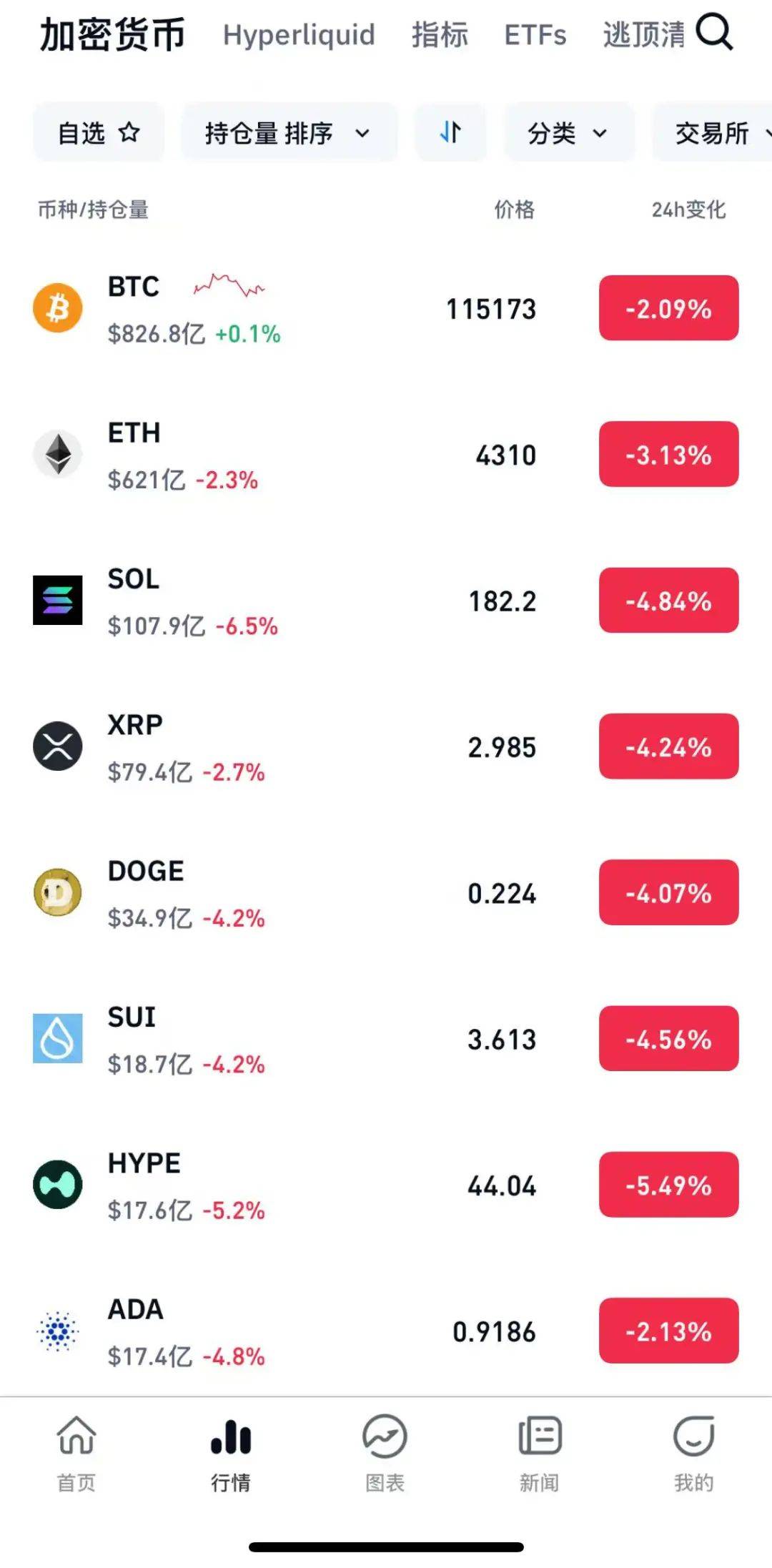
Cryptocurrency Market Overview - The cryptocurrency market experienced a significant downturn on August 18, with Bitcoin dropping below $115,000, a decline of over 2% [1] - Ethereum fell by more than 3%, while other cryptocurrencies such as Dogecoin, SOL, XRP, and SUI saw declines exceeding 4% [1] Market Data - Bitcoin (BTC) price at $115,173, down 2.09%, with a market cap of $82.68 billion, showing a slight increase of 0.1% [2] - Ethereum (ETH) market cap at $62.1 billion, down 2.3%, with a price of $4,310 [2] - SOL's market cap is $10.79 billion, down 6.5%, with a price of $182.2 [2] - XRP's market cap at $7.94 billion, down 2.7%, priced at $2.985 [2] - Dogecoin (DOGE) market cap at $3.49 billion, down 4.2%, priced at $0.224 [2] - SUI's price at $3.613, down 4.56% [2] Liquidation Data - Over 110,000 traders were liquidated in the cryptocurrency market, with total liquidation amounting to $475 million [3] - In the last 24 hours, liquidations included $480 million in total, with $370 million from long positions and $110 million from short positions [4] Economic Context - The upcoming Jackson Hole global central bank meeting is a focal point for the financial markets, with expectations of a potential 25 basis point rate cut by the Federal Reserve in September [5] - Morgan Stanley's report suggests that the anticipated rate cut may not occur, indicating a more hawkish stance from the Fed to maintain flexibility before the release of complete employment and inflation data [5] - Recent U.S. inflation data showed July CPI increasing by 2.7% year-over-year, while PPI rose significantly by 0.9% month-over-month, the largest increase since June 2022 [6]
高频数据扫描:居民贷款再减速、长债利率却上行
Bank of China Securities· 2025-08-18 04:14
Report Industry Investment Rating - Not provided in the given content Core Viewpoints - In July, the year-on-year growth rate of domestic household RMB loans dropped to 2.65%, and the growth rate of household medium - and long - term loans also fell to 3.43%. From January to July, the year-on-year growth rate of fixed - asset investment dropped to 1.60%, about 1.2 percentage points lower than that from January to June. The long - term Treasury bond yield continued to rise, which may reflect the market's expectation of more real - estate support policies [2][10]. - The PPI in the US in July exceeded expectations, with a year - on - year increase of 3.3% (the highest level since February this year) and a month - on - month increase of 0.9% (the largest increase since June 2022). The follow - up pressure transmission needs attention. The Fed's scenario of more than 2 interest rate cuts this year still requires the decline of inflation data as support [2][12]. - The year - on - year decline of the production material price index continued to narrow. From August 11th to 15th, 2025, the average wholesale price of pork decreased by 1.17% month - on - month and 25.69% year - on - year; the Shandong vegetable wholesale price index increased by 7.22% month - on - month and decreased by 26.99% year - on - year. The year - on - year decline of the production material price index narrowed to 5.29% [2]. - From August 1st to 14th, 2025, the average daily trading area of commercial housing in 30 large and medium - sized cities was about 181,000 square meters, while in August 2024, it was about 232,000 square meters per day [2]. Summary According to the Directory High - Frequency Data Panoramic Scan - In July, the growth of domestic household loans and fixed - asset investment slowed down. The long - term Treasury bond yield should have faced downward pressure but continued to rise, which may reflect the market's expectation of real - estate support policies. The new - issued mortgage rate in the second quarter decreased again, and the adjusted new - issued mortgage rate after tax and capital cost continued to decline, but the trend slowed down [2][10][11]. - The PPI in the US in July exceeded expectations. If the upstream price - increase pressure can be transmitted to consumer prices, it may form re - inflation pressure; otherwise, it may affect corporate inventory investment [2][12]. - Various high - frequency data showed different trends. For example, food prices, consumer goods prices, energy prices, and real - estate transaction data all had their own changes in terms of month - on - month and year - on - year comparisons [15][17]. High - Frequency Data and Important Macroeconomic Indicators Trend Comparison - Multiple high - frequency data were compared with important macroeconomic indicators, such as the comparison between the year - on - year change of LME copper spot settlement price and the year - on - year change of industrial added value and PPI, and the comparison between the year - on - year change of crude steel daily output and the year - on - year change of industrial added value [17][33]. Important High - Frequency Indicators in the US and Europe - Some important high - frequency indicators in the US and Europe were presented, including the US weekly economic indicators, initial jobless claims, same - store sales growth, and the Chicago Fed Financial Conditions Index, as well as the implied interest - rate hike/cut prospects of the US Federal Funds Futures and the ECB's overnight index swaps [92][94][103]. Seasonal Trends of High - Frequency Data - The seasonal trends of high - frequency data were analyzed, with indicators such as the monthly average of crude steel daily output and the production material price index showing their respective seasonal changes [105]. High - Frequency Traffic Data in Beijing, Shanghai, Guangzhou, and Shenzhen - The year - on - year changes in subway passenger volume in Beijing, Shanghai, Guangzhou, and Shenzhen were presented [160].
长盛基金管理有限公司 关于旗下基金参加招商银行费率优惠活动的公告
Zhong Guo Zheng Quan Bao - Zhong Zheng Wang· 2025-08-17 22:40
Group 1 - Longsheng Fund Management Co., Ltd. announces a fee discount for its funds through China Merchants Bank starting from August 18, 2025, offering a 90% reduction on subscription fees [1][2] - The applicable funds will have their original subscription fees reduced to 10% of the original rate when purchased through China Merchants Bank's mobile banking, online banking, or physical branches [1] - The duration of the fee discount will be determined by the announcements on China Merchants Bank's official website [1] Group 2 - The Guoyuan Yuanying 30-day holding period bond collective asset management plan will be renamed to Changsheng Yuanying 30-day holding period bond securities investment fund effective August 18, 2025 [3][5] - The management of the fund will transition from Guoyuan Securities Co., Ltd. to Longsheng Fund Management Co., Ltd. [6] - The product codes for the funds will change, with the A product code changing from "970140" to "024155" and the C product code changing from "970141" to "024156" [7] Group 3 - The investment managers will change from Guoyuan Securities' Li Yating and Ke Xianfa to Longsheng Fund's Li Qi and Wang Wenhao [8] - The valuation methods will be adjusted according to the standards set by the Asset Management Association of China for fixed income products [9] - The minimum holding period for the fund will be recalculated from the effective date of the new fund contract [10][11] Group 4 - The credit rating limits for investments in credit bonds will be updated to require a minimum rating of AA+ [12] - The performance benchmark will be revised from a composite index to the Zhongzhai Comprehensive Index [13] - The new fund contract will take effect on August 18, 2025, rendering the previous asset management contract invalid [14][15]


降息预期升温 美债长短端利差走阔
Shang Hai Zheng Quan Bao· 2025-08-17 17:59
Core Viewpoint - Recent economic data weakness and rising expectations for Federal Reserve interest rate cuts have led to a decline in U.S. Treasury yields, with the yield curve steepening due to widening term spreads [2][3] Group 1: Treasury Yield Movements - U.S. Treasury yields have shown volatility, with the 10-year yield fluctuating from nearly 4.5% in early July to below 4.2% mid-month, and currently oscillating around 4.3% to 4.45% [3] - The 2-year Treasury yield experienced a more pronounced decline, dropping from approximately 3.95% to below 3.7% after the release of disappointing non-farm payroll data [3][4] - The yield spread between the 10-year and 2-year Treasuries has widened from below 50 basis points in early July to 58 basis points recently [4] Group 2: Economic Data and Market Sentiment - The unexpected deterioration in non-farm payroll data has shaken market confidence in a "soft landing" for the U.S. economy, prompting a flight to safety into Treasuries and lowering yields [3][4] - Market expectations for a Federal Reserve rate cut in September have intensified, although inflation outlook remains uncertain, influencing Treasury yield movements [2][5] Group 3: Supply and Demand Dynamics - The recent passage of the "Big and Beautiful" bill has raised the U.S. debt ceiling by $5 trillion, leading to increased Treasury issuance to cover budget deficits [7] - Concerns are growing about a potential surge in Treasury supply in Q3, reminiscent of previous supply shocks that drove yields significantly higher [7][8] - Demand for U.S. Treasuries has shown signs of weakness, with recent auctions reflecting lower interest from investors, particularly foreign central banks [8]

【UNFX课堂】下周前瞻:通胀迷雾、央行分歧与地缘政治阴影
Sou Hu Cai Jing· 2025-08-17 09:20
Group 1 - The global financial markets are entering a phase of uncertainty and critical decision-making, influenced by unexpected U.S. inflation data, diverging monetary policies among major central banks, and potential geopolitical impacts [1] - The U.S. Consumer Price Index (CPI) showed a year-on-year increase of 2.5%, while core inflation rose by 2.7%, initially suggesting a clear path for a rate cut in September [2] - However, the Producer Price Index (PPI) unexpectedly surged by 0.9% month-on-month, with a core PPI year-on-year increase of 3.7%, indicating rising production costs and the reality of "tariff-induced inflation" [2][3] Group 2 - The unexpected rise in PPI, along with downward revisions in non-farm employment data, has diminished the likelihood of a September rate cut, leading to a shift in market sentiment from certainty to skepticism regarding rate cuts [3] - Risk assets, particularly cryptocurrencies, have been significantly impacted, reflecting their sensitivity to macroeconomic headwinds, while major U.S. stock indices show signs of hesitation and differentiation [3] - Geopolitical events, such as the meeting between Trump and Putin, could have immediate effects on oil prices, highlighting the direct impact of geopolitical stability on commodity markets [3] Group 3 - The Jackson Hole Economic Policy Symposium is expected to be a focal point for market participants seeking policy direction, with Fed Chair Jerome Powell's speech being particularly significant [4] - Powell's tone could either suppress rate cut expectations if he emphasizes inflation risks or provide relief to the market if he alleviates inflation concerns [4] - The Reserve Bank of New Zealand (RBNZ) is anticipated to cut rates by 25 basis points to 3%, marking it as another developed economy central bank adopting a loosening policy [5] Group 4 - The People's Bank of China (PBoC) is under scrutiny for potential additional stimulus measures to boost domestic demand and economic growth, which could significantly impact regional currencies and global commodity markets [5] - Producer Price Index (PPI) data from the UK and Germany will provide insights into European price trends, which could influence the European Central Bank's policy decisions [5] - Global PMI data will serve as a leading indicator for assessing the health of manufacturing and service sectors, providing further context for market conditions [5] Group 5 - The complexity of inflation, particularly "tariff-induced inflation," is challenging traditional monetary policy frameworks, as central banks strive to balance inflation control, growth support, and financial stability [6] - Geopolitical events add unpredictability to the market, necessitating investor vigilance regarding policy signals from the Jackson Hole Symposium and actions from various central banks [6] - The importance of flexibility in asset allocation and risk management is emphasized in the current high-volatility environment, where understanding macroeconomic trends and geopolitical dynamics is crucial for achieving stable returns [6]
债牛预期生变,存款或加速搬家
Western Securities· 2025-08-17 08:27
1. Report Industry Investment Rating The provided content does not mention the industry investment rating. 2. Core Viewpoints of the Report - The current round of deposit transfer continues, with a stronger momentum in July than the same period last year. In July, the combined deposits of residents and enterprises decreased by 2.56 trillion yuan, reaching a four - year high. The growth rate of resident deposits slightly declined, while the growth rate of non - bank deposits significantly rebounded to 15% [2][12]. - The money - making effect in the bond market has declined, and funds are more likely to flow into the "fixed income +" and equity markets. Since 2025, the bond market has entered a "three - low" era of low interest rates, low spreads, and low volatility. The scale growth rates of bond funds and money market funds have declined, and there has been redemption pressure since July. The growth rate of fixed - income wealth management products has also slowed down. The market risk preference has continuously increased, and the net value of equity funds has maintained high - speed growth. The growth of equity and hybrid wealth management products is not obvious, but their yields have been rising. The transferred deposits have flowed into non - bank institutions but not significantly into wealth management products, indicating that both financial institutions and residents' deposits are flowing into "fixed income +" and equity assets, which are important driving forces for the current bull market in equities [2][16]. - The expectation of a bond bull market has changed, the yield curve has steepened upwards, which may trigger a second - round redemption wave. It is recommended to control the duration, allocate anti - decline medium - and short - duration credit bonds. Asset management institutions with longer durations can seize the opportunity of loose funds during the initial issuance of special treasury bonds to reduce the duration. Stable - liability allocation investors are advised to moderately increase their allocation of 10Y treasury bonds in the range of 1.75% - 1.80% and 30Y treasury bonds in the range of 2.0 - 2.05% [3][21][24]. 3. Summary According to the Directory 3.1 Review and Outlook of the Bond Market - This week, the market risk preference further increased, the equity market rose sharply, and the bond market sentiment was under pressure, with the yield curve steepening. The yields of 10Y and 30Y treasury bonds increased by 6bp and 9bp respectively. The deposit transfer continued in July, with a stronger intensity than last year. The money - making effect in the bond market declined, and funds flowed into the "fixed income +" and equity markets [11][12][16]. - The expectation of a bond bull market has changed, the yield curve has steepened upwards, which may trigger a second - round redemption wave. The 7 - month social financing and credit data released this week were lower than expected, and domestic demand weakened, but the bond market was insensitive to the positive fundamentals. The overnight capital price increased marginally during the tax period, but the central bank maintained its supportive attitude, and the liquidity environment remained relatively abundant. It is expected that the central bank will continue to support the market during the initial issuance of 10 - year and 30 - year special treasury bonds next week [3][21][24]. 3.2 Bond Market Review 3.2.1 Funding Situation - The central bank conducted a net withdrawal of funds this week, and the funding rate increased. From August 11 to August 15, R001 and DR001 increased by 10bp and 9bp respectively compared to August 8, reaching 1.44% and 1.40%. The issuance rate of 3M certificates of deposit fluctuated upwards and then declined, and the FR007 - 1Y swap rate first increased, then decreased, and then slightly rebounded. By August 15, the transfer discount price of 1M national - share bank acceptance bills was 0.87%, a 10bp decrease compared to August 8 [25][26]. 3.2.2 Secondary Market Trends - Yields increased this week. Except for the 3m and 3y tenors, the yields of other key - term treasury bonds increased. Except for the 3y - 1y, 7y - 5y, and 30 - 20y term spreads, other key - term treasury bond term spreads widened. As of August 15, the yields of 10y and 30y treasury bonds increased by 6bp and 9bp respectively compared to August 8, reaching 1.75% and 2.05%. The term spread between them widened by 2bp to 30bp, which is at a medium - to - high percentile level in history [34]. 3.2.3 Bond Market Sentiment - This week, the median durations of all - sample bond funds and interest - rate bond funds decreased, and the divergence slightly increased. The turnover rate of ultra - long bonds rebounded, and the spreads between 50Y - 30Y and 20Y - 30Y treasury bonds widened. The inter - bank leverage ratio decreased to 107.5%, and the exchange leverage ratio remained flat at 122.4%. The implied tax rate of 10 - year China Development Bank bonds widened [44]. 3.2.4 Bond Supply - The net financing of interest - rate bonds decreased this week. From August 11 to August 15, the net financing of interest - rate bonds was 3791 billion yuan, a decrease of 2461 billion yuan compared to last week. The net financing of treasury bonds, local government bonds, and policy - based financial bonds all decreased. Next week, new 10Y treasury bonds and 30Y special treasury bonds will be issued for the first time. The issuance scale of local government bonds will increase, and the planned issuance of policy - based financial bonds is 340 billion yuan. This week, the net financing of certificates of deposit turned negative, and the issuance rate slightly increased to 1.61% [59][62][64]. 3.3 Economic Data - In July, loans showed negative growth, but the growth rate of social finance still had resilience. The growth of social retail sales further slowed down, and the decline in real estate investment widened. Since August, port throughput has returned to strength, and industrial production has marginally recovered. The high - frequency infrastructure and price data this week showed that the mill operating rate rebounded, vegetable prices continued to rise, and asphalt prices continued to fall [69][70][74]. 3.4 Overseas Bond Market - In July, the core CPI in the United States reached a six - month high, and retail sales achieved stable growth. The Fed's Daly hinted at a possible policy easing. In the overseas bond market, the bond markets in China and Japan declined, while most emerging markets rose. The spread between 10Y US and Chinese treasury bonds widened [81][82][84]. 3.5 Major Asset Classes - The CSI 300 index strengthened, closing at 4202.4 points on August 15, 2025, a 2.4% increase compared to August 8. This week, Shanghai gold slightly strengthened, while the Nanhua Pig Index and Shanghai gold weakened. The performance of major asset classes this week was: CSI 1000 > CSI 300 > Shanghai copper > Convertible bonds > Chinese - funded US dollar bonds > Crude oil > US dollar > Chinese bonds > Rebar > Shanghai gold > Pigs [85]. 3.6 Policy Review - On August 15, the People's Bank of China released the "2025 Second - Quarter China Monetary Policy Implementation Report", elaborating on the implementation effects of the moderately loose monetary policy in the first half of the year. On August 12, nine departments including the Ministry of Finance issued the "Implementation Plan for the Loan Interest Subsidy Policy for Service - Industry Business Entities", and three departments including the Ministry of Finance issued the "Implementation Plan for the Personal Consumption Loan Interest Subsidy Policy". Also on August 12, the "Sino - US Stockholm Economic and Trade Talks Joint Statement" was released, announcing a 90 - day suspension of the 24% tariff on each other's goods [88][90][92].
债市机构行为周报(8月第2周):股份行机构行为触发做多信号-20250817
Huaan Securities· 2025-08-17 03:42
Group 1: Report Overview - The report is a fixed - income weekly report titled "Institutional Behavior of Joint - stock Banks Triggers Bullish Signals - Weekly Report on Bond Market Institutional Behavior (Week 2 of August)" dated August 17, 2025 [1][2] - The chief analyst is Yan Ziqi, and the analyst is Hong Ziyan [2] Group 2: Core Viewpoints - The bond market's bullish space has opened, and institutional behavior indicators have triggered bullish signals. A trading - following strategy based on joint - stock banks' transactions may have a high win - rate [2][3][12] - Although there are short - term bearish factors in the bond market, the medium - and long - term trend remains unchanged, and the bullish space has opened [4][13] Group 3: Weekly Institutional Behavior Review 3.1 General Comment - A rate - timing signal was developed based on joint - stock banks' trading behavior. In the past year, it gave 5 long - lasting large - wave signals with a 100% win - rate on large waves. On August 13, it triggered a bullish signal that lasted for 3 days [3][12] - Big banks were the main buyers of short - and medium - term bonds, while funds and securities firms sold long - term interest - rate bonds, and rural commercial banks, insurance companies, and city commercial banks were the main buyers. The bond market's capital supply remained loose, and the overall spread of the curve widened [4][13] 3.2 Yield Curve - The yields of treasury bonds and China Development Bank bonds generally increased. For treasury bonds, the 1Y yield rose 2bp, 3Y fell 1bp, 5Y rose about 4bp, 7Y rose 5bp, 10Y rose 6bp, 15Y rose about 7bp, and 30Y rose 9bp. For China Development Bank bonds, the 1Y yield rose 3bp, 3Y rose 4bp, 5Y rose 8bp, 7Y rose 7bp, 10Y rose 8bp, 15Y rose 7bp, and 30Y rose 9bp [15] 3.3 Term Spread - For treasury bonds, the interest spread increased, and the term spread generally widened. For China Development Bank bonds, the interest - spread inversion deepened, and the short - end spread widened [16][19] Group 4: Bond Market Leverage and Funding 4.1 Leverage Ratio - The leverage ratio dropped to 107.22%. From August 11 to 15, it first increased and then decreased [20] 4.2 Repurchase Transactions - The average daily trading volume of pledged repurchase this week was 8.2 trillion yuan, with an average overnight proportion of 89.82%. The overnight trading volume increased by 0.03 trillion yuan month - on - month, and the overnight proportion decreased by 0.05pct [26][30] 4.3 Funding - Banks' fund lending first increased and then decreased. Big banks and policy banks' net lending on August 15 was 4.83 trillion yuan. The main fund borrowers were funds. DR007 fluctuated upward, and R007 continued to rise [32] Group 5: Duration of Medium - and Long - Term Bond Funds 5.1 Median Duration - The median duration of medium - and long - term bond funds remained at 2.81 years (de - leveraged) and 3.11 years (leveraged). On August 15, the de - leveraged median duration changed less than 0.01 year, and the leveraged median duration decreased by 0.02 years [44] 5.2 Duration by Bond - Fund Type - The median duration of interest - rate bond funds (leveraged) rose to 3.94 years, an increase of 0.02 years from last Friday. The median duration of credit - bond funds (leveraged) dropped to 2.86 years, a decrease of 0.03 years from last Friday [47] Group 6: Category Strategy Comparison 6.1 Sino - US Spread - The Sino - US treasury bond spreads generally widened. The 1Y spread widened by 2bp, 2Y by about 1bp, 3Y narrowed by 4bp, 5Y widened by about 3bp, 7Y widened by 1bp, 10Y changed less than 1bp, and 30Y widened by 2bp [52] 6.2 Implied Tax Rate - The implied tax rate generally widened. As of August 15, the 1Y spread between China Development Bank bonds and treasury bonds widened by about 2bp, 3Y by 5bp, 5Y by 3bp, 7Y by about 3bp, 10Y by 2bp, 15Y narrowed by 1bp, and 30Y changed less than 1bp [53] Group 7: Bond Lending Balance Changes - On August 15, the lending concentration of active 10Y treasury bonds and active 10Y China Development Bank bonds increased, while that of less - active 10Y treasury bonds, less - active 10Y China Development Bank bonds, and active 30Y treasury bonds decreased. By institution, the lending concentration of securities firms and other institutions increased, while that of big banks and small - and medium - sized banks decreased [54]
“存款搬家”,居民存款减少1.11万亿,老百姓的钱到底去哪了?
Sou Hu Cai Jing· 2025-08-17 03:17
Core Insights - The phenomenon of "deposit migration" in China's financial market reflects a significant shift of residents' funds from traditional bank deposits to non-bank financial institutions, driven by low deposit interest rates and attractive stock market performance [1][2][5] Group 1: Deposit Migration Dynamics - In July 2025, residents' deposits decreased by 1.11 trillion yuan, a year-on-year drop of 780 billion yuan, while non-bank financial institutions saw an increase of 1.39 trillion yuan, marking a near ten-year high [1] - The decline in bank deposit attractiveness is attributed to a continuous drop in interest rates, with many small and medium banks reducing rates by 10 to 40 basis points since April, leading to annualized rates below 2% [1][2] - The stock market's strong performance in July, with over 2 million new stock accounts opened, indicates a growing participation of ordinary citizens in equity investments [2][3] Group 2: Changing Investment Landscape - The diversification and convenience of investment channels have contributed to this trend, with mobile technology enabling easy access to various investment products [2][3] - A shift in the public's financial mindset is evident, as individuals now recognize that idle funds equate to depreciation due to inflation and rising living costs [2][5] - The younger generation, particularly those born after 2000, shows a higher acceptance of investment, actively engaging in the stock market and driving new investment trends [3][5] Group 3: Policy and Economic Implications - Recent monetary policy changes, including a reduction in loan market quotation rates and deposit rates by major banks, have further encouraged the flow of funds into alternative investment channels [3][5] - The "deposit migration" phenomenon is seen as a "seesaw effect" between resident deposits and non-bank deposits, where declining bank deposit yields push funds towards higher-yielding investments [5] - This shift is expected to enhance liquidity in the stock market, expand asset management for fund companies, and increase premium income for insurance firms, indicating a transformative impact on the financial ecosystem [5][7] Group 4: Future Outlook - The trend of "deposit migration" is likely to persist in the short term due to ongoing low bank deposit rates and deepening capital market reforms [7] - As the financial market matures, wealth management for residents is anticipated to become more diversified and professional, with bank deposits remaining a key option for risk-averse investors [7][9] - The overall societal impact of this shift is positive, promoting market activity, improving resource allocation efficiency, and creating more wealth opportunities for the public [9]


流动性:流动性税期资金波动怎么看?
CAITONG SECURITIES· 2025-08-16 12:45
1. Report Industry Investment Rating The document does not provide the industry investment rating. 2. Core Views of the Report - The central bank's operations in August are more optimistic than in June. In terms of timing, the purchase - style reverse repurchase was timely, and there was better coordination with fiscal policies. In terms of quantity, the net purchase - style reverse repurchase in August was more than in June, and there was no withdrawal of 6 - month liquidity. The net injection during the tax period was also higher than in June. The funds' central price has declined compared to June [3][16]. - Looking forward, considering the historical low of credit in July, the negative month - on - month growth of social retail and investment in July, the downward trend of bill rates, and the continuous increase in government bond issuance, the central bank will maintain a suitable financial environment, and liquidity can remain optimistic. There is no need to worry about "preventing idle capital circulation" as the central bank focuses on standardizing bank loans rather than raising capital rates [3][21]. - For certificates of deposit (CDs), the net financing of state - owned banks' CDs turned negative again last week. Under the central bank's support, the supply side is not a constraint. The secondary - market trading volume has continued to shrink, and yields have fluctuated within a narrow range. Institutions mostly adopt a configuration strategy. The supply - side pressure is relatively limited, and considering the low - level funds, the configuration value of CDs above 1.65% is not low. CDs may perform well when risk appetite declines and interest rates return to the fundamental logic [23]. 3. Summaries According to the Table of Contents 3.1 Keep an Optimistic Judgment on Funds - Last week, except for the last trading day, the weighted DR001 funds price remained at 1.31%, and state - owned banks' net lending remained high. The bond market adjusted, non - banks reduced leverage, and the overall stratification was at a low level [9]. - There are two key points to note in the past week: First, during the monetary - fiscal coordination period, the central bank maintains relatively stable liquidity, and more optimistic capital conditions are more likely to occur during the initial issuance of long - term bonds. Second, the marginal tightening of funds on August 15 was a normal tax - period fluctuation. Medium - and long - term funds remained stable and loose, and based on the fundamentals and the central bank's operating style, one can remain optimistic about funds [15][16]. 3.2 Weekly Funds and CDs Tracking and Key Point Reminders - This week (August 11 - 15), the central bank's OMO had a net withdrawal of 4149 billion yuan, with 7 - day OMO funds of 7118 billion yuan issued and 11267 billion yuan withdrawn. There was a 5000 - billion - yuan 6 - month purchase - style reverse repurchase operation. The government bond had a net financing of 2069 billion yuan, with a cumulative net financing of 97439 billion yuan and a net financing progress of 70.3%, and a net payment of 4344 billion yuan. Large banks' bill - buying efforts remained strong, and bill rates generally declined. The RMB was stable against the US dollar, and the central bank's counter - cyclical regulation demand was stable. In terms of funds, state - owned banks' lending ability was strong, and the leverage of some institutions changed [29]. - Next week (August 18 - 22), short - term funds of 7118 billion yuan will mature, and there will be 9000 - billion - yuan purchase - style reverse repurchase and 3000 - billion - yuan MLF maturities. The government bond's net financing will be 4979 billion yuan, with a cumulative net financing of 102418 billion yuan and a net financing progress of 73.9%, and a net payment of 2641 billion yuan. Attention should be paid to the central bank's support during the initial issuance of long - term government bonds on August 22 [29][30]. 3.3 Central Bank: 6 - Month Purchase - Style Reverse Repurchase Operation Implemented - This week, the central bank had a net withdrawal of short - term funds and carried out a 5000 - billion - yuan 6 - month purchase - style reverse repurchase operation. The OMO had a net withdrawal of 4149 billion yuan, with 7 - day OMO funds of 7118 billion yuan issued and 11267 billion yuan withdrawn. As of August 15, the reverse repurchase balance was 7118 billion yuan, down 4149 billion yuan from August 8, still higher than the seasonal level [32]. - Next week, 7118 billion yuan of short - term funds will mature, and there will be 9000 - billion - yuan purchase - style reverse repurchase and 3000 - billion - yuan MLF maturities in August [34]. 3.4 Government Bonds: Net Payment Declined to 264.1 Billion Yuan - This week, the government bond's net financing was 206.9 billion yuan, with a cumulative net financing of 9743.9 billion yuan and a net financing progress of 70.3%, and a net payment of 434.4 billion yuan. Next week, the net financing will be 497.9 billion yuan, with a cumulative net financing of 10241.8 billion yuan and a net financing progress of 73.9%, still at a seasonal high, and a net payment of 264.1 billion yuan [37]. - Structurally, the issuance of new special bonds has accelerated. The net financing progress of national bonds is 72.0% (higher than the historical average), and the issuance progress of new local government general bonds, new local government special bonds, and special refinancing bonds are 73.0% (lower than the historical average), 69.0% (lower than the historical average), and 97.3% respectively [39]. 3.5 Bills: Large Banks' Bill - Buying Efforts Remained Strong, and Rates Generally Declined - This week, large banks' bill - buying efforts remained strong, and bill rates generally declined. As of August 15, the 3 - month and 6 - month national - share direct and transfer bill rates were 1.13%, 1.00%, 0.70%, and 0.68% respectively, down 11BP, 12BP, 7BP, and 7BP from August 8 [47][48]. 3.6 Exchange Rates: Stable During the Statistical Period, with the RMB Spot Exchange Rate at 7.18 - This week, the RMB was stable against the US dollar, with the USDCNH/USDCNY swap points around 1600/1700 points. The carry - trade strategy for short - term bonds by foreign investors has limited value. The central bank's counter - cyclical regulation demand was stable, with the central parity rate of the US dollar against the RMB dropping to 7.14 and the depreciation upper limit around 7.28, and the counter - cyclical factor narrowing to around 314.68 pip [50][52]. 3.7 Market Funds Supply and Demand: State - Owned Banks' Lending Continued to Increase - The central bank's second - round purchase - style reverse repurchase operation strengthened state - owned banks' lending ability. The bond market adjusted, money market funds increased lending, and non - banks reduced borrowing. The average daily lending of the banking system was 4.28 trillion yuan, and that of national - share banks increased to 5.10 trillion yuan. The average daily lending of state - owned banks recovered to 5.14 trillion yuan, while that of joint - stock banks decreased to - 0.04 trillion yuan [55]. - The average daily lending of (money market funds + wealth management subsidiaries) increased to 1.21 trillion yuan. Major non - bank institutions reduced borrowing. The leverage ratios of the inter - bank market, commercial banks, and insurance companies increased, while those of broad - based funds and securities companies decreased [59][63]. - In terms of funds prices, the increase in the R series > the DR series > the Shibor series > the GC series, indicating tight funds for banks and non - banks and relatively stable funds for money market funds. The term stratification narrowed, and the institutional stratification was basically flat, showing a mitigation of market stratification [69]. 3.8 CDs: Net Financing Turned Negative, and the Buying Efforts of Money Market Funds and Joint - Stock Banks Increased 3.8.1 Primary Issuance Market: The Success Rate of Fund - Raising Improved, and the Overall Net Financing of CDs Turned Negative - This week, the net financing of CDs was - 131.1 billion yuan, and the average issuance rate increased by about 1BP. In the next three weeks, 794.72 billion yuan, 751.78 billion yuan, and 330.05 billion yuan of CDs will mature respectively. This week, the issuance scale of national - share banks increased, but the net financing turned negative. The weighted issuance duration of CDs increased, and the success rate of long - term CD fund - raising improved [72][75]. - In terms of different terms, the weighted issuance duration of CDs increased to 8.12 months. The issuance proportion of 9 - month and 12 - month CDs increased significantly, and the success rate of fund - raising for most terms improved. The issuance rates of CDs of all terms decreased to varying degrees, with a larger decline in short - term national - share banks [78][83]. 3.8.2 Secondary Trading Market: Trading Activity Declined, and the Buying Efforts of Money Market Funds Increased Significantly - In terms of quantity, the trading activity of CDs continued to decline this week, and the yields increased. Joint - stock banks, money market funds, and other non - non - bank institutions had strong buying, while other institutions mostly bought at a steady pace. The 1 - year AAA CD yield reached 1.6400% [85][87].